Right, let's get one thing straight from the outset. The term "visa extension" is a bit of a misnomer in Australia. You don't actually get your current visa stamped with a new expiry date.
Instead, you need to apply for a completely new visa before your existing one runs out. Getting your head around this is the single most important step in planning how you'll stay in the country legally.
Disclaimer: Australian migration laws and policies change frequently. The information provided here is for general guidance only and may no longer be accurate when you read it. For advice tailored to your specific situation, it is crucial to book an appointment with a registered migration agent. All government fees are subject to change; always refer to the official Department of Home Affairs website for the most current charges.
Understanding How to Stay Longer in Australia
It's a common mistake to think you can just add a few more months to your current visa. The Australian immigration system simply doesn't work that way. To stay on, you have to lodge a fresh application for a visa that fits your new situation. This means you'll be starting from scratch: meeting all the eligibility criteria, gathering a full set of documents, and paying the application fee for that specific visa.
The secret to a stress-free process is all in the timing. You absolutely must apply for your new visa while your current one (what the Department calls a "substantive visa") is still valid. If you do this, you'll usually be granted a Bridging Visa A (BVA). This little lifesaver kicks in the moment your old visa expires and keeps you legal in Australia while your new application is being processed.
Why Is This Distinction So Important?
Dropping the ball and letting your visa expire before you apply for a new one can land you in serious trouble. You could become an unlawful non-citizen overnight, lose any rights you had to work or study, and even face a re-entry ban that could complicate any future trips to Australia for years to come.
Thinking of it as a "new application" rather than an "extension" puts you in the right mindset from day one.
This flowchart breaks down the basic decision-making process for anyone looking to stay longer in Australia.
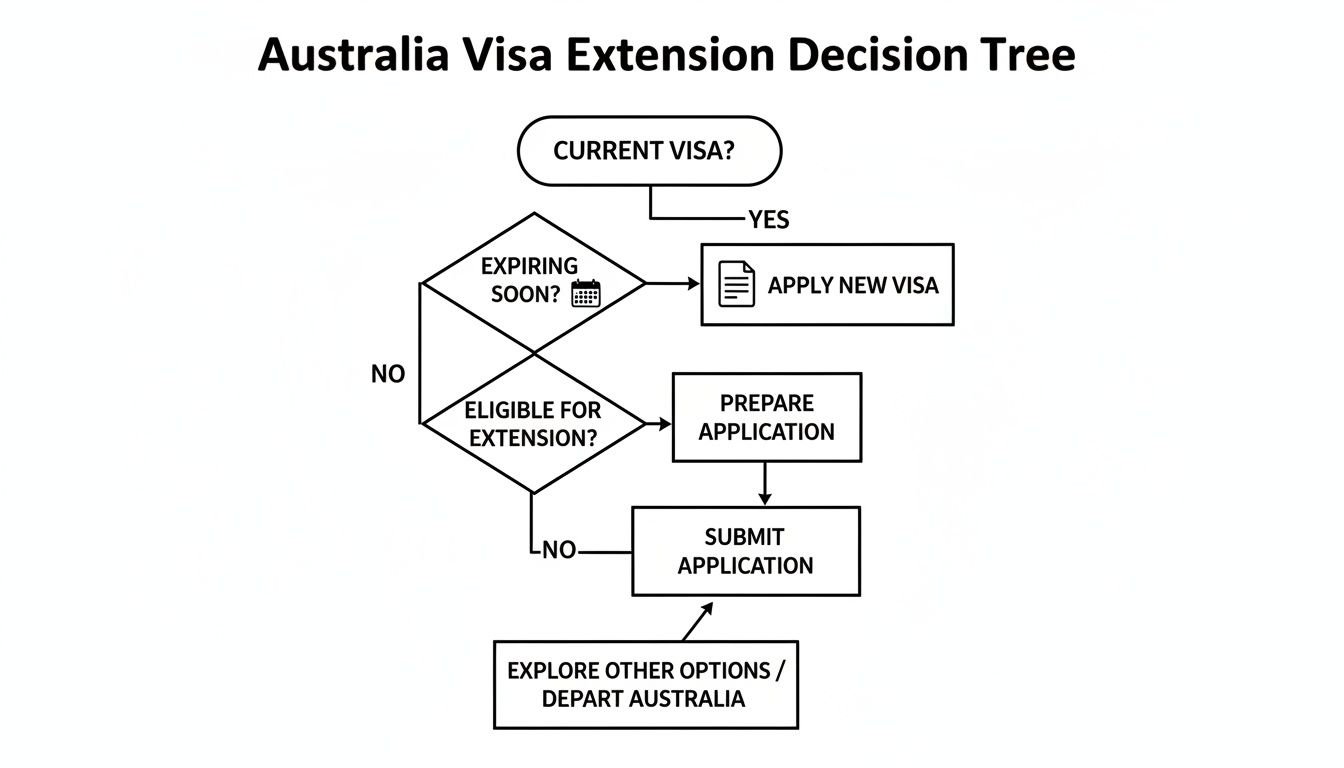
As you can see, the only path forward is to get a new application in before your current visa expires.
The Current Visa Landscape
Having a clear plan has never been more critical. Recent data shows a record 2.93 million temporary visa holders are currently in Australia, a massive jump of 1.2 million since 2019. This surge, driven largely by international students and temporary graduates, means more competition and tougher scrutiny on subsequent visa applications. You can read more about the temporary visa headcount in Australia and what it might mean for you.
To help you get started, here’s a quick look at some of the most common pathways people take to stay longer in Australia.
Common Pathways for Staying Longer in Australia
| Visa Option | Primary Purpose | Ideal Applicant Profile |
|---|---|---|
| New Visitor Visa (Subclass 600) | Tourism, visiting family, or short-term, non-work activities. | A tourist who wants more time to explore or someone visiting family who needs a bit longer. |
| New Student Visa (Subclass 500) | Full-time study in a CRICOS-registered course. | Someone finishing a course and wanting to enrol in another, or a visitor deciding to study. |
| Temporary Graduate Visa (Subclass 485) | Gaining skilled work experience after completing studies. | An international student who has recently graduated from an eligible Australian course. |
Of course, these are just a few examples. Your own personal circumstances—your skills, your relationships, your reasons for staying—will ultimately determine the best visa for you.
Disclaimer: Australian migration laws and policies change frequently. The information here is for general guidance only and might not be up-to-date when you read it. For advice that's tailored to your personal situation, it is essential to book an appointment with a registered migration agent. All government fees mentioned are subject to change; always check the official Department of Home Affairs website for the latest charges.
Staying Longer on a Visitor Visa Subclass 600
For plenty of people soaking up Australia's sun-soaked beaches or catching up with family, the thought of leaving after just a few months feels all too soon. If you're hoping to extend your holiday, the usual path is to apply for a brand new Visitor Visa (Subclass 600) while you're still in the country.
This isn't a simple stamp in your passport. Think of it as a completely fresh application that needs to convince the Department of Home Affairs of one critical thing: you are a genuine temporary entrant.
It’s a bit like applying for a new job. You have to build a strong case for yourself and show you tick all the boxes. Your number one goal here is to prove that you only intend to visit and that you will absolutely leave Australia before your visa runs out.
Proving You Are a Genuine Visitor
The Department looks very closely at these applications to make sure visitors aren’t secretly planning to stay unlawfully or work under the table. To build a solid case for your visa extension, you need to pull together some compelling evidence.
Your application must clearly show that you have:
- Sufficient Funds: You’ve got to prove you can support yourself financially for your entire extended stay without needing to work. Bank statements showing a healthy and consistent savings balance are your best friend here.
- Incentives to Return Home: What strong ties do you have back home? This could be anything from owning property, having a stable job to go back to, close family members waiting for you, or ongoing study commitments.
- A Clear Itinerary: A vague plan simply won't cut it. You need to outline what you plan to do with your extra time in Australia. Are you heading to a different state to explore, attending a special family event, or finishing that epic road trip you started?
A strong personal statement is your chance to tie all this evidence together into a convincing story. Clearly explain why you want to stay longer, detail your plans, and—most importantly—reaffirm your promise to respect Australia's laws and head home on time.
The Challenge of a 'No Further Stay' Condition
One of the biggest roadblocks you might hit is the 'No Further Stay' condition, most commonly seen as condition 8503. If this is stamped on your current visa, it flat-out prevents you from applying for most other visas while you're in Australia.
It's not an automatic "no," but it does mean you have to first apply to have the condition waived. This is a separate, and often tricky, process.
When Can You Waive Condition 8503?
Getting a waiver is tough and only happens in very specific situations. You must prove that since your visa was granted, your circumstances have changed in a major way that is both compelling and compassionate, and was completely beyond your control.
Examples of situations that might get a waiver include:
- A close family member in Australia becoming seriously ill.
- A major natural disaster in your home country that stops you from going back.
- Significant political turmoil at home making it unsafe for you to return.
Simply wanting a longer holiday or deciding to attend a wedding you already knew about will not be enough to get a waiver. This is a high-stakes application, and it's one of those times where getting professional guidance can make all the difference. To get a better handle on this visa, you can learn more about the Tourist Stream Subclass 600 and its specific rules.
At the end of the day, every application is judged on its own merits. Your best strategy is to provide clear, organised, and honest information to give yourself the best shot at getting that extended Aussie holiday approved.
Disclaimer: Australian migration laws and policies change frequently. The information provided here is for general guidance only and may no longer be accurate when you read it. For advice tailored to your specific situation, it is crucial to book an appointment with a registered migration agent. All government fees are subject to change; always refer to the official Department of Home Affairs website for the most current charges.
Applying for a New Student Visa Subclass 500
So, you’re in Australia, deep into your studies, and you realise you need more time. Maybe you’re levelling up to a higher-level course, or perhaps your current program just needs a little longer to complete. It’s a common scenario, but here’s the thing: you can’t actually “extend” your student visa. What you’re really doing is applying for a brand new Student Visa (Subclass 500) from scratch.

Think of it as a complete reset. You have to prove all over again that your main reason for being in Australia is to study. The absolute key to getting this new visa is nailing the Genuine Student (GS) requirement, which has now taken the place of the old Genuine Temporary Entrant (GTE) criteria.
Mastering the Genuine Student Requirement
The GS requirement is the heart and soul of your new visa application. You need to paint a clear, convincing picture for the Department of Home Affairs that you are a serious student with a genuine plan to study and that you'll stick to your visa rules.
The Department looks at everything to get a sense of your true intentions. They’ll dig into your immigration history, consider how valuable your chosen course is for your future, and look at your circumstances back home. If your answers are vague or your course choice seems a bit random, it’s going to raise some serious red flags.
The Genuine Student requirement isn't just a box-ticking exercise. It's a deep dive into your background, your academic goals, and what you plan to do next. Your story needs to be consistent and, most importantly, believable.
To make a strong case, you’ll be answering a series of targeted questions right there in the application form. They’re designed to give you a chance to really show you’re the real deal. If you want to get a head start, understanding how to apply for an Australian Student Visa is the perfect first step.
Your Essential Document Checklist for a New Student Visa
A strong application is all about the proof. Before you even think about starting the online form, you need to get your paperwork in order. Here’s a checklist of the absolute must-haves.
Confirmation of Enrolment (CoE): This is your golden ticket and the first thing you need. Without a valid CoE from your new course, you can't even start. It proves you’ve been accepted and paid your deposit.
Overseas Student Health Cover (OSHC): You must have health insurance for your entire planned stay in Australia. Make sure your policy is paid up and ready to go from the moment your new visa kicks in.
Evidence of Financial Capacity: Time to show you can support yourself. You’ll need to prove you have access to enough money to cover your tuition, travel, and living costs for at least the first 12 months. Bank statements or a loan agreement are the usual go-to documents here.
Proof of English Language Proficiency: Unless you qualify for an exemption, you’ll need to provide recent results from an approved English test like IELTS, TOEFL iBT, or PTE Academic.
Academic Transcripts and Certificates: Gather certified copies of your previous qualifications. This shows your academic history and proves you’re ready for the new course.
The Role of the Bridging Visa A
When you're applying for a new visa while still in Australia, timing is everything. This is where the Bridging Visa A (BVA) becomes your best friend.
If you get your new Student Visa application in before your current visa runs out, you'll automatically be granted a BVA. It’s a safety net that keeps you legally in the country while the Department works through your application.
Here’s the simple breakdown:
- You submit your Subclass 500 application while your current visa is still valid.
- The Department grants you a Bridging Visa A.
- Your old visa expires.
- The BVA kicks in instantly, and you remain lawful.
Your BVA will usually have the same conditions as your previous visa, including any work rights. It’s crucial you keep following those rules until you get a final decision on your new student visa. For a deeper dive into this, getting some expert Student Visa assistance for Subclass 500 can make all the difference.
Disclaimer: Australian migration laws and policies change frequently. The information provided here is for general guidance only and may no longer be accurate when you read it. For advice tailored to your specific situation, it is crucial to book an appointment with a registered migration agent. All government fees are subject to change; always refer to the official Department of Home Affairs website for the most current charges.
Pathways To Working After Your Initial Visa
So, you've finished your studies or your initial visa is coming to an end, and you're thinking, "What's next?" For a lot of people, the goal is to stick around and build a career here in Australia. This is a big step, and it means shifting gears from a visitor or student mindset to a skilled worker one.
Moving into the workforce requires a whole new game plan. You’re no longer applying based on a course enrolment or a holiday plan; you’re now looking at visas built around your professional skills or an employer’s needs. The two most well-trodden paths for recent graduates and skilled professionals are the Temporary Graduate visa and the employer-sponsored Temporary Skill Shortage visa.
Temporary Graduate Visa Subclass 485
Think of the Temporary Graduate visa (subclass 485) as a bridge connecting your life as a student to your professional career in Australia. It's specifically designed for international students who've just graduated from an Australian institution, giving you the breathing room to get some valuable local work experience under your belt.
The best part? The 485 visa gives you full work rights for a set period. You don't need a job offer or a sponsor to apply, which is a massive advantage.
Generally, to be eligible, you need to:
- Be under 50 years of age.
- Have held a Student visa within the last six months.
- Meet the Australian study requirement—this means your course was CRICOS-registered, lasted at least two academic years, and was taught in English.
- Prove you meet the English language proficiency requirements.
This visa is your golden ticket to put your Aussie qualification to work and show potential employers what you can do.
Temporary Skill Shortage TSS Visa Subclass 482
Now, the Temporary Skill Shortage (TSS) visa (subclass 482) is a completely different beast. This one isn’t about what you’ve studied here; it’s about an Australian employer needing your specific skills. In short, a business has to sponsor you to fill a job they can't find a suitable Australian worker for.
While there are a few different streams, the core principle is the same: you need a job offer first. The employer takes care of the sponsorship and nomination, while you handle your side of the visa application.
For applicants, the key requirements usually boil down to:
- Having the right skills and qualifications for the job.
- Holding at least two years of relevant work experience.
- Meeting the required English language standards.
The TSS visa links you directly to your sponsoring employer, meaning your right to stay in Australia is tied to that specific job.
Key Takeaway: The 485 visa is your reward for studying in Australia, giving you independent work rights to get started. The 482 visa is a partnership with an employer who needs you, making sponsorship the all-important first step.
Comparing Your Main Work Visa Options
So, which path is right for you? It really depends on where you're at. A fresh graduate's options are worlds apart from those of a seasoned professional with years of experience. Let's break down the fundamental differences to make it clearer.
Comparing Key Temporary Work and Graduate Visas
This table gives a quick, side-by-side look at the TSS (482) and Temporary Graduate (485) visas, helping you see which one aligns with your situation.
| Feature | Temporary Skill Shortage (TSS) Visa 482 | Temporary Graduate (TG) Visa 485 |
|---|---|---|
| Sponsorship | Required. You must be sponsored by an approved Australian employer. | Not required. It's an independent visa based on your qualifications. |
| Australian Study | Not a direct requirement. Your skills and experience are what matter. | Mandatory. You must have recently completed an eligible Australian qualification. |
| Work Experience | Generally requires at least two years of relevant work experience. | Not typically required for the initial application, as its purpose is to help you gain it. |
| Work Rights | Restricted to working for your sponsoring employer in the nominated role. | Unrestricted. You can work for any employer in any occupation. |
As you can see, your Australian study history is the deciding factor for the 485, while work experience and an employer's backing are crucial for the 482.
Other Long-Term Pathways
While the 485 and 482 visas are the main work-focused options, they aren't the only ways to stay. If you have an Australian partner, a Partner Visa (subclass 820/801) could be a strong possibility. This pathway is all about the genuineness of your relationship, not your professional skills.
If you're casting a wider net and exploring long-term work options globally, you might find some useful perspectives in guides about the best countries for digital nomads.
Disclaimer: Australian migration laws and policies change frequently. The information provided here is for general guidance only and may no longer be accurate when you read it. For advice tailored to your specific situation, it is crucial to book an appointment with a registered migration agent. All government fees are subject to change; always refer to the official https://www.homeaffairs.gov.au/ for the most current charges.
Your Essential Application Checklist
A rushed application is almost always a flawed one. When it comes to extending your stay in Australia, the single best thing you can do to boost your chances is to prepare your documents with care. Don't think of this as just a list of papers—see it as the building blocks of your case.
Getting everything organised can turn a massive, daunting job into a simple, step-by-step process. Every single document you submit tells a part of your story, proving you meet the strict criteria for the visa you’re after. A well-prepared application shows the Department you’re a serious, organised, and genuine applicant.
The Four Pillars of Your Application
Most visa applications are built on four main categories of evidence. The exact documents will change depending on which visa you're applying for, but the basic structure is almost always the same.
1. Personal Identity Documents:
- Passport: A certified copy of your current passport's bio-data page. Make sure it's valid for at least six months longer than you plan to stay.
- National Identity Card: If you have one, include a certified copy.
- Birth Certificate: A certified copy that clearly shows your parents' names.
- Passport-Sized Photographs: They must be recent and meet Australia’s specific photo requirements.
2. Proof of Financial Capacity:
- Bank Statements: You'll need at least three to six months of statements. They should show a consistent balance that's enough to cover your living costs, tuition fees (for students), and a flight home.
- Proof of Income: Things like payslips or a letter from your employer can really strengthen your application, especially if you're on a visitor visa.
- Sponsorship Documents: If someone is supporting you financially, you'll need a letter from them, plus proof of their financial situation.
3. Health and Character Checks:
- Health Examination: You might be asked to have a medical check-up with an approved panel physician.
- Police Clearance Certificates: You'll need one from every country you've lived in for 12 months or more over the past 10 years.
- Overseas Student Health Cover (OSHC) or adequate health insurance: This is an absolute must-have for student visa applicants and a very good idea for everyone else.
4. Visa-Specific Documents:
- For Students (Subclass 500): A valid Confirmation of Enrolment (CoE) is non-negotiable. Your application can't proceed without it.
- For Visitor Visas (Subclass 600): A detailed travel plan, return flight tickets (if you've booked them), and a personal letter explaining exactly why you want to stay longer.
- For Temporary Graduate Visas (Subclass 485): You'll need to show evidence of your Australian qualifications and your English language test results.
The Golden Rule of Timing
More important than any single document is the deadline. You must lodge your new visa application before your current substantive visa expires. A substantive visa is basically any regular visa—it’s not a bridging visa, a criminal justice visa, or an enforcement visa.
Letting your substantive visa expire before you apply is a critical mistake. The consequences are severe: you instantly become an unlawful non-citizen, you lose any rights to work or study, and you could be hit with a re-entry ban that stops you from coming back to Australia for up to three years.
Applying on time is your safety net. It’s what automatically grants you a Bridging Visa A (BVA), which keeps you lawful in Australia while you wait for a decision. Missing this deadline puts your entire future here at risk over a simple, avoidable error.
Disclaimer: Australian migration laws and policies change frequently. The information provided here is for general guidance only and may no longer be accurate when you read it. For advice tailored to your specific situation, it is crucial to book an appointment with a registered migration agent. All government fees are subject to change; always refer to the official Department of Home Affairs website for the most current charges.
Common Mistakes and When to Get Expert Help
Trying to navigate an Australian visa extension can sometimes feel like you’re walking a tightrope. One tiny misstep, and your whole plan could be in jeopardy. It’s a space where even the most diligent applicants can fall into common traps, from simple paperwork errors to a fundamental misunderstanding of visa law.

We see it all the time—small mistakes snowballing into big problems like frustrating delays, outright refusals, and a mountain of unnecessary stress. The key is knowing what these pitfalls are from the get-go so you can sidestep them entirely.
Avoiding Common Application Pitfalls
One of the most frequent mistakes we come across is submitting an incomplete or inconsistent application. This could be something as simple as a forgotten signature, or as complex as providing bank statements that don’t quite add up to the financial story you’ve told elsewhere.
Another major tripwire is misunderstanding visa conditions. For instance, a student visa holder might unknowingly work a few more hours than they’re allowed, creating a breach that could completely derail a future application. Of course, the big one is missing a deadline, especially letting your current visa expire. That’s a critical failure with some pretty severe consequences.
So, how do you avoid these common headaches?
- Double-check everything: Seriously. Before you hit that submit button, go over every single form and document. Make sure names, dates of birth, and passport numbers are identical across all your paperwork.
- Read the fine print: Get intimately familiar with the conditions of your current visa and the one you’re applying for next. Pleading ignorance of the rules is never an excuse the Department will accept.
- Create a timeline: Mark your visa expiry date in big red letters on your calendar. Then, work backwards, setting reminders for gathering documents and lodging your application with plenty of time to spare.
Think of your application as a reflection of your credibility. When the Department of Home Affairs receives an organised, accurate, and complete submission, it tells them you're a serious and compliant applicant. That alone can make a huge difference to the outcome.
When to Call in a Professional
Look, while plenty of applications are straightforward enough to manage on your own, some situations are just too complex and high-stakes to go it alone. This is where a MARA-registered migration agent becomes your most valuable asset. They aren't just form-fillers; they're strategic advisors who know how to navigate the legal maze on your behalf.
You should seriously consider getting expert help if you're facing:
- A 'No Further Stay' condition (like 8503): Trying to get a waiver for this condition is a complex legal process. It needs a compelling, well-argued case that most people aren't equipped to build themselves.
- A previous visa refusal: If you've been refused before, an agent can dissect the reasons why and build a much stronger, more targeted application that directly addresses those past concerns.
- Complex personal circumstances: Life happens. Situations involving tricky health issues, character concerns, or complicated family structures absolutely demand professional guidance.
- Tight deadlines: If the clock is ticking and you're up against it, an agent's efficiency and deep knowledge can be the difference between getting lodged successfully and becoming unlawful.
An experienced agent makes sure your application is not just complete, but flawless, compliant, and presents your case in the best possible light. If you're not sure where to start, have a look at our tips for choosing a migration agent to find the right expert for your situation.
Disclaimer: Australian migration laws and policies change frequently. The information provided here is for general guidance only and may no longer be accurate when you read it. For advice tailored to your specific situation, it is crucial to book an appointment with a registered migration agent. All government fees are subject to change; always refer to the official Department of Home Affairs website for the most current charges.
Your Visa Extension Questions, Answered
Let's cut through the noise. Here are some clear, no-nonsense answers to the questions we hear most often about extending a stay in Australia.
What Happens If My Visa Expires While I’m Waiting for a Decision?
This is a classic nail-biter, but there's a system in place for it. If you lodge a new, valid visa application before your current one runs out, you’ll almost always be granted a Bridging Visa A (BVA).
Think of the BVA as your legal lifeline. It kicks in the moment your old visa expires and keeps you lawfully in Australia until the Department makes a final decision on your new application. Crucially, your BVA will generally carry over the same conditions as your previous visa, including any work rights, so it’s business as usual until you hear back.
Can I Apply for Another Visa with a ‘No Further Stay’ Condition?
Ah, the dreaded 'No Further Stay' condition. If you see something like condition 8503 on your visa grant letter, it’s a roadblock. It’s designed to prevent you from applying for most other visas while you're still in Australia.
But it's not always the end of the road. You can request a waiver for this condition, but the bar is set incredibly high. You need to prove that compelling and compassionate circumstances have developed after your visa was granted—things you couldn't have foreseen. This is a complex legal hurdle, and honestly, it’s a situation where you absolutely want professional advice in your corner.
How Much Does It Cost to Extend a Visa in Australia?
There's no single price tag. The cost to "extend" is really the cost of the new visa you're applying for. Each visa type has its own Visa Application Charge (VAC), and they can vary wildly.
On top of the main application fee, you'll need to budget for other potential costs. These can include mandatory health examinations, police clearance certificates from various countries, or if you’re applying for another student visa, a new Overseas Student Health Cover (OSHC) policy.
A Word of Caution: Australian migration law is constantly shifting. The information here is a great starting point, but it might not be current by the time you're reading this. For advice that's built around your unique circumstances, the best move is always to book an appointment with a registered migration agent. For the latest government fees, check the official Department of Home Affairs website.
Navigating the maze of Australian visa applications takes careful planning and the right expertise. At My Visa Guide, our registered migration agents are here to provide clear, honest advice to make your application process as smooth and successful as possible. Book a consultation with My Visa Guide today and take the next step towards securing your future in Australia.