IMPORTANT NOTICE
If you've just had a visa refused, the first question on your mind is probably, "How long is this appeal going to take?" It's the question we hear every day, and the honest answer is: a long time. The wait for an AAT review has grown significantly, and you're likely looking at a timeline measured in months, and in many cases, years.
The exact wait depends on a whole host of factors, from the type of visa you were on to just how complex your case is.
Disclaimer: The information provided in this article is for general guidance only and may not be current when you read it. AAT processing times and immigration policies change frequently. For the most up-to-date advice tailored to your specific situation, you must book an appointment with a registered migration agent. For any official government fees, always refer to the Department of Home Affairs website at https://www.homeaffairs.gov.au/.
Understanding the AAT Processing Time Landscape in 2026
When we talk about "AAT processing time," we mean the entire journey. It starts the day your appeal is lodged and only ends when the Tribunal Member makes a final decision. It’s not a simple, orderly queue where the first person in is the first person out.
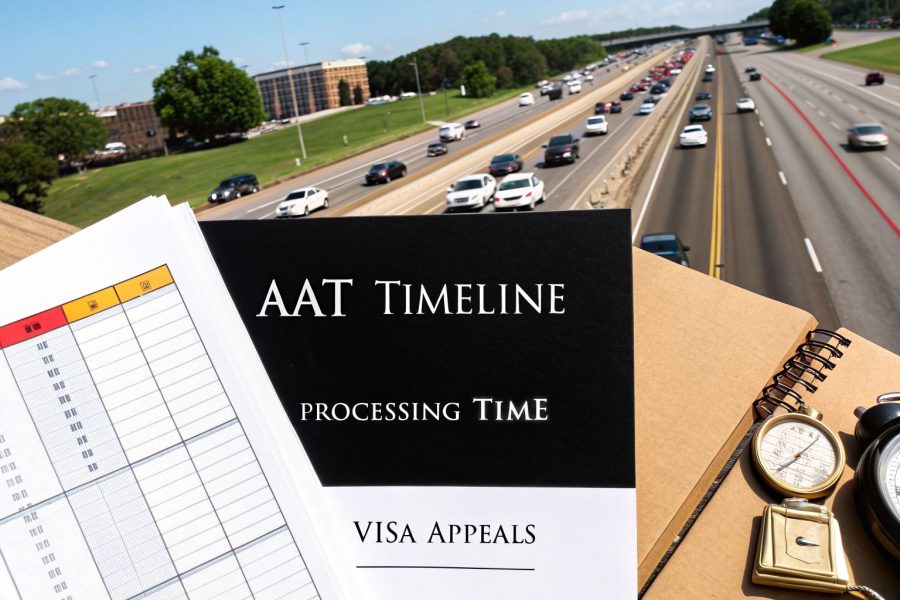
Think of it more like navigating a massive, congested traffic system. Government priorities, the specifics of your case, and the sheer backlog at the Tribunal all influence how and when your appeal moves forward. It's why two people appealing the exact same visa refusal might have completely different waiting experiences.
What Is Causing the Delays?
The core reason for these extended waits is the overwhelming volume of appeals flooding the Tribunal. We've seen a huge spike in visa refusals recently, especially after the government brought in stricter rules like Ministerial Direction No. 105. This has created a massive bottleneck.
This influx has put an incredible strain on the AAT's resources. In early 2026, the median processing time for migration appeals shot up to 14 months. To put that in perspective, it was just 11 months in mid-2025. That's a 27% increase in wait times in under a year, directly linked to the sheer number of people needing a review. You can get a deeper understanding of these recent changes to Australian visa processing times and what they mean for your application.
A Snapshot of Current Wait Times
To give you a realistic idea of what to expect, we've pulled together the latest median processing times for the most common types of visa appeals.
A "median" time means it's the middle point – 50% of cases were finalised by this time. The other 50% took longer, sometimes significantly longer. So, treat these numbers as a guide, not a guarantee.
Median AAT Processing Times for Common Visa Appeals 2026
| Visa Appeal Category | Median Processing Time (2026 Data) |
|---|---|
| Partner Visa Appeals | 23 months |
| Skilled Visa Appeals | 18 months |
| Student Visa Appeals | 16 months |
| Employer Nomination Appeals | 20 months |
| Visitor Visa Appeals | 9 months |
As you can see, the waits can be substantial, especially for complex cases like Partner and Employer-sponsored visas. It's a long road, and being prepared for the timeline is a critical first step.
Disclaimer: The information provided in this article is for general guidance only and may not be current when you read it. AAT processing times and immigration policies change frequently. For the most up-to-date advice tailored to your specific situation, you must book an appointment with a registered migration agent. For any official government fees, always refer to the Department of Home Affairs website at https://www.homeaffairs.gov.au/.
The Four Stages of Your AAT Appeal Journey
Waiting for your AAT appeal decision can be incredibly stressful. The silence from the Tribunal is often the hardest part, leaving you to wonder what’s happening with your case. To get a handle on why the AAT takes so long, it helps to break the process down into four distinct stages.
Each step has its own pace. Some are quick administrative tasks, while others involve long, quiet waiting periods. Understanding this journey from start to finish will help you manage your expectations and know where you stand.
This flowchart gives you a bird's-eye view of how your case moves from the moment you lodge it to the day you get a decision.

As you can see, it's a linear path, but the time spent in each phase can vary dramatically. Let's look at what really happens at each step.
Stage 1: Lodgement and Acknowledgement
This is where it all begins. Lodgement is simply the official act of filing your review application with the Administrative Appeals Tribunal. You’ll usually do this online, making sure to pay the correct fee and, most importantly, submit it within the strict deadline given in your visa refusal letter.
Once you’ve successfully lodged the application, the AAT will send you an acknowledgement letter or email. Hang onto this! It confirms your case is in their system and gives you a unique AAT case number, which you'll need for any future communication.
Stage 2: Triage and Allocation
After your application is acknowledged, it goes into a 'behind-the-scenes' phase. This is the triage and allocation stage. AAT staff will review your file to get the basics: what visa was refused, what the key issues are, and how complex your case seems. It’s an internal sorting process.
Based on this quick assessment, your case is put into a queue. In time, it gets assigned to a specific Tribunal Member who will ultimately review your file and make the call. You typically won't be told when this happens; your file just moves from the general pool onto a Member’s personal list.
Stage 3: Awaiting a Hearing or Decision
Get comfortable, because this is almost always the longest and most frustrating part of the AAT process. Your case is now sitting in a long queue, waiting for the assigned Member to either list it for a hearing or, in some cases, make a decision based on the documents alone ("on the papers").
How long you wait here really depends on the Member's caseload and how the government has prioritised your visa type.
The Tribunal is directed by the government to prioritise certain cases. If your visa category isn't on that high-priority list, your application will unfortunately sit in this queue for much longer while other cases are processed ahead of it.
There's very little to do during this stage but wait. You won't get regular updates, and this is where those wait times can stretch from many months to, for some visas, well over two years.
Stage 4: Hearing and Final Decision
Finally, your case makes it to the top of the pile. The AAT will reach out to you or your migration agent to schedule a hearing. This is your chance—your opportunity to present your arguments, evidence, and story directly to the Tribunal Member.
After the hearing, the Member reviews everything one last time. They'll consider your original application, the Department's reasons for refusing it, and all the new information and arguments from the hearing. From there, they will make one of three decisions:
- Affirm: The Member agrees with the Department’s original decision to refuse your visa.
- Remit: The Member finds the Department’s decision was incorrect and sends the case back to them, usually with instructions to grant the visa.
- Set Aside and Substitute: The Member overturns the Department’s decision and replaces it with a new, more favourable one.
You’ll receive this final decision, along with a written statement explaining the reasons, in the mail or by email. This officially marks the end of your AAT appeal journey.
Disclaimer: This information is for general guidance and may not be current. Immigration policies and processing times change. For advice specific to your case, you must book an appointment with a registered migration agent. Always check the official Department of Home Affairs website for current government fees.
Key Factors That Influence Your AAT Wait Time
It’s a question we hear all the time: why did one person’s partner visa appeal get a hearing date while another person’s skilled visa review is still gathering dust? The hard truth is that the Administrative Appeals Tribunal (AAT) doesn't work like a simple queue. There’s no neat, orderly "first-in, first-out" system.
Instead, a whole range of factors determines where your application lands in the pile and how quickly it moves. Think of it less like a single-file line and more like a multi-lane highway where some cars are directed into an express lane while others are stuck in traffic. Getting a handle on these factors—some you can control, some you can't—is the key to setting realistic expectations.
The Role of Visa Category and Ministerial Directions
By far the biggest influence on your wait time is the type of visa you’re appealing. The government doesn’t treat all appeals equally; it issues Ministerial Directions, which are legally binding instructions telling the Tribunal exactly which cases to handle first.
These directions act as a strict priority list. For instance, Ministerial Direction 105 currently puts certain employer-sponsored visas at the top of the pile, especially those for regional Australia, to help fill urgent skills gaps.
If your appeal falls into one of these priority categories, that’s great news for you. But for everyone else, it means your case gets actively pushed back. Appeals for partner visas, visitor visas, or other non-priority categories are effectively de-prioritised to make way for the urgent cases, which is a major reason why AAT processing times can stretch out for so long.
AAT processing times are not a simple queue. Ministerial Directions create a system of priorities, meaning some visa appeals are deliberately processed faster than others. This government-led prioritisation is a primary driver behind the long waits many applicants face.
The Complexity of Your Case
Putting government priorities aside, the actual details of your appeal play a massive part in the timeline. A clean, straightforward case with clear-cut evidence will almost always move faster than a messy, complicated one.
So, what makes a case "complex" in the Tribunal's eyes?
- Complex legal arguments: If your case hinges on a fine point of migration law, the Tribunal Member will need more time to review legislation and past decisions.
- Character or health issues: A refusal based on the character test or health requirements triggers a much deeper, more time-consuming investigation by the AAT.
- Need for external information: The Tribunal might have to pause your case while it waits for information from outside parties, like a medical opinion from a specialist or records from another government agency.
- Large volumes of evidence: While you absolutely need strong evidence, an application with thousands of pages of documents simply takes a Member longer to read and digest.
At the end of the day, the more questions or potential red flags your file presents, the longer it’s going to sit on a Member’s desk.
The Quality of Your Submission
This is the one area where you have real power. A well-prepared, complete, and easy-to-understand submission can make a world of difference to your AAT processing time. Your goal should be to hand the Tribunal a "decision-ready" application.
If your file is missing key documents or the arguments are confusing, the Tribunal will have to issue a Request for Information (RFI). This stops the clock on your case and can easily add weeks, if not months, to your wait. A strong application anticipates what the Member needs to see and addresses the original refusal reasons head-on, making their job as easy as possible.
These delays hit Australian businesses particularly hard. Employers relying on sponsored workers face huge operational headaches when an appeal gets bogged down. It’s a serious issue, with recent figures showing that 41% of sponsorship appeals take over 20 months to be finalised, creating major productivity gaps in crucial sectors like IT and engineering. You can read more about how appeal backlogs affect Australian businesses on Provisa.com.au.
Disclaimer: This information is for general guidance and may not be current. Immigration policies and processing times change. For advice specific to your case, you must book an appointment with a registered migration agent. Always check the official Department of Home Affairs website for current government fees.
Your Bridging Visa Status During the Long Wait
So, you've lodged your appeal against a visa refusal. That’s the first hurdle cleared. But now comes the big, nagging question: "What's my legal status in Australia while I wait?" Given the long AAT processing times, it's completely normal to feel anxious about whether you can legally stay, work, and just get on with your life.
The good news is that when you lodge a valid appeal for most visa refusals while you're in Australia, you'll almost always be granted a Bridging Visa A (BVA). Think of it as a literal "bridge" that keeps you lawfully in the country while your appeal is in the queue. It’s what keeps you on solid legal ground during what can be a very long and uncertain wait.

Understanding Your Work Rights
One of the most common points of confusion is whether you can actually work on this bridging visa. The short answer is: it depends. Your work rights on a BVA are directly tied to the conditions of the visa you held right before the one that got refused.
- If your previous visa had full work rights, your BVA will most likely have full work rights, too.
- If your previous visa came with restrictions (like those on a student visa), those same limitations will probably be carried over to your BVA.
- If your previous visa had no work rights, your BVA will likely come with a "no work" condition. In this scenario, you might be able to apply to have this condition removed if you can prove you're experiencing financial hardship.
This period of limbo can be incredibly tough, especially for some. For international students appealing a Subclass 500 refusal, the wait averages a staggering 16 months. Research shows that 62% of onshore applicants caught in this situation face significant financial hardship.
Can I Travel Overseas While Waiting for My AAT Decision?
This is a critical point that trips up many people. A Bridging Visa A will cease the moment you leave Australia. It is not a travel visa.
If you absolutely must travel overseas for any reason, you must apply for and be granted a Bridging Visa B (BVB) before you fly out. A BVB is specifically designed to let you leave and re-enter Australia while your AAT appeal is still being processed. If you fail to get a BVB before you go, you won't be able to come back, and your AAT appeal could be thrown out. Always plan ahead and apply for that BVB well in advance.
After the AAT Decision
Your Bridging Visa A doesn't just disappear the second the Tribunal makes a ruling. It stays in effect until 35 days after a final decision is made on your case. This gives you a clear window of time to figure out your next steps and make arrangements, regardless of whether the outcome is good or bad.
The waiting period for an AAT decision is filled with uncertainty. During this time, effectively managing client expectations is crucial for migration agents to maintain trust and help reduce applicant anxiety.
Disclaimer: Information about bridging visas and AAT processes can change. This content is for general informational purposes only and may not reflect the latest regulations. For advice tailored to your personal circumstances, you must book an appointment with a registered migration agent. All official government fees should be verified on the Department of Home Affairs website.
How to Proactively Manage and Reduce Delays

While much of the AAT’s timeline is out of your control, you aren’t entirely powerless. The single most effective thing you can do is to lodge a meticulously prepared, 'decision-ready' application right from the start.
Think of it this way: you’re making the Tribunal Member’s job as easy as possible. A clear, well-supported case that anticipates their questions minimises the back-and-forth that can add months to your wait. It means submitting a complete application that leaves no stone unturned, with all the evidence and persuasive arguments they need to see.
Building a Decision-Ready AAT Submission
What exactly is a ‘decision-ready’ case? It’s an application so clear, complete, and compelling that the Tribunal Member might be able to make a favourable decision “on the papers”—without even needing a hearing. While this isn't always possible, aiming for this standard dramatically cuts down delays caused by requests for more information.
Here’s what goes into it:
- Tackle the Refusal Head-On: Your submission must directly address every single reason for refusal listed in the Department’s letter. You need to counter their findings with your own evidence and legal arguments.
- Provide Watertight Evidence: This isn’t just about forms. It’s about statutory declarations, letters of support from friends or employers, financial records, expert reports, and anything else that backs up your claims.
- Write Clear Submissions: You need a persuasive written narrative that explains exactly why the original decision was wrong, referencing both your evidence and the relevant migration law.
The surest way to meet this high standard is to work with an expert. A good migration agent doesn't just fill out forms; they strategically build a robust case from day one. You can learn more by reading our guide on how to choose the right migration agent for your specific needs.
Minimising Back-and-Forth Communication
One of the biggest culprits for delays is the ‘Request for Information’ (RFI) from the Tribunal. If your file is incomplete or raises more questions than it answers, the whole process grinds to a halt while you scramble to find and submit the missing pieces. A decision-ready application makes an RFI far less likely.
The most powerful tool you have to influence your AAT processing time is the quality of your submission. A complete, well-argued case can prevent months of delays by eliminating the need for further information requests from the Tribunal.
For legal professionals, new tools like legal document automation software can also help speed up the preparation of complex submissions.
Of course, the best strategy is always prevention. Experts at firms like My Visa Guide have found that lodging an airtight initial visa application is the best way to avoid the AAT altogether. By being meticulous with health, character, and document checks from the very beginning, they’ve seen refusal rates drop by up to 75%.
Expediting a Case in Rare Circumstances
Can you ask the AAT to "jump the queue"? The short answer is yes, but only in extremely limited and severe circumstances. The Tribunal has a formal process for requesting an expedited hearing, but the bar is set very high.
To be successful, you must prove that your situation involves compelling and compassionate reasons that are truly exceptional. Simply experiencing financial hardship, which is common for many applicants, is almost never enough. You have to demonstrate that your circumstances are significantly more urgent than the thousands of others also waiting in the queue.
Disclaimer: This information is provided for general guidance and may not be current when you read it. AAT processing times and immigration policies change frequently. For the most up-to-date advice tailored to your specific situation, you must book an appointment with a registered migration agent. For any official government fees, always refer to the Department of Home Affairs website at https://www.homeaffairs.gov.au/.
What Happens After Your AAT Decision Arrives
The day you finally receive the decision from the Administrative Appeals Tribunal (AAT) is a massive moment. After waiting for months, sometimes years, this single outcome determines what comes next on your migration path. Broadly, there are two main results: a successful appeal (known as ‘remitted’) or an unsuccessful one (‘affirmed’).
Let’s break down what each of these means for you.
If Your Appeal Is Successful
A successful appeal is when your case is officially remitted to the Department of Home Affairs. In simple terms, this means the AAT has looked at your case and found the Department’s original decision to refuse your visa was incorrect. The Tribunal then sets that refusal aside and sends your application back to the Department for a final decision.
It’s a common misconception, but the AAT does not grant visas itself. Its job is to review the decision. Once it remits the case, it’s instructing the Department to process your application again, this time following the law correctly. For almost everyone, this results in a visa grant.
Your application goes back into a queue at the Department, but this last step is almost always much quicker than the long wait you endured for the AAT hearing. The time it takes can vary—some visas are finalised in a few weeks, while others might take a couple of months, depending on the visa subclass and the Department's workload.
To put departmental workloads into perspective, data from February 2026 highlighted major delays in other areas, like Partner visas, which were taking a median of 17 months and affecting over 40,000 families. While your post-AAT wait won't be nearly that long, it shows how backlogs can ripple through the system. You can learn more about the latest Australian visa processing trends from VisaHQ.
If Your Appeal Is Unsuccessful
An unsuccessful appeal, where the decision is affirmed, means the Tribunal agrees with the Department's original refusal. This is tough news to hear, but it doesn't always have to be the end of the road. Your options, however, do become much narrower and far more legally technical.
The main path forward is to consider an appeal to the Federal Circuit and Family Court of Australia. Now, it is absolutely critical to understand that this is not a second chance to argue the facts of your case.
A court appeal can only go ahead if you can prove the AAT made a jurisdictional error—that is, a specific mistake in how it applied the migration law. You cannot simply argue that the Tribunal came to the "wrong" conclusion based on the evidence.
This is a very specialised area of law with an unforgiving deadline, usually just 35 days from the date of the AAT decision. Trying to navigate a court appeal without an experienced immigration lawyer is incredibly risky. You can find more detail in our overview of understanding visa appeals and reviews.
Disclaimer: The information provided in this article is for general guidance only and may not be current when you read it. AAT processing times and immigration policies change frequently. For the most up-to-date advice tailored to your specific situation, you must book an appointment with a registered migration agent. For any official government fees, always refer to the Department of Home Affairs website at https://www.homeaffairs.gov.au/.
Frequently Asked Questions About AAT Processing Times
Waiting for an AAT hearing can be an incredibly stressful time, and it’s natural to have a lot of urgent questions. Let’s tackle some of the most common queries we hear from our clients to give you a clearer picture of what to expect.
Can I Ask to Speed Up My AAT Hearing?
Yes, you can ask the Tribunal to expedite your hearing, but it's important to know this is only granted in the most severe and unusual circumstances. You’ll need to make a formal written request and prove you're facing compelling and compassionate circumstances that go far beyond the typical stress and hardship of waiting.
Unfortunately, things like financial difficulty or the general anxiety of the appeal process usually aren't enough to jump the queue. The bar is set extremely high, so you must have a truly unique and pressing reason for your case to be pushed ahead of others.
Does a Migration Agent Make My AAT Case Faster?
While a migration agent can't magically move your case to the top of the AAT's list, their expertise is absolutely critical in preventing avoidable delays. A good agent makes sure your case is "decision-ready" right from the start.
What does that mean? It means lodging a rock-solid, well-argued case with all the right evidence from day one. This kind of professional preparation dramatically lowers the chances of the Tribunal issuing a Request for Information (RFI), which is a common setback that can easily add months to your wait time. In some cases, a particularly strong submission might even result in a positive decision "on the papers"—meaning you win your case without even needing a hearing.
Disclaimer: The information in this guide is for general purposes only and might not be current when you read it, as AAT processing times and immigration rules change often. For the latest advice specific to your case, you must book an appointment with a registered migration agent. For any official government fees, always check the Department of Home Affairs website at https://www.homeaffairs.gov.au/.
What Happens If My Visa Expires While Waiting?
This is a huge source of anxiety for many applicants, but thankfully, the process is straightforward. If you’re in Australia when you lodge a valid AAT appeal, you'll almost always be granted a Bridging Visa A (BVA) automatically.
This BVA is what allows you to stay in the country legally while your appeal is being processed. It remains in effect until 35 days after the AAT makes its final decision, giving you a crucial buffer to figure out your next steps without the risk of becoming unlawful.
How Can I Check My AAT Application Status?
The AAT does have an online portal where you can check on your appeal's status. Once you've lodged your case, you’ll get an acknowledgement letter with a file number that you can use to log in.
It’s vital to keep your contact details up to date with the Tribunal, as this is how they’ll send you critical documents, including your hearing invitation. Just be prepared that the portal typically only provides high-level updates, not a detailed, step-by-step report on your case’s progress.
Disclaimer: This information is provided for general guidance and may not be current when you read it. AAT processing times and immigration policies change frequently. For the most up-to-date advice tailored to your specific situation, you must book an appointment with a registered migration agent. For any official government fees, always refer to the Department of Home Affairs website at https://www.homeaffairs.gov.au/.
The AAT process is complex and the stakes are high. Having an expert on your side can make all the difference. At My Visa Guide, our registered migration agents provide honest, clear guidance to help you build the strongest possible case and navigate every stage of your appeal.