IMPORTANT NOTICE
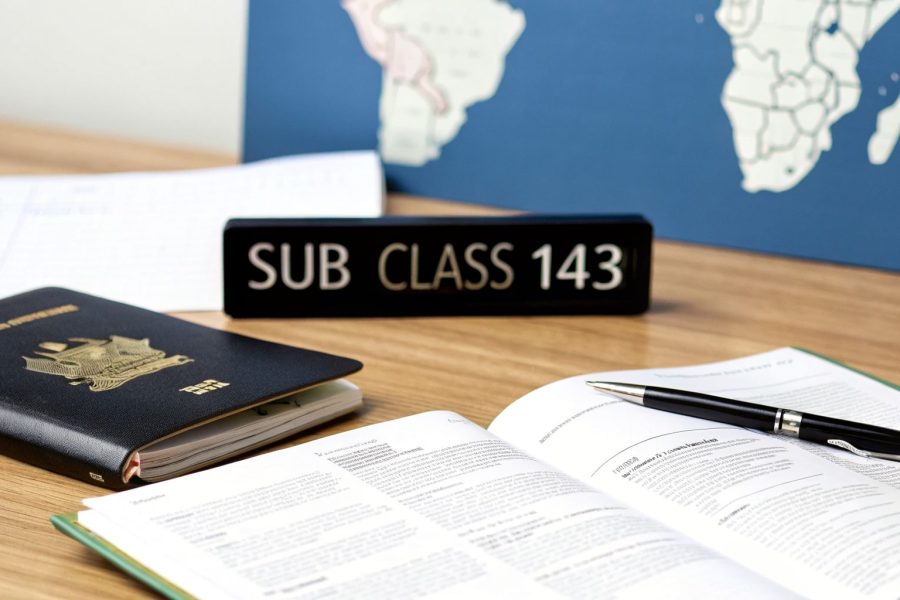
If you're dreaming of bringing your parents to Australia to live with you permanently, you’ve likely come across the Subclass 143 visa. Officially, it’s called the Contributory Parent (Migrant) visa, and it's one of the most talked-about pathways in family migration.
So, what is it, really? Think of it as the 'express lane' for parent visas.
A Clear Guide to the Subclass 143 Visa

At its heart, the Subclass 143 visa is all about reuniting families. It allows parents to join their children in Australia for good, granting them permanent residency from day one. This means they can live, work, and study here indefinitely, and importantly, gain access to Australia’s world-class public healthcare system, Medicare.
Now, you might be wondering about that word 'contributory'. It’s the key to understanding this visa. The name points directly to its main feature: a significant financial contribution you pay to the Australian Government.
This isn’t just a fee; it's a payment designed to help offset the future healthcare and social support costs that new residents might access over their lifetime. And this hefty contribution is precisely why the sub class 143 is prioritised for processing, letting you skip the decades-long queue of other parent visas.
The Trade-Off: Speed for Cost
Choosing the Subclass 143 means making a big decision: you're trading a high financial cost for a much, much shorter wait. It's a straightforward trade-off.
While the financial commitment is substantial, the reward is getting your family back together sooner. Non-contributory parent visas are known for their incredibly long processing times—we’re talking decades—because of the very limited number of spots available each year.
The contributory stream, on the other hand, moves significantly faster. For families who can manage the contribution, it’s often the most practical and realistic choice to be reunited without waiting a lifetime. Of course, once your parents arrive, a new chapter begins, and it can be helpful to read up on things like how to care for aging parents in a new country.
Disclaimer: Migration laws and regulations can change, and the information in this article may no longer be accurate at the time of reading. It is essential to book an appointment with a registered migration agent for the most up-to-date information. For any official government fees for any visa, please always refer to https://www.homeaffairs.gov.au/.
Who Is This Visa For?
This visa is designed specifically for parents whose child is a 'settled' Australian citizen, permanent resident, or an eligible New Zealand citizen.
So what does 'settled' mean? In the eyes of immigration, it generally means your child has been living lawfully in Australia for a reasonable amount of time, which is typically at least two years.
The benefits that come with a successful Subclass 143 visa are life-changing:
- Permanent Residency: The right to live in Australia permanently.
- Work and Study Rights: Complete freedom to work and study anywhere in Australia.
- Access to Medicare: Eligibility for Australia’s public healthcare scheme.
- Sponsor Others: The ability to sponsor other eligible family members for visas down the track.
- Pathway to Citizenship: Once they meet the residency requirements, your parents can apply to become Australian citizens.
Meeting the Subclass 143 Eligibility Requirements
Before we even get to the application forms, we need to talk about the first and most critical step: eligibility. The Australian Government has a strict, non-negotiable checklist for the Subclass 143 visa, and both the parent applying and their sponsoring child must tick every single box.
Getting this part right from the very beginning is everything. It lays the groundwork for your entire application, so let's break down exactly what the Department of Home Affairs is looking for.
The All-Important Balance of Family Test
One of the first major hurdles, and a common point of confusion, is the Balance of Family test. This isn't just a suggestion; it's a hard-and-fast rule designed to show that a parent's primary family connection is now with Australia.
Think of it like a 'family seesaw'. On one side, you place all your children who are permanent residents or citizens living in Australia. On the other side, you place your children living in any other single country.
To pass this test, the seesaw must tip towards Australia. This means one of two things must be true:
- At least half of your total children live permanently in Australia.
- More of your children live permanently in Australia than in any other single foreign country.
For instance, if you have four children, you pass if at least two are settled permanently in Australia. If you have three children—one in Australia, one in the UK, and one in Canada—you also pass, because Australia is home to more of your children than any other single country. This is a black-and-white test, and it's the first thing we need to confirm.
Health and Character Requirements
Once you've cleared the Balance of Family test, the next step is meeting Australia’s health and character standards. These are in place to safeguard the community and are taken very seriously.
Every parent applying will need to complete a full medical check-up with a doctor approved by the Australian government. This is to ensure you don't have a condition that could pose a public health risk or place a significant strain on Australia’s healthcare services.
On the character side, anyone over 16 must provide police clearance certificates from every country they’ve lived in for 12 months or more over the past decade. The Department will use this to assess your character. For a deeper dive into what they look for, you can read our detailed guide on the health and character requirements.
The Sponsor’s Role and Requirements
The sponsoring child is the absolute anchor of this visa application. Without an eligible sponsor, the process can't even begin.
To be an eligible sponsor, your child must be 'settled' in Australia and be one of the following:
- An Australian citizen
- An Australian permanent resident
- An eligible New Zealand citizen
So, what does 'settled' mean? While there isn't a strict legal definition, it generally means they have been living lawfully in Australia for a reasonable amount of time, which is usually considered to be at least two years. They'll need to show evidence of this, like employment contracts, rental history, or utility bills in their name, to prove they have established roots here.
To help you see it all at a glance, here’s a simple table summarising the core requirements for both the applicant and their sponsor.
Subclass 143 Applicant and Sponsor Eligibility Checklist
| Requirement | For the Parent (Applicant) | For the Child (Sponsor) |
|---|---|---|
| Family Connection | Must pass the Balance of Family test. | Not directly applicable. |
| Age | Must be old enough to receive the age pension in Australia (unless applying for a retirement pathway). | Must be at least 18 years old. |
| Health | Must meet Australia's minimum health standards. | Not applicable. |
| Character | Must meet Australia's character requirements. | Not applicable. |
| Citizenship/Residency | Not applicable. | Must be an Australian citizen, permanent resident, or eligible New Zealand citizen. |
| Residency Status | Not applicable. | Must be considered 'settled' in Australia (typically residing for at least two years). |
| Financial | Must have an Assurance of Support (AoS). | Must provide financial support and arrange the AoS. |
This checklist covers the foundational pillars of a Subclass 143 application. If you can confidently tick these boxes for both the parent and the child, you're in a strong position to start the formal application journey.
Disclaimer: Migration laws and regulations can change, and the information in this article may no longer be accurate at the time of reading. It is essential to book an appointment with a registered migration agent for the most up-to-date information. For any official government fees for any visa, please always refer to https://www.homeaffairs.gov.au/.
Understanding the Full Financial Commitment

There’s a reason the Subclass 143 is called the 'Contributory' Parent visa, and it's crucial to get your head around the full financial picture from day one. This isn't just a single application fee; it's a series of significant payments you'll need to plan for carefully to avoid any stressful surprises.
The costs are so high because this visa essentially puts your parents in the fast lane to permanent residency. Their contribution helps cover their future access to Australia’s world-class public services like Medicare, a benefit they can use right after the visa is granted.
This visa certainly reflects Australia's commitment to family reunion, but the numbers show it's an exclusive path. The main contribution has been a hefty $43,600 AUD per applicant for a few years now, the price for faster processing compared to the much slower, non-contributory options. Even so, with a backlog of around 140,000 parent visa applications in the system—including over 18,000 from India alone—the wait is still very real. You can get more insights on parent visa costs and backlogs on getme2oz.com.
The Three Core Payments Explained
The best way to think about the total cost is to break it down into three distinct financial commitments. Each has a different purpose and is paid at a different stage of the journey.
1. The First Visa Application Charge (VAC)
This is the fee you pay right at the start when you lodge the application. It’s your ticket to get into the queue and begin the process. While it's the smallest of the three main payments, it’s important to know that it is non-refundable if the application doesn't succeed or is withdrawn.
2. The Second Visa Application Charge (VAC)
Here's the big one—the substantial 'contribution' part of the visa. The Department of Home Affairs will only ask for this second instalment right at the very end of the process, just before they grant the visa. You’ll be given a set window to make the payment, so having the funds ready to go is absolutely essential.
3. The Assurance of Support (AoS) Bond
The AoS is a completely separate financial requirement. This isn't a fee you pay to the Department; it’s a refundable security bond you lodge with Services Australia. It's designed to act as a safety net, guaranteeing your parents won't need to access Australian social security for their first decade here.
Disclaimer: Migration laws and regulations can change, and the information in this article may no longer be accurate at the time of reading. It is essential to book an appointment with a registered migration agent for the most up-to-date information. For any official government fees for any visa, please always refer to the Department of Home Affairs.
Unpacking the Assurance of Support Bond
The AoS really deserves its own explanation, as it's a unique piece of the financial puzzle. The bond is held securely by the government for ten years, starting from the day your parents first arrive in Australia as permanent residents.
If your parents don't claim any recoverable social security payments (like Centrelink income support) during that ten-year period, the entire bond amount is refunded to the 'assurer'—the person who provided it. So, while it's a long-term commitment, it's ultimately a refundable part of your financial planning.
Given the significant financial outlay for the Contributory Parent Visa, you might also want to seek professional financial guidance. For some great tips on how to choose a financial adviser, this resource provides a solid starting point.
Understanding the Long Wait: Visa Processing Times and the Queue
Once families wrap their heads around the significant financial commitment for a Subclass 143 visa, the next question is always the same: "So, how long is the wait?" Unfortunately, there’s no simple answer. The timeline is caught in a tug-of-war between government policy, overwhelming demand, and a very deliberate queuing system.
It's helpful to think of the process in two distinct phases. First, you apply and secure your spot in the queue. Second, you wait in that line for your application to be processed. Grasping this distinction is crucial for setting realistic expectations for what is, frankly, a very long road ahead.
What Is a Queue Date and Why Is It So Important?
After you've successfully lodged your Subclass 143 application, the Department of Home Affairs will send an acknowledgement and, most importantly, assign you a queue date. This date is your official place in line. It isn't the date your visa will be granted; it's the date that locks in your position among thousands of other hopeful families.
Once you have that queue date, your application essentially goes into hibernation. The Department won't look at it again until it reaches the front of the line. All Contributory Parent visa applications are processed in the strict order they were received, based on their queue date, to keep the system fair for everyone.
Disclaimer: Migration laws and regulations can change, and the information in this article may no longer be accurate at the time of reading. It is essential to book an appointment with a registered migration agent for the most up-to-date information. For any official government fees for any visa, please always refer to the Department of Home Affairs website.
Annual Caps and the Ever-Growing Backlog
The main reason for the long wait comes down to a government policy known as capping and queuing. Every year, the Australian Government sets a hard limit, or 'cap', on the number of parent visas it can approve. For the 2024-25 program year, for instance, that cap was set at just 6,800 places for all Contributory Parent visas combined.
The problem is, the number of applications lodged each year completely dwarfs this annual cap. This massive gap between supply and demand has created an enormous backlog, stretching the wait times out for many years.
To give you a sense of just how big this backlog is, a Freedom of Information request revealed a staggering figure. As of 31 August 2021, there were already 24,558 applications waiting in the queue with a date on or before 27 February 2018. You can see the official data for yourself in the document released on the Department's website.
This isn't just a number; it’s a powerful illustration of the immense pressure on the parent visa program and why getting a queue date is only the first step in a very long marathon.
So, What Is the Real Wait Time?
With such a huge backlog and tight annual caps, the processing time for a Subclass 143 visa is measured in years, not months. The Department of Home Affairs has stopped giving specific processing time estimates because the queue is so long and unpredictable. However, based on current trends, families should prepare for a wait of at least 6-8 years from the moment they get their queue date.
It's critical to remember this is just an estimate. The actual wait time can shift based on several factors:
- Changes to the government's migration planning levels each financial year.
- The number of new applications being lodged, which adds more people to the line behind you.
- How complex an individual application is once it finally reaches a case officer.
This lengthy wait is precisely why the Subclass 143 is still known as the 'faster' option. By comparison, the queue for the non-contributory parent visas is estimated to be over 30 years long. Understanding how these government quotas and the queue work is the key to preparing your family, both financially and emotionally, for the journey to come.
Your Step-by-Step Subclass 143 Application Roadmap
Applying for the Subclass 143 visa can feel like a huge undertaking. It’s a journey with multiple stages, demanding patience and a whole lot of paperwork. But don't let that overwhelm you. We're going to break it down, step by step, so you know exactly what to expect.
Think of it less as one massive application and more as a series of phases. Let's walk through the entire process together, from start to finish.
Phase 1: The Preparation and Lodgement
This is where you lay the groundwork for your entire application. Getting this first stage right is absolutely critical. Any slip-ups here can cause major delays down the track or, in the worst-case scenario, put the whole application at risk.
Your first job is to pull together a bulletproof file of documents for both the parent applying and the child who is sponsoring. This isn't just about ticking boxes on a form; it's about proving every single claim with solid evidence.
Here are the key documents you’ll need to get started:
- Identity Documents: Certified copies of your parents' passports, birth certificates, and any national ID cards.
- Proof of Relationship: You'll need birth certificates for all children. This is to establish the parent-child link and, just as importantly, to prove you meet the Balance of Family Test.
- Sponsor's Status: Evidence showing the sponsor is a settled Australian citizen, permanent resident, or eligible New Zealand citizen. Think passports, visa grant letters, and proof of living in Australia for at least two years.
- Character Documents: Police clearance certificates for your parents from every country they have lived in for 12 months or more over the last 10 years.
Once every document is gathered, correctly certified, and ready to go, it’s time to complete the application forms (Form 47PA for the parent and Form 40 for the sponsor). You’ll then submit everything to the Department of Home Affairs and pay the first Visa Application Charge (VAC). This payment officially lodges your application and—most importantly—secures your queue date.
Phase 2: The Long Wait and Final Checks
After your application is lodged and you have your queue date, the longest part of the journey begins: the waiting game. As we've mentioned, this period can stretch on for many years because of the strict annual caps on parent visas.
This simple diagram shows how the process flows.

As you can see, your application goes from submission into a long queue before it's picked up for finalisation. It’s a marathon, not a sprint. During this time, it's vital to let the Department know if anything changes—a new address, a new passport, you name it.
Then, after years of waiting, you’ll finally get a request from the Department to move forward. This is the green light you've been waiting for, signalling that your application has reached the front of the line.
At this stage, you'll be asked to:
- Undergo Health Examinations: Your parents will have to book appointments with a government-approved panel physician for their medical checks.
- Lodge the Assurance of Support (AoS): The person acting as the assurer will need to apply for the AoS through Services Australia and pay the required financial bond.
Disclaimer: Migration laws and regulations can change, and the information in this article may no longer be accurate at the time of reading. It is essential to book an appointment with a registered migration agent for the most up-to-date information. For any official government fees for any visa, please always refer to https://www.homeaffairs.gov.au/.
Phase 3: The Final Payment and Visa Grant
Once the health checks are passed and the AoS is officially approved, you’re on the home stretch. The Department of Home Affairs will send you one last, very important request: the bill for the second Visa Application Charge.
This is the big one—the "contribution" part of the contributory parent visa. You'll have a set timeframe to make this payment. As soon as it's paid and processed, the Department can put the final stamp on your application.
The very last step is the visa grant. You'll receive a formal notification that the visa has been approved. This letter will outline the visa conditions and the date by which your parents must enter Australia to activate their permanent residency. From there, it’s time to start planning their new life down under. Taking a moment to understand the full range of permanent residency pathways can also give you a broader perspective on your family's future in Australia.
Of course. Here is the rewritten section, adopting the voice, tone, and style of an experienced human expert as demonstrated in the provided examples.
Common Application Pitfalls and How to Avoid Them
Getting a Subclass 143 visa approved is about more than just patience. It’s about playing by the rules, and unfortunately, many families get caught out by simple mistakes that could have been avoided.
These aren't just minor slip-ups; they can lead to an outright refusal, costing you years of waiting and a lot of money. Let's walk through the most common traps and, more importantly, how you can sidestep them.
Why the Stakes Are So High
It helps to understand just how competitive the parent visa program is. The numbers paint a clear picture. In the 2017-18 financial year alone, a massive 10,301 Contributory Parent applications were lodged. In that same period, only 6,712 were finalised.
That gap means the queue just keeps getting longer. On top of that, historical data shows that roughly 12% of all parent visa applications are ultimately refused. It’s a tough reality, but it underscores why getting every detail right from the start is so critical. You can dig into the numbers yourself in this Freedom of Information release from the Department of Home Affairs.
Pitfall 1: Failing the Balance of Family Test
This is the big one. The Balance of Family Test is a non-negotiable, black-and-white rule. If you get it wrong, your application will be refused, and the hefty first visa application charge is gone for good.
The test sounds simple: at least half of the parent's children must be settled permanently in Australia, OR more children must be settled permanently in Australia than in any other single country. The devil is in the details, though—specifically, how the Department defines a 'child' and who counts as living 'permanently in Australia'.
How to get it right:
- Map out your family. Literally draw a family tree showing all children, where they live, and what their residency status is.
- Check the definitions twice. Make sure you’re crystal clear on who is considered a 'child' (it's not always straightforward) and who qualifies as a permanent resident here.
- When in doubt, ask. If you have step-children or kids with different visa statuses, don’t guess. Get professional advice before you lodge.
Pitfall 2: The Sponsor's Assurance of Support Fails
The Assurance of Support (AoS) involves more than just paying the bond. Years after you first apply, the person providing the AoS (the 'assurer') has to pass a strict income test run by Services Australia.
Here’s the trap: if your sponsor’s financial situation changes and their income drops below the required level by the time the AoS is assessed, it will be rejected. If that happens, the visa cannot be granted, no matter how long you've waited.
Disclaimer: Migration laws and regulations can change, and the information in this article may no longer be accurate at the time of reading. It is essential to book an appointment with a registered migration agent for the most up-to-date information. For any official government fees for any visa, please always refer to the Department of Home Affairs website.
Pitfall 3: Messy and Inconsistent Paperwork
Nothing raises a red flag for a case officer faster than an application with missing documents or contradictory information. It suggests you’re disorganised, or worse, trying to hide something.
Common errors we see all the time include uncertified document copies, foreign language documents submitted without a proper NAATI-certified translation, or even just names and dates of birth that don't match up across different forms.
How to get it right:
- Work from a master checklist. Track every single document required and tick it off as you gather it.
- Do a final consistency check. Before you hit submit, sit down and cross-reference every form, certificate, and letter. Do all the names and dates line up perfectly?
- Follow certification rules to the letter. The Department is incredibly particular about how documents must be certified. A small mistake here can cause major delays or even put your whole application at risk.
Of course. Here is the rewritten section, adopting the specified human-like tone, style, and formatting.
Your Subclass 143 Visa Questions, Answered
As you start to map out the Subclass 143 visa journey, you’ll naturally run into some specific questions. We see the same queries come up time and time again from families, so let’s get you some clear, straightforward answers.
Can I Add My Dependent Siblings to My Parent’s Application?
Yes, you can include a dependent child in your parent's Subclass 143 application, but I have to be frank: the rules are incredibly strict. The Department has a very specific definition of 'dependency' that you'll need to meet.
For the most part, this applies to children under 18 years of age. If the child is between 18 and 23, they might qualify, but only if they are full-time students and completely financially reliant on the parent for their basic needs.
There’s also a provision for children over 23 who have a mental or physical disability that stops them from being able to work. Proving dependency in these cases is a high bar to clear and always requires a mountain of evidence.
What Happens After the 10-Year Assurance of Support Period Ends?
The Assurance of Support (AoS) bond is a serious financial undertaking, so it’s completely normal to wonder what happens once that 10-year period is up. The good news is that the bond is fully refundable.
Think of it as a security deposit for the government, not a fee. As long as your parent hasn't needed to claim any recoverable social security payments (like Centrelink income support) during that decade, the entire bond amount is returned to the person who provided it—the assurer.
Disclaimer: Migration laws and regulations can change, and the information in this article may no longer be accurate at the time of reading. It is essential to book an appointment with a registered migration agent for the most up-to-date information. For any official government fees for any visa, please always refer to https://www.homeaffairs.gov.au/.
Is There a Faster Way to Bring My Parents Here While We Wait?
This is probably the biggest concern for most families. The processing queue for the Subclass 143 visa is long, and unfortunately, there's no way to jump the line. However, there is a very popular interim solution: the Sponsored Parent (Subclass 870) visa.
This is a temporary visa that allows your parents to come and live in Australia for a solid block of either three or five years. It can even be renewed, allowing for a total stay of up to ten years.
While it's not a permanent visa and doesn't offer a path to Medicare, it’s a practical bridge. It lets you have your parents here with you in Australia while their permanent Subclass 143 application slowly makes its way through the system, keeping your family together during that long wait.
Navigating the complexities of parent visas requires careful planning and expert guidance. The team at My Visa Guide offers transparent advice and meticulous application support to help you reunite with your family. Book your consultation to start your journey with confidence.