IMPORTANT NOTICE
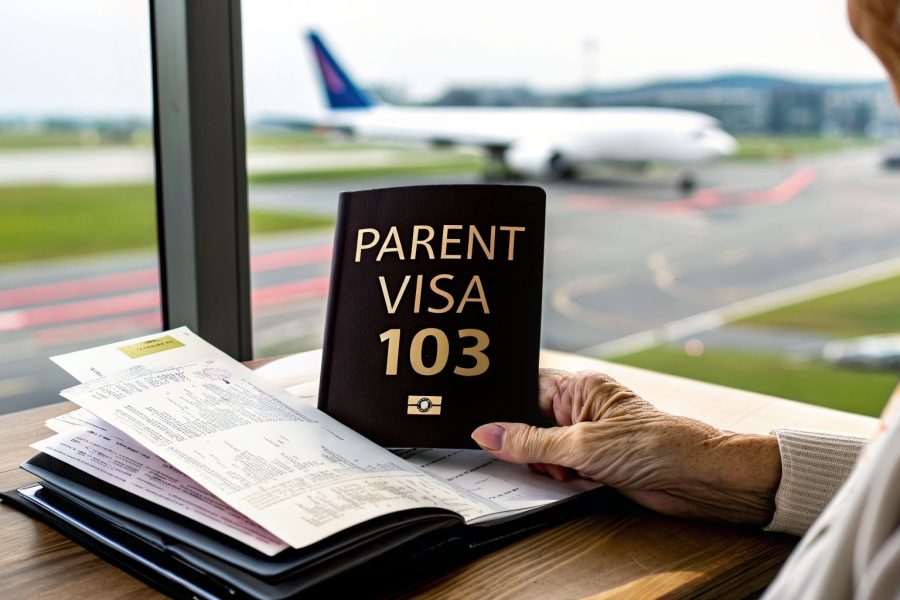
Bringing your parents to Australia is a dream for many, but navigating the visa system can feel overwhelming. One pathway you’ll almost certainly come across is the Parent Visa (Subclass 103), and it’s one that requires a very clear-eyed understanding from the start.
Disclaimer: Please be aware that immigration information and government policies can change unexpectedly. This article is for informational purposes only and may not be current when you read it. For the most up-to-date and personalised advice, book an appointment with a registered migration agent. All government fees should be confirmed on the official Department of Home Affairs website.
What Is the Parent Visa 103?

The Parent Visa 103 is a permanent visa that allows parents to move to Australia to be with their children. The big drawcard? It’s a ‘non-contributory’ visa, which means it doesn’t come with the hefty six-figure price tag of its contributory cousins.
Think of it as the long-game option. It offers the ultimate prize of permanent residency—the right to live, work, and access Medicare in Australia indefinitely—but it asks for something else in return: an incredible amount of patience.
Before we dive deeper, here’s a quick overview of what the Subclass 103 visa is all about.
Parent Visa 103 At a Glance
| Feature | Description |
|---|---|
| Visa Type | Permanent Residency |
| Who It's For | Parents with children who are settled Australian citizens or permanent residents. |
| Key Advantage | Low cost. It avoids the large 'contribution' fee of other parent visas. |
| Key Disadvantage | Extremely long wait time, currently estimated to be around 30 years. |
As you can see, the trade-off between cost and time is the defining feature of this visa. It’s a decision that has significant long-term implications for any family.
Who Is This Visa Really For?
Let's be direct: this visa isn’t a good fit for everyone. It’s designed for a very specific type of applicant.
This path really only makes sense for parents who:
- Are happy to wait many, many years to migrate.
- Are in good health and likely to remain so for the foreseeable future.
- Have a child sponsor in Australia who is a settled citizen or permanent resident.
- Meet the 'Balance of Family Test' (meaning at least half of their children live permanently in Australia).
The main reason families consider it is to avoid the substantial contribution fee required for the much faster Contributory Parent visas. But the reality is that the wait for the Subclass 103 isn't just long; it's measured in decades.
The Sobering Reality of the Wait
So, just how long are we talking about? The numbers paint a stark picture. The government allocates a very small number of places to non-contributory parent visas each year. For the 2025-26 program year, the cap is set at just 1,700 places.
With a backlog of over 151,000 parent visa applications in the queue, the wait time for a new Subclass 103 application lodged today is estimated to be between 30 and 33 years.
This isn't just a queue; it's a generational commitment. Families often lodge this visa knowing that by the time it’s granted, their circumstances will have changed dramatically. It's a crucial factor that needs to be weighed carefully against other options, and you can explore our guide on other family migration pathways to see what else might be possible.
Meeting the Strict Eligibility Criteria
Getting the Parent Visa 103 right is all about ticking a series of very specific boxes. The Department of Home Affairs looks closely at both the parents applying and the child sponsoring them. Honestly assessing where your family stands against these rules from the get-go is the only way to know if this visa is a realistic option for you.
Essentially, your application rests on three key areas: who your sponsor is, your family's overall structure, and whether you meet Australia's personal standards. Every single part is checked, and if one piece doesn't fit, the whole application can be refused. It’s a tough process, and that's why a clear-eyed look at the requirements is so important.
Disclaimer: Please be aware that immigration information and government policies can change unexpectedly. This article is for informational purposes only and may not be current when you read it. For the most up-to-date and personalised advice, book an appointment with a registered migration agent. All government fees should be confirmed on the official Department of Home Affairs website.
The Crucial Role of the Sponsor
The entire application is built on the foundation of a suitable sponsor. This isn't just any child wanting to bring their parents over; the sponsor has to meet a strict set of government criteria.
To be a sponsor, your child must be:
- An Australian citizen, an Australian permanent resident, or an eligible New Zealand citizen.
- "Settled" in Australia, which is a term the Department uses to mean they’ve been living here lawfully for a reasonable time—usually at least two years.
- At least 18 years old.
That "settled" requirement is more than just holding the right visa. It’s about proving a genuine, established life here. The Department wants to see that your sponsor has put down roots and is in a stable position to support you when you arrive.
Demystifying the Balance of Family Test
This test is, without a doubt, the biggest hurdle for most families. The Balance of Family Test (BoFT) is a simple, mathematical way for the government to measure your ties to Australia.
To pass this test, at least half of your children must live permanently in Australia. As an alternative, you can also pass if more of your children live permanently in Australia than in any other single country.
Let’s break that down. Say you have four children in total. To meet the test, at least two of them must be Australian citizens or permanent residents living in the country. If you have three children, but two live in the UK and only one is in Australia, you would unfortunately fail the test. The rule covers all of your children, including step-children and adopted children.
There is no grey area here. The rule is applied exactly as it's written, and if your family tree doesn't fit this equation, the Parent Visa 103 simply isn't a pathway for you. It’s a make-or-break condition that stops many applications in their tracks.
Passing Health and Character Checks
Finally, every parent on the application has to meet Australia’s health and character requirements. While these checks don't happen until much later in the process—often years down the line—you need to be aware of them from the very beginning.
The health check is there to protect the Australian public and manage the load on our healthcare system. You’ll need to show you don’t have a condition that would be a significant cost or take away from services that Australians might need. You can get a much deeper understanding by reading our guide on the health and character requirements for Australian visas.
For the character check, you'll need to provide police certificates from any country where you've lived for 12 months or more in the last 10 years. The Department is looking to ensure you are of good character, and a serious criminal record can lead to a refusal. It’s all about making sure new residents are ready to be law-abiding members of the community.
The True Cost and Wait Time for the Parent Visa 103
When you’re looking at the Parent Visa 103, two things really matter more than anything else: how much it costs and how long you’ll be waiting. Before your family even thinks about starting this process, you need a realistic grasp of both.
While the visa is one of the more affordable family pathways, the timeline is another story entirely. It demands a level of patience that you just don't see with other visas.
Disclaimer: Please be aware that immigration information and government policies can change unexpectedly. This article is for informational purposes only and may not be current when you read it. For the most up-to-date and personalised advice, book an appointment with a registered migration agent. All government fees should be confirmed on the official Department of Home Affairs website.
Breaking Down the Financial Investment
Compared to the Contributory Parent visas, the Subclass 103 looks like a bargain. But don't mistake "cheaper" for "free." There are several costs you'll need to plan for over the very long life of this application.
The main government fees are split into two payments:
- First Instalment: This is the visa application charge (VAC) you pay right at the start when you lodge the application. Think of it as the fee that gets your parent's name on the list and holds their spot in the queue.
- Second Instalment: This is a much smaller fee, and the Department won't ask for it until many years down the track, just before the visa is ready to be granted.
On top of these, you have to factor in the other expenses. This includes paying for health examinations, getting police clearance certificates from every country your parent has lived in, and sometimes paying for official translations of documents. For the most current government fees, always go straight to the source. The official Department of Home Affairs website is the only place you should trust for pricing.
The Unavoidable Reality of the Waiting Period
This is the part that makes the Parent Visa 103 such a tough decision for so many families. The wait isn't just long—it's measured in decades. The reason is simple supply and demand.
The Australian government places a very strict cap on how many of these non-contributory parent visas it will grant each year. For the 2025-26 program year, that number is a tiny 1,700 places. When you hold that figure up against the massive queue of hopeful families, the reason for the delay becomes painfully clear.
To put it in perspective, by October 2025, the Department of Home Affairs was looking at Subclass 103 applications that were lodged way back in June 1994. That’s a backlog of over 31 years. More recent official data from 31 January 2026 shows the queue is only being released for applications made in June 2013 or earlier. This incredible delay is all down to that rigid annual cap trying to deal with a national backlog that has ballooned to over 151,000 applications. You can read more about the data behind these wait times to get the full picture.
This timeline gives you a visual idea of the different stages a Parent Visa 103 application goes through on its very long journey.

As you can see, your application moves through very distinct phases. It starts with the Balance of Family Test and sponsor checks, but the final health and character checks won't happen for years. This really drives home that this is a marathon, not a sprint. Choosing this visa means accepting that bringing your parents to Australia is a very distant goal.
A Step-by-Step Guide to the Application Process

Applying for the Parent Visa 103 is less of a sprint and more of an ultra-marathon. It requires a clear strategy, meticulous preparation, and a healthy dose of patience. Let's break down exactly what this journey looks like, step by step, so you can move forward with confidence.
Disclaimer: Please be aware that immigration information and government policies can change unexpectedly. This article is for informational purposes only and may not be current when you read it. For the most up-to-date and personalised advice, book an appointment with a registered migration agent. All government fees should be confirmed on the official Department of Home Affairs website.
Phase 1: Laying the Groundwork
Before you even touch an application form, your first task is to get all your paperwork in order. Think of yourself as a detective building a case file. A complete, well-organised application is your best defence against unnecessary delays right out of the gate.
Your focus should be on gathering two sets of crucial documents: one for the parents applying and another for their sponsoring child in Australia.
Essential Documents Checklist
For the Parents (Applicants):
- Certified copies of passports and birth certificates that show the names of both of their parents.
- Their marriage certificate, if they are married.
- Four recent passport-sized photos for each applicant.
- Proof of their relationship to all of their children (birth certificates are perfect for this).
- Military service or discharge papers, if this applies to them.
For the Child (Sponsor):
- Evidence of your Australian citizenship, permanent residency, or eligible New Zealand citizenship.
- Proof that you are “settled” in Australia, which usually means showing you’ve lived here for at least two years. Think rental agreements, utility bills, or employment records.
- Proof of your relationship to the applicants, which is simply your own birth certificate.
This first stage is all about building a bulletproof file. The more organised you are now, the smoother things will go later on.
Phase 2: Lodging the Application
With your documents assembled, it’s time to officially lodge the parent visa 103 application. This is the moment your parents get their spot in the queue. Today, most applications are lodged online via the Department of Home Affairs’ portal.
Filling out the forms—Form 47PA for the parents and Form 40 for the sponsor—is a critical step. You have to double-check every name, date, and detail before you hit submit. At this point, you’ll also pay the first visa application charge, which formally secures your place in line.
Once it’s all submitted, you’ll get an acknowledgement letter from the Department. This letter is your official confirmation that they’ve received the application and it will include a file number. Keep this safe; it’s your reference for all future communications.
Phase 3: The Long Wait and Staying Updated
Here comes the toughest part of the Parent Visa 103 journey. Once the application is queued, you’re in for a very long wait—potentially decades. During this time, it is absolutely vital to keep the Department of Home Affairs updated on any changes in your circumstances.
It is a mandatory visa condition to notify the Department of changes such as a new residential address, a change in marital status, the birth of a new child, or any significant change in the sponsor's situation. Failing to do so can jeopardise the entire application.
This is not a "set and forget" process. Think of it as maintaining your file so it's ready to go when your number is finally called. Every time something changes, a quick update via your online account ensures your application is current. For more complex changes, knowing exactly what to report can be tricky, and that's where getting expert advice is a game-changer. If you’re ever unsure, our guide on tips for choosing a migration agent can point you in the right direction.
Phase 4: The Final Stretch to a Decision
After years, or even decades, you’ll finally receive a notification from the Department to start the final processing. This is the signal that your application has made it to the front of the queue. They will ask you to provide several key items to finalise the visa.
- Updated Police Clearances: You’ll need these from every country the applicants have lived in for 12 months or more over the last 10 years.
- Health Examinations: The applicants must complete a full medical check-up with a panel physician approved by the Department.
- Assurance of Support (AoS): This is a big one. You will be asked to apply for an AoS through Centrelink. It’s a legal and financial commitment to support your parents, which involves an income test and a substantial bond.
- Second Visa Application Charge: The final, much larger government fee will be due at this stage.
Once you’ve provided all of this, and the AoS has been approved, the Department can make its final decision. If all goes well, your parents will be granted their permanent Parent Visa 103, finally bringing their long journey to a happy conclusion in Australia.
Exploring Faster Parent Visa Alternatives
Let’s be honest. The biggest appeal of the Parent Visa 103 is its low cost. But this comes with a massive trade-off: a waiting period that can stretch out for decades. For most families, waiting 30 years to be reunited just isn't a realistic option.
If you’re hoping to bring your parents to Australia sooner rather than later, you'll need to look at other, faster routes. Fortunately, the government offers alternatives for families who can prioritise speed over cost. These options require a much larger financial commitment, but they can slash the wait time from decades down to just a few years.
Disclaimer: Please be aware that immigration information and government policies can change unexpectedly. This article is for informational purposes only and may not be current when you read it. For the most up-to-date and personalised advice, book an appointment with a registered migration agent. All government fees should be confirmed on the official Department of Home Affairs website.
The Contributory Parent Visa Pathway
The most common alternative to the Subclass 103 is the Contributory Parent visa category. This pathway was created to give families a faster option, provided they can make a significant financial contribution towards their parents' future healthcare costs in Australia.
You have two main choices here:
- Contributory Parent Visa (Subclass 143): This is the direct permanent visa. By paying a substantial contribution fee upfront, your parents are placed in a much, much shorter queue.
- Contributory Parent (Temporary) Visa (Subclass 173): Think of this as a two-step approach. It lets you split the high contribution cost over time. Your parents first get a two-year temporary visa, and before it runs out, you can apply for the permanent Subclass 143.
The real difference comes down to the processing time. For these contributory visas, you're looking at a wait of around 6 to 8 years. It's still a significant wait, but it’s a world away from the 30-year queue for the Subclass 103.
Comparing Your Permanent Visa Options
So, how do you choose? The decision between the Subclass 103 and the contributory options really boils down to a straightforward trade-off: time versus money. The table below lays out this choice clearly, comparing the main permanent parent visas.
Parent Visa Options Compared: Cost vs. Processing Time
| Visa Subclass | Visa Type | Approximate Cost (AUD) | Estimated Processing Time |
|---|---|---|---|
| Subclass 103 | Permanent | From $7,000+ | 30+ years |
| Subclass 143 | Permanent | From approx. $47,955 per parent | 6–8 years |
| Subclass 173/143 | Temporary to Permanent | High contribution fee paid in two stages | 6–8 years (total) |
As you can see, the financial leap is substantial. But for many families, the ability to be together while parents are still healthy and able to enjoy their life in Australia is an investment well worth making.
A Temporary Solution: The Sponsored Parent Visa 870
What if you need your parents here quickly, but you aren't ready to commit to the cost of a permanent contributory visa? Or perhaps you're already in the long queue for the 103 visa? The Sponsored Parent (Temporary) Visa (Subclass 870) offers a very practical middle ground.
This visa is not a pathway to permanent residency. Instead, it allows parents to come and live in Australia temporarily for either a three or five-year period. It can also be renewed, allowing for a total stay of up to 10 years.
The huge advantage of the Subclass 870 is its speed. Applications are often processed in just a few months, not years. This makes it a fantastic option for getting your family together now while you wait for a permanent visa application to process.
It’s a way to close the distance immediately, letting your parents become a part of your daily life and watch their grandkids grow up. Just keep in mind that parents on this visa have no access to Medicare, cannot work, and must hold private health insurance for their entire stay.
Frequently Asked Questions About the Parent Visa 103
When you're looking into the Parent Visa 103, it's natural for a lot of specific questions to pop up. It's a long road, after all. Let's tackle some of the most common queries we get from families just like yours, so you can get a clearer picture of what to expect.
Disclaimer: Please be aware that immigration information and government policies can change unexpectedly. This article is for informational purposes only and may not be current when you read it. For the most up-to-date and personalised advice, book an appointment with a registered migration agent. All government fees should be confirmed on the official Department of Home Affairs website.
Can My Parents Work in Australia on a Parent Visa 103?
Yes, they absolutely can. Once the Parent Visa 103 is granted, it’s a permanent visa. This gives your parents the full right to live, work, and study in Australia indefinitely, just like any other permanent resident.
What Is an Assurance of Support?
Think of the Assurance of Support (AoS) as a formal financial promise you make to the government. It’s a guarantee that your parents won’t need to rely on social security payments for a certain period after they arrive.
This is a step that comes much, much later in the process—usually right before the visa is finalised. The person providing the AoS (the "assurer") has to pass an income test with Centrelink and lodge a hefty bond, which is held for several years.
What if Our Family's Circumstances Change While Waiting?
You absolutely must tell the Department of Home Affairs about any changes while your application is in the queue. This isn't just a suggestion; it's a mandatory part of the process.
For instance, you must report a change of address, a change in marital status for your parents or yourself as the sponsor, the birth of a child, or if your own residency status changes. Not keeping your details updated can cause huge delays or even get the visa refused when it finally comes up for assessment.
Can We Lodge a Parent Visa 103 if My Parents Are in Australia?
Usually, the answer here is no. The Parent Visa 103 is an offshore visa, which has a very specific legal meaning: the applicants must be outside of Australia when the visa is granted.
They can visit Australia on another visa (like a visitor visa) after you've lodged the application, but they will have to leave the country before the final decision is made. There are very few exceptions to this rule, making it a tricky area where getting professional advice is a really good idea.
Navigating the complexities of the parent visa 103 or its alternatives requires expert guidance. At My Visa Guide, our registered migration agents provide honest advice and meticulous preparation to give your family the best chance of success. Book your consultation today at https://www.myvisaguide.com.au.