IMPORTANT NOTICE
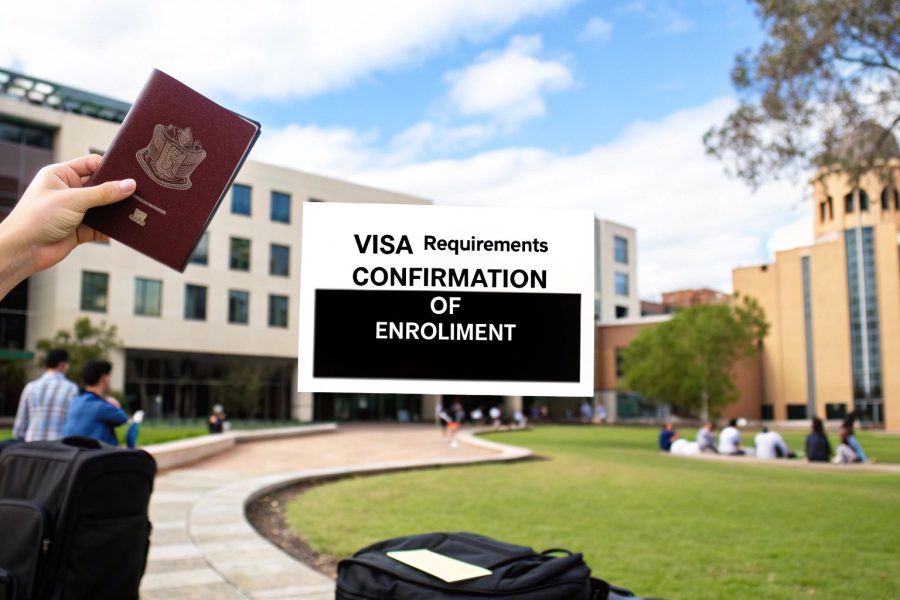
To get your Australian student visa application over the line, you’ll need to tick a few key boxes. Think of it as building a case for yourself. You must have a Confirmation of Enrolment (CoE) from an Aussie institution, prove you’re a Genuine Student (GS), show you have enough money to cover your course and living costs, and arrange your Overseas Student Health Cover (OSHC). Getting these core pillars right is non-negotiable for a successful Subclass 500 visa application.
Disclaimer: Information provided in this article is general in nature and may not be accurate at the time you are reading it. Immigration laws and policies change frequently. For the most up-to-date and personalised advice, we strongly recommend you book an appointment with a registered migration agent. Please always refer to the official Department of Home Affairs website for any department fees for any visa.
Your Roadmap to an Australian Student Visa
Starting your study journey in Australia is incredibly exciting, but let's be honest, the visa process can look a bit daunting at first. The trick is to see the Subclass 500 visa not as one giant hurdle, but as a series of milestones you need to hit. Each requirement is a crucial support beam for your application, and understanding them from the get-go is the best way to build a solid case.
We're here to break down every essential piece, giving you a clear picture of what’s ahead. It all boils down to these main pillars:
- Confirmation of Enrolment (CoE): This is your official acceptance letter into a registered course.
- Genuine Student (GS) Requirement: This is where you prove your main reason for coming to Australia is genuinely for study.
- Financial Capacity: You need to show you can afford your tuition, flights, and day-to-day living expenses.
- Overseas Student Health Cover (OSHC): This is your mandatory health insurance for your entire stay.
- English Language Proficiency: You’ll need to meet the minimum scores on an approved English test.
To give you a quick overview, here's a snapshot of what's involved.
Subclass 500 Visa Requirements At a Glance
| Requirement Category | What It Means for You | Key Document or Evidence |
|---|---|---|
| Confirmation of Enrolment (CoE) | You must be accepted into a full-time course registered on CRICOS. | A valid CoE issued by your education provider. |
| Genuine Student (GS) | Answering targeted questions to show your primary intent is to study. | Detailed responses in your visa application form. |
| Financial Capacity | Proving you have access to funds for tuition, travel, and living costs. | Bank statements, loan documents, or scholarship letters. |
| Health Cover (OSHC) | You need health insurance for the entire duration of your visa. | Your OSHC policy certificate. |
| English Proficiency | You must meet the minimum English language test score requirements. | An official test result (e.g., IELTS, PTE). |
| Health & Character | You need to be in good health and of good character. | Health examination results and police certificates. |
Think of this table as your starting checklist. Nailing each of these points is fundamental to lodging a strong and decision-ready application.
Keeping Up With Recent Visa Changes
The Australian government is always tweaking its migration policies, so staying in the loop is absolutely critical. For example, the student visa rules saw some major shifts for 2025-2026.
One of the biggest changes was replacing the old Genuine Temporary Entrant (GTE) test with the stricter Genuine Student (GS) assessment. Plus, the amount of money you need to show for living costs was increased to AUD 29,710. You can find more detail about the Australia study visa updates for 2025-2026 and what they mean for your application on our blog.
It’s also a good idea to check the official Department of Home Affairs website for the very latest on visa application fees. Doing your homework and preparing thoroughly is the best way to set yourself up for success.
Disclaimer: Information provided in this article is general in nature and may not be accurate at the time you are reading it. Immigration laws and policies change frequently. For the most up-to-date and personalised advice, we strongly recommend you book an appointment with a registered migration agent. Please always refer to the official Department of Home Affairs website for any department fees for any visa.
Proving You Are a Genuine Student
One of the biggest shake-ups to the student visa Australia requirements has been the move from the old Genuine Temporary Entrant (GTE) rule to the new Genuine Student (GS) requirement. This isn't just a name change; it's a complete shift in mindset. The Department of Home Affairs is now less focused on whether you’ll eventually leave Australia and much more interested in why you’re coming in the first place.
Essentially, they want to be sure you're here to genuinely study.
Think of it like this: a weak job applicant gives vague answers about wanting a job. A strong one tells a compelling story, connecting their past experience to their future goals with that specific company. The GS requirement is your chance to do the same—to build a strong case for your academic and career plans, with your own life story as the proof.
What Is the Genuine Student Test Really Asking?
At its heart, the GS requirement is all about your narrative. The Department wants to see the logic behind your application. It's no longer good enough to just say you want a top-quality education. You need to show them the clear, logical line connecting your past, your proposed studies in Australia, and your future career.
The application now asks a series of targeted questions that get into a few key areas:
- Your life back home: This covers your personal circumstances, including your family, community connections, and your financial situation.
- Your choice of course and uni: Why this particular course? What made you choose this institution over countless others, both in Australia and globally?
- The payoff: How will this specific Australian qualification realistically boost your career prospects when you return home or move elsewhere?
You have to back up your claims with detailed, evidence-based answers. Broad statements like "Australia has an amazing education system" or "this degree will open doors for me" simply won't cut it anymore.
Crafting a Strong GS Response
To nail the GS criteria, your answers need to be personal and specific. For example, don't just say you chose a Master of Data Science because it has great job prospects.
Instead, explain how your undergraduate degree in mathematics and your internship at a local tech startup ignited your passion for machine learning. Then, show how the specific modules in your chosen Australian course will fill the gaps in your knowledge, setting you up for a specific role—like a "Data Analyst"—at a particular company back in your home country.
To pass the GS assessment, you must show that your primary purpose for coming to Australia is to obtain a quality education that will benefit your future. Your study plan should be a logical and well-researched step in your overall career journey, not a detour to gain residency.
Weak responses are almost always generic and missing detail. For instance, claiming you can't find a similar course at home without showing you've actually researched local universities looks lazy. A strong response, on the other hand, is built on facts and a clear, logical story. For a deeper dive into what makes an application stand out, check out our detailed guide on what the Genuine Student requirement is and how to tackle it.
Ultimately, proving you're a genuine student is about painting a clear picture for the visa officer. It’s your opportunity to show them that studying in Australia is a well-considered investment in your future, not just a convenient backdoor into the country.
Disclaimer: Information provided in this article is general in nature and may not be accurate at the time you are reading it. Immigration laws and policies change frequently. For the most up-to-date and personalised advice, we strongly recommend you book an appointment with a registered migration agent. Please always refer to the official Department of Home Affairs website for any department fees for any visa.
Obtaining Your Confirmation of Enrolment
If the Genuine Student requirement is the story you tell immigration, your Confirmation of Enrolment (CoE) is the official ticket that actually gets you on the plane. Think of it as the bedrock of your application—without a valid CoE, you simply can't lodge a Subclass 500 visa. It’s the formal, government-recognised proof that a legitimate Australian institution has a spot waiting just for you.
But this document is much more than just an acceptance letter. It's a registered confirmation that you've enrolled in a full-time course with an institution on the Commonwealth Register of Institutions and Courses for Overseas Students (CRICOS). Your CoE comes with a unique code, which you'll enter directly into your online visa application, linking you to your specific course and provider.
The Journey from Offer Letter to CoE
Getting your hands on a CoE is a pretty clear-cut process, but it starts well before you even think about the visa itself. It’s the final step in your university application and the first critical piece of your visa puzzle.
Here's how it usually plays out:
- Receive Your Letter of Offer: After your application is approved, the institution sends you an official Letter of Offer. This breaks down your course details, tuition fees, and any conditions you still need to meet.
- Formally Accept the Offer: You’ll need to sign and return the acceptance form, officially agreeing to the institution's terms.
- Pay Your Initial Deposit: This payment almost always covers your first semester's tuition fees and the premium for your Overseas Student Health Cover (OSHC).
- Receive Your CoE: Once your acceptance and payment are processed, the institution issues your electronic CoE. This is the document you've been waiting for!
A CoE is your golden key. It proves to the Department of Home Affairs that you have a genuine place waiting for you in a registered Australian course, which is a non-negotiable part of the student visa Australia requirements.
Handling Common CoE Issues
While the process is usually smooth, hiccups can happen. Delays might pop up if your payment takes a while to clear or if you missed a signature on your acceptance paperwork. It's always a good idea to follow up with the admissions office if you haven't received your CoE within a week or two of making payment.
What if there's a typo on your CoE, like a misspelled name or the wrong birthdate? You must contact your education provider immediately to get it corrected and re-issued. A CoE with incorrect details will almost certainly throw a spanner in the works for your visa application.
It's also not unheard of for a student to get CoEs from multiple institutions. This can happen if you've paid deposits at more than one place, but you can only use one CoE for your visa application. You have to lock in your final choice before you apply, as your visa will be tied to that specific enrolment.
Disclaimer: Information provided in this article is general in nature and may not be accurate at the time you are reading it. Immigration laws and policies change frequently. For the most up-to-date and personalised advice, we strongly recommend you book an appointment with a registered migration agent. Please always refer to the official Department of Home Affairs website for any department fees for any visa.
Right then, once you’ve got your Confirmation of Enrolment (CoE) sorted and your Genuine Student (GS) statement drafted, it’s time to tackle the next big hurdles: proving your financial stability and your health cover.
These two are absolute non-negotiables for the student visa Australia requirements. The Department of Home Affairs needs to see cold, hard proof that you can support yourself and are medically insured before they’ll even consider granting your visa.
Think of this part as presenting a financial blueprint for your first year in Australia. You need to show that you have genuine access to enough money to cover a full year of tuition, all your living costs, a flight home, and any school fees for dependents coming with you. Vague promises or a shortfall in funds are classic reasons for visa refusal, so getting this bit right is crucial.
Breaking Down the Financial Capacity Requirement
The Department of Home Affairs is very clear about the numbers. As of the latest update, you must prove you have access to AUD 29,710 to cover your living costs for a 12-month period. This figure does get reviewed, so it's always smart to double-check for the most current amount before you apply.
On top of your living expenses, you'll also need to show funds for:
- First Year's Tuition Fees: The full amount, exactly as it appears on your CoE.
- Travel Costs: Roughly AUD 2,500 for a return airfare back to your home country.
- Dependent Schooling: If you have school-aged children joining you, add an extra AUD 13,502 per year for each child.
Simply having the money isn’t enough; you need to document it in a way the Department will accept. The most common forms of evidence are official bank statements (showing the funds have been held for at least three months), an education loan approval letter, or an official letter confirming government sponsorship. These documents have to be legitimate and clearly show the money is genuinely available for your studies down under.
To help you visualise this, here’s a quick breakdown of the minimum funds you need to demonstrate for a 12-month period.
Estimated Annual Costs for Financial Proof
| Cost Component | Estimated Amount (AUD) | Important Notes |
|---|---|---|
| Living Costs (12 months) | AUD 29,710 | This is the minimum set by the Department for a single applicant. |
| First-Year Tuition Fees | Varies by course | Check your Confirmation of Enrolment (CoE) for the exact amount. |
| Travel Costs | ~ AUD 2,500 | This is an estimate for a return airfare to your home country. |
| Dependent Schooling | AUD 13,502 per child | This applies only if you have school-aged children accompanying you. |
Remember, these are minimums. It's always a good idea to have a bit more than required to show a comfortable financial position.
Securing Your Overseas Student Health Cover
Alongside your proof of funds, you must have Overseas Student Health Cover (OSHC) arranged for the entire duration of your stay. This isn't optional—it's a hard-and-fast condition of your visa. OSHC is a specific type of health insurance that helps international students cover the costs of medical or hospital care they might need in Australia.
You must get a policy from an approved Australian provider, and your cover needs to start from the day you land in Australia, not the day your classes begin. It also has to stay valid for the full length of your visa. The good news is that most universities and colleges can help you arrange OSHC, often bundling the cost into your initial deposit payment, which makes life a lot easier.
Having valid OSHC is a fundamental requirement. It ensures you won't face significant financial hardship if you require medical attention, giving both you and the Australian government peace of mind.
It’s also important to understand what your policy actually covers. Most standard policies will cover doctor visits, some hospital treatments, ambulance services, and limited prescription medicines. However, things like dental, optical, or physiotherapy usually aren't included. For a more detailed look at choosing the right policy, check out our in-depth guide to Overseas Student Health Cover (OSHC).
Disclaimer: Information provided in this article is general in nature and may not be accurate at the time you are reading it. Immigration laws and policies change frequently. For the most up-to-date and personalised advice, we strongly recommend you book an appointment with a registered migration agent. Please always refer to the official Department of Home Affairs website for any department fees for any visa.
Meeting English, Academic, and Character Standards
Beyond the money and enrolment letters, the Australian government looks at three other core areas to make sure you're a good fit for a student visa. These are your English skills, your academic background, and your health and character. Getting these pieces of the puzzle right is absolutely essential to meeting the student visa Australia requirements.
Think of it as a three-part quality check. You need to prove you can keep up in class, that you have a solid track record of study, and that you’re of good character and health to join the community here in Australia.
Proving Your English Language Proficiency
It goes without saying, but to do well in an Australian classroom, you need a decent grasp of English. The Department of Home Affairs needs most international students to prove this by sitting a standardised language test.
You’ll have to hit a minimum score on one of the approved tests. The big ones you'll see are:
- IELTS Academic: International English Language Testing System
- TOEFL iBT: Test of English as a Foreign Language internet-based test
- PTE Academic: Pearson Test of English Academic
The score you need isn't a single magic number; it shifts depending on what you plan to study. A vocational course might have different requirements than a PhD, for example. As a general guide, a simple English language course (ELICOS) might only need an IELTS score of 4.5, but for a university degree, the benchmark is usually 6.0 or higher. If hitting those scores feels like a struggle, getting some professional guidance can make all the difference. You can find out more about how we help students prepare with our English proficiency support services.
Your Academic History Matters
How you've done in your past studies is a huge clue for the visa officer about how you'll do in the future. They need to see a clear, credible educational path that makes sense and leads logically to the course you want to study in Australia.
This means you'll need to provide certified copies of your academic transcripts and completion certificates for everything you've studied before. We're talking official documents from your high school, college, or university. If they aren't in English, they must be translated by a NAATI-certified translator. Be aware that any long, unexplained gaps in your study history can look like a red flag, so be ready to explain them clearly in your Genuine Student statement. Once you arrive, using tools like AI for studying can be a great way to maintain the strong academic performance your visa requires.
Passing Health and Character Checks
Finally, Australia has very strict health and character standards in place to protect the community. Every single student visa applicant has to meet these standards to be granted a visa.
The health and character checks are there to make sure visa holders won’t be a risk to public health or safety. Being completely honest in these declarations is non-negotiable—providing false information can lead to a visa refusal and a ban on applying again in the future.
For the health check, you'll most likely need to have a medical exam with a doctor approved by the Department. This usually involves a physical check-up, a chest x-ray, and sometimes blood tests to check for things like tuberculosis.
For the character requirement, you have to declare any criminal convictions. You might also be asked for police certificates (sometimes called penal clearance certificates) from every country you’ve lived in for 12 months or more over the last 10 years, since you turned 16.
Disclaimer: Information provided in this article is general in nature and may not be accurate at the time you are reading it. Immigration laws and policies change frequently. For the most up-to-date and personalised advice, we strongly recommend you book an appointment with a registered migration agent. Please always refer to the official Department of Home Affairs website for any department fees for any visa.
Getting Your Visa Application Across the Line
Alright, you’ve gathered all your core documents and ticked off the big requirements. Now for the final hurdle: lodging the actual visa application. This part can feel a bit like navigating government red tape, but if you treat it as a clear, step-by-step process, it’s far less intimidating. The goal here is to submit what’s known as a “decision-ready” application—one that’s complete, accurate, and makes the case officer’s job as easy as possible.
Everything happens online through the Department of Home Affairs’ portal. Your first move is to create your personal ImmiAccount. Think of this as your secure online dashboard for everything visa-related. It’s where you’ll fill out the application, upload your documents, and anxiously track its progress once you’ve submitted it.
Lodging Your Subclass 500 Application
Once your ImmiAccount is good to go, the application itself unfolds in a few distinct stages. Attention to detail is your best friend here. Even tiny mistakes or inconsistencies can lead to frustrating delays, so take your time and double-check every single entry.
Here’s the game plan:
- Fill Out the Online Application Form: This is where you’ll provide all the details about who you are, your course, your finances, and your background. Be honest and make sure your answers line up perfectly with the documents you’re about to upload.
- Attach Your Supporting Documents: You’ll need to upload high-quality, colour scans of everything. This means your passport, CoE, financial proof, OSHC policy, English test results—the whole lot.
- Pay the Visa Application Charge (VAC): Your application isn't officially in the queue until you've paid the fee. These fees can change, so always check the Department of Home Affairs' official website for the current amount.
- Hit Submit: After one last review (seriously, check it again!), you can submit your application. You'll get an immediate acknowledgement. If you applied from within Australia, you'll also be granted a bridging visa to keep you lawful while you wait.
Prepping Your Documents for Upload
How you present your digital files actually matters. A case officer trying to decipher blurry scans or a mess of poorly named files is not a happy case officer. A bit of organisation goes a long way.
- Use simple, descriptive file names. Think "Jane-Doe-Passport.pdf" instead of "scan_001.pdf".
- Make sure every scan is high-resolution and crystal clear.
- For documents with multiple pages, like bank statements, combine them into a single PDF file. It keeps things tidy.
The Waiting Game: Processing Times and RFIs
Once you’ve submitted, the waiting begins. How long will it take? Honestly, it varies wildly depending on where you’re applying from and how swamped the Department is. It’s crucial to be realistic and apply well ahead of your course start date.
During this period, don't be surprised if you get a Request for Further Information (RFI). It’s quite common and just means the case officer needs another document or some clarification to finalise their assessment. The key is to respond quickly and provide exactly what they’ve asked for.
It's also worth noting that recent policy changes are affecting processing. In the 2024/25 fiscal year, Australia saw nearly 230,000 student visa applications from offshore, a big 30% drop from the year before. This is mainly due to new caps designed to steer students towards university degrees, causing visa grants for vocational and English courses to fall by a massive 50%. You can learn more about how these caps have shifted demand toward university courses to see how your choice of study might be viewed.
Once that glorious visa grant notice lands in your inbox, it's time to shift gears and plan your move! Getting ready for life in a new country is a big project, so check out a comprehensive checklist for your first international journey to make sure you've got all your bases covered for a smooth arrival.
Disclaimer: Information provided in this article is general in nature and may not be accurate at the time you are reading it. Immigration laws and policies change frequently. For the most up-to-date and personalised advice, we strongly recommend you book an appointment with a registered migration agent. Please always refer to the official Department of Home Affairs website for any department fees for any visa.
Your Top Questions Answered
Going through the finer details of the student visa Australia requirements always brings up a few common questions. It's completely normal to feel a bit overwhelmed by the specifics. To help clear things up, I’ve put together answers to some of the most frequent queries we get from applicants.
Let's start with a quick look at the application lodgement process itself. It’s a pretty straightforward, three-step journey once you have all your ducks in a row.
This visual really drives home the need for a methodical approach. It all begins with setting up your ImmiAccount, then meticulously gathering and uploading your documents before hitting that final submit button.
Can I Bring My Family With Me on a Student Visa?
Yes, absolutely. You can include eligible family members, known as 'dependents', in your student visa application. This usually covers your partner and any dependent children who are under 18 years old.
It's a non-negotiable requirement that you declare all your immediate family members on the form, even if they aren’t planning to come to Australia with you. For those who are joining you, you'll need to supply solid proof of your relationship, like marriage certificates and birth certificates.
Just be aware that bringing family significantly bumps up the financial capacity you need to show. You must prove you have enough money to cover their living costs, flights, and school fees for any school-aged children.
What Are the Rules for Working in Australia on a Student Visa?
As a student visa holder, you’re allowed to work to help support yourself and get some local experience, but there are strict limits. The current rule is a maximum of 48 hours per fortnight while your course is in session.
During official course breaks, like the big semester holidays, you can typically work unlimited hours. It's crucial to understand that any income you earn is meant to be supplementary. You can't use potential work income to meet the main financial evidence requirement for your visa.
The Department of Home Affairs is very firm on this: your primary reason for being in Australia must be your studies. If you breach your work conditions, it’s a serious issue that can lead to your visa being cancelled. Always double-check your visa grant notice for the latest rules.
What Happens If I Want to Change My Course or Institution?
It's possible to change your course or switch education providers, but you have to follow a specific process to keep your visa valid. The golden rule is that you must stay enrolled in a course at the same Australian Qualifications Framework (AQF) level or higher than your original one.
If you’re thinking of dropping to a lower-level course (say, from a Master's degree down to a Graduate Diploma), you'll almost certainly need to apply for a brand-new student visa. Also, if you want to leave before completing the first six months of your main course, you’ll need a "letter of release" from your current institution before you can move to a new one.
Any change means getting a new Confirmation of Enrolment (CoE) from your new school and telling the Department of Home Affairs straight away. Not doing this can put your visa in serious jeopardy.
Disclaimer: Information provided in this article is general in nature and may not be accurate at the time you are reading it. Immigration laws and policies change frequently. For the most up-to-date and personalised advice, we strongly recommend you book an appointment with a registered migration agent. Please always refer to the official Department of Home Affairs website for any department fees for any visa.
Navigating the Australian visa system requires careful planning and expert guidance. For professional assistance with your student visa or any other migration pathway, trust the experienced team at My Visa Guide. We provide clear, honest, and effective advice to ensure your application has the best possible chance of success. https://www.myvisaguide.com.au