Australia's buzzing economy and incredible lifestyle make it a magnet for skilled people from all over the world. To welcome this talent, there are a whole raft of visas to work in Australia, but they mostly boil down to two main flavours: visas where an employer sponsors you, and visas you can get on your own steam, based on your skills.
Disclaimer: Immigration law and visa policies are subject to frequent changes. The information in this article is for general guidance only and may not be current when you read it. For the most accurate and personalised advice, we strongly recommend booking an appointment with a registered migration agent. All official government visa application charges can be found on the Department of Home Affairs website at https://www.homeaffairs.gov.au/.
Navigating the Australian Work Visa System
Think of Australia's work visa system as a network of roads, each leading to the same destination—working Down Under—but designed for different types of travellers. Whether you're a specialist with a job offer in hand, a professional in a high-demand field, or a young adventurer looking to work and travel, there's a good chance a pathway exists for you.
The whole system is geared towards one thing: filling skill gaps in the Aussie workforce and keeping the economy humming. This guide is your starting point, your GPS for figuring out which road is right for you and your career goals.
Understanding the Main Visa Pathways
The first question you need to ask yourself is simple: do you have an Australian job offer? Your answer to this is the first major turn you'll take on your visa journey, as it splits the options into two clear streams.
This flowchart breaks down that initial decision perfectly.
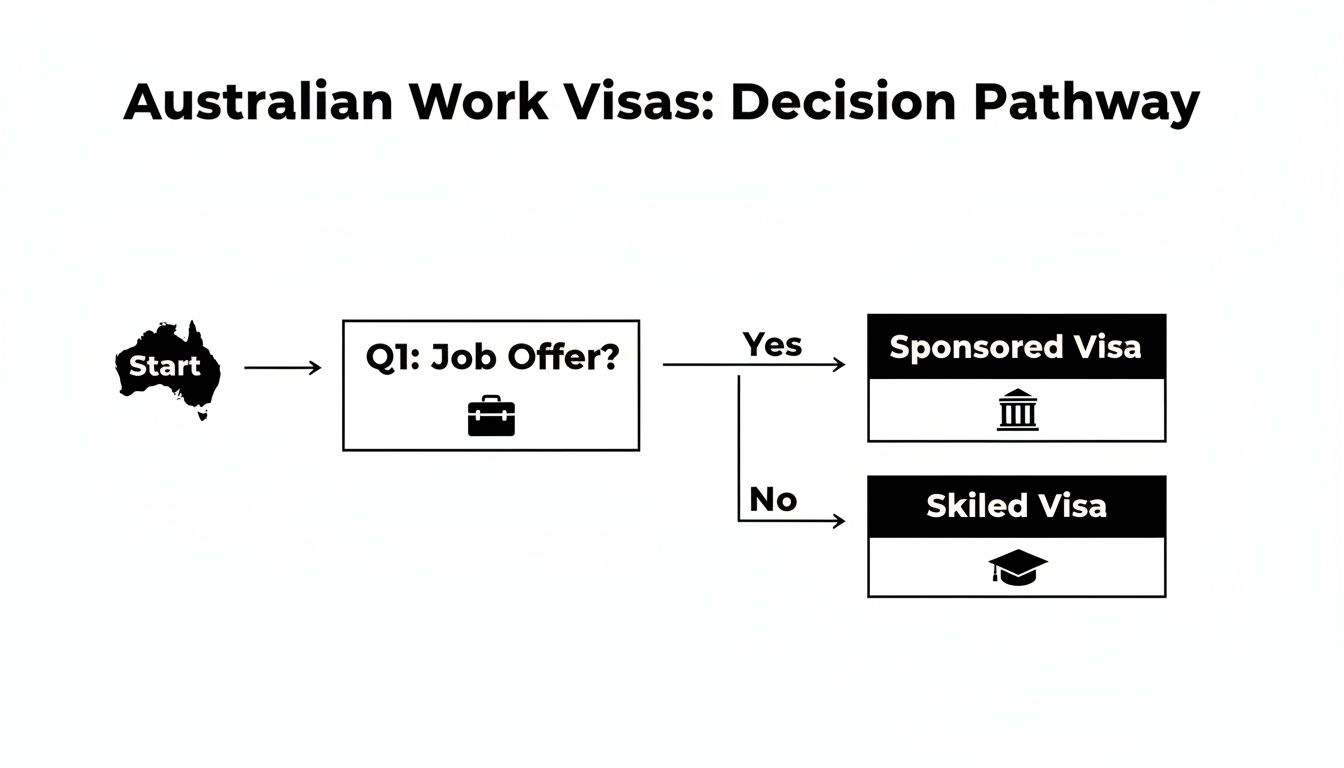
As you can see, if you've got an employer ready to back you, you'll head down the sponsored visa path. If not, you'll be looking at the skilled migration stream, where it's all about your own qualifications and experience.
And the demand for skilled workers? It’s massive. In fact, as of 30 September 2023, the number of temporary skilled visa holders in Australia hit a record 197,940. This isn't just a number; it's a clear signal that Australia is actively and enthusiastically welcoming skilled migrants.
To give you a clearer picture, here’s a quick breakdown of the main visa categories.
Australian Work Visa Categories at a Glance
| Visa Category | Primary Purpose | Typical Applicant |
|---|---|---|
| Employer-Sponsored | For businesses to fill skill shortages by sponsoring overseas workers. | A skilled professional with a job offer from an Australian company. |
| Skilled Migration | For skilled individuals who can pass a points test without needing a sponsor. | An expert in an occupation on Australia's skilled occupation list. |
| Graduate & Student | To allow recent graduates to gain work experience or students to work part-time. | An international student who has completed an Australian qualification. |
| Working Holiday | A cultural exchange program for young people to travel and work short-term. | A young person (18-30/35) from an eligible country wanting to travel. |
| Business & Investor | For entrepreneurs and investors to establish or manage a business in Australia. | An experienced business owner or high-net-worth investor. |
This table helps map out the main roads, but remember, each category has multiple specific visa subclasses, each with its own set of rules.
Key Requirements to Keep in Mind
No matter which visa you apply for, some requirements are non-negotiable. Everyone has to meet certain health and character standards. This means you’ll need to prove your medical fitness for work and provide police clearance certificates from any country you've lived in for a significant period.
Disclaimer: Immigration law and visa policies are subject to frequent changes. The information in this article is for general guidance only and may not be current when you read it. For the most accurate and personalised advice, we strongly recommend booking an appointment with a registered migration agent. All official government visa application charges can be found on the Department of Home Affairs website at https://www.homeaffairs.gov.au/.
Employer-Sponsored Visas: The Direct Path to a Job
For a lot of skilled professionals, the most straightforward way to start working in Australia is by getting a job offer first. This route is called employer sponsorship, and it’s exactly what it sounds like: an Australian business nominates you to fill a role they haven’t been able to fill locally. It’s a hugely popular pathway because it gives you a clear, structured way into the country with a job locked in from day one.
The cornerstone of the whole system right now is the Temporary Skill Shortage (TSS) visa (Subclass 482). The best way to think of the TSS is as a multi-lane highway. It’s designed to bring skilled people into Australia for a defined period, and the specific lane you travel in depends on your occupation. That lane dictates how long you can stay and, crucially, whether your journey can eventually lead to permanent residency.
The Three Lanes of the TSS Visa Highway
The TSS visa isn't a one-size-fits-all deal. It's split into different streams to meet specific economic needs, and figuring out which one applies to you is the first step.
The Short-Term Stream: This lane is for jobs on the Short-term Skilled Occupation List (STSOL). It typically lets you stay for up to two years, with the possibility of another two-year extension. For a long time, this stream was a dead end for permanent residency, but some recent policy shifts have started to open that door.
The Medium-Term Stream: If your occupation is on the Medium and Long-term Strategic Skills List (MLTSSL), this is your lane. It’s a more direct route, offering a visa for up to four years and a well-trodden path to permanent residency after you've worked for your employer for a few years.
The Labour Agreement Stream: Think of this as a special, custom-built lane. It's for employers who've negotiated a unique deal with the government to bring in workers with skills that aren’t on the standard occupation lists.
It's worth noting that big changes are on the horizon. The government is phasing out the TSS visa and bringing in a new Skills in Demand (SID) visa. This new visa will also have different pathways, including a Specialist Skills Pathway for very high earners. The goal is to make the system more responsive for everyone involved. For a full rundown of what's available now, you can dive deeper into employer sponsorship pathways on our site.
Bridging to Permanence: The Employer Nomination Scheme
While the TSS visa is temporary, it’s often the bridge to a permanent future in Australia. The main vehicle for making that jump is the Employer Nomination Scheme (ENS) visa (Subclass 186). The ENS is a permanent visa that lets skilled workers, nominated by their employer, live and work in Australia for good.
The most common way people get an ENS visa is through the Temporary Residence Transition (TRT) stream. This is designed specifically for TSS visa holders who have been with their sponsoring employer in the same role for a set period, usually two or three years.
This is where the good news comes in. Recent changes have made the TRT stream much more accessible. The government has cut down the required work period with the sponsor and opened up eligibility to nearly all TSS visa holders, including those in the Short-Term stream. This is a massive development, creating a clear PR pathway for thousands of skilled workers who previously didn't have one.
This policy shift is a big nod to the contribution that sponsored workers make to the Australian economy, offering them much-needed certainty about their future.
Comparing Key Employer-Sponsored Visas
To help you see the bigger picture, it’s useful to compare these visas side-by-side. The TSS is your entry ticket, while the ENS is the final destination.
| Feature | TSS/SID Visa (e.g., Subclass 482) | ENS Visa (Subclass 186) |
|---|---|---|
| Visa Type | Temporary | Permanent |
| Primary Requirement | Sponsorship from an approved Australian employer. | Nomination from an employer for a permanent position. |
| Length of Stay | Up to 4 years, depending on the stream and occupation. | Indefinite (Permanent Resident). |
| Path to PR | Acts as a direct pathway, especially via the TRT stream. | Is a permanent residency visa itself. |
| Typical User | A skilled worker with a job offer to fill a temporary skill shortage. | A TSS visa holder transitioning to permanent residency with their employer. |
At the end of the day, employer-sponsored visas to work in Australia provide a solid, reliable pathway for anyone who has skills in demand and a job offer on the table. They offer security for you and a vital solution for Australian businesses that need to fill critical roles.
Disclaimer: Immigration law and visa policies are subject to frequent changes. The information in this article is for general guidance only and may not be current when you read it. For the most accurate and personalised advice, we strongly recommend booking an appointment with a registered migration agent. All official government visa application charges can be found on the Department of Home Affairs website at https://www.homeaffairs.gov.au/.
Skilled Migration: Your Expertise Is Your Ticket
What if you have the skills Australia desperately needs, but you don't have a job offer lined up? This is exactly where the skilled migration pathway comes in. It’s a powerful set of visas to work in Australia, built for talented professionals whose expertise is in high demand.
Instead of being tied to an employer, this route is all about you. Your qualifications, your work experience, and your English language skills become your biggest assets. The whole system is built around a points test—think of it as a scorecard where you rack up points for different personal and professional attributes to prove you're the right fit for Australia's economy.

If you've got the right credentials, this pathway is a direct invitation from the Australian government to come and contribute your talents.
Demystifying the Points System
The points-based system is the engine driving skilled migration. It’s the government's way of objectively selecting the best and brightest candidates from a global pool of talent. You earn points for various factors, and your total score determines your ranking against other hopeful migrants.
The key scoring factors include:
- Age: You’ll score the most points if you’re between 25 and 32 years old.
- English Language Proficiency: A higher score on a test like IELTS or PTE directly translates to more points.
- Skilled Employment Experience: Points are awarded for relevant work experience in your nominated occupation, whether it was in Australia or overseas. The more years you have under your belt, the more points you get.
- Educational Qualifications: Your level of education, from a diploma right up to a PhD, contributes significantly to your score.
- Australian Study: If you’ve already completed a degree, diploma, or trade qualification in Australia, you can claim some valuable extra points.
Other things, like having a skilled partner or completing a Professional Year program, can also give your total a handy boost. While the official pass mark to be eligible is 65 points, the reality is that for most popular occupations, the competition is so high that you'll need a much higher score to actually receive an invitation.
Navigating Your Skilled Visa Options
Once you have a rough idea of your points score, you can start looking at the main skilled visa subclasses. Each one is a little different, but they all run on the same points-based foundation.
Skilled Independent Visa (Subclass 189)
This is the one everyone wants. The Subclass 189 is a permanent visa that lets you live and work anywhere in Australia, completely independent of any employer or state government sponsorship. Because of this freedom, it's incredibly competitive, and you'll almost certainly need a very high points score to get an invitation.
Skilled Nominated Visa (Subclass 190)
The Subclass 190 is also a permanent visa, but with a twist: you need a nomination from a specific Australian state or territory government. Every state has its own list of in-demand jobs and unique criteria. The good news? Securing a nomination instantly adds 5 points to your total score, which can be the difference-maker. The trade-off is that you're generally expected to live and work in that state for at least your first two years in Australia.
Skilled Work Regional (Provisional) Visa (Subclass 491)
This visa is all about encouraging skilled workers to settle in regional Australia (which is basically everywhere outside of Sydney, Melbourne, and Brisbane). To get it, you need a nomination from a state or territory, or sponsorship from an eligible family member who lives in a designated regional area. A successful nomination gives you a massive 15 bonus points. The Subclass 491 is a provisional visa that's valid for five years, and you must live and work in a regional area during that time. After meeting these requirements for three years, you'll have a clear pathway to a permanent visa.
The Crucial First Step: The Expression of Interest (EOI)
You can't just apply for these visas directly. The mandatory first step is submitting an Expression of Interest (EOI) through the government's SkillSelect portal. An EOI isn't a visa application; it's more like your professional profile, where you lay out all your claims for points based on your age, skills, and experience.
Submitting an EOI places you into a pool with other candidates. The government then holds regular "invitation rounds," picking the highest-ranking people from the pool and officially inviting them to apply for the visa. Your EOI will stay active in the pool for up to two years.
This process ensures Australia invites only the candidates who meet the specific, immediate needs of the economy. If this sounds like the path for you, getting a detailed points assessment is the absolute best place to start. For a deeper dive, check out our guide on skilled migration visas.
Disclaimer: Immigration law and visa policies are subject to frequent changes. The information in this article is for general guidance only and may not be current when you read it. For the most accurate and personalised advice, we strongly recommend booking an appointment with a registered migration agent. For the latest government fees, please always refer to the official Department of Home Affairs website at https://www.homeaffairs.gov.au/.
Niche Visas for Graduates, Travellers, and Entrepreneurs
Beyond the main highways of employer sponsorship and skilled migration, Australia has a few really interesting side roads. These are specialised visas designed for very specific groups: recent graduates, young globetrotters, and business-minded individuals looking for visas to work in Australia. They often act as fantastic entry points that can blossom into long-term careers.
These pathways exist because Australian immigration understands that not everyone fits neatly into a standard skilled worker box. They’re built to attract dynamic people who enrich the country's economy and culture, whether that’s by picking fruit for a season or launching the next big startup.
The Temporary Graduate Visa: Your Bridge from Study to Career
If you've just finished your degree in Australia, the Temporary Graduate visa (Subclass 485) is your golden ticket. Think of it as a bridge connecting your student life to your professional one. It grants you full, unrestricted work rights for a set period, giving you the crucial time you need to find your feet and gain that all-important Australian work experience.
This visa is split into two main flavours:
- Post-Study Work Stream: This one’s for graduates who’ve completed a Bachelor, Masters, or PhD here. Depending on your qualification, you could get anywhere from two to four years of work rights.
- Graduate Work Stream: This stream is tailored for graduates whose qualifications and skills line up with a specific occupation on the skilled occupation list. It typically grants a visa for up to 18 months.
Honestly, this visa is a game-changer. The local experience you can rack up during this time massively boosts your chances of qualifying for a permanent skilled visa later on. We dive much deeper into this in our guide on post-study pathways in Australia.
The Working Holiday Maker Program: An Aussie Rite of Passage
Australia’s Working Holiday Maker (WHM) program is legendary, and for good reason. It’s a brilliant cultural exchange that lets young people fund an epic adventure by working short-term jobs. It's so much more than a holiday—it’s an immersive experience that helps travellers and supports key Australian industries like tourism and agriculture.
There are two different visas under the WHM banner, and which one you apply for is all about your passport:
- Working Holiday Visa (Subclass 417): This is for passport holders from places like the UK, Canada, Germany, and Japan.
- Work and Holiday Visa (Subclass 462): This one is for citizens of countries including the USA, China, Spain, and Argentina.
Both visas give you an initial 12 months to live and work in Australia, with a rule that you can’t stay with one employer for more than six months. The really cool part? You can earn a second or even a third year on your visa by doing a few months of specified work in regional Australia, which often means an unforgettable stint in farming or hospitality.
The WHM program is more than just a visa; it’s a rite of passage for countless young travellers. It’s about gaining independence, making mates for life, and seeing the real Australia while earning your way.
Student Visa Work Rights: Earning While You're Learning
You don’t have to wait until you graduate to get a taste of the Australian workforce. If you’re here on a Student visa (Subclass 500), you have built-in permission to work. It's a fantastic way to gain experience, sharpen your English, and help cover your living costs. But, and this is a big but, there are strict rules.
Students can typically work up to 48 hours per fortnight while their course is in session. During scheduled holidays, like the big summer break, you can work unlimited hours. Sticking to these limits is non-negotiable—breaching your work conditions is one of the fastest ways to get your visa into serious trouble.
Visas for the Business-Minded: Owners and Investors
Finally, for the entrepreneurs and investors out there, Australia has dedicated pathways. These visas are for people with the capital and drive to start a new business or manage an existing one down under. The most common starting block is the Business Innovation and Investment (Provisional) visa (Subclass 188).
This visa has a few different streams, but two of the most popular are:
- Business Innovation stream: For experienced business owners who want to set up and run a new or existing business in Australia.
- Investor stream: For individuals prepared to make a designated investment of at least AUD $2.5 million into a compliant Australian investment fund.
These visas start as temporary, but they offer a clear line of sight to permanent residency once you’ve hit certain business or investment targets. It's a key part of how Australia attracts global talent and investment to keep its economy thriving.
Disclaimer: Immigration law and visa policies are subject to frequent changes. The information in this article is for general guidance only and may not be current when you read it. For the most accurate and personalised advice, we strongly recommend booking an appointment with a registered migration agent. For the latest government fees, please always refer to the official Department of Home Affairs website at https://www.homeaffairs.gov.au/.
The Visa Application Process: A Step-by-Step Guide
Figuring out which visa might work for you is a huge milestone, but the journey has really just begun. Now comes the application itself—a process that can feel pretty overwhelming at first.
Think of it like putting together a complicated piece of flat-pack furniture. Each screw, dowel, and panel needs to be in the right place for the final product to be sturdy and functional. Miss a step, and the whole thing could fall apart.
This is your instruction manual. We'll walk through the core requirements that underpin nearly every work visa application, helping you get your documents in order and understand what’s coming next.
The Non-Negotiables: Your Application Checklist
No matter which visa you’re aiming for—sponsored, skilled, or graduate—the Australian government needs to confirm two fundamental things about you: that you’re healthy and that you’re of good character. These are the absolute bedrock of the entire visa system.
Almost every applicant will need to provide:
- Health Examinations: These are standard medicals, usually involving a physical check-up, a chest x-ray, and sometimes blood tests. You have to see a specific panel physician approved by the Department of Home Affairs. The whole point is to make sure you don’t present a public health risk.
- Character Assessments: This is mainly about getting police clearance certificates from every country you’ve lived in for 12 months or more over the last 10 years (since you turned 16). It’s how you show you meet Australia's character test.
- English Language Tests: For the vast majority of skilled and sponsored visas, you’ll need to prove your English skills. This is typically done with a recognised test like IELTS, PTE Academic, or TOEFL iBT.
A word of advice? Get onto these early. Sourcing police certificates from overseas can sometimes take weeks, if not months, so it’s a smart move to start the process as soon as you can.
What Does the Application Journey Actually Look Like?
While everyone's path is a little different, most applications follow a predictable sequence. Knowing the key milestones helps you manage your own expectations and keeps things from stalling.
Here’s a common timeline:
- Skills Assessment or Sponsorship: For skilled visas, the first real step is getting a positive skills assessment. If you're going the sponsored route, this is when your employer lodges their nomination application for you.
- Expression of Interest (EOI): This is purely for skilled visas. You submit a profile into the SkillSelect system, outlining your skills, experience, and points claim.
- Invitation to Apply (ITA): If your EOI is competitive enough, the government sends you an official invitation to apply for the visa. You can’t apply without one.
- Visa Lodgement: This is the big one. You fill out the official forms, upload all your supporting documents, and pay the visa application charge.
- Biometrics and Health Checks: After lodging, you'll usually be asked to provide fingerprints and a photo at a collection centre and get your medical exams done.
- The Waiting Game: Honestly, this is often the hardest part. The Department of Home Affairs processes your application, and you wait. Processing times can be anything from a few months to over a year, depending on the visa.
Disclaimer: Immigration law is constantly changing. The information here is for general guidance and might not be current by the time you read it. For advice that's tailored to your specific situation, we always recommend booking an appointment with a registered migration agent. Always refer to https://www.homeaffairs.gov.au/ for any department fees for any visa.
Budgeting for Your Visa: Costs and Timelines
The financial side of a visa application is a huge part of the planning. The government fees, known as the Visa Application Charge (VAC), can vary wildly. A Working Holiday visa might set you back a few hundred dollars, whereas a permanent skilled visa can cost several thousand.
These fees often increase without warning, typically at the start of the Australian financial year on July 1st. So it’s absolutely critical to check the official source for the latest figures before you lodge.
The only place to get the real numbers is the Department of Home Affairs website. This is the single source of truth for the latest government fees. Similarly, the Department publishes its global visa processing times, which will give you a realistic idea of how long you might be waiting for that final decision.
Where to From Here? Planning Your Next Steps
Figuring out the right visa to work in Australia is a big deal. Whether you’re looking at sponsored jobs, skilled migration, or something in between, it’s a journey. The Australian visa system is one of the most powerful in the world, but it’s also notoriously complex and always changing. This is where getting some professional guidance can make all the difference.
Maybe you're a skilled professional trying to calculate your points, a recent graduate looking to switch from a student visa, or an employer hoping to bring in overseas talent. Whatever your situation, having an expert in your corner helps demystify the whole process. A MARA-registered agent doesn't just fill out forms; they offer personalised eligibility checks and strategic advice tailored to you.
Why Professional Advice is Worth Its Weight in Gold
A seasoned agent knows the common pitfalls and helps you put together a ‘decision-ready’ application. This seriously cuts down the risk of simple mistakes that can lead to frustrating delays or, worse, a refusal. They’re also completely on top of legislative changes, which means your strategy is always based on the most current rules, not last year's.
For a bit of real-world perspective on what life and work are actually like Down Under, it’s worth reading an expat interview about living in the Australian Outback. Hearing these firsthand stories can add some valuable colour to your planning and help you prepare for the reality of your new life.
Disclaimer: Immigration law and visa policies can and do change frequently. The information in this article is for general guidance only and might not be current by the time you read it. For the most accurate and personalised advice, we strongly recommend booking an appointment with a registered migration agent. All official government visa application charges can be found on the Department of Home Affairs website at https://www.homeaffairs.gov.au/.
At the end of the day, investing in expert advice is about ensuring you get the most up-to-date and accurate information for your specific journey. It's a step that can genuinely make or break your chances of a successful outcome.
Frequently Asked Questions
When you're digging into the world of Australian work visas, a million little questions can pop up. Let's tackle some of the most common ones we hear every day.
Can I Include My Family on My Australian Work Visa Application?
Absolutely. For most work visas, both temporary and permanent, you can include your partner and any dependent children in your application.
Key visas like the Subclass 482 (TSS), 186 (ENS), and the skilled migration visas (189, 190, 491) are all designed to accommodate family units. They'll be considered 'secondary applicants'. Just be aware that every single family member, including the little ones, will need to pass the standard health and character checks.
A word of advice: always declare all your family members on the application, even if they aren't planning to move with you right away. It keeps your options open down the track.
What Is a Skills Assessment and Do I Need One?
Think of a skills assessment as an official stamp of approval. It’s a process where a designated Australian authority checks your qualifications and work experience to confirm they meet the local standard for your profession.
This is a non-negotiable first step for most skilled migration pathways. If you're eyeing the 189, 190, or 491 visas, you’ll need one. It's also required for the Direct Entry stream of the employer-sponsored Subclass 186 visa.
Different jobs have different gatekeepers. For example, IT professionals get assessed by the Australian Computer Society (ACS), while VETASSESS looks after a huge range of other professional and trade occupations. You can’t even lodge an Expression of Interest (EOI) without a positive skills assessment in your hands.
How Long Does It Take to Get a Work Visa for Australia?
This is the million-dollar question, and the honest answer is: it depends. The waiting time can vary wildly depending on the visa you're applying for, how many other people are in the queue, and how well you’ve prepared your application.
A Temporary Skill Shortage (TSS) 482 visa, for instance, might only take a few months. But the points-tested skilled visas can take much, much longer because they're competitive and you have to wait for an invitation to apply.
The Department of Home Affairs publishes global visa processing times on its website, which can give you a rough idea. The single best thing you can do to speed things up is to submit a "decision-ready" application—that means it's complete, accurate, and has all the evidence needed from day one.
Disclaimer: Australian immigration law is always changing. This article is intended as general guidance and might not be up-to-date when you read it. For advice that’s tailored to your specific situation, we strongly recommend booking a chat with a registered migration agent. All official government fees can be found on the Department of Home Affairs website.
The Australian visa system is a maze, but you don't have to find your way through it alone. My Visa Guide offers expert, end-to-end support to make sure your application is spot-on and has the best possible chance of success. Book your consultation today and start your journey with confidence.