So, you’ve tossed your graduation cap in the air, finished your final exams, and are now looking at what comes next. For many international students, this is where the Temporary Graduate visa (subclass 485) comes into play. It's not just another visa; it's your ticket to stay in Australia after your studies to live, study, and, most importantly, get some real-world work experience under your belt.
This visa is designed to be the stepping stone from your life as a student to becoming a skilled professional within the Australian workforce.
Your Bridge from Student to Professional in Australia
Think of the Subclass 485 visa as the crucial bridge connecting your hard-earned Australian qualification to a professional career. For countless graduates, this visa is the most logical and essential next step. It gives you the breathing room to find your feet, put your new skills to the test in a local workplace, build a professional network, and even start exploring pathways to permanent residency.
But it’s not a one-size-fits-all deal. The 485 visa is split into two main streams, each tailored for different types of qualifications. Getting your head around which one fits your situation is the very first, and most important, piece of the puzzle.

Understanding the Two Main Visa Streams
From the get-go, you need to know which of the two main Subclass 485 pathways you're aiming for:
- The Post-Study Work stream: This is the most common path for international students who've just graduated with a degree—think a bachelor's, master's, or PhD—from an Australian university.
- The Graduate Work stream: This one is generally for graduates whose skills and qualifications are directly related to a specific occupation on Australia’s skilled occupation list.
The stream you qualify for depends entirely on what you studied and the level of your qualification. This decision will directly shape how long you can stay and the specific requirements you’ll have to meet, so it’s a critical choice to get right.
Disclaimer: Migration laws are subject to frequent change. The information in this article is for general guidance only and may no longer be accurate at the time you are reading it. To receive the most current and personalised advice for your situation, it is essential to book an appointment with a registered migration agent.
Preparing for Your Journey
Applying for a temporary graduate visa subclass 485 is your chance to put everything you learned into practice. The experience you gain during this time is invaluable for your future, whether you decide to stay in Australia or head elsewhere. To really make the most of it, you might want to look into the growing number of remote job opportunities in Australia that could be a perfect match for your skills.
This guide will walk you through what's required, but always double-check official government fees. For any department fees for any visa, always refer to https://www.homeaffairs.gov.au/.
Choosing Your Subclass 485 Visa Stream
So, you’ve finished your studies in Australia—congratulations! Now comes the next big step: choosing the right stream for your Temporary Graduate Visa (Subclass 485). Think of this as the first crucial decision in your post-graduation journey. It’s a bit like standing at a fork in the road; both paths lead toward your professional career in Australia, but they’re designed for different travellers and have very different requirements.
Getting this choice right is fundamental. It will directly impact how long your visa lasts and exactly what evidence you’ll need to pull together for your application.
The 485 visa is split into two main pathways: the Post-Study Work stream and the Graduate Work stream. This isn't a choice you get to make based on preference—it’s dictated entirely by the qualification you just spent years earning. One is built for university graduates with higher education degrees, while the other is tailored for those with vocational qualifications tied to specific in-demand jobs.
The Post-Study Work Stream
This is the go-to option for the vast majority of international students who've just wrapped up a university degree. If you’ve recently graduated with a Bachelor, Masters, or PhD from an Australian institution, this is almost certainly your path.
What makes this stream so popular is its flexibility. The Department doesn’t care what you studied; your degree doesn't need to link to a particular skilled occupation list. The focus here is purely on the level of your qualification. This frees you up to explore all sorts of career opportunities across various industries without being tied to a specific job title.
The length of the visa you get under this stream is directly tied to the degree you completed:
- Bachelor Degree: Typically lets you stay and work for up to 2 years.
- Masters Degree: Usually grants a stay of up to 3 years.
- Doctoral Degree (PhD): Can provide a visa for up to 4 years.
The Graduate Work Stream
The Graduate Work stream, on the other hand, is a much more specialised route. It’s designed for international students whose skills and qualifications are directly relevant to an occupation Australia has identified as being in need. This is the stream for those who’ve typically completed a diploma or a trade qualification.
Unlike its university-focused counterpart, this pathway comes with a couple of extra hurdles. First, your qualification must be closely related to a job on the Medium and Long-term Strategic Skills List (MLTSSL). You can’t just pick any occupation; it has to be on that specific list.
Second, you’ll need to get a positive skills assessment from the relevant authority for your nominated occupation. This is basically an official check to confirm your skills are up to the standard required for that job in Australia. For many graduates heading down this path, structured training can be a game-changer. You can learn more about how Professional Year Programs can seriously boost your skills and job prospects.
Disclaimer: Migration laws are subject to frequent change. The information in this article is for general guidance only and may no longer be accurate at the time you are reading it. To receive the most current and personalised advice for your situation, it is essential to book an appointment with a registered migration agent.
To make things crystal clear, let's lay out the key differences side-by-side.
Subclass 485 Visa Streams at a Glance
This table breaks down the core distinctions between the two streams to help you quickly identify which one fits your situation.
| Feature | Post-Study Work Stream | Graduate Work Stream |
|---|---|---|
| Eligible Qualification | Bachelor, Masters, or PhD Degree | Diploma, trade qualification, or degree |
| Occupation List | Not required | Must nominate an occupation on the MLTSSL |
| Skills Assessment | Not required | A positive skills assessment is mandatory |
| Typical Visa Length | 2 to 4 years, based on qualification | Up to 18 months |
As you can see, your Australian qualification is the key that unlocks one door or the other. Nailing this choice from the get-go means you’ll be on the right track, gathering the correct documents, and smoothly transitioning into the next chapter of gaining valuable Australian work experience. For any department fees for any visa, always refer to https://www.homeaffairs.gov.au/.
Meeting the Core Eligibility Requirements
So, you've figured out which 485 visa stream is the right fit for you. Excellent. Now comes the nitty-gritty part: making sure you tick all the non-negotiable boxes that apply to every single applicant.
Think of these as the absolute foundations of your application. Get one wrong, and the whole thing can come tumbling down. Nailing these core requirements from the get-go is the key to a stress-free process. It's how the Department of Home Affairs confirms you have a genuine link to Australia through your studies and meet their baseline standards.
Let’s walk through each one so you know exactly where you stand.
The Australian Study Requirement
This is the big one. You can't just wave any old Australian certificate and expect it to work; you must satisfy what's known as the Australian Study Requirement (ASR). At its heart, this means the course (or courses) you completed was registered on the Commonwealth Register of Institutions and Courses for Overseas Students (CRICOS).
But it goes a bit deeper than that. The ASR has two critical components you must meet:
- Duration: Your CRICOS-registered course had to be at least two academic years long. In visa terms, this translates to a minimum of 92 weeks of study.
- Physical Presence: You needed to be physically in Australia to complete this study, and it had to take place over a minimum of 16 calendar months. You also had to hold a valid visa that allowed you to study.
A quick heads-up: if you received credits for studies you did back home, those generally don't count towards the 92-week requirement. The Department is focused purely on the study you undertook in Australia.
The qualification you earn—whether it's a university degree or a vocational diploma—is what points you to the correct visa stream. This flowchart breaks it down nicely.
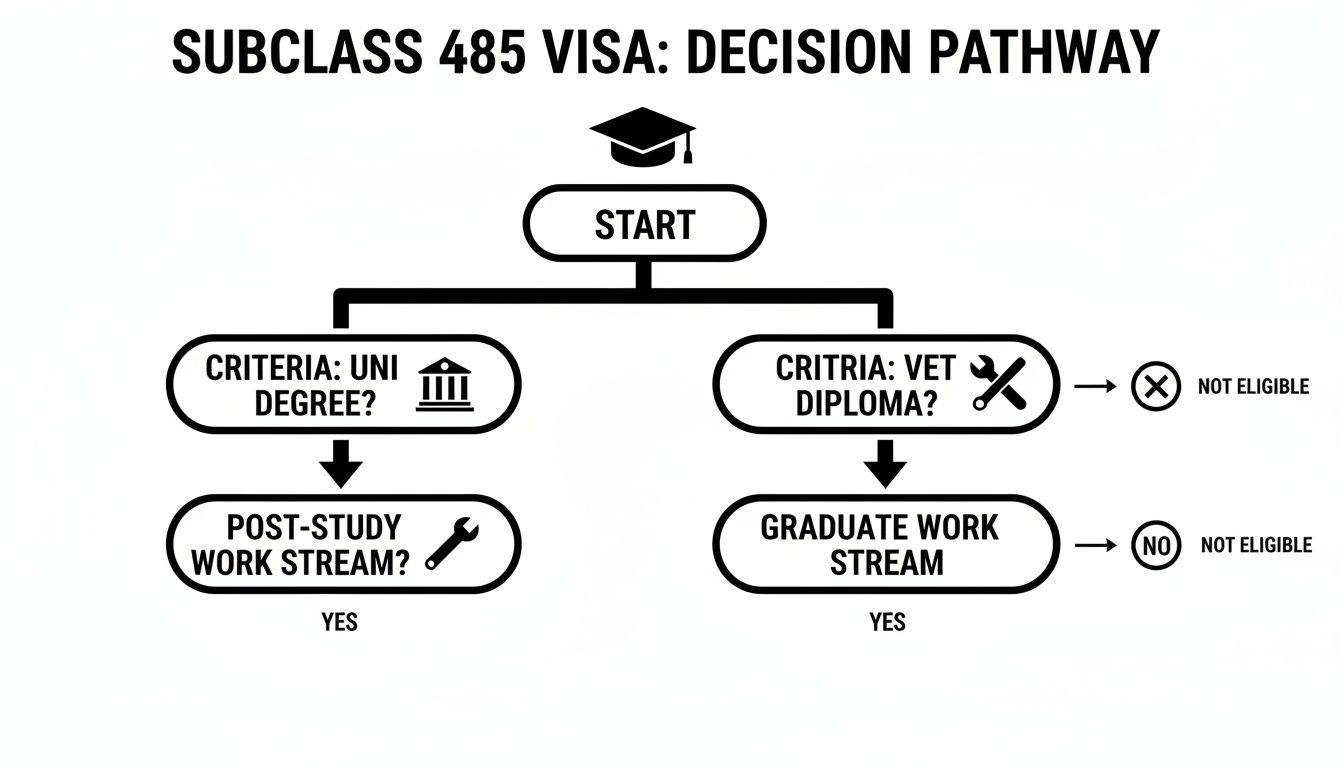
As you can see, your educational path is the first and most important factor in deciding which 485 visa is for you.
Critical Timelines and Age Limits
With the 485 visa, timing is absolutely everything. You have a very specific window to apply: within six months of your official course completion date. Be careful here—this isn't your graduation ceremony date. It's the date your final results are officially released or you get that formal completion letter from your university or college. Miss that deadline, and your eligibility disappears.
There's also a hard age limit. You must be under the age of 50 on the day you lodge your application. No ifs, ands, or buts. This is a strict rule with no room for negotiation, so it’s a vital checkpoint for every applicant.
Disclaimer: Migration laws are subject to frequent change. The information in this article is for general guidance only and may no longer be accurate at the time you are reading it. To receive the most current and personalised advice for your situation, it is essential to book an appointment with a registered migration agent.
English Language Proficiency
Next up, you need to prove you have a competent level of English. This means taking an approved English language test and hitting the minimum required score. The Department accepts a few different tests, but the most common ones are:
- IELTS (International English Language Testing System): An overall score of at least 6.0, with no individual band dipping below 5.0.
- PTE Academic (Pearson Test of English): An overall score of at least 50, with no skill score (speaking, reading, listening, writing) under 36.
- TOEFL iBT (Test of English as a Foreign Language): A total score of at least 64, with minimums of 4 for listening, 4 for reading, 14 for writing, and 14 for speaking.
Your test results have to be valid when you apply, so it’s a smart move to book your test well in advance to avoid any last-minute panic.
Visa Status at Time of Application
Finally, your visa status when you hit 'submit' matters. You must be physically in Australia and holding either a valid substantive visa (like your Student visa) or a Bridging Visa A or B. For most people, this means applying while their Student visa (subclass 500) is still active.
This pathway is incredibly popular for a reason. Between early 2018 and the end of 2023, almost 98,000 Student visa holders applied for a Temporary Graduate visa, cementing its place as the go-to option after graduation. This shows just how vital the 485 visa is for international students looking to kick-start their careers in Australia.
Meeting these fundamental requirements, along with others like health and character, is the bedrock of a successful application. For a deeper dive, check out our guide on meeting health and character requirements for Australian visas.
Gathering Your Essential Documents
A strong temporary graduate visa subclass 485 application is really built on one thing: solid, correct evidence. Let's walk through exactly what you need to pull together to prove you’re eligible. Think of this as preparing the four pillars of your application: your health, character, skills, and insurance.
Getting this part right isn’t just about ticking boxes on a form. It's about presenting a clear, decision-ready application that gives the Department of Home Affairs no reason to slow things down. We’ll break down exactly what you need for each pillar, so you can gather everything with confidence and sidestep those common slip-ups that can stall the whole process.

Proving Your Health And Character
The Australian government needs to know that all visa applicants meet certain health and character standards. For your 485 visa, this boils down to two key steps you should get started on as early as you can.
First up is the health check. You'll likely need to book a medical examination with a panel physician approved by the Department. It's a pretty standard check-up just to make sure you meet Australia’s public health criteria. You can do this either before or after lodging your application, but from our experience, getting it done beforehand often helps speed things up.
Second is proving your good character. This means getting an Australian Federal Police (AFP) National Police Check. It is absolutely crucial that you apply for this check before you hit submit on your visa application. Why? Because you must provide the receipt or reference number at the time you lodge. The certificate itself also needs to be fresh—it can’t have been issued more than 12 months before you apply.
The Skills Assessment For Graduate Work Stream Applicants
Now, if you’re applying under the Graduate Work stream, there's an extra, non-negotiable step. You have to get a positive skills assessment for your nominated occupation from the right assessing authority.
This assessment is basically an independent body verifying that your qualifications and skills are up to Australian standards for your chosen profession. It’s not a general review; it’s specific to the occupation you’ve picked from the skilled occupation list.
Every occupation has its own designated assessing body. For example:
- Trades Recognition Australia (TRA) handles most trade qualifications.
- VETASSESS covers a huge range of general professional occupations.
- Engineers Australia looks after engineering professionals.
You must have at least applied for this skills assessment before you lodge your visa. Providing proof of this—like a receipt or a confirmation letter—is mandatory. A successful 485 application completely hinges on eventually getting that positive outcome.
Disclaimer: Migration laws are subject to frequent change. The information in this article is for general guidance only and may no longer be accurate at the time you are reading it. To receive the most current and personalised advice for your situation, it is essential to book an appointment with a registered migration agent.
Securing Adequate Health Insurance
Last but not least, every single applicant for the Subclass 485 visa (and any family members you include) must hold adequate health insurance for their entire stay in Australia. A common mistake is thinking your student cover (OSHC) is enough—it’s not. You need to switch to Overseas Visitor Health Cover (OVHC).
This is a strict, black-and-white requirement. You’ll need to provide proof you have this cover when you lodge your application. Dropping the ball and failing to maintain your OVHC while on the 485 visa can lead to a breach of your visa conditions, which is a situation you definitely want to avoid.
Before you submit, just remember that having the right health insurance is non-negotiable. Trying to figure out the options can be a bit tricky, but there are resources to help you make sense of it all. For instance, a good health insurance for international students guide can help clarify what's needed.
For any department fees for any visa, always refer to https://www.homeaffairs.gov.au/.
Navigating the Application Process
You’ve got all your documents organised and checked off the list. Now for the final hurdle: actually lodging your temporary graduate visa subclass 485 application. This is where precision is everything. Think of it as following a detailed roadmap—from hitting 'submit' to the nerve-wracking wait for a decision, every single step counts.
The whole show runs online through the Department of Home Affairs’ ImmiAccount portal. This is your command centre for filling out the form, uploading all your evidence, and paying the Visa Application Charge. Your best friend here is accuracy. A simple typo or a document uploaded to the wrong section can throw a real spanner in the works and cause major delays.
Lodging and Post-Submission Steps
Once you’ve triple-checked every last detail and finally submitted the application, your job isn't quite done. It's pretty common for the Department to ask for more information or for you to complete another step. Don't panic; this is a normal part of the process. You might get a request for:
- Biometrics Collection: This involves giving your fingerprints and having a photograph taken at an official centre, like an Australian Visa Application Centre (AVAC) or an Australian Biometrics Collection Centre (ABCC).
- Requests for Further Information (RFI): If your case officer needs a bit more clarity on something or is missing a document, they’ll send you a request directly through your ImmiAccount. It’s absolutely vital to respond to these requests as quickly as you can to keep things moving.
You need to stay on the ball here. Keep a close eye on your ImmiAccount and the email address you linked to it. Missing a request from the Department could mean they make a decision on your application without that crucial piece of info, and that often leads to a refusal.
Understanding Processing Times
"So, how long is this going to take?" It's the question on everyone's mind. The Department of Home Affairs does publish global processing times, which give you a rough idea, but they are by no means a guarantee. How long your specific application takes can be swayed by a few things:
- Application completeness: If you submit a "decision-ready" application with every single required document attached from day one, it’s generally going to be processed faster.
- Response times: How quickly you jump on any RFIs makes a huge difference.
- Complexity: If your case involves tricky health or character issues, expect it to take a bit longer for assessment.
- Application volume: Sometimes, it just comes down to the sheer number of applications the Department is wading through at any given time.
The visa landscape can also change pretty fast due to government policy shifts, which impacts how quickly applications are processed and even grant rates. We've seen this happen recently, with a much tougher approach to this visa. While grants for the 485 visa dropped by over 38% in 2022-23 compared to the year before, the number of people applying shot up, creating an incredibly competitive environment. You can dig into more of the data and get a feel for these trends on the changing landscape of the Temporary Graduate visa.
Disclaimer: Migration laws are subject to frequent change. The information in this article is for general guidance only and may no longer be accurate at the time you are reading it. To receive the most current and personalised advice for your situation, it is essential to book an appointment with a registered migration agent.
For the latest visa application charges, always go straight to the source: the official Department of Home Affairs website. A methodical, careful approach is what will empower you to submit your application with confidence, knowing you’ve put your best foot forward.
Turning Your 485 Visa Into a PR Pathway
Getting your Temporary Graduate visa (subclass 485) grant is a massive win, but it’s really the starting line, not the finish. For many, the real goal is to turn this temporary stay into a permanent future in Australia. Your focus should now pivot from simply holding the visa to using it as a strategic stepping stone toward permanent residency (PR).
Think of your 485 visa as a golden ticket. With full-time work rights, you finally have the chance to get the skilled Australian work experience that is so highly valued in PR applications. Every month you spend in a role that’s relevant to your studies adds serious weight to your profile and edges you closer to your goal.

Building a Strong PR Profile
Let's be clear: the competition for PR is intense. As of early 2025, there were a staggering 214,714 international graduates holding a Subclass 485 visa. That number absolutely dwarfs the permanent migration cap, which means not everyone will be able to make the jump.
This creates fierce competition for pathways like the Subclass 190 (Skilled Nominated) or Subclass 189 (Skilled Independent) visas. To stand out from the crowd, you need a solid plan. It's time to use your 485 visa to methodically build a profile that selectors can't ignore.
Here are the key areas to pour your energy into:
- Get Relevant Experience: Make it your top priority to find a job directly related to your nominated occupation. Even one year of skilled employment can give your points score a significant boost.
- Improve Your English Score: A 'Proficient' or 'Superior' English score can add up to 20 points to your application. Re-sitting that English test could be one of the best investments you make.
- Consider a Professional Year Program: If you're an IT, Accounting, or Engineering graduate, a Professional Year Program is a game-changer. It provides valuable workplace training and adds 5 crucial points to your profile.
Exploring State Nomination and Other Avenues
Beyond just clocking up work hours, you need to be actively researching state and territory nomination options. Every state has its own list of in-demand occupations and specific requirements for nominating skilled migrants for the Subclass 190 or Subclass 491 visas.
Don't forget that living and working in a regional area can also open up additional pathways and provide extra points. These strategies can dramatically improve your odds. For a detailed breakdown of your options after graduation, have a look at our guide on Australian post-study pathways.
Disclaimer: Migration laws are subject to frequent change. The information in this article is for general guidance only and may no longer be accurate at the time you are reading it. To receive the most current and personalised advice for your situation, it is essential to book an appointment with a registered migration agent.
By using your time on the 485 visa wisely, you can turn this temporary opportunity into a solid foundation for your Australian future.
Got Questions About the 485 Visa? We've Got Answers.
As you get closer to finishing your studies, the next big step—the Temporary Graduate visa (subclass 485)—can bring up a lot of practical questions. Let's tackle some of the most common ones we hear from graduates just like you.
Can I Include My Family on My 485 Visa?
Yes, absolutely. You can include your partner and any dependent children in your Subclass 485 application right from the start.
It's really important to add them when you first lodge your application. Trying to add family members after your visa has already been granted is often not possible and can get very complicated. Just remember, every family member will also need to meet the standard health and character checks.
Can I Travel Overseas While My 485 Application Is Being Processed?
This is a big one. When you apply for your 485 visa in Australia, you'll likely be put on a Bridging Visa A (BVA). This keeps you legally in the country while you wait for a decision. The catch? A BVA automatically cancels the moment you leave Australia.
If you need to travel overseas, you must apply for and be granted a Bridging Visa B (BVB) before you fly out. If you leave without a BVB, you won’t be able to get back into the country, which could put your entire 485 visa application at risk. Don't take the chance.
What Happens When My 485 Visa Is About to Expire?
Thinking ahead is key. Well before your 485 visa is due to expire, you should be planning your next move. What you can do next really hinges on the skills and work experience you’ve picked up while on your 485.
Some of the more common pathways people take include:
- Skilled Migration: If you can meet the points threshold and get an invitation, you might look at applying for a points-tested visa like the Subclass 189, 190, or 491.
- Employer Sponsorship: Finding an Australian employer willing to sponsor you is another great option, which could lead to a visa like the Subclass 482 or 186.
- Further Study: You could also decide to enrol in another course and apply for a new Student visa to gain more specialised qualifications.
Disclaimer: Migration laws are subject to frequent change. The information in this article is for general guidance only and may no longer be accurate at the time you are reading it. To receive the most current and personalised advice for your situation, it is essential to book an appointment with a registered migration agent. For any department fees for any visa, always refer to https://www.homeaffairs.gov.au/.
Navigating Australia's visa system can feel overwhelming, but you don't have to do it alone. At My Visa Guide, our registered migration agents are here to give you clear, honest, and strategic advice to help you reach your goals. Book your consultation today at https://www.myvisaguide.com.au.