
So, you’re wondering how long the wait is for a Subclass 186 visa. It’s the million-dollar question, and the honest answer is: it varies. A lot. We’ve seen some applications sail through in just a few months, while others can feel like they're stuck in limbo for over a year.
The biggest factors influencing your wait time are the specific stream you apply under and just how well-prepared your application is.
Disclaimer: Australian migration law and visa processing times are subject to change. The information provided in this article is for general guidance only and may not be true when you are reading it. For the most up-to-date information and personalised advice, it is essential to book an appointment with a registered migration agent. For any department fees for any visa, always refer to https://www.homeaffairs.gov.au/.
Getting a Handle on the Subclass 186 Visa Timeline
The Employer Nomination Scheme (ENS) visa, or Subclass 186, is a fantastic permanent residency pathway for skilled workers with a sponsoring Australian employer. But let’s be real, the waiting period can be a major source of stress. It’s not a single, fixed number on a calendar. Think of it more like a dynamic range that shifts based on a few key things.
Processing times are constantly in flux, influenced by the Department's current priorities, the sheer volume of applications they're dealing with, and, crucially, the quality of your submission. For example, there have been times when 90% of Direct Entry applications were finalised within 18 months. To really get a feel for your potential wait, you first need to understand the different pathways.
The Three Visa Streams
The Subclass 186 visa is split into three distinct streams, and each one marches to the beat of its own drum when it comes to processing times:
- Direct Entry (DE) Stream: This is for applicants who might not have worked for their employer in Australia before. It often involves a full skills assessment, which adds another layer to the process.
- Temporary Residence Transition (TRT) Stream: A popular pathway for temporary skilled visa holders (like those on a Subclass 482 or the old 457 visa) who have already been working for their nominating employer for a set period.
- Labour Agreement Stream: This one is for applicants sponsored by an employer who has a special, negotiated labour agreement directly with the Australian government.
The best starting point for a realistic estimate is the global visa processing times tool on the Department of Home Affairs website.

Here's a quick look at what those median processing times look like, based on the latest data from the Department.
Subclass 186 Visa Processing Time At a Glance
| Visa Stream | 50% of Applications Processed Within | 90% of Applications Processed Within |
|---|---|---|
| Direct Entry | 6 months | 12 months |
| Labour Agreement | 5 months | 11 months |
| Temporary Residence Transition | 4 months | 10 months |
As you can see, the TRT stream is currently moving the fastest, which makes sense as those applicants are already known to the system. The Direct Entry stream takes a bit longer, reflecting the extra checks and assessments involved. Remember, these numbers are a guide—your personal timeline could be shorter or longer.
You can dive deeper into these figures by exploring a more detailed analysis of statistics for the Employer Nomination Scheme.
Disclaimer: Australian migration law and visa processing times are subject to change. The information provided in this article is for general guidance only and may not be true when you are reading it. For the most up-to-date information and personalised advice, it is essential to book an appointment with a registered migration agent. For any department fees for any visa, always refer to https://www.homeaffairs.gov.au/.
How Each Visa Stream Impacts Your Timeline
The Subclass 186 visa isn't a one-size-fits-all pathway. It's more like a multi-lane highway, with each lane moving at a different speed. The stream your application falls into is the single biggest factor determining your journey and, ultimately, the subclass 186 processing time.
Your personal and work history dictate which lane you're in. Each stream is built for a different type of applicant, which directly affects the level of scrutiny from the Department of Home Affairs and, you guessed it, how long you'll be waiting for that final decision.

The Temporary Residence Transition (TRT) Stream: The Commuter Lane
Think of the Temporary Residence Transition (TRT) stream as the familiar commuter lane. It’s designed for skilled workers who are already here in Australia, typically on a Subclass 482 (or the old 457) visa, and have already been working for their nominating employer for a while.
Because these applicants are a known quantity to the immigration system, the journey is usually smoother. The Department already has a file on their employment history and compliance, which means fewer checks are needed. It's a pathway that rewards a proven track record with an Australian employer.
The latest government data backs this up. For the TRT stream, 50% of applications are finalised in 13 months, and 90% are done within 18 months. This provides a clear and reliable bridge to permanent residency for 482 visa holders who've already proven their value onshore. This established relationship just means there's less new information for a case officer to wade through, making the TRT one of the more predictable employer-sponsored pathways.
The Direct Entry (DE) Stream: The International Lane
The Direct Entry (DE) stream, on the other hand, is the international arrivals lane. This route is for applicants who might not have worked for their sponsoring employer in Australia before, or who simply don't meet the TRT stream criteria. As a result, the application process is a lot more intensive.
Imagine merging onto the highway from an overseas on-ramp. There are more toll booths and checkpoints to get through before you can get up to speed. For DE applicants, this means a few mandatory hurdles that can really stretch out the timeline.
These extra steps usually include:
- A formal skills assessment: An independent body has to verify that your skills and qualifications are up to Australian standards for your job. This process alone can take months.
- Deep-dive work experience checks: You'll need to provide rock-solid proof of at least three years of relevant, full-time work experience.
- Overseas police clearances: You have to get police certificates from every country you’ve lived in for 12 months or more over the last 10 years.
Each one of these adds another layer of complexity and paperwork, requiring meticulous preparation and contributing to a much longer wait compared to the TRT stream.
The Labour Agreement Stream: The Pre-Approved Express Lane
Finally, we have the Labour Agreement stream—the pre-approved express lane. This is a special pathway for skilled workers nominated by an employer who has hammered out a specific labour agreement with the Australian government. These agreements are usually for industries with critical, ongoing skill shortages that can't be filled locally.
Because the job requirements, skill levels, and even English language standards are all pre-negotiated in the agreement, the assessment for an individual application is often much faster. All the heavy lifting has already been done between the employer and the government.
Key Insight: The Labour Agreement stream often boasts the fastest subclass 186 processing times because the framework for nominating people is already in place. The main focus is just on checking if the individual applicant fits the pre-agreed criteria.
This makes it an incredibly efficient route, but it's also the rarest. Access is limited only to those employers who have gone through the long process of getting one of these agreements approved.
Disclaimer: Australian migration law and visa processing times are subject to change. The information provided in this article is for general guidance only and may not be true when you are reading it. For the most up-to-date information and personalised advice, it is essential to book an appointment with a registered migration agent. For any department fees for any visa, always refer to https://www.homeaffairs.gov.au/.
The Hidden Factors That Speed Up or Slow Down Your Visa
When you look at the government's published processing times, you're only seeing part of the story. The real-world subclass 186 processing time for your application is a mix of things you can influence and things you absolutely can't. Knowing what they are is the key to setting your expectations and giving your application the best possible shot.
Think of it like this: your application is a boat, and you want to get it down the river as quickly as possible. How well you build that boat (your application quality) matters a lot, but so does the river's current (external departmental pressures).
Your journey is really shaped by three players: you, your employer, and the Department of Home Affairs. Let’s break down what each one brings to the table.
What You Can Control as the Applicant
This is where you have the most power. A clean, comprehensive, and well-organised application can sail through the system, while a messy one gets stuck in the weeds.
-
Aim for a 'Decision-Ready' Application: This is the gold standard. A decision-ready file gives the case officer everything they need, right from the start. All the evidence is there, it’s clearly labelled, and it leaves no room for questions. Get this right, and you avoid a Request for Information (RFI), which is an instant application-killer for momentum.
-
Jump on RFIs Immediately: If you do get an RFI, treat it like an emergency. The clock on your application literally stops the second they send that request, and it doesn't start again until you’ve given them a complete answer. A slow or half-baked response can easily add weeks, if not months, to your wait.
-
Get Your Health and Character Checks Done Early: Many people wait to be asked, but getting your medicals and police clearances sorted out ahead of time is a pro move. Having them ready to go means you can upload them the moment they’re requested, cutting out one of the most common delays right at the end of the process.
The Employer's Crucial Role
Your sponsoring employer isn't just signing a form; their reputation and the quality of their nomination paperwork directly affect your visa timeline. A strong nomination from a trusted business gives the Department confidence.
The single biggest advantage here is if your employer is an Accredited Sponsor. This is a special status the Department gives to businesses with a proven track record of sponsoring overseas workers without any issues.
Applications lodged by Accredited Sponsors get priority processing. This is a big deal. It means both the nomination and your visa application are essentially moved to the front of the queue, often leading to a much faster outcome than a standard application.
Beyond accreditation, the nomination itself has to be solid. Your employer needs to prove the job is genuine, that the business truly needs you, and that the salary and conditions are all above board. A weak or poorly documented nomination is a red flag that will trigger extra scrutiny and slow everything down.
External Factors Beyond Your Control
And then there’s the stuff that’s completely out of your hands. These are the big-picture issues that can affect every single application, no matter how perfect it is.
These external pressures include:
- Government Processing Priorities: From time to time, the government will tell the Department of Home Affairs to focus on certain occupations. If you’re a nurse or a tech specialist and those skills are in demand, your file might get picked up faster. If not, you wait your turn.
- Overall Application Backlogs: Sometimes, the system is just swamped. A huge surge in applications means every case officer has a bigger pile on their desk, and that naturally leads to longer waits for everyone.
- Departmental Policy Shifts: A sudden change in migration policy or an internal processing tweak can also throw timelines out the window with no warning.
You can't do anything about these factors, but just knowing they exist helps explain why your subclass 186 processing time might not match the official averages. By focusing on what you can control—a perfect application and a diligent employer—you give yourself the best possible chance of a smooth run.
Disclaimer: Australian migration law and visa processing times are subject to change. The information provided in this article is for general guidance only and may not be true when you are reading it. For the most up-to-date information and personalised advice, it is essential to book an appointment with a registered migration agent. For any department fees for any visa, always refer to https://www.homeaffairs.gov.au/.
How to Build a Decision Ready Application
In the world of visa applications, the waiting is always the hardest part. While a lot of things that affect the subclass 186 processing time are out of your hands, the single best thing you can do is lodge what we call a 'decision-ready' application.
So, what does that mean? It means putting together a file so complete, so clear, and so well-documented that a case officer can pick it up, see that everything is in order, and approve it—ideally without ever needing to ask you for a single extra piece of paper.
Think of it like giving the case officer a pre-packaged kit. If all the parts are there and neatly organised with clear instructions, they can build it and sign it off in one go. But if pieces are missing or the information doesn't line up, they have to hit pause, send out a Request for Information (RFI), and stick your file on a shelf. That simple act can instantly add weeks, or even months, to your wait time.
The Nomination Stage Checklist
It all kicks off with your employer's nomination. A strong, well-supported nomination is the foundation of your entire 186 visa application. It gives the Department of Home Affairs confidence that the job is real and the business is legitimate.
Here’s what a solid nomination needs:
- Proof of a Genuine Need: This isn't just about saying the business needs you. It's about showing it with things like an organisational chart, a super-detailed job description, and a written submission explaining exactly why this role is critical.
- Financial Viability: The business has to prove it can afford to pay you. This usually means providing financial documents like recent profit and loss statements and tax returns.
- Labour Market Testing (LMT): This is absolutely essential for the Direct Entry stream. Your employer must provide solid evidence that they advertised the job locally and couldn't find a suitable Australian to fill it.
- Salary Evidence: You need documents to prove the salary being offered is in line with the Australian market rate and meets any minimum thresholds.
The Visa Application Stage Checklist
Once the nomination is in, it’s your turn. The quality of the visa application itself is completely down to you. Every single claim you make about your skills, experience, or history has to be backed up with high-quality evidence.
A decision-ready application anticipates what a case officer will want to know and provides the answers upfront. It’s about removing any doubt and cutting out the back-and-forth emails that cause the biggest delays.
Here’s a practical checklist to get you started:
- Skills Assessment: If you're applying through the Direct Entry stream, a valid, positive skills assessment from the right authority is a must-have. Don't leave this to the last minute; get it sorted well in advance.
- English Language Test: Make sure your English test results (from a provider like IELTS or PTE) are still valid when you lodge your application. An expired test is a rookie mistake that can derail everything.
- Detailed Employment References: These need to be much more than a simple letter confirming your job title. They should be on official company letterhead, signed, and spell out your specific duties, hours, and salary, making sure everything lines up perfectly with your nominated occupation.
- Police Clearances: You’ll need a police certificate from every country you’ve lived in for 12 months or more over the last 10 years. This can take a surprisingly long time, so start gathering these early on.
Avoiding Common Application Pitfalls
Even with all the right documents, tiny mistakes can lead to big delays. The good news is that most of these common slip-ups are easy to avoid if you're careful.
One of the biggest red flags for a case officer is inconsistency. Every single date, job title, and duty listed on your CV, reference letters, and application forms must match perfectly. Any discrepancy, no matter how small, will raise questions.
It's also crucial to be upfront about any minor character issues. Trying to hide something is almost always worse than the issue itself. For a deeper dive on this, check out our detailed guide to meeting the health and character requirements.
While some visa streams are naturally quicker than others, a perfectly prepared application can help close that gap. The Labour Agreement stream, for instance, is moving quite fast right now—50% of applications are finalised in just 5 months. Putting in the effort to build a decision-ready application is easily your best strategy for a faster, smoother journey.
Disclaimer: Australian migration law and visa processing times are subject to change. The information provided in this article is for general guidance only and may not be true when you are reading it. For the most up-to-date information and personalised advice, it is essential to book an appointment with a registered migration agent. For any department fees for any visa, always refer to https://www.homeaffairs.gov.au/.
Your 186 Application Journey from Start to Finish
Thinking about the Subclass 186 visa process as one long, anxious wait is a recipe for stress. A much better way to look at it is as a series of manageable milestones. Knowing the roadmap—what comes next and when—can make all the difference.
The entire process isn't just a single application. It's a sequence of crucial steps, and the clock starts ticking long before anything is lodged with the Department. In fact, a lot of the heavy lifting happens on your end, and getting this groundwork right can take several months.
Stage 1: The Pre-Lodgement Phase
The foundation for a smooth and speedy application is laid well before you ever hit 'submit' in your ImmiAccount. This is the preparation stage, and frankly, it's the part you have the most control over. Rushing through this is a classic mistake that almost always leads to delays down the track.
Here's what you'll be focused on:
- Skills Assessment: If you're applying through the Direct Entry stream, a positive skills assessment is non-negotiable. Depending on your occupation's assessing authority, this process alone can take anywhere from a few weeks to several months.
- English Language Testing: You'll need to sit an approved English test and achieve the required score. Factoring in time to book a test, wait for results, and maybe even re-sit it is essential. Don't leave it to the last minute.
This simple diagram captures the essence of preparing what we call a 'decision-ready' application—a concept that really begins in this critical first stage.
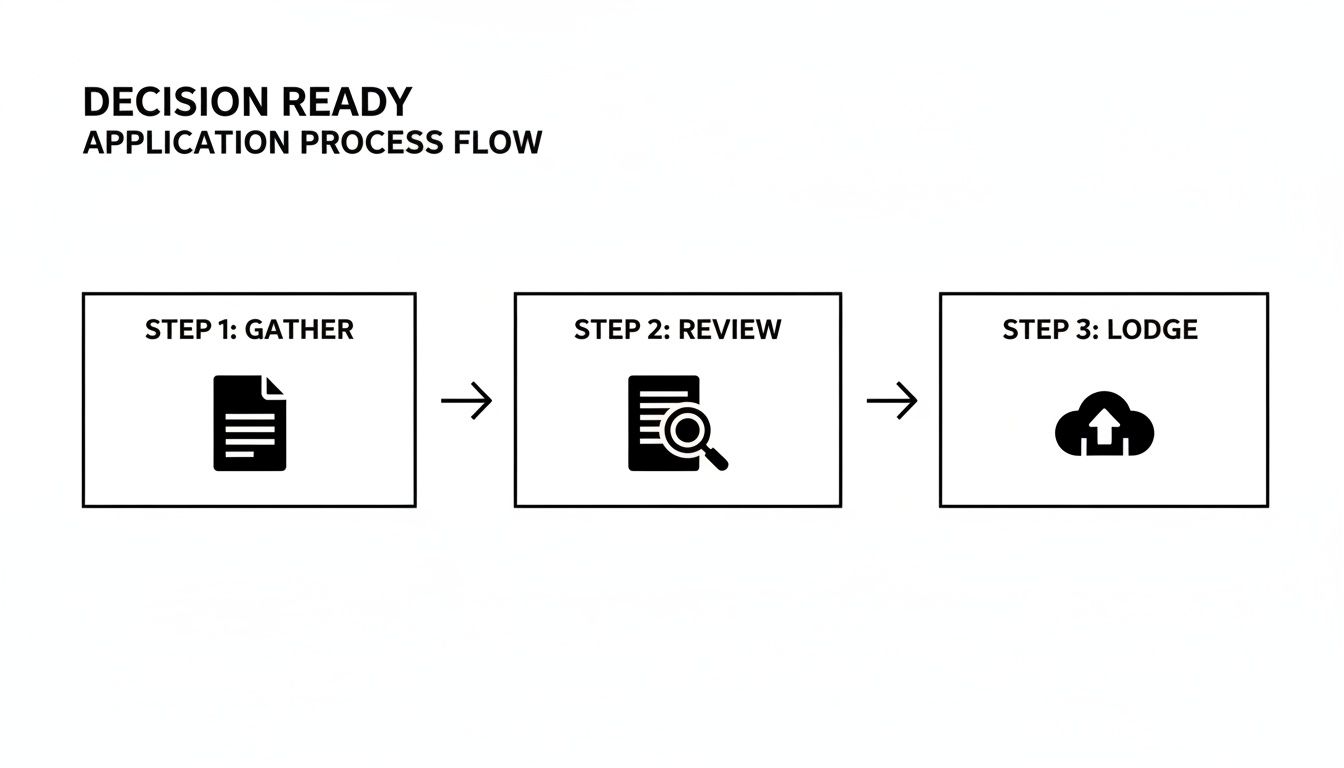
Thinking about it as simple steps—Gather, Review, Lodge—really drives home how vital that initial preparation is for your subclass 186 processing time.
Stage 2: Nomination and Visa Lodgement
Once all your personal documents are lined up and ready to go, the formal process kicks off. This stage involves two separate but closely linked applications being lodged with the Department of Home Affairs.
First up, your employer lodges the Nomination application. This is where they have to prove the business is sound, the job is real, and they’ve met all their sponsorship obligations. Think of this as the bedrock of your entire application.
Then, usually straight after, you lodge your Visa application. This is your part, where you upload all the documents you prepared in Stage 1—skills assessment, English test, identity docs, police checks, and any relationship evidence. The Department then links these two applications together.
Stage 3: The Assessment Journey
With everything submitted, your application officially joins the Department's queue. You can keep an eye on its progress through your ImmiAccount, but let's be honest, the status updates can be a bit cryptic.
Learning to interpret the application statuses is key to managing your own expectations. Each one signals a specific point in the assessment process and gives you a clue about what’s happening behind the scenes.
Here's a quick translation of what those statuses actually mean:
- Received: It's in. Your application has been successfully submitted and is now sitting in the queue, waiting for a case officer to be assigned.
- Initial Assessment: Someone's picked it up! A case officer has been allocated and is doing a preliminary scan of your file.
- Further Assessment: This is where your application will live for most of its life. It means the case officer is actively working on it. If they need more information (an RFI), you'll get the request during this stage.
- Finalised: This is it—the moment of truth. A decision has been made, and you'll get a notification of either a grant or a refusal.
The final hurdles are usually the health and character checks. While you can do these upfront, many people wait until the case officer requests them during the 'Further Assessment' stage. When that request comes, responding quickly is the best thing you can do to keep your application moving.
Disclaimer: Australian migration law and visa processing times are subject to change. The information provided in this article is for general guidance only and may not be true when you are reading it. For the most up-to-date information and personalised advice, it is essential to book an appointment with a registered migration agent. For any department fees for any visa, always refer to https://www.homeaffairs.gov.au/.
Why Expert Guidance Makes a Difference
You can lodge a Subclass 186 visa application yourself, but with the high stakes involved, even a small oversight can lead to massive delays or a heartbreaking refusal. The subclass 186 processing time is long enough as it is, without adding preventable roadblocks. For many, partnering with a MARA-registered migration agent isn't a cost—it's a critical investment in their future.
An experienced agent does far more than just fill out paperwork. Think of them as your strategist. Their job is to make sure your application isn't just complete, but is presented in a compelling way that ticks every single legislative box right from the get-go. This kind of professional oversight becomes absolutely vital in certain tricky situations.
When a Migration Agent Is Essential
Some scenarios instantly raise red flags for a case officer, significantly increasing the risk of your application getting stuck or questioned. Professional guidance is pretty much non-negotiable if you are:
- Navigating a complex work history with several employers, different roles, or employment gaps that need a very clear, logical explanation.
- Addressing a previous visa refusal or cancellation, which requires an incredibly careful and strategic approach to overcome.
- Clarifying potential health or character concerns that could otherwise derail your entire application.
An agent's real value is their foresight. They've seen where applications go wrong and can proactively build a case designed to sail through assessment, rather than get bogged down in endless requests for more information.
Australian migration law is a constantly moving target; policies and government priorities can shift with little warning. What was standard practice six months ago might not be today. A good agent gives you the most current advice, ensuring your application is perfectly aligned with the latest rules. For more on this, our article on tips for choosing a migration agent is a great place to start.
Disclaimer: Australian migration law and visa processing times are subject to change. The information provided in this article is for general guidance only and may not be true when you are reading it. For the most up-to-date information and personalised advice, it is essential to book an appointment with a registered migration agent. For any department fees for any visa, always refer to https://www.homeaffairs.gov.au/.
Your Top Questions Answered
Let's clear up some of the most common questions people have about the Subclass 186 visa process and what to expect with timings.
Can I Pay a Fee to Speed Up My Subclass 186 Visa?
That’s a common question, but unfortunately, the answer is no. The Department of Home Affairs doesn’t have a paid fast-track or priority service for the Subclass 186 visa.
Any priority processing is based on the Department’s own internal directives. This sometimes means applications from accredited sponsors or those in critical sectors get a look-in first. The single best thing you can do to influence your subclass 186 processing time is to lodge a perfect, decision-ready application right from the very beginning.
How Does a Request for Information (RFI) Impact My Timeline?
Getting a Request for Information, or an RFI, stops the clock on your application. The moment the Department sends that request, your processing is paused, and it only starts again once they have everything they’ve asked for.
This can easily tack on weeks, or even months, to your wait. It’s a perfect example of why getting your application complete and correct the first time is so critical.
What Is the First Entry Date After My Visa Is Granted?
Once your Subclass 186 visa is granted (congratulations!), the Department will give you a "first entry date." You absolutely must travel to Australia before this date to officially activate your permanent residency.
This date isn't random; it's usually tied to the 12-month expiry date of your police and health checks, and it is non-negotiable. It’s vital you factor this into your travel plans to make sure you don’t miss this crucial deadline.
Disclaimer: Australian migration law and visa processing times are subject to change. The information provided in this article is for general guidance only and may not be true when you are reading it. For the most up-to-date information and personalised advice, it is essential to book an appointment with a registered migration agent. For any department fees for any visa, always refer to https://www.homeaffairs.gov.au/.
Navigating the Subclass 186 visa can be challenging, but you don't have to do it alone. For expert guidance and a clear strategy tailored to your circumstances, get in touch with the experienced team at My Visa Guide. Let us help you achieve your goal of permanent residency in Australia. https://www.myvisaguide.com.au