So, let's get right to the big question: how many hours can you actually work on a student visa in Australia?
The rule of thumb is a maximum of 48 hours per fortnight while your course is officially in session. But once you hit a scheduled course break, those restrictions are lifted, and you’re free to work unlimited hours.
Disclaimer: Immigration law is complex and subject to change. The information provided in this article is for general guidance only and may not be current at the time of reading. You must book an appointment with a registered migration agent for updated and personalised advice. For any official government fees, always refer directly to the Department of Home Affairs website at https://www.homeaffairs.gov.au/.**
Understanding Your Work Rights on a Student Visa

For most international students, juggling part-time work with studies is a huge part of the Aussie experience. It's a way to gain valuable local experience, build connections, and help cover living costs.
The rules around your working hours are there to make sure your primary focus stays on your education. It’s best to think of them not as a barrier, but as a framework designed to help you find a healthy balance.
This guide will walk you through the essential rules, recent changes, and practical steps to ensure you stay on the right side of your visa conditions. Getting your head around these rules is the first step toward a successful and stress-free time in Australia.
A Quick Look at the Rules
For a simple breakdown, here are the standard working hour rules for most Subclass 500 visa holders.
Student Visa Work Hours At a Glance
| Study Period | Maximum Working Hours |
|---|---|
| While your course is in session | 48 hours per fortnight |
| During scheduled course breaks | Unlimited hours |
This table gives you the basics, but it's crucial to understand what "in session" and "course breaks" actually mean to avoid any accidental missteps.
The Story Behind the 48-Hour Rule
The allowance for student visa australia working hours hasn't always been the same. Not long ago, the government bumped the limit up from 40 to 48 hours per fortnight. This was a direct response to the rising cost of living, acknowledging the financial pressures many students are under.
And students are definitely making use of it. Recent analysis shows that around 63% of employed international student visa holders work right up to this 48-hour cap during their study periods.
It's clear this allowance is a critical part of making the study journey in Australia manageable for thousands of students.
A Word of Caution: Immigration policies can and do change, sometimes with little notice. The information here is for general guidance and was current at the time of writing. For the most up-to-date information and advice tailored to your specific situation, you must book a consultation with a registered migration agent. All Department of Home Affairs fees can be found on their official website.
To really get a firm grasp on your work rights and ensure you’re always doing the right thing, it can be incredibly helpful to learn an online compliance course at the college level. This kind of knowledge empowers you to protect your visa status while confidently navigating the Australian workplace.
Getting Your Head Around the 48-Hour Per Fortnight Rule
That ‘48 hours per fortnight’ rule might sound a bit strict at first glance, but it’s actually more flexible than you think. Getting a handle on how it works is the secret to balancing your studies and a part-time job without any of the stress. The most important thing to wrap your head around is what the Department of Home Affairs actually considers a 'fortnight'.
It’s not just any two-week period. Think of it as a fixed, rolling 14-day block that always kicks off on a Monday and finishes on the second Sunday after that. This little detail is a game-changer for students juggling lectures, tutorials, and work shifts.
What this means is you aren't chained to a rigid 24-hour weekly limit. Your work schedule can breathe and adapt to your uni timetable, which is an absolute lifesaver during hectic exam periods or when you've got a massive assignment due.
How the Fortnightly Limit Works in the Real World
The best way to see the flexibility of the student visa Australia working hours cap is with a real-world example. Let's say you've got a big mid-term exam on the horizon and you need to hit the books, hard.
- Week 1: You decide to dial it back at work, only clocking in for 18 hours so you can spend more time cramming and revising.
- Week 2: The exam is done and dusted. You’re free to pick up more shifts and work 30 hours to make up for lost income.
See what happened there? Your total for the fortnight comes to a perfect 48 hours. You’ve stayed well within your visa conditions, all while making your studies the number one priority when it really counted. This is exactly how you can plan your finances and academic life so they don't clash.
Heads Up: It's completely on you to track your hours across all your jobs. Your employers aren't required to check in with each other to see your combined total, so keeping your own simple log or spreadsheet is non-negotiable.
So, When Is Your Course "In Session"?
Another piece of the puzzle is understanding what "in session" actually means. It's not as simple as just the days you have to be on campus for a class.
The term "in session" covers all the mandatory periods of your course as laid out by your uni or college. This includes:
- The standard semester or term dates.
- Official examination periods (even if your classes have already finished for the term).
- Any time you're enrolled and are expected to be studying or working on coursework.
Basically, if the semester has officially begun and you haven't hit a scheduled break yet, you are "in session." The 48-hour limit is in full effect.
Understanding Your Scheduled Course Breaks
Right, so when do you get to work unlimited hours? The good news is that the working restrictions are lifted during scheduled course breaks. These are the official holiday periods you see on your institution's academic calendar.
This is usually for the big breaks, like the long summer and winter holidays between semesters. During these specific windows, you’re free to work full-time—or even juggle multiple jobs—to save up some cash or get a solid block of professional experience under your belt.
Always, always double-check your uni's official academic calendar so you're 100% certain of the start and end dates for these breaks. Planning your work schedule around this calendar is the smartest way to boost your earnings while playing by the visa rules.
Disclaimer: Immigration law is complex and subject to change. The information provided in this article is for general guidance only and may not be current at the time of reading. You must book an appointment with a registered migration agent for updated and personalised advice. For any official government fees, always refer directly to the Department of Home Affairs website at https://www.homeaffairs.gov.au/.**
When You Can Work Beyond the Standard Limit
While the 48-hour fortnightly rule is the standard for most students, it's not a rigid, one-size-fits-all condition. It pays to know the specific situations that allow you to work beyond this cap, even when your course is technically in session. Getting this right can open up more work opportunities without putting your visa at risk.
The most common exception is for work that's a formal, registered part of your course. If your studies include a mandatory work placement, internship, or practical training component, the hours you spend on that specific activity don't count towards your 48-hour limit.
This makes perfect sense. It’s designed to ensure your practical training isn't held back by your visa conditions. For example, a nursing student completing a required 80-hour clinical placement over a fortnight can still work a separate part-time job for up to 48 hours during that same period.
Special Rules for Research Students
A major exception applies to students diving into higher-level research degrees. If you’re enrolled in a Master's by research or a Doctor of Philosophy (PhD), you generally have unlimited work rights.
This special condition kicks in once your main course of research or thesis work officially begins. It's a recognition that the structure and demands of a postgraduate research degree are completely different from coursework-based programs. From the moment your research component starts, you're free to work full-time.
This simple flowchart helps visualise the core working hour guidelines for most student visa holders.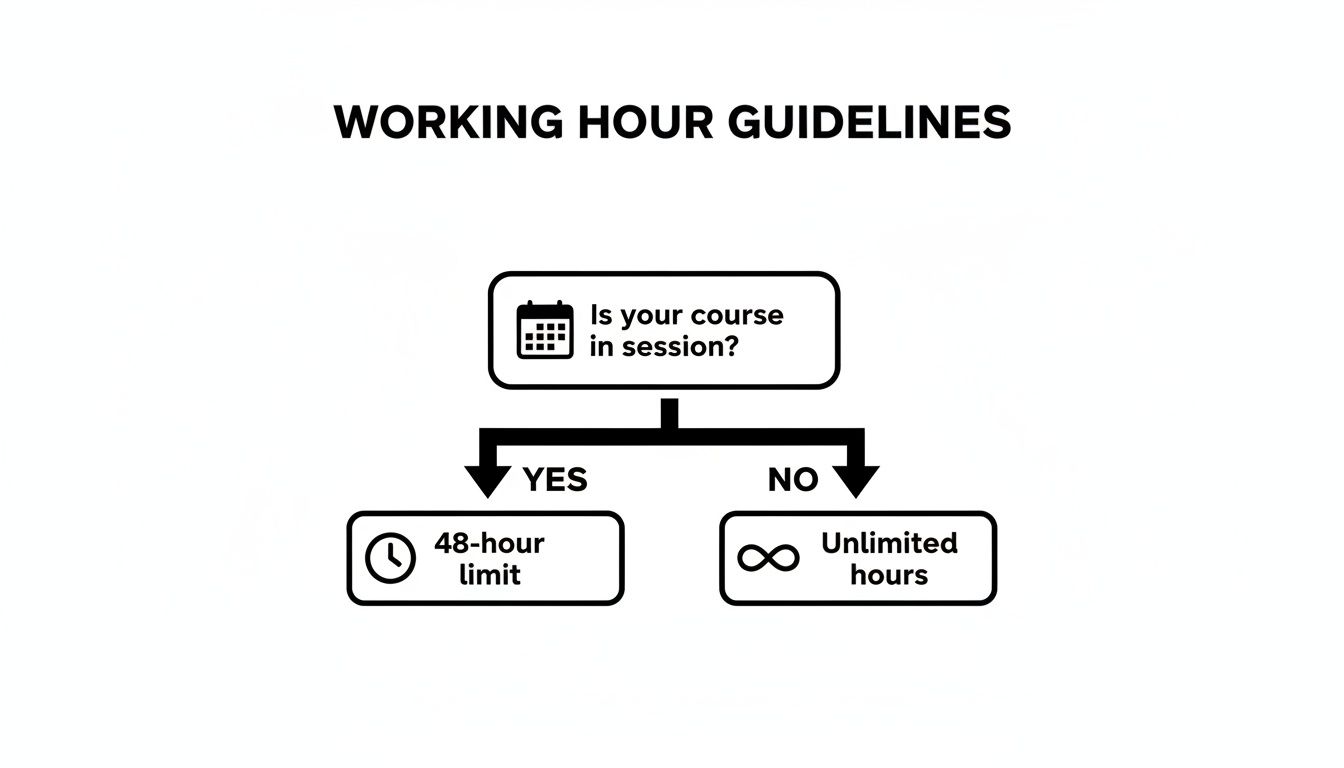
As you can see, the main question is always whether your course is currently in session or on a scheduled break.
How to Confirm Your Specific Work Conditions
Even with these common exceptions, you should never make assumptions about your own visa. The only source of truth for your specific work rights is your official visa grant notification letter and the Visa Entitlement Verification Online (VEVO) system.
Your visa conditions are unique to you. Always check VEVO to see the exact rules that apply to your Subclass 500 visa. This is the only way to be 100% certain of your work limitations and any exceptions you might have.
Checking VEVO is your best defence against accidentally breaching your conditions. If you think one of these exceptions applies to you but it isn’t reflected in your visa details, you should seek professional advice right away. Knowing your exact work rights is essential for planning your finances and is a critical step before exploring various post-study pathways in Australia. It ensures your work choices today support, rather than get in the way of, your goals for tomorrow.
Disclaimer: Immigration law is complex and subject to change. The information provided in this article is for general guidance only and may not be current at the time of reading. You must book an appointment with a registered migration agent for updated and personalised advice. For any official government fees, always refer directly to the Department of Home Affairs website at https://www.homeaffairs.gov.au/.**
Your Rights and Protections in the Workplace

Getting your head around the rules for your student visa Australia working hours is a huge step, but it’s only half the story. Just as crucial is understanding your rights as an employee in Australia. It’s a simple but powerful fact: every single person working in this country, no matter their visa status, is protected by Australian workplace laws.
This means you are legally entitled to some basic, non-negotiable rights and protections from the first day you start a job. Your employer has clear responsibilities, and you have rights that can never be signed away or ignored.
Your Fundamental Workplace Rights
By law, your employer must give you a safe and fair place to work. This isn’t just a suggestion; it’s a legal requirement that covers several key protections to make sure you’re treated properly.
Here are the absolute basics you are entitled to as an employee in Australia:
- Minimum Wage: You must be paid at least the national minimum wage. Your pay rate can't legally dip below this amount, which gets reviewed every year.
- Payslips: You have to get a payslip within one working day of being paid. It should clearly show your earnings, any money taken out (deductions), and your superannuation contributions.
- Superannuation: If you’re eligible, your employer has to pay a percentage of what you earn into a superannuation (that’s a retirement fund) for you.
- A Safe Working Environment: Your employer has a duty of care to ensure your workplace is free from health and safety risks.
These rights are universal. It doesn’t matter if you’re paid in cash or if you’re working for a tiny local business—the law is the law for everyone.
Understanding Workplace Exploitation
Unfortunately, some employers try to take advantage of international students, assuming they might not know their rights. History shows us that this is a real risk. The 2016 Australian Census revealed that while 51.8% of student visa holders were in the workforce, they also faced a high unemployment rate of 20.1%. Many ended up in roles like cleaning and hospitality, which can sometimes lead to shaky work situations. You can read more about these employment trends from the Parliamentary Budget Office.
Workplace exploitation is completely illegal. This includes being underpaid, not receiving your superannuation, being pressured to work more hours than your visa allows, or being forced to work in unsafe conditions.
If an employer ever pushes you to break your visa conditions or refuses to give you what you’re owed, you have backup. The Fair Work Ombudsman is an independent government agency that offers free advice and help to all workers in Australia. They can help you understand your rights and take action against unfair treatment, and you don’t have to worry about your visa being cancelled for reporting exploitation.
Disclaimer: Immigration law is complex and subject to change. The information provided in this article is for general guidance only and may not be current at the time of reading. You must book an appointment with a registered migration agent for updated and personalised advice. For any official government fees, always refer directly to the Department of Home Affairs website at https://www.homeaffairs.gov.au/.**
The Real Consequences of Breaching Work Conditions
Let's be honest—it can be tempting to pick up a few extra shifts, especially with the cost of living what it is. But when it comes to your student visa Australia working hours, the risks of going over the limit are so much bigger than any short-term cash boost.
Knowing just how serious the consequences are is the first step to protecting your future here. Breaching your work conditions isn't seen as a minor slip-up; it's a direct violation of your visa grant. The Department of Home Affairs is not lenient on this, and the penalties can completely change the course of your life.
The Most Severe Outcome: Visa Cancellation
The biggest, most immediate blow is having your Student Visa (Subclass 500) cancelled. If the Department discovers you’ve worked more than your allocated hours, they have the power to cancel your visa on the spot. This means your Australian dream could come to a sudden halt.
But it’s not just about your current studies being cut short. A visa cancellation leaves a permanent mark with long-term consequences that can haunt you for years.
- Departure from Australia: You could be required to pack up and leave Australia almost immediately.
- Re-entry Bans: A cancellation often comes with an exclusion period—typically lasting three years—barring you from being granted most other Australian visas.
- Financial Loss: Think of the huge investment you've already poured into tuition fees, accommodation, and flights. All of that could be lost.
Jeopardising Your Future in Australia
Even if your visa isn't cancelled right away, a breach creates a negative immigration history. This black mark on your record can poison any future visa applications you ever make, effectively slamming the door on your dream of transitioning from study to work in Australia.
A breach of your work conditions can directly impact your character assessment in future applications. It raises serious doubts about your integrity and willingness to follow Australian laws, making it incredibly difficult to get approved for another visa down the line.
Imagine you’ve finished your degree and are ready to apply for a post-study work visa like the Temporary Graduate visa (Subclass 485), or even permanent residency. Your entire history of compliance will be put under a microscope. A past work breach could be the single reason for a refusal.
It can even damage your ability to meet the new Genuine Student requirement on future student visa applications. This is why carefully tracking your hours isn't just about following the rules—it’s about protecting your entire journey in Australia.
Disclaimer: Immigration law is complex and subject to change. The information provided in this article is for general guidance only and may not be current at the time of reading. You must book an appointment with a registered migration agent for updated and personalised advice. For any official government fees, always refer directly to the Department of Home Affairs website at https://www.homeaffairs.gov.au/.**
Need an Expert to Guide Your Visa Journey?
Australian migration law isn't static; it's constantly shifting. Making sure you're on the right side of your student visa work rules is absolutely critical for your success here. This is where getting professional guidance can turn a whole lot of uncertainty into pure confidence.
Our team of MARA-registered agents, led by our Director Vijay Bharti (MARN 2217817), is here to give you clear, ethical, and current advice. We help you get your head around your visa conditions from day one and stick with you to make sure you stay compliant all the way through your studies.
Why Expert Advice Really Matters
Let's be honest, trying to navigate this alone can lead to some costly mistakes. Partnering with an expert lets you sidestep those pitfalls and focus on what you came here for—your education and your future. On that note, a solid resume is a must-have for any student on the job hunt. It’s worth checking out the best resume builder for students to help you create something professional that really sells your skills.
If you want advice tailored specifically to your situation, the best next step is to book a consultation with us. You can get a better feel for how we help students in our guide to student visa assistance for the Subclass 500.
Disclaimer: Immigration law is a complex beast and is always subject to change. The information in this article is meant as a general guide and might not be current by the time you read it. You must book an appointment with a registered migration agent for up-to-date and personalised advice. For any official government fees, always refer directly to the Department of Home Affairs website at https://www.homeaffairs.gov.au/.
Your Questions Answered
When it comes to the nitty-gritty of student visa Australia working hours, a lot of real-world questions pop up. Let's tackle some of the most common ones so you can handle these situations like a pro.
Does Unpaid Volunteer Work Count Towards My 48-Hour Limit?
This is a great question. Generally, if you're doing genuine volunteer work for a registered non-profit organisation, it won't count towards your work limit. The key here is "genuine" – it has to be a role that wouldn't normally be a paid position.
A word of caution, though. Any "unpaid work" or "internship" at a for-profit business could easily be seen by the Department of Home Affairs as a breach of your visa conditions. Before you commit, always double-check the organisation's non-profit status to stay on the right side of the rules.
How Do I Track Hours If I Have Two Different Jobs?
It's simple: the 48-hour per fortnight cap is the total for all your jobs combined. You, and only you, are responsible for keeping track. The easiest way is to use a spreadsheet or a basic app on your phone. Just log the hours from each payslip as you get it.
While it's smart to let both employers know about your visa limit, don't ever assume they're tracking your hours for you. The legal responsibility to stay compliant rests entirely on your shoulders.
Important Reminder: The government defines a fortnight as a fixed 14-day block that always starts on a Monday. You need to make sure your total hours from all jobs don't go over 48 within any of these official fortnightly periods.
My Course Is Finished But My Visa Is Still Valid. Can I Work Full-Time?
Yes, you absolutely can! The moment you've officially finished your course (meaning your final results are out), the government considers you to be on a "course break." During this window, you're free to work unlimited hours right up until your student visa expires.
This is a fantastic opportunity to get more industry experience under your belt or save up some cash before your next move, like applying for a Temporary Graduate visa (Subclass 485).
Can My Family Members Work in Australia?
Yes, they can. Dependents included on your student visa application usually get work rights, too. They’re held to the same 48-hour per fortnight limit while your course is running.
There is one major exception: this limit is lifted for your family members if you, the main visa holder, are studying a Master's by research or a PhD. It's crucial to check the VEVO for each family member individually, as their specific work conditions can sometimes vary.
At My Visa Guide, our goal is to help you navigate every part of your Australian visa journey with clarity and confidence. If you're still unsure about your work rights or anything else, book a consultation with one of our MARA-registered agents today. Visit https://www.myvisaguide.com.au to get started.
Disclaimer: Immigration law is complex and subject to change. The information provided in this article is for general guidance only and may not be current at the time of reading. You must book an appointment with a registered migration agent for updated and personalised advice. For any official government fees, always refer directly to the Department of Home Affairs website at https://www.homeaffairs.gov.au/.**