The student visa 500 australia is your golden ticket to living and studying full-time at one of Australia’s world-class institutions. It's the official green light that allows you to stay for the entire length of your course, which can be up to five years, and it's the absolute foundation of your academic journey Down Under.
Disclaimer: Information in this article is general in nature and may not be current at the time of reading. Visa regulations and fees can change without notice. For the most up-to-date and personalised advice, we strongly recommend you book an appointment with a registered migration agent. Always refer to the official Department of Home Affairs website for the latest government fees.
Your Essential First Step to Studying in Australia
Think of the Student Visa (Subclass 500) as your all-access pass to an incredible education and an unforgettable cultural experience. This guide is here to untangle what can feel like a complex process, breaking it down into clear, manageable steps. We'll help you understand not just what you need to do, but why each piece of the puzzle is so important for getting that visa approval.
This is about much more than just filling out forms. It’s about building a strong foundation for your success from day one. We’ll walk through the critical pillars of a solid application, from proving you are a Genuine Student to meeting the strict financial requirements.
Navigating a Competitive Landscape
The secret is out: an Australian education is in high demand. As of September 30, 2025, the number of Student Visa holders in Australia soared to a record 736,306. This is happening even as the government brings in tighter rules and caps on student numbers, making the entire application process more competitive than ever.
This fierce competition means your application needs to be flawless. There's simply no room for error. Working with a MARA-certified agent from My Visa Guide, like Vijay Bharti, gives you the personalised expertise needed to navigate these tricky waters and make your application stand out.
As you get ready for your studies, it pays to have the right tools in your pocket. Check out these essential apps for college students to help you hit the ground running, boost your productivity, and manage your new life as a student.
Right, let's get down to what it really takes to get your hands on an Australian Student Visa. Think of your application less like filling out a form and more like building a case. The Department of Home Affairs needs to be convinced that you're a serious student with a solid plan.
These core requirements aren't just separate boxes to tick; they're interconnected pieces of a puzzle. Each one helps to paint a clear picture of who you are, why you want to study in Australia, and what your long-term intentions are. Let's break down what you need to focus on to build a strong, successful application.
The Genuine Student Requirement
This is the absolute heart of your application. The Genuine Student (GS) requirement is your opportunity to tell your story and prove that your main reason for coming to Australia is, genuinely, to study. It's about showing, not just telling.
Your GS statement needs to a-clearly lay out your intentions. You’ll have to answer specific questions about why you chose Australia over other countries, why you picked your particular university or college, and exactly how this course fits into your future career plans back home. For example, you might explain how a Diploma of IT is the critical link to securing a high-demand cybersecurity job in your home country's booming tech industry.
You also need to show that you have strong ties to your home country—things like family, property, or a clear job path waiting for you. This helps demonstrate that you plan to return after you finish your studies. To really nail this part, check out our in-depth guide on what is the Genuine Student requirement.
To help you get organised, here’s a quick checklist of the key pillars we're discussing. Think of it as your roadmap to a successful application.
Student Visa 500 Australia Key Requirements Checklist
| Requirement Category | What It Means | Key Document/Evidence |
|---|---|---|
| Genuine Student (GS) | Proving your primary purpose in Australia is to study. | Detailed answers to GS questions in the online application. |
| Enrolment | You must be accepted into a full-time, registered course. | A valid Confirmation of Enrolment (CoE). |
| Financial Capacity | Showing you can afford your tuition, travel, and living costs. | Bank statements, proof of income, or evidence of financial support. |
| English Proficiency | Demonstrating you have the language skills to succeed. | Results from an approved test (e.g., IELTS, PTE, TOEFL). |
| Health | Meeting Australia's public health standards. | A completed health examination with a panel physician. |
| Character | Proving you are of good character. | Police clearance certificates from relevant countries. |
Getting these fundamental elements right from the start is the key to building a strong and convincing visa application.
Proof of Enrolment and Financial Capacity
Your academic goals need to be backed up with hard evidence. First up is your Confirmation of Enrolment (CoE). This is a non-negotiable document from your CRICOS-registered institution that officially confirms your spot in a full-time course. No CoE, no visa. It’s that simple.
Just as crucial is proving you have the money to support yourself. You must show that you have enough funds to cover your travel to Australia, your first 12 months of tuition fees, and your living costs for one year. The Australian government sets a specific minimum amount for living expenses, so this isn't a number you can just guess.
Disclaimer: Information in this article is general in nature and may not be current at the time of reading. Visa regulations and fees can change without notice. For the most up-to-date and personalised advice, we strongly recommend you book an appointment with a registered migration agent. Always refer to the official Department of Home Affairs website for the latest government fees.
Health, Character and English Proficiency
The final pieces of the puzzle are the health, character, and English language checks. These are standard requirements designed to ensure all international students meet Australia's community standards.
While they are straightforward, you need to handle them meticulously.
- English Proficiency: You'll have to provide results from an approved English test, like IELTS, PTE Academic, or TOEFL iBT. This proves you have the language skills to actually understand and participate in your course. The minimum score you need will depend on your course and institution.
- Health Requirements: Every student visa applicant needs to have a health check-up with a specific doctor approved by the Department of Home Affairs. This is simply to make sure you meet Australia’s public health criteria.
- Character Requirements: You’ll have to declare any criminal convictions. You may also need to provide police certificates from any country you've lived in for 12 months or more over the last ten years. This is to show you are of good character.
By carefully and honestly addressing each of these core criteria—from your genuine student intentions to your financial standing and personal record—you put yourself in the best possible position for a successful student visa 500 australia application.
How to Navigate the Application Process
So, you've got your heart set on studying in Australia. Fantastic. Now, let's break down the application process for the Student Visa (subclass 500) into clear, manageable steps. Think of it less like a maze and more like a roadmap. Getting this part right is all about careful preparation and a bit of patience. Small mistakes can cause big delays, so we'll build your application piece by piece.
The journey really kicks off once you've been accepted into your course. The first thing you'll need is your Confirmation of Enrolment (CoE) from your CRICOS-registered institution. This document is crucial—it's essentially the key that unlocks the entire visa application process. Without it, you can't even start.
Setting Up Your ImmiAccount
Next up, you'll head over to the Department of Home Affairs' digital portal to create an ImmiAccount. This will be your personal command centre for everything related to your visa. It’s where you'll fill out the online application, upload all your documents, and keep an eye on how things are progressing.
When you're filling out the online form, accuracy is your best friend. Seriously, double-check every single detail—your name, date of birth, passport number. A simple typo can create a world of headaches down the line, so take your time and review everything before you hit 'next'.
Disclaimer: Information in this article is general in nature and may not be current at the time of reading. Visa regulations and fees can change without notice. For the most up-to-date and personalised advice, we strongly recommend you book an appointment with a registered migration agent. Always refer to the official Department of Home Affairs website for the latest government fees.
Compiling Your Document Checklist
Think of your supporting documents as the evidence that backs up everything you're claiming in your application. Your checklist is your evidence kit, and every single item plays a part in building a strong, believable case for your student visa 500 australia.
This flowchart gives you a bird's-eye view of the main stages, from getting enrolled to hitting that final submit button.
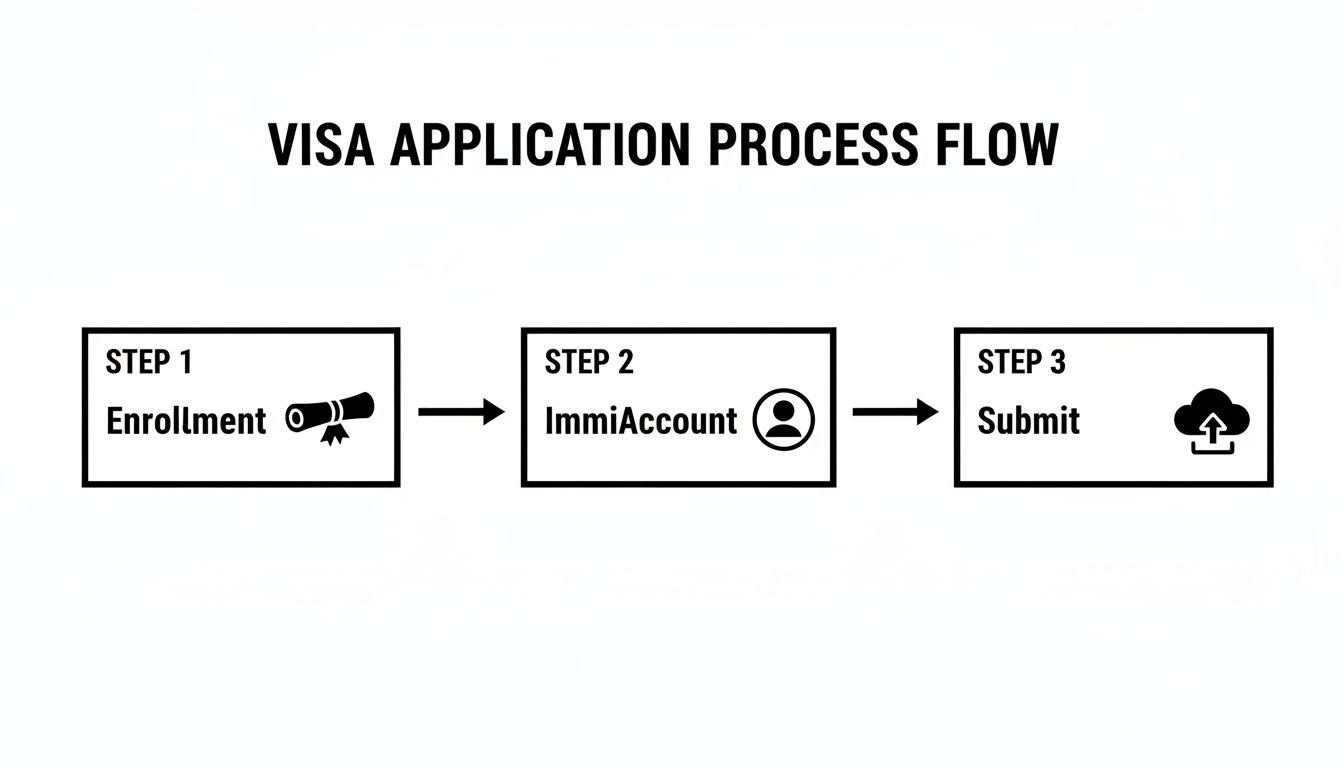
As you can see, it’s a logical flow. You have to get each step right before you can confidently move on to the next one.
Your evidence kit needs to be complete and organised. Here are the core documents you’ll be gathering:
- Identity Documents: A certified copy of your passport bio-data page is non-negotiable. You might also need your birth certificate or national ID card.
- Confirmation of Enrolment (CoE): This is the proof of your spot in a CRICOS-registered course.
- Genuine Student (GS) Statement: Your detailed answers to the GS questions in the form are absolutely critical for showing your genuine study intentions.
- Financial Evidence: Bank statements or loan documents proving you have the funds to cover tuition, travel, and living costs.
- Overseas Student Health Cover (OSHC): You must have proof of health insurance for your entire stay in Australia.
- English Proficiency Results: Your official scores from an approved test like IELTS or PTE.
- Academic and Work History: Transcripts, certificates, and any relevant job records that paint a picture of your background.
Submitting Your Application Correctly
Once you've got all your documents ready, it’s time to upload them to your ImmiAccount. Make sure every scan is crystal clear and saved in an accepted format (PDF is usually a safe bet). Give each file a clear name—like "Passport_Bio_Page.pdf"—to make life easier for the case officer reviewing your file. An organised application is a happy application.
The final hurdle is paying the Visa Application Charge (VAC). Your application isn't officially lodged until this payment goes through.
Navigating each of these stages with a bit of care gives you the best shot at a smooth and successful outcome. If it all feels a bit much, an expert from My Visa Guide can go through every document and form with a fine-tooth comb, making sure your application is rock-solid and ready to go.
Understanding Visa Fees and Processing Times
Let's get straight to it. The two questions I hear most often are, "How much is this going to cost?" and "How long will this all take?" Getting your head around the budget and timeline for a student visa 500 australia is crucial, and it’s about more than just the main application fee.
Think of the official Visa Application Charge (VAC) as the price of your ticket to the show. It gets you in the door, but it doesn't cover the popcorn, drinks, or transport. To plan properly, you need to account for all the other "hidden" costs that are actually part of the main event.
Deconstructing the Total Cost of Your Visa
Beyond that initial VAC, a few other non-negotiable costs will pop up. Being prepared for these from the get-go will save you a world of last-minute financial stress.
These aren't optional extras; they're essential parts of lodging a valid application. You’ll need to open your wallet for:
- Overseas Student Health Cover (OSHC): This is your compulsory health insurance. It must be paid upfront to cover you for the entire time you plan to be in Australia.
- Biometrics Collection: Most people will need to visit a special collection centre to have their fingerprints and a photograph taken.
- Health Examinations: You’ll need a full medical check-up with a government-approved doctor to prove you meet Australia's health requirements.
Tally these up, and you're looking at several hundred extra dollars on top of the main visa fee. It's always smart to factor these into your budget from day one.
Disclaimer: Information in this article is general in nature and may not be current at the time of reading. Visa regulations and fees can change without notice. For the most up-to-date and personalised advice, we strongly recommend you book an appointment with a registered migration agent. Always refer to the official Department of Home Affairs website for the latest government fees.
Navigating Processing Times in a Competitive Climate
There's no magic number for how long your visa will take. The timeline can swing wildly depending on how many applications the Department is dealing with, whether you're applying for a university or a vocational course, and—most importantly—how well you've prepared your application. The government does publish global processing times, with 90% of applications often decided within a few months, but this is a moving target.
Be warned: the game has changed recently. Australia has brought in a national cap on new international student numbers, aiming for just 270,000 places in 2025. This new policy heavily favours university students, who snapped up nearly 75% of the visa grants in the 2024/25 period. Meanwhile, vocational and English language courses have seen their numbers slashed. You can read more about how these new limits for international students might affect you.
What does this mean for you? It means choosing a university or college that fits within the cap and submitting a perfect, decision-ready application is no longer just a good idea—it's essential. Any small mistake, missing document, or inconsistency can see your file pushed to the bottom of an already very crowded pile.
Common Factors That Can Delay Your Application
Knowing what slows things down is the key to speeding things up. A complete, well-organised application is like taking the express lane on the motorway. A messy, incomplete one is like being stuck in peak-hour traffic.
Here are the most common roadblocks I see trip people up:
- Incomplete Forms: Simple but costly errors, like leaving a field blank or ticking the wrong box.
- Missing Documents: Forgetting to upload a critical piece of evidence like your financial statements or Confirmation of Enrolment (CoE).
- Poorly Scanned Documents: Submitting files that are blurry, cut off, or impossible for a case officer to read.
- Requests for More Information (RFIs): The moment a case officer has to email you for clarification, you've automatically added weeks, if not months, to your wait time.
- Health and Character Checks: Delays in getting your medicals done or waiting for police clearances to come through.
The single best strategy to avoid all this? Meticulous preparation. Your goal is to hand the case officer a file so complete and clear that they have no questions left to ask. That’s your golden ticket to a faster, positive outcome.
Visa Conditions and Responsibilities
Congratulations, you’ve got your Australian student visa! That’s a massive step, but it’s not the finish line. Think of your visa as the start of a partnership with the Australian government. You get some fantastic rights, but you also have to hold up your end of the bargain by meeting a few key responsibilities.
Getting this right from the beginning is the secret to a stress-free and successful time in Australia. It’s all about balancing your studies with things like part-time work, making sure you never accidentally step over the line and put your visa at risk.
Understanding Your Work Rights
One of the best perks of the Subclass 500 visa is the permission to work. This is your chance to get a feel for the Australian workplace, build your CV, and earn some money to help with living costs. But, and this is a big but, there are strict rules you need to follow.
Right now, you’re allowed to work up to 48 hours per fortnight while your course is running. A 'fortnight' is just a 14-day period that kicks off on a Monday. It’s absolutely vital you keep a close eye on your hours to make sure you don't go over this limit.
The good news? During official course breaks, like your semester holidays, the rules relax. You can work unlimited hours, which is a perfect opportunity to save up or dive into a more intensive work experience.
Disclaimer: Information in this article is general in nature and may not be current at the time of reading. Visa regulations and fees can change without notice. For the most up-to-date and personalised advice, we strongly recommend you book an appointment with a registered migration agent. Always refer to the official Department of Home Affairs website for the latest government fees.
Core Academic and Personal Responsibilities
While working is great, your main job in Australia is to be a student. The Department of Home Affairs needs to see that you’re genuinely here to study, and they have a few non-negotiables to make sure of it.
Here are the key things you must do:
- Stay Enrolled: You have to be enrolled full-time in a course registered on the CRICOS list. No ifs or buts.
- Make Good Progress: Your school or university will have standards for attendance and passing your subjects. If you start failing or skipping classes, it can trigger a red flag for your visa.
- Keep Your Details Updated: Moved to a new apartment? Changed your phone number? You have seven days to let the Department of Home Affairs know. The same goes if you decide to change your education provider.
- Keep Your Health Cover Active: You must have valid Overseas Student Health Cover (OSHC) for your entire stay. It’s a mandatory condition. You can learn more about why Overseas Student Health Cover (OSHC) is so important and how to get it sorted.
Bringing Family Members with You
If you've brought your partner or children along on your visa, they have rules to follow too. Their conditions are usually tied to yours. For example, the partner of a student studying a Bachelor's degree can typically also work up to 48 hours per fortnight.
Making sure your whole family understands and follows these rules is crucial for everyone to stay compliant. Beyond hitting the books, getting a handle on your work rights and personal duties is the key to supporting yourself and making your Australian adventure a success. Many students find part-time jobs to help out, and you might want to explore opportunities like becoming a home tutor. Following the rules protects your visa and lets you enjoy everything Australia has to offer.
Planning Your Career After Graduation

Finishing your course in Australia is a huge milestone, but it's really just the beginning of your journey. Your student visa 500 australia isn't just a ticket to get an education; think of it as a powerful launchpad for your professional life. The key to turning that qualification into a successful career is to start thinking about what comes next—long before you toss your graduation cap in the air.
For most graduates, the natural next step is the Temporary Graduate visa (Subclass 485). This visa is the bridge that connects your student life to your professional one. It gives you the chance to stay in Australia after graduation to live, study, and most importantly, gain that crucial local work experience in your field.
The Temporary Graduate Visa (Subclass 485)
The Subclass 485 visa is hands-down the most popular pathway for international students looking to kickstart their careers here. The numbers speak for themselves: between January 2018 and December 2023, nearly 98,000 former student visa holders lodged an application. By September 2025, there were over 217,000 Graduate visa holders in Australia.
You can dive into the full details in the official government report to see the trend for yourself.
This visa has a few different streams, and the one you apply for depends on the type of qualification you've completed. The main eligibility hurdle is that you must have finished a CRICOS-registered course that lasted at least two academic years.
That’s why planning for this visa while you’re still studying is such a smart move. It means you can make sure your course choices and study duration line up perfectly with the visa requirements, avoiding any nasty surprises down the track.
Disclaimer: Information in this article is general in nature and may not be current at the time of reading. Visa regulations and fees can change without notice. For the most up-to-date and personalised advice, we strongly recommend you book an appointment with a registered migration agent. Always refer to the official Department of Home Affairs website for the latest government fees.
Looking Beyond the Graduate Visa
While the Subclass 485 is a brilliant first step, it’s still a temporary one. The real magic happens when you use the work experience you gain on this visa as the cornerstone of a long-term plan for permanent residency. This is where your Australian qualification truly shines.
Many graduates use this time to build a case for other long-term pathways:
- Skilled Migration: Your Australian qualification, age, English skills, and local work experience all add up to valuable points towards a skilled visa, like the Subclass 189 or 190.
- Employer Sponsorship: If you impress an employer during your post-study work period, they might offer to sponsor you for a work visa, such as the Subclass 482 TSS visa.
- Professional Year Programs: For those in fields like IT, Engineering, and Accounting, a Professional Year program not only gives you workplace training but also boosts your points for skilled migration.
Mapping out these long-term goals can feel complex, but you don't have to do it alone. At My Visa Guide, we specialise in helping students navigate their post-study pathways in Australia. We can help with everything from skilled migration assessments to planning for a Professional Year, making sure your journey from student to professional is as smooth and successful as it can be.
Your Questions, Answered
Let's be honest, the student visa 500 australia process can feel like a maze. To help you find your way, here are some straightforward answers to the questions we hear most often from aspiring students just like you.
What Is This "Genuine Student" Requirement All About?
Think of the Genuine Student (GS) requirement as your chance to tell your story. It's how the Department of Home Affairs gets to know your real reasons for wanting to study in Australia.
You'll need to answer a few specific questions in your application about why you picked a particular course and university, and how it all fits into your bigger career picture. They also want to understand your life back home—your financial situation and your ties to your country. It's not a trick question; it's about showing a clear, honest, and logical plan.
Can I Change My Course or University Later On?
Yes, you can, but it’s not as simple as just switching classes. The general rule is you must stick with your original institution for the first six months of your main course.
After that, moving to a course at the same or a higher academic level is usually manageable. But if you’re thinking of dropping down to a lower-level course, you’ll need to apply for a brand new student visa. Either way, you'll need a new Confirmation of Enrolment (CoE) and you must let the Department know to keep your visa valid.
Disclaimer: Information in this article is general in nature and may not be current at the time of reading. Visa regulations and fees can change without notice. For the most up-to-date and personalised advice, we strongly recommend you book an appointment with a registered migration agent. Always refer to the official Department of Home Affairs website for the latest government fees.
How Much Money Do I Actually Need to Show?
You’ll need to prove you’ve got the financial firepower to cover a few key things: your flight to Australia, your first 12 months of tuition fees, and 12 months of living costs.
The government sets a specific minimum amount for annual living expenses, which you have to meet. And if you’re bringing family along, you'll need to show you can support them, too.
What Are the Most Common Reasons for a Visa Refusal?
Hands down, the biggest tripwires are failing to convince the Department you're a Genuine Student (GS) and providing weak or confusing financial documents. An incomplete application is another classic mistake.
Other issues can include not passing the health or character checks, or having an invalid CoE. Your best defence? A carefully prepared, thorough, and honest application from the get-go.
Ready to turn your dream of studying in Australia into a reality? The MARA-certified experts at My Visa Guide are here to guide you through every step of your Student Visa (Subclass 500) application, making sure it’s pitch-perfect. Book your consultation today and apply with confidence.