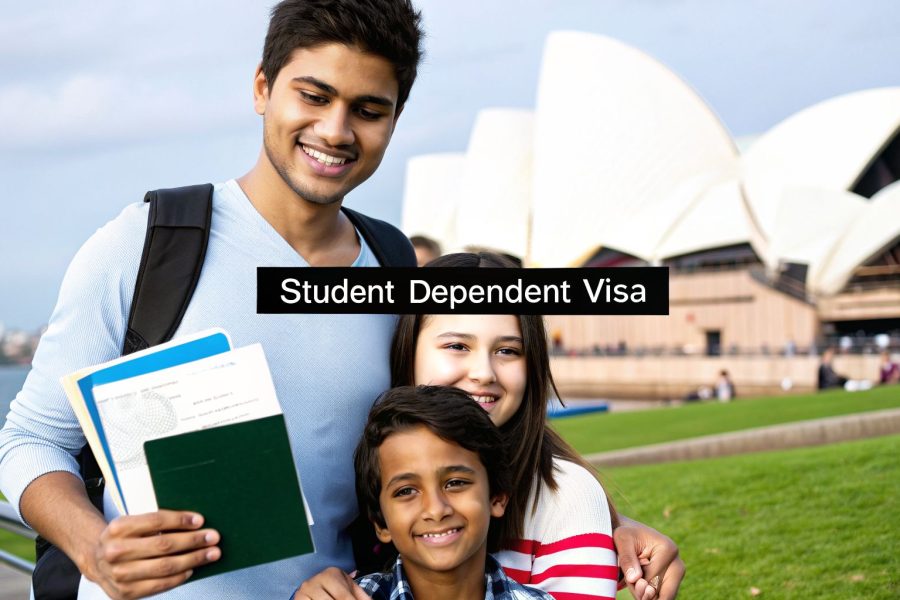
Embarking on your studies in Australia is a monumental step, but it's a journey you don’t have to take alone. The student dependent visa is a pathway built into the main Student visa (subclass 500), and it’s specifically designed to help you keep your family unit together while you chase your academic dreams. It’s the official channel for your partner and children to join you Down Under.
Disclaimer: Please be aware that Australian immigration policies are subject to change. The information provided in this article may become outdated. For the most current and personalised advice, it is highly recommended to book an appointment with a registered migration agent. All official visa application charges can be found on the Department of Home Affairs website at https://www.homeaffairs.gov.au/.
Bringing Your Family on Your Study Journey

Think of this visa as the bridge that connects your academic life with your family life. It gives your loved ones a structured way to live, and in some cases, work or study in Australia for the same duration as your course. Having that support system in place can make all the difference, turning your study abroad chapter into a shared family adventure.
But getting there requires some smart planning. One of the first big decisions you’ll need to make is when to apply. Your family can be included right from the start in your initial Student visa application, or they can apply later on as 'subsequent entrants' once you're already settled into your course. Each path has its own set of requirements and strategic angles to consider.
Why Careful Planning is So Important
The Australian student visa landscape is incredibly competitive and the rules are always evolving. To give you some perspective, for the fiscal year ending June 30, 2023, the government processed a staggering 473,634 student visa applications, with 592,342 student visa holders in the country on that date. These aren't just numbers; they reflect a system under immense pressure.
Recent government reforms, aimed at ensuring every applicant has a genuine intention to study, have only intensified the scrutiny. What does this mean for you? It means a half-hearted application just won't cut it. You need a rock-solid case that doesn’t just tick the boxes but tells a clear, compelling story to the Department of Home Affairs.
The benefits of bringing your family are huge, but they come with the responsibility of putting together a bulletproof application.
- Emotional Bedrock: Let's be honest, studying in a new country can be tough. Having your family close by provides an essential support system to navigate the highs and lows.
- A Shared Adventure: It’s an opportunity for your whole family to immerse themselves in Australian culture and create memories that will last a lifetime.
- Stability for the Kids: For those with children, it means their education and family life can continue without major disruption.
Disclaimer: Please remember, Australian immigration laws and policies can and do change. The information in this article might not be current when you read it. We always recommend booking an appointment with a registered migration agent to get the most up-to-date, personalised advice for your specific situation. For any department fees for any visa, always refer to https://www.homeaffairs.gov.au/.
For official government application charges, the Department of Home Affairs website is your source of truth. It's also a good idea to understand the bigger picture of your family's future in Australia. Check out our guide on other Australian family migration pathways to explore all the possibilities.
Who Can You Bring? Understanding Dependent Eligibility
So, you're planning to study in Australia and want to bring your family along? That's a huge step, and the first thing you need to get crystal clear on is who exactly counts as a 'family member' in the eyes of Australian immigration.
Getting this part right is absolutely foundational. The government has a very specific definition for a ‘member of the family unit,’ and if your loved ones don’t fit into their neat little boxes, your application can hit a wall before it even gets started.
Essentially, the Department of Home Affairs only recognises two main groups. Let's break down who makes the cut.
Your Partner: Spouse or De Facto
This is the most common path for couples. Your partner can be your legally married spouse or your de facto partner. The great thing is that Australia recognises same-sex relationships, so these rules apply equally to everyone.
But here’s the catch: simply saying you're a couple isn't enough. Not even close. You have to prove that your relationship is both genuine and continuing. This is a major stumbling block for many applicants. You're basically building a case, and you need solid, compelling evidence to back it up.
Think of it like telling the story of your relationship through official documents. Every piece of paper is a chapter that builds the narrative of your commitment.
- Financial Interdependence: Do you share money? Show them. Joint bank accounts, shared credit cards, a rental lease with both your names on it, or even just utility bills addressed to you both at the same address are golden.
- Social Recognition: How do you present yourselves to the world? Photos of you together at weddings, parties, and on holidays are great. Even social media posts and statutory declarations from friends and family who can vouch for you as a couple can be powerful stuff.
- Shared Commitment: What does your future look like together? Evidence like joint travel itineraries or even just messages and call logs from when you've been apart can help demonstrate that your bond is the real deal.
A Word of Caution: The Department scrutinises relationship evidence with a fine-tooth comb. Vague or insufficient proof is one of the top reasons dependent visa applications get bogged down in delays or flat-out rejected. A marriage certificate is a start, but it's the evidence of your shared day-to-day life that truly matters.
Your Dependent Children
The second category covers your (or your partner's) dependent child. The rules here are very strict: the child must be unmarried and under the age of 18. Once a child turns 18, they generally can't be included as a dependent on your student visa.
You'll also need to prove you have legal custody. If there are any custody orders from a previous relationship, you must provide the official court documents to show you have the legal right to bring the child to Australia with you.
Now for a crucial, non-negotiable point. For any school-aged child (usually between 5 and 18), you must have their schooling arrangements sorted out in Australia before you even lodge the visa application. This means you need proof of their enrolment in an Australian school. It’s a mandatory step that shows you’ve properly planned for their welfare and education, which is a big part of your responsibility as a student visa holder.
Getting your application right from the start is everything. For a deeper dive into the main visa itself, our guide on student visa assistance for the Subclass 500 offers plenty of valuable insights.
Disclaimer: Please be aware that Australian immigration policies are subject to change. The information provided in this article may become outdated. For the most current and personalised advice, it is highly recommended to book an appointment with a registered migration agent. For any department fees for any visa, always refer to https://www.homeaffairs.gov.au/.
Choosing Your Application Pathway: Onshore vs. Offshore
Where you are when you apply for the student dependent visa is a big deal. It's the first fork in the road, and it determines whether you'll be lodging an 'offshore' application (from outside Australia) or an 'onshore' one (from within Australia). Each path has its own map and its own set of rules, and understanding them can make all the difference to your family’s journey.
Think of it like planning a trip. Your starting point dictates the route you take. Getting your head around the pros and cons of each pathway is the first step to a smooth and successful application.
The Offshore Application Pathway
This is the most common route. It's for families who apply together from their home country as part of the initial Student visa (subclass 500) application. Honestly, this is often the most straightforward way to do it, as everyone’s application is looked at as a single family unit right from the get-go.
When you apply together, the Department of Home Affairs gets the full picture of your family's situation all at once. It can seriously simplify things, cutting down on paperwork and ensuring everyone's visas are granted at the same time. This makes coordinating your big move to Australia much, much easier.
So, who exactly counts as an eligible family member? Here’s a quick breakdown.

As you can see, we're mainly talking about a partner (your spouse or de facto partner) and any dependent kids who are under 18 years old.
The Onshore Application Pathway
The onshore path is for dependents who are already in Australia on another valid visa and want to switch over to join your student visa. This is what's known as a 'subsequent entrant' application. A classic example is a partner who is in Australia on a Visitor visa (subclass 600) and decides they want to stay for the duration of your course.
But be warned, this route has gotten a lot trickier recently. The government has brought in new rules that stop most visitor visa holders from applying for a student visa while they are in Australia. It's all part of a bigger plan to manage the country's migration numbers.
These policy shifts are having a real impact. According to the Australian Bureau of Statistics, net overseas migration is expected to fall by 29% in the 2024-25 financial year. A big part of that is a projected 34% drop in temporary visitors making the switch to other visas while onshore.
Navigating Bridging Visas Onshore
If you do go down the onshore path, you’ll quickly become familiar with the Bridging Visa. When your family member lodges their application to switch to a student dependent visa, they’ll usually be granted a Bridging Visa A (BVA).
A Bridging Visa is exactly what it sounds like: a 'bridge' that keeps your family member legally in Australia between their old visa expiring and a decision being made on their new one. It only kicks in once their previous substantive visa runs out.
However, bridging visas have their own set of rules you need to know about. A BVA, for instance, doesn't let you travel overseas. If your family member has to leave Australia for any reason while their application is being processed, they must apply for a Bridging Visa B (BVB) before they leave the country. Get this wrong, and they might not be able to get back in.
This is why it's so important to get your information directly from the source. This screenshot from the Department of Home Affairs website shows you where to find the official guidance on including family members in your application.
Always go to the official government website for the most accurate and up-to-date information. It’s the only way to be sure you have the right details for your application.
Disclaimer: Please be aware that Australian immigration policies are subject to change. The information provided in this article may become outdated. For the most current and personalised advice, it is highly recommended to book an appointment with a registered migration agent. For any department fees for any visa, always refer to https://www.homeaffairs.gov.au/.
Your Essential Document Checklist for a Strong Application

When it comes to a successful student dependent visa Australia application, it’s all about the paperwork. Think of it this way: you’re building a case for the Department of Home Affairs, and every claim you make needs solid proof. A single missing document can throw a wrench in the works, causing major delays or even an outright refusal.
Getting your documents in order is your best strategy. To keep things from getting overwhelming, we’ve split the essentials into four key categories. This checklist is your roadmap to putting together a "decision-ready" application that tells a clear and complete story.
Core Identity and Travel Documents
First things first, let's establish who you are. These are the non-negotiable documents that form the foundation of your entire application.
- Passports: You’ll need certified copies of the bio-data page for every single person on the application. A quick but crucial check: make sure every passport has at least six months of validity left from the day you plan to land in Australia.
- Birth Certificates: Grab the official birth certificates for everyone applying. The key here is that they must clearly list the names of both parents.
- National Identity Cards: If your country issues a national ID, you'll need to include a copy of that for each applicant too.
- Passport-Sized Photographs: Make sure you have recent, good-quality photos for each family member that meet the Department's specific photo guidelines.
A quick heads-up: if any of your documents aren't in English, you'll need to get them translated. It's best to use professional document translation services for immigration to ensure everything is certified and meets the standards.
Proving Your Relationship is Genuine
For partners, this is where the real scrutiny happens. The Department needs to see that your relationship is real and ongoing, not just something on paper.
A marriage certificate is a great start, but it’s rarely enough on its own. You have to paint a picture of a shared life. Think about documents like:
- Joint Bank Account Statements: This shows you manage your money together.
- Shared Tenancy Agreements or Property Deeds: Proof that you share a home.
- Utility Bills in Both Names: Things like electricity, gas, or internet bills addressed to both of you.
- Evidence of Social Recognition: This is the fun part! Photos of you as a couple over time, flight tickets from trips you’ve taken together, and even statements from friends and family can help.
Health and Character Requirements
Australia is serious about protecting its community, which means every visa applicant has to meet strict health and character standards.
Every family member on your student visa application must meet the health requirement. This applies even if they aren't migrating with you. It usually involves a medical check-up with a doctor approved by the Australian government.
On top of that, you’ll also need to provide:
- Police Clearance Certificates: You'll need one from every country where an applicant aged 16 or over has lived for 12 months or more in the past decade.
- Form 80: The Department might ask you to fill this out. It’s a detailed form used to assess your character.
A huge piece of the puzzle is having the right health insurance. Our guide on Overseas Student Health Cover (OSHC) breaks down what you need. Remember, your policy must cover every family member for the entire time you're in Australia.
Demonstrating Financial Capacity
Last but not least, you need to prove you have the funds to support your family without running into financial trouble. This is a deal-breaker for the Department.
You’ll need to show you have enough money to cover three things:
- Travel Costs: For everyone to get to and from Australia.
- Living Expenses: Enough for 12 months for the student, your partner, and every child.
- Schooling Costs: At least one year's worth of fees for any school-aged kids (usually 5-18 years old).
These funds have to be genuinely yours and accessible. You can prove this with bank statements, loan agreements, or scholarship letters.
To give you a clearer picture, here’s a breakdown of what the Department of Home Affairs generally expects for a 12-month period.
Minimum Financial Capacity Requirements for 2026
| Family Member | Required Annual Living Costs (as of 2026) | Important Notes |
|---|---|---|
| Primary Applicant (Student) | AUD $24,505 | This is the baseline amount for the student's personal living costs. |
| Spouse or Partner | AUD $8,574 | This is the additional amount required for your accompanying partner. |
| Dependent Child | AUD $3,670 per child | This is the extra amount needed for each dependent child included. |
| Schooling Costs | AUD $9,661 per child | Required for each child aged 5-18, in addition to living costs. |
These figures are a guide to help you plan. Having clear, well-organised financial documents is essential to showing you're well-prepared for your new life in Australia.
Disclaimer: Please be aware that Australian immigration regulations and policies are subject to change. The information provided in this article may become outdated. For the most current and personalised advice, booking an appointment with a registered migration agent is highly recommended. For any department fees for any visa, always refer to https://www.homeaffairs.gov.au/.
Getting to Grips With Your Visa Conditions in Australia

Getting that student dependent visa Australia grant is a huge moment, but it's really just the first step. Your visa comes with a set of rules—or conditions—that you and your family absolutely must follow to stay legally in the country.
Think of these conditions as the "terms of service" for your time here. They aren't just suggestions; they're essential for ensuring everything goes smoothly.
Getting your head around these rules isn't about box-ticking or avoiding trouble. It's about empowering you to plan your family's future with confidence—from finances to your kids' schooling. A simple mistake can cause big problems, so let’s break down exactly what you need to know.
Work Rights for Dependents
This is probably the number one question we get from families: "Can my partner work?" The answer is yes, but it comes with a specific limit that’s tied to the primary student's course.
The standard rule is that your dependent partner can work up to 48 hours per fortnight. This clock starts ticking as soon as the main student visa holder officially begins their course. It’s vital you keep a close eye on these hours, as going over the limit is a breach of your visa conditions.
But there's a major exception to this rule, and it's a big one.
If the primary student is studying a master’s degree by research or a doctoral degree (PhD), their partner gets unlimited work rights. This is a massive advantage that reflects the demanding nature of these higher-level research qualifications.
This exception can be a real game-changer, offering much-needed financial breathing room. Always, always check the official visa grant letter from the Department of Home Affairs to see which work rights apply to your specific situation.
Study and Schooling Obligations
Your dependents can also study in Australia, but there are different rules for partners and children. While your partner has some flexibility, the rules around your children’s education are non-negotiable.
Here’s how it works:
- Study Rights for Partners: Your partner is allowed to study for up to three months on their dependent visa. If they get the study bug and want to enrol in a course that’s longer than that, they'll need to apply for their own separate student visa.
- Mandatory School Enrolment for Children: This is an absolute must. Any dependent child you bring to Australia who is between the ages of 5 and 18 must be enrolled in school. You’ll need to show proof of this enrolment when you apply for the visa.
Failing to have your school-aged kids in school is a serious breach of your visa conditions and can put your whole family's stay in Australia at risk.
Maintaining Health Cover is Essential
Finally, there’s one condition that hangs over everyone on the visa for the entire time you're in Australia: Overseas Student Health Cover (OSHC). You are required to have and maintain adequate health insurance for yourself and every family member with you.
Your OSHC policy must be active from the day you land in Australia right through to the day you leave. Letting your cover lapse, even for a short time, is a major breach of your visa conditions. It’s your family’s safety net and a core requirement from the Australian government.
Disclaimer: Please be aware that Australian immigration policies are subject to change. The information provided in this article may become outdated. For the most current and personalised advice, it is highly recommended to book an appointment with a registered migration agent. For any department fees for any visa, always refer to https://www.homeaffairs.gov.au/.
Bringing Your Family to Australia Shouldn't Be a Gamble
Trying to figure out the student dependent visa process on your own can feel like wading through mud. As we've covered, it’s a path filled with potential pitfalls, from proving your relationship is genuine to satisfying the Department's strict financial requirements.
At My Visa Guide, we get it. We know that behind every single application is a family with real hopes and dreams. Our job is to help turn those dreams into reality.
As MARA-certified experts led by Vijay Bharti (MARN 2217817), we specialise in making sense of the complex and building clear pathways to success. We'll give you a thorough, honest assessment of your chances from the get-go, meticulously guide you in preparing your documents, and handle the entire application from start to finish.
Building Your Strongest Possible Case
Our whole mission is to provide clear, ethical, and effective advice that makes your family’s journey to Australia as smooth as it can be. We cut through the red tape and show you the way forward.
While Australia's offshore student visa grant rate is still a healthy 86.5%, the system is under enormous pressure. Consider this: the Administrative Review Tribunal is expected to have a backlog of 46,000 student visa refusal reviews by October 2025. This shows that even solid applications can hit a wall without expert preparation. You can read more about the latest student visa success rates and processing trends.
My Visa Guide is here to help you build an application that’s designed for a yes from day one. We can help with:
- Comprehensive Eligibility Checks: We’ll size up your family's situation against the most current immigration rules.
- Meticulous Document Guidance: We help you find and present every piece of evidence needed to build a rock-solid case.
- Full Application Management: From lodging the application to dealing with the Department, we’ve got it covered.
Disclaimer: Australian immigration law and government policies can change overnight. The information in this article might not be current when you read it. We always recommend booking a consultation with a registered migration agent for advice tailored to your specific situation. For the latest visa fees, the official Department of Home Affairs website is your best source: https://www.homeaffairs.gov.au/.
Got Questions? We’ve Got Answers
When you're trying to figure out the student dependent visa for Australia, it's only natural for a lot of specific questions to pop up. To give you some clear, straightforward answers, here are a few of the most common queries we handle.
Can My Dependent Partner Work Full-Time in Australia?
This is a big one. Generally, your partner's work rights are capped at 48 hours per fortnight once your course officially kicks off.
There is one major exception, though. If you, as the primary student visa holder, are doing a master’s by research or a PhD, your partner might get unlimited work rights. The golden rule is to always check the specific conditions printed on your official visa grant letter – that’s the final word.
What Happens if My Child Turns 18 While in Australia?
If your child was under 18 when their dependent visa was granted, they can usually stay on it until it expires, even after their 18th birthday.
However, once that visa runs out, they're no longer considered your dependent for future applications. If they want to stay in Australia, they'll need to qualify for a new visa in their own right, like getting their own student visa to study here.
How Much Money Do I Need to Show for My Family?
You’ll need to prove you have enough money to cover a full year of living costs for everyone in your family unit. This also includes travel expenses and school fees for any school-aged children.
The Department of Home Affairs sets these amounts, and they do get updated from time to time. It’s absolutely vital to check the official government website for the most current figures before you lodge your application.
Can I Add My Parents as Dependents on My Student Visa?
Unfortunately, no. The Australian student visa framework is very specific about who counts as a ‘member of the family unit’. It’s strictly limited to your partner (spouse or de facto) and your dependent children under 18.
Your parents would need to look into other visa options, like a Visitor Visa, if they want to come to Australia for a visit.
Disclaimer: Please remember that Australian immigration regulations and policies are dynamic and can change without notice. The information provided here may no longer be accurate when you are reading it. To receive the most current and personalised advice, it is highly recommended to book an appointment with a registered migration agent. For all official department fees for any visa, always refer to https://www.homeaffairs.gov.au/.
Navigating these complexities is where expert guidance makes a real difference. At My Visa Guide, our team of MARA-certified agents is here to provide the clear, accurate, and strategic advice you need to bring your family to Australia with confidence.
Ready to start your journey? Book a consultation with us today!