When you start looking into skilled migration for Australia, one of the first questions that pops up is about cost. The skills assessment fee isn't just a number; it's your first real investment in making this dream happen. Generally, you can expect this to be anywhere from $500 to over $1,500 AUD, but it really depends on your specific line of work and which organisation is tasked with verifying your credentials.
Think of it as your "professional passport." It's the official process that validates your qualifications and work experience against Australian industry standards.
Disclaimer: Migration laws and fees are subject to change. The information provided here is for general guidance and may not be current. To ensure you have the most up-to-date information, we strongly recommend booking an appointment with a registered migration agent. Please refer to the official Department of Home Affairs website at https://www.homeaffairs.gov.au/ for any government visa fees.
Understanding The True Cost Of Your Australian Dream
Before you can even get in the queue for popular skilled visas like the Subclass 189, 190, or 491 by lodging an Expression of Interest (EOI), you need a positive skills assessment. It's non-negotiable. This is the green light that says your skills are officially recognised and up to the high standards required to work in your profession Down Under.
But here’s the thing: there's no flat fee. The cost is all over the place because each profession is handled by a specific assessing authority, and they all set their own prices. An IT professional going through the Australian Computer Society (ACS) will pay something different to a mechanical engineer applying with Engineers Australia (EA), or a carpenter needing a tick from Trades Recognition Australia (TRA).
A First Look At The Costs
This initial outlay is a cornerstone of your migration budget. It's not just an administrative fee; it’s the key that unlocks your eligibility to even apply for a skilled visa. Without it, the door stays firmly shut.
To give you a clearer idea of what to expect, we've put together a quick guide to the standard fees for some of the main assessing bodies.
Estimated Skills Assessment Fees At A Glance
This table gives you a ballpark figure for the standard application costs from some of Australia's most prominent skills assessing authorities. Keep in mind these are just estimates and can change.
| Assessing Authority | Primary Occupations Covered | Estimated Standard Fee Range (AUD) |
|---|---|---|
| VETASSESS | General Professional & Trade Occupations | $880 – $1,526 |
| Australian Computer Society (ACS) | Information & Communication Technology (ICT) | $560 – $1,450 |
| Engineers Australia (EA) | Engineering Professionals | $850 – $1,315 |
| Trades Recognition Australia (TRA) | Various Trade Occupations | $720 – $1,280 |
| ANMAC | Nursing and Midwifery Professions | $540 – $690 |
As you can see, the costs vary quite a bit. That's why getting a handle on your specific requirements early on is so important for planning. If you want to see how this fits into the bigger picture, our guide to https://www.myvisaguide.com.au/skilled-migration/ is a great place to start.
Beyond these initial fees, getting your head around your future tax obligations is a smart move for your overall financial planning. Getting a jump on understanding taxes for expats can help you prepare for what's ahead. This skills assessment fee is just the first step in a much bigger, and very exciting, journey.
Disclaimer: Migration laws and fees are subject to change. The information provided here is for general guidance and may not be current. To ensure you have the most up-to-date information, we strongly recommend booking an appointment with a registered migration agent. Please refer to the official Department of Home Affairs website at https://www.homeaffairs.gov.au/ for any government visa fees.
Why a Skills Assessment Is Your First, Non-Negotiable Step
So, you’re thinking about a skilled visa for Australia? Before you get lost in visa subclasses and points calculators, there’s a critical first hurdle you need to clear: the skills assessment. This is the official process where a designated body puts your qualifications and work history under a microscope to see if they measure up to Australian standards.
Think of it as getting your professional passport stamped. It’s the formal verification that says, "Yes, your skills are what we need." This isn't just a box-ticking exercise; it's the absolute foundation for the most common skilled visas, like the Subclass 189, 190, and 491. Without a positive assessment, your application is a non-starter.
If you're making a big career change, this step is even more vital. A practical guide on how to change careers in Australia really drives home how this initial check shapes your entire migration pathway.
What Are They Really Looking For?
At its heart, a skills assessment is about matching you to a specific occupation. Every profession has a unique Australian and New Zealand Standard Classification of Occupations (ANZSCO) code, and the assessing authority's job is to see if your career genuinely fits the description for that code.
They don't just glance at your degree. They dig deep into two key areas:
- Your Qualifications: Is your degree, diploma, or trade certificate truly equivalent to its Australian counterpart? They’ll scrutinise everything—your transcripts, where you studied, and even the specific subjects you took.
- Your Work Experience: Does what you actually do day-to-day line up with the duties listed for your ANZSCO code? This is where many people get tripped up. Your reference letters need to be incredibly detailed, spelling out your responsibilities, not just listing your job title.
For instance, an IT professional wanting to be assessed as a "Software Engineer" has to prove they were involved in designing, developing, and testing software. Simply providing evidence of general IT support work won't cut it. Vague job descriptions are one of the fastest routes to a negative outcome.
Your Professional Ticket to the Migration Pool
A positive skills assessment is the official green light that tells the Department of Home Affairs you’ve got the goods. It’s the proof that your professional background isn't just a claim on a form—it's been independently verified by experts.
A positive skills assessment is the bedrock of a strong visa application. It proves to the Australian government that your professional history has been officially validated, massively boosting your eligibility for skilled migration.
This single document is what unlocks your ability to submit an Expression of Interest (EOI) and join the pool of candidates waiting for a visa invitation. Without it, you can't even get in the game.
It’s crucial to see this for what it is. It's not just another administrative task or a fee to be paid. It’s the essential first move that validates your entire professional identity within the Australian system, setting the stage for everything that follows.
Disclaimer: Migration laws and fees are subject to change. The information provided here is for general guidance and may not be current. To ensure you have the most up-to-date information, we strongly recommend booking an appointment with a registered migration agent. Please refer to the official Department of Home Affairs website at https://www.homeaffairs.gov.au/ for any government visa fees.
What Are the Fees For Australia's Main Skills Assessment Bodies?
When you start digging into the skills assessment process, one of the first things you'll notice is that there’s no single, flat fee. The cost really depends on who is assessing your profession. Each assessing authority has its own rulebook, different pathways, and, of course, a unique price list. The final figure is directly linked to how complex your occupation is and the level of detail they need to verify.
Budgeting for this is a crucial first step. It helps to understand why an IT professional's assessment might have a different price tag than a general manager's. It often comes down to the evidence required—some fields need you to submit detailed project reports or technical portfolios, which naturally adds more layers (and cost) to the evaluation.
The infographic below really nails down the core purpose of this whole exercise, showing how your qualifications and experience are the building blocks for your visa eligibility.
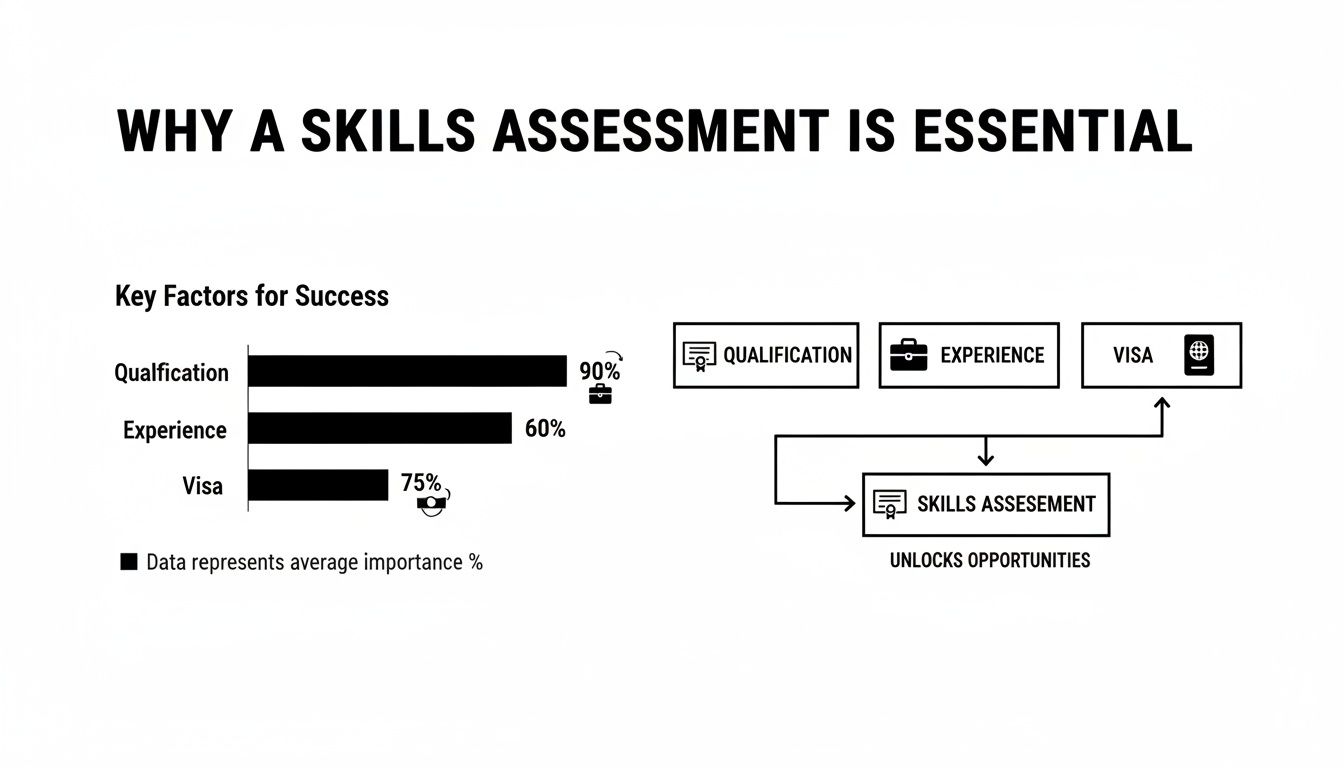
Think of the assessment as the critical bridge connecting your professional life to your Australian migration goals. Let's break down the actual costs you can expect from some of the most common assessing bodies.
VETASSESS for General Professional Occupations
VETASSESS is a big one. They handle a huge range of general professional and trade roles, from marketing specialists to internal auditors. Because they cover so much ground, their fees are tiered to match what you’re applying for.
- Full Skills Assessment: This is the go-to for most migration applications, covering both your qualifications and work experience. You’re looking at around $1,058.20 AUD if you’re applying from within Australia (GST included), and it's slightly cheaper for offshore applicants.
- Post-485 Skills Assessment: Specifically for graduates from Australian institutions, this pathway is often a bit less, typically around $950 AUD.
- Priority Processing: If time is tight, VETASSESS offers a fast-track service for an extra $660 AUD. It can seriously cut down your waiting time.
Getting the right pathway is key. Picking the wrong one could mean paying for a service that isn’t suitable for your visa or that you simply don’t need.
Australian Computer Society (ACS) for ICT Professionals
If you're in the tech world, the Australian Computer Society is your gatekeeper. The skill assessment fee for Australia for ICT roles really hinges on the type of application you need.
The ACS has a few different routes, each with its own price:
- Temporary Graduate (Post-485): For recent IT grads from Australian unis, the fee is about $560 AUD.
- Skills (General Application): This is the standard path for experienced ICT professionals, costing roughly $605 AUD.
- Recognition of Prior Learning (RPL): This is for applicants who have heaps of industry experience but no formal ICT qualification. It’s a more intense review, so it costs more—around $665 AUD.
- Review or Appeal: If you get a negative outcome and want them to take a second look, there are separate fees for that, starting from $475 AUD.
The higher price for an RPL application makes sense when you consider the extra work involved. You have to submit detailed project reports to prove your knowledge, which means a more labour-intensive assessment for the ACS.
Engineers Australia (EA) for Engineering Occupations
For engineers, Engineers Australia is the authority. Their process can be incredibly detailed, especially if your qualifications aren't from a country that has a formal agreement with Australia. This complexity is baked into their fees.
- Standard Competency Demonstration Report (CDR): This is the main pathway for engineers with non-accredited qualifications. The standard assessment fee is approximately $962.50 AUD (with GST for onshore applicants).
- Fast Track Service: Like the others, EA has an express lane. It’ll cost you an extra $379.50 AUD.
- Relevant Skilled Employment Assessment: Need your work experience formally assessed on top of your qualifications? That’s an additional service, typically around $462 AUD.
The table below provides a clearer side-by-side look at the costs for these major authorities.
Detailed Fee Comparison For Popular Assessing Bodies
Here’s a breakdown of the various fees you might encounter, including standard processing, priority options, and appeals for some of the most common assessing bodies.
| Assessing Authority | Service Type | Onshore Fee (AUD) | Offshore Fee (AUD) | Notes |
|---|---|---|---|---|
| VETASSESS | Full Skills Assessment | $1,058.20 | $962.00 | Standard pathway for most professionals. |
| Priority Processing | +$660.00 | +$600.00 | Significantly reduces processing time. | |
| Review Application | $448.80 | $408.00 | For a review of a negative outcome. | |
| ACS | Skills (General Application) | $605.00 | $605.00 | Standard for experienced ICT professionals. |
| Recognition of Prior Learning (RPL) | $665.00 | $665.00 | For applicants without formal ICT qualifications. | |
| Review Application | $475.00 | $475.00 | To have an unsuccessful application reviewed. | |
| Engineers Australia | Standard CDR Assessment | $962.50 | $875.00 | Main pathway for engineers with non-accredited qualifications. |
| Fast Track Service | +$379.50 | +$345.00 | Expedited processing option. | |
| Skilled Employment Assessment | +$462.00 | +$420.00 | Optional add-on for work experience assessment. |
This table shows just how much the fees can vary not just between bodies, but also based on the specific services you need. Always double-check the official websites for the most current pricing before you lodge your application.
One clear trend is that fees are always on the rise. Between 2019 and 2025, skills assessment costs have climbed steadily, impacting everyone from skilled migrants to international graduates. For instance, Managers & Leaders (which assesses management occupations) set its Migration Skills Assessment fee at $788 AUD for offshore applicants and $866 AUD (including GST) for those in Australia, effective from 8 September 2025. This is a noticeable jump from just a few years ago when similar assessments were in the $500–$700 AUD range, reflecting higher administrative and compliance costs across the board. You can learn more about these changes on their official website.
Disclaimer: Migration laws and fees are subject to change. The information provided here is for general guidance and may not be current. To ensure you have the most up-to-date information, we strongly recommend booking an appointment with a registered migration agent. Please refer to the official Department of Home Affairs website at https://www.homeaffairs.gov.au/ for any government visa fees.
Factoring In The Hidden Costs Of Your Application

The standard skill assessment fee for Australia you see on an assessing body’s website is rarely the full picture. It’s really just the tip of the iceberg. Many applicants get caught off guard by the extra expenses that inevitably pop up, which can quickly blow out their budget.
Thinking about these potential costs from the very beginning helps you build a much more realistic financial plan for your migration journey. These aren't just minor add-ons; they are essential services that can make or break your application.
Priority Processing Fees
Are you racing against the clock? Maybe your current visa is about to expire, or a state nomination window is closing fast. If that’s your situation, you’ll probably need to consider paying for priority processing.
Most of the major assessing authorities offer this fast-track service, but it comes at a premium. This can add an extra 50% to 70% on top of your base application fee. For instance, VETASSESS charges an extra $600 AUD for its priority service for offshore applicants. It’s a hefty price, but it can slash your waiting time from months down to just a few weeks—which can be absolutely critical when time is not on your side.
Reviews, Appeals and Re-assessments
So, what happens if you get a negative outcome? It’s a gut-wrenching moment, but it’s not always the end of the line. Most assessing bodies have pathways for you to request a review or launch a formal appeal. Unsurprisingly, these services come with their own fees.
A review might set you back several hundred dollars, and there’s no guarantee the decision will be overturned. And don’t forget that skills assessments have an expiry date, typically three years. If yours expires, you’ll have to apply for a renewal or a completely new assessment, meaning you pay the full fee all over again.
Ancillary and Third-Party Costs
Beyond the fees you pay directly to the assessing authority, a whole range of other expenses will almost certainly come into play. These are the third-party costs that are easy to forget but are absolutely essential for a successful application.
- Document Translation: Are your work references or university transcripts in a language other than English? You’ll need to get them translated by a NAATI-accredited translator. This can cost anywhere from $40 to $80 per page.
- Document Certification: Many authorities demand certified true copies of your documents. Depending on where you are, you may need to pay a Justice of the Peace or a notary public for this service.
- Courier Fees: If you have to send original documents or need a hard copy of your assessment outcome, international courier fees can easily add another $50 to $100 to your total.
- Professional Memberships: For some occupations, particularly in accounting or engineering, you might need to be a paid-up member of a professional body as a prerequisite for your assessment.
These extra costs aren't just an anecdotal problem. A 2024 government report on a Faster Migrant Skills Assessments Pilot found the average cost of a fast-tracked assessment was A$852. On the bright side, the pilot showed a clear return on investment, with 56% of employed participants reporting higher earnings after getting their positive assessment. You can dive into the full findings in the official skills assessment pilot evaluation report.
Disclaimer: Migration laws and fees are subject to change. The information provided here is for general guidance and may not be current. To ensure you have the most up-to-date information, we strongly recommend booking an appointment with a registered migration agent. Please refer to the official Department of Home Affairs website at https://www.homeaffairs.gov.au/ for any government visa fees.
Navigating The Application Process And Timelines
Knowing the costs is one thing, but understanding how to actually get through the skills assessment process is where the real work begins. Think of it as a clear pathway—if you follow the signposts correctly, you’ll save yourself a world of time, money, and stress. A strong application is your best insurance that your investment in the skill assessment fee for Australia pays off.
The whole journey kicks off with one crucial step: locking in your correct Australian and New Zealand Standard Classification of Occupations (ANZSCO) code. Getting this wrong is an easy and expensive mistake to make. An assessing authority will only evaluate you against the single occupation you nominate, so there’s no room for error here.
The Step-by-Step Journey
Once you’ve got your ANZSCO code sorted, the process follows a fairly standard sequence. Be warned, though—the preparation stage is by far the most time-consuming part, but it’s also the most critical.
- Gather Flawless Documentation: This is the make-or-break stage. You'll need certified copies of your qualifications, academic transcripts, and ID. But the real heavy lifting is in your employment reference letters. They need to be incredibly detailed, spelling out exactly how your day-to-day duties match the tasks listed in the official ANZSCO description for your job.
- Lodge Your Application Online: These days, pretty much every assessing body has an online portal. You'll set up an account, fill out the form, upload all your carefully prepared documents, and pay the fee.
- Await the Outcome: After you hit ‘submit,’ the waiting game begins. The authority will comb through your evidence to see if your skills and experience are up to Australian standards.
A meticulously prepared application is your best defence against delays. Every missing document or vague employment reference is an invitation for the assessing authority to issue a request for more information, pushing your application to the back of the queue and extending your wait time.
Setting Realistic Timelines
Processing times can swing wildly from one authority to another, often depending on how swamped they are with applications. As a general rule, standard processing can take anywhere from eight to sixteen weeks, and sometimes even longer for more complex trade assessments.
If you’re racing against a deadline, many bodies offer a priority processing service for an extra fee. This can often slash the waiting time to just a few weeks. But be aware, these fast-track options can be paused during busy periods. For instance, the Australasian Veterinary Boards Council (AVBC) had to temporarily halt its priority service between late 2023 and early 2024 due to high demand. It’s a perfect example of how timelines—and even available services—can change with little notice. You can learn more about their skills assessment fee changes.
Validity Periods And Refund Policies
A positive skills assessment is a huge win, but it has an expiry date. Typically, your assessment is valid for migration purposes for three years from the day it’s issued. You must make sure it’s still valid when you get your invitation to apply for a visa.
It’s also crucial to know that refund policies are incredibly strict. The skill assessment fee pays for the administrative work of the evaluation itself, whether you get a good outcome or not. In almost all situations, the fees are non-refundable if your application is unsuccessful. This makes it absolutely vital to submit a complete, decision-ready application right from the start. Getting a positive outcome is a foundational piece of the entire skilled migration puzzle, which you can learn more about in our comprehensive skilled visa guide.
Disclaimer: Migration laws and fees are subject to change. The information provided here is for general guidance and may not be current. To ensure you have the most up-to-date information, we strongly recommend booking an appointment with a registered migration agent. Please refer to the official Department of Home Affairs website at https://www.homeaffairs.gov.au/ for any government visa fees.
Getting It Right the First Time: Why an Expert Partner is a Must
Your skills assessment is a major investment in your future. Trying to tackle this critical first step on your own is a huge risk. Simple mistakes can lead to a negative outcome, forcing you to pay for the whole thing all over again and causing serious delays to your plans. Don’t leave your migration dream to chance.
This is where a MARA-certified expert becomes your most valuable asset. A registered migration agent does so much more than just fill out paperwork; they work with you to build a powerful, decision-ready application from the very beginning. They’ll ensure you’ve chosen the right ANZSCO code and that every piece of evidence, especially your employment reference letters, ticks all the boxes for the assessing authority.
Why Professional Guidance Makes All the Difference
It's heartbreakingly easy for common application errors to completely derail your visa plans, turning a significant investment into a total loss. These are the classic pitfalls we see all the time:
- Picking the wrong ANZSCO code: This is a fatal mistake. It leads to an automatic negative outcome, no questions asked.
- Submitting weak or generic evidence: Vague, poorly written reference letters are one of the top reasons applications get rejected.
- Missing specific requirements: Every assessing body has its own unique, and often confusing, set of rules that are easy to overlook.
An expert guide helps you sidestep these traps completely. At My Visa Guide, our team, led by Registered Migration Agent Vijay Bharti, develops a personalised strategy to frame your skills and experience in the strongest possible light. For a deeper dive, check out our guide on the key factors to consider when you look for tips for choosing a migration agent.
Let us handle the complexities so you can stay focused on your future in Australia. Book a consultation today and move forward with confidence.
Disclaimer: Migration laws and fees are subject to change. The information provided here is for general guidance and may not be current. To ensure you have the most up-to-date information, we strongly recommend booking an appointment with a registered migration agent. Please refer to the official Department of Home Affairs website at https://www.homeaffairs.gov.au/ for any government visa fees.
Got Questions? We've Got Answers
The skills assessment process can feel like a maze. It's completely normal to have questions pop up along the way. Here are some straightforward answers to the most common queries we hear from applicants.
What if My Skills Assessment Comes Back Negative? Can I Get a Refund?
This is a tough one, but generally, the answer is no. Think of the skill assessment fee for Australia as payment for the work done, not for the outcome. The assessing authority has invested time and resources to review your qualifications and experience. Because that work has been completed, refunds aren't typically issued, even for a negative result.
How Long Does a Positive Skills Assessment Last?
Your positive skills assessment is usually valid for three years from the date it's issued. Keep in mind, this can sometimes differ slightly between assessing bodies, so always double-check. The key is to make sure your assessment is still valid when you receive that all-important invitation to apply for your visa.
Will I Have to Pay GST on My Skills Assessment Fee?
This all comes down to where you are when you hit 'submit'. If you're lodging your application from within Australia, then yes, you can expect to pay the Goods and Services Tax (GST). However, if you're applying from overseas, you're generally exempt from this tax.
What's the Difference Between a Review and an Appeal?
It’s easy to mix these up. A ‘review’ is basically asking for a second opinion internally. A different, more senior assessor will take a fresh look at your original application to see if any errors were made the first time around.
An ‘appeal’, on the other hand, is a more formal and serious challenge to the decision itself. It's less about checking for errors and more about contesting the final judgement, which can sometimes involve an external body. Both routes come with their own fees and very strict deadlines.
At My Visa Guide, our entire focus is on providing clear, ethical, and effective migration advice. Don't risk your time and money on an application that isn't quite right. Book a consultation with one of our MARA-certified experts. We'll help you make sure your skills assessment is decision-ready from day one, giving you the strongest possible chance of success.
Disclaimer: Migration laws and fees are subject to change. The information provided here is for general guidance and may not be current. To ensure you have the most up-to-date information, we strongly recommend booking an appointment with a registered migration agent. Please refer to the official Department of Home Affairs website at https://www.homeaffairs.gov.au/ for any government visa fees.