While the old Regional Sponsored Migration Scheme (Subclass 187) has closed its doors to new applicants, its spirit lives on through newer, more refined visa pathways. The main player in this space now is the Subclass 494 Skilled Employer Sponsored Regional (Provisional) visa, a pathway specifically created to bring talented people to regional Australia with a clear road to permanent residency.
Disclaimer: Migration laws and visa requirements are subject to change. The information provided here is for general guidance and should not be considered legal advice. The information in this article may no longer be accurate at the time of reading. For the latest, most accurate information tailored to your circumstances, it is essential to book an appointment with a registered migration agent. All government fees can be confirmed on the official Department of Home Affairs website.
Understanding Australia's Regional Migration Program
The government's push for regional migration isn't just a policy—it's a deliberate strategy. The goal is to spread the economic and social benefits of skilled migration beyond the major hubs of Sydney, Melbourne, and Brisbane. Think of it as a nationwide effort to boost growth, plug critical skills gaps, and build more vibrant communities in the towns and smaller cities that form the backbone of the country. The "regional sponsored migration scheme" is the overarching framework that makes this happen.
It’s a genuine win-win. Regional businesses get to tap into a global talent pool to fill roles they simply can't find locals for, which helps them grow and prosper. In return, skilled migrants and their families get a structured pathway to live and work in Australia—often enjoying a more relaxed lifestyle and a lower cost of living—with the ultimate goal of settling here for good.
The Key Players in Your Migration Journey
Getting this right isn't a solo act; it's a partnership between three key parties. Grasping what each one does is the very first step to lodging a successful application.
-
You, the Skilled Applicant: You're the professional with the qualifications, work experience, and English skills that a regional business needs. Your job is to prove you meet all the strict criteria laid out by the Department of Home Affairs.
-
Your Sponsoring Employer: This is the Australian business, based in a designated regional area, that has offered you the job. They need to be an approved sponsor and prove they have a genuine need for someone with your specific skills.
-
The Department of Home Affairs: This is the government department that has the final say. They assess every visa and nomination application, set the rules, and ensure the entire program runs with integrity.
Important Disclaimer: Australian migration law changes all the time. The information here is for general guidance only and shouldn't be taken as legal advice. To get the most up-to-date and personalised advice for your situation, you must book a consultation with a registered migration agent. The information in this article may no longer be accurate at the time of reading. All official government fees are available on the Department of Home Affairs website.
Making your way through the regional sponsored migration scheme is all about understanding how these three pieces fit together. Your employer nominates you for a role, and you then apply for the visa. The Department of Home Affairs looks at both sides of the application before making a decision. This guide will walk you through each stage, showing you exactly how to turn that regional job offer into a new life in Australia.
Exploring the Main Regional Sponsored Visa Pathways
At the heart of Australia's modern regional migration strategy is the Subclass 494 Skilled Employer Sponsored Regional (Provisional) visa. This is the go-to pathway for skilled professionals who’ve landed a job offer outside of the major cities like Sydney, Melbourne, and Brisbane.
Think of it as your primary ticket to building a new life and career in one of Australia's thriving regional communities. It's not just a temporary work visa; it's a deliberate stepping stone. The Subclass 494 offers a structured five-year provisional stay that directly paves the way to permanent residency for those who commit to their regional home.
Disclaimer: Migration laws and visa requirements are subject to change. The information provided here is for general guidance and should not be considered legal advice. The information in this article may no longer be accurate at the time of reading. For the latest, most accurate information tailored to your circumstances, it is essential to book an appointment with a registered migration agent. All government fees can be confirmed on the official Department of Home Affairs website.
The Two Streams of the Subclass 494 Visa
To understand how it works, you need to know about its two distinct streams. Both lead to the same destination, but they cater to different employer situations.
-
The Employer Sponsored Stream: This is the most common route. It’s for when a regional business has a specific, skilled role they genuinely can't fill with local talent. The job must be on the relevant skilled occupation list, and the employer generally needs to prove they’ve looked for an Australian worker first through Labour Market Testing.
-
The Labour Agreement Stream: This stream is a more tailored solution. It's for employers who have negotiated a special arrangement with the Australian government to bring in skilled workers for industries with unique or ongoing shortages that aren't covered by the standard visa programs.
No matter the stream, a genuine job offer from an approved regional employer is a must. The key difference is whether the job fits a standard occupation list or a pre-approved, bespoke agreement. This flexibility is what allows the regional scheme to adapt to the diverse needs of regional economies.
The Pathway to Permanent Residency
One of the best features of the Subclass 494 visa is its direct link to permanent residency. Once you’ve held the visa for at least three years and met a few key requirements, you can apply for the Subclass 191 Permanent Residence (Skilled Regional) visa.
What are those requirements? You need to have lived, worked, and (if applicable) studied only in a designated regional area and met a minimum income threshold during that time.
This two-stage process ensures that migrants make a real contribution to their local community before being granted permanent status. The government has also made the system more flexible recently. For example, Subclass 494 visa holders can now change employers more easily, and work experience with any approved regional sponsor can count towards their permanent residency application.
How Does the Regional Visa Compare to Non-Regional Options?
To really see the value in the regional sponsored migration scheme, it helps to put it side-by-side with its big-city cousin: the Subclass 186 Employer Nomination Scheme (ENS) visa. They're both employer-sponsored, but they serve different purposes entirely. Knowing these differences is critical when deciding which of the skilled visa options is the right fit for you.
To help you see how they stack up, here’s a quick comparison.
Subclass 494 vs. Subclass 186 At a Glance
| Feature | Subclass 494 (Regional) | Subclass 186 (ENS) |
|---|---|---|
| Location Requirement | Must live and work in a designated regional area. | No location restrictions; can be anywhere in Australia. |
| Visa Type | Provisional visa valid for 5 years. | Permanent residency from day one. |
| PR Pathway | Leads to PR via the Subclass 191 after 3 years of regional commitment. | Grants immediate permanent residency. |
| Age Limit | Generally must be under 45 years old. | Generally must be under 45 years old. |
| Skills Assessment | Mandatory for almost all applicants. | Mandatory for the Direct Entry stream. |
| Employer Nomination | Requires nomination from an employer in a designated regional area. | Requires nomination from any eligible Australian employer. |
As you can see, the Subclass 494 offers a clear but staged path to residency that’s tied to a regional commitment. In contrast, the Subclass 186 provides that coveted permanent residency stamp in your passport straight away but often comes with tougher experience requirements from the get-go. Your choice really depends on your career, your long-term goals, and whether you're ready for life outside the big smoke.
A Practical Checklist for Skilled Visa Applicants
Before you even think about lodging an application for a regional sponsored visa, you need to know exactly where you stand. This isn’t just about ticking off boxes; think of this as your personal pre-flight check, a way to assess your own profile against the non-negotiables.
Getting these fundamentals right from the outset is crucial. The Department of Home Affairs has a clear set of benchmarks, and these are the first things they’ll look at.
Disclaimer: Migration laws and visa requirements are subject to change. The information provided here is for general guidance and should not be considered legal advice. The information in this article may no longer be accurate at the time of reading. For the latest, most accurate information tailored to your circumstances, it is essential to book an appointment with a registered migration agent. All government fees can be confirmed on the official Department of Home Affairs website.
Core Eligibility Requirements
The government lays out these core requirements to make sure anyone coming to regional Australia on a skilled visa can hit the ground running. They’re designed to be straightforward, so every potential applicant knows what’s expected.
- Age Limit: For the most common streams of the Subclass 494 visa, you absolutely must be under 45 years of age when you apply. This isn't flexible. It's in place to ensure applicants have a long working life ahead of them in Australia.
- English Proficiency: You'll need to prove you have at least Competent English. This usually means getting a minimum score on a recognised test like IELTS, PTE Academic, or TOEFL iBT. This isn't just red tape—it's about ensuring you can communicate clearly and safely at work and in the community.
- Health and Character: Every applicant must meet Australia’s health and character standards. This means you'll need to complete a medical examination and get police clearance certificates for countries you've lived in for a significant time.
These are the foundational pillars of your application. If you fall short on any one of these, your application can be stopped in its tracks before it even gets going.
The All-Important Skills Assessment
Once you’ve cleared those initial hurdles, you face what is arguably the most critical step: the skills assessment. This is where an independent body, officially recognised by the government, puts your qualifications and work experience under the microscope.
A skills assessment is essentially a professional seal of approval. It’s an impartial authority for your occupation confirming that your skills and experience are genuine and meet the standards expected in Australia.
For instance, an accountant’s qualifications would be scrutinised by an authority like CPA Australia, while a software developer would likely go through the Australian Computer Society (ACS). For most skilled visa applicants, this is a mandatory step that proves you can actually do the job you’re being nominated for. It gives the government confidence that you’re bringing valuable, verified expertise to the region.
This step is particularly important for the talented people looking to make a life in regional Australia. Whether you're an international student on a Subclass 500 visa or a skilled professional from a country like India—which recently saw an 11,000-person increase in migration to Australia—validating your skills early is the key to a successful pathway. You can get a better sense of these trends in the latest International Migration Outlook from the OECD.
By working through this checklist methodically—confirming your age, locking in your English score, and, most importantly, securing that positive skills assessment—you’re building the strong, solid foundation your regional visa application needs to succeed.
What Do Regional Employers Need to Know About Sponsorship?
For any skilled migration visa to get off the ground, an Australian business needs to be leading the charge. The whole process really hangs on the employer meeting a strict set of rules—rules designed to protect the local job market and the integrity of the whole migration program.
First things first, you have to become an approved sponsor. This means applying to be a Standard Business Sponsor (SBS), which is where you prove your business is legitimate, financially stable, and operating lawfully. Think of it as getting your official licence to bring in overseas talent. This status usually lasts for five years, giving you a good window to nominate multiple skilled workers if you need to.
Disclaimer: Migration laws and visa requirements are subject to change. The information provided here is for general guidance and should not be considered legal advice. The information in this article may no longer be accurate at the time of reading. For the latest, most accurate information tailored to your circumstances, it is essential to book an appointment with a registered migration agent. All government fees can be confirmed on the official Department of Home Affairs website.
Your Key Sponsorship Obligations
Getting your SBS approval is a huge step, but the responsibilities don't end there. For every single skilled worker you want to bring on board, you have to go through a nomination process. This is where you prove that the specific job you're offering is genuine and essential for your business.
- A Genuine Position: You’ve got to show that the job is a real, full-time role that fits squarely within the normal day-to-day operations of your business.
- Labour Market Testing (LMT): This one’s a biggie. You must prove you’ve genuinely tried—and failed—to find a suitable Australian worker for the job. This usually means advertising the position on specific platforms for a set period.
- The Right Salary: The salary you offer must be at or above the Temporary Skilled Migration Income Threshold (TSMIT). It also has to be on par with what an Australian would earn for the same job in the same location (this is called the annual market salary rate).
These rules make sure that sponsoring a skilled worker is a last resort for genuine skill shortages, not just a way to undercut local wages. You can get a deeper understanding of the whole process in our guide on becoming an employer sponsor.
Disclaimer: Migration law changes all the time, and that includes employer obligations and salary thresholds. The information here is a general guide. It’s absolutely essential to book an appointment with a registered migration agent for up-to-the-minute advice. The information in this article may no longer be accurate at the time of reading. Always double-check the official Department of Home Affairs website for the latest information.
Looking at the Bigger Financial Picture
Sponsorship costs more than just the salary. Employers are also on the hook for levies like the Skilling Australians Fund (SAF), which goes towards training local workers. For any regional employer, getting a handle on the full financial commitment is key. For example, understanding the essential tax deductions for small business can help you manage your overheads while still investing in the skilled people you need.
The government is leaning heavily on these employer-led pathways. In the Permanent Migration Program, the Skill stream has been allocated 132,200 places, which is about 71% of the entire program. That number alone shows just how central businesses are to building the nation's workforce. By doing your part and meeting these sponsorship duties, you're not just filling a critical gap in your team—you're directly boosting the growth and vibrancy of your entire regional community.
A Step-by-Step Guide to Your Visa Application
Thinking about the application process for a regional sponsored visa can be daunting. It often feels like you're trying to solve a complex puzzle with a million moving parts. But if you break it down into a clear roadmap, you'll see how each piece neatly connects to the next.
The whole journey is best split into two main stages, each with its own crucial steps.
First, it’s all about your employer. Before you can even think about your own application, your employer has to do the heavy lifting. They need to get their sponsorship and nomination sorted, proving to the government that a legitimate regional business genuinely needs your skills.
Only then does the spotlight turn to you. Stage two is your chance to lodge your visa application and show that you tick all the personal eligibility boxes.
This flowchart gives you a bird's-eye view of the key tasks your employer needs to handle.
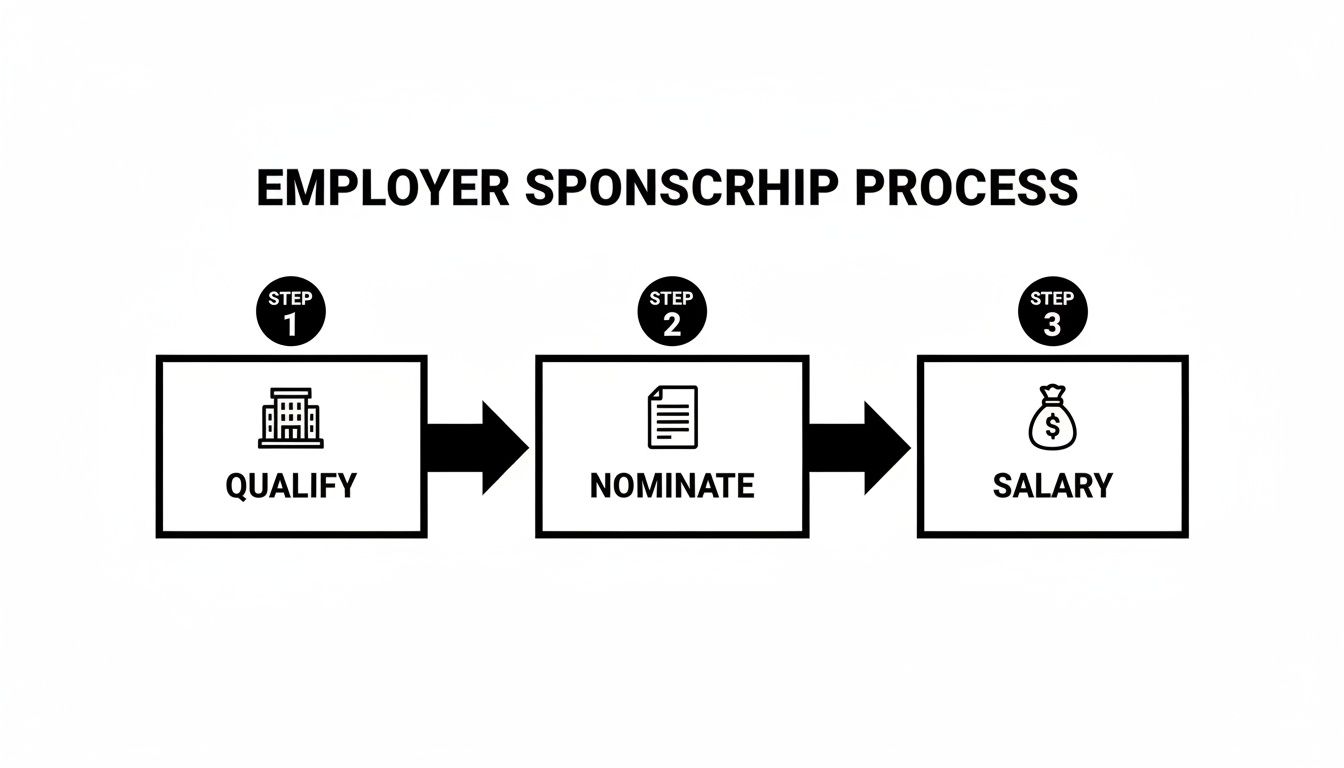
As you can see, the employer first needs to qualify as a sponsor, then nominate you for a specific role, all while ensuring the salary is compliant. Think of it as building a solid foundation—each step must be completed successfully before you can start building your part of the application on top.
Disclaimer: Migration laws and visa requirements are subject to change. The information provided here is for general guidance and should not be considered legal advice. The information in this article may no longer be accurate at the time of reading. For the latest, most accurate information tailored to your circumstances, it is essential to book an appointment with a registered migration agent. All government fees can be confirmed on the official Department of Home Affairs website.
Stage 1: The Employer Nomination
This first major milestone is entirely in your employer's hands. Their success here is what opens the door for you to apply for the visa.
- Sponsorship Approval: First things first, the business needs to become a Standard Business Sponsor (SBS). This involves showing the Department of Home Affairs that they're an actively and lawfully operating business in Australia.
- Nomination Lodgement: With their SBS status approved, the employer then lodges a nomination application specifically for your position. This is where they submit evidence of their Labour Market Testing and confirm the salary on offer meets all government requirements.
- Nomination Approval: The Department then assesses the nomination. A green light confirms the role is genuine and the employer is compliant. This approval generates a Transaction Reference Number (TRN), a critical piece of information you’ll need for your own application.
Stage 2: The Applicant’s Visa Application
Once the nomination is approved, it’s your turn. Now you need to demonstrate that you're the right person for the job and meet all the personal requirements for the visa.
- Gather Your Documents: This is where most of your prep work will be. You'll need to pull together your positive skills assessment, English language test results, identity documents (like your passport and birth certificate), and police clearance certificates.
- Lodge via ImmiAccount: You'll use your ImmiAccount to fill out the visa application form online. This is where you’ll enter the TRN from your employer's approved nomination, which links your application directly to theirs.
- Pay the Visa Application Charge: There’s a fee that needs to be paid when you lodge. You should always check the official Department of Home Affairs website for the most current fees.
- Await a Decision: After you submit, your application joins the processing queue. The Department might ask you to complete health examinations or provide more information, like biometrics.
As you navigate the process, remember that all aspects of your profile will be assessed, including your character. Part of this can involve understanding employment background checks, so it pays to be prepared.
Important Disclaimer: Australian migration policies and visa requirements can change with little warning. This guide is intended for general informational purposes only. For the most accurate and personalised advice tailored to your situation, it is crucial to book an appointment with a registered migration agent. The information in this article may no longer be accurate at the time of reading.
How We Can Help Secure Your Migration Success
Let's be honest: navigating Australia's regional sponsored migration scheme is rarely a walk in the park. The path is often paved with strict eligibility rules, complex legal documents, and immigration laws that can change with very little warning. For both skilled workers and the regional employers who need them, a single mistake on paperwork or a small misunderstanding of the latest policy can lead to expensive delays or, worse, a visa refusal.
This is where getting the right advice becomes absolutely critical. The challenges are very real—from proving a position is genuine and meeting Labour Market Testing requirements to putting together a flawless skills assessment and visa application. You don't have to tackle this maze alone.
Disclaimer: Migration laws and visa requirements are subject to change. The information provided here is for general guidance and should not be considered legal advice. The information in this article may no longer be accurate at the time of reading. For the latest, most accurate information tailored to your circumstances, it is essential to book an appointment with a registered migration agent. All government fees can be confirmed on the official Department of Home Affairs website.
Your Trusted Partner in Migration
At My Visa Guide, we see ourselves as your dedicated partner, here to turn a confusing and stressful process into a clear, straightforward strategy. Our MARA-certified agents, led by Director Vijay Bharti (MARN 2217817), specialise in building successful application pathways for both skilled migrants and the regional businesses that are counting on their talent. We dive into the intricate details so you don't have to.
Our job is to give you peace of mind by:
- Running thorough eligibility checks to make sure you're on the right track from the very beginning.
- Preparing and lodging decision-ready applications that cut down the risk of getting those dreaded requests for more information.
- Liaising directly with the Department of Home Affairs for you, so you always have a professional voice on your side.
- Giving you clear, honest advice at every single stage of your journey.
We know that choosing who to trust with your migration journey is a huge decision. To help you feel confident in your choice, we've put together some practical advice on what to look for in our guide on the essential tips for choosing a migration agent.
Let us handle the complexity so you can focus on what truly matters—building your future career and life in regional Australia. Your success is our mission.
Ready to take the first step with confidence? Book a consultation with our expert team today and start your journey with a trusted expert by your side.
Important Disclaimer: Australian migration laws and visa requirements are subject to constant change. The information provided in this article is for general informational purposes and should not be considered legal advice. For the latest, most accurate information tailored to your specific circumstances, it is essential to book an appointment with a registered migration agent. The information in this article may no longer be accurate at the time of reading. Please refer to the official Department of Home Affairs website for current government fees.
Got a question? You're not the only one. The regional sponsored visa path can bring up a lot of "what ifs".
Here are some quick, straight-to-the-point answers to the questions we hear most often.
What Exactly Counts as Regional Australia for This Visa?
This is a big one, and the answer surprises many people. For migration purposes, "regional Australia" is basically anywhere in the country except for the major metro areas of Sydney, Melbourne, and Brisbane.
That’s a much broader definition than most people realise. It means that major cities like Perth, Adelaide, Canberra, the Gold Coast, and Newcastle are all officially on the list. The whole point of the policy is to steer skilled people towards the cities and towns that are eager for talent to grow their communities and local economies.
The only source that matters for this is the Department of Home Affairs' official list of designated regional postcodes. This list can and does change, so checking it before you lock in any plans is non-negotiable.
Can I Change Jobs While on a Subclass 494 Visa?
Yes, you can, but it’s not as simple as just handing in your notice and starting somewhere new. You have to follow a very specific process.
Your new employer must also be an approved sponsor and get a new nomination lodged and approved for you. Crucially, you can only start working for them after that new nomination is officially approved.
If your job ends for any reason, you’re usually given a grace period, often 90 days, to find another approved sponsor. If you can't, you could be in breach of your visa conditions, so it's a situation that needs to be handled with care and urgency.
How Does the Subclass 494 Lead to Permanent Residency?
The Subclass 494 visa was designed with one clear goal in mind: to be a direct pathway to permanent residency. It specifically leads to the Subclass 191 Permanent Residence (Skilled Regional) visa. Think of it as a reward for migrants who have genuinely put down roots and contributed to a regional community.
To make that jump from the 494 to the 191 visa, you’ll need to tick a few key boxes:
- You must have held your Subclass 494 visa for at least three years.
- You've got to show you've complied with all your visa conditions, especially living and working in a designated regional area.
- You must meet a minimum taxable income threshold for at least three of those years on the provisional visa.
This isn't a vague promise; it's a clear, structured pathway that gives you certainty as you invest your skills and your life in regional Australia.
Disclaimer: Migration laws and visa requirements are subject to change. The information provided here is for general guidance and should not be considered legal advice. The information in this article may no longer be accurate at the time of reading. For the latest, most accurate information tailored to your circumstances, it is essential to book an appointment with a registered migration agent. All government fees can be confirmed on the official Department of Home Affairs website.
Navigating the specifics of the regional visa system is where My Visa Guide truly makes a difference. For expert advice that’s tailored to your unique situation, book a consultation on myvisaguide.com.au and move forward with total confidence.