Embarking on the Australian partner visa journey is a significant step towards building a life together, but the path is paved with intricate documentation requirements. A single missing document or an overlooked piece of evidence can lead to significant delays, added stress, and even the heartbreaking outcome of a refusal. This comprehensive partner visa Australia checklist is meticulously designed to demystify the entire process, providing a clear roadmap for both onshore (Subclasses 820/801) and offshore (Subclasses 309/100) applicants. Forget ambiguity and confusion; this guide is your definitive resource for compiling a robust, decision-ready application.
We will break down the essential categories of evidence you must prepare, from foundational identity documents to the nuanced proof required to demonstrate a genuine and continuing relationship. You will find actionable insights, practical examples of what to include, and expert tips to help you avoid common pitfalls that plague many applications. Think of this as more than just a list; it is a strategic framework for presenting your case to the Department of Home Affairs in the strongest possible light.
By following this detailed checklist, you can confidently navigate the complexities of the application, ensuring every form is correctly completed and every piece of evidence is properly organised. From sponsor requirements and financial capacity to character assessments and health examinations, we will cover every critical component. Let's ensure every box is ticked correctly, helping you move one step closer to your future in Australia with your partner.
1. Proof of Identity Documents
The very foundation of your partner visa application rests on unequivocally proving the identities of both the applicant and the sponsor. The Department of Home Affairs needs to verify who you are, your nationality, and your legal name. This is a non-negotiable first step in any comprehensive partner visa Australia checklist and requires meticulous attention to detail.

Submitting clear, certified copies of these core documents prevents initial processing delays and establishes credibility from the outset. Missing or incorrect identity documents can immediately flag an application for further scrutiny or even lead to a request for more information, stalling your journey.
Key Identity Documents Required
For both the visa applicant and the Australian sponsor, you will typically need to provide:
- Passport Biodata Page: A high-quality colour scan of the page showing your photo, name, date of birth, and passport number.
- Birth Certificate: This must show the names of both your parents. If your original birth certificate is not in English, you must provide a certified translation alongside a copy of the original.
- National Identity Card: If your country of origin issues one, include a copy of both sides.
- Proof of Name Change: If either party has changed their name (e.g., through marriage or deed poll), you must provide official evidence of this change.
Crucial Tip: Check the expiry dates on all passports before you begin. A passport that is due to expire soon could complicate the visa process. It's often best to renew it before lodging your application. Similarly, ensure your birth certificate is an official version, preferably with a raised seal or other security features, to prove its authenticity beyond doubt.
2. Proof of Relationship Documents
Following identity verification, the heart of your application is proving that your relationship is genuine and continuing. The Department of Home Affairs scrutinises this aspect rigorously, looking for compelling evidence that you and your partner share a life together, to the exclusion of all others. This section of your partner visa Australia checklist requires a comprehensive collection of documents covering the four key pillars of a genuine relationship: financial, social, household, and the nature of your commitment.
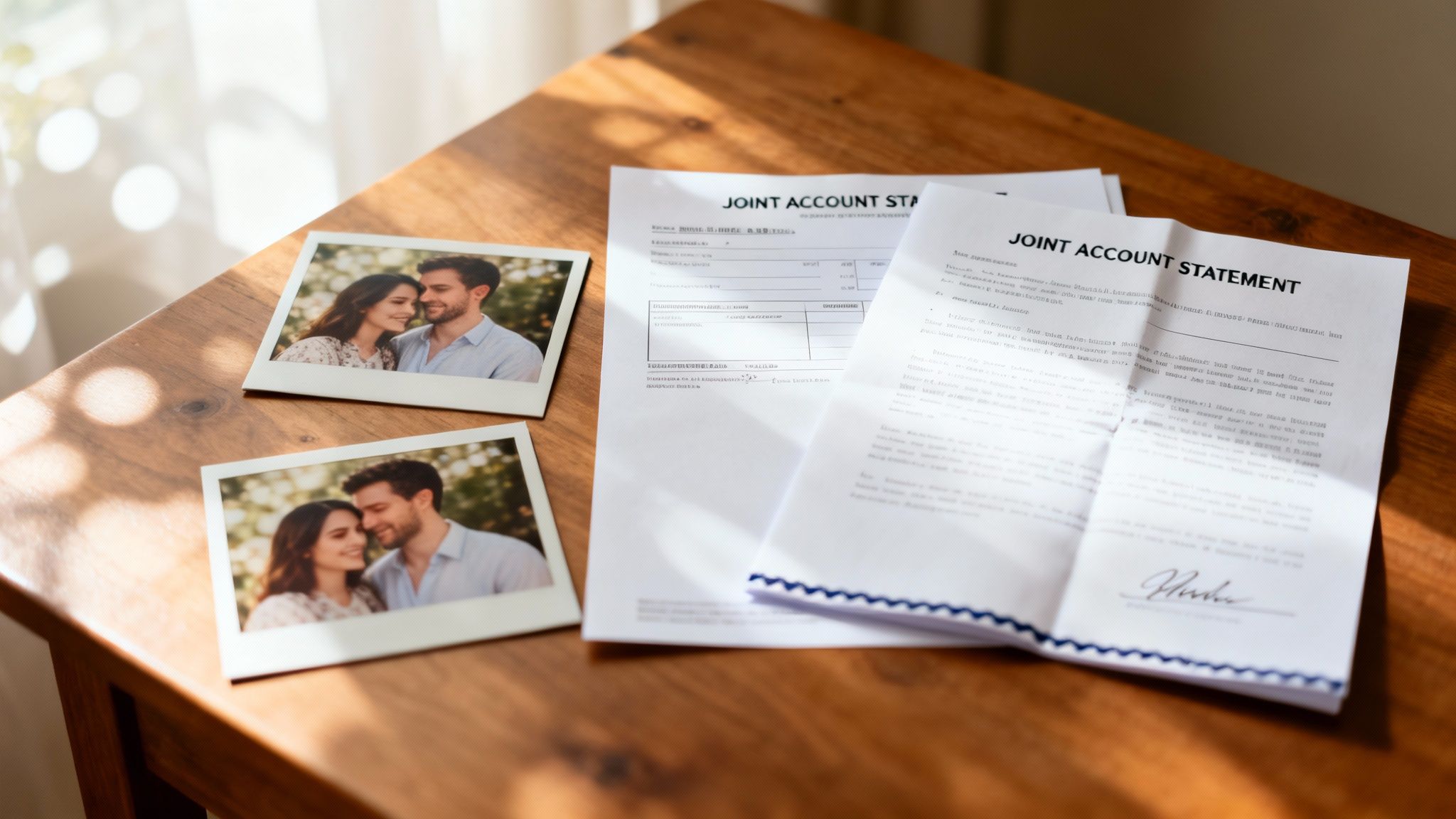
Simply stating you are in a relationship is insufficient; you must demonstrate it with concrete, verifiable evidence. A well-organised and diverse portfolio of documents paints a clear picture for the case officer, substantiating the claims made in your application and reducing the likelihood of requests for further information. Neglecting this area is one of the most common reasons for visa refusal.
Key Relationship Evidence Required
Your evidence should be organised to cover the entire history of your relationship, from when you met to the present day. You'll need to provide documents such as:
- Financial Aspects: Joint bank account statements showing shared income and expenses, joint loan or mortgage documents, shared bills (utilities, rent), and evidence of transferring money to one another.
- Household Nature: A joint lease agreement or mortgage, mail addressed to both of you at the same address, and statements outlining how you share domestic responsibilities.
- Social Aspects: Statutory declarations (Form 888) from Australian friends and family, photos together across different occasions and timelines, joint travel itineraries, and evidence of joint invitations to social events.
- Nature of Commitment: A detailed relationship history statement from both partners, evidence of communication while apart (e.g., chat logs, call records), and proof of any children you have together. Learn more about the specific proof of relationship documents required for a strong application.
Crucial Tip: Create a chronological timeline of your relationship and match your evidence to key dates. For example, pair photos from a holiday with the flight bookings for that trip. For de facto applicants, it is vital to provide at least 12 months of cohabitation evidence, unless compelling and compassionate circumstances apply. Start collecting this evidence as early as possible.
3. Police Clearance Certificates
A critical component of your partner visa Australia checklist is satisfying the character requirement, which involves demonstrating good character for both the applicant and the sponsor. The Department of Home Affairs mandates this to ensure the safety and wellbeing of the Australian community. The primary way to meet this requirement is by providing police clearance certificates from every country you have lived in.
These official documents, also known as penal checks or police records, provide a summary of any criminal history. Failing to provide these certificates for all relevant countries or having serious character concerns can lead to significant delays or an outright visa refusal. It's a non-negotiable step that verifies you and your partner pose no risk.
Key Character Documents Required
Both the visa applicant and the Australian sponsor must obtain police clearance certificates from every country where they have resided for a cumulative total of 12 months or more in the last 10 years, since turning 16 years of age.
- Australian National Police Check: Required for the sponsor and any applicant who has lived in Australia for 12 months or more. This must be obtained from the Australian Federal Police (AFP).
- Overseas Police Clearances: You must obtain a certificate from the national police authority of each relevant country. For example, applicants from the UK would need a certificate from the ACRO Criminal Records Office, while those from the USA need an FBI Identity History Summary Check.
- Military Service Records: If either party has served in the armed forces of any country, you must provide certified copies of their military service record or discharge papers.
Crucial Tip: Obtaining police clearances, especially from multiple countries, can be the most time-consuming part of your application. Start this process as early as possible. Some certificates can take several months to be issued, and waiting for them can delay your ability to lodge a complete application. To understand the full scope of these requirements, you can explore the official health and character requirements.
4. Medical Examination by AHPRA-Registered Doctors
Meeting Australia's health requirement is a critical component of your partner visa application. The Australian Government must ensure that visa applicants do not pose a public health risk or place significant costs on the community's health care services. This involves a mandatory medical examination conducted by a panel physician approved by the Department of Home Affairs.
This step in your partner visa Australia checklist is not just a formality; the results are sent directly to the Department and form a key part of the decision-making process. Failing to complete the medical examination, or having a significant health condition identified, can lead to delays or, in some cases, a visa refusal.
Key Aspects of the Health Examination
The specific tests required depend on your age, country of residence, and individual medical history. Generally, applicants can expect:
- Physical Examination: A general check-up by the panel physician to assess your overall health.
- Chest X-ray: Required for most applicants aged 11 and over to screen for tuberculosis (TB).
- HIV Test: Required for all permanent visa applicants aged 15 and over.
- Other Tests: Depending on your circumstances, you may also need blood tests (e.g., for Hepatitis B/C) or a specialist medical report for any pre-existing conditions.
Crucial Tip: You can complete your health examinations before lodging your visa application using the 'My Health Declarations' service. However, it is often recommended to wait until you have lodged your application and received a request from the Department. This ensures your medicals do not expire before a decision is made on your visa, which could require you to undertake and pay for them again. Always bring your HAP ID, passport, and any relevant medical records to your appointment.
5. Financial Documents and Proof of Income
Demonstrating financial stability is a critical component of a strong partner visa application. The Department of Home Affairs needs to be satisfied that the sponsoring partner has the financial capacity to support the applicant upon their arrival in Australia. This section of your partner visa Australia checklist is about proving that your relationship is not only genuine but also financially sound and will not place an undue burden on Australia’s social security system.
Submitting comprehensive and well-organised financial evidence paints a picture of a stable partnership. A lack of clear financial proof can raise red flags for case officers, suggesting potential dependency on welfare or questioning the sponsor’s ability to meet their obligations. This evidence primarily focuses on the sponsor, but including the applicant's financial documents can further strengthen the case.
Key Financial Documents Required
Evidence of the sponsor's financial capacity and employment is paramount. You should aim to provide:
- Employment Letter: An official letter from the sponsor’s employer confirming their position, salary, and length of employment.
- Payslips: At least three recent payslips showing consistent income.
- Bank Statements: Statements showing regular salary deposits and a healthy financial standing.
- Tax Assessment Notices: The sponsor's Australian Taxation Office (ATO) Notice of Assessment for the most recently concluded financial year.
- Proof of Assets: Evidence of significant assets like property deeds, vehicle ownership, or investment portfolios can also be included.
- Business Documents: For self-employed sponsors, provide evidence such as ABN registration, Business Activity Statements (BAS), and statements from an accountant confirming annual income.
Crucial Tip: The sponsor’s ability to support the applicant is heavily scrutinised. Ensure the sponsor's employment history is stable, ideally for at least 12 months prior to lodging. If there are employment gaps or variable income, provide a detailed statutory declaration explaining the circumstances and demonstrating how financial obligations will be met. Consistency across all financial documents is key to building a credible application.
6. Accommodation and Housing Proof
Demonstrating that the applicant will have a stable and adequate place to live in Australia is a key, yet often underestimated, part of a strong partner visa application. The Department of Home Affairs needs assurance that the applicant will not face housing insecurity upon arrival. This element of your partner visa Australia checklist provides tangible proof of your shared domestic life or firm plans for it.
Submitting clear evidence of your living arrangements helps paint a complete picture of your life together. Whether you own a home, are renting, or will be living with family, this documentation substantiates your claims of a shared life and demonstrates practical planning for your future in Australia.
Key Accommodation Documents Required
Evidence of your living situation can take many forms, depending on your circumstances:
- Property Ownership Documents: If the sponsor owns their home, provide a copy of the property title deed and recent mortgage statements.
- Rental/Lease Agreement: A copy of the current lease agreement showing both the applicant and sponsor’s names is ideal. If only the sponsor's name is on the lease, you can supplement this with utility bills addressed to both of you at that address.
- Letter from Family/Friends: If you plan to live with family or friends initially, a statutory declaration or a signed letter from them is required. This should confirm the arrangement, describe the property (e.g., number of bedrooms), and state how long the applicant can stay.
- Utility Bills: Recent electricity, gas, water, or internet bills showing your shared address are excellent supporting documents.
Crucial Tip: If you are relying on a letter from family or friends offering accommodation, strengthen it significantly by including photos of the home, particularly the bedroom the applicant will use. Also, include a copy of the homeowner's or tenant's proof of residence, such as their own utility bill or rates notice, to add credibility to their offer.
7. English Language Proficiency Test Results
A key requirement for most partner visa applicants is demonstrating a functional level of English. This ensures applicants can integrate into the Australian community, access services, and understand their rights and responsibilities. This part of your partner visa Australia checklist verifies your ability to communicate effectively, which the Department of Home Affairs considers crucial for successful settlement.
Failing to provide evidence of functional English, or not meeting the minimum score, can result in your application being refused. It is essential to understand the requirements, book a test well in advance, and prepare accordingly to avoid any setbacks in your visa journey. Note that some applicants may be exempt from this requirement.
Key English Proficiency Evidence
For most visa applicants, you will need to provide results from an approved English language test taken within the 12 months before you apply:
- IELTS (International English Language Testing System): An overall band score of at least 4.5.
- TOEFL iBT (Test of English as a Foreign Language internet-based test): A total band score of at least 32.
- PTE Academic (Pearson Test of English Academic): An overall band score of at least 30.
- CAE (Cambridge English: Advanced): An overall band score of at least 147.
Crucial Tip: Book your test 4-6 weeks before you plan to lodge your visa application to ensure results are available in time. To excel in the test, consider adopting these daily habits to speak English fluently. Exemptions may apply if you hold a passport from an English-speaking country (UK, USA, Canada, New Zealand, or Ireland) or have completed certain levels of education in English. Always verify your specific exemption eligibility before assuming you do not need to sit a test.
8. Character References (Form 888)
Beyond the evidence you and your partner provide, the Department of Home Affairs values insights from others who can vouch for the genuineness of your relationship. This is officially done through Form 888, a statutory declaration provided by supporting witnesses. These forms are a crucial part of any partner visa Australia checklist, adding an external, credible layer of validation to your claims.
These declarations allow friends, family, and colleagues to formally state under oath that they know you and your partner and believe your relationship is genuine and continuing. A strong set of Form 888 declarations can significantly bolster your case by providing personal anecdotes and observations that raw data like bank statements cannot.
Key Details for Form 888
Witnesses completing Form 888 must be Australian citizens or permanent residents. You should aim to provide at least two, but more can be beneficial if they offer unique perspectives.
- Who Can Be a Witness: Family members (parents, siblings), close friends, colleagues, or long-term neighbours who have known you as a couple.
- Content of the Declaration: The witness must explain how they know you and your partner, how often they are in contact, and why they believe your relationship is genuine. They should include specific examples, such as witnessing your shared life, social outings together, or mutual support during difficult times.
- Formal Requirements: Each Form 888 must be completed correctly and signed in the presence of a prescribed person (like a Justice of the Peace or lawyer). The witness must also provide evidence of their Australian citizenship or permanent residency, such as a copy of their passport or birth certificate.
Crucial Tip: Choose your witnesses wisely. Select people who have known you throughout different stages of your relationship and can speak with genuine conviction. Provide them with guidance on what to include, but ensure the words and examples are their own to maintain authenticity. A generic, template-like statement is far less impactful than a heartfelt, personal account.
9. Marriage or Commitment Ceremony Documentation
The official legal recognition of your relationship is a cornerstone of the partner visa application. For married couples, this is straightforward; for de facto partners, it requires demonstrating a commitment equivalent to marriage. This section of your partner visa Australia checklist is about providing the definitive legal document that validates your partnership status in the eyes of Australian immigration law.
Whether you are legally married or in a committed de facto relationship, this evidence formally establishes the date your commitment began. For de facto couples, it's crucial to prove you have lived together for at least 12 months immediately before applying, unless you have registered your relationship with an Australian state or territory authority.
Key Documents for Your Relationship Status
Depending on your circumstances, you will need to provide one of the following:
- Marriage Certificate: A certified copy of your official, government-issued marriage certificate. If the certificate is not in English, a certified translation must be attached to a copy of the original document.
- Relationship Registration Certificate: For de facto partners, a certificate from an Australian state or territory government officially registering your relationship can waive the 12-month cohabitation requirement.
- Proof of De Facto Cohabitation: If not registering your relationship, you must provide substantial evidence that you have lived together for at least 12 months. This includes documents like a shared lease agreement, joint bank account statements showing a shared address, or bills addressed to both partners at the same residence.
Crucial Tip: Ensure your marriage or relationship registration certificate is an official copy issued by the relevant government authority (e.g., Births, Deaths and Marriages). A commemorative certificate from your wedding day is not sufficient. For de facto partners, start compiling cohabitation evidence well in advance of the 12-month mark to build a strong, undeniable case.
10. Visa Application Form Completion and Lodgement
This final procedural step is where all your hard work and meticulous document collection culminates. Completing the official online application via ImmiAccount and formally lodging it with all supporting evidence is the official submission of your partner visa application to the Department of Home Affairs. This is the moment your case formally enters the processing queue.
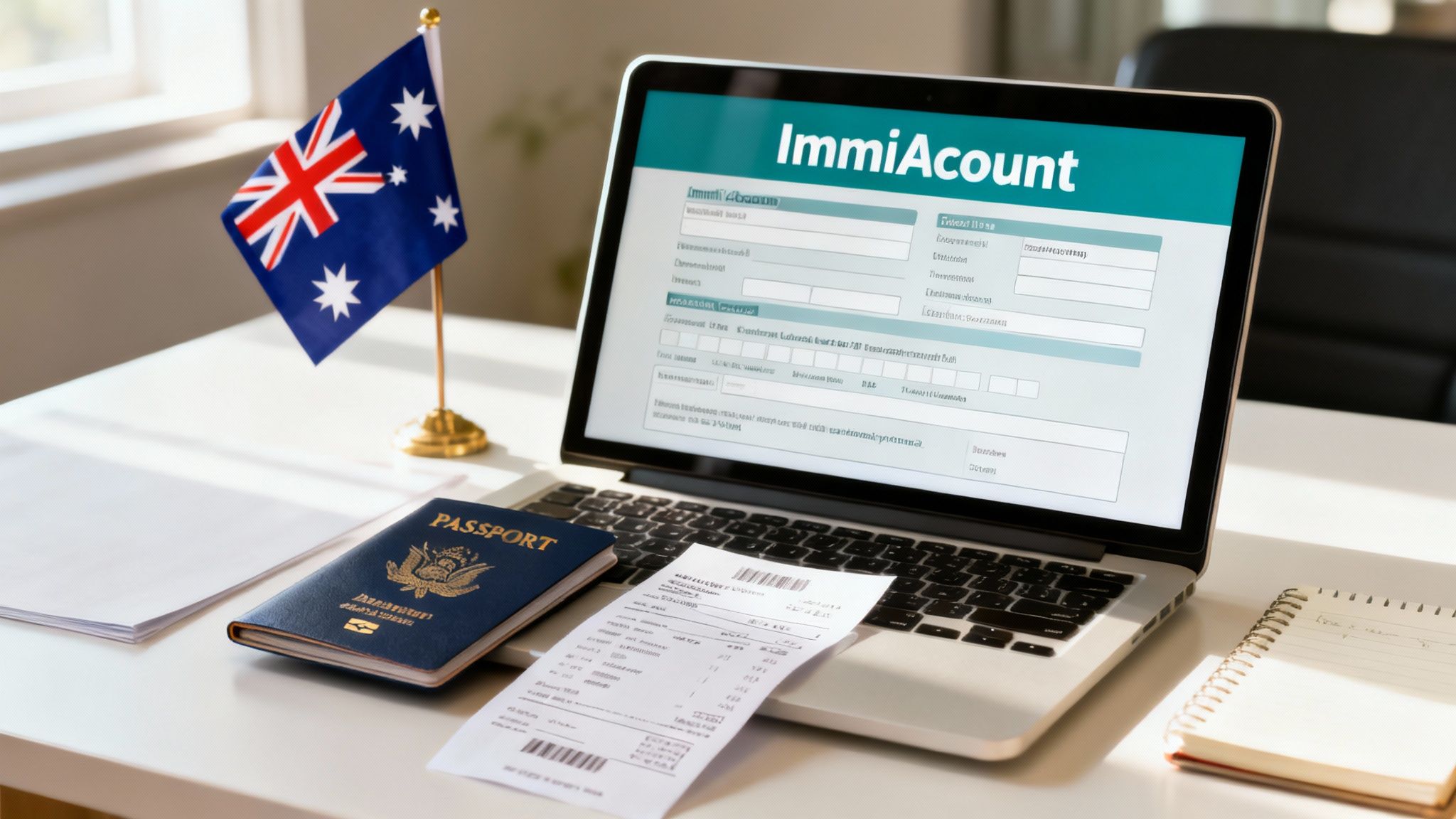
Successfully navigating the ImmiAccount portal and ensuring every form field is accurate is crucial for a smooth process. Even a small mistake, like a mistyped date or an incorrect name, can cause significant delays or lead to a request for further information, interrupting the progress of your application. This step requires precision and a final, thorough review of all details.
Key Lodgement Actions
The online lodgement process involves several critical actions for both the applicant and the sponsor:
- Complete the Online Forms: The applicant and sponsor each complete their respective parts of the application online through ImmiAccount. This is the modern equivalent of paper forms like the 47SP and 40SP.
- Upload All Supporting Documents: Attach all your prepared evidence to the application in the correct categories. Ensure files are correctly named, clear, and in an accepted format (e.g., PDF, JPG).
- Pay the Visa Application Charge (VAC): The application is not considered officially lodged until the full VAC has been paid. You will receive a transaction reference number (TRN) as proof of payment.
- Post-Lodgement Monitoring: Regularly check your ImmiAccount for any communication or requests from the Department. Prompt responses are essential to keep your application moving forward.
Crucial Tip: Before starting the online form, gather all your documents and key information into one place. To ensure accuracy and save time when completing your visa application forms, you may find it helpful to efficiently learn how to extract data from various PDF documents. Double-checking every entry before hitting ‘submit’ can save you months of potential delays. If you're uncertain, seeking advice from a professional before you lodge can provide invaluable peace of mind. Find out more about the benefits of working with a migration agent to ensure a flawless submission.
Partner Visa Australia: 10-Item Checklist Comparison
| Item | Implementation complexity 🔄 | Resource requirements ⚡ | Expected outcomes ⭐📊 | Ideal use cases 💡 | Key advantages ⭐ |
|---|---|---|---|---|---|
| Proof of Identity Documents | Low 🔄 — straightforward certified copies or originals | Moderate ⚡ — possible travel, notarisation fees, time | High ⭐📊 — essential for identity verification and background checks | Mandatory for all partner visa applications | Prevents identity fraud; legally establishes identity |
| Proof of Relationship Documents | High 🔄 — collate varied evidence across time and contexts | High ⚡ — time-consuming, witness cooperation, privacy management | High ⭐📊 — primary evidence of genuine and continuing relationship | De facto or married applicants proving relationship genuineness | Strongly supports genuineness claims and reduces rejection risk |
| Police Clearance Certificates | Moderate 🔄 — formal applications per country, variable processes | Moderate–High ⚡ — cost, long wait times, international logistics | High ⭐📊 — confirms character and criminal history compliance | Applicants with residence in multiple countries or long stays abroad | Verifies criminal record; meets character requirements |
| Medical Examination by AHPRA-Registered Doctors | Moderate 🔄 — must use panel doctors and specific tests | High ⚡ — examination fees, possible follow-up tests, limited availability | High ⭐📊 — assesses public health risk and healthcare burden | Applicants from high-risk countries or with health issues | Standardised health assessment; results sent directly to authorities |
| Financial Documents and Proof of Income | Moderate–High 🔄 — gather tax returns, payslips, asset statements | Moderate ⚡ — sensitive records, possible accountant fees for complex cases | Medium–High ⭐📊 — demonstrates financial stability and support capacity | Applicants needing to show ability to support self or dependents | Shows economic stability and reduces welfare concerns |
| Accommodation and Housing Proof | Low–Moderate 🔄 — obtain leases, sponsor letters, photos | Low–Moderate ⚡ — minimal cost but requires sponsor cooperation | Medium ⭐📊 — indicates settled living arrangements on arrival | Applicants relying on sponsor-provided housing or pre-arranged tenancy | Demonstrates preparation and an established support network |
| English Language Proficiency Test Results | Low 🔄 — standardised tests with clear scoring | Moderate ⚡ — test fees and preparation time | Medium–High ⭐📊 — proves communication ability; may be required or exempt | Applicants required to show functional English or seeking exemptions | Objective, widely accepted measure of language ability |
| Character References and Statutory Declarations | Low–Moderate 🔄 — collect sworn statements from referees | Low ⚡ — low monetary cost but requires referee time and notarisation | Medium ⭐📊 — provides independent verification of character | Applicants needing personal or professional character support | Low cost; strengthens credibility through independent attestations |
| Marriage or Commitment Ceremony Documentation | Low 🔄 — certified marriage certificate or 12‑month cohabitation evidence | Low–Moderate ⚡ — certification and translations may be needed | High ⭐📊 — legally confirms relationship status for visa eligibility | Married couples or de facto partners proving legal commitment | Clear legal proof; internationally recognised standard |
| Visa Application Form Completion and Lodgement | Moderate 🔄 — detailed online form and correct attachments required | High ⚡ — substantial application fees, time, and possible agent costs | Critical ⭐📊 — official submission that initiates processing | Final submission step for all partner visa applicants | Official lodgement, confirmation receipt, and tracking via ImmiAccount |
Ready for Your Next Step? Secure Your Future with Expert Guidance
Navigating the extensive partner visa Australia checklist is a monumental task, but you have now armed yourself with the detailed knowledge required to begin this life-changing journey. We have meticulously detailed the ten critical pillars of a successful application, from foundational identity documents and police clearances to the deeply personal evidence that illustrates the genuine nature of your relationship. You understand the importance of providing comprehensive financial records, securing proof of your shared household, and meeting the stringent health and character requirements set by the Department of Home Affairs.
This guide was designed to be more than just a list; it is a strategic blueprint. By understanding the 'why' behind each document, you can assemble an application that is not just complete, but compelling. It’s about creating a narrative that is consistent, verifiable, and leaves no room for doubt in the case officer's mind. The difference between a successful application and a refusal often lies in the details: the correct formatting of certified copies, the timely submission of medical examinations, and the eloquent articulation of your shared life through statutory declarations.
Key Takeaways for Your Application Success
As you prepare to lodge your visa, keep these crucial insights at the forefront of your mind:
- Consistency is King: Every piece of evidence, from joint bank statements to social media photos, must tell the same story. Discrepancies, no matter how small, can raise red flags. Your timeline of events should be logical and supported by documentation across all four pillars of your relationship: financial, social, household, and commitment.
- Front-loading is Non-Negotiable: The "decision-ready" approach is paramount. Do not wait for a Request for Further Information (RFI). Submitting a complete, thoroughly documented application from the outset not only demonstrates your diligence but can significantly reduce processing times and stress. Assume the case officer will only review what you initially provide.
- Evidence Must Be Continuous: A strong application showcases the evolution of your relationship over time, not just snapshots from a specific period. Gather evidence that spans the entire duration of your de facto relationship or marriage, demonstrating its ongoing and genuine nature. This continuity is a powerful indicator of a legitimate partnership.
Crucial Insight: The burden of proof rests entirely on you, the applicant and sponsor. The Department does not build your case for you; it assesses the case you present. A meticulously organised, clearly labelled, and comprehensively documented application is your single most effective tool for achieving a positive outcome.
Mastering this checklist is about more than just ticking boxes. It is about strategically presenting your life together in a way that aligns perfectly with Australia's migration laws. The reward for this diligence is immeasurable: the opportunity to build a future with your partner in a country that offers stability, opportunity, and a vibrant community. Your journey together deserves the strongest possible foundation, and that begins with a flawless visa application. Don't let a preventable administrative error or a poorly presented piece of evidence jeopardise that future. Your meticulous preparation today is the key that unlocks your shared tomorrow in Australia.
Navigating the partner visa Australia checklist can be overwhelming, but you don't have to do it alone. The MARA-registered migration agents at My Visa Guide specialise in transforming complex requirements into successful, decision-ready applications. Let us handle the intricate details so you can focus on your future together by visiting My Visa Guide for a professional consultation.