That feeling of hitting ‘submit’ on your Australian visa application is a mix of relief and… well, a whole lot of waiting. The days and weeks that follow can feel like a marathon of refreshing your inbox, hoping for good news.
The best way to cut through the uncertainty is to go straight to the source: the Department of Home Affairs’ official online portal, ImmiAccount. This is your command centre for everything related to your application.
Disclaimer: Immigration information can change without notice. The details in this article may not be current when you read it. For the most up-to-date advice, please book an appointment with a registered migration agent. For any Department fees, always refer to the official site: https://www.homeaffairs.gov.au/.
Your Guide to Checking Australian Visa Status
Let’s be honest, every email notification after you’ve lodged your application sends your heart racing. The good news is you don’t have to guess what’s happening. ImmiAccount gives you a direct line of sight into your application's journey, acting as the single source of truth.
To get started, you just need the login details you created when you first applied and your Transaction Reference Number (TRN). Think of the TRN as the unique barcode for your specific application.
Knowing how to navigate this system is more important than ever. The number of active bridging visas skyrocketed to a staggering 405,150 as of September 2025—a massive 112% increase from just 191,235 two years earlier. This surge really highlights the significant processing queues many applicants are in, making it crucial to know exactly where you stand.
What You Need Before You Start
A little preparation goes a long way. Before you even open your browser, get these details ready to make the process smooth and stress-free:
- ImmiAccount Login: This is simply the username and password you set up when you initially lodged your visa application.
- Transaction Reference Number (TRN): This number is automatically generated when you submit your online application. You’ll find it in the acknowledgement letter that was sent to your email.
- Personal Details: It’s always a good idea to have your passport and other key documents handy, just in case you need to verify any details.
A common reason for delays is incorrect or uncertified documentation. If you have any documents that aren't in English, make sure you use professional certified document translation services to avoid any unnecessary hold-ups.
Your ImmiAccount is the digital front door to your visa application. It’s best to think of it less like some clunky government website and more like your personal dashboard, giving you a direct line of sight into your application's journey.
Let’s walk through exactly how to get in and find what you're looking for.
First up, you’ll need to head over to the official Department of Home Affairs online services login page. Grab the username and password you set up when you lodged your application. Once you’re in, you’ll land on your main dashboard.
This first screen can feel a bit busy, but it’s actually laid out quite logically. It shows a list of every application you’ve ever started or submitted with the Department.
Locating Your Submitted Application
Your most recent application should be sitting right at the top of the list. Look for the summary that matches the visa you applied for. Each one will have a few key details: your name, the submission date, and most importantly, your Transaction Reference Number (TRN).
That TRN is the unique code for your application. It’s what you'll always come back to when you want to check your status, and it’s how the Department keeps track of your file among the millions of others.
Here's what the ImmiAccount interface generally looks like when you log in.
This screenshot shows that central hub where all your applications live—whether they’re imported, submitted, or just sitting in draft form.
Understanding the Dashboard Sections
Once you find and click on your application, you’re taken to a more detailed view. Getting familiar with these different sections will save you a world of stress. It’s not just about seeing the status; it's about managing your entire application from one place.
You’ll see a few key options:
- Application status: This is the big one. It's the headline that will show a term like 'Received', 'Initial assessment', or 'Further assessment'. We'll get into what these actually mean in the next section.
- Messages: Think of this as your official inbox. All communication from the Department lands here. You need to check this regularly, as this is where they’ll send a Request for Further Information (often called an s56 Request) or, eventually, the final decision.
- Attachments: Here, you can see every single document you uploaded. It’s always a good idea to double-check that everything you intended to provide is listed and attached correctly.
- Update us: This section is absolutely crucial. If your circumstances change—you get a new passport, move house, or have a baby—you must update the Department here. Not doing so can cause serious delays.
A quick pro tip: The information in your ImmiAccount is the single source of truth. If you're using an agent and they tell you something that doesn't match what you see here, don't be afraid to ask why. Your ImmiAccount shows you exactly what the Department sees.
A Practical Scenario: Checking Your Status
Let's say you've just lodged a Subclass 500 Student visa. You log into your ImmiAccount, find the application in your list, and click on it. The status says 'Received'.
All this means is that the system has successfully accepted your application and payment. It’s now officially in the queue, waiting to be picked up by a case officer.
You might also spot a new message in your 'Messages' tab. If you open it, you’ll likely find a standard acknowledgement letter confirming your lodgement and repeating your TRN. It’s a good idea to download and save this for your records.
At this point, there’s nothing else for you to do but wait. The next step is for the status to change, which tells you a case officer has started their assessment. Checking in once a week is plenty at this early stage—it keeps you informed without adding to the stress of waiting.
Disclaimer: Immigration information can change without notice. The details in this article may not be current when you read it. For the most up-to-date advice, please book an appointment with a registered migration agent. For any Department fees, always refer to the official site: https://www.homeaffairs.gov.au/.
Decoding Your Visa Application Status Message
You’ve successfully logged into your ImmiAccount and found your application. Now, you’re just staring at a single phrase under the "Status" heading. Seeing an update is one thing, but figuring out what it actually means for your application is another story altogether. This is where we cut through the official jargon.
Think of the status message as the Department's shorthand for where your file is sitting in the processing queue. It doesn't give you the full picture, of course, but it’s a crucial signpost on the journey from submission to a final decision.
Let's break down each stage so you know exactly what’s happening behind the scenes.
From Submitted to Received
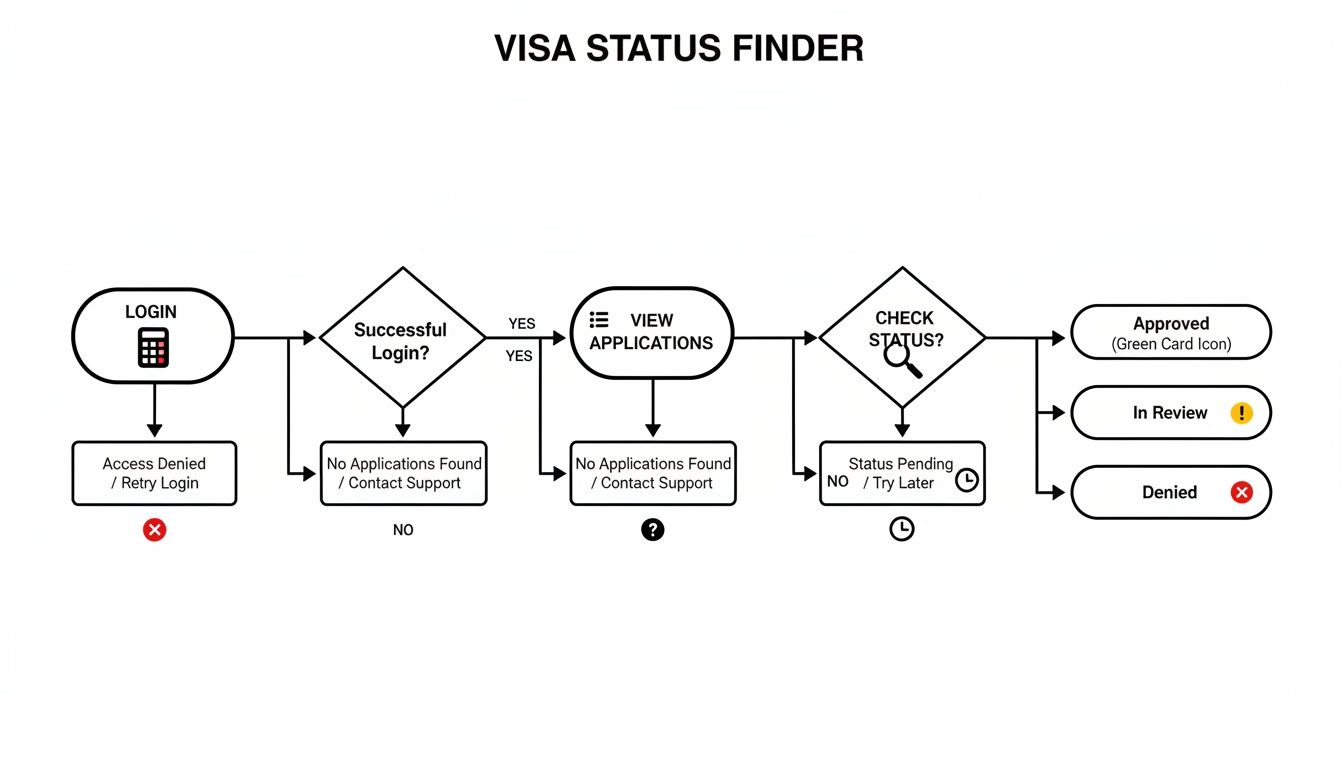
The very first status you’ll see, usually for a very short time, is ‘Submitted’. This is just a temporary confirmation that you’ve successfully uploaded everything into the system. It’s the digital equivalent of handing your paperwork over a counter.
Soon after, this will flick over to ‘Received’. This is your first real milestone. It means the Department of Home Affairs has formally acknowledged your application and your payment has gone through. Your application is now officially in the queue, waiting to be picked up by a case officer. At this point, your only job is to be patient.
Initial and Further Assessment
The next update you're hoping for is ‘Initial Assessment’. This is a great sign. It means a real person—a case officer—has been assigned to your application and has started their first look at your documents and claims. They're doing a preliminary check to see if all the essential information is there and if you seem to meet the basic visa criteria.
If the status then shifts to ‘Further Assessment’, don't panic. This is a normal part of the process for most applications and simply means the case officer is digging deeper. They might be running more thorough checks, like verifying your employment history, cross-referencing your relationship evidence, or waiting on results from external agencies for things like health or character assessments.
A change to 'Further Assessment' can also be a heads-up that a Request for Further Information (an 's56 Request') might be on its way. Always keep a close eye on your 'Messages' tab in ImmiAccount and your email inbox during this phase.
Understanding Your ImmiAccount Status
To make things crystal clear, here’s a quick-reference table that translates each status and tells you what you should be doing at every stage. This will help you manage your expectations and stay on top of any actions you might need to take.
| Status Message | What It Really Means | Your Next Move |
|---|---|---|
| Submitted | Your application has been uploaded but not yet formally logged by the Department. | None. This status will change very quickly. |
| Received | It's official—your application is in the queue and waiting to be allocated to a case officer. | Be patient. Check for the acknowledgement email and keep your TRN safe. |
| Initial Assessment | A case officer has opened your file and is doing the first round of checks. | No action is needed just yet, but be ready for potential information requests. |
| Further Assessment | The case officer is doing detailed checks or waiting for results from other agencies (health, character, etc.). | Keep a close watch on your messages and emails for any requests from the Department. |
| Finalised | A decision has been made on your application. The waiting is over. | Check your ImmiAccount messages or your email for the official decision letter. |
This table should give you a solid idea of what's happening. The key is to know when to act and when to simply wait.
The Finalised Status
The status everyone is hanging out for is ‘Finalised’. This means a decision—either a grant or a refusal—has been made. It's really important to know that the status itself won't tell you the outcome.
To find out the actual decision, you have to go to the 'Messages' section of your ImmiAccount or check the email address you registered with. The Department will send the official notification letter there. This document, titled 'Grant Notification' or 'Refusal Notification', will contain all the details of the decision, including your visa conditions if it’s a grant, or the reasons for refusal and your review rights if not. Reading this letter carefully is the final, most important step.
Disclaimer: Immigration information can change without notice. The details in this article may not be current when you read it. For the most up-to-date advice, please book an appointment with a registered migration agent. For any Department fees, always refer to the official site: https://www.homeaffairs.gov.au/.
Managing Expectations Around Processing Times
The big question on every applicant's mind is, "How long will this take?" While there's no magic number, you can get a solid estimate. Your best starting point is the Department of Home Affairs' Visa Processing Times guide tool. It gives you a decent idea of the standard timeframe for your specific visa subclass.
But let's be real—that tool provides an average, a benchmark. A whole host of real-world factors can stretch that timeline out considerably. Knowing what these potential roadblocks are is key to managing your own expectations and avoiding the stress of refreshing your ImmiAccount every hour.
Using the Official Processing Times Tool
The Department’s online tool is meant to give you a transparent look at how long applications are currently taking. You'll typically see two key numbers: the time it takes to finalise 75% of applications and the time for 90%.
It's simple to use. Just select your visa subclass from the dropdown menu. For instance, if you've applied for a Subclass 500 Student visa, the guide might show that 90% of applications are processed within three months. This gives you a reasonable ballpark figure to work with.
It's crucial to remember, however, that these are just guides, not guarantees. Your application's complexity, the quality of your documents, and the Department's workload all play a massive part.
Why Some Applications Take Longer Than Others
So, what are these "real-world factors" that cause delays? It's rarely just one thing. More often than not, it's a combination of issues that can add weeks, or even months, to your wait time. Being aware of them helps you understand the 'why' behind the wait.
Here are some of the most common culprits for extended processing times:
- Incomplete or Inconsistent Information: Left a few fields blank? Does the information across your forms not quite match up? A case officer has to stop and query it. This immediately puts your application on pause.
- Requests for More Information (s56 Requests): If the Department needs more evidence to make a decision, they'll issue a formal request. The clock on your application is effectively paused until you provide everything they've asked for.
- External Checks: Some checks are completely out of the Department's hands. This includes health examinations, character assessments (police checks), and national security vetting, which all have their own processing queues.
- Peak Application Periods: Certain times of the year see a huge surge in applications. Think about the lead-up to a new university semester. This increased volume naturally creates a bottleneck, leading to longer waits for everyone in the queue.
A Practical Scenario: Imagine two people apply for a Partner visa. Applicant A submits a "decision-ready" application, packed with comprehensive relationship evidence, all documents correctly certified and organised. Applicant B submits the bare minimum, thinking they can add more later. A case officer can assess Applicant A’s file smoothly. Applicant B, on the other hand, will almost certainly get a lengthy Request for More Information, adding months to their processing time.
The Impact of Health and Character Checks
Health and character assessments are two of the most common and significant sources of delay, hands down.
If you have a complex medical history or declare a health condition, your case gets referred to a Medical Officer of the Commonwealth (MOC) for an opinion. That process alone can easily add several months to your wait.
Similarly, if you've lived in multiple countries, you’ll need to provide police clearance certificates from each one. Just getting these certificates from overseas authorities can sometimes be a mission in itself, stalling your application indefinitely. The Department simply cannot finalise your visa until these mandatory checks are cleared, no matter how strong the rest of your application is. Preparing for these requirements well in advance is one of the smartest things you can do.
Disclaimer: Immigration information can change without notice. The details in this article may not be current when you read it. For the most up-to-date advice, please book an appointment with a registered migration agent. For any Department fees, always refer to the official site: https://www.homeaffairs.gov.au/.
Troubleshooting Common Issues and When to Seek Help

Even the most buttoned-up visa application can hit a snag. The real test is knowing how to handle these bumps without letting the stress take over. Most of the time, common problems have surprisingly simple solutions, as long as you know where to look.
This section is all about giving you practical, actionable advice for navigating those little dramas. We'll walk through common technical glitches, how to respond to official requests from the Department, and the right way to keep your details up to date. Most importantly, you'll learn to spot the difference between a minor hiccup you can fix yourself and a serious red flag that needs a professional’s eye.
Common Problems and How to Fix Them
Let's start with a classic heart-stopper: you've logged into your ImmiAccount, and your application has vanished. Before you panic, this is often just a simple import issue. If a migration agent lodged the application on your behalf, it won’t magically appear in your personal account unless they specifically share it with you.
If you lodged it yourself, take a breath and double-check that you're using the right login details. It’s not uncommon for applicants to accidentally create more than one account in the heat of the moment.
Another frequent scenario is getting a Request for More Information, officially known as an s56 Request. This is absolutely not a reason to worry; it’s a standard, and often predictable, part of the process.
- Read the request meticulously: The Department will tell you exactly what documents or details they need. Don't skim it.
- Watch that deadline: You'll be given a specific timeframe to respond, which is usually 28 days. Missing this deadline means they can make a decision on your visa using only the information they already have.
- Upload your documents correctly: Make sure you provide high-quality scans and upload them directly through the ‘Attach Documents’ function in your ImmiAccount. Don't email them unless specifically told to.
But what if your life changes mid-application? If you get a new passport, change your address, or get married, you are legally obligated to let the Department know straight away. Use the 'Update us' section in your ImmiAccount to submit the right forms. Not doing so can lead to massive delays or even serious problems when your visa is ready to be granted.
Knowing When to Seek Professional Help
While it’s great to handle small admin tasks yourself, some situations are just too complex and high-stakes to go it alone. One wrong move on a critical legal point can have devastating consequences, including a visa refusal that could affect you for years. Recognising when it's time to call in a professional is a vital skill.
It’s generally time to contact a Registered Migration Agent when:
- You get a complex request for information that you genuinely don’t understand.
- Your application has dragged on for much longer than the standard processing time with complete radio silence.
- You have a tricky health or character issue that needs to be declared and explained carefully.
- You receive a 'Natural Justice' letter (also called an Invitation to Comment), which is a serious sign they have found potentially negative information about you.
A good agent can communicate with the Department for you, translate complex legal requests into plain English, and help you put together a professional response that gives your application the best possible chance. If you're looking for guidance, it helps to know the key tips for choosing a migration agent.
Here’s a solid rule of thumb: if the issue is about updating simple facts (like your phone number), you can probably handle it. If it involves interpreting immigration law or pushing back against a potentially negative finding, it’s time to call an expert.
Contacting the Department of Home Affairs directly should really be a last resort, best saved for technical glitches with your ImmiAccount. If you ask about your specific case, they'll almost certainly point you back to the public website or tell you to keep waiting. An experienced agent, on the other hand, knows the right channels to use to follow up on a stuck application when it’s truly necessary.
Disclaimer: Immigration information can change without notice. The details in this article may not be current when you read it. For the most up-to-date advice, please book an appointment with a registered migration agent. For any Department fees, always refer to the official site: https://www.homeaffairs.gov.au/.
Answering Your Top Visa Status Questions
Waiting for a visa decision can be a stressful time, and it's natural to have questions pop up along the way. Let's tackle some of the most common queries we hear from applicants, giving you clear, practical answers to help you feel more in control.
What’s the Difference Between a TRN and an Application ID?
Think of the Transaction Reference Number (TRN) as your golden ticket. It's the unique number you'll use almost every single time you log into your ImmiAccount to check on your visa's progress. It’s the one that really matters for day-to-day tracking.
You might also spot an Application ID, which is more of an internal reference number for the Department. While it’s attached to your file, it's not the number you'll be reaching for.
For all practical purposes, keep your TRN handy. It's the key to your online application portal.
My Current Visa Is Expiring, but My New Application Still Says ‘Received’. What Should I Do?
This is a classic scenario, and thankfully, it's usually nothing to panic about. If you lodged a valid visa application while in Australia and before your current visa ran out, you were almost certainly granted a Bridging Visa A (BVA) automatically.
This BVA is designed specifically for this situation. It acts as a safety net, keeping you lawful in Australia while the Department processes your new application. It kicks in the very moment your old visa expires.
To put your mind at ease, you can log into the Visa Entitlement Verification Online (VEVO) system. It will show you exactly what your current visa status is, including any bridging visas you hold.
A Crucial Warning: Your standard Bridging Visa A does not come with travel rights. If you need to leave Australia for any reason, you absolutely must apply for and be granted a Bridging Visa B (BVB) first. Leaving without a BVB will likely mean you can't get back into the country to await your visa decision.
Can a Migration Agent Check My Visa Status for Me?
Yes, and this is one of the biggest advantages of working with a professional. When you appoint a Registered Migration Agent, they formally link your application to their own professional portal within the Department's system.
This gives them a direct line of sight into your application's status. They receive all official correspondence and can respond to any requests for more information on your behalf. It takes the daily stress and guesswork off your plate, as they become the primary contact and actively manage your case.
This expert oversight is invaluable for making sure nothing gets missed and that any requests are handled quickly and correctly, preventing avoidable delays.
What Does ‘Finalised’ Mean, and How Do I See the Result?
Seeing that status flip to 'Finalised' is the moment you've been waiting for. But hold on—it’s important to know that this status simply means a decision has been made. It doesn't tell you what that decision is.
To find out the outcome, you need to check two places immediately:
- The 'Messages' tab inside your ImmiAccount.
- The email inbox for the address you registered with your application.
The Department will have sent an official decision letter to one or both of these spots. If your visa was approved, you'll find a 'Grant Notification' letter detailing your new visa conditions and start date.
If it was refused, you'll receive a 'Refusal Notification' letter. This document will explain the reasons behind the decision and, crucially, outline any rights you have for a review or appeal. If you find yourself in this situation, you can learn more about the next steps in our guide to Australian visa appeals and reviews.
Disclaimer: Immigration information can change without notice. The details in this article may not be current when you read it. For the most up-to-date advice, please book an appointment with a registered migration agent. For any Department fees, always refer to the official site: https://www.homeaffairs.gov.au/.
Navigating the Australian visa system can feel complex, but you don't have to do it alone. At My Visa Guide, our MARA-certified agents provide clear, honest advice and meticulous application support to give you the best chance of success. Whether you're a student, a skilled professional, or a family, we're here to guide you every step of the way. Book your consultation today and take the first step towards your future in Australia. https://www.myvisaguide.com.au