Thinking about Australian Permanent Residency? It’s a huge goal, and honestly, the path can feel a bit tangled. But with a solid plan, it's absolutely doable.
The whole process really boils down to a few key things: hitting the right score on a points test, figuring out the best visa for your situation, and then formally telling the government you're interested by submitting an Expression of Interest (EOI) through their SkillSelect system.
Think of this guide as your personal roadmap. We'll walk you through it, step by step.
Disclaimer: Immigration laws and information can change without notice. The content in this article may not be current when you read it. For the most up-to-date and personalised advice, we strongly recommend you book an appointment with a registered migration agent. Always refer to the official Department of Home Affairs website for any department fees for any visa.
Your Roadmap to Australian Permanent Residency

Starting the journey to Australian PR is a massive life decision, and it demands careful planning and a crystal-clear understanding of what's required. We've put this guide together to break down the entire process into clear, manageable stages, giving you the confidence to move forward.
From that first moment of checking if you qualify, right through to lodging the final application, every phase has its own critical tasks.
At the heart of most skilled migration applications are two core elements: the points test and the SkillSelect online system. This is how the Australian government finds and invites skilled people who can contribute to the economy.
Key Stages in the PR Journey
Getting a handle on the main milestones from the start helps you prepare properly and sidestep common frustrations. Here’s a look at the typical journey:
- Eligibility Assessment: First things first, do you meet the basics? This means checking your age, English skills, and making sure your job is on a relevant skilled occupation list.
- Choosing Your Visa Pathway: This is where you find your fit. Is it a skilled independent visa? A state-nominated one? Or maybe an employer-sponsored route is better for you.
- Skills Assessment: You’ll need to get a positive assessment from the official authority for your nominated occupation. It's non-negotiable.
- Expression of Interest (EOI): You submit your profile to the SkillSelect system. This isn't a visa application yet; it's you raising your hand to say you're keen and eligible.
- Receiving an Invitation: This is the big one. It's when the government formally invites you to apply for the visa.
- Application Lodgement: Once invited, the clock starts ticking. You'll need to compile and submit all your documents within the specified timeframe.
Disclaimer: Immigration laws and information can change without notice. The content in this article may not be current when you read it. For the most up-to-date and personalised advice, we strongly recommend you book an appointment with a registered migration agent. Always refer to the official Department of Home Affairs website for any department fees for any visa.
Navigating Fees and Official Information
It’s also crucial to get your head around the costs involved. All official government fees for visa applications can change, often with little notice.
To make sure you have the right numbers, always go straight to the source. You can find the latest schedule of charges on the Department of Home Affairs website. Planning your budget with accurate fee information is a non-negotiable part of a successful application.
Before you even think about lodging a visa application, the very first step is figuring out exactly where you stand. The whole skilled migration system in Australia is built on the points test – it’s the government's way of picking out candidates who have the skills and qualifications the economy needs right now.
Think of it as your initial reality check.
Every key part of your profile, from how old you are to your work history, gets a certain number of points. You need to add it all up and hit a minimum target, which is currently 65 points. But let's be real: just hitting 65 points often isn't enough. For most popular occupations, you’ll need a much higher score to actually get an invitation.
The Core Components of the Points Test
The points system itself is pretty logical, but the devil is in the details. You can claim points across a few main areas, and your goal is to squeeze every possible point out of your profile to make your Expression of Interest (EOI) competitive.
Here’s a look at the big ones:
- Age: This is a biggie. If you’re between 25 and 32 years old, you'll score the maximum 30 points. The points start to drop off after that, and once you hit 45, you can’t claim any age points for skilled migration.
- English Language Proficiency: Your English skills are non-negotiable. You can pocket a massive 20 points for a ‘Superior’ English score (like an 8 or more in each band of the IELTS test). Even a ‘Proficient’ score (like IELTS 7s) will get you a handy 10 points.
- Skilled Employment Experience: Your real-world work experience is highly valued. You can claim points for relevant work in your nominated occupation, both in Australia and overseas. For example, if you have eight or more years of overseas experience in the last decade, that could add 15 points to your total.
So, imagine a 30-year-old software developer with a Master's degree, top-notch English, and five years of solid overseas experience. Their points calculation will look very different from a 40-year-old accountant with different qualifications. You can dive deeper into the specifics by exploring Australia’s comprehensive skilled migration program.
To give you a clearer picture, here’s how the points are generally allocated across different categories.
Australian PR Points Test Breakdown
| Category | Criteria | Points Awarded |
|---|---|---|
| Age | 18–24 years | 25 |
| 25–32 years | 30 | |
| 33–39 years | 25 | |
| 40–44 years | 15 | |
| English Proficiency | Competent English (e.g., IELTS 6+) | 0 |
| Proficient English (e.g., IELTS 7+) | 10 | |
| Superior English (e.g., IELTS 8+) | 20 | |
| Overseas Skilled Employment | 3–4 years (in last 10 years) | 5 |
| 5–7 years (in last 10 years) | 10 | |
| 8+ years (in last 10 years) | 15 | |
| Australian Skilled Employment | 1–2 years (in last 10 years) | 5 |
| 3–4 years (in last 10 years) | 10 | |
| 5–7 years (in last 10 years) | 15 | |
| 8+ years (in last 10 years) | 20 | |
| Educational Qualifications | Doctorate (PhD) | 20 |
| Bachelor's or Master's Degree | 15 | |
| Diploma or Trade Qualification | 10 | |
| Specialist Education | Master's by research or Doctorate from an Australian institution in STEM fields | 10 |
| Partner Skills | Partner has competent English | 5 |
| Partner has a positive skills assessment in a relevant occupation & competent English | 10 | |
| State/Territory Nomination | Subclass 190 (State Nomination) | 5 |
| Subclass 491 (Regional Nomination) | 15 |
This table is a great starting point, but always double-check the latest criteria on the Department of Home Affairs website as things can change.
Education and Other Ways to Boost Your Score
Your qualifications can really give your score a leg up. It’s not just about having a degree; the type of qualification and where you got it can make a big difference.
A PhD, for example, is worth 20 points. A Bachelor's or Master's degree will net you 15 points. And if you’ve completed specialist studies, like a research-based Master's or a Doctorate from an Australian university in a STEM field, you can add another 10 points on top.
Disclaimer: Immigration laws and information can change without notice. The content in this article may not be current when you read it. For the most up-to-date and personalised advice, we strongly recommend you book an appointment with a registered migration agent. Always refer to the official Department of Home Affairs website for any department fees for any visa.
On top of the main criteria, there are a few other ways to grab some extra points:
- Partner Skills: If your partner is also under 45, has competent English, and can get a positive skills assessment for an occupation on the same list as you, you can claim an extra 10 points.
- Professional Year: If you’ve completed a Professional Year Program in Australia in your field (like accounting, IT, or engineering), that’s an easy 5 points.
- State Nomination: This is a big one. Getting nominated by a state for a Subclass 190 visa adds 5 points, while a regional nomination for a Subclass 491 visa gives you a huge 15-point boost.
The Non-Negotiable Health and Character Checks
Finally, remember that scoring enough points is only one piece of the puzzle. Every single person on the application – including your partner and kids – must pass Australia’s strict health and character checks.
This means you'll need to do a medical exam with an approved doctor and get police clearance certificates from every country you’ve lived in for 12 months or more over the past decade. These checks are there to protect the community, and if you don’t pass, your visa will be refused, no matter how many points you have.
Choosing the Right Australian PR Pathway
Once you’ve got a handle on your points score, the next big step is figuring out your route. The Australian permanent residency system isn't a single highway; it's more like a network of different roads, each designed for specific people. Choosing the right visa pathway is less about finding the single "best" one and more about finding the one that perfectly aligns with your skills, your life circumstances, and where you see your career going.
Most people will find their fit in one of the main streams: Skilled Migration, Employer-Sponsored, or Family visas. Each comes with its own rulebook and is aimed at a different kind of applicant, so getting your head around the differences is absolutely essential.
The Skilled Migration Stream: A Popular Route
For most professionals and tradies, the Skilled Migration stream is the go-to pathway. This entire stream is built around the points test and is designed for people with skills in occupations Australia genuinely needs. It’s not just about what you do, but how in-demand your profession is right now.
This stream is broken down into three main visa subclasses, each offering a different level of freedom:
- Skilled Independent (Subclass 189): This is the gold standard for many. It's a points-tested visa that doesn't need any sponsorship from a state, territory, or boss. You're invited based purely on your own merit and points score, giving you the freedom to live and work absolutely anywhere in Australia.
- Skilled Nominated (Subclass 190): This visa needs a nomination from an Australian state or territory government. In exchange for committing to live and work in that state for a couple of years, you get an extra 5 points added to your total score. This can be a real game-changer if you're just shy of a competitive score for the 189 visa.
- Skilled Work Regional (Subclass 491): Think of this as a provisional visa that leads to PR. To get it, you need a nomination from a state/territory or sponsorship from an eligible family member living in a designated regional area. It gives you a massive 15-point boost, but you must live and work in a specified regional area for at least three years before you can apply for the permanent Subclass 191 visa.
Disclaimer: Immigration laws and information can change without notice. The content in this article may not be current when you read it. For the most up-to-date and personalised advice, we strongly recommend you book an appointment with a registered migration agent. Always refer to the official Department of Home Affairs website for any department fees for any visa.
Employer-Sponsored Visas: A Direct Path with a Job Offer
Have a job offer from an Australian company? The Employer-Sponsored stream might be your most direct shot. This pathway is less about your personal points score and more about your relationship with a sponsoring employer who has a genuine need for your skills.
The main visa here is the Employer Nomination Scheme (Subclass 186). It allows skilled workers nominated by their employer to live and work in Australia for good. It usually has two streams: the Direct Entry stream for those with a solid skills assessment and relevant experience, and the Temporary Residence Transition stream for people who've already been working for their employer on a temporary visa (like the 482) for a while.
The government is always tweaking this pathway, as it's a huge part of its migration strategy. Australia's 2025-26 Permanent Migration Program, which is set at 185,000 places, heavily favours skilled migrants, allocating a massive 132,200 spots—over 70% of the total. Within this, employer-sponsored visas are front and centre.
This flowchart gives you a simple decision tree to help visualise the core checks you'll need to pass for most PR pathways.
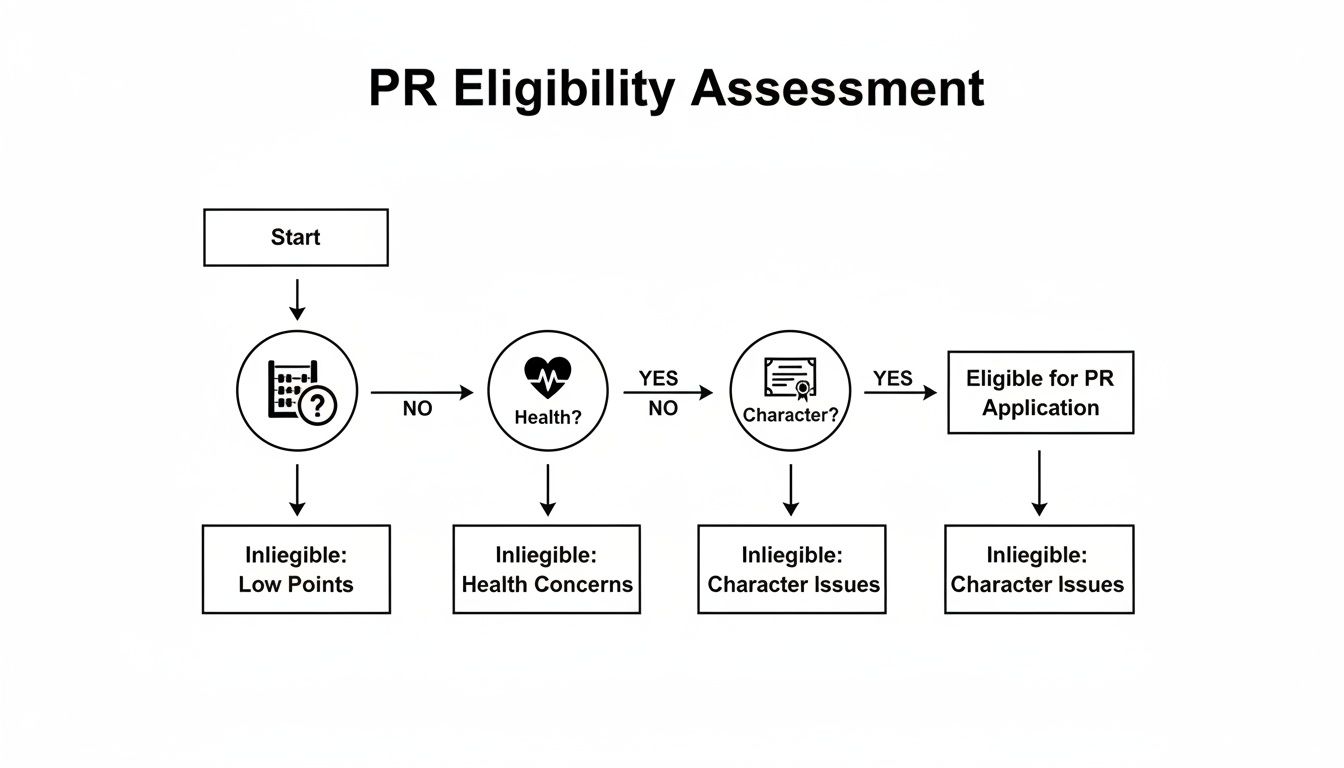
As you can see, getting through the points system is just the first hurdle. The health and character assessments are equally critical gates you need to pass through.
Family and Partner Visas: A Pathway Through Relationships
If you have close family ties to Australia, the Family stream opens up another set of options. These visas aren't based on your skills or work history but on your relationship with an Australian citizen, permanent resident, or eligible New Zealand citizen.
The most common one by far is the Partner Visa (Subclasses 820/801 or 309/100). This is for spouses or de facto partners and involves a two-stage process. You start on a temporary visa and then, after about two years, move to a permanent one, as long as the relationship is still genuine and ongoing.
This stream is a big part of the migration program. The 2025-26 allocation has set aside 52,500 places for family visas, with a huge 40,500 of those specifically for Partner visas. It just shows how much importance Australia places on family reunification.
Choosing the right stream really comes down to a careful look at your own situation. A nurse with a high points score might aim for a state-nominated 190 visa to tap into specific state occupation lists. On the other hand, a finance manager with a solid job offer might find the employer-sponsored 186 visa a faster and more certain option. For a more detailed comparison, check out our guide on different permanent residency pathways.
Gathering Your Documents and Lodging the Application

This is where the rubber hits the road. All your careful planning and points calculation now needs to take concrete shape, starting with your Expression of Interest (EOI). You’ll submit this through the government's SkillSelect portal, which officially puts your hat in the ring.
Think of the EOI as your formal pitch to the Department of Home Affairs. It’s a digital summary of everything you're claiming, and absolute accuracy is non-negotiable. The details in your EOI must perfectly mirror the evidence you'll provide later. Even a tiny mismatch can create massive headaches, so triple-check every date, name, and qualification before you hit submit.
Creating a Strong Expression of Interest
When you lodge your EOI, you aren't actually uploading any documents yet. Instead, you're making a series of claims and promising you can prove every single one.
If you claim 15 points for having eight years of relevant work experience, you better have the signed reference letters, contracts, and payslips ready to go the second you get an invitation. It’s a promise you have to be able to keep.
A classic blunder is claiming points for work that your skills assessing authority didn't recognise as "skilled." Always, always align the employment dates in your EOI with the dates officially confirmed in your skills assessment outcome letter. Don't give them a reason to question your claims.
Your Core Document Checklist
Once the EOI is in, the real document hunt begins. Getting everything organised before you receive an Invitation to Apply (ITA) will save you a world of stress. Here’s a look at the essential evidence you’ll need to have on hand:
- Identity Documents: A crisp, colour copy of your passport's biodata page is a must, along with your birth certificate.
- Skills Assessment: This is the heart of your application. You need a valid, positive skills assessment from the right authority for your nominated job.
- English Language Test Results: Your official report from IELTS, PTE Academic, TOEFL iBT, or another approved test, proving you meet the English requirement.
- Educational Qualifications: Certified copies of your university transcripts and completion certificates for every degree or diploma you're claiming points for.
- Employment Evidence: This is often the trickiest part. Be prepared to provide detailed reference letters on company letterhead, payslips, tax records, and even bank statements to prove your entire work history.
When putting together your documents, you might also need a personal statement. It's worth looking at examples of powerful personal statements to see how to frame your story effectively.
Disclaimer: Immigration laws and information can change without notice. The content in this article may not be current when you read it. For the most up-to-date and personalised advice, we strongly recommend you book an appointment with a registered migration agent. Always refer to the official Department of Home Affairs website for any department fees for any visa.
This prep work is especially vital for international students hoping to stay on. As of April 30, 2025, Australia was home to a staggering 720,720 Student Visa holders. Many will try to transition to PR, and their success often comes down to flawless documentation.
Lodging Your Application After an Invitation
Getting that Invitation to Apply (ITA) in your inbox is an amazing feeling. But it also starts a ticking clock. You have exactly 60 days from the invitation date to lodge your complete visa application and pay the fee via your ImmiAccount.
This 60-day window is not for chasing down old payslips. It's for compiling your already-prepared evidence, meticulously filling out the online forms, and uploading everything without a single error.
Here are a few final pointers for a smooth lodgement:
- Certified Translations: If any of your documents aren't in English, they must be translated by a NAATI-accredited translator. No exceptions.
- High-Quality Scans: Make sure every scanned document is clear, in colour, and perfectly readable. A blurry or cropped scan is a common reason for a case officer to request more information, causing delays.
- Consistency is Key: The details in your final application form must be identical to what’s in your EOI and your supporting documents. A different job title or a slightly off employment date will absolutely raise a red flag.
After you lodge, you'll also get instructions to complete your health examinations. And remember, you have to continue meeting all the core visa criteria, which we cover in our guide on health and character requirements. Your attention to detail at this final stage is what will get you over the line.
Navigating the Process After You Apply

You’ve done it. Hitting 'submit' on your PR application is a massive moment, but it’s also the start of what can be a very anxious waiting game. Knowing what to expect can make this whole phase a lot less stressful.
Your application hasn't just disappeared into the ether; it has officially entered the queue to be assessed by a case officer at the Department of Home Affairs.
If you lodged your application from within Australia while holding a valid visa (like a student or temporary work visa), you will almost always be granted a Bridging Visa A (BVA). This is your lifeline. The BVA kicks in the second your current visa expires, keeping you legally in the country while you wait for a decision.
Understanding Timelines and Bridging Visas
Processing times are notoriously unpredictable. They can swing wildly depending on the visa subclass you've applied for, the complexity of your case, and whatever the Department's workload looks like at that moment. Some people get a decision in a few months; others are left waiting for over a year.
It's a good idea to keep an eye on the Department's global visa processing times page for a rough estimate, but my advice is to mentally prepare for a long haul.
The competition for skilled PR places is fierce and getting fiercer. In the 2024-25 program year, primary applications for skilled visas shot up by 53% to 63,700. This shows just how many people are vying for a spot. With 185,000 total PR places on the table for the 2025-26 program, you can bet the competition will be intense. For a deeper dive, check out the Department's latest temporary resident skilled visa report summary.
Responding to a Request for Further Information
Don't panic if you get a Request for Further Information (RFI) in your ImmiAccount. It’s actually very common. An RFI simply means your case officer needs a bit more evidence or some clarification before they can make a final call.
You'll be given a strict deadline, usually 28 days, to provide what they've asked for. It is absolutely crucial that you respond on time with complete and accurate information. This is a pivotal moment, and how you handle it can make or break your application.
Disclaimer: Immigration laws and information can change without notice. The content in this article may not be current when you read it. For the most up-to-date and personalised advice, we strongly recommend you book an appointment with a registered migration agent. Always refer to the official Department of Home Affairs website for any department fees for any visa.
The Final Decision: Grant or Refusal
After the long wait, one of two things will happen: a grant or a refusal. If it's good news, a formal visa grant letter will appear in your ImmiAccount. This letter is the official proof of your permanent residency.
It contains some incredibly important details you need to pay attention to:
- Your Visa Grant Number: The unique ID for your new permanent visa.
- Initial Entry Date: This is the deadline by which you (and anyone else on your application) must enter Australia to activate the PR visa.
- Visa Conditions: This section outlines any specific rules attached to your visa, like the five-year travel facility that allows you to leave and re-enter Australia.
This letter is the finish line. Read it carefully, save a copy somewhere safe, and take a moment to celebrate. You're officially an Australian permanent resident.
Your Top Questions About Australian PR, Answered
As you get deeper into the process, specific questions are bound to come up. The journey to Australian permanent residency is paved with details, and getting straight answers can help you dodge common roadblocks and build a much stronger case from the start.
We've pulled together some of the most common queries we hear from applicants to give you that clarity. Knowing this stuff makes a huge difference—it helps you plan your timeline, manage expectations, and make sure your application is rock-solid before you even think about lodging an Expression of Interest (EOI).
What's a Truly Competitive Points Score?
You'll see the number 65 points everywhere—it's the bare minimum to even be considered for a skilled migration visa. But I have to be blunt: for most popular occupations, 65 is nowhere near enough to get an invitation. Hitting the minimum just gets you into the pool; it doesn't get you a ticket to the party.
The reality is, the score you need for an invitation changes all the time. It depends on how many people are applying and the demand for specific jobs. For high-demand roles like software developers or accountants aiming for the Skilled Independent (Subclass 189) visa, a competitive score these days often starts at 85, 90, or even higher.
A dose of reality: Think of the points system like an auction. The government has a limited number of invitations to hand out in each round. They're always going to invite the people with the highest points first. Your goal isn't just to meet the minimum—it's to score as high as you possibly can to get to the front of the queue.
How Long Are My Documents Valid For?
Timing is everything when you're pulling your application together. Two of your most important documents have expiry dates, and letting them lapse can completely derail your plans.
Here’s the breakdown:
- English Language Test Results: Your scores from tests like IELTS or PTE Academic are generally valid for three years from the test date.
- Skills Assessments: This one varies. Most skills assessments are valid for three years, but it really depends on the assessing body. VETASSESS, for example, is typically three years, but you must check the specifics for your own authority.
Crucially, both your English test and your skills assessment must be valid at two key moments: the day you receive your Invitation to Apply (ITA) and the day you lodge your final visa application. If either one expires before you lodge, your application could be refused on the spot.
Can I Include My Family in My Application?
Yes, absolutely. You can include your partner and any dependent children in your skilled migration application as "secondary applicants." It's a very common path.
However, every single person included in the application—you, your partner, your kids—must meet Australia's strict health and character requirements. No exceptions.
When it comes to your partner, there are two ways they can be part of the application:
- As a Secondary Applicant: They don't need to meet any skill or English requirements themselves, but they must pass the health and character checks.
- To Claim Partner Points: If you're hoping to claim those extra 5 or 10 points for partner skills, your partner has to meet specific criteria. This includes being under 45, having at least 'Competent' English, and (for the full 10 points) getting a positive skills assessment in an occupation on the same skilled list as yours.
Just remember that adding family members will increase the total visa application charge. Always check the official Department of Home Affairs website for the latest fees.
What Are the Top Reasons for Visa Refusal?
Knowing why applications get rejected is the best way to avoid making the same mistakes. While every case has its own story, a few common themes pop up again and again in visa refusals.
Here are the most frequent culprits we see:
- Inconsistent Information: Discrepancies between your EOI, your visa form, and your supporting documents are a massive red flag for case officers. Everything must line up perfectly.
- Not Enough Evidence: This is a big one. You can't just claim work experience or a relationship—you have to prove it with solid, verifiable evidence.
- Failing the Character Test: This could be due to a criminal record or, more commonly, providing false information to the Department. This is a serious issue known as a Public Interest Criterion 4020 breach.
- Bogus Documents: Submitting fraudulent or misleading documents is a one-way ticket to a refusal and a potential multi-year ban from applying for any other Australian visas.
Be meticulous. Be honest. By double-checking everything and presenting a clear, credible application, you can sidestep these common pitfalls.
Disclaimer: Immigration laws and information can change without notice. The content in this article may not be current when you read it. For the most up-to-date and personalised advice, we strongly recommend you book an appointment with a registered migration agent. Always refer to the official Department of Home Affairs website for any department fees for any visa.
Navigating the complexities of how to apply for Australian PR requires expert guidance and a meticulous approach. At My Visa Guide, our MARA-certified agents provide transparent, end-to-end support to ensure your application is decision-ready. Book your consultation today at https://www.myvisaguide.com.au and take the next step with confidence.