Finishing your degree in Australia is a huge milestone, and a moment to be proud of. But what comes next? For many international students, the dream is to stick around, get some local work experience under your belt, and really kickstart a career. This is where the Temporary Graduate visa (subclass 485) comes in.
Disclaimer: Migration laws and visa requirements are subject to change. The information provided in this article is for general informational purposes only and may not be current at the time of reading. For the most accurate and personalised advice, it is essential to book an appointment with a registered migration agent. For all official visa application fees, please refer directly to the Department of Home Affairs website.
So You've Graduated in Australia… What's Next?
Completing your qualification is just the beginning of a whole new adventure. Now, it's time to transition from the lecture hall to the workplace, and the subclass 485 visa is the perfect bridge to get you there. It's designed specifically to let you apply everything you've learned in a real-world job, gain priceless local experience, and start building your professional network.
Think of it as your chance to truly understand Australian workplace culture and take those first crucial steps in your chosen field.
It's an incredibly popular pathway for good reason. As of 30 September 2025, Australia was home to 217,624 Temporary Graduate visa holders, making it one of the go-to options for graduates ready to launch their careers. You can find more detailed insights on these visa trends over at vsure.com.au.
Before we dive in, here’s a quick snapshot of how the two streams compare.
Graduate Visa (Subclass 485) At A Glance
| Feature | Post-Study Work Stream | Graduate Work Stream |
|---|---|---|
| Who is it for? | Graduates of Bachelor, Masters, or PhD degrees. | Graduates with specific vocational qualifications (e.g., diplomas, trade certs). |
| Key Requirement | Your qualification is at a degree level or higher. | Your qualification must be on the skilled occupation list. |
| Typical Stay | Generally 2 to 4 years, depending on the qualification. | Typically 18 months (though temporary extensions may apply). |
| Skills Assessment | Not usually required. | Mandatory skills assessment is required. |
This table gives you a basic idea, but the details are what really matter. Choosing the right stream is the most important first step, so let’s break them down.
The Two Main Pathways: Which One Is for You?
The graduate visa isn't a one-size-fits-all solution. It's split into two very distinct streams, each catering to different types of qualifications.
-
The Post-Study Work Stream: This is the most common route for anyone who has just finished a higher education degree—think a Bachelor's, Master's, or PhD from an Australian university. It’s designed to be a more direct pathway for university graduates.
-
The Graduate Work Stream: This stream is tailored for those who've completed vocational qualifications, like diplomas or trade certificates. The catch here is that your qualification must link directly to an occupation on Australia’s skilled occupation list.
Figuring out which stream you fit into is the most critical part of the puzzle. Getting this right from the start makes the whole application process smoother and sets you up for success.
Once you've secured your visa, the next challenge is the job hunt. This visa gives you the right to work, but it's a strong application that lands you the job. A big part of that is crafting a powerful recent graduate resume that stands out.
Choosing Your Path: Post-Study Work vs. Graduate Work
So you've tossed your graduation cap in the air. Congratulations! Now comes the big decision: which stream of the Temporary Graduate visa (Subclass 485) is right for you? This isn't just a box to tick on a form; it's the first major step in your post-study journey, and it sets the stage for your stay, your work rights, and your future opportunities in Australia. Getting this choice right from the start is absolutely crucial.
Think of it like choosing a path after leaving university. The Post-Study Work stream is the broad, open highway. It’s designed for the majority of international students who've just finished a Bachelor, Masters, or PhD degree from an Australian institution. The best part? It doesn't matter what you studied—this road is open to you.
On the other hand, the Graduate Work stream is a more specialised route. It’s for graduates whose skills are on Australia’s in-demand list, often those with diplomas or trade qualifications. This path is narrower and has a few more requirements, but it leads directly to industries where Australia needs skilled people right now.
This flowchart makes it easy to see which path your qualification points you towards.
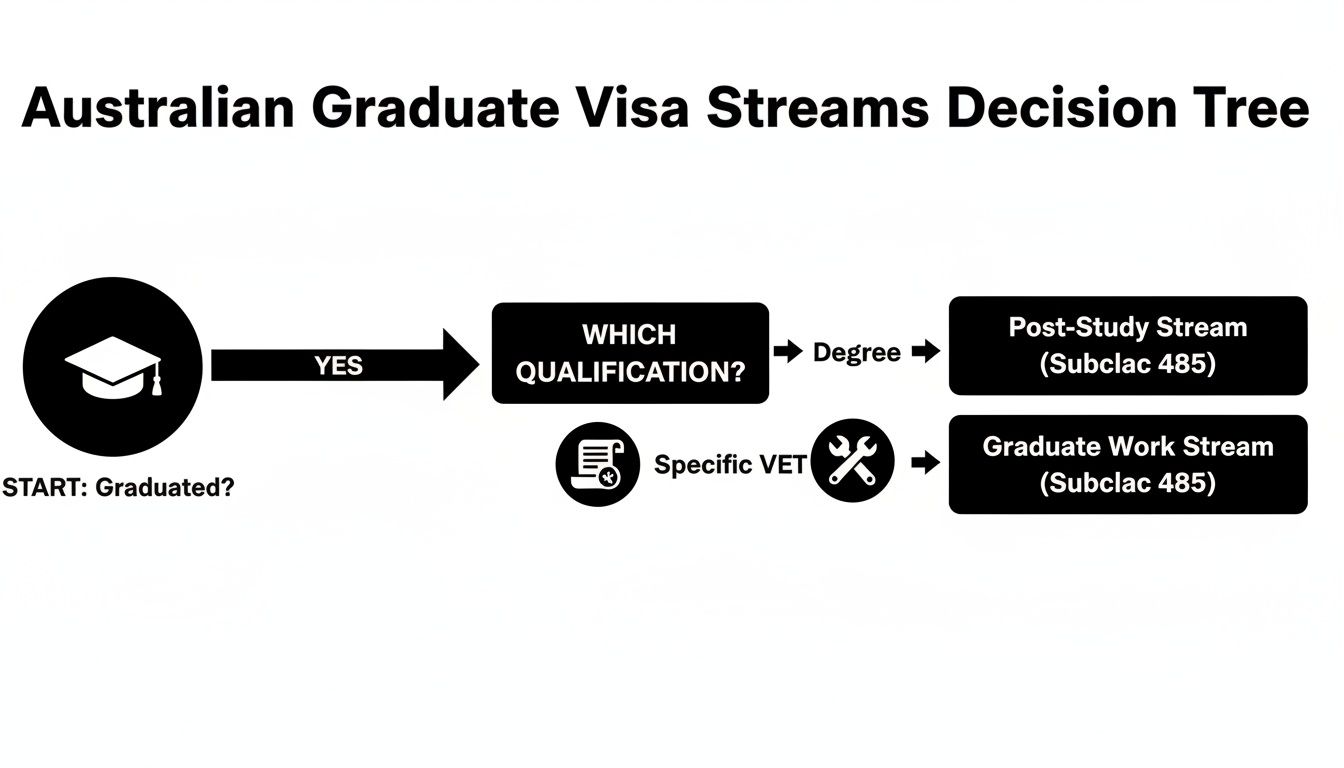
As you can see, it really boils down to what you studied. A higher education degree almost always leads to the Post-Study Work stream, while specific vocational training will have you looking at the Graduate Work stream.
The Post-Study Work Stream Explained
This is, by far, the most popular option for international graduates. If you've just wrapped up a degree at an Australian university, this is most likely your ticket. Its biggest drawcard is flexibility—you aren't locked into a specific occupation.
The freedom this stream offers is its key advantage. You get full, unrestricted work rights. That means you can work for any employer, in any industry, anywhere in Australia. It’s the perfect way to test the waters, gain a wide range of professional experience, and figure out what you really want to do with your career.
How long you can stay is tied directly to the level of your degree:
- Bachelor Degree (including honours): Generally gives you a 2-year stay.
- Masters Degree (coursework or research): Unlocks up to a 3-year stay.
- Doctoral Degree (PhD): Offers the longest visa, with up to 4 years of stay time.
Basically, the higher your qualification, the more time you get to build your career in Australia. This visa is an incredible stepping stone and a fantastic foundation for exploring the various post-study pathways to permanent residency.
The Graduate Work Stream Explained
This stream is much more targeted. It’s specifically for graduates who have qualifications and skills that match occupations Australia has identified as being in short supply. Think VET (Vocational Education and Training) graduates—plumbers, chefs, mechanics, and other trade professionals.
Unlike the Post-Study Work stream, this one comes with a couple of extra hurdles you’ll need to clear:
- Nominated Occupation: Your qualification has to be closely related to a job on the Medium and Long-term Strategic Skills List (MLTSSL).
- Skills Assessment: You’ll need to get a positive skills assessment from the relevant authority for your nominated trade. This is an official check to confirm you have the skills Australia expects for that occupation.
The Graduate Work stream is a direct answer to Australia's labour market shortages. Getting through this process shows that your skills aren't just theoretical—they are officially recognised and in high demand.
The visa for this stream typically lasts up to 18 months. It might be shorter, but it’s a golden opportunity to get your foot in the door and gain critical work experience in your specific field. That hands-on experience can be a massive advantage if you plan to apply for other skilled visas down the line.
Making the right choice at this stage is everything. Take a good, hard look at your qualification and line it up with these two streams to make sure your application for a graduate visa in Australia starts off on the right foot.
Disclaimer: Migration laws and visa requirements are subject to change. The information provided in this article is for general informational purposes only and may not be current at the time of reading. For the most accurate and personalised advice, it is essential to book an appointment with a registered migration agent. For all official visa application fees, please refer directly to the Department of Home Affairs website.
Meeting the Core Eligibility Requirements
Navigating the path to a graduate visa in Australia really comes down to ticking a few fundamental boxes. Think of these requirements as the non-negotiables—the absolute foundation of your application. If you miss one, the whole thing can fall over, so it's vital to get each part right from the very start.

Lodging a successful application is so much more than just filling out forms. It’s about building a solid case that proves you meet every single criterion. In this section, we’ll walk through the pillars of a strong application, helping you avoid the common slip-ups that cause unnecessary delays or even refusals.
The Australian Study Requirement Explained
This is probably the most important hurdle you need to clear. At its heart, the Australian Study Requirement is there to make sure you genuinely came to Australia to study. It's not just about getting a piece of paper at the end; it's about proving you’ve completed a substantial course within the Australian education system.
To meet this, your course must have:
- Been registered on the Commonwealth Register of Institutions and Courses for Overseas Students (CRICOS).
- Led to an eligible qualification (like a degree, diploma, or a trade qualification).
- Been completed over a minimum of two academic years, which the Department calculates as 92 weeks of registered study.
That '92 weeks' rule trips a lot of people up. It’s about the standard registered duration of your course on CRICOS, not how long it actually took you to finish it. For example, if you fast-tracked a two-year degree and completed it in 18 months, you still meet the requirement because the course itself is registered as a 92-week program.
Key Takeaway: The Australian Study Requirement is all about the official structure of your course. Always double-check your course’s CRICOS registration to make sure you're in the clear.
Age and Recent Study Rules
When it comes to the 485 visa, timing is everything. The Department of Home Affairs is very strict about your age and how recently you finished your studies, ensuring the visa goes to genuine, recent graduates ready to kickstart their careers.
First up, you must be under 35 years of age when you lodge your application. This is a hard-and-fast rule for most applicants. (There are exceptions for Hong Kong and British National Overseas passport holders, who have an age limit of 50).
Just as critical is the 'six-month rule'. You have to apply for your graduate visa within six months of your official course completion date. This isn’t your graduation ceremony! It’s the date you get that formal notification from your uni or college—usually an email or a portal update—saying you’ve officially met all your academic requirements.
Proving Your English Language Proficiency
Showing you have a competent level of English is completely non-negotiable. You’ll need to provide results from an approved English language test, such as IELTS, PTE Academic, or TOEFL iBT.
Here are the minimum scores you’ll need to hit:
- IELTS: An overall score of at least 6.0, with no band lower than 5.0.
- PTE Academic: An overall score of at least 50, with no skill score below 36.
My advice? Book your test well in advance. Spots fill up fast, and getting your results back can take time. If you’re worried about hitting those scores, getting some professional coaching can make all the difference. You can find more information in our detailed guide on navigating English proficiency support for your visa.
Health and Character Checks
Finally, every applicant has to meet Australia’s health and character standards. These are routine checks designed to protect the Australian community.
- Health Requirement: You’ll most likely need a medical examination with a panel physician approved by the Department. It’s a general check-up but can include chest x-rays or other tests.
- Character Requirement: You must provide an Australian Federal Police (AFP) check. It’s crucial to apply for the right one (use Code: 33) and make sure it has been issued within the last 12 months before you apply.
On top of this, you need to have the right health insurance in place. Your standard Overseas Student Health Cover (OSHC) won’t cut it for a 485 visa. You must switch to an adequate level of Overseas Visitor Health Cover (OVHC) and include proof of your policy with your application.
Disclaimer: Migration laws and visa requirements are subject to change. The information provided in this article is for general informational purposes only and may not be current at the time of reading. For the most accurate and personalised advice, it is essential to book an appointment with a registered migration agent. For all official visa application fees, please refer directly to the Department of Home Affairs website.
Assembling Your Decision-Ready Document Checklist
Think of your graduate visa application like building a case for yourself—every document is a crucial piece of evidence. A messy or incomplete application is one of the fastest ways to hit a delay or, even worse, a refusal. This section is your blueprint for pulling together every single document you need to build a strong, decision-ready application that leaves no room for doubt.
We'll go beyond the obvious things like your passport and photos. The real focus here is on the evidence that proves you meet the strict visa criteria. It’s not just about having the documents; it’s about presenting them so clearly that the case officer's job is as easy as possible.

Core Identity and Academic Documents
First things first, let's get the foundational documents sorted. These are the non-negotiables that confirm who you are and that you’ve done the study you say you have. Make sure you have high-quality, colour scans of everything.
- Passport: You'll need the biodata page of your current passport. If you have older passports that contain previous Australian visas, it's a good idea to include those too.
- Birth Certificate: A certified copy is required, and it must show both of your parents' names.
- Passport-Sized Photographs: Get two recent, identical photos that meet Australia's specific photograph guidelines.
Next up is proving your academic chops. This is where you back up your claim of meeting the Australian Study Requirement.
- Official Academic Transcript: This has to be the final, complete transcript showing every subject and all your marks.
- Course Completion Letter: This isn't just any letter. It needs to be a formal document from your uni or college stating the exact date your course was completed, the course duration on CRICOS, your campus location, and that the language of instruction was English.
Proving Your Eligibility Claims
Beyond who you are and what you studied, you need to provide solid evidence for the other key eligibility criteria. These documents are just as critical, and this is often where small but costly mistakes happen.
You'll need to prove your English language skills with official results from a test like IELTS or PTE Academic. The key here is to make sure your test results are still valid on the day you lodge your visa application.
For the health and character checks, you must provide:
- Australian Federal Police (AFP) Check: Your certificate can't be more than 12 months old when you apply. And this is vital: you must request the check using Code: 33. The wrong code will get you a rejection.
- Overseas Visitor Health Cover (OVHC): You need to provide the policy document confirming you have adequate health insurance for the entire time you plan to be on the visa. Your old student cover (OSHC) won't cut it.
Digital Document Preparation Tips
Your application is lodged online through an ImmiAccount, so how you prepare your digital files really matters. A bunch of poorly named or formatted files can create frustrating delays and slow down the whole process.
Here are a few pro tips for a smooth submission:
- File Naming: Use a simple, consistent naming system. For example:
Jane_Smith_Passport.pdforJane_Smith_Academic_Transcript.pdf. - File Format: The Department of Home Affairs strongly prefers PDF files. Try to avoid using JPGs unless you have to, as PDFs are clearer and can be combined easily.
- File Size: Keep an eye on file sizes. The ImmiAccount system has limits, so you might need to compress larger files, but make sure they stay perfectly legible.
- Combine Documents: If a document has multiple pages, like your transcript, combine them all into a single PDF instead of uploading each page separately.
Finally, before you hit submit, always double-check the official Department of Home Affairs website for the current visa application fees. This ensures you pay the right amount and avoid any simple payment errors that could derail your graduate visa application.
Disclaimer: Migration laws and visa requirements are subject to change. The information provided in this article is for general informational purposes only and may not be current at the time of reading. For the most accurate and personalised advice, it is essential to book an appointment with a registered migration agent. For all official visa application fees, please refer directly to the Department of Home Affairs website.
What Happens After You Lodge: Fees, Timelines, and Bridging Visas
So, you’ve pulled everything together and finally hit ‘submit’ on your graduate visa application. Congratulations! But now comes the part that can feel like a bit of a waiting game.
Don’t worry—knowing what’s happening behind the scenes can make this period feel a lot less uncertain. Let’s break down everything from processing timelines and costs to the all-important bridging visa that keeps you lawfully in Australia. It’s all about turning this waiting period into a time of confident preparation for your new career chapter.
Decoding Visa Processing Times
The first question on everyone's mind is, "How long is this going to take?" There's no single answer, unfortunately. Processing times for the Subclass 485 visa can swing quite a bit depending on a few key factors. The most reliable place to get a current estimate is always the Department of Home Affairs itself.
Here’s what can speed things up or slow them down:
- Application Quality: A "decision-ready" application—one that’s complete, with every document perfectly in place—is always going to be processed faster.
- Your Personal Circumstances: If your case is straightforward, it’ll move through the system quicker. Complex situations that require extra background checks will naturally take more time.
- The Department's Workload: Sometimes, it’s just a matter of volume. A flood of applications can create backlogs that are outside of your control.
To get the most realistic idea of what to expect, keep an eye on the official global visa processing times tool on the Department’s website. It’s updated regularly.
The All-Important Bridging Visa A (BVA)
This is a crucial one. When you lodge a valid graduate visa application while you’re in Australia and your current visa (like your student visa) is still active, you are automatically granted a Bridging Visa A (BVA).
Think of the BVA as your legal lifeline. It kicks in the exact moment your student visa expires, allowing you to stay in Australia legally while the Department processes your Subclass 485 application. For most former students, the BVA inherits the work rights from your student visa, meaning you can typically work full-time while you wait for a decision.
Critical Travel Warning: A standard Bridging Visa A will cease the moment you step outside of Australia. If you have to travel overseas for any reason, you absolutely must apply for and be granted a Bridging Visa B (BVB) before you leave. If you don't, you could find yourself stuck overseas, unable to return.
Budgeting for Your Application Costs
The final cost of your visa application is more than just one single fee. The main expense is the Visa Application Charge (VAC), which you pay directly to the Department of Home Affairs. This figure is adjusted from time to time, so it's vital to check the latest amount before lodging.
But the VAC isn't the whole story. You’ll also need to factor in other potential costs:
- Health Examination: This has to be done by a government-approved panel physician and comes with its own fee.
- Police Checks: You'll need to pay for an Australian Federal Police (AFP) check.
- English Language Test: Fees for tests like IELTS or PTE can add to your total budget.
- Biometrics: In some cases, you might be asked to provide biometrics (fingerprints and a photo), which involves a separate service fee.
Disclaimer: Migration laws and visa requirements are subject to change. The information provided in this article is for general informational purposes only and may not be current at the time of reading. For the most accurate and personalised advice, it is essential to book an appointment with a registered migration agent. For all official visa application fees, please refer directly to the Department of Home Affairs website.
Your 485 Visa: Turning a Temporary Stay into Permanent Residency
Getting your Temporary Graduate visa is a huge win, but it’s crucial to see it for what it truly is: a launchpad, not the final destination. This visa is your golden ticket, a chance to strategically build a rock-solid case for permanent residency (PR). Every move you make during this time can be a deliberate step toward your long-term goal of calling Australia home.

Think of your time on the Subclass 485 visa as a probationary period where you prove your value to the Australian economy and community. It’s about much more than just finding any job to pay the bills; it’s about crafting a compelling profile that perfectly aligns with the country's skilled migration needs. Let’s break down the key strategies to make it happen.
Gain Relevant Skilled Employment
The single most valuable thing you can do on a graduate visa is get relevant work experience. I can't stress this enough. We're not just talking about earning an income; this is about clocking up skilled employment in your nominated occupation or a field that's very closely related. This experience is the absolute cornerstone for most skilled migration visas, including the big ones: the Subclass 189, 190, and 491 visas.
Your focus should be on roles where your day-to-day tasks match the official ANZSCO description for your occupation. Keep meticulous records of everything—contracts, payslips, detailed position descriptions—because this paper trail will be critical when you lodge future visa applications.
Pump Up Your Points Score
Australia's skilled migration system is a points game, and your time on the 485 visa is the perfect opportunity to rack them up. Two of the most effective ways to give your score a serious boost are by mastering your English and enrolling in a Professional Year Program.
- Superior English: Nailing a 'superior' English score (think an 8 in each band of the IELTS test) can add a massive 20 points to your total.
- Professional Year Program (PYP): If you're an accounting, IT, or engineering graduate, a PYP is a no-brainer. It gives you targeted industry training and adds 5 points to your score.
A Professional Year Program is a double-win. It doesn't just add crucial points; it gives you invaluable local work experience and helps you build a professional network, which dramatically improves both your job prospects and your PR chances.
Explore Regional Pathways
Don't make the mistake of only looking for work in the big cities. The advantages of working in a designated regional area are huge. Gaining skilled work experience outside of major hubs like Sydney, Melbourne, and Brisbane can unlock exclusive visa pathways, most notably the Subclass 491 Skilled Work Regional (Provisional) visa.
This visa often provides a clearer, and sometimes faster, route to permanent residency. Living and working regionally shows a genuine commitment to contributing to all of Australia, something that state and territory governments value highly when offering visa nominations. To really get your head around the options, check out our detailed guide on the various permanent residency pathways available in Australia.
Disclaimer: Migration laws and visa requirements are subject to change. The information provided in this article is for general informational purposes only and may not be current at the time of reading. For the most accurate and personalised advice, it is essential to book an appointment with a registered migration agent. For all official visa application fees, please refer directly to the Department of Home Affairs website.
Your Top Graduate Visa Questions Answered
When you're at the finish line of your studies, a few last-minute questions about the graduate visa are bound to pop up. It's completely normal. We've put together some quick, straightforward answers to the queries we hear most often from graduates just like you.
Can I Bring My Family on a 485 Visa?
Yes, absolutely. The Subclass 485 visa lets you include members of your family unit when you apply. This typically means your partner and any dependent children.
Here’s a crucial tip: it’s vital to include all your family members on the initial application, even if they aren't planning to come to Australia right away. Trying to add them later can be incredibly complex and, in many cases, simply isn't an option.
What Are My Work Rights on the Graduate Visa?
Once your visa is granted, you get full, unrestricted work rights. This is one of the biggest advantages of the 485 visa.
It means you can work for any employer, in any job, for as many hours as you like. This freedom is your ticket to gaining valuable and diverse Australian work experience without being tied to a specific company or role.
What if My Circumstances Change After I Apply?
Life doesn’t stop just because a visa application is pending, and the Department of Home Affairs gets that. If your situation changes after you've lodged—maybe you get married, have a child, or even just move to a new apartment—you are required to let them know.
You can update all your details easily through your ImmiAccount. Keeping your information up to date isn't just good practice; it's a visa condition and helps prevent any unnecessary hold-ups with your application for a graduate visa Australia.
Disclaimer: Migration laws and visa requirements are subject to change. The information provided in this article is for general informational purposes only and may not be current at the time of reading. For the most accurate and personalised advice, it is essential to book an appointment with a registered migration agent. For all official visa application fees, please refer directly to the Department of Home Affairs website.
Your Australian dream is closer than you think, but navigating the visa system can feel overwhelming. Let My Visa Guide give you the clear, expert, and ethical support you need to secure your future. Our registered migration agents are with you every step of the way, from the first assessment to a decision-ready application. Book your consultation today and apply with total confidence: https://www.myvisaguide.com.au.