Sometimes, your study plans in Australia don't go exactly as you first mapped them out. You might find your course is taking a little longer than expected, or maybe a new academic opportunity has popped up that you just can't pass on. If that sounds familiar, you're likely looking at an extension of your student visa.
This just means lodging a completely new Student visa (Subclass 500) application. The golden rule? You must do this before your current visa runs out to stay lawful in Australia. It’s the key to making sure you can keep studying without any stressful interruptions while you wait for the new visa to be approved.
Disclaimer: Please be aware that immigration information can become outdated. This article is for informational purposes only. To receive the most current and personalised advice for your situation, we strongly recommend booking an appointment with a registered migration agent. All government visa fees mentioned should be confirmed on the official Department of Home Affairs website at https://www.homeaffairs.gov.au/.
Why You Might Need a Student Visa Extension
Seeing that expiry date on your visa creeping closer can definitely cause a bit of panic. But honestly, it’s a situation thousands of international students find themselves in every year. Needing an extension of your student visa usually comes from a good place—either a new academic goal or just an unexpected hiccup in your original study plan.
The first step is always figuring out exactly why you need one, as this will shape your entire application.
Maybe you’ve just wrapped up your Bachelor’s degree and scored a place in a fantastic Master’s program. That's a classic example of academic progression. Or perhaps you've had a change of heart and want to switch to a different course or even a new university, which naturally changes your study timeline.
Common Reasons for Extending Your Stay
Life happens, and sometimes unexpected delays are the culprit. It's not uncommon to have to retake a subject, which could push your graduation into the next semester. For research students, it's also pretty normal for a project to need a bit more time than you first thought. These are all perfectly valid reasons for needing to stay in Australia a bit longer to finish what you started.
No matter your reason, the process is the same: you have to apply for a fresh visa to cover the new study period. To be successful, you’ll need to prove you still meet all the key eligibility criteria, including:
- Maintaining Enrolment: You’ll need a brand new Confirmation of Enrolment (CoE) from your education provider for the extended or new course.
- Health Cover: Your Overseas Student Health Cover (OSHC) can't have any gaps. It must be valid for the full length of your requested visa.
- Genuine Student Requirement: You have to convince the Department you are a Genuine Student (GS) whose primary purpose in Australia is still to study.
Disclaimer: Immigration information can change rapidly. For the most up-to-date advice tailored to your personal circumstances, it is essential to book an appointment with a registered migration agent. Always refer to https://www.homeaffairs.gov.au/ for the latest Department fees for any visa.
The Critical Timing of Your Application
If there's one thing to take away, it's this: lodge your new visa application before your current student visa expires. This is non-negotiable. If you let it lapse, you become an unlawful non-citizen, which creates a whole world of problems for any future visa applications you might make. As a general guide, you can usually apply for your extension up to 60 days before your visa is set to expire.
A massive part of your application's success hinges on the Genuine Student (GS) requirement. You need to present a clear, logical story explaining why you need more time. To get this right, it’s worth taking the time to understand what is the Genuine Student requirement in detail. It’ll help you build a much stronger and more convincing application.
And for the latest government visa application charges, always double-check the fees directly on the Department of Home Affairs website.
Getting Your Documents in Order for a Smooth Extension
Putting together a solid visa application is a bit like packing for a long trip—you need to have everything organised and accounted for. If you miss a single crucial document, you could face serious delays or, worse, a flat-out refusal. The goal here is to present a clear, consistent story to the Department of Home Affairs that leaves no room for doubt.
Every piece of paper you submit has a job to do. It’s all about proving you still meet the strict criteria for a Student visa (Subclass 500). This isn't just a box-ticking exercise; it's your chance to proactively show you’re a genuine student with a clear purpose.
Disclaimer: Immigration laws are subject to change, and information in this article may become outdated. We strongly advise you to book an appointment with a migration agent for current and personalised advice. For all official visa fees, please consult https://www.homeaffairs.gov.au/.
Your Academic Anchor: The Confirmation of Enrolment (CoE)
First things first, the absolute cornerstone of your extension application is a new Confirmation of Enrolment (CoE). This is completely non-negotiable. You can't just reuse your old one.
The CoE is the official document from your uni or college confirming you’re enrolled in a registered course for a specific period. To get a new one, you’ll have to get in touch with your student services team. They usually won't issue it until you’ve formally accepted your offer and paid a deposit on your tuition fees, so factor that timing into your plans.
- Your move: Chat with your international student advisor the moment you know an extension is on the cards.
- Crucial detail: Double-check that the start and end dates on your new CoE cover the full period you're applying for.
Don't Let Your Health Cover Lapse
Australian visa rules are incredibly strict on this point: you must have adequate health insurance for your entire stay. This means your Overseas Student Health Cover (OSHC) needs to be extended to match the end date on your new CoE. Even a one-day gap in your cover will lead to a refusal. It’s that serious.
When you renew your OSHC, make sure the new policy kicks in the day after your current one ends. You can usually sort this out directly through your uni or with an approved provider. For a deeper dive into what’s needed and how to pick the right provider, you can learn more about Overseas Student Health Cover (OSHC) to make sure you're fully compliant.
Insider Tip: I always advise clients to buy OSHC for a couple of months past their CoE end date. This little buffer covers you for things like graduation ceremonies or gives you breathing room for post-study plans. The Department looks on this favourably.
Showing You Have the Funds to Succeed
Your finances will be put under the microscope, so be prepared. You need to prove you have genuine access to enough money to cover your tuition, travel, and living costs for at least the next 12 months. This isn’t just a formality—it’s how the Department confirms you can support yourself without needing to work excessively or rely on public assistance.
Before you start pulling documents together, it’s worth creating a simple checklist. Here’s a quick overview of what you’ll likely need to gather for your application.
Document Checklist for Student Visa Extension
This table summarises the essential and supporting documents you'll need to prepare. Having everything in one place makes the online application process much smoother.
| Document Category | Specific Item | Key Tip |
|---|---|---|
| Identity | Passport Bio-Data Page | Must be valid for at least six months. Check your expiry date now! |
| Enrolment | New Confirmation of Enrolment (CoE) | Ensure the course dates align perfectly with your visa request. |
| Health Cover | OSHC Policy Certificate | The policy must cover the entire duration of your proposed visa. |
| Financial Capacity | Bank Statements (3-6 months) | Show a consistent savings history. A large, unexplained deposit right before applying is a major red flag. |
| Financial Support | Sponsor's Income/Employment Evidence | If parents are sponsoring you, include their payslips or business registration. |
| Student Status | Genuine Student (GS) Statement | Be specific and personal. Connect your past, present, and future studies logically. |
| Academic History | Previous Transcripts/Certificates | Include all academic records from Australia and your home country. |
| Health | Health Examination Results | You may be required to undergo a medical check-up if you haven't recently. |
Remember, this list is a general guide. Depending on your country of citizenship and personal circumstances, the Department might ask for additional information. Always check the Document Checklist Tool on the Home Affairs website for your specific requirements.
Commonly accepted financial evidence includes:
- Bank statements that show a stable savings history.
- Proof of financial support from your parents or partner, including their income statements.
- An official letter confirming a scholarship or other formal financial backing.
A big part of proving financial capacity involves providing clear bank statements. Getting to grips with how to access and present these is key. For practical advice, check out your guide to online bank statements.
Nailing Your Genuine Student Statement
The old Genuine Temporary Entrant (GTE) essay is gone, replaced by the Genuine Student (GS) requirement. This is your opportunity to speak directly to the case officer through a series of targeted questions in the application form. It’s your chance to explain why you need an extension and reaffirm that your primary goal in Australia is to study.
Your GS answers need to be sharp and to the point, addressing:
- Your academic journey so far: Briefly mention your achievements in your current course.
- The reason for extending: Be crystal clear about why you need more time. For instance, "I am extending to pursue a Master of Data Science, which is a logical next step after completing my Bachelor of Information Technology and will equip me with specialised skills."
- Your future plans: Clearly link this extra study to your career goals back in your home country.
Steer clear of generic, copy-paste answers. The more personal and specific you are, the better. This is your single most important tool for convincing the case officer you’re the real deal. A vague or poorly explained GS statement is one of the top reasons applications get rejected.
Navigating the Online Application in ImmiAccount
Alright, you’ve gathered all your documents and you’re ready for the final stretch: lodging the visa application itself. In Australia, this is all handled online through the Department of Home Affairs’ portal, ImmiAccount. It's a pretty user-friendly system, but knowing the lay of the land can help you avoid common slip-ups that might set your application back.
Everything from starting the application to uploading your files and paying the fee happens inside this portal. Think of it as your personal hub for all things visa-related, so it pays to get comfortable with it. My best advice? Block out some time, read every single question carefully, and have all your scanned documents ready to go before you even start.
Disclaimer: Please be aware that immigration information can become outdated. This article is for informational purposes only. To receive the most current and personalised advice for your situation, we strongly recommend booking an appointment with a registered migration agent. All government visa fees mentioned should be confirmed on the official Department of Home Affairs website at https://www.homeaffairs.gov.au/.
Kicking Off Your Application
First things first, you'll need to log into your ImmiAccount. If you don't have one from your first visa, you’ll need to create one. Once you’re in, you’ll hit ‘New Application’ and find the ‘Student Visa (500)’ in the list. The form is lengthy, so be prepared—it covers everything from your personal details and travel history to your education and financial standing.
Most questions are straightforward, but a few can trip people up. For instance, when it asks for your 'intended date of arrival', you should put the start date of your new course. This simple detail tells the case officer the exact visa period you're applying for.
Heads Up: The old GTE statement has been replaced by the Genuine Student (GS) requirement, which is now a series of targeted questions within the application form. Don't just breeze through this part. These answers are your main chance to prove to the Department that your study intentions are legitimate. Generic or inconsistent answers are a huge red flag for case officers.
Attaching Documents and Finalising Your Submission
As you work your way through the form, you’ll get to the document attachment section. This is where all that prep work pays off. The system will show a list of document categories, and you'll upload each of your files into the right slot.
A couple of pro tips here:
- File Naming: Always name your files clearly. Think 'Passport_John_Smith.pdf' or 'CoE_University_of_Sydney.pdf'. It helps keep you organised and makes the case officer's job easier.
- File Size and Type: Keep an eye on the file size limits—it's usually 5MB per file. PDF is always the safest format. If your files are too big, you'll need to compress them before uploading.
This flowchart gives you a quick visual breakdown of the key document piles you’ll need ready for this stage.
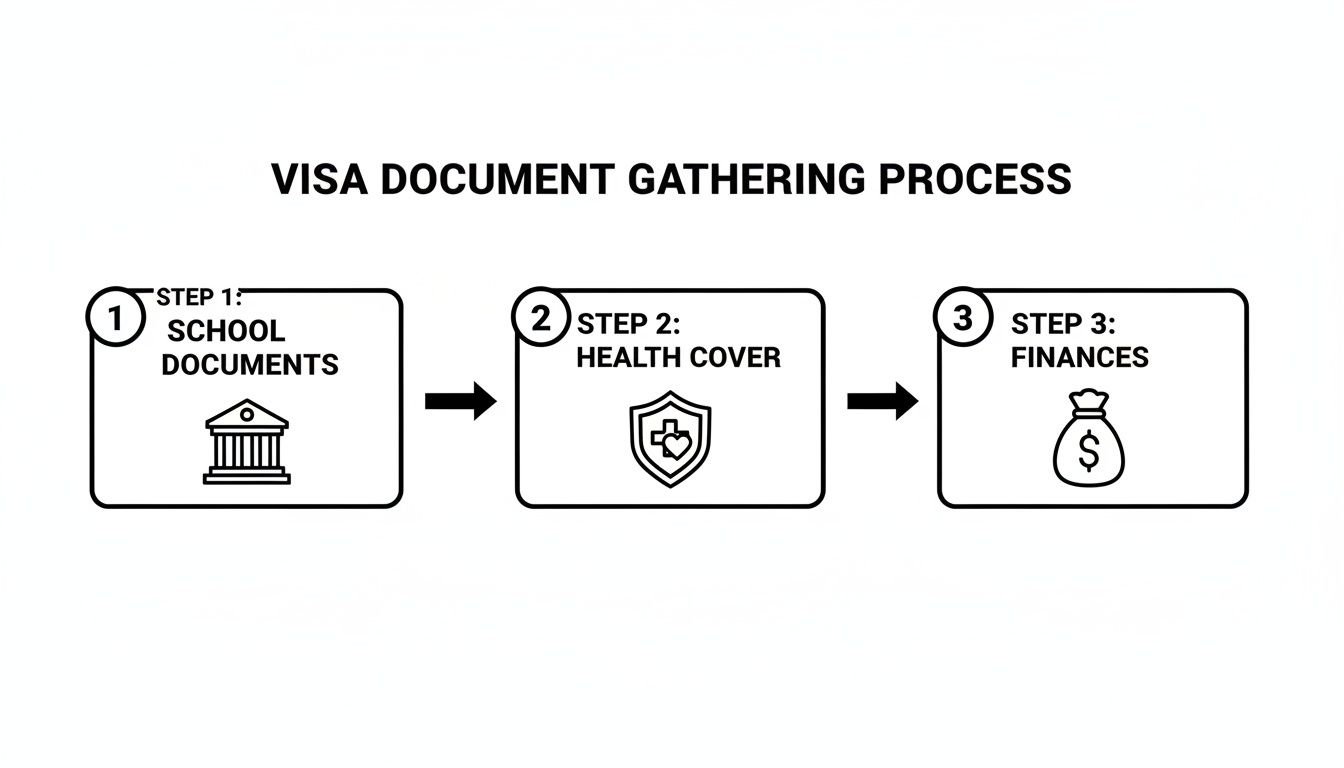
Think of these as the three pillars of your application's evidence: academic, health, and financial. You need all three to be solid.
Once your documents are all uploaded, you'll be directed to the payment page. Visa fees can and do change, so it's crucial to double-check the current cost on the official Department of Home Affairs website. After your payment goes through, you’ll get a confirmation letter and receipt in your ImmiAccount. That's it—your application is officially in the system!
Understanding Your Bridging Visa A (BVA)
This is a really important part of the process. The moment you lodge your new student visa application, you are automatically granted a Bridging Visa A (BVA).
The BVA is a temporary visa designed to keep you lawfully in Australia while you're waiting for a decision on your main application. It doesn't kick in immediately, though. It only becomes active the day after your current student visa expires.
Let’s say your current visa ends on March 15th and you apply for your extension on March 1st. You’ll stay on your current student visa until the 15th, and your BVA will automatically activate on March 16th, keeping you legal while you wait.
Generally, the work rights on your BVA mirror those of the visa you just held. This usually means you can keep working up to 48 hours per fortnight while your course is in session. But always, always check your official BVA grant notice to be sure of the specific conditions attached to your visa. If you want a deeper dive into the nitty-gritty of the visa itself, check out our detailed guide on student visa assistance for the Subclass 500.
How Current Immigration Policies Affect Your Application
Applying to extend your student visa isn't just a personal matter—it's about understanding the bigger picture you're fitting into. Australian immigration policies aren't static; they shift and evolve, and recent changes are having a huge impact on how applications are assessed, especially when it comes to processing times and the likelihood of success.
The government is always tweaking its immigration strategy to manage the number of international students coming into the country. Think of it as a balancing act between economic benefits, population growth, and making sure our cities and services can keep up. For you, this means the goalposts can move, sometimes making it tougher to get that visa grant.
Right now, there's a very deliberate push to manage the flow of new students, and that has a serious knock-on effect for those of us already here. This isn't just background noise; it's actively shaping the future of international education in Australia.
Disclaimer: Immigration policies are subject to change, and the information provided here may not be current when you read it. For the latest advice tailored to your specific situation, please book an appointment with a registered migration agent. All official visa fees should be confirmed on the Department of Home Affairs website.
The Impact of National Planning Levels
You might have heard terms like National Planning Levels (NPL) or Ministerial Direction 111 (MD111) floating around. These aren't just bureaucratic jargon—they're powerful policies that directly influence who gets a visa. The main goal is to control the intake of international students and prioritise certain types of study.
What does that look like in practice? Well, these policies are definitely tilting the scales in favour of higher education. If you're extending your visa to start a Bachelor's, Master's, or PhD at a university, your application is likely to be viewed much more favourably in the current climate.
On the flip side, students looking to enrol in Vocational Education and Training (VET) or English language (ELICOS) courses are facing a lot more scrutiny. This doesn't mean getting an extension is impossible, but it does mean your application has to be rock-solid. Your Genuine Student (GS) statement, in particular, needs to be incredibly strong and well-reasoned.
The Big Shift to Onshore Applications
One of the most significant trends we're seeing is the massive jump in students applying for their next visa from within Australia. With offshore visa grants getting harder to secure, many are choosing to enrol in a new course and lodge their extension application before their current visa runs out. This lets them stay in Australia on a Bridging Visa while they wait for a decision.
The numbers don't lie. We've seen an explosion in onshore student visa applications, with the count skyrocketing to over 100,000. This is a direct response to the government capping new student numbers from overseas. Students already here are strategically enrolling in new courses to hang onto their Subclass 500 status.
This boom has coincided with a clear preference for university programs, which now account for nearly 75% of recent visa grants. As a result, approvals for VET and ELICOS courses have dropped sharply. You can dig into more of this data on most international education news sites.
This data paints a very clear picture: applying onshore has become the go-to strategy for navigating stricter offshore rules. It hammers home why a flawless application and a compelling reason for your continued study are more critical than ever.
What This All Means for You
So, how do you translate all this policy talk into practical steps for your visa extension?
- Be Prepared for Varied Processing Times: With the flood of onshore applications, wait times can be unpredictable. Applications that align with government priorities (like higher education) might get processed faster, while others could take longer.
- Your Course Sector Really Matters: If you're planning to move into a VET course, expect your application to be put under a microscope. You absolutely must provide a powerful justification for why this is the right educational path for you.
- Professional Guidance Is No Longer a 'Nice-to-Have': The rules are more complex than ever. In a climate where the Department is looking for reasons to refuse, a small mistake or a weak GS statement can be the difference between staying and leaving.
Successfully navigating these policy shifts means understanding what case officers are looking for. It's not enough to just tick the boxes anymore; you need to present a compelling case that shows how your study plans align with Australia's current goals for education and immigration.
What to Expect and Do After You Apply
Hitting that "submit" button on your visa extension feels like a massive weight off your shoulders, but it also kicks off a waiting game that can be seriously nerve-wracking. The trick is to stay on top of things, not just sit back and hope for the best.
Your first port of call is your ImmiAccount. Get into the habit of logging in every week or so to check the status. This is the only official channel for updates from the Department of Home Affairs, and processing times can be all over the place depending on how busy they are and how complex your file is.
Disclaimer: Immigration information can change rapidly. For the most up-to-date advice tailored to your personal circumstances, it is essential to book an appointment with a registered migration agent. Always refer to https://www.homeaffairs.gov.au/ for the latest Department fees for any visa.
Responding to a Request for Further Information
Don't have a mini-heart attack if you get a Request for Further Information (RFI) from your case officer. It's actually pretty common and just means they need a few more pieces of the puzzle to finalise their decision. Think of it as your chance to make your application even stronger.
You’ll be given a hard deadline, usually 28 days, and it is absolutely critical you stick to it. The request will tell you exactly what they need.
Some common things they ask for include:
- Up-to-date bank statements to double-check your financial capacity.
- A clearer explanation of why you chose your course for the Genuine Student (GS) assessment.
- More proof of your relationship if you’ve included a partner or family member.
My best advice? Give them what they've asked for as quickly and clearly as you can. If the Department has to make assumptions because your documents are a mess, it rarely ends well. Be thorough and get straight to the point.
Facing a Potential Visa Refusal
Getting a refusal notice is gut-wrenching, but it doesn't automatically mean your time in Australia is over. The first step is to understand why it happened. More often than not, it comes down to failing the GS test or not providing solid proof of your finances.
While most applications get approved, refusals are a real risk. A significant chunk of rejections, around 15%, are linked directly to financial capacity or the Genuine Student criteria. This just goes to show how closely case officers scrutinise these parts of your application. You can dig deeper into these trends by checking out the latest analysis on Australian visa rejection reasons.
If your visa is refused, you'll get a decision letter spelling out the reasons. From there, you have a few paths forward, but a common one is to appeal the decision at the Administrative Appeals Tribunal (AAT).
Your Options After a Refusal
The AAT is a completely separate body that reviews the Department's decision. It’s a merits-based review, which means they look at everything you originally submitted, plus any new evidence, to determine if the right call was made.
Be warned, filing an AAT appeal is a long and complicated road that can take many months. The good news is that the success rates can be surprisingly high, with the tribunal overturning a lot of visa refusals when a strong, well-prepared case is put forward.
This is where you really need an expert in your corner. A registered migration agent can pull apart the reasons for your refusal, give you an honest opinion on your chances at the AAT, and help you build a compelling case for the tribunal. Trying to navigate this process alone is incredibly tough and not something I'd recommend.
Got Questions About Your Student Visa Extension? We've Got Answers
Even with the clearest instructions, extending your visa can throw up a few curveballs specific to your situation. It's completely normal to have questions pop up when you're trying to figure out how the rules apply to your unique academic journey.
Let's dive into some of the most common—and critical—questions we get from students just like you. We'll give you straight, practical answers to clear up the confusion and help you move forward with confidence.
Disclaimer: Immigration laws are subject to change, and information in this article may become outdated. We strongly advise you to book an appointment with a migration agent for current and personalised advice. For all official visa fees, please consult https://www.homeaffairs.gov.au/.
Can I Switch My Course or School When I Extend?
Absolutely. In fact, changing your course or education provider is one of the top reasons students find themselves needing a new visa in the first place. But you have to navigate this change carefully to keep on the right side of your visa conditions.
A classic example is moving from a higher qualification to a lower one, like from a Bachelor's degree down to a VET diploma. In this scenario, lodging a new student visa application is non-negotiable. Your first move, always, is to get a new Confirmation of Enrolment (CoE) from your new school for the new course.
This is where your Genuine Student (GS) statement becomes your most powerful tool. You can't just say you "wanted a change." You need to use the GS questions to build a strong case, clearly explaining why you're making the switch and how it logically fits into your long-term career plans. Your new course must be a sensible step in your academic progression, and it's up to you to prove it.
What Are My Work Rights While My Extension Is Being Processed?
Once you've lodged your student visa extension, you’ll automatically be granted a Bridging Visa A (BVA). This is your legal lifeline, and it kicks in the moment your current student visa expires, keeping you lawfully in Australia while the Department makes a decision.
In most cases, the work conditions on your BVA will simply carry over from your previous student visa. This means you can keep working up to 48 hours per fortnight while your course is in session.
Crucial Tip: Don't just assume your work rights are standard. You must log into VEVO (Visa Entitlement Verification Online) and check the official grant notice for your BVA. If you're granted a BVA without work rights and can prove you're in financial hardship, it's sometimes possible to apply for a new BVA with work permission, but you'll need a very compelling case.
How Much Money Do I Need to Show for My Visa Extension?
This is a big one. You have to provide rock-solid proof that you have genuine access to enough money to cover your travel, tuition, and living costs for at least the first 12 months of your new visa. This is a deal-breaker for the Department and a very common reason for visa refusals.
The minimum annual living cost figure is updated by the Department of Home Affairs from time to time, so make sure you check their official website for the latest number before you start gathering your documents.
You’ve got a few options to prove your financial capacity:
- Bank Statements: Showing bank statements from the last three to six months is a great way to demonstrate a stable history of savings.
- Support from Family: If your parents or partner are footing the bill, you’ll need proof of their income, like payslips or business registration documents, and a letter confirming their support.
- Scholarship Letters: An official letter detailing your scholarship can be used as part of your financial evidence.
A word of warning: a large, last-minute deposit into your account right before you lodge your application is a massive red flag for case officers. They are trained to spot funds that don't look like they're genuinely yours to use. Your money trail needs to be clean, clear, and easy to verify.
The Australian visa landscape can be complex, but you don't have to face it alone. If you're feeling unsure about your student visa extension or need expert guidance to ensure your application is as strong as possible, the team at My Visa Guide is here to help. Book a consultation with our MARA-registered agents today for clear, honest, and professional advice.