
It's a scenario that plays out all the time for international students: your visa's expiry date is creeping up, but your studies in Australia aren't quite done. Extending your student visa is a standard part of the journey for many, often needed because of a change in your academic plan, a course extension, or just one of life's unexpected curveballs.
Common Reasons for Extending Your Student Visa

Finding yourself needing a bit more time in Australia to finish your qualification is more normal than you might think. An international student's path is rarely a perfectly straight line, and all sorts of academic and personal situations can lead to a visa extension. Knowing the common reasons helps you realise you're not alone and lets you plan your next move with a bit more confidence.
Many students need an extension simply because their academic journey took an exciting turn. You might have discovered a new passion, prompting a switch from a diploma to a longer bachelor's degree. Or perhaps you've decided to package your current course with another to really deepen your expertise.
Academic Hurdles and Opportunities
Sometimes, the need to extend a student visa comes from hitting a bump in the academic road. Failing a unit is a very common reason, as having to repeat it can easily push your graduation date past your visa's expiry. It's a normal part of learning and a frequent trigger for a new visa application.
On the flip side, great academic opportunities can also mean you need more time. You might get offered a spot in an honours program or decide to take on a research project that adds an extra semester or year to your degree. These are fantastic developments that naturally require a longer stay.
The key thing to remember is that the Department of Home Affairs knows that study plans can and do change. As long as you have a legitimate academic reason backed up by a new Confirmation of Enrolment (CoE), needing an extension is just a standard part of the process.
Personal Circumstances and Delays
Life doesn't just hit pause because you're studying overseas. Unexpected personal or family situations can sometimes mean you need to take a temporary break from your course. This could involve flying home for a family emergency or dealing with health issues that force you to drop to a part-time study load for a semester.
These compassionate and compelling circumstances are completely valid reasons for needing more time to finish up. When this happens, your education provider will usually adjust your CoE, and you'll then need to apply for a new visa to cover the new end date.
Strategic Timing Is Everything
Understanding why you need an extension is the first step, but knowing when to apply is just as critical. The window for applying is pretty specific. You can usually lodge your application up to three months before your current visa expires, but you absolutely must apply before it runs out.
Applying too early might raise some eyebrows, while applying too late—after your visa has already expired—lands you in the tough spot of being in the country unlawfully. Your goal is to get all your documents in order and submit the application while your current visa is still active. This is crucial because it ensures you're automatically granted a Bridging Visa A (BVA), which lets you stay in Australia legally while your new student visa application is being processed. Nailing this timing is the foundation of a stress-free visa extension.
Checking Your Eligibility for a Visa Extension
Before you even think about logging into your ImmiAccount, you need to be dead certain you tick all the boxes for a student visa extension. I always tell my clients to treat this as a pre-flight check—getting it right now saves a world of stress, time, and money down the line. The Department of Home Affairs is very clear about its criteria, and there’s no room for error.
The absolute first thing to check is that you’re applying while you hold a substantive visa. For most students, this is your current Student visa (Subclass 500). Applying before your current visa expires is crucial. It keeps you lawfully in Australia and automatically puts you on a Bridging Visa A (BVA) while you wait for the outcome.
Core Academic and Health Requirements
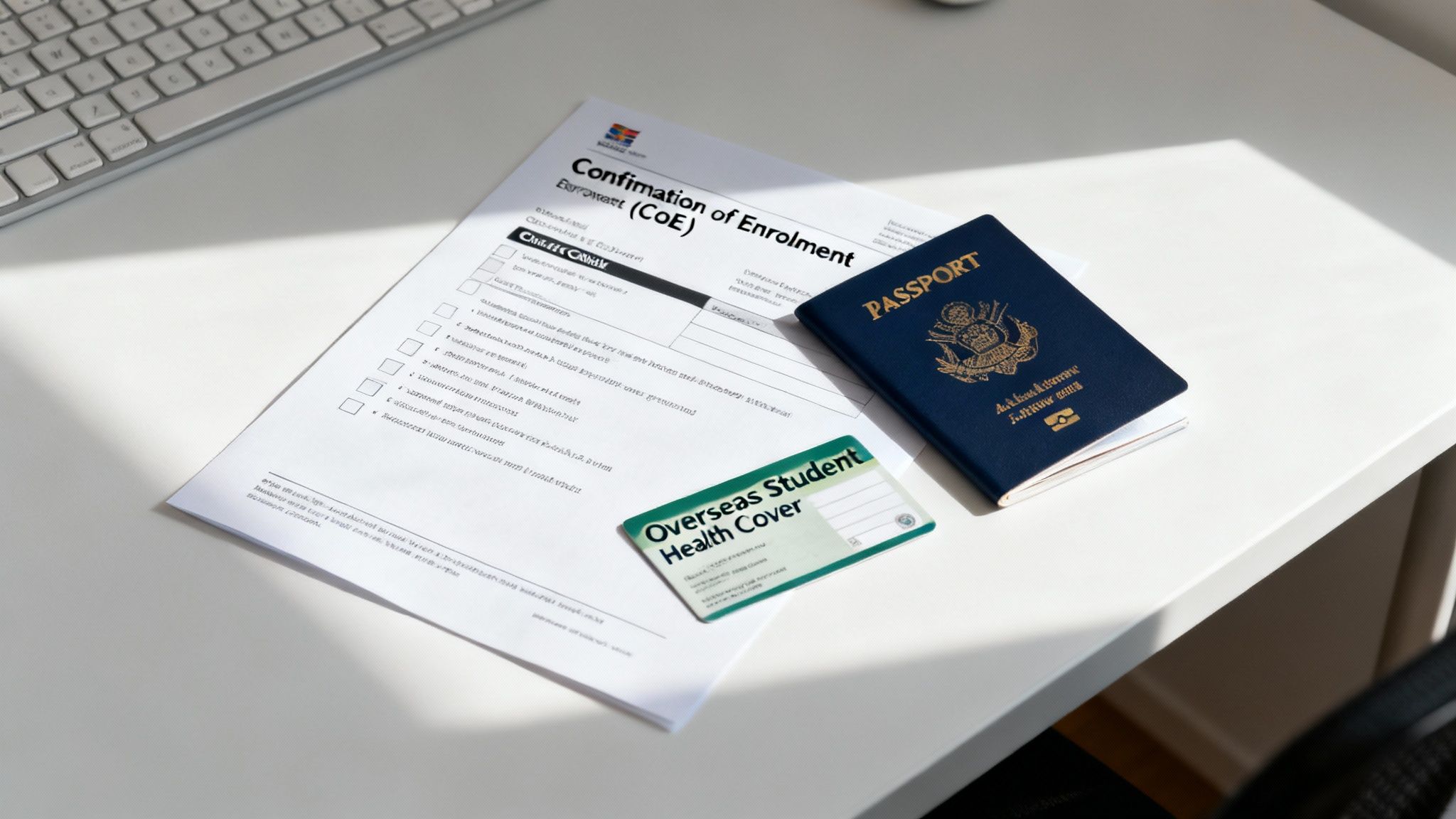
At the heart of any extension is the very reason you’re here: to study. You absolutely must have a new Confirmation of Enrolment (CoE) for a full-time, CRICOS-registered course. Your uni or college will issue this once you’ve been accepted and paid the deposit for your next study period.
Hand-in-hand with your CoE is your health cover. You must have valid Overseas Student Health Cover (OSHC) for the entire length of your proposed new visa. A rookie mistake I see all too often is letting a policy lapse or failing to extend it far enough into the future. Get a certificate from your OSHC provider confirming your cover is fully paid up for the new visa's duration.
A quick tip from experience: don't underestimate the OSHC requirement. The Department will match the dates, and even a small gap in your health cover can be a fast track to a refusal. Make sure your new policy kicks in the exact day your old one expires.
Proving Your Financial Stability
One of the most heavily scrutinised parts of your application is proving you can support yourself financially. You need to show that you have genuine access to enough money to cover your travel, 12 months of living expenses, and the first year of your remaining course fees.
The exact figures do change, so always double-check the latest numbers on the Department's website. The goal is to reassure the case officer that you can live and study comfortably in Australia without falling back on public assistance or working beyond your visa's limits.
To give you a clearer picture, here’s a breakdown of the minimum funds you’ll generally need to show.
Minimum Financial Capacity Requirements
| Expense Category | Required Amount (AUD) |
|---|---|
| Living Costs (12 months) | $24,505 (for a primary applicant) |
| Course Fees | First 12 months of remaining tuition |
| Travel Costs | $2,000 (approximate return airfare) |
These funds have to be genuinely yours (or your sponsor's). This usually means providing bank statements from the last three months that show a consistent, stable balance. A large, sudden deposit right before lodging your application is a major red flag and will almost certainly trigger a request for a detailed explanation of where that money came from.
The Genuine Student Requirement
Beyond the paperwork and bank balances, you have to convince the Department that your main reason for staying in Australia is, genuinely, to study. This is now assessed against the Genuine Student (GS) requirement, which replaced the old Genuine Temporary Entrant (GTE) criteria in early 2024.
This isn't just about ticking a box. It’s a holistic assessment of your personal situation, your immigration history, and the real value of the course to your future. In the application, you’ll face targeted questions designed to test your understanding of your chosen course and its benefits. To learn more about how to nail this part, check out our in-depth guide on what is the genuine student requirement.
Your answers need to clearly explain:
- Why you chose this particular course at this specific university or college.
- How it logically follows on from your previous studies and fits into your future career path.
- Your personal circumstances, including evidence of strong ties to your home country.
Successfully meeting the GS criteria is fundamental. It's about painting a clear and believable picture of a dedicated student with a legitimate academic reason for extending their stay in Australia.
Assembling Your Application Documents
Getting your paperwork sorted is hands down the most critical part of a successful student visa extension. A well-organised application is your best shot at avoiding delays or those dreaded 'Request for Further Information' emails from the Department of Home Affairs. It's about more than just grabbing your passport and new CoE; you need to build a complete, convincing case.
Let's walk through exactly what you need to pull together. Think of this as your game plan for a rock-solid application.
The Essential Paperwork
First up, the absolute non-negotiables. These are the core documents that your entire application rests on. Without them, your application is a non-starter.
- Your Current Passport: Get a clear, colour scan of your passport's photo page. Double-check that it’s valid for the entire length of your proposed new visa. This seems obvious, but it catches people out.
- New Confirmation of Enrolment (CoE): This is the golden ticket from your uni or college. It officially confirms you're enrolled in a full-time, CRICOS-registered course and clearly states your new course start and finish dates.
- Overseas Student Health Cover (OSHC): You must prove your health insurance is paid up and covers you for the entire duration of your new visa. Your OSHC provider will issue a certificate with your policy dates – this is what you need to upload.
It's also worth noting that having adequate International Student Health Insurance is a fundamental requirement. Make absolutely sure there are no gaps between your old policy and the new one.
Demonstrating Financial Capacity
Next, you have to prove you can support yourself financially. This isn't just about flashing a big number in a bank account; it's about showing you have genuine and consistent access to funds.
Home Affairs needs to see you've got enough money to cover 12 months of living costs (currently $24,505 for a single applicant), your first year of remaining course fees, and your travel expenses. The standard way to do this is with official bank statements from the last three months. Crucially, these statements need to show a stable history of funds—a huge, last-minute deposit is a massive red flag for case officers.
Crafting a Compelling Genuine Student Statement
The Genuine Student (GS) requirement is your chance to tell your story directly to the person deciding your fate. This statement needs to be personal, persuasive, and structured to answer the key questions they have about your intentions.
You need to clearly explain a few things:
- Your Academic Journey: Why do you need this extension? Spell out how your new course is a logical next step from what you've already studied, either here in Australia or back home.
- The Value of the Course: Show you've actually researched the course. Talk about how the specific skills you'll gain will directly boost your career prospects in your home country. Back this up by researching job roles and salary expectations to make your claims more concrete.
- Your Ties to Home: This is a big one. You have to prove you have strong reasons to return home after your studies. This could be anything from family responsibilities and property ownership to job offers or strong community ties.
A generic, copy-paste statement is one of the most common mistakes I see. Get specific. Mention particular subjects in your new course that you're excited about. Name a few companies in your home country you’d love to work for. That level of personal detail makes your story far more believable.
Additional Supporting Documents
Depending on your situation and home country, you might need a few extra documents. My advice? It's always better to be over-prepared.
- Police Certificates: If you've been in Australia for 12 months or more since you turned 16, you'll need an Australian Federal Police (AFP) check. You might also need police clearance from other countries you've lived in for 12+ months over the last 10 years.
- Health Examination: The ImmiAccount system will tell you if you need a health check-up after you've lodged your application. If required, it must be done at a Bupa Medical Visa Services clinic.
- Relationship Evidence: Including a partner or family? You'll need to prove your relationship is genuine with documents like a marriage certificate or evidence of your de facto partnership (think joint bank accounts, bills, photos).
Getting your head around the health cover details is a vital piece of the puzzle. You can dive deeper into the specifics in our complete guide to Overseas Student Health Cover (OSHC). Take the time to get these documents right, and you'll be setting yourself up for success.
How to Tackle Your ImmiAccount Application
The ImmiAccount portal is your one-stop shop for lodging the student visa extension. I know it can look a bit intimidating when you first log in, but it’s actually a pretty logical system once you get the hang of it.
Let's walk through the entire online journey, from logging in to hitting that all-important ‘submit’ button.
Kicking Things Off in the Portal
First up, you'll need to log into your ImmiAccount. If you’re extending your visa, you almost certainly have one from your original application. That’s a good thing—it often means some of your basic details are already pre-filled, saving you a bit of typing.
Once you’re in, you’ll start a new application. The crucial part here is picking the right form: "Student Visa (500)". From there, the application unfolds across a series of pages, each one asking for specific info about you, your new course, and your situation in Australia.
Filling Out the Application Forms
This is not the time to rush. Take a breath and work through each section carefully. It’s the small mistakes—a typo in your passport number or a mixed-up date of birth—that can cause massive headaches and delays down the track. Keep all your documents handy so you can copy the details across accurately.
You'll be guided through pages covering:
- Personal Details: Your identity, passport info, and current contact details.
- Family Members: Any details about family members who are being included in your application.
- Course Details: This is where you'll need your new CoE to enter the course name, CRICOS code, and provider information.
- Financial Capacity: You'll need to declare you have access to enough funds for your stay.
- Health and Character: This involves a series of yes/no questions about your health and any criminal history.
My biggest tip? The ImmiAccount system is notorious for timing out if you leave it idle for too long. Make it a habit to hit the 'Save' button at the bottom of every single page you complete. Trust me, this simple click will save you the immense frustration of having to re-enter a whole section from scratch.
Getting Your Documents Uploaded Correctly
The final step before payment is uploading all the documents you’ve so carefully prepared. This is where good organisation really pays dividends. Remember, a real person—a case officer—will be reviewing these files. Making their job as easy as possible is a fantastic strategy for a smoother, faster assessment.
Before you even think about uploading, check that your files are:
- Clearly Labelled: Don't just upload "scan_final.pdf". Name your files logically, like "Jane_Doe_Passport.pdf" or "Jane_Doe_OSHC_Policy.pdf".
- In the Right Format: The portal accepts a few different formats, but PDF is king. It's the most reliable. Double-check that your scans are crystal clear and every word is legible.
- Grouped Logically: If you’re providing bank statements to show your financial capacity, don't upload ten separate files. Combine them into a single, multi-page PDF. It keeps your application neat and tidy.
This infographic really breaks down the core documents that form the backbone of your application.
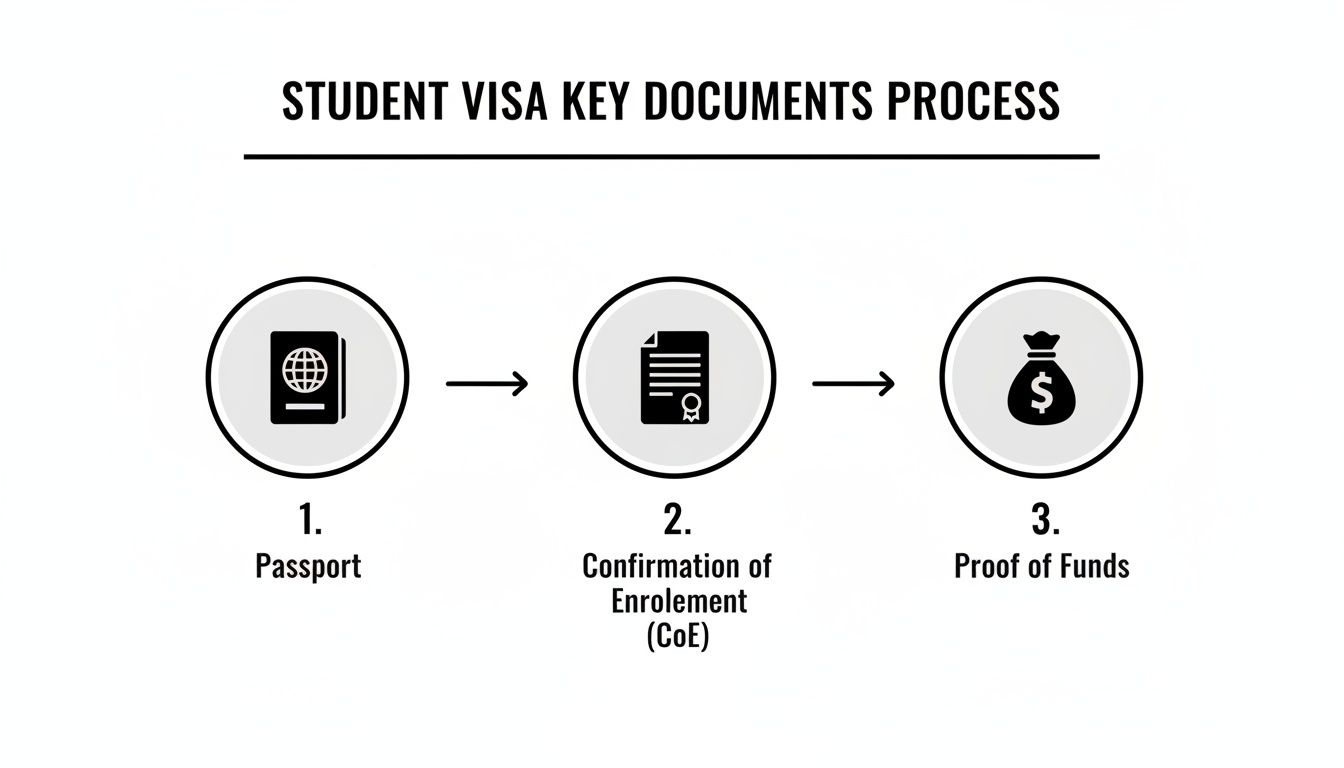
Think of it this way: each document validates the next, creating a complete and compelling story of why you’re a genuine student.
The Final Review and Submission
Before you get to the payment page, the system will show you a complete summary of your application. Do not skip this. This is your last chance to be your own proofreader.
Go through every answer one last time. Are all names, dates, and passport numbers 100% correct? Have you attached every single document you need to?
Once you’re absolutely certain everything is perfect, you can proceed to pay the Visa Application Charge (VAC). As soon as the payment goes through, your application is officially lodged. You should get an acknowledgement email from the Department of Home Affairs almost instantly. This email will also contain your Bridging Visa A (BVA) grant notice. Keep this email somewhere safe—it's your proof that you’ve lodged a valid application and have a legal right to remain in Australia while you wait for a decision.
You’ve done the hard yards. You’ve navigated the ImmiAccount portal, uploaded every last document, and finally hit that ‘submit’ button. The first feeling is usually a wave of relief, but that’s quickly followed by a new question: what now?
The time after you lodge your student visa extension is a bit of a waiting game, but it’s one governed by a very clear set of rules. It pays to know exactly what’s happening behind the scenes.
The moment your application is successfully submitted, you should get an acknowledgement letter from the Department of Home Affairs. Don't just file this away—it's a critical document. It confirms your application is in the system and, most importantly, includes your Bridging Visa A (BVA) grant notice.
Your Lifeline: Understanding the Bridging Visa A
Think of the Bridging Visa A, or BVA, as your legal safety net. It kicks in the very second your current student visa expires, keeping you lawfully in Australia while the Department gets around to assessing your new application. The best part? You don't need to apply for it. It's automatically granted when you lodge a valid visa application while you're in Australia.
Your BVA essentially mirrors the conditions of your previous student visa. This means you can keep studying and, crucially, maintain the same work rights you had before. So, if your student visa allowed you to work up to 48 hours per fortnight, those exact same rules apply while you're on your BVA.
Here's a critical point many people miss: a standard BVA evaporates the moment you leave Australia. If you have an urgent need to travel overseas while your extension is being processed, you must apply for and be granted a Bridging Visa B (BVB) before you fly out. If you don't, you won't be allowed back in.
Budgeting for Your Visa Extension
Extending your stay isn't cheap, so it’s smart to have a clear idea of the costs involved. The main expense is the Visa Application Charge (VAC), which you pay directly to the Department of Home Affairs when you lodge your application in ImmiAccount.
As it stands, the base application fee for a student visa is $710. But that’s often just the starting point.
- Subsequent Temporary Application Charge: This is the one that catches people out. If this is your second (or third, or fourth…) time applying for a temporary visa onshore, you’ll likely be hit with an extra $700 fee. This applies to most students who are simply extending their stay.
- Adding Family: If you’re including a partner or children on your application, they’ll each have their own separate application charge to factor in.
Remember, these are just the government fees. You’ll also need to account for other potential costs, like renewing your OSHC, paying for a health examination if one is requested, or getting an Australian Federal Police check.
The Waiting Game: Navigating Processing Times
This is where you need to practice some patience. The "official" processing times you see on the Department's website are a rough guide at best. The reality on the ground is that these numbers can, and do, change dramatically.
Lately, the system has been under enormous pressure. The number of students applying for new visas from within Australia has ballooned to over 100,000. This massive surge is a direct result of students trying to prolong their stay amidst a whirlwind of policy changes.
This increased demand, combined with tougher financial checks and new assessment rules, has created a significant backlog. To get a handle on why this is happening, you can discover more insights about recent trends impacting Australian student visas.
What does this mean for you? You could be waiting anywhere from a few weeks to several months. While you're in this limbo, the single most important thing you can do is keep your contact details in ImmiAccount perfectly up to date. If a case officer needs more information from you, this is how they'll get in touch. A quick response is your best bet for keeping things moving.
Answering Your Trickiest Visa Extension Questions
Even with a perfect plan, you’re bound to have questions. Visa applications are notorious for throwing curveballs. Instead of just rehashing the basics, let’s tackle the tricky, real-world scenarios that often leave students feeling stuck.
Can I Travel Outside Australia While My Extension Is Processing?
This one trips up so many students. The short answer is yes, but you can't just pack your bags and go.
If you’ve lodged your extension and are now on a Bridging Visa A (BVA), you cannot leave Australia and expect to get back in. The moment your plane takes off, your BVA is cancelled. You’ll be stranded overseas with no way to return until your new student visa is granted.
For any overseas travel—even a quick trip for a family emergency—you absolutely must apply for a Bridging Visa B (BVB) before you leave. The BVB is specifically designed for this purpose, letting you travel and re-enter while your main application is in the queue.
- Don't leave it to the last minute. BVB applications take time to process, so apply well before your travel dates.
- You'll need a good reason. Be prepared to explain why you need to travel in your application.
- Watch the dates. Your BVB will specify a travel period. Make sure your trip falls squarely within it.
What if I Change My Course or Uni?
Switching your study plan can definitely throw a wrench in your visa situation. The most important thing to understand is how your new course relates to your old one on the Australian Qualifications Framework (AQF).
If you’re moving to a course at the same or a higher AQF level (say, from one Master's program to another), you can often stay on your current student visa until it expires. No immediate drama.
But if you drop down to a lower AQF level—for example, switching from a Master's degree (AQF Level 9) to a Graduate Diploma (AQF Level 8)—it's a different story. This is almost always seen as a breach of your visa conditions, and you’ll need to apply for a brand new student visa straight away.
No matter what, get a new Confirmation of Enrolment (CoE) from your new provider and tell the Department of Home Affairs about the change immediately. Your first stop should always be the international student advisor at your university—they live and breathe this stuff.
When you're applying for any visa, you're handing over a mountain of personal data. It’s a good time to brush up on protecting your digital footprint to make sure your information stays secure.
What Are My Options if My Visa Extension Is Refused?
Seeing that "Refused" email is a gut-wrenching moment. But take a deep breath—it might not be the end of your Australian journey.
Your refusal letter is a crucial document. It will spell out exactly why the decision was made and, most importantly, tell you if you have the right to appeal.
If you’re in Australia when you get the news, you can usually apply to have the decision reviewed by the Administrative Appeals Tribunal (AAT). You have to be quick, though. There are strict deadlines, often just 21 days from when you receive the notice.
The AAT isn't a simple process, and the wait times can be incredibly long. This is one scenario where trying to go it alone is a huge risk. For something as serious as a refusal, getting professional advice is non-negotiable. Our guide on tips for choosing a migration agent can help you find the right support.
Trying to figure out the visa system can feel overwhelming, but you're not on your own. The team at My Visa Guide is here to offer clear, expert advice for every part of your application. Contact us today for a consultation and let's make sure your application is as strong as it can possibly be.