Disclaimer: Immigration rules change frequently—book an appointment with a MARA-registered migration agent to get the most current advice as information may no longer be true when you read this article.
Maintaining your student visa in Australia comes down to four essentials: keeping your enrolment active, proving you have enough funds, completing any health and character checks, and lodging your application before your current visa lapses.
Take Jane, for example. With exams around the corner, she gathered her updated Confirmation of Enrolment, bank statements and police clearance eight weeks before expiry. That extra buffer meant she never missed a day of class.
Key Steps To Extend Your Student Visa
A realistic timeline keeps stress at bay. Here’s what you’ll tackle:
- Maintain Enrolment: Upload your new Confirmation of Enrolment (CoE) showing updated course dates.
- Show Financial Capacity: Provide recent bank statements or scholarship letters that meet the Department of Home Affairs’ requirements.
- Meet Health & Character Checks: Book your medical examination and obtain police clearance early.
- Lodge Via ImmiAccount: Finalise and submit your application at least six weeks before your visa expires.
“Starting eight weeks out gave me breathing room and avoided last-minute rush fees,” says one postgraduate student.
Key Steps Checklist
Below is a quick look at the main tasks and how long each typically takes:
Key Steps And Average Processing Times
| Step | Description | Average Processing Time |
|---|---|---|
| Enrolment Update | Submit new CoE reflecting course dates | 4–6 weeks |
| Financial Evidence | Upload bank statements or scholarship documents | 2–4 weeks |
| Health And Character Checks | Complete OSHC and police clearance | 3–5 weeks |
| Application Lodgement | Final submission through ImmiAccount | 2–8 weeks |
Keep these timeframes in mind when you’re juggling study and paperwork—plan each milestone around your assignment deadlines and exam blocks.
Timeline Visualisation
Below is an infographic showing the sequence from enrolment to submission.
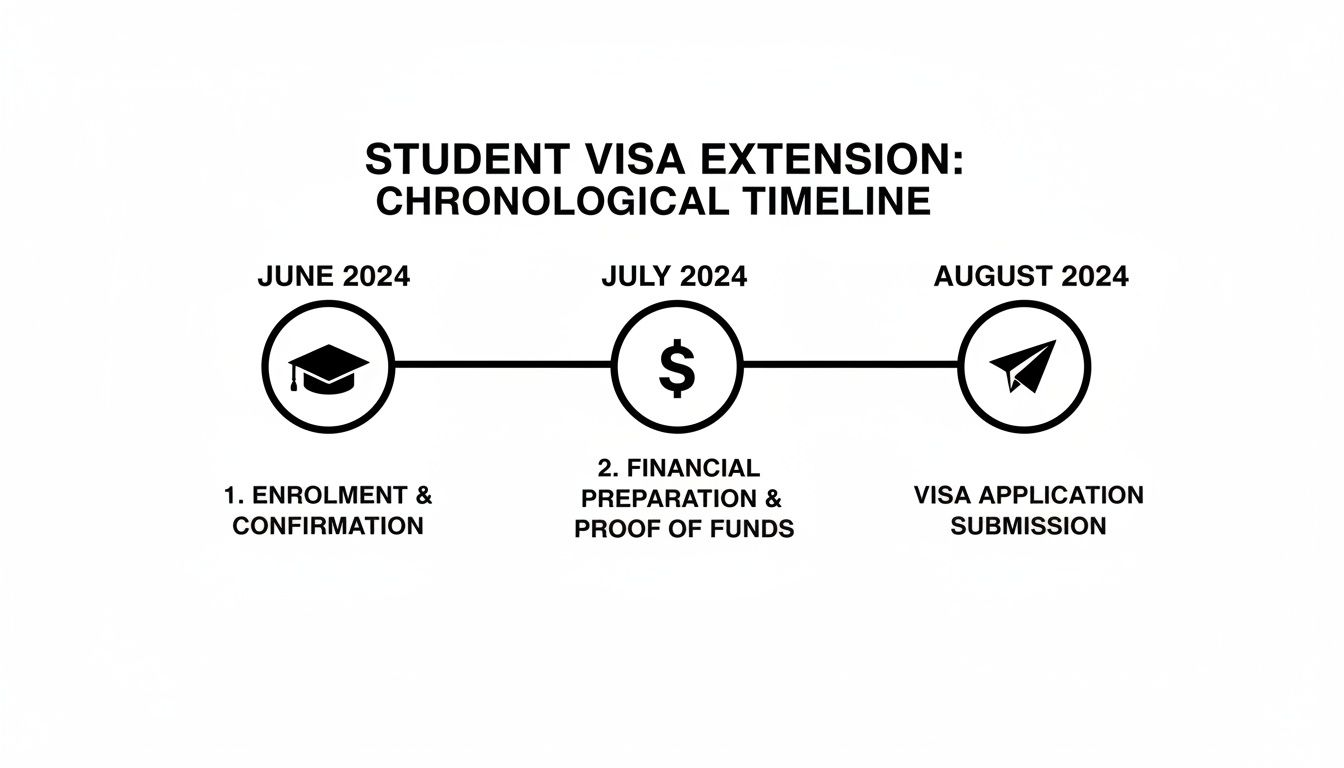
This visual makes it clear: kicking off paperwork early means less last-minute panic and zero gaps between visas.
Common Pathways Highlighted
- Course Transfers: Update your CoE to reflect any change of course or provider—this stops your visa from lapsing.
- Post-Study Options: Once you’ve finished, think about the Subclass 485 temporary graduate visa for work rights.
- Bridging Visa: If your extension is still being processed, check the work and travel conditions attached to your bridging visa.
Plan early to transition smoothly into each pathway without interruptions.
Real-World Timing Insight
In practice, 73% of student visa extensions lodged eight weeks early receive a decision within six weeks.
One student I advised sent her application well ahead of time and had her visa renewed just days after her final exam results came through. With early budgeting and document prep, she sidestepped the stress of late lodgement and had room to handle any follow-up questions from Home Affairs.
Contact a MARA-registered agent for personalised guidance—your future self will thank you.
Confirm Eligibility And Timing For Extension
Immigration rules shift often, so it’s wise to chat with a MARA-registered migration agent before you start.
Before you lodge your extension, make sure you tick every box: full-time enrolment, academic progression, financial capacity and health and character standards.
I once coached Maria, who set a six-week reminder ahead of her visa expiry. Gathering her updated Confirmation of Enrolment early meant she avoided the usual last-minute race.

Maintain Full-Time Enrolment
Valid enrolment is non-negotiable. Reach out to your provider well before your CoE expires to lock in new dates and confirm your status.
• Check that your updated CoE shows correct start and end dates.
• Keep transcripts or progress reports on standby.
• Advise the Department of Home Affairs immediately if you switch courses.
Keeping enrolment records accurate demonstrates genuine study intent.
Prove Financial Capacity
Showing you’ve got enough funds can make or break your application. Pull together bank statements from the last three months and any scholarship or loan letters that outline amounts and coverage periods.
• Include a buffer for living expenses.
• Attach official scholarship documents.
• Provide lender statements if you’ve taken a student loan.
Genuine Student Test Explained
This test confirms that your primary aim is studying, not just staying longer. You’ll need to supply evidence such as:
• A concise statement of purpose tailored to your course.
• Your updated Confirmation of Enrolment.
• Academic references or prior transcripts.
For all the question details and preparation tips, check out Learn more about the Genuine Student Test
Plan Your Application Window
Moving from undergraduate to postgraduate can stretch your timeline. For instance, honours results often drop in mid-November, so your new CoE might not be available until late in the month.
Here’s how to stay on track:
• Set calendar reminders eight weeks before your visa expires.
• Sync CoE start dates with your exam schedule.
• Monitor processing times each term—policy shifts can slow things down.
That said, recent figures show a sharp rise in onshore applications. By late 2024, migration expert Abul Rizvi reported over 100,000 onshore student visa applicants, fuelled by course changes and tighter policies. Read more on student visa trends.
Key Timing Takeaway
Sync your CoE end date with your final exam schedule to avoid gaps between visas.
Confirm your CoE dates with your provider, submit early and keep every document at hand to minimise delays.
Meet Health And Character Requirements
Book your medical exam with an approved panel doctor and gather police certificates from any country where you’ve lived more than 12 months since turning sixteen.
• Show Overseas Student Health Cover valid for your extended course dates.
• Provide certified translations for any non-English documents.
Tackle these checks early to prevent last-minute hiccups. If your case has complications, engaging a MARA expert can save you time and stress.
Set Up ImmiAccount And Complete Your Application
I’ve seen plenty of students panic at the last minute because they left their ImmiAccount until the eleventh hour. Opening your account now means every lodgement detail lives under one roof, and you’ll spot any missing documents far sooner.
Head over to the Department of Home Affairs and hit Create New Account. Use an email address you check daily and craft a strong password you won’t forget.
As soon as you’re inside, switch on two-factor authentication. Then pop into Account Settings and add any authorised recipients—like your education agent—using their MARA number. That way, updates and officer requests land straight in their inbox too.
Before you log off today, tick off these quick tasks:
- Confirm your email verification is complete
- Set up SMS codes for 2FA
- Add any agent with a valid MARA number
Choosing The Right Form
Deciding on Form 157A versus a sponsored stream comes down to who’s covering your fees.
| Form Type | When To Use | Key Benefit |
|---|---|---|
| 157A | Self-sponsored cases | Faster lodgement for solo applicants |
| Sponsored | Employer or education-sponsored | Fee support and fewer document requests |
Thom found that organising his files into clearly labelled folders ahead of time shaved two weeks off his processing time.
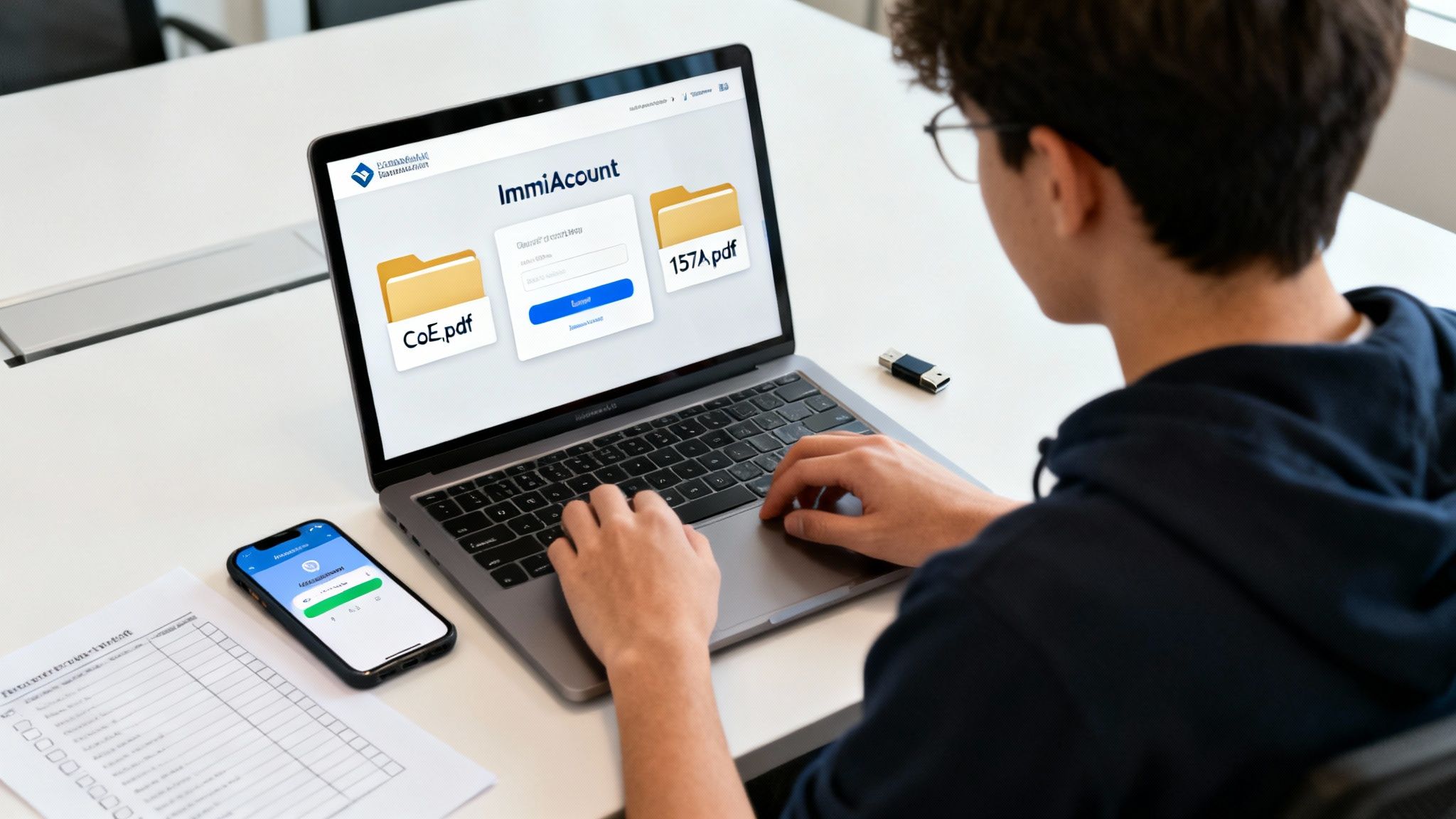
That view shows the Login and Register buttons front and centre, plus quick links for password resets and account setup.
Uploading Documents Efficiently
A little attention to file names and size limits can prevent big delays. Stick to PDF under 5 MB and adopt a naming convention like financials_YourName.pdf. Always preview each upload to catch missing pages or wrong formats.
- Label folders by document type and date
- Combine related pages into one PDF where possible
- Check each preview before hitting Submit
Thom zipped through his uploads in 10 minutes, saving two weeks of back-and-forth with case officers.
Scheduling OSHC Medical Checks
Timing is everything when booking your OSHC and medical exam. Plan your medical within 12 weeks before lodgement so your visa remains valid.
- Compare panel doctor fees and wait times
- Pick a slot that leaves room for report processing
- Attach your OSHC certificate as proof of coverage
Aligning exams with payment schedules avoids extra charges and processing gaps.
Enable Account Notifications
Never miss an update by turning on email alerts. You can even link ImmiAccount to your calendar for deadline reminders.
- Get notified of status updates
- Receive alerts for document requests
- Reminders before payment due dates
This proactive setup keeps your visa timeline on track.
Review Application Before Submission
Give everything one final once-over: scan for empty fields, mismatched dates or missing attachments.
- Confirm each section shows accurate details
- Validate that uploaded documents open without errors
- Ensure payment receipts attach correctly
Checking every section twice slashed Rohan’s follow-up queries by 50% and sped up his approval.
Once you’ve hit Submit, download the confirmation PDF and tuck it away with your records.
In the next section, we’ll compile a detailed documents checklist to make sure nothing slips through the cracks.
Payment And Lodgement Timing
Aim to lodge at least six weeks before your current visa expires.
- Upload the payment receipt immediately after paying
- Verify the billed amount matches your CoE
- Keep proof until you receive approval
Getting your timing right prevents bridging visa gaps and extra OSHC billing. Check ImmiAccount messages daily for payment confirmation and updates.
Compile Required Documents Checklist
Getting your paperwork sorted early not only eases the stress but keeps your visa timeline on track. Missing just one page can put everything on hold for weeks.
Gather these essentials before you start the online form:
- Confirmation of Enrolment (CoE) with accurate course dates
- Updated CoE if you switch providers
- Financial evidence (bank statements, loan letters, scholarship awards)
- Proof of health cover and your OSHC certificate
- Police clearance certificates for every country you’ve lived in
- English test score reports (IELTS, TOEFL, or PTE)
Think of this checklist as your navigation map—tick off every item to stay ahead of the game. Each document plays a vital role in proving you meet the Department of Home Affairs’ standards.
Confirmation Of Enrolment
Your CoE is the cornerstone of your application. It must list the correct start and end dates and cover your full course load.
- Check the provider’s letterhead and authorised signature
- Ask for a new CoE if you change courses mid-session
- Match course codes and campus details with what you enter in ImmiAccount
Tip: Any non-English documents should be translated by a NAATI-accredited translator to avoid last-minute hiccups.
Financial Capacity Documents
You’ll need to show you can handle both tuition and living costs. Home Affairs typically expects at least AUD 21,041 per year for living expenses.
- Bank statements covering the last three months
- Official loan offer letters or scholarship award notices
- Evidence of extra funds if you’re bringing dependents
I always recommend having an additional month’s living expenses in reserve. It signals that you’re prepared for bumps in the road.
Health And Character Documents
Your visa won’t proceed without proof of health cover and clear police checks. Start here: Overseas Student Health Cover (OSHC) for the right policy options.
- OSHC certificate valid through your entire course extension
- Police clearance from any country you’ve lived in for 12+ months since age 16
- NAATI-certified translations for all non-English records
Pro tip: Book your panel doctor exam as soon as your OSHC is approved. That way, you get results in time for lodgement.
English Proficiency Evidence
No shortcuts here—prove your English skills with a test taken within the last two years.
- IELTS Academic: minimum overall score of 6.0
- TOEFL iBT: at least 60 total score
- PTE Academic: per your provider’s requirements
Some institutions accept OET or Cambridge tests. Always double-check with your education provider. And remember to factor in test-centre processing times.
Document Organisation Tips
A well-labelled filing system can save you days of back-and-forth. My client Rohan beat the deadlines by naming each PDF clearly and slotting his medical exam six weeks before lodgement.
| File Type | Naming Convention | Size Limit |
|---|---|---|
| CoE | coE_YourName.pdf |
5 MB |
| Financial Evidence | financials_YourName.pdf |
5 MB |
| Health Cover | OSHC_YourName.pdf |
5 MB |
| Police Clearance | policeclearance_YourName.pdf |
5 MB |
| English Test Report | english_YourName.pdf |
5 MB |
“Proper organisation slashed follow-up requests by 50%, so I could focus on my studies instead of chasing paperwork,” Rohan shared.
Here are a few extra pointers:
- Use a checklist app alongside digital folders labelled by category
- Keep a spreadsheet index for quick reference
- Always preview your uploads in ImmiAccount before you hit submit
- Back everything up in the cloud for easy agent or MARA access
With your files in order, you’ll breeze through the visa extension process and stay focused on what really matters—your academic journey.
Understand Bridging Visas And Post Study Pathways
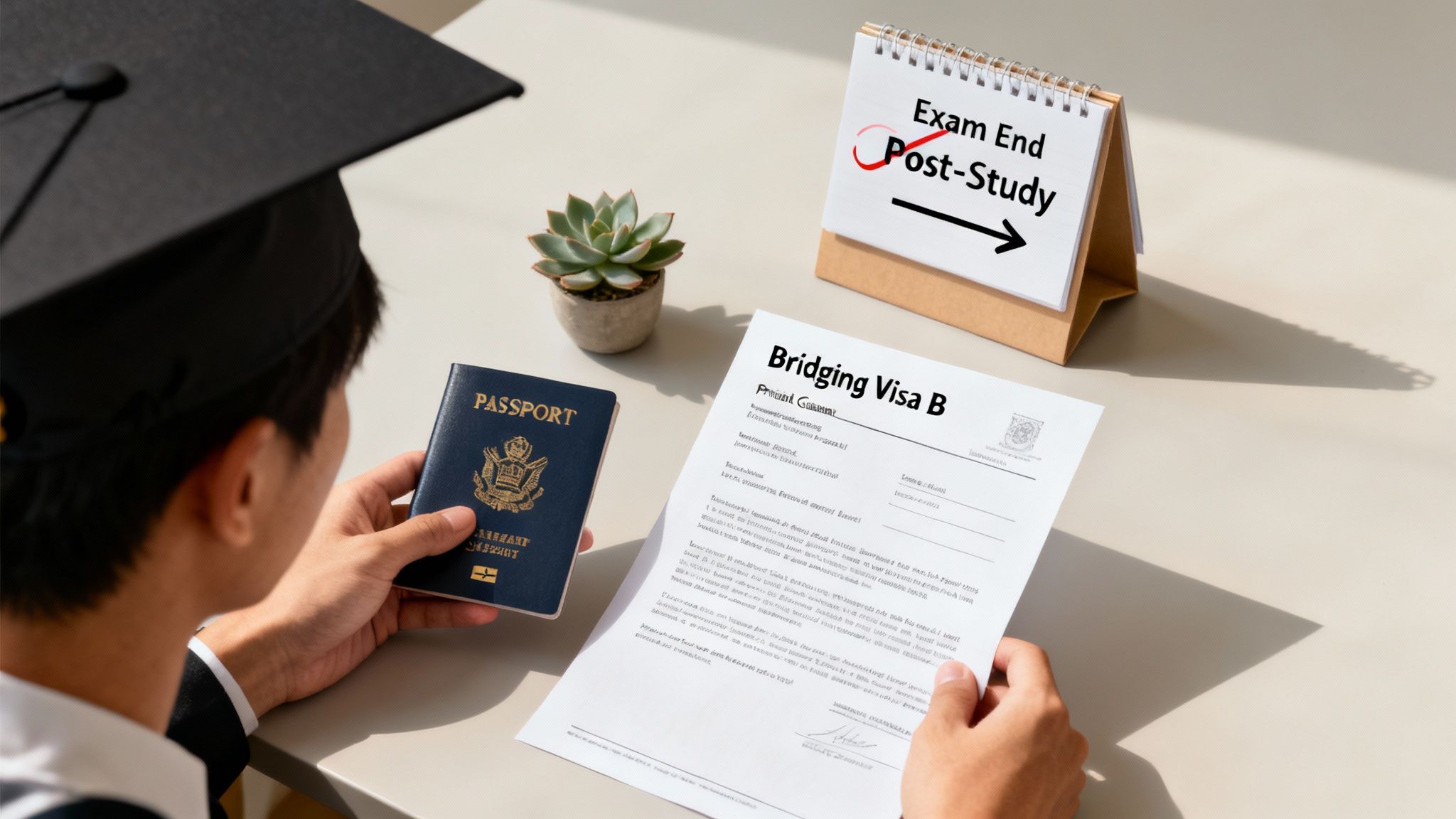
When you lodge an extension for your student visa, you’ll usually be placed on a Bridging Visa B or C. These visas ensure you stay lawful while Home Affairs works through your application.
- Bridging Visa B offers limited work rights and a one-off travel allowance under specific conditions.
- Bridging Visa C keeps you in Australia with no work or travel entitlements until a decision lands.
Knowing exactly which bridging visa you hold helps you plan your job hunt and any travel without nasty surprises. For instance, Emily timed her exam finish just four weeks before her CoE end date. By applying early, she had zero gap between visas and kept her work rights intact.
Bridging Visa Conditions And Planning
Understanding your work limits can save you a headache when applying for part-time roles. On a Bridging Visa B, you might pick up hours in roles linked to your course. Meanwhile, Visa C holders focus on study without work until the extension clears.
- Visa B lets you exit and re-enter Australia if the travel is for study or urgent reasons.
- Visa C prohibits work but guarantees your stay is lawful while you wait.
Aligning your travel and work plans with bridging visa rules prevents costly delays.
Post Study Pathway Options
After you finish, the Temporary Graduate visa (Subclass 485) is the go-to. Around 30% of international students picked this visa in the five years to 2022. In fact, graduates on 485 account for roughly one-third of Australia’s permanent resident intake, highlighting its long-term significance.
For deeper insight, read the full research about international students and the Australian economy. And if you’re ready to map out your next move, check our guide on post-study pathways.
Timing is everything for subclass 485. You’ve got six months from your final transcript or provisional results to lodge. Don’t forget to update your ImmiAccount with any CoE end-date changes so your bridging visa remains active.
Case Study Of Transition Timing
When Emily’s exam delays pushed her CoE end date out by two weeks, she didn’t panic. Instead, she:
- Synced her new CoE, exam results and visa deadlines in one calendar.
- Set alerts in ImmiAccount for any changes.
- Booked a chat with a MARA-registered agent to double-check her timing.
Four days after her updated CoE start date, her subclass 485 application was lodged without a hitch. Keeping hard copies of bridging visa grants and subclass 485 receipts means you’re always ready, no matter how policies shift.
Should your bridging visa expire before the 485 is granted, you’ll automatically move onto a Bridging Visa A until Home Affairs finalises your new visa.
Common Pitfalls And Troubleshooting
Missing a date can cost days of unlawful status. One student who received her final results late left her subclass 485 window behind and faced a gap.
- Verify every official date in your ImmiAccount summary.
- Double-check emails for CoE amendments.
- Scan and upload certified translations for any non-English documents.
Name mismatches between passport and CoE are a classic snag. Upload every page clearly to avoid officer requests. If processing drags, you can request a status update via ImmiAccount or get your MARA agent to intervene.
Expert migration advice saves time and stress—book an appointment with a MARA agent to confirm your unique timeline.
Disclaimer: Immigration rules change—always consult a MARA-registered agent for the latest advice.
Manage Fees, Processing Times And Troubleshoot Issues
Costs for extending your student visa can quickly add up, so planning ahead is essential. Beyond the AUD 650 student visa charge, you’ll need to budget for health checks, police clearances and OSHC renewals.
• OSHC Renewal: Around AUD 600 per year.
• Health Examination: Typically AUD 400 with panel providers.
• Police Check & Translations: Approximately AUD 100 in total.
Budget Sample Calendar
Fitting payments around your study schedule helps avoid late fees or rushed applications. In practice, many students set reminders well before assignment deadlines or exam weeks.
Case in point: Sarah booked her OSHC renewal two weeks before finals. That simple tweak saved her from last-minute surcharge stress.
| Due Date | Item | Estimated Cost |
|---|---|---|
| Day 0 | Visa Application Lodgement | AUD 650 |
| Week 2 | OSHC Renewal | AUD 600 |
| Week 4 | Health Examination | AUD 400 |
| Week 6 | Police Checks And Misc | AUD 100 |
Pop this into a spreadsheet or calendar app and you’ll always know what’s coming up.
Understand Processing Times
Most online student visa extensions wrap up in 3–8 weeks, but timing fluctuates. Peak seasons—February and July—can push that out closer to 10 weeks. Conversely, off-peak months like May and November often deliver quicker results.
Several factors influence your wait:
• Accuracy and completeness of your forms and attachments
• Current workload in ImmiAccount queues
• Turnaround for additional information requests
“Early lodgement prevented my application from being caught in the July rush,” says David, who studies in Perth.
Troubleshoot Common Issues
A missing page here or a mismatched name there can stall your application. Before you hit submit, run through this quick checklist:
• Names on your CoE and passport must match exactly.
• Translations need certification and the correct date format.
• Bank statements should be continuous—no blank pages.
• PDFs over 5 MB will fail to upload.
Don’t skip the preview in ImmiAccount. It’s your last line of defence against simple errors.
When To Escalate And Seek Support
If you’ve crossed the 12-week mark without a decision, take these steps:
- Send a message via ImmiAccount’s centre for a status update.
- Lodge a formal review request once 12 weeks have passed.
- Book time with a MARA-registered agent for expert intervention.
Professional help isn’t an admission of defeat—it’s a smart way to fast-track a stalled file. Keep scans of your lodgement receipts handy; they’re vital when following up.
Additional Cost Saving Tips
Locking in OSHC early can shave 5 % off renewal rates. Some panel doctors even offer package rates for health and radiology checks.
• Compare quotes from multiple providers.
• Split OSHC payments into instalments if your provider allows.
• Look for bank or credit-card promotions to minimise fees.
• Check student-union vouchers for discounted exams.
Every dollar saved here frees up funds for rent and groceries.
Tracking Payments And Notifications
Missed fee notices often create unwanted bridging-visa gaps. Switch on email and SMS alerts in ImmiAccount to stay ahead.
• Sync alerts with your smartphone calendar.
• Keep a simple tracker—lodgement dates, fee deadlines, follow-ups.
Sharing access with your education agent means a second pair of eyes catches anything you might miss.
Key Takeaways
Budget for every fee and slot payments into your calendar early.
Track your application and answer any requests within 48 hours.
• Cross-verify documents before uploading.
• If processing drags beyond expectations, escalate via ImmiAccount and then consult a MARA agent.
Proactive planning keeps your study rights intact and your mind at ease.
Frequently Asked Questions
Here are the common hiccups that pop up when extending your student visa in Australia. If something feels off or you’re dealing with a less-typical scenario, touch base with a MARA-registered migration agent to get your situation checked.
“Applying early and staying proactive cut my wait time in half,” says a recent student-visa extender.
What Happens If Your Visa Expires Before Approval
As soon as you submit your extension application, Bridging Visa A kicks in. You remain lawful while your new visa is processed.
This bridging visa may come with tighter travel restrictions or a reduced work cap until you receive a final decision. It’s worth double-checking any changes on the Department of Home Affairs website.
How To Switch Providers During Your Application
You don’t need a brand-new visa to change courses or campuses mid-application. Just log into ImmiAccount, upload your updated CoE and inform Home Affairs of the new provider.
- Keep both your old and new CoEs ready in case an officer asks.
- Confirm the start and end dates line up perfectly to avoid any coverage gaps.
When in doubt, chat with a MARA-registered agent for peace of mind.
Can You Increase Work Hours On A Bridging Visa
If your study load lightens—say, during exam periods—your Bridging Visa A or B could allow extra work hours. To make it happen, upload a letter from your provider confirming the reduced study load.
That simple step often unlocks the chance to pick up shifts when you need a bit more cash in hand.
What If Evidence Requirements Change After Lodgement
Sometimes Home Affairs will ask for additional documents. You’ll see a notification in ImmiAccount under your application tasks.
Submit anything requested as soon as you can. Miss the deadline and you risk a refusal. If you’re unsure what they want, speaking to a MARA-registered agent can save you from missteps.
Check Status
Log into ImmiAccount regularly to track processing notes and updates. Switch on email or SMS alerts so you don’t miss any critical requests.
Disclaimer: Immigration rules can shift without much warning. Always consider booking a session with a MARA-registered migration agent for the latest guidance.
Need personalised support and up-to-date advice? Get in touch with My Visa Guide.