The Employer Sponsored Visa 482, more formally known as the Temporary Skill Shortage (TSS) visa, is the go-to pathway for Australian businesses needing to bring in skilled workers from overseas. It’s designed to fill a position when, after a good look around, a company just can't find a suitable Australian citizen or permanent resident to do the job.
It’s the main visa that allows companies to tackle labour shortages by tapping into global talent.
Disclaimer: Please be aware that Australian immigration laws and policies can change frequently. The information provided in this article is for general guidance only and may not be current at the time of reading. For the most up-to-date and personalised advice, it is essential to book an appointment with a registered migration agent. For any official government fees, please always refer to the official Department of Home Affairs website.
So, What Exactly Is the Employer Sponsored Visa 482?

Think of Australia's job market like a complex engine. Most of the time, it runs smoothly with local talent, but every now and then, it needs a very specific part—a particular skill set—that just isn’t available on the shelf. The Employer Sponsored Visa 482 is the tool that lets businesses source that specific part from overseas to keep the engine running and growing.
But this visa isn't a simple, one-size-fits-all solution. It's cleverly designed with different "streams" or pathways to suit different business needs and timeframes. For a skilled professional, this visa is often the first significant step towards building a career and, potentially, a new life in Australia.
The Real Purpose Behind the TSS Visa
At its core, the TSS visa is a direct response to the demands of the labour market. It allows an employer to sponsor a specific person for a specific role, making sure the skills being brought into Australia are exactly what an industry needs right now.
This targeted approach helps businesses keep their doors open and continue to expand, which is especially vital in sectors hit hard by skill shortages. To get a handle on the bigger picture of bringing overseas talent into your team, it’s worth reading a practical guide to hiring international employees. The TSS visa is the mechanism that makes it all possible.
The Three Different Visa Streams
The 482 visa is split into three distinct pathways, each built for a different scenario. You can almost think of them as different types of employment contracts.
- Short-Term Stream: This is for filling temporary skill gaps. It's typically for occupations on the Short-term Skilled Occupation List (STSOL) and, as the name suggests, is for a shorter stay.
- Medium-Term Stream: This one is aimed at filling more critical, longer-term skill shortages. The jobs on this list are found on the Medium and Long-term Strategic Skills List (MLTSSL), and it offers a longer visa period with a clearer pathway to permanent residency.
- Labour Agreement Stream: This is the specialised option. It’s for employers who have negotiated a custom arrangement with the Australian government because they have unique skill needs that aren't covered by the standard occupation lists.
Choosing Your Path: The Three 482 Visa Streams
Think of the employer-sponsored 482 visa not as a single road, but as a junction with three distinct paths leading to a skilled job in Australia. This visa is broken down into three "streams," each built for a specific kind of skill shortage and a different kind of journey. For both you and your sponsoring employer, picking the right stream from the very beginning is one of the most important decisions you'll make.
This initial choice sets the stage for everything that follows: how long you can stay, your work conditions, and most importantly, your potential future in Australia. Let's walk through these pathways so you can see which one truly fits your long-term career plans.
Disclaimer: Please be aware that Australian immigration laws and policies can change frequently. The information provided in this article is for general guidance only and may not be current at the time of reading. For the most up-to-date and personalised advice, it is essential to book an appointment with a registered migration agent. For any official government fees, please always refer to the official Department of Home Affairs website.
The Short-Term Stream: For a Specific Project
The Short-Term stream is exactly what it sounds like—a way to fill a temporary skills gap. It’s like bringing in a specialist contractor for a fixed-term project. This stream is designed for occupations on the Short-term Skilled Occupation List (STSOL), which are roles Australia needs right now, but not necessarily forever.
- Visa Duration: You're typically looking at a visa for up to two years.
- Renewal: It can be renewed once while you're in Australia, for another two-year period.
- Permanent Residency: This is the crucial point: this stream generally does not offer a direct route to permanent residency.
This is a fantastic option if you're looking to gain some valuable international experience or complete a specific assignment in Australia before your next move. It’s a targeted solution for an immediate business need.
The Medium-Term Stream: A Long-Term Career Move
On the other hand, the Medium-Term stream is built for a much longer commitment. This path is for professionals in occupations considered vital to Australia's long-term economic stability—jobs you'll find on the Medium and Long-term Strategic Skills List (MLTSSL). If you're hoping to build a career and potentially a new life down under, this is almost certainly the stream for you.
This is much more than just a temporary work permit; it's a stepping stone.
For most skilled professionals with an eye on the future, the Medium-Term stream is the strategic choice. It's designed to connect directly to the Employer Nomination Scheme (subclass 186) visa, which is one of the most common pathways to permanent residency.
Here’s why it’s the go-to for those with bigger plans:
- Visa Duration: Can be granted for up to four years, giving you plenty of stability.
- Renewal: You can renew it multiple times as long as you remain eligible.
- Permanent Residency: It offers a clear, well-trodden pathway to PR after you've worked for your employer for a specific period (usually two years).
The Labour Agreement Stream: A Custom-Built Solution
Finally, we have the Labour Agreement stream. This is the most specialised of the three and much less common. You can think of it as a bespoke arrangement, a custom-built solution for employers who have negotiated a special deal directly with the Australian Government.
These agreements come into play when a business has unique and ongoing labour needs that just aren't met by the standard occupation lists. It allows them to sponsor workers for roles not available in the other streams, sometimes with concessions on the usual visa requirements. Because every labour agreement is tailor-made, the visa conditions—including its length and any PR pathways—are all defined by the specific terms of that agreement.
At a Glance: Comparing the 482 Visa Streams
To make things clearer, here’s a simple breakdown of how the three streams stack up against each other.
| Feature | Short-Term Stream | Medium-Term Stream | Labour Agreement Stream |
|---|---|---|---|
| Occupation List | Short-term Skilled Occupation List (STSOL) | Medium and Long-term Strategic Skills List (MLTSSL) | As per the specific labour agreement |
| Maximum Visa Stay | Up to 2 years (or 4 if an International Trade Obligation applies) | Up to 4 years | As per the specific labour agreement (often up to 4 years) |
| Renewals in Australia | Can be renewed once | Can be renewed multiple times | As per the specific labour agreement |
| Pathway to PR | Generally No | Yes, typically after 2 years with the same employer | Yes, if specified in the agreement |
| Best For | Short-term projects, gaining experience | Long-term careers, seeking permanent residency | Niche roles where standard lists don't apply |
As you can see, the stream you and your employer choose will have a massive impact on your journey in Australia. It's a decision that needs careful thought and expert guidance.
Meeting The Eligibility Requirements
Getting a 482 visa isn't a one-person show. It’s a partnership. Both the business sponsoring you and you, the skilled applicant, have a set of boxes to tick. Think of it as a joint venture where success depends on both parties meeting their specific obligations.
If one side falls short, the whole application can stall. A brilliant, highly-skilled applicant can't get the visa without a fully eligible sponsor, and a fantastic company can't bring someone in if they don't meet the personal criteria.
Disclaimer: Please be aware that Australian immigration laws and policies can change frequently. The information provided in this article is for general guidance only and may not be current at the time of reading. For the most up-to-date and personalised advice, it is essential to book an appointment with a registered migration agent. For any official government fees, please always refer to the official Department of Home Affairs website.
Let's break down exactly what’s needed from both sides of the table.
What The Employer Needs To Prove
Before a business can even think about nominating a worker, it has to become a Standard Business Sponsor (SBS). This is the first and most crucial step, proving to the Australian government that the company is legitimate, stable, and a trustworthy sponsor.
Becoming an SBS isn't just a formality. The business needs to demonstrate that it is:
- A Lawfully Operating Business: This means the company is active, legally registered, and has a real trading history in Australia. It can't be a shell company.
- Committed to Local Employment: The government wants to see a genuine commitment to the local workforce. This means having a solid history of employing Australians and upholding workplace standards.
- Financially Sound: The business must be able to afford its sponsorship obligations, including paying you the correct market salary rate without financial strain.
- Clean on the Record: There can't be any "adverse information" on the books, like a history of breaching immigration or workplace laws.
Beyond getting the sponsorship approval, the business also has to prove the job itself is genuine. This usually involves Labour Market Testing (LMT), where they must show they advertised the role and couldn't find a suitable Australian worker to fill it.
One critical point: an employer is legally forbidden from asking you to pay for any sponsorship-related costs. Fees like the Skilling Australians Fund (SAF) levy and the nomination fee are 100% the responsibility of the business.
What The Visa Applicant Needs To Demonstrate
Once the employer has their side sorted, the spotlight turns to you. Your part of the deal is to prove you have the right skills, qualifications, and personal background for both the job and for living in Australia.
This is your chance to show you’re the perfect fit for the role your employer wants you to fill. Here are the main things you'll need to satisfy.
Skills and Work Experience
This is the heart of your application. You have to prove you’ve got the goods for your nominated occupation. This breaks down into a few key areas:
- Relevant Qualifications: You’ll need a degree, diploma, or a trade qualification that directly relates to the job.
- Work Experience: Generally, you must have at least two years of full-time, relevant work experience under your belt. This experience usually needs to be within the last five years to be considered current.
- Skills Assessment: For some occupations, especially trade roles, you might need a formal skills assessment. This is done by a specific assessing authority that will officially verify your skills and qualifications are up to Australian standards.
English Language Proficiency
You’ll need to show you have a competent level of English. Most people do this by taking an approved English test, like IELTS or PTE Academic. The score you need will depend on which visa stream you're applying under.
Good news if you're a citizen of the UK, USA, Canada, New Zealand, or the Republic of Ireland – you are generally exempt from this requirement.
Health and Character Checks
Finally, every person applying for a 482 visa must meet Australia's health and character standards. This is non-negotiable and is in place to protect the Australian community. You'll have to complete a medical examination and provide police clearance certificates from any country you’ve lived in for 12 months or more over the past decade.
For a complete rundown, you can learn more about Australia's strict health and character requirements in our detailed guide.
How To Navigate The Application Process
Think of the 482 visa application not as a single, monolithic task, but more like a three-act play. Each stage has its own distinct purpose and sets the scene for the next. Approaching it this way turns a potentially confusing bureaucratic maze into a clear, step-by-step roadmap.
Understanding how each part connects is crucial. It allows both the sponsoring business and the visa applicant to prepare properly, steering clear of common mistakes that lead to frustrating—and expensive—delays.
Disclaimer: Please be aware that Australian immigration laws and policies can change frequently. The information provided in this article is for general guidance only and may not be current at the time of reading. For the most up-to-date and personalised advice, it is essential to book an appointment with a registered migration agent. For any official government fees, please always refer to the official Department of Home Affairs website.
Let's walk through this three-part journey together.
This flowchart breaks down the three essential stages of the 482 visa application, showing the journey from the employer's approval right through to your final visa submission.
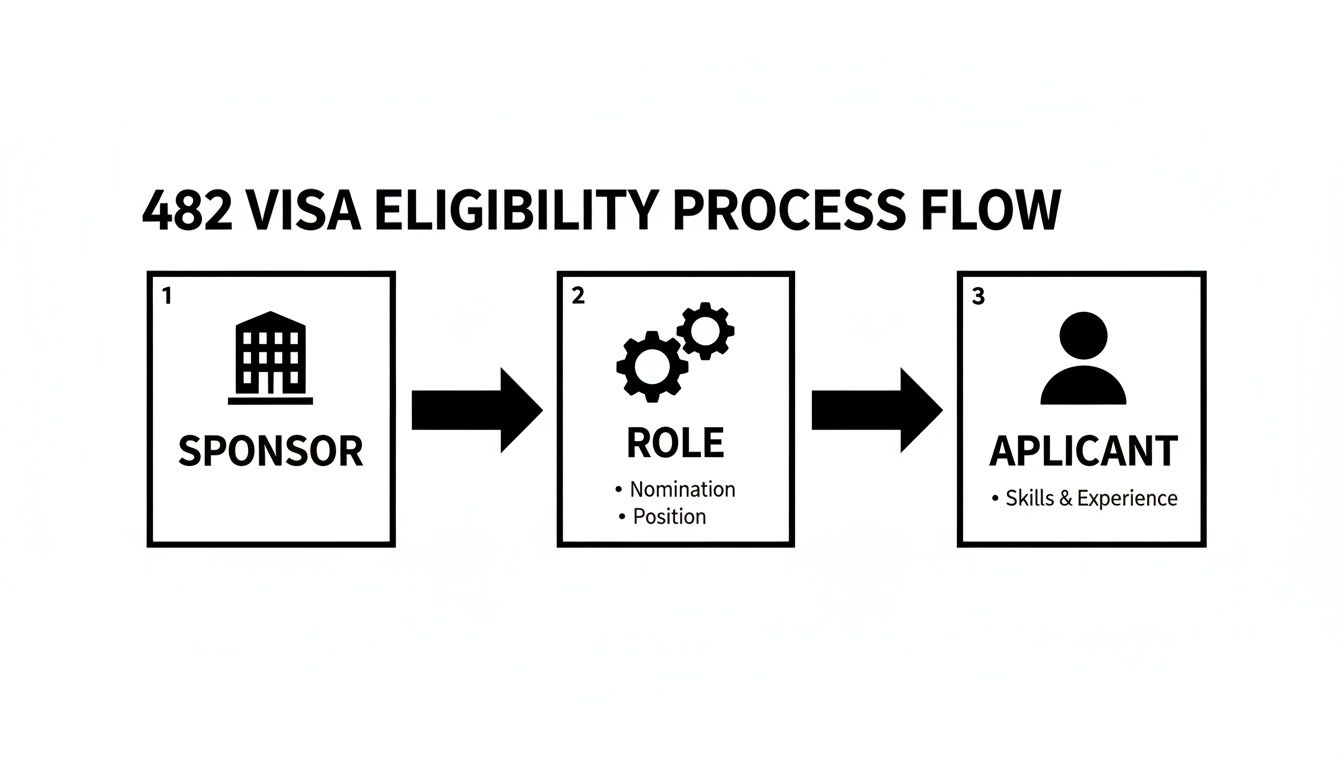
As you can see, the process always starts with the business (Sponsor), then moves to defining the specific job (Role), and only then does the focus shift to you (Applicant). This sequence is non-negotiable.
Stage 1: The Sponsorship Application
The very first step has absolutely nothing to do with the person applying for the visa. Before a company can even think about hiring someone from overseas, it must first get the green light from the Department of Home Affairs as a Standard Business Sponsor (SBS).
This stage is all about the business itself. The government is essentially doing its due diligence, making sure the company is a legitimate, financially stable operation that plays by Australian rules. Once approved, this SBS status is usually valid for five years, giving the business a window to sponsor multiple skilled workers without starting from scratch each time.
Stage 2: The Nomination Application
Once the business has its sponsorship approval sorted, it can move on to the second stage: nominating a specific position for a skilled worker. This is where the company officially connects its sponsorship approval to a particular job role and, ultimately, to you.
The nomination application is where the nitty-gritty details of the job come under the microscope. The employer has to provide solid evidence covering:
- Genuineness of the Position: Proof that the job is real, necessary, and not just created to facilitate a visa.
- Labour Market Testing (LMT): Hard evidence that they've advertised the role locally and couldn't find a suitable Australian citizen or permanent resident to fill it.
- Salary Details: Confirmation that the salary on offer meets the going Annual Market Salary Rate (AMSR) and is also above the government-mandated Temporary Skilled Migration Income Threshold (TSMIT).
Stage 3: The Visa Application
Only after the nomination is lodged (and often, fully approved) can the final act begin. This is your moment. You, the visa applicant, formally submit your application, and the focus shifts entirely to your personal eligibility for both the role and an Australian visa.
You’ll need to pull together a comprehensive set of documents to prove you tick all the boxes we discussed earlier—your skills, qualifications, work history, English proficiency, and of course, health and character checks. A well-prepared, "decision-ready" application can make a real difference to processing times. The sheer complexity here is why so many people choose to get expert help; you can learn more by reading our tips for choosing a migration agent to guide you on your journey.
Your Pathway To Permanent Residency
For many skilled professionals, the employer-sponsored visa 482 is much more than just a temporary work gig. It's often the crucial first step on the journey to making Australia your permanent home. While not every stream offers this, the Medium-Term stream is specifically designed to pave a clear, structured route to permanent residency.

Understanding this long-term potential right from the start is a game-changer. It elevates the visa process from a simple job application to a major life decision, letting you plan your future with real confidence from day one.
Disclaimer: Please be aware that Australian immigration laws and policies can change frequently. The information provided in this article is for general guidance only and may not be current at the time of reading. For the most up-to-date and personalised advice, it is essential to book an appointment with a registered migration agent. For any official government fees, please always refer to the official Department of Home Affairs website.
The Main Bridge to PR: The Subclass 186 Visa
The most well-trodden path from a Medium-Term 482 visa to permanent residency is through the Employer Nomination Scheme (subclass 186) visa. Think of the 482 visa as the bridge and the 186 visa as the destination. To get across, you’ll typically use the Temporary Residence Transition (TRT) stream of the 186 visa.
This stream is built for 482 visa holders who’ve put in the time and proven their commitment to their sponsoring employer.
The Subclass 482 visa remains a golden pathway to PR, with data showing a significant number of skilled visa-holders transitioning to permanent residency via employer-sponsored streams. The surge in applications underscores Australia's urgent need for skilled workers, meaning businesses in high-demand sectors are increasingly comfortable sponsoring visas. Learn more about Australia's skills demand on bravomigration.com.au.
Key Milestones on the TRT Pathway
Qualifying for the 186 visa via the TRT stream isn’t just a waiting game; you need to hit several key milestones. It's all about maintaining your eligibility and demonstrating your value over a sustained period.
Here’s what you’ll generally need to do:
- Employment Duration: You must have worked full-time for your sponsoring employer in Australia for at least two years while holding your 482 visa.
- Same Occupation: You need to have been working in the exact same role your 482 visa was granted for. Consistency is crucial here.
- Continued Sponsorship: Your employer has to be ready to offer you a permanent, full-time position for at least two more years and officially nominate you for it.
- Meeting Visa Criteria: You’ll still need to meet the standard age, English language, health, and character requirements for the 186 visa when you apply.
This structured pathway gives both you and your employer a clear set of goals to work towards, providing stability and a predictable timeline.
Are There Other Permanent Residency Options?
While the 186 TRT stream is the most direct route, it isn't the only one. Depending on your occupation, skills, and unique situation, other doors might open up for you down the track.
These could include general skilled migration visas (like the Subclass 189 or 190), especially if your occupation is in high demand and you can meet the points test requirements.
Exploring all your potential options is always a smart move. For a closer look at the different routes you could take, check out our comprehensive guide on Australian permanent residency pathways. Having the full picture allows you to pivot and adapt if your circumstances change.
Your Top 482 Visa Questions Answered
When you're deep in the visa process, a million practical questions pop up. Let's tackle some of the most common queries we get from both sponsors and visa applicants. Getting these answers straight can help you map out your journey with a bit more clarity.
Disclaimer: Please be aware that Australian immigration laws and policies can change frequently. The information provided in this article is for general guidance only and may not be current at the time of reading. For the most up-to-date and personalised advice, it is essential to book an appointment with a registered migration agent. For any official government fees, please always refer to the official Department of Home Affairs website.
Can I Change Employers On A 482 Visa?
Yes, you absolutely can, but it’s not as simple as giving notice and starting a new job the next week. Think of it less like changing jobs and more like transferring your visa's sponsorship.
Before you can start with your new employer, they must lodge a new nomination application for you, and—this is the crucial part—that nomination must be approved. You have to stop working for your old employer once your contract ends and can only legally start the new role after the new nomination gets the green light from the Department of Home Affairs.
Can My Family Come To Australia With Me?
Of course! The 482 visa is designed to let you bring your family along for the ride. You can include your partner and any dependent children as secondary applicants in your visa application.
If your visa is granted, your family will typically get a visa for the same length of time and with the same conditions as yours. This is a huge plus, as it means they’ll have full rights to work and study in Australia, making the transition to a new life down under much smoother for everyone.
What Happens If My Employment Ends?
Losing your sponsored job doesn't mean your visa is cancelled on the spot. But it does start a clock ticking, and you need to act fast to stay in Australia legally.
From the day your employment officially ends, you generally have 60 days to sort out your situation. Your options are to:
- Find a new employer who is willing to sponsor you and lodges a new nomination.
- Apply for a completely different Australian visa that you're eligible for.
- Make plans to leave Australia.
This 60-day window can fly by, so it's vital to get expert advice straight away to figure out the best path forward for you.
What Are The Main Reasons For A 482 Visa Refusal?
A visa refusal is tough, but it often boils down to a few common, preventable issues. Being meticulous with your application is your best line of defence.
Here are the top reasons we see for refusals:
- Genuineness of the Position: The Department isn't convinced that the job is a real, necessary role within the sponsoring company. They need to see a genuine need for the position.
- Applicant's Skills and Experience: The applicant can't show clear proof of the required two years of relevant work experience or doesn't hold the right qualifications for the job they've been nominated for.
- Documentation Issues: This is a big one. Missing documents, inconsistent information between forms, or not meeting the strict formatting rules can easily sink an otherwise strong application.
Navigating the twists and turns of the employer sponsored visa 482 takes careful planning and the right guidance. At My Visa Guide, our registered migration agents give you clear, honest advice to make sure your application is put together perfectly. We're here to help you sidestep the common traps and reach your goal of living and working in Australia.
Ready to get started? Book a consultation with us today!