For many skilled professionals, the Employer Nomination Scheme (Subclass 186) visa is the most direct route to calling Australia home permanently. It’s a powerful pathway built on a simple premise: an Australian business with a critical skills gap sponsors you, and in return, you get to build a life and career here for the long haul. It's no wonder this visa is a popular goal for those who have an in-demand skillset and a solid job offer in hand.
Disclaimer: Immigration laws and visa requirements change frequently. The information in this article is for general guidance only and may not be current when you read it. For the most up-to-date advice tailored to your situation, we strongly advise you to book an appointment with a registered migration agent. For any Department fees, please refer to the official Department of Home Affairs website at https://www.homeaffairs.gov.au/.
Your Pathway to Australian Permanent Residency
Landing permanent residency through the Subclass 186 visa might feel like a huge mountain to climb, but with a clear map and the right preparation, it's absolutely achievable. The visa is specifically designed for skilled workers nominated by an Australian employer to fill a genuine, full-time position that the local market can't. The first step to a successful application is getting your head around how it all works.
This guide is here to demystify the whole process. We’ll break it down into simple, manageable pieces, starting with the three distinct streams you can apply through. Figuring out which one fits your professional background and current circumstances is key.

Understanding the Visa Streams
The Subclass 186 isn't a one-size-fits-all visa. It’s split into three main streams, each designed for different situations:
- Direct Entry Stream: This is often for skilled workers applying from overseas. You'll need a positive skills assessment in your nominated occupation and at least three years of solid, relevant work experience.
- Temporary Residence Transition (TRT) Stream: A common pathway for those already in Australia on a temporary skilled visa (like the Subclass 482). It’s for people who have been working for their sponsoring employer for a set period and are now ready to transition to permanent residency.
- Labour Agreement Stream: This is a more specialised option. It’s for workers whose employer has a formal labour agreement with the Australian government, often to fill very specific or niche skill shortages.
If you're still looking for that all-important sponsoring employer, a good recruitment agency directory can be a great place to start your search. And remember, the 186 visa isn't the only option out there; you can get a broader view by exploring our detailed guide on other Australian permanent residency pathways.
Choosing Your Subclass 186 Visa Stream
The Employer Nomination Scheme (Subclass 186) visa isn't a one-size-fits-all solution. Think of it as a destination—permanent residency—with three distinct trails leading there. Picking the right one from the start is absolutely fundamental to your success.
Each stream is designed for a very different set of circumstances. Your work history in Australia, your specific skills, and even your employer's situation will all point you toward the correct path. Getting this first step right means you avoid the heartache of a refused application and wasting time and money on a pathway you were never eligible for. Let's break them down.
The Direct Entry Stream
The Direct Entry (DE) stream is the go-to option for skilled professionals who are either outside Australia or have only worked here for a short time. It's essentially a direct path for employers to bring in top global talent whose skills are badly needed, without the person needing to hold a temporary work visa first.
So, who is this for? You'll typically need to tick a few key boxes:
- A Positive Skills Assessment: This is non-negotiable. You must have your qualifications and experience formally validated by the designated Australian authority for your occupation.
- Solid Work Experience: You need to show you have at least three years of relevant experience under your belt, gained after you qualified.
- The Right Occupation: Your job must be listed on the relevant skilled occupation list for this stream.
The Direct Entry stream is all about proving your worth upfront. You're demonstrating to the Australian government that you have the skills and experience to contribute from day one.
The Temporary Residence Transition Stream
As the name suggests, the Temporary Residence Transition (TRT) stream is for skilled workers already here, building their careers with a sponsoring employer. It’s a pathway that rewards loyalty and commitment from both the visa holder and the business.
This is the logical next step for many people on a temporary visa, like the Subclass 482 (TSS), who are being offered a permanent position. It's often seen as a more straightforward route because you've already proven your value on the ground. The main requirement is having worked for your employer in the same role for a specific period (usually two or three years) on an eligible visa. Because of this, a formal skills assessment is often not needed for TRT applicants—your track record speaks for itself.
The TRT stream offers a clear, predictable route to permanent residency for those who have already put in the hard yards and become a valued part of an Australian business.
The Labour Agreement Stream
The Labour Agreement (LA) stream is the most specialised and least common of the three. You can't just choose this path; it's only available if your employer has negotiated a bespoke labour agreement with the Australian government.
What's a labour agreement? It’s a formal arrangement designed to tackle critical skill shortages in specific industries or regions where the standard visa programs just don't fit. The eligibility rules for applicants—things like age limits, skill requirements, and English language levels—are all defined within the agreement itself, meaning they can vary wildly. This stream is entirely dependent on your employer having this special arrangement in place.
To help you see the differences side-by-side, here’s a quick comparison.
Subclass 186 Visa Streams at a Glance
This table breaks down the core differences to help you identify which stream aligns with your situation.
| Feature | Direct Entry Stream | Temporary Residence Transition Stream | Labour Agreement Stream |
|---|---|---|---|
| Ideal Candidate | Skilled workers (often from overseas) without a long-term work history in Australia with their sponsor. | Temporary skilled visa holders (e.g., Subclass 482) who have already worked for their sponsor for a set period. | Skilled workers whose employer has a unique, government-approved labour agreement in place. |
| Skills Assessment | Mandatory. You must secure a positive skills assessment for your occupation. | Generally not required. Your work history with the employer is the primary evidence. | Requirements are dictated by the specific terms of the labour agreement. |
| Work Experience | Requires at least three years of relevant, post-qualification experience. | Requires a specific period of work for the nominating employer (e.g., 2-3 years) while on an eligible visa. | The required type and length of experience are outlined within the labour agreement itself. |
Getting your head around these streams is the first major step in your migration plan. To see how these visas fit into the bigger picture, you can learn more about all employer-sponsored pathways on our website.
Disclaimer: Immigration laws and visa requirements change frequently. The information in this article is for general guidance only and may not be current when you read it. For the most up-to-date advice tailored to your situation, we strongly advise you to book an appointment with a registered migration agent. For any Department fees, please refer to the official Department of Home Affairs website at https://www.homeaffairs.gov.au/.
Meeting the Visa Applicant Eligibility Criteria
So, you've figured out which Employer Nomination Scheme Subclass 186 stream is the right fit. That’s a huge step. But now, the spotlight swings over to you, the visa applicant. Getting your employer's nomination is only one half of the equation; you also have to prove you meet a strict set of personal criteria laid out by the Department of Home Affairs.
Think of it as a two-part qualification. Your employer makes the case for why the job is necessary, and you make the case for why you’re the right person to fill it, meeting all of Australia’s standards for skilled migrants. Let's break down the core requirements you'll need to tick off, from your age and skills to your English ability and character.

Proving Your Skills and Experience
This is where you really get to show what you're made of. Demonstrating that you have the right qualifications and a solid work history is absolutely central to the Subclass 186 visa. What you need to provide can differ quite a bit between the streams, so it’s vital to know exactly what’s expected of you.
For anyone on the Direct Entry stream, this part is a major hurdle. You'll need to lock in two key pieces of evidence:
- A Positive Skills Assessment: This isn't just a suggestion; it's a non-negotiable step. It’s a formal evaluation from a designated Australian authority that confirms your skills and qualifications are up to the standard required for your nominated occupation.
- Three Years of Relevant Experience: You have to prove you’ve got at least three years of full-time work experience under your belt. And it can't be just any experience—it has to be directly relevant to your nominated role and gained after you got your qualifications.
On the other hand, if you're applying through the Temporary Residence Transition stream, things are a bit different. You often won't need a new skills assessment because your long-term, consistent employment with your sponsoring employer in Australia is seen as the primary proof of your skills.
The Age Requirement
For most people, there's a pretty firm age limit. You generally need to be under 45 years of age when you officially lodge your visa application. This rule is consistent across both the Direct Entry and Temporary Residence Transition streams.
But, like with many rules, there are exceptions. The government recognises the immense value that some highly skilled and experienced individuals can bring, so exemptions are available for certain high-income earners, university academics, and some medical practitioners. These exceptions are very specific, so it's worth getting professional advice to see if you might qualify.
English Language Proficiency
To ensure you can hit the ground running in an Australian workplace and community, you must prove you have a competent level of English. This is usually done by taking a recognised English language test and hitting a minimum score.
The benchmark is an IELTS score of at least 6.0 in all four bands (listening, reading, writing, and speaking). Of course, equivalent scores from other approved tests like PTE Academic, TOEFL iBT, or Cambridge (C1 Advanced) are also accepted. Some people are exempt, particularly if you hold a passport from an English-speaking country like the UK, USA, Canada, New Zealand, or the Republic of Ireland.
Health and Character Checks
Lastly, every single applicant for an Australian permanent visa has to meet the national health and character standards. These checks are fundamental—they're in place to protect the entire Australian community.
- Health Requirement: You, and any family members you include in your application, will need to complete a medical examination. This is done by a panel physician approved by the Department to ensure you don’t have a health condition that could be a public health risk or put a major strain on Australia's healthcare system.
- Character Requirement: Get ready to gather some paperwork. You'll be asked for police clearance certificates from every country you've lived in for 12 months or more over the last 10 years (since you turned 16). The Department uses this information to assess whether you are of good character.
Disclaimer: Immigration laws and visa requirements change frequently. The information in this article is for general guidance only and may not be current when you read it. For the most up-to-date advice tailored to your situation, we strongly advise you to book an appointment with a registered migration agent. For any Department fees, please refer to the official Department of Home Affairs website at https://www.homeaffairs.gov.au/.
Understanding the Employer's Nomination Requirements
A successful Employer Nomination Scheme (Subclass 186) visa isn't just about the applicant's skills and experience. It hinges just as much on the strength of the employer's nomination. For business owners and HR managers, this is where you step onto the stage. The Department of Home Affairs needs to be completely convinced that your nomination is legitimate and genuinely benefits the Australian economy.
Think of the nomination as the very foundation of the visa application. If that foundation has cracks—like a vague job description or a questionable salary—the whole thing can come tumbling down. This section breaks down exactly what's required of you as an employer, ensuring you can build a rock-solid case from the get-go.

Proving the Position Is Genuine
At the heart of every successful nomination is the genuine position requirement. This is non-negotiable. You have to prove that the role you're nominating someone for is not only real but absolutely necessary for your business to function and grow. This means the job must be full-time, ongoing for at least two years, and fit logically within your company's structure and operations.
To get this across the line, you'll need to provide clear evidence, such as:
- A detailed organisational chart that shows exactly where this new role fits in.
- A comprehensive position description that clearly outlines the day-to-day duties and responsibilities.
- A strong written statement explaining why you need this position and how it contributes to your business activities.
The Department is on high alert for roles that look like they've been created just to help someone get a visa. Your evidence must paint a clear picture of a legitimate commercial need.
Meeting Salary and Income Thresholds
Paying your nominee a fair wage is another critical checkpoint. The salary you offer has to meet two key benchmarks, which are in place to protect Australian wage standards and prevent the undercutting of local workers.
First, the salary must be at least the Annual Market Salary Rate (AMSR). In simple terms, this is what an Australian worker would be paid for doing the same job in the same location. You’ll need to prove this with documents like enterprise agreements, industry awards, or solid data from reputable salary surveys.
Second, the salary must also meet the income threshold set by the government. As of 1 July 2025, the income thresholds for the Employer Nomination Scheme subclass 186 visa increased by 4.6%. The Core Skills Income Threshold (CSIT), which is essential for all 186 nominations, went up from AUD 73,150 to AUD 76,515. Similarly, the Specialist Skills Income Threshold was raised from AUD 135,000 to AUD 141,210. This adjustment ensures sponsored salaries keep pace with real market rates.
For smaller businesses navigating the sponsorship landscape, getting your internal processes in order is just as important. It pays to brush up on essential HR practices for small businesses.
The Skilling Australians Fund Levy
The Skilling Australians Fund (SAF) levy is a mandatory fee that every employer must pay when lodging a nomination. This money goes directly into a fund that supports apprenticeships and traineeships for Australian workers. It’s a way of ensuring that sponsoring skilled migrants also contributes to building up our local workforce.
The amount you pay depends on your business's annual turnover:
- For businesses with a turnover of less than $10 million, the one-off SAF levy is $3,000.
- For businesses with a turnover of $10 million or more, the levy is $5,000.
This isn't a fee you can pay later; it's due upfront when you submit the nomination. It’s a significant cost, so be sure to factor it into your sponsorship budget. If you're feeling overwhelmed by the process, our guide on how to become an approved employer sponsor can help clear things up.
From Blueprint to Build: The Application Process, Step-by-Step
Figuring out the right stream and making sure you tick all the eligibility boxes is the strategic part of your ENS 186 journey. Now, let’s get our hands dirty and walk through the practical steps—actually lodging the application and putting all the pieces together for the Department of Home Affairs.
Think of it like building a house. You've got the architectural plans (your chosen stream) and you’ve gathered all the best materials (your evidence). The application process is the construction phase. Every step needs to be done in the right order, with a keen eye for detail, to make sure the final structure is solid enough to be approved without any hitches.
Phase 1: The Groundwork
Before you even think about lodging anything official, both you and your employer have some crucial prep work to do. Getting this stage right is everything. A single missing document or a test result that’s a day late can bring the whole process to a grinding halt. This is where you cross your t's and dot your i's.
For you, the visa applicant, the big tasks usually include:
- Getting Your Skills Assessed: This is absolutely non-negotiable for the Direct Entry stream. You need an official assessing body to look at your qualifications and work history and give them the Australian stamp of approval.
- Passing an English Language Test: Unless you're lucky enough to hold a passport from an exempt country, you'll need to prove you have competent English. This means hitting the required scores on an approved test like IELTS or PTE.
For your employer, the prep work involves digging up all the business documents needed to show the company is in good financial health and that the job offer is legit. If Labour Market Testing (LMT) is required, this is also the time to get that evidence in order to build the strongest possible case for the nomination.
Phase 2: Lodging the Nomination and Visa
With all the groundwork done, it’s time for the main event. The process isn't just one application; it's two separate but closely linked applications: the employer’s nomination and your visa application.
- The Employer Lodges the Nomination: Your employer kicks things off by submitting the nomination application through their ImmiAccount. This is their moment to present all the evidence—company financials, a detailed statement explaining why the position is genuine, your employment contract, and proof they've paid the Skilling Australians Fund (SAF) levy.
- You Lodge the Visa Application: You can lodge your visa application right after the nomination goes in, or even at the same time. The key thing to remember is that your visa application must be linked to the nomination. You’ll use the Transaction Reference Number (TRN) from the nomination to make sure the two are connected.
Honestly, lodging both at the same time is usually the smartest move. It lets the Department look at the whole picture at once, which can often speed things up.
What About Bridging Visas?
If you’re already in Australia on another visa when you apply for the 186, you'll almost always be granted a Bridging Visa A (BVA). This little lifesaver kicks in the moment your current visa expires, letting you stay in the country legally while you wait for a decision on your 186.
Better yet, the BVA typically comes with the same work rights as your previous visa. This means you can keep working for your sponsor without any interruption, giving you that all-important stability and peace of mind during the waiting game.
Disclaimer: Immigration laws and visa requirements change frequently. The information in this article is for general guidance only and may not be current when you read it. For the most up-to-date advice tailored to your situation, we strongly advise you to book an appointment with a registered migration agent. For any Department fees, please refer to the official Department of Home Affairs website at https://www.homeaffairs.gov.au/.
Navigating Timelines, Costs, and Common Pitfalls
So, you've decided the Employer Nomination Scheme (ENS) subclass 186 visa is the right path. Now for the practical stuff. Every applicant and employer eventually asks the same three questions: How long will it take? How much will it cost? And what mistakes could trip us up?
Getting a solid handle on these three areas from the get-go can make the entire journey feel a lot less daunting.
The timeline for a 186 visa isn't set in stone. It can shift quite a bit depending on how many applications the Department is dealing with, what their current priorities are, and—most importantly—how well you've put your case together. A clean, decision-ready application will almost always get through the system faster than one riddled with missing documents or confusing information.
This flowchart gives you a bird's-eye view of the main stages, from getting your ducks in a row to lodging the final visa application.
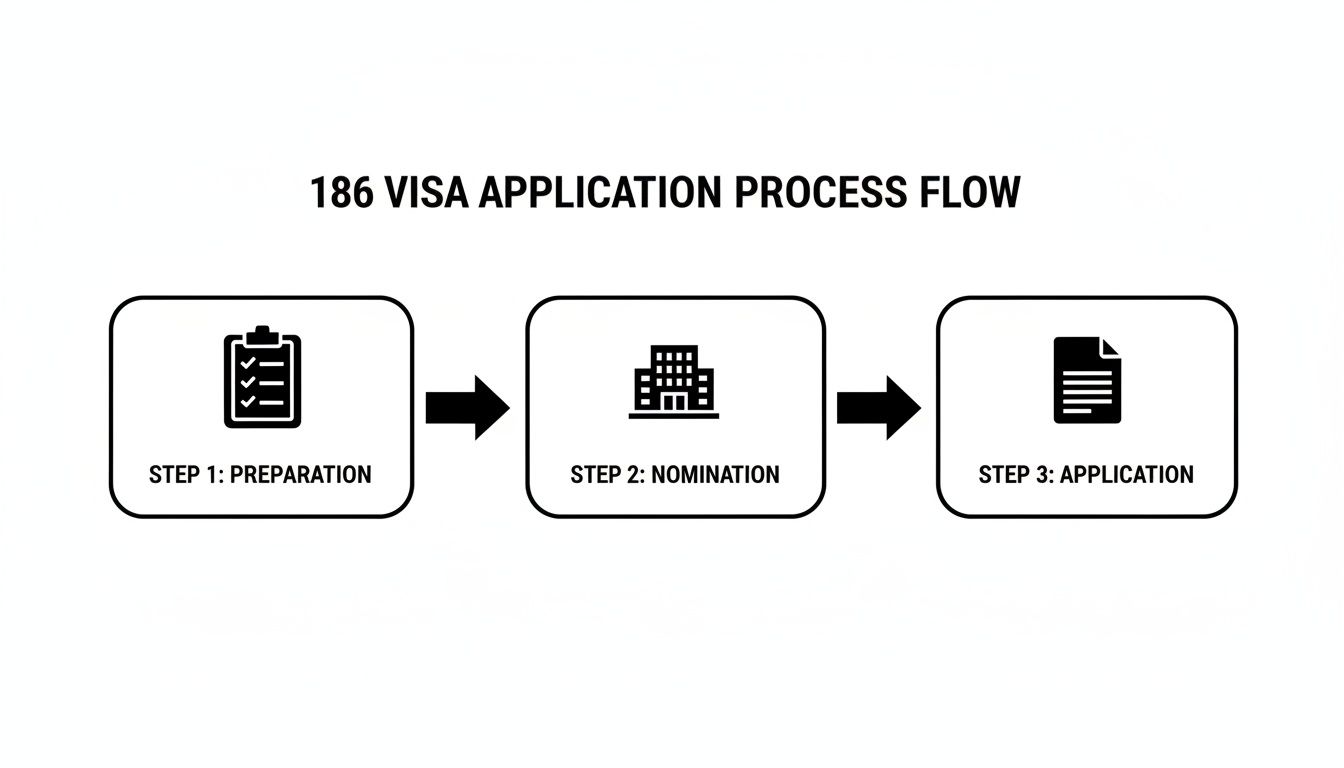
As you can see, that initial prep work is absolutely foundational for a smooth nomination and application.
Understanding Visa Processing Times
Government backlogs can, and often do, have a huge impact on how long you'll be waiting for an answer. For example, processing times for the 186 visa blew out in late 2025 because of a massive flood of applications.
As of 31 October 2025, we saw the Department assessing nominations that were lodged way back in March 2024 for standard cases. That’s a serious wait time. You can get a feel for these shifts by checking out ENS processing time updates on ahclawyers.com.
A Clear Breakdown of the Costs
Budgeting for the 186 visa is about more than just the main application fee. There are a handful of other costs you need to factor in, both for the applicant and the sponsoring employer.
Key Costs to Consider:
- Visa Application Charge (VAC): This is the main fee you'll pay directly to the Department of Home Affairs.
- Skilling Australians Fund (SAF) Levy: This is a mandatory charge for the employer. It’s calculated based on business turnover and sits at $3,000 for businesses with a turnover under $10 million and $5,000 for those with $10 million or more.
- Skills Assessment Fees: If your stream requires a skills assessment, you'll pay this fee directly to the relevant assessing body. The cost varies depending on your occupation.
- Ancillary Costs: Don’t forget to set money aside for things like health examinations, police clearances from any country you’ve lived in, and English language tests.
Common Pitfalls to Sidestep
Knowing where others have gone wrong is the best way to make sure you don't. Many applications get delayed or even refused because of simple, preventable errors that weaken an otherwise solid case.
Here are three of the most common issues we see:
- Mismatched Job Duties: The duties you list in the employment contract and position description have to line up perfectly with the official tasks outlined by ANZSCO for your nominated occupation. Any little inconsistency can raise a red flag about whether the position is genuine.
- Insufficient Salary Evidence: It’s not enough for the employer to just state the salary meets the Annual Market Salary Rate (AMSR). They have to prove it. This means providing hard evidence like industry awards, salary surveys, or even job ads for similar roles to back up the figure.
- Weak or Incomplete Documentation: Throwing together a disorganised or incomplete application is a one-way ticket to delays. Make sure every single required document is provided, clearly labelled, and meets the Department's exact specifications right from the start.
Disclaimer: Immigration laws and visa requirements change frequently. The information in this article is for general guidance only and may not be current when you read it. For the most up-to-date advice tailored to your situation, we strongly advise you to book an appointment with a registered migration agent. For any Department fees, please refer to the official Department of Home Affairs website at https://www.homeaffairs.gov.au/.
Your Top Questions Answered
When you're deep in the visa process, a lot of specific "what if" questions can pop up. Let's tackle some of the most common ones we hear from both applicants and employers navigating the Employer Nomination Scheme (186) visa.
Can I Change Jobs After My 186 Visa Is Granted?
The short answer is yes. Once your Subclass 186 visa comes through, you're officially an Australian permanent resident. That means you aren't legally tied to the employer who nominated you.
However, and this is a big however, the Department of Home Affairs grants this visa based on a genuine intention to work in the nominated role. It's generally expected that you'll stick with your sponsor for a reasonable period—most in the industry would say around two years is a good benchmark. If you resign almost immediately without a very good reason, it could raise red flags about the sincerity of your original application, which might come up for review if you later apply for Australian citizenship.
What Happens If My Employer's Nomination Is Refused?
This is a scenario no one wants, but it's important to understand. If the employer's nomination application is refused, the visa application linked to it will also be refused. You can't have one without the other; an approved nomination is the foundation the visa is built on.
If this happens, the first thing to do is get professional advice, and fast. You need to understand exactly why the nomination was knocked back. Depending on the reasons, your options could include lodging an appeal with the Administrative Appeals Tribunal (AAT) or seeing if you're eligible for another visa pathway altogether. Time is of the essence in these situations.
Disclaimer: Immigration laws and visa requirements change frequently. The information in this article is for general guidance only and may not be current when you read it. For the most up-to-date advice tailored to your situation, we strongly advise you to book an appointment with a registered migration agent. For any Department fees, please refer to the official Department of Home Affairs website at https://www.homeaffairs.gov.au/.
The journey to permanent residency is a big deal, and it pays to have an expert in your corner. At My Visa Guide, our registered migration agents provide clear, honest, and detailed support to give your application the best possible chance of success. Ready to get started? Book your consultation today at https://www.myvisaguide.com.au.