Securing Australian citizenship is a huge milestone, marking the final, exciting step in your migration story. At its heart, the process is about showing you're ready to fully commit to Australia. It boils down to a few key things: your residency status, how long you’ve physically been in the country, your character, and your grasp of what it means to be an Australian.
In simple terms, you need to be a permanent resident who has spent enough time here to truly understand and respect the nation’s laws and way of life.
Disclaimer: Please be aware that immigration information, requirements, and fees are subject to change. The content in this article may no longer be accurate at the time of reading. For the most current government fees, please refer to the official website at https://www.homeaffairs.gov.au/. We highly recommend booking an appointment with a registered migration agent for up-to-date and personalised advice.
Your Essential Australian Citizenship Checklist
Becoming an Australian citizen is so much more than a legal formality. It’s about officially joining a vibrant, diverse community and calling this country home. The whole journey is built on several pillars designed to confirm your connection and commitment to Australia.
Think of it like a checklist where each ticked box proves you're ready to take the pledge of allegiance. The pathway is clear and structured, making sure new citizens understand both the incredible privileges and the important responsibilities that come with the title. In the 2024-25 financial year alone, a massive 165,193 people from over 190 different nationalities successfully ticked all these boxes, with many of them having started on skilled migration pathways that My Visa Guide knows inside and out. If you're curious about the history, you can explore more about Australian nationality law on Wikipedia.
Let’s break down the whole process into clear, manageable steps. We'll start with this high-level overview before we get into the nitty-gritty of each requirement in the sections that follow.
The Four Pillars of Citizenship Eligibility
Your entire application stands on four main foundations. You absolutely have to satisfy each one, as they work together to paint a complete picture of your suitability.
- Permanent Residency Status: This is your ticket to the game. You must already hold a valid Australian permanent resident visa.
- The General Residence Requirement: This is all about demonstrating your long-term connection to Australia through your physical presence here. It's proof that you've made a life in this country.
- The Character Requirement: This involves comprehensive background checks to ensure you're someone who respects Australian laws and community values.
- Knowledge and Language: You’ll need to pass a citizenship test which assesses your basic English skills and your understanding of Australia.
To make things even clearer, let's summarise the core requirements in a simple table.
Australian Citizenship Core Requirements at a Glance
This table breaks down the main pillars of eligibility for Australian citizenship by conferral, giving you a quick snapshot of what you need to achieve.
| Requirement Pillar | Brief Description | Key Condition |
|---|---|---|
| Permanent Residency | You must hold a valid Australian permanent resident visa at the time of application and decision. | Must be a current PR. |
| Residence Requirement | You must have lived in Australia on a valid visa for four years, including 12 months as a PR. | Specific timeframes and absence limits apply. |
| Character Requirement | You must pass the character test, which involves police checks from Australia and other countries. | Full disclosure of all criminal history is vital. |
| Citizenship Test | You must demonstrate basic English and an understanding of Australian values, laws, and history. | A pass mark of 75% is required. |
Getting these four pillars right is the key to a successful application. In the next sections, we'll dive deeper into each one so you know exactly what to expect.
The Four Year Residency Pathway Explained
Think of the General Residence Requirement as laying the groundwork for your future in Australia. It’s the government's way of seeing a genuine, long-term commitment to the country before handing you a passport. This requirement is all about a clear timeline, making sure applicants have spent a decent chunk of time living and contributing to the community here.
At its heart, the rule is pretty straightforward. You must have been living in Australia on a valid visa for at least four years immediately before you lodge your citizenship application. The good news is this period doesn't have to be on just one visa; the time you've spent on various temporary visas, like a student or work visa, usually counts towards this total.
But the final year is the most important one. Within that four-year window, you must have spent at least 12 months as a Permanent Resident (PR). This last leg of the journey really cements your connection to Australia, marking your transition from a temporary visitor to a permanent member of the community on the verge of becoming a citizen.
Disclaimer: Please be aware that immigration information, requirements, and fees are subject to change. The content in this article may no longer be accurate at the time of reading. For the most current government fees, please refer to the official website at https://www.homeaffairs.gov.au/. We highly recommend booking an appointment with a registered migration agent for up-to-date and personalised advice.
Understanding Lawful Residence
The term "lawfully resident" isn't as complicated as it sounds. It simply means you were physically in Australia while holding a valid visa. Any time you were in the country without a valid visa, or perhaps on a bridging visa linked to a visa refusal or cancellation, won't count towards your four years.
Picture your time in Australia like building with blocks. Each day on a valid temporary visa is one block. When you finally get permanent residency, you add the last, most crucial set of blocks to complete the four-year structure. For anyone just starting to think about the move, checking out some essential tips for moving abroad can really help smooth out the transition before you even start worrying about these residency rules.
This diagram breaks down the main stages of the citizenship journey, kicking off with this foundational residency period.
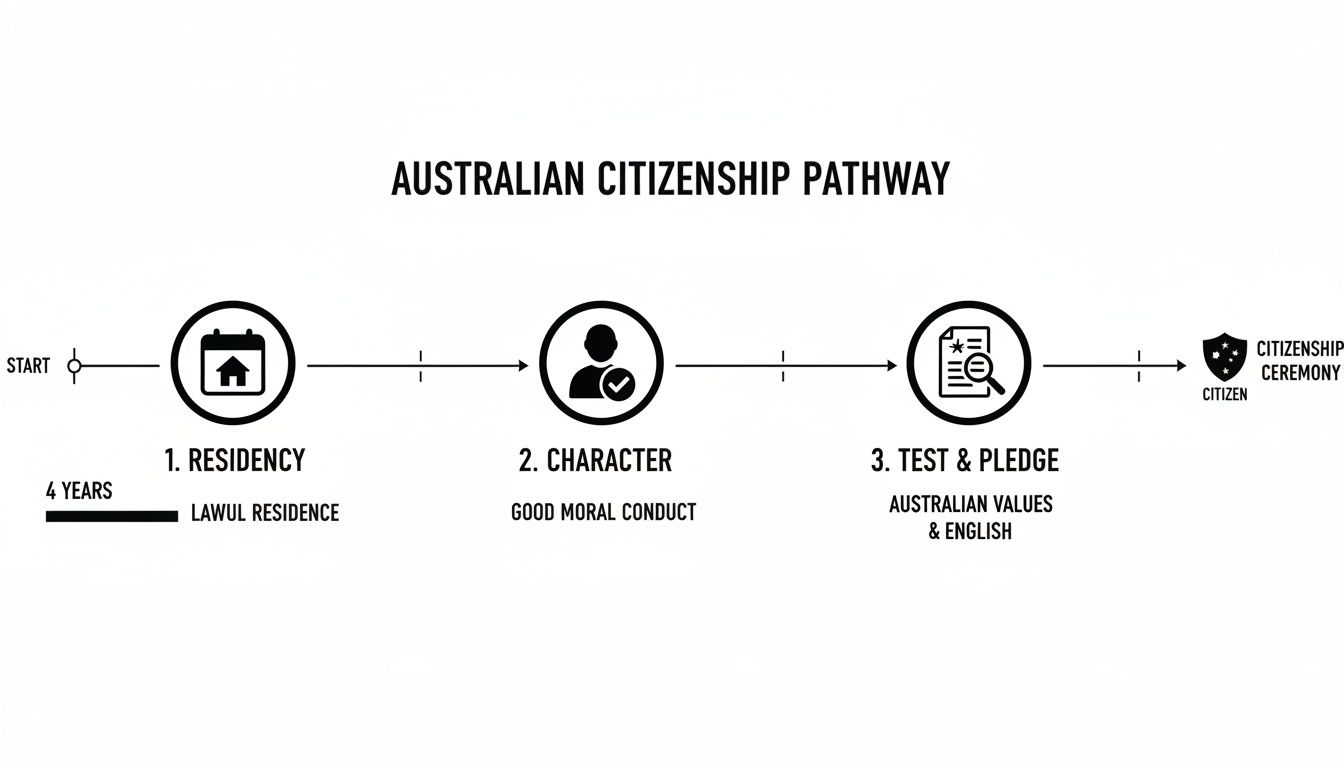
As you can see, ticking off the residency rules is the very first major milestone on your path to becoming a true blue Aussie.
Managing Your Time Outside Australia
While living in Australia is the whole point, the Department of Home Affairs knows that life happens. You might need to travel overseas for work, family, or a well-deserved holiday. The residence requirement does allow for some time abroad, but you need to be careful with the rules.
Here's the deal: you can't have been absent from Australia for more than a total of 12 months in the four years leading up to your application. This is a cumulative total, so it’s on you to keep track of every single overseas trip during this time.
On top of that, there’s an even tighter restriction on your final year. In the 12 months right before you apply (when you're a permanent resident), your time away can't add up to more than 90 days. If you go over these limits, you could reset your eligibility clock, so planning your trips is absolutely vital.
Let's break it down with a quick example. Imagine you spent three years on a student visa and then immediately became a permanent resident. To meet the full requirement, you'd need to live in Australia for another 12 months as a PR, making sure any overseas travel during that final year stays under the 90-day limit.
If you're just starting this journey, getting your head around the various permanent residency pathways is the critical first step. It all starts there.
How to Prepare for the Citizenship Test and Interview
The citizenship test often feels like the final, daunting exam before you can call Australia home. But it’s much less intimidating than it sounds. Think of it less as a history quiz and more as a confirmation that you understand the shared values that bind us all together as Australians.
It’s not about memorising obscure dates or facts. The real focus is on the privileges and responsibilities that come with being a citizen, making sure everyone is on the same page about our fundamental beliefs, laws, and the spirit of a ‘fair go’.
As for the interview, it’s far simpler than most people expect. It’s really just a procedural step where an official verifies your original documents and confirms your identity. It's about making sure you are who you say you are.
Disclaimer: Please be aware that immigration information, requirements, and fees are subject to change. The content in this article may no longer be accurate at the time of reading. For the most current government fees, please refer to the official website at https://www.homeaffairs.gov.au/. We highly recommend booking an appointment with a registered migration agent for up-to-date and personalised advice.
Deconstructing the Citizenship Test
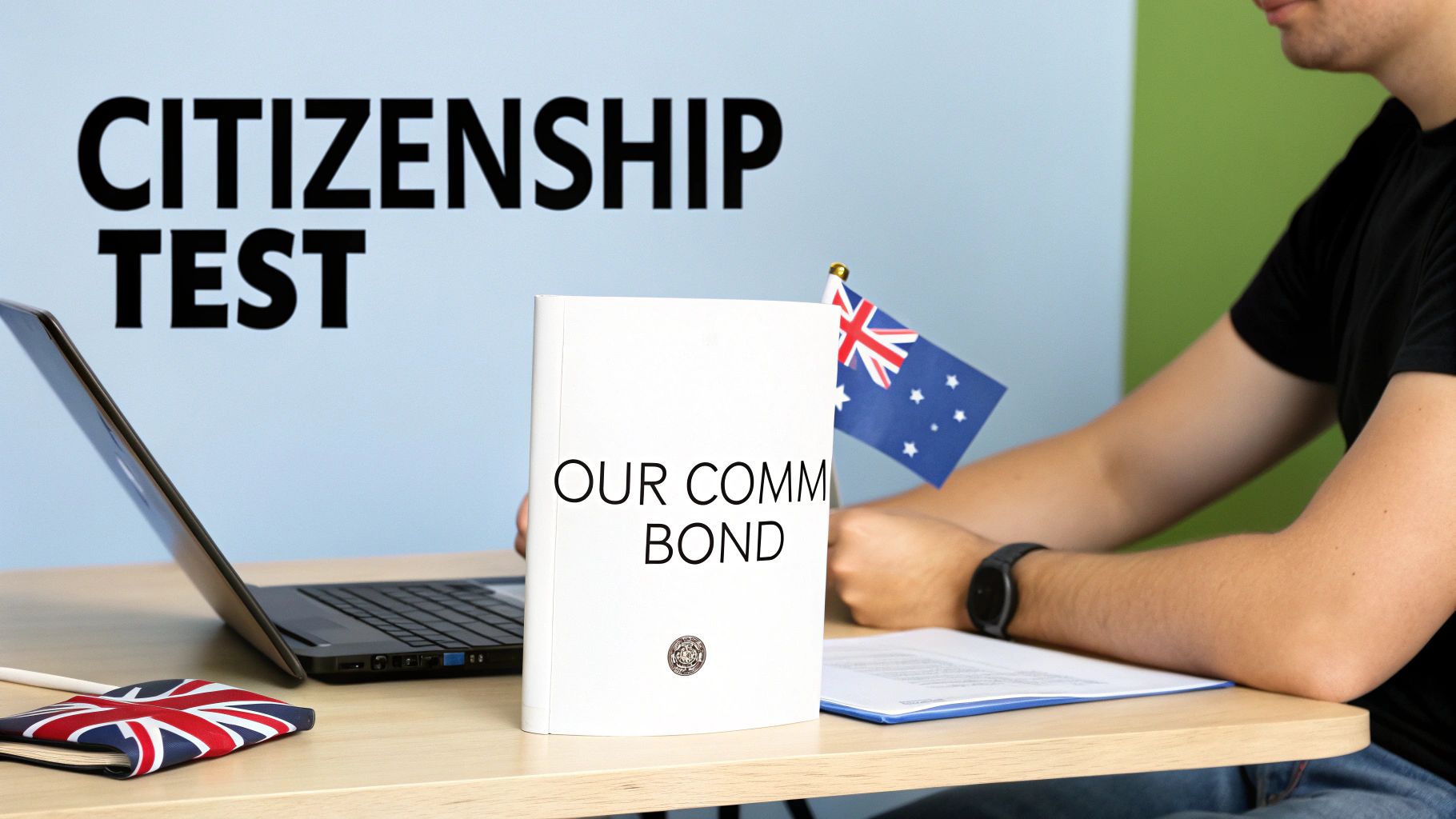
The Australian citizenship test is a computer-based, multiple-choice assessment conducted in English. You’ll be presented with 20 questions pulled directly from the official resource booklet, 'Our Common Bond'.
To pass, you need an overall score of at least 75%—that means getting 15 out of 20 questions right. But here’s the crucial part: there's a special section within the test where you can't afford to make a single mistake.
This section covers Australian values and consists of five questions. You must answer all five of them correctly to pass, no matter how well you do on the rest of the test. These questions are non-negotiable because they touch on the very core of what it means to be part of Australian society.
Breakdown of the Australian Citizenship Test
To give you a clearer picture of what to expect, this table breaks down the structure and key areas of the test. Knowing this will help you focus your preparation where it counts.
| Test Section | Topics Covered | Number of Questions |
|---|---|---|
| Part 1: Australia and its people | Australian history, national symbols, and our diverse society. | Part of the 20 total questions |
| Part 2: Australia's democratic beliefs, rights, and liberties | Freedoms of speech, religion, association, and the importance of mutual respect. | Part of the 20 total questions |
| Part 3: Government and the law in Australia | The three levels of government and the rule of law. | Part of the 20 total questions |
| Part 4: Australian Values (Mandatory Pass) | The five core values: respect, equality, freedom, rule of law, and democracy. | 5 (must answer all correctly) |
As you can see, while the test covers a range of topics, the Australian Values section is weighted most heavily in terms of passing requirements.
Key Topics and Study Resources
Your single most important study guide is the 'Our Common Bond' booklet, provided by the Department of Home Affairs. Everything you need to know is in there. The booklet is even split into testable and non-testable sections, so you can streamline your study efforts.
You’ll need to be comfortable with topics like:
- Australia and its people: Our history, symbols, and multicultural fabric.
- Australia's democratic beliefs, rights, and liberties: This covers things like freedom of speech and the importance of mutual respect.
- Government and the law in Australia: Understanding our three levels of government (federal, state/territory, and local).
- Australian values: This is the most critical part, covering respect, equality, and the spirit of a 'fair go'.
The core of your preparation should revolve around those five Australian values, as those are the questions you absolutely cannot get wrong. And remember, these aren't just for the test; they form the basis of your rights and responsibilities as a new citizen. If you need help proving your language skills along the way, check out our guide on meeting the English proficiency requirements for your visa journey.
The Citizenship Interview Process
The interview typically takes place on the same day as your test. It’s a brief, formal chat, not an interrogation. An officer from the Department will simply sit down with you to review the original documents you submitted with your application.
They’ll check your photo ID (like your passport) against your application and verify other key documents like your birth certificate and proof of address. It's a straightforward process designed to maintain the integrity of the system.
So, for most applicants between 18 and 59, the path is clear: demonstrate 'good character', hold a valid permanent residency, and pass the citizenship test. Acing that test means scoring at least 75% overall while getting a perfect 100% on the five Australian values questions.
Proving Your Identity and Good Character
Passing the ‘good character’ requirement is a non-negotiable part of becoming an Australian citizen. It’s about more than just not having a criminal record; it’s about showing you’re an upstanding, law-abiding member of the community who respects Australian values. You’re essentially building a case to prove your integrity.
The Department of Home Affairs looks at this very closely, reviewing your history both in Australia and overseas. They need to be confident that new citizens will be a positive addition to the country. Because of this, total honesty and transparency are your most powerful tools throughout the application.
Disclaimer: Please be aware that immigration information, requirements, and fees are subject to change. The content in this article may no longer be accurate at the time of reading. For the most current government fees, please refer to the official website at https://www.homeaffairs.gov.au/. We highly recommend booking an appointment with a registered migration agent for up-to-date and personalised advice.
First Things First: Verifying Your Identity
Before your character can be assessed, the Department needs to confirm exactly who you are. This means providing a solid set of identity documents that paint a clear and consistent picture of your personal details and legal status.
You’ll need to provide high-quality, original copies of your key documents. This isn’t the time for blurry phone pictures or out-of-date IDs.
Here’s a quick checklist of the documents you’ll typically need to get in order:
- Proof of Identity: Your current passport, your full birth certificate, and a national identity card if you have one.
- Proof of Address: Recent utility bills (like electricity or gas), your current lease or rental agreement, or a bank statement showing your residential address. These help establish your roots in the community.
- Change of Name Evidence: If your name has ever changed, you must show the official proof, such as a marriage certificate or a legal name change document.
The All-Important Police Checks
A huge part of the character assessment comes down to police checks. The Department automatically runs an Australian National Police Check when you apply, so you don’t have to arrange this one yourself. It gives them a full picture of any dealings you’ve had with the law here in Australia.
But that’s not all. You’ll also need to get overseas police certificates for every country where you have lived for a total of 12 months or more since you turned 16. It’s up to you to get these from the right authorities in each country, and be warned—this can sometimes take months.
My advice? Start chasing these documents long before you’re ready to lodge your application to avoid any frustrating delays.
Full Disclosure is Not Optional
If you remember only one thing about the character test, make it this: you must declare everything. So many people trip up by not mentioning a minor traffic fine or a small shoplifting charge from their teenage years, thinking it’s too small to matter. That’s a massive mistake.
The Department values honesty above all else. Failing to declare an offence—no matter how small or how long ago it happened—is seen as far worse than the offence itself. It can look like you’re trying to mislead the government, which is a fast track to a visa refusal.
Your declaration needs to include:
- All criminal convictions, both in Australia and overseas.
- Any pending charges or court cases that are still ongoing.
- Times you were found guilty of an offence, even if a conviction wasn't recorded.
- Any association with individuals or groups that are of concern to the authorities.
Being upfront about your entire history builds trust. It lets the case officer see the full picture and assess your character fairly. For a deeper dive, you can read more about the broader health and character requirements that apply across Australian visas. In this part of the process, honesty is always the best policy.
Alright, you’ve done the hard yards getting your eligibility sorted. Now for the final stretch: the application itself.
Think of this next part less like a puzzle and more like a roadmap. We’re going to walk through the practical steps, from gathering your documents right through to that unforgettable citizenship ceremony. I'll break down each stage into clear, manageable actions, so you can move forward with confidence and sidestep the common mistakes that trip people up.
Disclaimer: Please be aware that immigration information, requirements, and fees are subject to change. The content in this article may no longer be accurate at the time of reading. For the most current government fees, please refer to the official website at https://www.homeaffairs.gov.au/. We highly recommend booking an appointment with a registered migration agent for up-to-date and personalised advice.
Stage 1: Assembling Your Application
Before you even dream of clicking ‘submit’, your first job is to get organised. Meticulously. This is where you gather every single piece of evidence and double-check that you tick all the citizenship in Australia requirements.
I always tell my clients to start with a master checklist. It’s a simple thing, but it works. Yours will typically include:
- Identity Documents: Your passport, full birth certificate, and any official proof of name changes.
- Proof of Residence: Things that prove where you live, like recent utility bills or a current lease agreement.
- Character Documents: This is a big one. Have all your required overseas police checks completed and ready to upload.
- Photographs: A recent, passport-sized photo that meets the Department’s very specific guidelines. Don't get this wrong!
Once you have everything neatly scanned and filed, it’s time to lodge the application and pay the fee. The easiest and most efficient way to do this is online through an ImmiAccount. It’s the official platform where you can upload digital copies of everything and keep an eye on your application's progress.
Stage 2: The Citizenship Appointment and Test
After your application is in, you’ll eventually get an invitation for a citizenship appointment. This is where you’ll sit the citizenship test and have a brief interview, which almost always happen on the same day.
The main point of the appointment is to verify your identity and your original documents. An officer will physically check your passport and other key papers, making sure they’re the real deal and match the copies you submitted online.
Once they've confirmed who you are, you’ll sit the computer-based citizenship test. As we’ve discussed, it’s 20 multiple-choice questions. You need to get 75% overall, and critically, you must get all five questions on Australian values correct to pass.
Stage 3: The Waiting Period and Decision
With your test and interview done, your application officially enters the processing queue. Honestly, this can be the toughest part of the whole journey. The waiting game can be nerve-wracking, and processing times can vary wildly depending on how busy the Department is and the complexity of your case.
During this time, the Department of Home Affairs is doing its final background checks. If they hit a snag or need more information, they’ll contact you. Should you get a "Request for Further Information" (RFI), it is absolutely vital to respond quickly and give them exactly what they’ve asked for to avoid any extra delays.
Finally, the day comes when you receive written notification of their decision. A successful outcome means you've been approved for Australian citizenship… almost.
Stage 4: Attending Your Citizenship Ceremony
Getting that approval letter is a massive moment of relief and excitement, but you aren't officially a citizen just yet. The final, non-negotiable step is attending a citizenship ceremony to make the Australian Citizenship Pledge.
These ceremonies are usually organised by your local council and are genuinely special, meaningful events. You'll get an invitation to a ceremony in your area, though it might take a few months to be scheduled after your approval comes through.
At the ceremony, you’ll take the pledge, which is your formal commitment to Australia and its people. It's only after you've made this pledge that you'll be handed your Certificate of Australian Citizenship. From that moment on, you’re an Aussie. You can apply for an Australian passport and enjoy all the rights and responsibilities that come with your new life here.
Your Future as an Australian Citizen
Making it to citizenship is the final, most rewarding chapter in a long migration story. It’s the culmination of years of hard work and commitment, a sign that you’ve successfully met the core requirements of Australian life—residency, good character, and an understanding of the nation itself.
While the journey can feel a bit complex at times, every step is there for a reason. It's a clear, achievable path that ends with you becoming a full participant in Australian society. Hitting this milestone doesn't just close one door; it opens a brand new one, filled with significant privileges and important responsibilities that tie you permanently to this country's future.
Disclaimer: Please be aware that immigration information, requirements, and fees are subject to change. The content in this article may no longer be accurate at the time of reading. For the most current government fees, please refer to the official website at https://www.homeaffairs.gov.au/. We highly recommend booking an appointment with a registered migration agent for up-to-date and personalised advice.
Embracing New Rights and Responsibilities
As a citizen, you get a real say in the nation’s direction. This isn’t just a symbolic title; it comes with fundamental democratic rights that are now yours to exercise.
- The Right to Vote: You can finally have your say in federal, state, and local elections, helping to choose the people who govern the country. It’s your voice, and it counts.
- Holding an Australian Passport: This is a big one. You get the freedom to travel the world with one of the most respected passports out there, giving you visa-free or visa-on-arrival access to over 185 countries.
- Access to Consular Services: No matter where you are in the world, you’ll have the full support and protection of the Australian government through its network of embassies and consulates.
- Eligibility for Public Office: Ever thought about shaping the country's laws yourself? As a citizen, you can stand for parliament and take an active role in public life.
Of course, these rights go hand-in-hand with the responsibility to live by the values you agreed to in your Australian Citizenship Pledge. It's about upholding the rule of law and respecting the democratic beliefs that hold us all together.
Got Questions? We've Got Answers
The path to Australian citizenship is a well-trodden one, but it's natural for questions to pop up along the way. Think of this section as a quick chat with an expert, clearing up some of the most common queries we hear from applicants every day.
Disclaimer: Please be aware that immigration information, requirements, and fees are subject to change. The content in this article may no longer be accurate at the time of reading. For the most current government fees, please refer to the official website at https://www.homeaffairs.gov.au/. We highly recommend booking an appointment with a registered migration agent for up-to-date and personalised advice.
How Long Will My Citizenship Application Take?
This is the million-dollar question, and the honest answer is: it varies. Every application is unique, and processing times can shift based on how complex your situation is, whether the Department of Home Affairs needs more information from you, and even the ceremony schedule at your local council.
There are official processing time guides, but they're more of a ballpark figure than a hard deadline. For the most up-to-date and realistic timeline for your specific application, your best bet is always the Department's official global processing times tool.
Can My Kids Be Included in My Application?
Absolutely. In most cases, you can include your children under the age of 16 on your application. They won't have to meet the General Residence Requirement themselves, but the crucial part is that they must hold a permanent resident visa when you apply.
Just a heads-up, if you have a child born overseas after you become an Aussie citizen, that’s a different ball game. It’s a process called citizenship by descent, and it has its own set of rules. We can certainly guide you through that separate pathway if it applies to you.
What Happens if I Don't Pass the Citizenship Test?
First off, don't panic! Failing the citizenship test isn't a dead end. The Department knows people get nervous, so you're allowed to re-sit the test. Often, you might even get another shot on the same day if there’s time, or you can simply book another appointment.
While there’s no official cap on how many times you can try, the best strategy is to nail it the first time. Really spend some time with the 'Our Common Bond' resource—it’s the key to walking in there with confidence and avoiding any extra delays.
Do I Have to Give Up My Original Citizenship?
Australia is quite progressive on this front and allows for dual citizenship. This means you won’t be asked to renounce your original citizenship to become an Australian. You can happily hold two passports.
But here’s the critical part: While Australia is fine with it, your country of origin might not be. It is entirely up to you to check the laws of your home country. Some nations automatically cancel your citizenship if you take on another, so getting this confirmed is a non-negotiable step in your journey.
Navigating the ins and outs of the citizenship in Australia requirements can feel like a maze, but you don't have to find your way through it alone. The team at My Visa Guide is here to offer clear, expert advice that’s tailored to your story, making sure your application isn't just submitted, but submitted to succeed.
Ready to take that final, exciting step with a professional by your side? Book a personalised consultation with our MARA-certified migration agents today!