To get your foot in the door with an Australian business visa, you need to show you’ve got the entrepreneurial chops, the investment power, and a real commitment to adding value to the Australian economy. The main pathway for most is the Business Innovation and Investment visa (subclass 188), which hinges on getting a state nomination and meeting some serious financial targets.
Disclaimer: Immigration laws and visa requirements are subject to change. The information in this article may not be current when you read it. To receive the most accurate and personalised advice, please book an appointment with a registered migration agent. For all current government visa fees, always consult the official Department of Home Affairs website.
Understanding Australia's Business Visa Pathways
Starting a business in Australia is a big move, and the first step is getting your head around the visa landscape. At its core, the whole system is designed to bring in talented entrepreneurs, savvy investors, and proven business leaders. Australia is looking for people who can inject fresh skills, capital, and innovative ideas to help the national economy tick.
Think of it as a strategic invitation—the goal is to match the right business minds with the right opportunities.
Every visa pathway is built for a different kind of business person. Our guide is here to cut through the jargon and even offers some great insights for foreigners setting up business in Australia to make sure you land on the route that actually fits your ambitions.
Key Visa Categories
Australia has a few different channels for business migration, but you'll mainly come across two major pathways:
- Business Innovation and Investment (Provisional) visa (subclass 188): This is the go-to for most business migrants. It’s a points-tested, temporary visa that sets you on the path to permanent residency once you’ve successfully established and run your business or investment here in Australia.
- Business Talent (Permanent) visa (subclass 132): This one’s a bit more exclusive. It’s a direct-to-permanent residency option for high-calibre business owners who already have a significant track record of success. As you can imagine, it demands a much higher level of achievement and investment right from the start.
Figuring out which of these categories you fit into is the crucial first step. It's well worth your time to dig into the specifics of business and investment migration to see which stream really lines up with your background and goals.
The bigger picture shows just how much Australia relies on skilled people from overseas. As of 30 September 2025, the total number of temporary visa holders in Australia hit a record 2.90 million. This points to a thriving economy that’s actively looking for international talent. For anyone with a business idea, it’s a clear signal that the environment here is ripe with opportunity.
Disclaimer: Immigration laws and visa requirements are subject to change. The information in this article may not be current when you read it. To receive the most accurate and personalised advice, please book an appointment with a registered migration agent. For all current government visa fees, always consult the official Department of Home Affairs website.
A Closer Look at the Subclass 188 Business and Investment Visa
The Business Innovation and Investment (Provisional) visa, often just called the Subclass 188, is the main gateway for most entrepreneurs and investors wanting to set up shop in Australia.
Don't think of it as a single door. It’s more like a corridor with several specialised entryways, each designed for a different kind of business person. It’s a provisional visa, which means it’s your first step towards permanent residency—you get to prove your business or investment commitment first.
This visa is built on a points-based system and, crucially, requires a nomination from an Australian state or territory government. You can't just apply directly. You first need an invitation from a region that believes your business idea will genuinely benefit its local economy. Getting your head around the different "streams" is the key to finding the one that perfectly matches your financial standing and business background.
This decision tree gives you a quick visual guide to see how different profiles align with the main visa pathways.
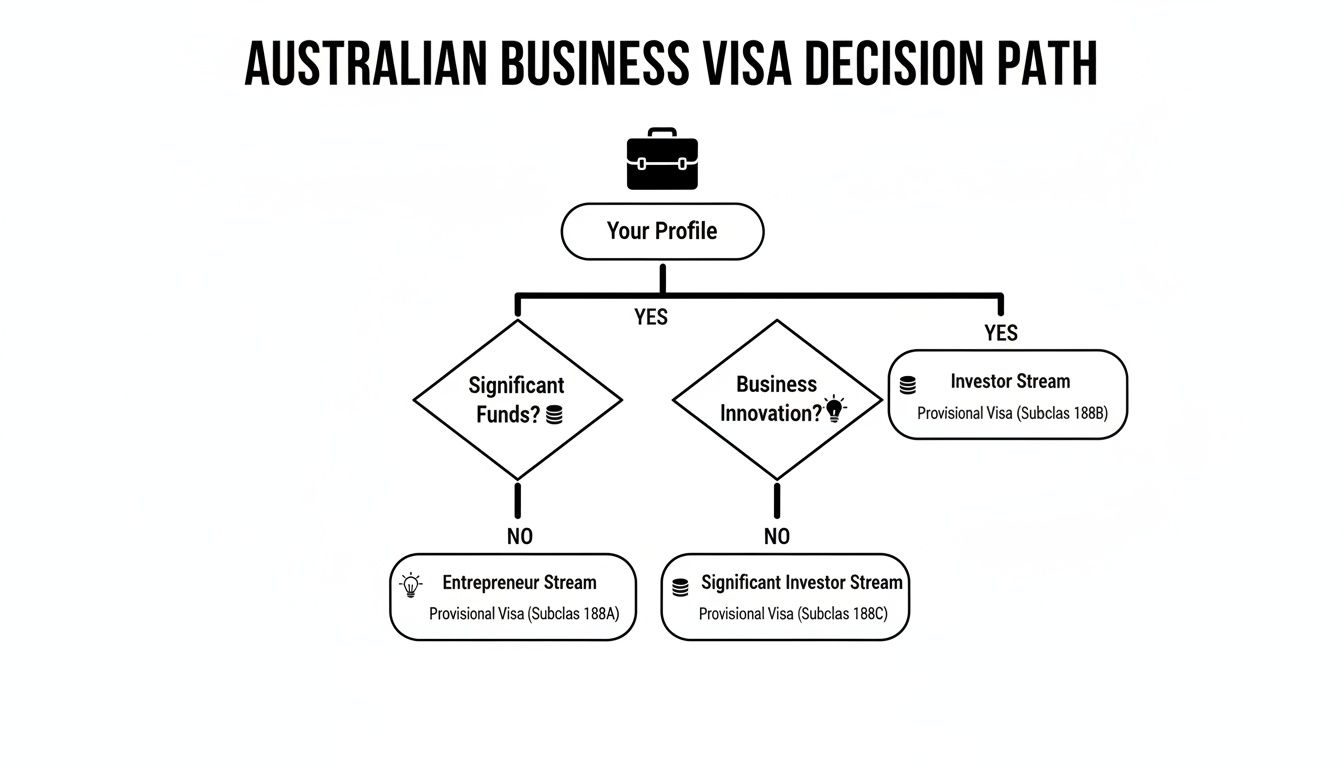
As the flowchart shows, everything starts with your personal and business profile. From there, your path branches out depending on whether you're primarily an investor or an entrepreneur with a groundbreaking idea.
The Business Innovation Stream
This stream is built for people with a successful business career who want to own and manage a new or existing business in Australia. It’s for the hands-on operator. The business visa Australia requirements for this stream really dig into your past performance and your future plans.
To be eligible, you'll generally need to:
- Be under 55 years of age, though a state or territory can waive this if your business is considered to be of exceptional economic benefit.
- Score at least 65 points on the points test.
- Have held an ownership stake in a business with a turnover of at least AUD $750,000 for two of the last four financial years.
- Hold personal and business assets worth at least AUD $1.25 million.
This path is all about proving you have solid business acumen and the financial muscle to repeat that success down under.
The Investor and Significant Investor Streams
If your strength is in investment rather than the day-to-day grind of running a business, these two streams offer a clear route. The main difference between them is simply the scale of the investment required.
The Investor Stream requires you to make a designated investment of at least AUD $2.5 million into a complying Australian investment framework for the entire duration of your provisional visa. You also have to show a high level of management skill with eligible investments and a genuine commitment to keeping your investment activity going in Australia.
On the other hand, the Significant Investor Stream (SIV) demands a much bigger commitment. SIV applicants must invest a minimum of AUD $5 million into complying significant investments. The payoff for this substantial capital injection? More flexible residency requirements and no age limit, which makes it a very appealing option for high-net-worth individuals.
The Entrepreneur Stream
This is the most specialised stream, designed for visionaries with genuinely innovative ideas and solid financial backing from a third party. It’s less about your past business turnover and more about the potential of what you plan to build.
To qualify, you must have a funding agreement of at least AUD $200,000 from a specific entity, like a Commonwealth Government agency, a State or Territory Government, or a Venture Capital Limited Partnership. Your proposed entrepreneurial activity must centre on an innovative idea that will lead to a commercialised product or service in Australia.
To help you see the key differences at a glance, here’s a quick comparison of the main financial and eligibility requirements for the Subclass 188 visa streams.
Subclass 188 Visa Streams At a Glance
| Stream | Minimum Net Assets | Minimum Investment | Business Turnover Requirement | Points Test Required |
|---|---|---|---|---|
| Business Innovation | AUD $1.25 million | N/A | AUD $750,000 p.a. | Yes (65 points) |
| Investor | AUD $2.5 million | AUD $2.5 million | N/A | Yes (65 points) |
| Significant Investor | N/A | AUD $5 million | N/A | No |
| Entrepreneur | N/A | AUD $200,000 funding | N/A | No |
This table makes it clear how each stream is tailored to a different type of applicant, from hands-on business owners to high-level investors and forward-thinking innovators. Choosing the right one is the first and most important step in your journey.
Disclaimer: Immigration laws and visa requirements are subject to change. The information in this article may not be current when you read it. To receive the most accurate and personalised advice, please book an appointment with a registered migration agent. For all current government visa fees, always consult the official Department of Home Affairs website.
If the Subclass 188 visa is the main pathway into Australian business, think of the Business Talent (Permanent) visa (Subclass 132) as the express lane. This visa was designed as a direct-to-permanent residency option for high-calibre, established business owners with a serious track record of success.
Unlike its provisional counterpart, the Subclass 132 granted permanent status from day one. It was a reflection of the incredible level of achievement required from applicants. Where the Subclass 188 asks you to prove your business capabilities over several years, the 132 was for those whose history already spoke volumes, allowing them to skip the provisional stage entirely. This made it one of the most sought-after—and demanding—business visas available.
The visa itself was split into two very different streams, each targeting a specific type of exceptional business talent.
The Significant Business History Stream
This was the more traditional route, built for seasoned business owners who had successfully managed major enterprises. The financial benchmarks were deliberately high, making it clear that the Australian government was looking to attract proven leaders.
To get a foot in the door, you generally had to show:
- High Net Assets: You and your partner needed at least AUD $1.5 million in net business and personal assets, all legally acquired and ready to be transferred to Australia within two years of the visa being granted.
- Substantial Business Turnover: Your business (or businesses) had to have an annual turnover of at least AUD $3 million for two of the four financial years right before you applied.
- Significant Ownership Stake: You needed to own a decent slice of the pie—at least 51% if the business turnover was under AUD $400,000, 30% for turnovers above that, or 10% if it was a publicly listed company.
These figures weren’t just arbitrary numbers; they were designed to ensure that applicants were genuinely at the top of their game.
The Venture Capital Entrepreneur Stream
This stream took a completely different approach. It was aimed squarely at innovators and entrepreneurs who had already secured significant backing from a qualified Australian venture capital firm. The focus here wasn't so much on past turnover, but on the future potential of a game-changing business idea that had already attracted serious investment.
To qualify, you needed to have locked in at least AUD $1 million in funding from an Australian venture capital firm. The firm had to be a member of the Australian Investment Council (AIC), which ensured the funding came from a credible, recognised source. The money was specifically for getting a high-value business idea off the ground—whether for a start-up, product commercialisation, or major business development.
A Critical Note on Visa Status: It’s really important to know that as of July 2021, the Subclass 132 visa was closed to new applications. We're covering it here to give you the full context of Australia's business migration framework, as existing visa holders may still be working to meet their obligations.
Australia remains committed to attracting top-tier talent, which is clear from its broader migration policies. For the 2025-2026 financial year, the permanent migration cap is set at 185,000 places. A huge chunk of that—around 70%, or 129,500 places—is reserved for skilled migration streams, showing just how focused the government is on bringing in people who can drive economic growth. You can read more about Australia’s migration cap and what it means for skilled workers.
Disclaimer: Immigration laws and visa requirements are subject to change. The information in this article may not be current when you read it. To receive the most accurate and personalised advice, please book an appointment with a registered migration agent. For all current government visa fees, always consult the official Department of Home Affairs website at https://www.homeaffairs.gov.au/.
Putting Together Your Key Documents
Think of your business visa application like a legal case you're presenting to a judge. Your success hinges entirely on the quality of your evidence. For Australian immigration, that evidence is your documentation. Getting this right isn't just a box-ticking exercise; it's one of the most crucial steps to meeting the business visa Australia requirements.

You're essentially telling the story of your business journey and your future plans in Australia. Every single document you provide is a chapter in that story, backing up your claims and making your case believable to the Department of Home Affairs. Even one missing document or a small mistake can cause serious delays or, worse, lead to a flat-out refusal.
Personal and Identity Documents
First things first, you need to prove who you are. These are the foundational documents that establish your identity, your family ties, and your legal status. It's absolutely critical that you provide certified copies of the originals and ensure everything is up to date.
Here's what you'll typically need:
- Passports: Certified copies of the bio-data pages for you and any family member on the application.
- Birth Certificates: Must show the names of both parents for every applicant.
- Marriage or De Facto Relationship Evidence: A marriage certificate is standard. If you're in a de facto relationship, you'll need proof of your life together, such as joint bank accounts, shared bills, or rental agreements.
- National Identity Cards: If these are issued in your country, include them.
- Recent Passport-Sized Photos: Make sure they meet the specific photo guidelines for each applicant.
Proof of Your Finances and Assets
Next up is the money. You have to clearly show that you meet the financial thresholds for your chosen visa stream. The evidence needs to be straightforward, verifiable, and give a complete overview of your net worth.
This usually means pulling together:
- Bank Statements: Both personal and business statements, covering a specific period to show a consistent financial history.
- Asset Valuations: Get professional, independent valuations for any real estate you or your business owns.
- Share Certificates or Company Registers: These officially prove your ownership stake in any businesses.
- Evidence of Other Investments: This could be anything from a stock portfolio to term deposits.
A very common pitfall is submitting financial documents that are out-of-date or haven't been properly valued. Every piece of evidence must be current and, where required, professionally assessed to show its value in Australian dollars at the time you lodge your application.
Your Business and Career History
This is where you really get into the details. It's the most intensive part of your application, requiring a full history of your business or investment career. The goal is to prove you've got the track record and expertise to succeed in Australia.
The evidence you'll need to compile includes:
- Business Registration Certificates: To prove legal ownership and the operational status of your company.
- Financial Reports: Audited statements are key here—think profit and loss statements and balance sheets for the required number of years.
- Tax Documents: Your personal and business tax returns are used to cross-reference and confirm your financial claims.
- Organisational Chart: This visually shows your position and seniority within the business.
- Evidence of Your Management Role: Documents that outline your specific day-to-day duties and prove you have decision-making power.
On top of these core documents, you'll also have to meet other criteria. For a detailed guide on what’s involved, our article on Australia's health and character requirements is an essential read. Remember, every document plays a part in building a strong, decision-ready application.
Disclaimer: Immigration laws and visa requirements are subject to change. The information in this article may not be current when you read it. To receive the most accurate and personalised advice, please book an appointment with a registered migration agent. For all current government visa fees, always consult the official Department of Home Affairs website at https://www.homeaffairs.gov.au/.
Securing a State or Territory Nomination
Before your business visa application even gets a look-in from the Department of Home Affairs, you've got to pass a crucial first test: getting a nomination from an Australian state or territory government.
It helps to think of Australia not as a single country, but as a collection of unique economic ecosystems. Every state and territory has its own specific goals, its own industries it’s trying to grow, and its own vision for the future.
The nomination process is their way of making sure your business or investment idea is a perfect fit for their local economy. It’s essentially a strategic "yes" to your proposal, confirming that you’re not just another qualified applicant, but the right applicant for their region. A nomination is their stamp of approval, an endorsement that says your business plan will bring real, tangible value to their community.
Why Each State Is Different
This is a point that trips a lot of people up: no two states are looking for the exact same thing. Getting this right is a fundamental part of the business visa Australia requirements.
For instance, a cutting-edge tech startup would likely get a very warm welcome in Victoria, which is heavily invested in its innovation hubs around Melbourne. But that same startup might not be as high a priority in a state like Queensland or South Australia, where agribusiness is the backbone of the economy. An investor with a background in large-scale farming would be a much more compelling candidate there.
Some states are desperate to attract investment into regional areas to create local jobs. Others are more focused on bringing high-net-worth individuals into their capital cities. This regional difference means you absolutely must do your homework. A generic, one-size-fits-all business plan just won’t cut it.
Aligning Your Plan with State Goals
Nailing the nomination is all about strategic alignment. Your job is to dive into the economic development plans of each state and figure out where your business expertise and investment power can make the biggest impact.
Let’s make this practical:
- If you’re a tech entrepreneur targeting Victoria: Your plan needs to show exactly how you’ll plug into Melbourne's tech scene. Will you hire local software developers? Partner with the universities? Solve a problem for a key local industry?
- If you’re an agribusiness investor looking at Queensland: Your proposal should detail how your investment will boost agricultural output, introduce new farming technologies, or open up new export markets for local produce.
The nomination is more than a simple box-ticking exercise; it's a competitive pitch. You're showing a state government that your business isn't just a good idea—it's the solution they've been looking for.
And the competition for these spots is getting tougher. Recent figures show that net overseas migration is projected to be 306,000 in 2024-2025. That’s a big drop from 429,000 the year before, which points to much tighter migration policies across the board. For business visa applicants, this means the playing field is more crowded than ever, making a perfectly aligned state nomination absolutely critical. You can explore more about Australia’s migration trends to get a feel for the current climate.
Disclaimer: Immigration laws and visa requirements are subject to change. The information in this article may not be current when you read it. To receive the most accurate and personalised advice, please book an appointment with a registered migration agent. For all current government visa fees, always consult the official Department of Home Affairs website at https://www.homeaffairs.gov.au/.
Partnering with a Migration Expert
Trying to navigate the complex world of business visa Australia requirements on your own can feel like sailing through a storm without a map. The rules are notoriously intricate, the stakes are incredibly high, and one small misstep can lead to major delays or even an outright refusal. This is where the real-world value of a MARA-registered migration agent truly shines.

An expert doesn’t just fill out forms for you; they give you a strategic edge. A great agent will use effective immigration case management tips to keep your application organised and moving forward. Their job is to translate your business goals into a compelling, decision-ready application that speaks directly to what the Department of Home Affairs is looking for.
Going Beyond the Paperwork
Here at My Visa Guide, our team, led by Registered Migration Agent Vijay Bharti (MARN 2217817), knows that a winning application is always built on a solid strategy. We start with a deep-dive eligibility assessment to identify the exact visa stream that aligns with your unique profile and ambitions.
From there, our support is hands-on and practical. We’ll help you:
- Craft a Compelling Business Proposal: Your business plan needs to be more than just a great idea. It must align perfectly with the economic goals of the state or territory nominating you. We’ll guide you in shaping a proposal that makes your value crystal clear.
- Ensure Flawless Documentation: We meticulously review every single document, from your financial statements to personal records, ensuring everything is accurate, current, and correctly certified. No stone is left unturned.
- Lodge a Decision-Ready Application: By anticipating potential roadblocks and addressing them upfront, we submit an application that’s designed for a smooth and efficient assessment. Our article on tips for choosing a migration agent offers more insight into what to look for in an expert partner.
This level of professional guidance helps you sidestep the common mistakes that can so easily derail an application. It takes the immense stress out of the process and dramatically boosts your chances of success, letting you focus on what you do best: planning your business future in Australia.
Disclaimer: Immigration laws and visa requirements are subject to change. The information in this article may not be current when you read it. To receive the most accurate and personalised advice, please book an appointment with a registered migration agent. For all current government visa fees, always consult the official Department of Home Affairs website at https://www.homeaffairs.gov.au/.
If you’re ready to build a personalised migration strategy for your Australian business goals, we invite you to book a consultation with our expert team today.
A Few Common Questions
When you're diving into the world of Australian business visas, it's natural for a lot of practical questions to pop up. We get them all the time. Here are some clear, straightforward answers to the queries we hear most often, helping you get a better handle on the details.
How Does The Points Test For The Subclass 188 Visa Actually Work?
The best way to think about the points test is as a scorecard. It's the system the Australian government uses to see if you’re the right fit for a business visa. To even get an invitation to apply for streams like the Business Innovation Stream, you need to hit a minimum of 65 points.
So, where do these points come from? They’re awarded across a few key areas that paint a picture of your potential to contribute to the Australian economy:
- Age: Younger applicants tend to score more points.
- English Language Ability: The better your English, the higher your score.
- Qualifications: A degree or other tertiary qualification can give you a nice boost.
- Business Experience: This is a big one. The years you’ve spent successfully running your own business are heavily weighted.
- Net Personal and Business Assets: Your overall net worth is a key factor—more assets mean more points.
- Business Turnover: You'll need to show a strong annual turnover.
- Innovation: Do you hold any patents or trademarks? Have you developed innovative business models? This can also add to your score.
At its core, the points test is just an objective way for the government to measure your background against what they see as the ideal profile for a successful business owner or investor in Australia.
Can I Include My Family On My Business Visa Application?
Yes, you absolutely can. This is one of the biggest upsides to Australia’s business visa programs—the ability to bring your family unit along with you. This typically means your partner (your spouse or de facto partner) and any dependent children.
Just a heads-up: it's incredibly important to provide solid documentation for every family member you include. Think birth certificates, passports, and proof of your relationship. Every single person on the application also has to pass Australia's health and character checks.
When you add family members, they get the same visa and the same rights as you. That means they can live, work, and study in Australia, making this a genuine pathway to starting a new life and business adventure with your whole family.
What Happens After My Provisional Business Visa Is Granted?
Getting your provisional visa, like the Subclass 188, is a huge win. But it’s not the finish line—it’s the start of the next phase. Once you’re in Australia, your main job is to knuckle down and meet the specific requirements of your visa stream within the set timeframe.
For most people, this means you'll need to be actively:
- Establishing and Managing Your Business: If you're on the Business Innovation stream, this means getting involved in the day-to-day management of your new Australian company.
- Maintaining Your Investment: For the investor streams, you’ve got to keep your designated investment in place for the whole required period.
- Meeting Residency Requirements: You'll also need to live in Australia for a minimum amount of time before you can think about the next step.
Once you’ve ticked all these boxes and met the conditions, you’ll finally be eligible to apply for the permanent Business Innovation and Investment (Permanent) visa (subclass 888).
Disclaimer: Australian immigration law is a complex beast and changes often. The information here might not be current when you read it. To get advice that’s right for your specific situation, we always recommend booking an appointment with a registered migration agent. For the most up-to-date government visa fees, please check the Department of Home Affairs website directly.
Trying to make sense of Australian business visa requirements is a lot easier when you have an expert in your corner. My Visa Guide provides clear strategies and careful application support to make sure your business journey gets off to the best possible start. Book a consultation with our experienced migration agents today.