Picture this: you’re studying at a world-class university, with a buzzing city and breathtaking landscapes right on your doorstep. For thousands of students, this dream kicks off by securing an Australian visa for international students – specifically, the Student Visa (Subclass 500). Think of this guide as your roadmap, breaking down the entire application journey from start to finish.
Disclaimer: Please be aware that immigration laws and visa requirements are subject to change. The information in this article is for general guidance only and may not be current at the time of reading. For the most accurate and up-to-date advice tailored to your specific situation, it is crucial to book an appointment with a registered migration agent. For any department fees, always refer to the official Department of Home Affairs website.
Your Journey to Studying in Australia Starts Here
The idea of studying in Australia is incredibly exciting, and it’s no wonder hundreds of thousands of students make the move each year. The country’s reputation for top-tier education and incredible quality of life makes it a premier destination. But before you can get there, you have to navigate the legal requirements, all of which revolve around the Student Visa (Subclass 500).
It’s best to think of this visa as more than just a stamp in your passport; it's the very foundation of your entire Aussie experience. Putting together a thoughtful, well-prepared application shows the Department of Home Affairs that you're a genuine student who understands and respects the rules. We’re here to break down what can feel like a daunting process into clear, manageable steps.
Why Meticulous Preparation Matters
The Australian Government is always tweaking its immigration policies to protect the integrity of its education sector. This means the goalposts can shift, and you need to present a rock-solid case for why you should be granted a visa.
A successful application really boils down to three key things:
- Understanding the requirements: Knowing exactly what paperwork and evidence you need to provide.
- Demonstrating genuine intent: Clearly explaining your study plans and how they connect to your future career goals.
- Meeting financial and health standards: Proving you have the funds to support yourself and have arranged the required health cover.
Nailing your application from the get-go massively boosts your chances of a quick, smooth approval. That lets you focus on the exciting stuff—like packing and planning your arrival—instead of stressing about visa dramas.
Important Disclaimer: Please remember that Australian immigration laws and visa requirements can and do change. This article is a general guide, and the information might not be current by the time you read it. For the most accurate, up-to-date advice tailored to your specific situation, it is crucial to book a consultation with a registered migration agent.
Also, any government fees mentioned here are for illustrative purposes only. Always check the official Department of Home Affairs website for the latest fee schedule before you lodge your application.
What Is the Subclass 500 Visa and Are You Eligible?
So, you're dreaming of studying in Australia. The key to unlocking that dream is the Student Visa (Subclass 500). Think of it as your official pass to live and learn Down Under for the entire length of your course, which can be up to five years.
But getting this visa isn't just a matter of filling out a form. Before you even think about packing your bags, you need to prove you meet a specific set of criteria. These are non-negotiable requirements the Australian Government has put in place to protect the high standards of its education system.
The Four Pillars of Student Visa Eligibility
To build a strong application for an Australian visa for international students, you need to focus on four essential pillars. Each one is critical, and if one is weak, the whole application could come tumbling down.
Let's break down the foundational requirements you must meet:
- Enrolment in a CRICOS-Registered Course: First things first, you need a Confirmation of Enrolment (CoE) from an Australian institution. And it's not just any course – both the institution and the specific course must be listed on the Commonwealth Register of Institutions and Courses for Overseas Students (CRICOS).
- English Language Proficiency: You’ll have to show you have a solid grasp of English. This is usually done by taking a recognised test like IELTS, TOEFL iBT, or PTE Academic and achieving the minimum required score.
- Overseas Student Health Cover (OSHC): This is mandatory. You must have adequate health insurance for your entire stay in Australia. OSHC is there to help cover your medical costs, giving you peace of mind while you study.
- Genuine Student (GS) Requirement: This is often the trickiest part of the application. You have to genuinely convince the Department of Home Affairs that your main reason for coming to Australia is to study, not for any other purpose.
Understanding the Crucial Genuine Student Requirement
The Genuine Student (GS) requirement is much more than a simple checkbox. It’s a deep dive into your personal circumstances, your immigration history, and how your chosen course will genuinely benefit your future.
You need to tell a clear and convincing story that shows you intend to study in Australia temporarily and then use your new qualification to build a career, whether back home or elsewhere. We break down exactly how to do this in our guide on what is the Genuine Student requirement.
A Word on Evolving Standards
There’s no denying Australia is a top spot for international students. By the end of the 2024 financial year, the number of student visa holders hit a massive 608,262. Even with the government tightening the rules—like asking for more savings and introducing the new Genuine Student test—the numbers are still near record highs. It just goes to show how popular this visa is. You can read about the latest international student intake statistics for more on these trends.
Age Requirements and Including Family Members
As a general rule, you need to be at least six years old to apply for a Student visa. If you're under 18, you'll also need to have proper welfare arrangements in place for your entire stay.
Thinking of bringing family? You can include eligible family members in your application. This usually means your partner and any dependent children who are unmarried and under 18. Just keep in mind that bringing family along will increase the amount of money you need to show you have to support everyone.
Disclaimer: Please be aware that immigration laws and visa requirements are subject to change. The information in this article is for general guidance only and may not be current at the time of reading. For the most accurate and up-to-date advice tailored to your specific situation, it is crucial to book an appointment with a registered migration agent. For any department fees, always refer to the official Home Affairs website.
A Step-by-Step Guide to Your Visa Application
Applying for an Australian student visa can feel like a mountain of paperwork, but it’s really just a series of logical steps. If you break it down into a clear sequence, what seems complex becomes a very manageable project.
Think of it like building a bridge to your future in Australia; every single document and form you complete is a critical support beam. This guide will walk you through the process, making sure each piece is placed perfectly for a strong and successful outcome.
The journey actually starts well before you even think about logging into your ImmiAccount. It begins with the most important choice of all: your course.
Stage 1: Laying the Foundation
Before you can even dream of applying for the visa, you need to be accepted into an Australian school, college, or university. This isn't just about picking a course that sounds fun—it’s a strategic decision that needs to align with your career goals and, crucially, the visa requirements.
- Choose a CRICOS-Registered Course: This is the absolute first step and it’s non-negotiable. Your chosen course and institution must be on the Commonwealth Register of Institutions and Courses for Overseas Students (CRICOS). This register confirms the provider is government-approved to enrol international students.
- Get Your Letter of Offer: Once you apply and are accepted, the institution will send you a formal Letter of Offer. This document lays out all the important details: your course, tuition fees, and any conditions you need to meet.
- Secure Your Confirmation of Enrolment (CoE): After you’ve accepted the offer and paid your initial deposit, you’ll receive the golden ticket: your Confirmation of Enrolment (CoE). This official document is the key piece of evidence you need to lodge your visa application.
This whole process—from choosing a course to getting your CoE—is how you start to prove your genuine intention to study, which is a massive part of a successful visa application.
The infographic below neatly summarises these essential first steps to get your eligibility in order.
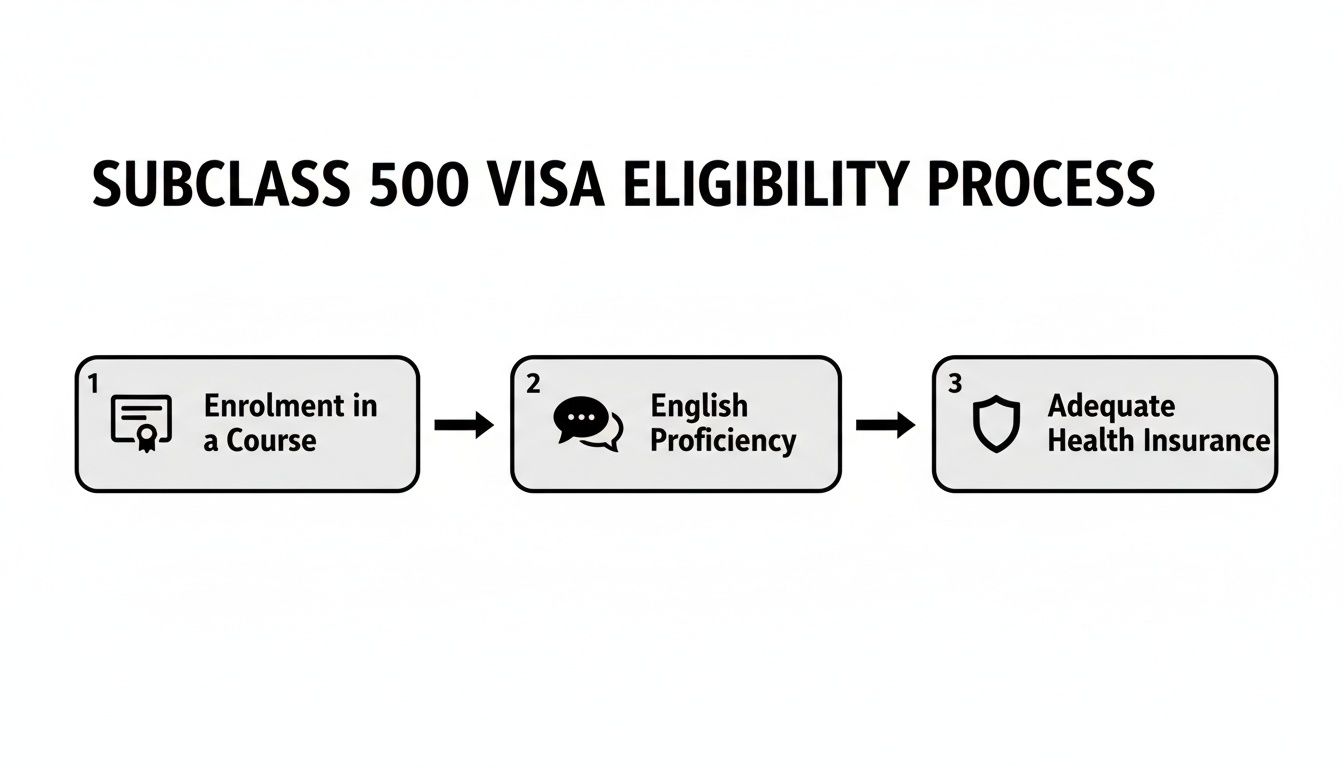
As you can see, your enrolment, English skills, and health cover are the foundational pillars. You need to have them all sorted before you can move forward.
Stage 2: Assembling Your Documents
With your CoE in hand, it's time to shift into organisation mode. The next phase is all about meticulously gathering every single document you need. A complete, well-prepared file can make a huge difference, potentially speeding up processing times and helping you avoid frustrating delays.
Every document tells a piece of your story and backs up your claims, so take this part seriously.
I can’t stress this enough: get organised from day one. Creating a digital folder on your computer and scanning every document as you get it is a game-changer. Naming your files clearly (e.g., "Passport_JohnSmith.pdf", "CoE_UTS_Masters.pdf") will save you a world of pain when you're uploading everything later.
You’ll need to put together a comprehensive file that proves your identity, academic background, financial capacity, health, and character. Being thorough here is your best defence.
Below is a checklist to help you get started on the core documents you’ll need.
Essential Document Checklist for Your Student Visa
Use this checklist to gather and organize the core documents needed for your Subclass 500 visa application. A well-prepared file is the foundation of a successful outcome.
| Document Category | Required Items | Expert Tip |
|---|---|---|
| Proof of Identity | Passport, National Identity Card, Birth Certificate | Ensure your passport is valid for at least six months beyond your intended stay. |
| Enrolment | Confirmation of Enrolment (CoE) for all intended courses | Your CoE is the non-negotiable proof of your student status. Double-check all details are correct. |
| Financial Capacity | Bank statements, evidence of scholarships, or proof of annual income | You must show you can cover your tuition, travel, and living costs for at least the first 12 months. |
| Health Insurance | Overseas Student Health Cover (OSHC) for the full duration of your stay | This is mandatory. You must be covered from the day you arrive in Australia. |
| English Proficiency | IELTS, TOEFL, PTE, or other accepted test results | Check the specific score required by your institution and the Department of Home Affairs. |
| Academic History | Transcripts, certificates, and grading scales from previous studies | Provide certified copies of all your academic records. |
| Genuine Student | Evidence supporting your GS requirement (see our detailed guide) | Focus on your ties to home, the value of the course to your future, and your personal circumstances. |
This table covers the essentials, but your specific circumstances might require additional documents. It’s always best to be over-prepared.
Stage 3: Lodging Your Application Online
Finally, it’s time to bring it all together. All Subclass 500 visa applications must be lodged online through the Department of Home Affairs' ImmiAccount portal.
- Create Your ImmiAccount: If you don't have one, your first step is to set up an ImmiAccount. This is your personal dashboard for everything—managing your application, uploading your documents, and getting updates from the Department.
- Fill Out the Online Form: The application form is incredibly detailed. It will ask about your personal background, family, education, and travel history. Take your time and answer every question accurately and honestly. Inconsistencies are major red flags.
- Upload Your Evidence: This is where your beautifully organised digital folder comes in handy. You’ll upload all the documents you’ve prepared. Make sure each file is a clear, high-quality scan and that you put it in the correct category in your ImmiAccount.
- Pay the Application Fee: The last click before you submit is paying the visa application charge. Be aware that this fee is non-refundable, even if your application isn't successful.
A final word of advice: the information you provide must be consistent across every single form and document. Even small discrepancies can lead to delays, questions, or a refusal. Be precise and be truthful—it’s the only way to go.
Disclaimer: Please be aware that immigration laws and visa requirements are subject to change. The information in this article is for general guidance only and may not be current at the time of reading. For the most accurate and up-to-date advice tailored to your specific situation, it is crucial to book an appointment with a registered migration agent. For any department fees, always refer to the official Home Affairs website.
Right, so you’ve got your course and your Confirmation of Enrolment sorted. The next hurdle is showing the Australian government you’re a suitable person to live here, even temporarily.
Think of it as building a case for yourself based on three non-negotiable pillars: your financial stability, your health, and your good character. Getting any of these wrong is one of the fastest routes to a visa refusal, so it’s crucial to get this part right. These aren’t just boxes to tick; they’re in place to make sure you can support yourself without struggling, won’t strain the public health system, and will be a positive member of the community.
Demonstrating Your Financial Capacity
This is a big one. The Department of Home Affairs needs solid proof that you have enough money to cover your tuition fees, travel costs, and living expenses for at least the first 12 months of your stay. This is what’s known as demonstrating 'financial capacity', and it’s where a lot of applications stumble.
You can't just say you have the money—you have to prove it with clear, official documents. Some of the accepted forms of evidence include:
- Official bank statements that show a consistent history of funds, not a sudden large deposit just before you apply.
- Evidence of a loan agreement from a reputable financial institution.
- Proof of scholarships or sponsorships from your home government or your university.
- Evidence of annual income from your parents or partner that meets the specific government threshold.
What the case officer is looking for is a credible financial story. They need to be confident that the funds are genuinely yours and available to support your studies throughout your time in Australia.
Meeting the Health Requirements
Australia has very strict health standards for visa applicants. It's all about protecting public health and managing healthcare costs. As an international student, you'll need to meet these standards without exception.
Overseas Student Health Cover (OSHC)
This is completely mandatory. You must have adequate OSHC for the entire time you'll be on your student visa. It's your health safety net in Australia, covering things like doctor's visits, hospital care, and ambulance services. You need to arrange this before you lodge your visa, as you’ll need to include proof of your policy in the application.
Health Examinations
Depending on where you’re from and how long you plan to stay, you might also need to have a full medical check-up. This is done by a panel physician approved by the Department of Home Affairs and usually involves a physical exam, a chest x-ray, and some blood tests to screen for certain conditions.
For a more detailed breakdown, have a look at our guide on the specific health and character requirements for your visa.
Passing the Character Test
The final piece of the puzzle is your character. The Australian government needs to be satisfied that you're a person of good character who won’t pose a risk to the community. You'll be asked a series of questions about this in your application form.
You may also need to provide a police certificate (sometimes called a penal clearance certificate) from every country you’ve lived in for 12 months or more over the last 10 years (since you turned 16). This document is official proof of your criminal record, or the lack of one. Being upfront about any past convictions, no matter how minor, is critical. Hiding something is a sure-fire way to get your visa refused.
The current landscape for an australian visa for international students has become more selective. After a 40.1% drop in offshore visa grants in early 2025, the Australian government is scrutinising applications more closely to favour genuine study intentions. This shift underscores the importance of preparing a flawless application that clearly meets every financial, health, and character requirement. For more information on recent trends, you can explore the latest international student data from the Department of Education.
When it comes to these three areas, honesty and transparency are always the best approach. Don't leave anything to chance.
Disclaimer: Please be aware that immigration laws and visa requirements are subject to change. The information in this article is for general guidance only and may not be current at the time of reading. For the most accurate and up-to-date advice tailored to your specific situation, it is crucial to book an appointment with a registered migration agent. For any department fees, always refer to the official Home Affairs website.
Life in Australia: Your Visa Conditions and Work Rights

Congratulations, your visa has been granted! It’s a massive achievement and the start of an incredible journey. But getting the visa is just the first step. Think of your Australian visa for international students as a contract between you and the Australian government; to keep your stay smooth and successful, you need to uphold your end of the deal.
Your responsibilities are just beginning, and they go beyond simply showing up for class. These visa conditions are in place to ensure you remain a genuine student and to maintain the integrity of the whole program. If you don't stick to the rules, you could face serious consequences, including having your visa cancelled.
Understanding Your Student Visa Conditions
Every holder of a Student Visa (Subclass 500) is bound by a specific set of conditions. These aren't just suggestions—they are mandatory rules. You'll find the exact conditions listed on your visa grant notice, but a few are standard for almost every student.
You absolutely must:
- Maintain enrolment: You have to stay enrolled in a CRICOS-registered course for the entire time your visa is valid.
- Achieve satisfactory academic progress: Your uni or college will be keeping an eye on your grades. Not meeting their course progress requirements can put your visa in jeopardy.
- Maintain adequate health cover: Your Overseas Student Health Cover (OSHC) must be kept active for your whole stay in Australia. No gaps allowed.
- Keep your details updated: You’ve got seven days from when you arrive to tell your education provider your Australian address. If you move, you have another seven days to let them know.
Staying on top of these rules is non-negotiable. If you find yourself in a situation where you might need to change your study plans, it's vital to handle it the right way. For instance, if you're thinking about switching majors, our guide on how to change your course or education provider is a must-read.
Your Work Rights as an International Student
One of the best parts about studying in Australia is the chance to get some real-world work experience and earn an income. But these work rights come with strict limits to make sure your studies remain your top priority.
Right now, you can work up to 48 hours per fortnight while your course is in session. A 'fortnight' is just a 14-day period that starts on a Monday. During your official course breaks, like the long summer holiday, this restriction is lifted, and you’re free to work as many hours as you like. It’s a great way to earn a bit extra during your downtime.
Managing your budget is a key part of student life. This includes finding smart ways to stay in touch with family back home without breaking the bank. Doing a little research on the cheapest international calling rates can really help your money go further.
Planning for Life After Graduation
As you get further into your course, it's only natural to start thinking about what comes next. The good news is that Australia offers a pretty clear pathway for graduates who want to stick around and gain some professional work experience. It's a fantastic opportunity to put all those skills you've learned into practice in an Australian workplace.
The most common option is the Temporary Graduate visa (Subclass 485). This visa allows eligible students who've just graduated from an Australian institution to live and work here for a set period. How long you can stay depends on the qualification you completed. It’s the perfect bridge between your student life and a professional career, and for many, it's the first real step towards a longer-term migration plan.
Disclaimer: Please be aware that immigration laws and visa requirements are subject to change. The information in this article is for general guidance only and may not be current at the time of reading. For the most accurate and up-to-date advice tailored to your specific situation, it is crucial to book an appointment with a registered migration agent. For any department fees, always refer to the official Home Affairs website.
Avoiding Common Rejection Traps and Keeping Up with Policy Changes
Knowing what not to do is just as important as knowing what to do. Getting your student visa across the line means more than just ticking boxes; it's about understanding why other applications get knocked back. This is your inside guide to spotting the common pitfalls so you can build a stronger, more resilient application from the ground up.
A vague Genuine Student (GS) statement, shaky proof of funds, or inconsistent information are the usual suspects in a visa refusal. You need to think of your application as one complete story. Every single document has to back up your primary goal: coming to Australia to study. Even a tiny mismatch can throw up a red flag for the case officer reading your file.
Staying on Top of Policy Shifts
The rules of the game for international students are constantly changing. The Australian government often adjusts its policies, and these shifts can directly affect your visa chances. Staying informed isn't just a good idea—it's essential. Most of these changes are about striking a balance between growing the education sector and managing national interests.
A perfect example was the introduction of new planning levels in the 2024/25 financial year. These changes effectively put 'soft caps' on student numbers, aiming to bring intake back to pre-pandemic levels. The effect was instant. Lodgements for primary offshore student visas dropped to nearly 230,000, a steep 30% dive from the year before. You can learn more about how these policy shifts refocused student demand and what it all means for you. In this new, more competitive environment, a high-quality application is no longer a goal; it's a necessity.
Disclaimer: Visa regulations and government policies can and do change, often without warning. The information here might not be current by the time you read it. For the most up-to-date and personalised advice, your best bet is always to book an appointment with a registered migration agent.
Bullet-Proofing Your Application Against Common Risks
To get through this more selective process, your focus has to be on making your application absolutely rock-solid. The best strategy is to anticipate the problems before they happen.
- Write a GS Statement That Tells a Real Story: Your Genuine Student statement is your one chance to speak directly to the decision-maker. Don't be generic. Clearly explain why you picked this exact course at this particular university, how it connects to what you've already studied, and how it’s going to build your future career. Vague, copy-paste answers are a fast track to a refusal.
- Get Your Financial Evidence Right: Your financial documents need to be clean, legitimate, and easy to follow. Make sure your bank statements show a steady savings history. A large sum of money appearing out of nowhere right before you apply looks suspicious and will almost certainly be questioned.
- Be Obsessive About Consistency: Go through every document with a fine-tooth comb. Are all the names, dates, and details identical across your passport, your Confirmation of Enrolment (CoE), and your bank statements? Even a small typo can cause major delays or, worse, a refusal.
At the end of the day, the best way to avoid these traps is with meticulous preparation and a solid grasp of the current immigration landscape. With policies updated so frequently, working with a MARA-certified expert like My Visa Guide gives you the strategic insight to build an application that stands out. And remember, always double-check all government fees directly on the official Department of Home Affairs website, which you can find through this link to the Home Affairs website.
Common Questions About the Student Visa
As you get closer to lodging your application, a few specific, practical questions always seem to pop up. Let's tackle some of the most common ones we hear from students to give you that extra bit of clarity and confidence.
How Long Does the Australian Student Visa Process Take?
This is the million-dollar question, and the honest answer is: it varies. A lot. The time it takes can swing wildly depending on where you're applying from, the time of year, and how rock-solid your application is.
While the Department of Home Affairs gives you guide times, it's smart to lodge everything at least two to three months before your course is due to start. Your best bet for a smooth run is to submit a perfectly prepared application with zero missing documents. To see what you're up against right now, always check the official visa processing times tool on the Home Affairs website.
Can I Bring My Family on My Student Visa?
Yes, in many cases you can include your partner and dependent children in your student visa application. They’re officially known as 'secondary applicants', and you must declare them right from the very start.
A word of caution here: you’ll need to prove you have enough money to support everyone. This isn’t just about living costs; it covers their travel and any school fees for your kids. The financial evidence for a family can get complicated, so we strongly recommend getting expert advice to make sure you've got all your bases covered.
What Happens If My Student Visa Is Refused?
Getting a refusal notice is a gut punch, but it doesn't automatically mean your dream of studying in Australia is over. What you can do next depends entirely on why it was refused and whether you applied from inside or outside Australia.
Sometimes, you might have the option to appeal the decision at the Administrative Appeals Tribunal (AAT). Other times, the best move is to submit a brand new, much stronger application that directly fixes the issues from the first one. Your refusal letter will spell out your review rights. This is a critical moment—you need to get professional advice from a registered migration agent immediately to figure out the smartest way forward.
Disclaimer: Please be aware that immigration laws and visa requirements are subject to change. The information in this article is for general guidance only and may not be current at the time of reading. For the most accurate and up-to-date advice tailored to your specific situation, it is crucial to book an appointment with a registered migration agent. For any department fees, always refer to the official Department of Home Affairs website.
Ready to start your Australian study journey with total confidence? The team at My Visa Guide offers expert, end-to-end help to make sure your application is prepared meticulously. From course selection to visa lodgement and planning your future, we’re here to support you. https://www.myvisaguide.com.au