The waiting game for an Australian student visa can feel like the longest part of your study abroad journey. It’s the final hurdle, and the uncertainty can be stressful.
So, how long does it really take? For the popular Higher Education stream, you can expect around half of all applications to be decided within about a month. However, the vast majority are finalised within six months, which gives you a realistic baseline for planning your move.
Disclaimer: Information in this article may not be current. Visa regulations and processing times can change without notice. For the most up-to-date and personalised advice, we strongly recommend you book an appointment with a registered migration agent. Always refer to the official Department of Home Affairs website for current visa fees and charges.
Decoding the Official Student Visa Timelines
That burning question every applicant has—"How long will it take?"—doesn't have a single, fixed answer. But the Australian Department of Home Affairs provides official processing data that gives us a clear and realistic framework. Getting your head around this data is the first step toward managing your expectations and planning properly.
Think of these official timelines not as guarantees, but as statistical benchmarks. They show how long it has taken to finalise a certain percentage of applications in the recent past. This means while some straightforward applications fly through, others that need a more detailed look will naturally take longer.
Understanding the 50% and 90% Benchmarks
The Department breaks down processing times into two key tiers for each education sector:
- 50% of Applications: This number is the median processing time. Half of all applicants in that category got their visa outcome within this many days. It's a pretty good indicator of how long a smooth, simple application might take.
- 90% of Applications: This figure represents the outer limit for almost everyone. Nine out of ten people had their visas finalised within this timeframe. If your application has any complex elements, it’s smart to plan around this longer duration.
This infographic for Higher Education applicants shows the big difference between that median time and the 90% window.
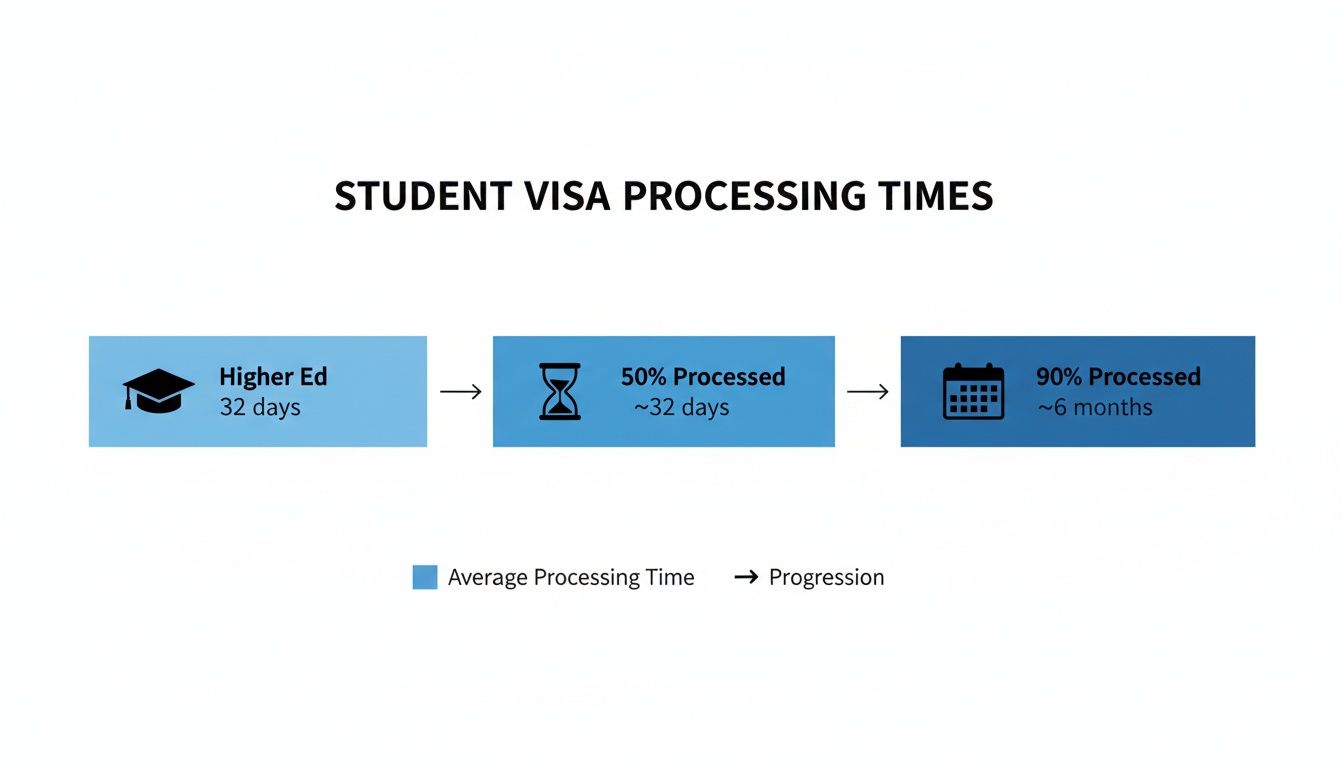
As you can see, while half of the applications are wrapped up relatively quickly, a good number can take several months. This really drives home the importance of preparing your application early and making sure it's perfect.
To put some real numbers on it, recent data from the Department of Home Affairs shows this variation clearly. Roughly 50% of student visa applications for higher education courses are processed within about 32 days. But the timeline stretches out for others, with 90% of these applications finalised within 6 months. You can explore these visa processing findings to see the details for yourself.
Here's a quick look at how the processing times vary across different education sectors:
Subclass 500 Visa Processing Times by Education Sector
This table shows the estimated processing times for different Australian education sectors, highlighting the 50% (median) and 90% finalisation windows.
| Education Sector | 50% of Applications Processed Within | 90% of Applications Processed Within |
|---|---|---|
| Foreign Affairs or Defence Sector | 18 days | 53 days |
| Postgraduate Research Sector | 27 days | 5 months |
| Independent ELICOS Sector | 26 days | 70 days |
| Schools Sector | 37 days | 4 months |
| Vocational Education and Training (VET) Sector | 57 days | 6 months |
| Higher Education Sector | 32 days | 6 months |
| Non-Award Sector | 14 days | 44 days |
These times highlight just how much the stream you're applying for can influence your wait.
Disclaimer: Information in this article may not be current. Visa regulations and processing times can change without notice. For the most up-to-date and personalised advice, we strongly recommend you book an appointment with a registered migration agent. Always refer to the official Department of Home Affairs website for current visa fees and charges.
The Key Factors That Influence Your Visa Timeline
Ever wonder why one student visa application seems to fly through in weeks, while another gets stuck in limbo for months? It’s not random luck. The difference usually comes down to a few critical factors that let a case officer make a quick, confident decision.
Think of your application like a package moving down a conveyor belt. If it's complete, clearly labelled, and has everything in order, it sails right through to the destination. But if it has missing parts or confusing information, it gets pulled off the line for a slow, manual inspection.
Understanding what immigration officials are looking for is the first step to managing your own Australian student visa processing time. A well-prepared application answers all the potential questions before they’re even asked, paving a smooth path to approval. On the other hand, an application with even a tiny gap can trigger a request for more information, easily adding weeks or even months to your wait.

Application Completeness and Document Quality
By far, the single biggest influence on your timeline is how complete and clear your application is. Every single document you submit—from academic transcripts to financial statements—needs to be accurate, legible, and in the exact format required by the Department of Home Affairs.
An incomplete application is an immediate red flag. If a case officer has to issue a Request for Further Information (RFI), your application is effectively put on pause. The clock stops ticking until you supply the missing pieces, and then you're placed back in the queue, which can stretch out your wait time considerably.
Here are some of the most common documentation tripwires:
- Financial Evidence: Not providing enough proof of funds, using unapproved sources, or just submitting messy, disorganised bank statements will lead to heavy scrutiny. The Department must be confident you can genuinely support yourself.
- Academic Records: Missing transcripts, sending unofficial copies when certified ones are required, or failing to get documents properly translated can grind your application to a halt.
- Identity Documents: It sounds basic, but ensuring your passport is valid for your entire planned stay and that every detail matches perfectly across all forms is non-negotiable.
The Genuine Student Requirement
Beyond just the paperwork, your application must tell a convincing story about your intentions as a genuine student. The Department needs to be completely satisfied that your main reason for coming to Australia is to study and that you'll respect your visa conditions.
Your statement addressing the Genuine Student (GS) requirement is the heart of this assessment. A generic or vague statement that doesn't clearly explain your personal situation, why you chose your specific course, and how it links to your future career will only raise doubts. To get this right, check out our in-depth guide on what the Genuine Student Requirement is and how to tackle it.
A strong GS statement tells a personal and logical story. It connects your past education, your chosen Australian course, and your future aspirations in a way that leaves no room for ambiguity about your intentions.
Your Country and Provider Risk Profile
Here’s something many applicants don't realise: the Department of Home Affairs uses a combined risk model that looks at both your country of citizenship and your chosen education provider. This "immigration risk" rating directly impacts the amount of evidence you need to provide.
This system means two students applying for the exact same course could face very different requirements.
- Lower Risk Profile: If you're from a country and applying to an institution with a lower combined risk rating, you'll likely be asked for less evidence, especially around finances and English skills. This often translates to a faster, more streamlined assessment.
- Higher Risk Profile: On the flip side, applicants with a higher risk rating face stricter evidence requirements. Their applications are examined much more closely, which naturally takes more time.
Health and Character Checks
Finally, the mandatory health and character checks are hurdles every applicant must clear. Any delay here will directly delay your visa outcome, as a case officer simply cannot finalise an application until these are signed off.
Common hold-ups include:
- Health Examinations: Waiting too long to book your medical exam or delays from the panel physician in sending your results to the Department.
- Police Clearances: This is a big one. Forgetting to provide a police certificate from every country you’ve lived in for 12 months or more over the last 10 years is a frequent and easily avoidable mistake.
Getting these checks done proactively, as soon as you lodge your application, is one of the smartest moves you can make to keep your visa process on track. By staying on top of each of these factors, you can build an application that’s designed for a quick and positive outcome.
Disclaimer: Information in this article may not be current. Visa regulations and processing times can change without notice. For the most up-to-date and personalised advice, we strongly recommend you book an appointment with a registered migration agent. Always refer to the official Department of Home Affairs website for current visa fees and charges.
How to Prepare a Decision-Ready Application
Here’s a secret not many applicants realise: you have more control over your visa processing time than you might think. While you can't control the queues inside the Department of Home Affairs, you can absolutely influence how quickly your file gets through. The trick is to submit what’s known as a 'decision-ready' application.
This is an application so clear, complete, and compelling that it gives the case officer every reason to say "yes" without having to stop and ask for more information. It’s not about luck; it’s about meticulous, thoughtful preparation. This is hands-down the most effective way to cut down on delays and get a positive outcome faster.

Mastering Your Financial and Academic Documents
Your supporting documents are the bedrock of your application. If they’re weak, confusing, or incomplete, you’re almost guaranteed a delay. The moment a case officer has a doubt, they'll issue a Request for Further Information (RFI), and your application goes to the back of the line while you sort it out.
Think of preparing your documents like a professional audit. Everything needs to be spot-on.
- Financial Capacity: It's not enough to just show the required amount of money. You need to prove where it came from and that it's stable. This means clean, easy-to-read bank statements showing a consistent history of funds. If a sponsor is involved, their evidence needs to be just as solid, leaving no doubt they can and will support you.
- Academic Records: All your transcripts, certificates, and completion letters must be certified copies. If they aren't in English, they need to be paired with an accredited translation. Check every detail—your name, your course titles—to ensure everything matches perfectly across the board.
When you present these documents in a logical, well-organised way, you make the case officer's job easier. And that can only ever work in your favour.
Crafting a Compelling Genuine Student Statement
The Genuine Student (GS) statement is where your application comes to life. It’s your chance to speak directly to the case officer and convince them that you are a genuine student who intends to study temporarily in Australia. A vague or generic statement is a massive red flag and one of the quickest ways to get a refusal.
A powerful GS statement connects all the dots for the case officer. It should clearly explain your personal situation, why you chose Australia over your home country or others, what led you to this specific university and course, and—crucially—how this qualification will concretely benefit your career back home.
Think of it as the story that ties all your evidence together. It has to be personal, logical, and fully supported by the documents you’ve provided.
The Role of Professional Review
This is where getting an expert eye on your application becomes invaluable. A tiny, seemingly innocent mistake—a missing page from a bank statement, an unclear explanation in your GS statement—can add months to your wait time. A Registered Migration Agent is trained to spot these potential pitfalls before you ever hit "submit".
At My Visa Guide, our MARA-certified agents go through every single detail of your file with a fine-tooth comb. We work to ensure your application doesn't just meet the basic requirements but actually exceeds the Department's standards. This thorough review is all about building a robust, decision-ready application that gives you the best possible chance of a fast and successful outcome.
If you want to be certain your application is as strong as it can be, our team provides detailed student visa assistance for the Subclass 500 to guide you through every step of this critical process. By focusing on these key areas, you can turn your application from a source of stress into a powerful tool for getting your visa granted swiftly.
Disclaimer: Information in this article may not be current. Visa regulations and processing times can change without notice. For the most up-to-date and personalised advice, we strongly recommend you book an appointment with a registered migration agent. Always refer to the official Department of Home Affairs website for current visa fees and charges.
What Causes Most Student Visa Delays?
Knowing what trips up other applicants is your best defence against a painfully long wait. While the Department of Home Affairs controls the overall queue, some common mistakes can yank your application out of the fast lane and dump it into a much slower, manual review pile. Think of them as completely avoidable roadblocks on your journey.
Let's break down the most frequent blunders that add weeks, or even months, to the Australian student visa processing time. By seeing these traps ahead of time, you can build an application that’s designed to sail through.
Shaky or Unclear Financial Evidence
Hands down, one of the biggest reasons for a delay is failing to properly prove you can support yourself. It’s not just about having the money; it’s about presenting the proof in a way that’s crystal clear, verifiable, and leaves no room for doubt in the case officer's mind.
One simple mistake here can throw your whole application into question. The person assessing your file has to be 100% satisfied that you can pay for your tuition, travel, and living costs for your entire stay in Australia without a problem.
Here are the classic financial mistakes we see:
- Mysterious Money: Submitting bank statements that show a large lump-sum deposit without a clear paper trail of where it came from. Big, unexplained deposits are a massive red flag.
- Messy Paperwork: Providing disorganised, hard-to-read statements or forgetting to include certified translations for documents that aren't in English.
- Wrong Kind of Funds: Trying to use money from sources the Department doesn't accept, like unsecured loans from friends or assets that you can't easily turn into cash.
The fix is all in the preparation. Your financial documents need to tell a simple, consistent story that shows a stable and accessible source of funding that’s well above the minimum required amount.
Vague or Unconvincing Genuine Student Statement
The Genuine Student (GS) requirement is your one real chance to speak directly to the case officer. Handing in a generic, poorly written statement is one of the fastest ways to get your file flagged for a much deeper, and therefore longer, investigation.
The Department needs to be absolutely sure that your main reason for coming to Australia is to study and that you plan to go home afterwards. Your answers to the GS questions must create a compelling, personal narrative that ticks all their boxes.
A weak GS statement just lists facts about a course. A strong one tells a story, connecting your past education and work to your chosen Australian course and clearly explaining how it will boost your career back home.
Failing to explain gaps in your study history or giving weak reasons for choosing Australia over other countries will only create more questions and slow things right down.
Missing Police and Character Clearances
Another frustrating—and totally avoidable—delay comes from incomplete character documents. You must provide a police clearance certificate from every country you have lived in for a total of 12 months or more over the last 10 years (since you turned 16).
Forgetting even one of these will grind your application to a halt. The case officer literally cannot finalise your visa until every single required clearance is on file. This simple oversight can add a huge delay as you scramble to get the missing paperwork sorted.
The solution is simple: carefully map out where you’ve lived for the last decade and apply for all the necessary police clearances well before you lodge your visa. Having these ready to go is a massive step toward a decision-ready application.
Common Visa Delays and How to Avoid Them
| Common Cause of Delay | Potential Impact on Timeline | Preventative Action or Solution |
|---|---|---|
| Incomplete or Inconsistent Documents | Weeks to months. The application is paused while the Department requests more information (RFI). | Create a checklist. Double-check every document for accuracy, ensure all pages are included, and get certified translations for anything not in English. |
| Unconvincing Financial Capacity | Weeks to months. Triggers a detailed financial assessment and can lead to a refusal if not resolved. | Provide clear, well-organised bank statements with a consistent history. Document the source of any large deposits and ensure funds exceed the minimum requirement. |
| Weak Genuine Student (GS) Statement | Weeks to months. The case officer will need to do more research, potentially leading to an interview or refusal. | Write a detailed, personal, and compelling statement. Clearly link your chosen course to your past and future career goals in your home country. |
| Missing Police or Health Checks | Significant delays. The application cannot be finalised until all required checks are completed and cleared. | Identify all required clearances early. Complete your health examination and apply for all necessary police certificates well before you lodge your visa application. |
| Incorrect Information or Typos | Days to weeks. Even a small error in a name, date of birth, or passport number can cause processing issues and require correction. | Proofread everything meticulously. Have a friend or family member review the forms for any errors before you submit them. |
By proactively addressing these common issues, you shift the odds dramatically in your favour, paving the way for a much smoother and faster decision from the Department.
Disclaimer: Information in this article may not be current. Visa regulations and processing times can change without notice. For the most up-to-date and personalised advice, we strongly recommend you book an appointment with a registered migration agent. Always refer to the official Department of Home Affairs website for current visa fees and charges.
How to Track Your Visa Application Status
Once you’ve hit that ‘submit’ button, the real waiting game begins. It's completely natural to feel a bit on edge, wanting to know what’s happening with your application. Thankfully, the Department of Home Affairs provides a way for you to peek behind the curtain and monitor your application's journey. The main tool for this is your ImmiAccount.
Think of your ImmiAccount as the central dashboard for your entire visa application. It’s not just where you lodge your forms; it’s your direct line to real-time updates on your application's status. Keeping an eye on this portal is the best and most accurate way to stay in the loop.
Navigating Your ImmiAccount Portal
When you log in, you’ll see your application listed with a status next to it. Getting your head around what these statuses mean is the key to managing your expectations and understanding what’s actually happening.
Here’s a look at what the dashboard looks like, based on an example from the Department's website.
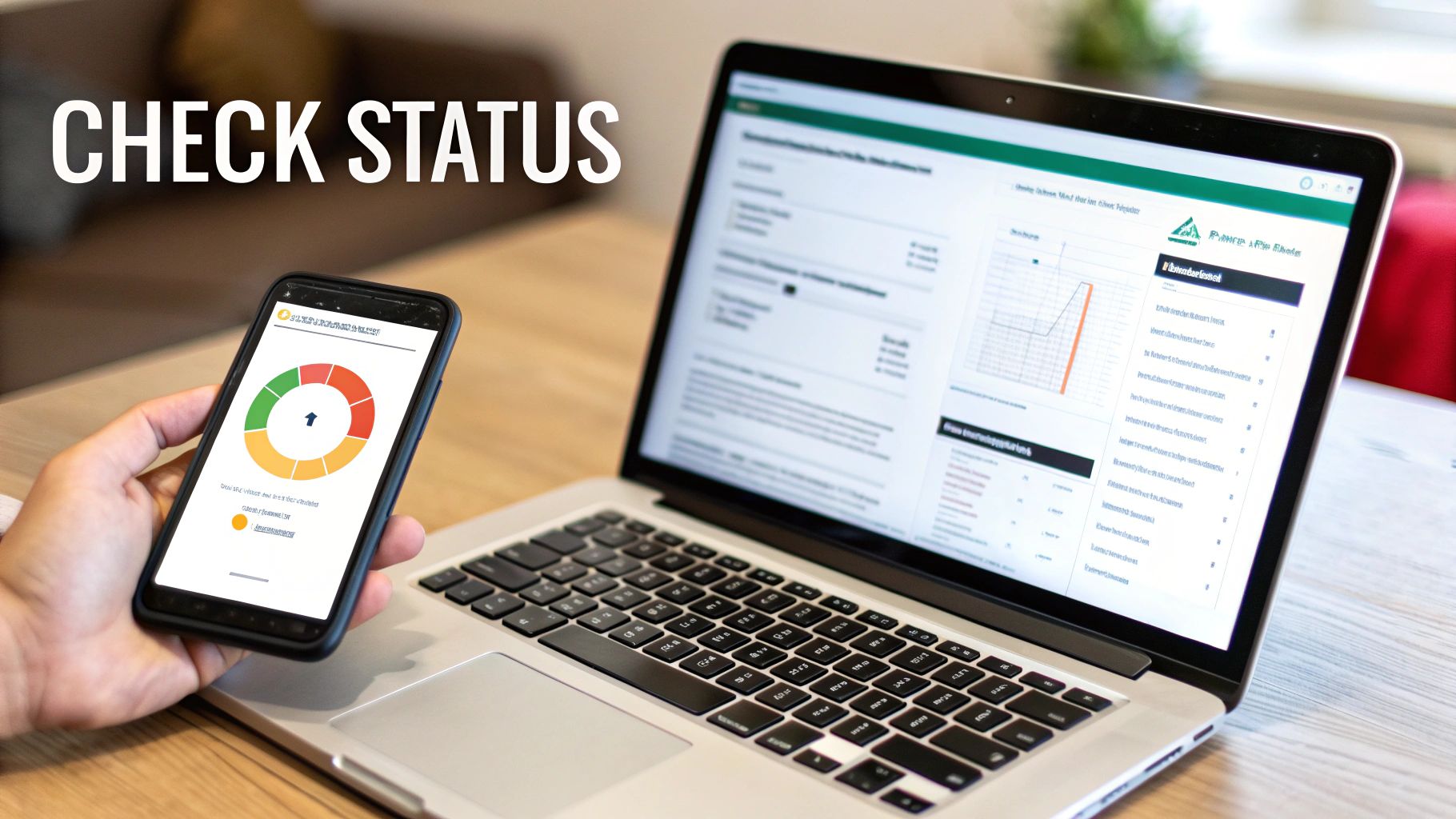
As you can see, key details like your application status, transaction reference number (TRN), and the last update date are all laid out clearly.
So, let’s decode what the most common statuses really mean for you:
- Submitted: This is straightforward. Your application has landed safely with the Department and is now in the queue, waiting for its turn to be looked at.
- Initial Assessment: A case officer has picked up your file. They're doing a preliminary check to make sure all the required documents are there before they dive deeper.
- Further Assessment: This is where your application will likely spend most of its time, and it’s a perfectly normal part of the process. It means a case officer is actively reviewing your evidence, running the necessary checks, and assessing everything against the visa criteria. Your application could sit in this stage for weeks or even months without changing.
- Finalised: The decision is in. You’ll receive an official notification letter in your ImmiAccount explaining whether your visa has been granted or, in some cases, refused.
It's so important to set realistic expectations here. Long stretches of silence where the status doesn't change are completely normal and not a sign that something is wrong. The 'Further Assessment' stage is incredibly thorough, and case officers are juggling a huge number of applications at once.
For our clients at My Visa Guide, we take this whole waiting game off your shoulders. Our team manages the tracking process from start to finish, giving you regular, easy-to-understand updates. We handle all the back-and-forth with the Department, letting you focus on the exciting part: preparing for your new life in Australia.
Disclaimer: Information in this article may not be current. Visa regulations and processing times can change without notice. For the most up-to-date and personalised advice, we strongly recommend you book an appointment with a registered migration agent. Always refer to the official Department of Home Affairs website for current visa fees and charges.
Partnering with a Migration Agent for a Smoother Journey
Trying to navigate the Australian student visa application on your own can feel like building IKEA furniture without the instructions. You can give it a go, sure, but the stakes are much higher than a wobbly bookcase. One tiny mistake doesn’t just cause a delay; it can lead to an outright refusal, throwing your entire plan to study in Australia into jeopardy.
This is where bringing a MARA-certified migration agent onto your team completely changes the game. Instead of a source of constant stress, your application becomes a meticulously managed project handled by someone who’s seen it all before. It’s the difference between trying to be your own mechanic and handing your car keys to a trusted professional before a long road trip.
Turning Complexity into Clarity
A registered migration agent does so much more than just fill in forms. Their real value lies in their ability to spot potential problems long before they become deal-breakers. They’re trained to recognise the subtle red flags in financial documents or a Genuine Student statement that might make a case officer pause and ask for more information.
This proactive approach is all about minimising your Australian student visa processing time. By making sure every piece of evidence is rock-solid and every explanation is crystal clear, they build an application designed for a fast, positive outcome. They also take care of all the back-and-forth with the Department, giving you complete peace of mind.
Think of an experienced migration agent as your personal strategist, advocate, and guide. They don't just submit your documents; they craft a compelling story for your application, making sure it not only meets but exceeds the Department's expectations. This significantly stacks the odds of success in your favour.
Maximising Success and Minimising Risk
The world of Australian migration is constantly changing, with rules and requirements being updated all the time. It’s a migration agent's full-time job to stay on top of these shifts, ensuring your application is always 100% compliant with the very latest regulations.
This professional oversight looks like this:
- Meticulous Document Review: They go through every single page of your evidence, checking that it’s complete, correctly formatted, and tells a consistent story.
- Strategic Advice: You'll get expert guidance on which pieces of evidence are strongest and how to present your case in the most effective way.
- Effective Communication: If the government asks for more information, they'll respond professionally and quickly, preventing those frustrating and unnecessary delays.
If you’re thinking this is the right path for you, our guide has some valuable tips for choosing a migration agent to help you find the perfect expert for your situation.
The journey to studying in Australia should be an exciting one, not an overwhelming ordeal. Let our team of MARA-certified experts at My Visa Guide handle all the complex bits, so you can focus on getting ready for your new academic adventure with total confidence.
Disclaimer: Information in this article may not be current. Visa regulations and processing times can change without notice. For the most up-to-date and personalised advice, we strongly recommend you book an appointment with a registered migration agent. Always refer to the official Department of Home Affairs website for current visa fees and charges.
Your Top Questions Answered
When you're trying to figure out visa timelines, a lot of specific questions pop up. It's completely normal. Let's tackle some of the most common ones we hear from students to give you a bit more clarity on your journey.
Can I Pay for Faster Processing on My Student Visa?
In a word, no. The Department of Home Affairs doesn't have a priority queue or a fast-track service you can pay for when it comes to the Subclass 500 visa. Every application is handled in the order it's received.
The single best thing you can do to speed things along is to lodge what we call a "decision-ready" application. That means it’s so complete and well-prepared that the case officer has everything they need, which dramatically cuts down the risk of them having to stop and ask you for more information.
What Should I Do If My Visa Is Taking Too Long?
It’s incredibly stressful when your application sails past the standard processing window. We get it. If you've passed the 90% processing mark for your education sector, the first port of call is to log into your ImmiAccount. Check for any status updates or new requests from the Department.
While it's easier said than done, try not to panic. Some complex cases just take longer to assess. If you're working with a migration agent, they can make a formal enquiry on your behalf to get an update on what's happening.
Does My Choice of University Affect Processing Time?
It can, but indirectly. The Department uses a risk framework that looks at two main things: your country of citizenship and your chosen education provider.
If you apply to study at a university with a lower immigration risk rating, you might find the evidence requirements are a bit simpler. This can lead to a smoother assessment process, which often translates to a faster decision.
Is It Faster to Apply from Inside Australia?
Not really. The speed of your visa decision isn't based on whether you're onshore or offshore when you apply. It all comes down to the quality and completeness of your application.
The core principle is the same no matter where you are: a thorough, well-documented application that ticks all the legislative boxes right from the start is your ticket to a faster outcome.
If you're interested in the thinking behind structuring helpful Q&As, this article provides some general guidance on creating a robust FAQ section and explains what makes them effective.
Disclaimer: Information in this article may not be current. Visa regulations and processing times can change without notice. For the most up-to-date and personalised advice, we strongly recommend you book an appointment with a registered migration agent. Always refer to the official Department of Home Affairs website for current visa fees and charges.
Navigating the visa process can feel like a maze, but you don't have to find your way through it alone. The MARA-certified experts at My Visa Guide are here to offer clear, professional guidance. We'll help ensure your application is as strong as it can be, boosting your chances of a successful and timely outcome. Book your consultation today and take the first step towards your Australian study journey with confidence. Learn more at https://www.myvisaguide.com.au.