An Australian PR points calculator is a tool designed to give you a pretty good idea of where you stand for a skilled migration visa. It tallies up points based on things like your age, English skills, work history, and qualifications to see if you can clear the minimum 65-point bar needed to lodge an Expression of Interest (EOI).
Disclaimer: Immigration laws, visa requirements, and the points system are subject to change without notice. The information in this article is for general guidance only and may not be current when you read it. For accurate and personalised advice, please book an appointment with our registered migration agent.
So, How Does the PR Points System Actually Work?
Before you jump onto an online calculator, it’s really important to get your head around the thinking behind Australia's points-tested visa system. This isn't just about hitting a magic number; it's a competitive framework built to hand-pick skilled professionals who can jump in and contribute to the Australian economy.
The points test is the backbone for the most popular skilled migration visas—the Skilled Independent visa (Subclass 189), Skilled Nominated visa (Subclass 190), and the Skilled Work Regional visa (Subclass 491). Each visa relies on this system to rank candidates. If you're not sure which one fits you, we break them all down in our guide to skilled migration visas in Australia.
The Truth About the 65-Point "Pass Mark"
Let's be clear: hitting 65 points is the bare minimum. Think of it as your ticket to get into the candidate pool, but it absolutely does not guarantee you an invitation to apply for the visa. This is a crucial point that trips a lot of people up. With so many skilled people wanting to come to Australia, the actual score you need to get an invitation is often much, much higher.
While the Department of Home Affairs sets the pass mark at 65 points, this just gets your foot in the door. For high-demand jobs like software engineers or accountants, the invitation cut-offs can skyrocket, often climbing to 90 points or even more.
Key Point-Scoring Categories at a Glance
So, where do these points actually come from? Your total score is a combination of points awarded across several key areas of your personal and professional profile. Here's a quick look at the main categories that make up your score:
| Category | Maximum Points Available | Brief Explanation |
|---|---|---|
| Age | 30 | Points are highest for applicants aged 25-32. |
| English Language | 20 | Scored based on test results: Competent, Proficient, or Superior. |
| Skilled Employment | 20 | Points for relevant work experience, both in Australia and overseas. |
| Educational Qualifications | 20 | Awarded for your highest qualification, from a trade certificate to a PhD. |
| Partner Skills | 10 | If your partner meets age, English, and skill assessment requirements. |
| State Nomination | 15 | For securing a nomination from a state or territory government (Subclass 190/491). |
Understanding how these pillars build your total score is the first step to realistically figuring out where you stand and how you can build a stronger application.
Disclaimer: Immigration laws, visa requirements, and the points system are subject to change without notice. The information in this article is for general guidance only and may not be current when you read it. For accurate and personalised advice, please book an appointment with our registered migration agent.
If you're looking to get a wider view on the ins and outs of moving to a new country, you can also explore some comprehensive immigration resources.
Calculating Your Core Points Category by Category
Alright, let's get down to the practical side of things and start tallying up your score. To really make sense of any Australian PR points calculator, you need to understand how points are awarded across the core categories. We'll break down these foundational pillars one by one: age, English language skills, skilled employment, and your educational qualifications.
Age: The Unchangeable Factor
Your age is the one thing you can't influence, and it carries significant weight in your final points tally. The system is intentionally designed to favour younger applicants, the logic being they have more time to contribute to the Australian economy over their working lives.
The sweet spot is between 25 and 32 years old, which lands you the maximum 30 points. Once you hit 33, the points start to taper off, and they disappear entirely once you reach 45. That’s the hard upper age limit for most skilled migration visas.
This diagram gives a great overview of how the PR points system is structured, showing the baseline score and how these core areas build your total.
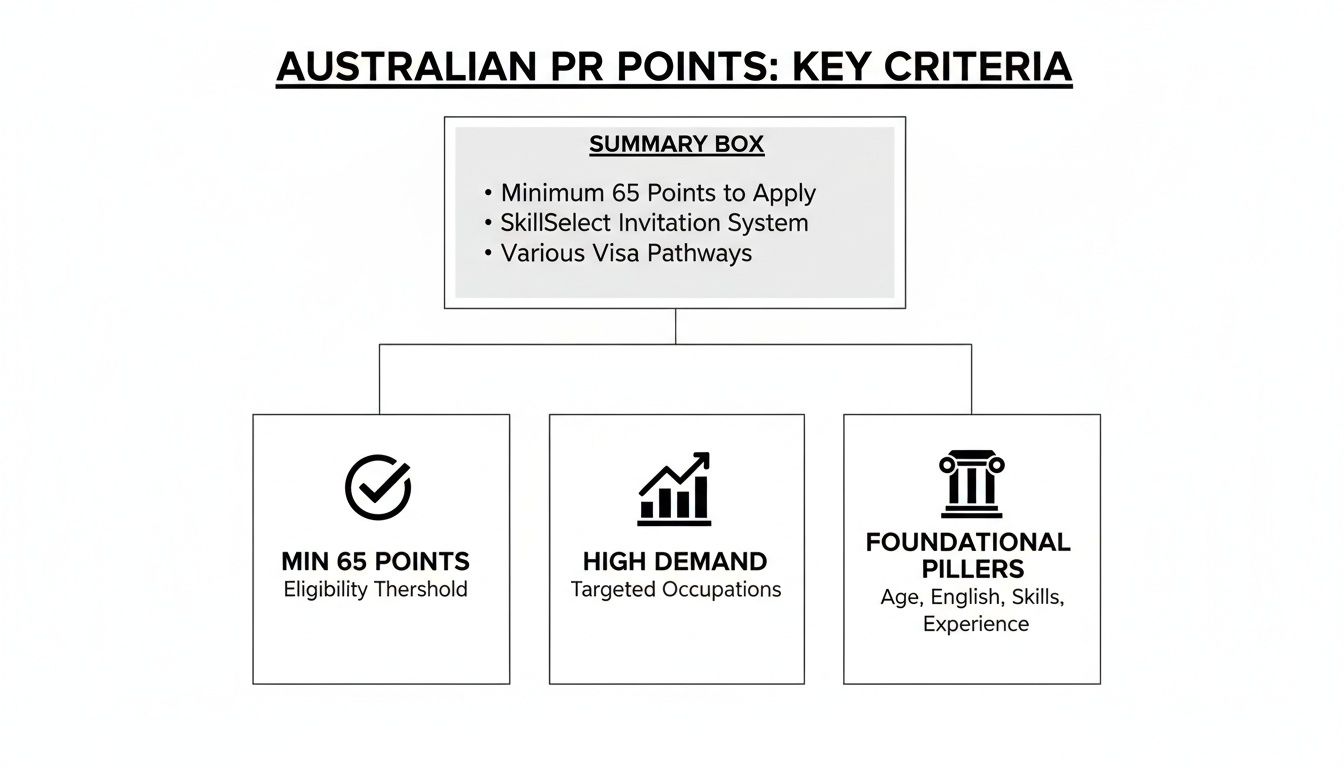
As you can see, hitting the 65-point minimum is just the starting line. Your success often hinges on how high you can score in these fundamental areas, especially if your occupation is in high demand.
English Language Skills
Your ability to communicate in English isn't just a tick-box exercise; it's a heavily weighted component. You'll need to sit a recognised test—like IELTS, PTE Academic, or TOEFL iBT—and your points will depend on your score.
It works in tiers:
- Competent English: This is the absolute minimum to be eligible, but it scores 0 points. Think of it as an IELTS score of 6 across all four bands.
- Proficient English: Stepping up to this level, which is like getting an IELTS 7 in each band, will earn you a handy 10 points.
- Superior English: This is where you can make a real difference. Nailing a top-tier score, such as an IELTS 8 in each band, gives your total a massive 20-point boost.
Putting in the effort to prepare for your English test is one of the most direct and effective ways to increase your overall score. It's a critical part of a smart application strategy.
Skilled Employment Experience
Your work history is another major source of points. But there’s a catch: the experience must be directly relevant to your nominated skilled occupation, and it has to be from the last 10 years.
Points are awarded differently for experience gained inside Australia versus overseas. For instance, having three to five years of relevant offshore experience gets you 5 points. That same amount of experience gained onshore in Australia is worth double, at 10 points. If you've got eight or more years of overseas experience, you can claim a maximum of 15 points.
Important Note: A skills assessing authority will often deduct a period of your work experience to deem you "skilled." Only experience gained after this date can be claimed for points.
Educational Qualifications
Finally, let’s look at your education. The Department of Home Affairs awards points based on your highest qualification. A Doctorate (PhD) from an Australian university or a recognised international equivalent will bag you the maximum of 20 points.
Most applicants with a Bachelor's or Master's degree can claim 15 points. If you have a diploma or a trade qualification from an Australian institution, that's worth 10 points. Sometimes, completing a specialised course can also help; for example, many IT graduates explore Professional Year Programs in Australia to gain valuable industry experience and extra points.
Disclaimer: Immigration laws and visa requirements are subject to change. The information in this article is for general guidance and may not be current. For accurate, personalised advice, please book an appointment with our registered migration agent.
Strategic Ways to Boost Your Total Score
Once you’ve tallied up your core points, the real game begins. The difference between an Expression of Interest (EOI) that gets picked from the pool and one that just sits there often comes down to the bonus points you can claim. Think of these as your chance to stand out from the crowd.
Let’s dive into the high-impact areas where you can gain a serious advantage. These aren’t just small top-ups; they can be the game-changers that nudge your score into that coveted invitation zone.

Specialist Educational Qualifications
While any degree gets you points, certain specialist qualifications pack a much bigger punch. If you’ve finished a Master's by research or a Doctorate (PhD) from an Australian university in a designated STEM field (Science, Technology, Engineering, or Mathematics), you can claim an extra 10 points.
This bonus is a clear signal from the government – they’re actively looking to attract and keep highly skilled people in fields that are crucial for Australia’s future.
Australian Study and Professional Year
Studying here in Australia can unlock several pathways to more points. For a start, just completing a degree, diploma, or trade qualification that took at least two academic years at an Australian institution adds a handy 5 points to your total.
Beyond that, a Professional Year Program (PYP) can be a really smart move. These programs, which are offered in fields like Accounting, IT, and Engineering, give you a mix of formal learning and genuine Australian workplace experience. Get through one successfully, and that’s another 5 points in the bank.
The Australian PR points system has evolved over the years, but one thing remains constant: language skills are a massive differentiator. Hitting 'Proficient' English adds 10 points and is a benchmark met by around 80% of successful migrants.
Partner Skills and Language Credentials
Your partner can be one of your biggest assets in this points race. If your partner is under 45, has at least 'Competent' English, and has secured a positive skills assessment for a job on the same skilled list as yours, they can add a massive 10 points to your application.
Even if they have 'Competent' English but don't meet the skills assessment criteria, you can still claim 5 points. And to keep things fair for those going it alone, single applicants also receive 10 points.
Another great option is to get your language skills accredited. If you can pass the Credentialed Community Language (CCL) test from NAATI, you can claim an extra 5 points. This is perfect for anyone fluent in a language other than English. Of course, improving your English score is also a direct way to get more points, and our team provides dedicated English proficiency support to help you get there.
Strategic Bonus Points Comparison
To help you weigh your options, we've put together a quick comparison of the most common bonus point categories. This can help you focus your energy on the areas that will make the biggest difference to your score.
| Bonus Category | Points Awarded | Who It's For |
|---|---|---|
| STEM Qualifications | 10 points | PhD or Master's by research graduates from an Australian uni. |
| Partner Skills | 10 points | Applicants whose partner has a positive skills assessment and competent English. |
| Single Applicant | 10 points | Applicants without a partner. |
| NAATI CCL Test | 5 points | Applicants fluent in a community language other than English. |
| Professional Year | 5 points | Graduates in Accounting, IT, or Engineering who complete a PYP. |
| Australian Study | 5 points | Anyone who completed a 2+ year course at an Australian institution. |
Looking at the table, it's clear that specialist qualifications and partner skills offer the biggest single boosts. However, every point counts, and combining smaller bonuses like a Professional Year and the CCL test can be just as effective in pushing your total score higher.
Disclaimer: Immigration laws and visa requirements can and do change. This information is for general guidance only and may not be up to date. For accurate, personalised advice tailored to your situation, please book an appointment with our registered migration agent.
State and Regional Nomination: Your PR Points Secret Weapon
When you're trying to hit that magic number for Australian permanent residency, sometimes the most straightforward path isn't going it alone. A smarter strategy? Aligning your skills with the needs of a specific Australian state or territory. This is where state and regional nominations become your secret weapon, giving your points score a serious boost.
Think of it this way: states and territories are constantly on the lookout for skilled professionals to fill crucial job shortages and drive their local economies. By securing a nomination, you’re not just gaining a chunk of points; you're often getting access to a clearer, and frequently faster, route to receiving that coveted invitation.

Unlocking Points with the Subclass 190 and 491 Visas
Two key visas are central to this strategy: the Skilled Nominated visa (Subclass 190) and the Skilled Work Regional visa (Subclass 491). Each offers a different but powerful advantage on the Australian PR points calculator.
-
Subclass 190 Nomination: Getting a nomination from a state or territory for this visa instantly adds 5 points to your total. For many people, these five points are the difference-maker that lifts their score into a competitive range. The trade-off is a commitment to live and work in the nominating state for at least two years.
-
Subclass 491 Nomination: This one is a genuine game-changer. A nomination from a state or a designated regional area for a Subclass 491 visa gives you a massive 15 points. It’s a provisional visa, which means you’ll need to live, work, and study in that designated regional area for three years before you can apply for permanent residency down the track.
Since the points system was refined in 2019, there's been a clear push towards regional migration, and the 15-point bonus for the Subclass 491 is the perfect example. We've seen a huge uptake in this provisional pathway, with over 28,000 approvals in 2023-2024 alone as states like South Australia and Tasmania actively work to fill their labour gaps. You can dive deeper into how the Australian PR calculator prioritises regional migration on keymartvisa.com.
The Bonus for Studying in Regional Australia
There’s another way to turn regional Australia to your advantage. If you completed a qualification at an educational institution in a designated regional area, you could claim an extra 5 points.
This bonus is specifically for students who lived and studied on a regional campus for at least two years. It’s a clever way to reward former international students for their connection and contribution to communities outside the big cities like Sydney and Melbourne. If you can combine these study points with a regional nomination, you’ll have an exceptionally strong application.
Disclaimer: Immigration laws, visa requirements, and the points system are subject to change without notice. The information in this article is for general guidance only and may not be current when you read it. For accurate and personalised advice, please book an appointment with our registered migration agent.
Your Score is In: What Are the Next Steps?
Right, so you’ve crunched the numbers and have your points score. That’s a massive first step, but what happens next? Think of your points score as the key to the door; now you actually have to open it. This next part is all about getting your profile in front of the Australian government and having all your ducks in a row for when they call your name.
The first move is to lodge an Expression of Interest (EOI) using the Department of Home Affairs’ SkillSelect system. An EOI isn't a visa application. It’s more like putting your hand up in a very big, very competitive room and saying, “Pick me! Here’s what I bring to the table.”
From EOI to Invitation
Once you submit your EOI, you officially join the pool of candidates. The government then holds "invitation rounds" every so often, where they invite the highest-scoring people to apply for a visa. Your EOI will stay active in this pool for up to two years, so it's a bit of a waiting game.
Now, this is important: your EOI is a live document. It’s not a set-and-forget thing. If you finish another year of work, nail a better English test, or get a new qualification, you need to jump into your SkillSelect profile and update it straight away. Every point counts, and those updates could be the very thing that bumps you to the top of the list for the next invitation round.
Crucial Reminder: The government issues an invitation based on the claims in your EOI at that precise moment. If you get invited based on a score you can't actually prove (because the information was wrong or old), your visa application will almost certainly be refused. Honesty and accuracy are non-negotiable.
Get Your Document Checklist Ready
While you’re in the EOI pool, you should be on a mission to gather every single piece of paper that proves your claims. It's not enough to just say you have a degree or five years of experience—you have to prove it with specific, official documents.
Start building your evidence file now. You'll need:
- Proof of Identity: Your passport and birth certificate are the absolute basics.
- Skills Assessment: The official positive outcome letter from your assessing authority.
- English Test Results: Your test report form from IELTS, PTE, or another approved test.
- Education Documents: Certified copies of your degree or trade certificates and the full academic transcripts.
- Employment Evidence: This is a big one. Think employment reference letters, payslips, tax records, and even bank statements showing your salary coming in.
- Partner Documents: Claiming points for your partner? You'll need all their equivalent documents for identity, skills, and English ability.
The Clock Starts Ticking After the Invitation
Getting that invitation email is an incredible feeling, but it also fires the starting pistol on a very tight race. You have a strict 60-day window from the date of invitation to lodge a complete, decision-ready visa application.
This is exactly why you prepare everything beforehand. Sixty days fly by, and it’s no time to start chasing up old employers for reference letters or realising your passport is about to expire. Be prepared, and you'll be ready to go the moment that good news lands.
Disclaimer: Immigration rules and goalposts are always shifting. This information is a general guide to get you started, but it can become outdated. For advice that’s tailored to your specific situation and based on the very latest laws, it’s always best to book a consultation with a registered migration agent.
Answering Your Top Questions About the Points Calculator
As you work through the Australian PR points system, it's completely normal for a few questions to pop up. Let's tackle some of the most common ones we hear from applicants to clear up any confusion.
Does Scoring 65 Points Guarantee an Invitation?
In short, no. Hitting 65 points is the magic number to get your foot in the door—it's the minimum score you need to submit an Expression of Interest (EOI) and be considered. But it's not a golden ticket.
Think of it as a competitive pool. For really popular occupations, the bar is set much higher by the sheer volume of high-scoring candidates. It's not uncommon to see invitation scores climbing well into the 85 to 95-point range, or even higher, for those in-demand roles.
Can I Claim Points for Unrelated Work Experience?
This is a firm no. The Department of Home Affairs is incredibly strict here: you can't claim points for any work experience that falls outside your nominated skilled occupation.
To be eligible for points, your employment history has to be officially recognised as both "skilled" and "closely related" to your nominated field by the relevant skills assessing authority. Any job you've had that doesn't fit this description, unfortunately, won't add to your points tally.
What if My Situation Changes After I've Submitted My EOI?
It is absolutely crucial to jump into the SkillSelect system and update your EOI the moment your circumstances change. This could be anything from finishing a new degree, landing a new job, getting a better English test score, or even a change in your relationship status.
Whenever you update your profile, your points total is recalculated on the spot. If you receive an invitation based on old, inaccurate information, you're looking at a likely visa refusal. Keeping your EOI current isn't just good practice—it's essential for success.
A Quick Word of Caution: Immigration law is always on the move. The points system, visa rules, and requirements can and do change. The information here is designed to give you a solid general understanding, but it might not be up-to-the-minute when you're reading it. For advice that's tailored to you and based on the very latest regulations, the best move is always to book an appointment with our registered migration agent.
How Long Does an EOI Stay Active?
Your Expression of Interest will remain active in the SkillSelect pool for a maximum of two years. If you don't receive an invitation to apply for a visa within that window, your EOI will expire.
If that happens, you’ll need to start fresh and submit a completely new EOI to get back into the pool for future invitation rounds.
Getting the points system right and making sure your EOI is perfect can feel like a huge challenge. The team at My Visa Guide is here to cut through the complexity and give you the expert support you need at every stage of your migration journey.
Ready to build a clear, effective strategy for your permanent residency application? Book a consultation with us today and let's get started.