Disclaimer: Immigration rules and requirements can change over time. Please book an appointment with a registered migration agent for updated information before relying on this guide.
Australian citizenship by conferral opens the door for permanent residents and eligible New Zealand citizens to claim full Australian citizenship. It’s much like joining a close-knit club: you meet the requirements, pass the test and pledge your allegiance, then you’re part of the community.
Quick Overview Of Australian Citizenship By Conferral
Note: Rules can change. For tailored advice and the latest updates, consult a registered migration agent.
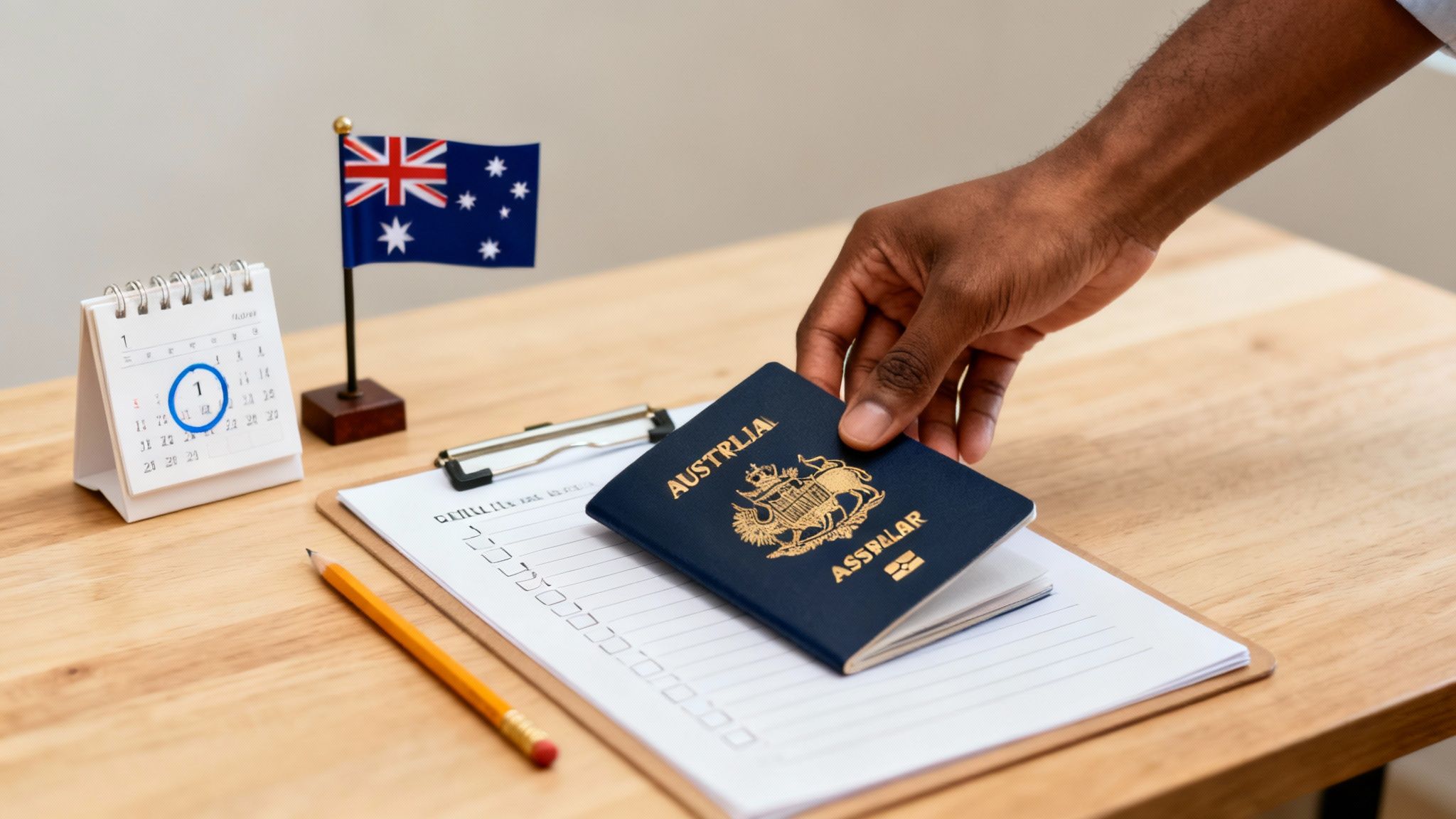
Your journey to citizenship breaks down into five clear phases:
- Eligibility Assessment: Have you met the residency, character and English requirements?
- Document Gathering: Certified identity papers, proof of residence and character references.
- Application Lodgement: Submit your form online via ImmiAccount or on paper.
- Test Preparation & Completion: Study Australian values and language, then sit the test.
- Ceremony Participation: Take the pledge and receive your citizenship certificate.
By the end of your ceremony, you’ll embrace new rights alongside important responsibilities.
Key Steps At A Glance
Each milestone brings you one step closer to becoming an Australian citizen:
- Eligibility Check – Confirm you fulfil the residency, character and language criteria.
- Document Compilation – Organise certified copies of your ID and proof of address.
- Application Submission – Lodge online or post your completed form.
- Citizenship Test – Demonstrate your grasp of Australian history, culture and values.
- Ceremony Enrolment – Finalise the process by taking the citizenship pledge.
For more detailed tips and examples of successful applications, check out our guide on citizenship applications.
Why This Roadmap Matters
- Clarity: See exactly which milestone comes next.
- Efficiency: Focus on the sections that matter to you.
- Confidence: Move forward with a clear plan.
Next, we’ll dive into the eligibility criteria in detail—laying the groundwork for a smooth application process. My Visa Guide is here to support you at every stage, helping you avoid delays and make informed decisions. Keep this overview handy as you tackle each step of your citizenship journey.
History And Impact Of Australian Citizenship By Conferral
Disclaimer: Please book an appointment with a registered migration agent for updated information as requirements may change.
Think of the path to Australian citizenship by conferral as an explorer’s map. It began under the Nationality and Citizenship Act 1948, offering migrants a clear route to belonging. Back then, completing those first forms felt as daunting as charting unmarked coastlines.
Early Beginnings
In 1949, 2,493 people from 35 countries took that first step. Each new citizen arrived carrying more than luggage—they brought stories, traditions and hope. These pioneers not only proved their loyalty, they became living bridges between cultures.
Steady Growth
Year after year, conferral gathered momentum. Today, more than 6.2 million migrants have joined Australia through this programme. In a single recent year, over 165,000 people from more than 190 nationalities received citizenship.
Discover more insights about citizenship statistics on the Department of Home Affairs website
Statistical Highlight
The rise from 2,493 conferrals in 1949 to 165,000 annually reveals how migration waves have reshaped Australia’s social fabric.
Community Integration
Conferral isn’t just paperwork—it’s a launchpad into community life. New citizens often describe the ceremony as a turning point. Suddenly, they feel not just welcome, but woven into Australia’s tapestry.
Key impacts include:
- Stronger social networks through multicultural clubs and volunteer groups
- Full civic rights, like voting in federal and local elections
- Cultural exchanges that keep festivals, food and language thriving
Over time, these ripple effects reinforce Australia’s standing as an inclusive nation built on democracy, respect and the rule of law.
Looking Forward
Global migration trends keep shifting, but conferral remains the cornerstone of Australian citizenship. Recent upgrades—think online lodgement portals and virtual ceremonies—have smoothed the journey.
On the horizon:
- Digital identity checks for quicker turnarounds
- Local welcome events so communities can celebrate newcomers
- Policy reviews to reflect Australia’s ever-evolving multicultural story
Expert Insight
New digital pathways are making citizenship more accessible and inclusive.
Understanding this evolution helps applicants see themselves as part of a long line of conferees—each building a more diverse and unified Australia.
Ceremony Evolution
Citizenship ceremonies used to be small affairs in town halls. Fast forward to today and you’ll find weekly occasions in 500+ venues nationwide. Each year, roughly 165,000 new citizens stand to recite the pledge, often accompanied by cultural performances that highlight our shared heritage.
A ceremony marks the end of one journey and the beginning of another—binding citizen and country together.
Eligibility Criteria For Australian Citizenship By Conferral
Before you begin, it’s wise to book a chat with a registered migration agent for the latest updates. Rules evolve and you want the most current advice.
Think of your residency as points in a loyalty scheme. To qualify, you need to rack up 1,460 days onshore under a valid visa over the past four years. Meanwhile, total absences must stay below 365 days, with no more than 90 days spent overseas in the final 12 months. These limits keep you firmly anchored in Australia’s way of life.
How To Demonstrate Residency
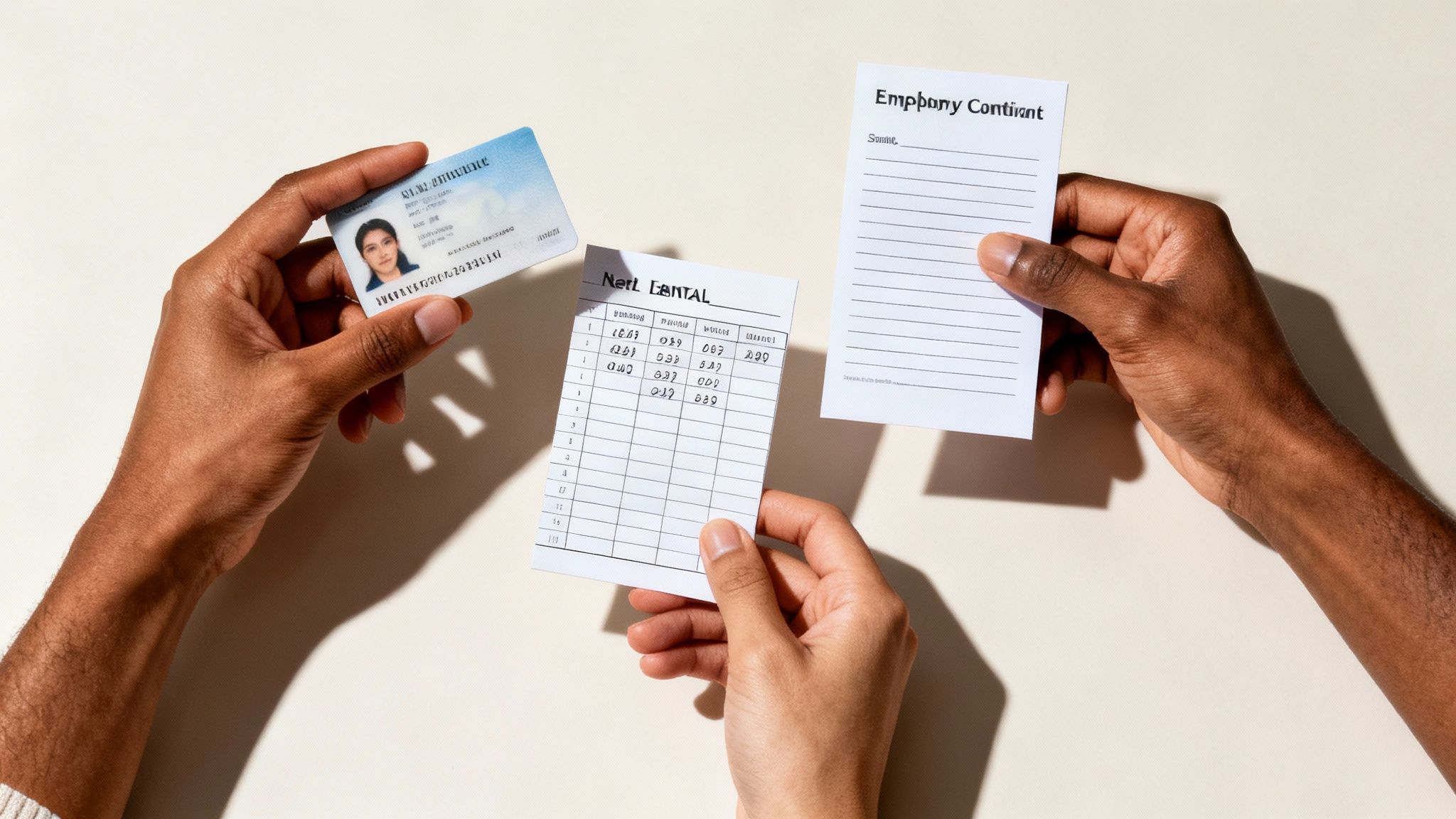
You’ll need solid proof for every visa period. Common documents include:
- Bank statements showing local transactions
- Rental contracts or property titles
- Utility bills with your name and address
- Passport entry/exit stamps
- School enrolments or employment agreements
For instance, if you held a subclass 189 visa for two years, then subclass 485 for one year, and clocked 300 days offshore on work trips, you still have 950 days onshore—plenty to meet the rule once absences are deducted.
Understanding Character Requirements
Good character is like having strong referees in sports. You must provide two referees—typically managers, teachers or respected community figures—who’ll vouch for your integrity.
Referees must:
- Be aged 18 or over and not related to you
- Sign and date their reference within the last 12 months
- Include full contact details for verification
Curious how your path to permanent residency feeds into this? Check our guide on permanent residency pathways.
English Language Requirements
A solid grasp of English helps you settle in and engage with the community. Generally, you’ll need:
- IELTS score of 6.0 in each band (or equivalent in PTE/TOEFL)
However, if you hold an English-speaking passport or completed 2 years of full-time study at an Australian tertiary institution, you’re exempt from testing.
Overview Of Conferral Eligibility Requirements
Below is a quick comparison of the essentials:
| Requirement | Details | Exceptions |
|---|---|---|
| Residency | 4 years lawful residence with 1 year as PR | Applicants under 16; certain aged/disability cases |
| Character | Police clearance and 2 referees | Referees under 18 not accepted |
| English Proficiency | IELTS 6.0 each band or equivalent | Exempt if 2 years’ study in English |
| Special Exemptions | Children, seniors, SCV holders | SCV holders count as PR; over 60 can choose interview |
This table summarises the core criteria you must satisfy. Keep it handy as you gather your evidence.
Key Takeaway: Meticulous records and clear documentation turn a complex process into a straightforward journey.
Exemptions to note:
- Children under 16 don’t need residency proof but must be permanent residents
- Applicants over 60 may opt for an interview instead of a language test
- Special Category Visa holders count as permanent residents even if they travel frequently
Illustrative Applicant Examples
Maria arrived on a subclass 444 in 2010 and has lived here continuously. At 67, she opts for a citizenship interview rather than the language exam.
Ahmed spent three years on a subclass 189 visa, then 13 months on a subclass 191. His absences total under 60 days and he scored 7.5 on each IELTS band.
Liang has lived here for five years with no breaks. He lined up two referees—a work supervisor and a local community leader—and is set to apply.
“Your journey may look different, but the criteria apply equally to everyone.”
Use this checklist to tick off each requirement before your application. Good luck—and enjoy the journey towards your Australian citizenship!
Step by Step Application Journey For Citizenship By Conferral
Picture your citizenship by conferral journey as a road trip across Australia’s rich and varied landscapes. Each milestone on the route—gathering documents, submitting your application, sitting the test and finally attending the ceremony—serves as a handy pit stop. Along the way, a quick check-in with a registered migration agent keeps you on the right track, since requirements can shift without much notice.
Gathering Documents As Your First Pit Stop
For this leg of the trip, think of your paperwork as the vehicle that gets you from A to B. You’ll need to assemble:
- Certified identity documents (passports, visa labels)
- Proof of residence such as bank statements with your address
- Police certificates from every country you’ve called home
- Two character referees with signed statements and contact details
Set up a dedicated folder or use a document-tracking app. That way, when the application portal opens, you’ll breeze past any unexpected roadblocks.
Application Submission And Portfolio Review
When your documents are lined up neatly, it’s time to hit “submit.” Most people opt for online lodging via ImmiAccount—faster processing and instant receipts. If you have special circumstances, a paper form remains an option.
Once lodged, your file enters a review phase. To stay ahead:
- Check your ImmiAccount regularly for status updates and secure messages
- Reply promptly to any information requests to avoid stoppages
- Note that current processing sits at around 16 months on average
Missing just one police certificate can delay you for weeks. So, keep your eyes on the prize.
Test Booking And Interview Arrangements
Next on the map is the citizenship test—or an interview if you’re outside the 18–59 age bracket. Your test covers Australian values, history and civic responsibilities. You’ll need a 75% pass mark to continue.
Slots fill fast, especially in capital cities. Get familiar with the format by:
- Completing our 20-question practice quizzes on government structures and national symbols
- Joining community study groups for mock tests and peer support
- Checking test centre locations to cut down on travel time
Ceremony Registration And Final Celebration
Once you’ve cleared every hurdle, it’s time to register for your ceremony. There are over 500 venues across the country, usually holding weekly events.
At this stage:
- Pick a ceremony date within the timeframe specified in your invitation
- Confirm how many guests you’ll bring along
- Update any changes to your name or address before the big day
Dress comfortably but respectfully. When you recite the pledge, it feels like crossing the finish line of a marathon that’s been both challenging and deeply rewarding.
Embrace your new rights and responsibilities as a full Australian citizen.
Tips To Avoid Common Detours
Even the best-planned trip can hit bumps. Keep these pointers in mind:
- Double-check all signatures and dates before you lodge
- Maintain a clear record of your absences and residency days
- Set reminders in your calendar for ImmiAccount tasks and deadlines
- Keep copies of every communication in case of technical glitches
A proactive approach will help you steer clear of most speed humps.
How My Visa Guide Supports You
Think of our registered migration agents as your co-pilots. We’ll:
- Review your documents and advise on any gaps
- Assist with form completion and fee payments
- Liaise directly with Department officers on your behalf
Our customised checklists and timely alerts mean you’ll never miss a key date. For instance:
- One client received a test invitation in just 8 months
- Another sailed through her ceremony booking, thanks to our reminder system
On average, you can plan for an 18-month journey from start to finish. Let us help you navigate those checkpoints smoothly.
Safe travels as you make your way to full Australian citizenship.
Summary Of Application Steps
Below is a quick glance at each stage of your journey, from the initial eligibility check right through to the citizenship ceremony.
| Step | Action |
|---|---|
| 1 Eligibility Check | Submit proof of residency, character and language eligibility |
| 2 Document Compilation | Gather certified IDs, police certificates and referee statements |
| 3 Application Submission | Lodge form via ImmiAccount or paper and pay the fee |
| 4 Test Or Interview | Sit the citizenship test or attend an interview |
| 5 Ceremony Enrolment | Choose a ceremony date and take the pledge |
Keep this summary close at hand—it’s your road map to becoming an Australian citizen.
Document Requirements, Fees And Processing Times
It’s easy to underestimate how a missing signature or an outdated utility bill can hold up your citizenship process by months. That’s why it pays to know exactly what’s required and how long each stage takes.
Before you start, have a chat with a registered migration agent to confirm current criteria – rules can shift without notice.
Document Checklist
Every piece of paper you supply slots into your citizenship puzzle. Think of it as laying the groundwork for your new status.
You’ll need certified identity documents, proof of residence and character references in place before you lodge your application.
- Certified passport copy or birth certificate showing visa details
- Four years of residence evidence, like bank statements, lease agreements or utility bills
- Police certificates from any country where you’ve lived 12 months or more since turning 16
- Two referee statements from adults (over 18) such as community leaders or workplace supervisors
Here is an infographic mapping key steps in document submission, test booking and oath ceremony.
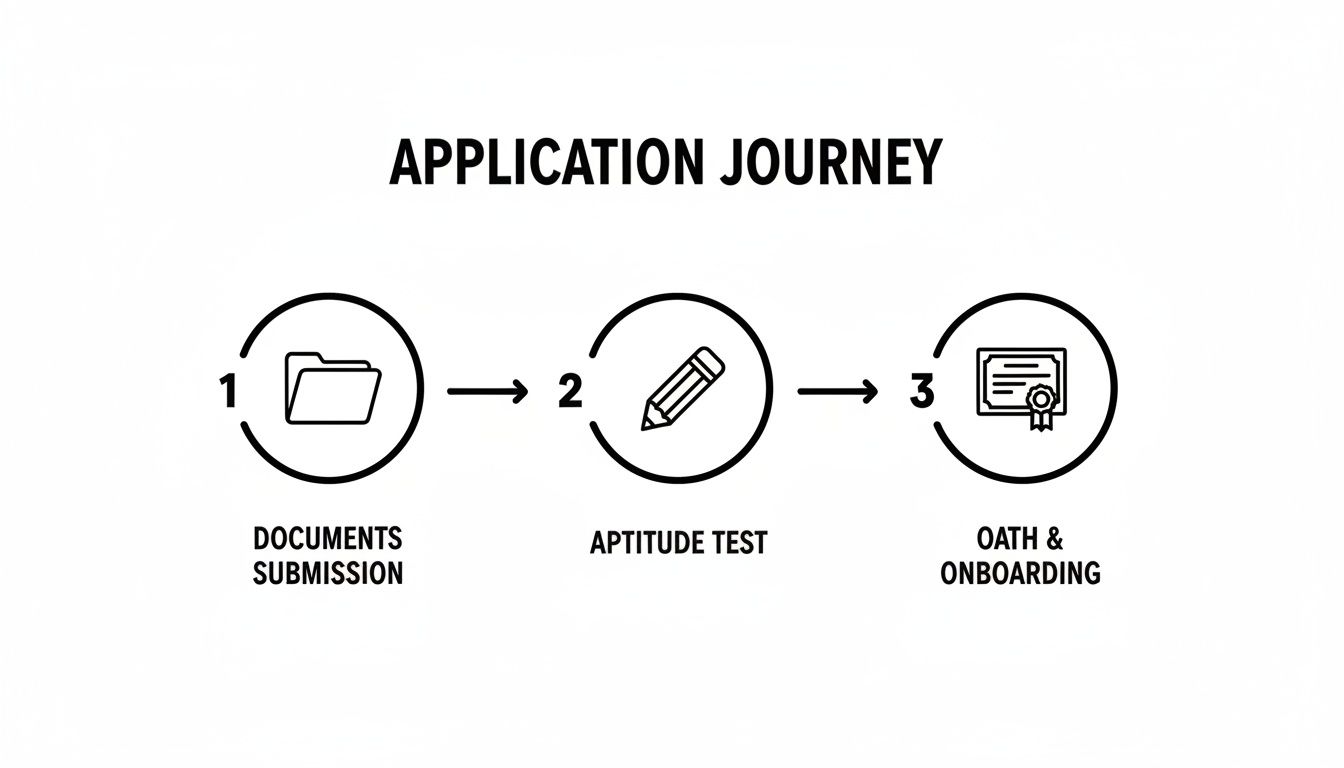
This visual walks you through how the department reviews documents, schedules your citizenship test and finally invites you to the oath ceremony.
Document Formatting Tips
A quick format check now can save weeks later. PDF is your friend – just keep each file under 5MB.
- Certify each page in black ink and include a date stamp
- Label files clearly (for example: “Passport Bio Page” or “Lease Agreement 2021-2024”)
- Scan at 300 DPI so text stays sharp but file sizes stay manageable
Fees And Payment Options
Citizenship fees can feel steep until you break them down. Spread the cost over a year, and it’s roughly like a streaming subscription.
- The standard application fee is $560, which works out to about $46 a month
- If you hold a pensioner concession card (or you’re a dependent of one), the fee drops to $80
- Certain groups—veterans, former child migrants and stateless people—may qualify for a waiver
You can pay by credit card, BPAY or direct deposit through your ImmiAccount.
Processing Timelines
From that first click on “lodge” to stepping up at the oath ceremony is a journey of stages. Recent efforts are trimming backlogs, but timelines still vary by case.
For the latest figures, check out Australian citizenship processing time updates at Kangaroo Education.
On average, you’ll wait around 16 to 18 months in total, though complex cases can run longer or shorter.
- Eligibility review: typically 3–4 months
- Document verification: often 3–6 months
- Test booking: around 2–3 months, depending on location
- Ceremony scheduling: roughly 1–2 months after approval
| Stage | Average Duration |
|---|---|
| Eligibility Review | 3–4 months |
| Document Verification | 3–6 months |
| Test Booking | 2–3 months |
| Ceremony Scheduling | 1–2 months |
This table highlights the stages where delays are most common, so you can follow up at the right times.
Case Study
When Lina submitted every document fully certified, her ImmiAccount status shifted from “Lodged” to “Test Invitation” in just 8 months. It felt like watching the green light flick on.
Ahmed, however, forgot a police certificate. That single oversight added 5 months to his wait and plenty of stress.
Tips For Follow Up
- Set calendar reminders for ImmiAccount updates and document expiry dates
- Check your inbox daily for requests from the Department of Home Affairs
- Keep backups of all files and payment receipts until you’ve taken the oath
- Ask a migration agent to review your folder periodically for gaps
- Contact us today for a free file audit and catch missing pieces early
Key Insight
Planning ahead and double-checking every document can shave months off your path to citizenship.
Take the small steps now, and you’ll speed up that moment when you say, “I am Australia.”
Preparing For The Test And Ceremony And Avoiding Refusal

Disclaimer: Information can change over time. Please book an appointment with a registered migration agent for the latest advice before sitting your citizenship test or attending the ceremony.
Think of the citizenship test as your final hurdle to full membership in the Australian community. It’s designed to check your grasp of civics—our history, government structure and civic duties—while also ensuring you can communicate clearly in English.
Test Day Expectations
When you walk into the test centre, here’s what to expect:
- Answer 20 multiple-choice questions covering government, symbols and values
- Achieve at least a 75% pass mark to progress to the next stage
- Bring your original ID and the notification letter with you
Arrive early to get comfortable with the surroundings. Dress in layers, pack water and a small snack to keep your energy levels steady. For instance, Ali found that daily timed quizzes sharpened both his speed and accuracy before test day.
Study Tips
To build confidence and retention:
- Schedule mock exams under timed conditions to mimic real pressure
- Create flashcards for important dates, terms and government roles
- Join local study groups or online forums for peer feedback
Regular review cements knowledge and eases test-day nerves.
Expert Insight
The ceremony itself symbolises your official welcome into Australia—an experience that many describe as deeply emotional and affirming.
Booking Your Test
Once you receive your invitation via ImmiAccount:
- Check your dashboard daily; spots in major cities can fill up fast
- Secure a test date within 7 days of your invitation
- If needed, request a new date as soon as you know you can’t attend
In some regions, waiting lists run 2–3 months. Consider regional centres to shorten the delay.
Test Reminders
Set multiple calendar alerts and double-check the expiry dates on your documents. Nina nearly missed her slot because the email landed in her spam folder—so keep an eye on all your inboxes.
Citizenship Ceremony Experience
The ceremony is the moment you’ve been working towards. You’ll recite the pledge, receive your certificate and officially join the Australian community. Guests are welcome to share in this milestone.
- Invitations arrive by email or post
- You must schedule your ceremony within six months of approval
- Bring two original IDs along with your invitation letter
Ceremony Logistics
Your invitation usually lands about a week after approval. At that point:
- Choose from available dates and venues—town halls, museums or community centres
- RSVP promptly if required
- Arrive at least 15 minutes early for final checks
Many people describe the day as the finish line of a long journey.
Common Reasons For Refusal
- Missing or uncertified documents at lodgement
- Insufficient character evidence or unresolved criminal matters
- Exceeding the maximum 365 days of allowable gaps in residency
Strategies To Avoid Pitfalls
- Create a detailed checklist and tick off each document as you gather it
- Ensure referees meet the Department’s guidelines for character statements
- Track all your absences and keep a clear record of your residency
Small oversights can lead to months of delay or even refusal. Working with My Visa Guide means a fresh pair of eyes reviews your file and flags any missing pieces early.
Learn practical advice to stay on track by checking out our guide on health and character requirements.
After Your Ceremony
Once you hold your citizenship certificate:
- Enrol on the electoral roll within 14 days
- Update your Medicare and Centrelink profiles
- Apply for an Australian passport to enjoy visa-free travel
You now have the right to vote and access public services. Celebrate with family and dive into community events to strengthen your new ties.
Next Steps
To fully activate your citizenship:
- Update your electoral enrolment and local service records within 14 days
- Apply for your Australian passport
- Explore local community groups to build meaningful connections
Enjoy your rights, responsibilities and sense of belonging as an Australian citizen.
Frequently Asked Questions
Disclaimer: Requirements can shift, so it’s best to book an appointment with a registered migration agent for the latest advice.
Visa Period Counting And Residency Eligibility
When you’re mapping out those 1,460 days, Australia tallies every day you’ve held a valid visa onshore—including permanent visas and Special Category Visas (SCVs). Keep in mind, any absence longer than 90 days in the final 12 months gets knocked off your total.
For a deep dive into the residency rules, head back to the Eligibility Criteria section above.
- Every day on a valid visa counts towards your residency clock
- Subtract absences over 90 days in your last year
- SCV holders are treated like permanent residents
English Test Retakes And Alternatives
Fell just short of the pass mark? No worries. You can:
- Retake the test as soon as slots open
- Submit proof of two years’ tertiary study in English
- Discuss complex scenarios with a migration agent to avoid hiccups
Early preparation pays off. Book your retest quickly to keep your application on track.
Activating Citizenship Rights
Your new rights kick in the moment you receive your citizenship certificate. From that day on, you can:
- Enrol to vote (remember the 14-day window)
- Apply for an Australian passport
- Access all other citizen services
Make sure you update your electoral enrolment within two weeks to stay compliant.
Family And Dependent Applications
Bringing young ones on board? Children under 16 join a parent’s application free of charge, all in one ImmiAccount. It’s a great way to save time and fees.
“Including your children saves both time and fees,” says a migration expert.
If you have step-children or adopted dependents, get tailored advice from a registered agent to cover every family situation.
Each of the FAQs above links back to more detailed sections earlier in this guide. For unique cases—split residency periods, borderline English scores or blended family scenarios—book in with a migration agent. They’ll review your documents and chart the clearest route to citizenship by conferral.
Ready for personalised support? Contact My Visa Guide today.