If you’re thinking about studying in Australia, you’ve probably heard there’s been a bit of a shake-up with the student visa rules. The Australian government has made some significant changes to the Student Visa (Subclass 500), and they kicked in from early 2024. The biggest news is the replacement of the old Genuine Temporary Entrant (GTE) requirement with a brand-new Genuine Student (GS) test.
On top of that, they've also bumped up the amount of money you need to show you have and raised the minimum English language scores. It's all part of a bigger plan to make sure people coming here are genuinely focused on getting a quality education.
Disclaimer: Immigration laws and requirements are subject to change, and the information in this article may no longer be accurate at the time of reading. For the most current and personalised advice, it is essential to book an appointment with a registered migration agent. Always refer to the official Department of Home Affairs website for any department fees for any visa.
Navigating the New Australian Student Visa Landscape
Australia has always been a go-to spot for international students, but these recent tweaks to the visa rules have definitely changed the game. These updates are part of the government's much broader Migration Strategy, which is all about protecting the integrity of our education sector and keeping a handle on migration numbers.
For anyone hoping to study here, getting your head around these new rules is absolutely the first step.
The real heart of the change is how visa applications are now being looked at. It's less about proving you'll pack your bags and leave the second you finish your course, and more about showing that your main reason for coming is to get a solid education that actually helps your future career.
What Has Changed for Student Visas?
A few key parts of the Subclass 500 visa have been overhauled. It’s crucial to know what they are, because not meeting these new standards could mean your visa gets refused.
Here are the main things you need to be across:
- The Genuine Student (GS) Requirement: This is the big one. It replaces the old GTE statement. Now, instead of a long essay, you'll need to answer a series of targeted questions about why you want to study your specific course, why you chose Australia, and how it all fits into your long-term plans.
- Increased Financial Evidence: The government has increased the amount of money you need to prove you have for your living costs. The idea is to make sure students can comfortably support themselves without having to work excessive hours.
- Higher English Language Scores: The minimum scores for English tests like IELTS and PTE have been lifted. This applies whether you're applying directly for your main course or starting with a pathway program.
To make this a bit clearer, here's a quick side-by-side look at what’s changed.
Quick Summary of Australian Student Visa Changes
This table breaks down the most significant updates, showing you exactly what was expected before versus what's required now.
| Visa Component | What Was Required Before | What Is Required Now |
|---|---|---|
| Genuineness Test | A 300-word written statement (the GTE) proving temporary intent to stay for study. | Answer specific, targeted questions about study intentions and career benefits (the GS test). |
| Financial Capacity | Proof of funds for living expenses set at $24,505 AUD per year. | The required amount for living expenses has increased to $29,710 AUD per year. |
| English Language | IELTS minimum score of 5.5 for a direct visa application. | IELTS minimum score increased to 6.0 for a direct visa application. |
| English for ELICOS | IELTS minimum score of 4.5 for students in pathway programs. | IELTS minimum score increased to 5.0 for students in pathway programs. |
As you can see, the bar has been raised across the board. The focus is firmly on attracting students who are well-prepared, financially stable, and truly committed to their education in Australia.
Mastering the New Genuine Student Requirement
The biggest shake-up to the Australian student visa rules is, without a doubt, the replacement of the old Genuine Temporary Entrant (GTE) requirement with the new Genuine Student (GS) test. This isn't just a name change; it’s a complete pivot in how immigration officials look at your application. Before, the game was all about proving you’d leave Australia once you finished your degree.
Now, the focus has shifted squarely onto you as a student. The goal is to show you're a legitimate applicant with a rock-solid, believable study plan. The GS requirement scraps the single, lengthy written statement and brings in a series of targeted questions to get to the heart of your motivations, your personal situation, and what you plan to do with your qualification.
What Is the Genuine Student Test Really Asking?
You can think of the GS test as an in-depth interview about your academic and career story, just on paper. You’ll need to provide answers that logically connect your past experiences, your current situation, and your future ambitions. The questions are designed to dig into why you've chosen a specific course, at a particular university, in Australia, and how that qualification will genuinely benefit your career back home or elsewhere.
Your answers need to weave together a compelling and logical narrative. Flimsy, generic statements like "Australia has a great education system" just won't cut it anymore. You have to get personal and specific, showing the case officer you’ve done your homework and are truly serious about your education.
At its core, the GS requirement is designed to filter for students whose primary purpose is to study, not to find a back door to migration. Your application has to tell a clear story of genuine academic ambition.
This map helps visualise how the key pieces of the new student visa process fit together.
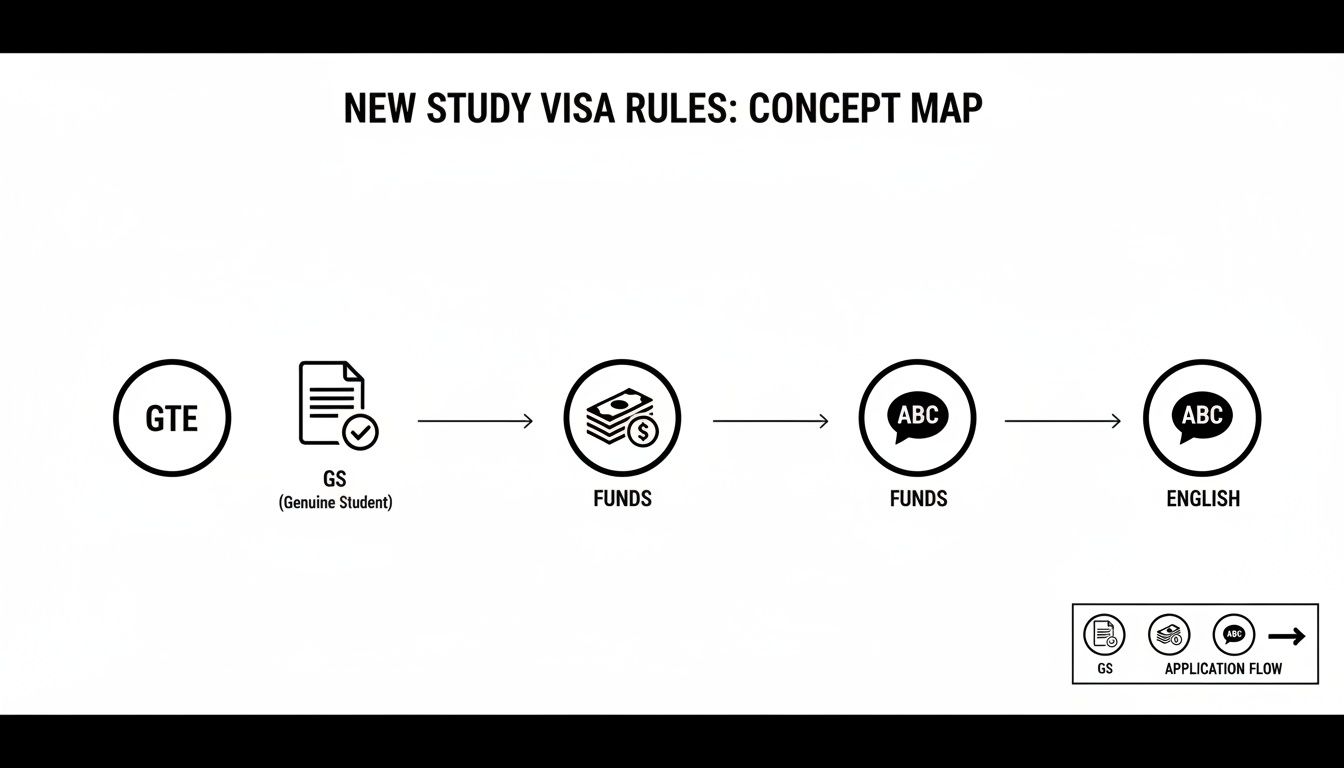
As you can see, proving you meet the GS requirement is now a central pillar of the application, sitting right alongside having sufficient funds and meeting the English language standards.
Building a Strong GS Narrative
Putting together a strong response is about more than just listing facts—it’s about building a convincing case for yourself. For every claim you make, there needs to be solid reasoning behind it.
Let's look at the difference:
- Weak Answer: "I want to study IT in Australia because it is a popular course."
- Strong Answer: "After finishing my Bachelor of Commerce in India, I spent two years as a junior business analyst where I quickly realised the huge demand for data skills. I specifically chose the Master of Data Science at XYZ University in Melbourne because its curriculum focuses heavily on machine learning applications in finance. This lines up perfectly with my goal to become a senior financial data analyst in India's booming fintech sector."
See the difference? The strong answer gives context, shows a clear career progression, and ties the chosen course to a tangible, well-researched outcome. This is exactly the level of detail case officers are now looking for. For a deeper dive, check out our guide on what is the Genuine Student requirement.
Don't underestimate this. Failing to meet the new GS standard is quickly becoming the number one reason for visa refusals. Recent data shows that a weak or unconvincing GS narrative accounts for over 40% of all rejections, which tells you everything you need to know about how critical this part of your application has become.
Meeting the Higher Financial and English Language Hurdles
So, you’ve convinced Immigration you’re a genuine student. That’s a huge step, but the journey isn’t over. Your visa application now rests on two other massive pillars: proving you have the money to support yourself and showing you have the English skills to succeed.
The Australian government has recently lifted the bar for both. Why? They want to be absolutely sure that students arriving here can hit the ground running, both financially and academically, from day one.
Getting this part wrong is one of the fastest routes to a visa refusal. Let’s break down exactly what you need to have in order.

Demonstrating Increased Financial Capacity
The government has dialled up the minimum amount of money you need to have access to for your living expenses. As of late 2024, a single student now needs to show proof of at least $29,710 AUD to cover their first year in Australia. Keep in mind this figure is tied to inflation and gets reviewed each year, so it can change.
Think of this as your financial safety net. It’s your proof to the government that you can afford to live and focus on your studies without falling into financial hardship or having to work excessive hours just to get by.
But having the money is only half the battle; presenting the evidence correctly is just as crucial. You'll need to provide clear, legitimate documents that tell a convincing story. This could include:
- Bank Statements: A history of consistent savings over time looks much better than a large, unexplained deposit that suddenly appears right before you apply.
- Loan Documents: This needs to be an official confirmation of an education loan from a recognised financial institution.
- Scholarship Letters: If you’ve been awarded a scholarship, a formal letter detailing the financial support from your university or another organisation is essential evidence.
Disclaimer: Immigration laws and financial requirements are subject to change, and this information can become outdated. For personalised and current advice, you must book an appointment with a registered migration agent. All official government fees for any visa should be confirmed directly on the Department of Home Affairs website.
Meeting the New English Language Benchmarks
It goes without saying that to succeed in an Australian classroom, you need to communicate effectively. Because of this, the minimum English language test scores for the Subclass 500 visa have been raised.
For a standard student visa application, you’ll now generally need an overall IELTS score of 6.0 (or the equivalent in other approved tests like PTE). If your pathway includes an English language course (ELICOS) before you start your main degree, the minimum entry score for that has been bumped up to an IELTS 5.0.
Nailing these exams is non-negotiable. Many students find that specialised coaching is the key to hitting their target score, often turning to institutions that use the best test prep center software to help them prepare effectively. If you feel you need a hand getting your English skills up to scratch, you can find out more in our detailed guide on English proficiency support.
How Student Caps and Priority Processing Affect Your Application
It's not just about you and your application anymore. Beyond the personal hurdles like the Genuine Student test and proving you have the funds, a much bigger picture is now at play. The Australian government has brought in some major changes to manage the sheer number of international students, which has turned the whole visa process into a far more competitive game.
Getting your head around how these new rules work is absolutely crucial if you want to give your application the best shot at success.
The biggest shake-up is the introduction of a formal cap on how many international students can enrol. In a massive policy shift, the government decided to limit the number of available places to manage demand and, frankly, to make sure the quality of the education sector doesn't suffer.
Navigating the New Student Enrolment Caps
So, what does this mean for you? It means getting a Confirmation of Enrolment (CoE) is no longer a simple case of meeting a uni's or college's academic requirements. Now, you’re also competing for one of a strictly limited number of spots.
For the upcoming intake, the game has completely changed. The government has put a new cap on international student numbers, setting it at 295,000 places. While this is actually an increase from a previous limit, it’s a strategic move to find a balance between the huge demand for Australian education and pressures on things like housing. You can discover more insights about this policy and its impact on student visa success rates.
This cap has a direct knock-on effect on how universities and colleges recruit students. The bottom line? Getting your application in early and making sure it’s rock-solid has never been more important.
The Role of Priority Processing
With a cap now in place, the government is also using a priority processing system to manage the flood of visa applications. Think of it like the triage system in a hospital emergency room – some cases get seen before others based on how urgent or important they are to national priorities.
This means your application won't necessarily be processed in the order it was received. A few key factors can push your application to the front of the queue:
- Your Level of Study: Applications for higher education degrees—like a Bachelor's, Master's, or PhD at a university—are usually given a higher priority than vocational (VET) courses.
- Your Chosen Institution: If you’re enrolled at a top-rated university (based on the government's own evidence level framework), you might find your application gets processed faster.
- Your Field of Study: If your course is aligned with Australia's critical skills shortages, in areas like healthcare, IT, or engineering, it could get preferential treatment.
Disclaimer: Visa processing times and priorities can change. For the most current information and strategic advice tailored to your situation, it is essential to book an appointment with a registered migration agent, as this information may no longer be true when you read it. Always check official fees on the Department of Home Affairs website.
Understanding Changes to Post-Study Work Visas
For many international students, the chance to get real-world work experience in Australia after graduation is a massive part of the appeal. It's often a key reason for choosing to study here in the first place.
But things have changed. The government has recently tightened the rules for the Temporary Graduate visa (Subclass 485), shifting the landscape for post-study work quite a bit. It’s a move designed to better align the skills of graduates with what the Australian workforce actually needs.
These changes mean the amount of time you can stay and work in Australia after your studies has been cut back. This is a big deal for your long-term plans, so it's vital to get your head around the new rules right from the start.
New Post-Study Stay Periods
How long you can work in Australia after you graduate now depends entirely on the level of your qualification. The previously announced extended periods have been wound back.
Here’s a simple breakdown of the standard stay periods now in place:
- Bachelor's Degree: You can now stay for up to two years.
- Master's Degree (Coursework & Research): Graduates are eligible for up to two years.
- PhD Graduates: If you’ve completed a doctorate, you get the longest stay period of up to three years.
This is a clear policy shift away from the more generous extensions that were available before. If you're planning to study in Australia, you absolutely must factor these shorter timeframes into your career strategy from day one.
Disclaimer: Immigration laws, including post-study work rights and visa fees, are subject to change. This information may not be current when you read it. For the most up-to-date and personalised advice, it is crucial to book an appointment with a registered migration agent. Always refer to the official Department of Home Affairs website for any department fees for any visa.
Higher English Language Requirements
It’s not just the stay periods that have changed. The English language requirements for the Temporary Graduate visa have also been beefed up.
The minimum score you’ll need in an IELTS test (or an equivalent test) has been lifted from 6.0 to 6.5.
This change really underlines the government's focus on making sure all graduates have a strong command of English, which is essential for thriving in a professional Aussie workplace. It’s another hurdle to be aware of and prepare for.
To get a clearer picture of your options after graduation, have a look at our detailed guide on post-study pathways in our guide. These combined changes highlight just how important it is to have a realistic and well-thought-out plan for your time in Australia after you finish your course.
A Practical Checklist for a Successful Visa Application
Knowing the new rules is one thing, but putting them into action is what really counts. This checklist will walk you through the essential steps to build a solid Subclass 500 visa application that's up to scratch with the latest standards.

Getting every detail right is crucial. While projections suggest that well-prepared applicants have a success rate of around 83-88%, rejection rates have been known to jump for certain groups, often because their applications just weren't strong enough. You can learn more about Australia's student visa success rates and trends on uniacco.com.
Pre-Application Essentials
Before you even think about starting the online form, you need to get your foundations sorted. Nailing these basics from the outset will save you a world of pain down the track.
- Select a Relevant Course: This is a big one. Your chosen course must have a clear and logical link to your previous studies or your work history. A random choice that doesn't make sense is a huge red flag for immigration officials.
- Secure Your Confirmation of Enrolment (CoE): This is your golden ticket. Without a CoE from a CRICOS-registered institution, your application is a non-starter.
- Gather Financial Documents: You need to prove you can support yourself. Get your evidence in order to show you meet the $29,710 living expense requirement. This means clean, organised bank statements, official loan approval letters, or scholarship documents.
Crafting Your Application
Once you have your core documents, it’s time to build your case. This is where your attention to detail will make or break your application.
A common mistake is just seeing the application as a form-filling task. Under the new rules, it's more like a detailed pitch where you have to prove you're a sincere and valuable student.
Your Action Steps:
- Draft a Powerful Genuine Student Statement: You'll be answering a series of targeted questions, so be specific and personal. Explain why you chose this particular course, why this institution, and why Australia is the right place for you, tying it all back to your career ambitions.
- Organise All Supporting Paperwork: Be meticulous. Gather every single document needed—academic transcripts, English test results like IELTS or PTE, and your identity papers.
- Review for Common Mistakes: Triple-check everything. Look for any incomplete sections, inconsistent details between documents, or a weak Genuine Student argument.
Disclaimer: Immigration rules change, often without much notice. This information may no longer be true when you are reading it. For advice that’s tailored to your specific situation, your best bet is to book an appointment with a registered migration agent. Always double-check the latest fees directly on the Department of Home Affairs website.
Your Top Questions About the New Visa Rules, Answered
When visa rules change, it’s natural to have a lot of questions. Let’s tackle some of the most common ones we're hearing from students to give you a bit more clarity.
What Is the Biggest Mistake on a Genuine Student Statement?
Hands down, the biggest mistake is being vague and generic. Immigration officials have seen thousands of statements, and they can spot a copy-paste job from a mile away.
Saying "Australia has a great education system" just doesn't cut it anymore. Your statement has to be your story. You need to connect the dots for the decision-maker: why this specific course? Why this particular university? And how, exactly, does it build a bridge to your future career goals back home or elsewhere? A weak, impersonal statement is a massive red flag.
Do the New Rules Change How Many Hours I Can Work?
No, the work limit itself hasn't changed. You're still capped at 48 hours per fortnight while your course is in session.
What has changed is the emphasis. With the increased financial requirements, the government is making it crystal clear that you must prove you can support yourself without relying on that income. They want to see that your primary purpose here is to study, not to work. Sticking to that 48-hour limit is now more critical than ever to stay compliant.
What Should I Do If My Visa Is Refused?
Getting a refusal is tough, but it doesn't automatically mean it's the end of your Australian dream. Your next steps depend on where you applied from.
If you applied while you were in Australia, you might have the option to appeal the decision at the Administrative Appeals Tribunal (AAT). If you applied from overseas, your main path forward is often to submit a completely new, much stronger application. The key is to get the official refusal letter and understand the exact reasons why it was rejected, then meticulously address every single point.
Disclaimer: Immigration law is constantly shifting, and the information in this article may no longer be true when you read it. For advice that’s current and tailored to your specific case, you must book an appointment with a registered migration agent. For the latest official government fees, always check the Department of Home Affairs website.
Trying to make sense of all these changes can feel overwhelming, but you don’t have to figure it all out on your own. The expert team at My Visa Guide is here to give you personalised help, ensuring your application is solid, complete, and ticks all the latest boxes.
Book a consultation with us today and let’s get your future in Australia on the right track.