Let's get straight to the point: how many hours can you actually work on a student visa in Australia?
The magic number for most Subclass 500 visa holders is 48 hours per fortnight while your course is in session. Think of this as the standard rule of thumb. It's designed to let you gain some valuable work experience and cover living costs without letting your job overshadow your main purpose for being here—your studies.
But what about holidays? During scheduled course breaks, that limit disappears completely. It’s a brilliant opportunity to work full-time and save up.
Disclaimer: Information in this article is general in nature and may not be current at the time of reading. Immigration laws and policies are subject to frequent changes. For the most up-to-date and personalised advice tailored to your specific situation, we strongly recommend you book an appointment with a registered migration agent. For any official government fees, please refer directly to the Department of Home Affairs website at https://www.homeaffairs.gov.au/.
Your Quick Guide to Student Visa Work Rules
Getting your head around the work rules for your Student Visa (Subclass 500) can feel a bit daunting at first, but it's simpler than it looks. The main thing to remember is that your visa is for studying. The right to work is a fantastic perk, not the main event. It’s there to help you support yourself and get a feel for the Australian workplace.
The current cap is a really important rule to stick to. Since 1 July 2023, the government reinstated the 48-hour per fortnight limit. This was a return to normal after a temporary period during the pandemic where the rules were relaxed. Now, the focus is firmly back on balancing work with your academic commitments. You can read a bit more about what this change means on the Desire Migration blog.
So, What Exactly is a 'Fortnight'?
This is where a lot of students get tripped up. A ‘fortnight’ isn't just any two-week period, and it's definitely not tied to your employer's pay cycle.
The Department of Home Affairs is very specific about this. A fortnight is a rolling period of 14 consecutive days, and it always starts on a Monday.
This means you need to track your hours continuously. For example, if you work 30 hours in the first week (starting Monday), you only have 18 hours left to use in the following seven days. It’s like a "rolling budget" of hours, and it’s your responsibility to make sure you don't go over.
To help you visualise this, here is a quick summary of the work hour rules.
Student Visa Work Hours At a Glance
The table below provides a simple breakdown of when the different work hour limits apply to you as a Subclass 500 visa holder.
| Study Period | Working Hour Limit |
|---|---|
| While your course is in session | 48 hours per fortnight |
| During scheduled course breaks | Unlimited hours |
| Before your course commences | Unlimited hours |
| After your course completion | Unlimited hours (until visa expiry) |
Understanding these different periods is key to managing your work and study life without running into any visa trouble.
When You Can Work More
Beyond the term-time limit, there are some great windows where you can work as much as you like. Planning around these can make a huge difference to your finances.
You can work unlimited hours:
- During Scheduled Course Breaks: This means official holidays listed on your university or college calendar, like the big summer break or mid-semester breaks.
- Before Your Course Starts: As soon as your visa is granted and you’ve arrived in Australia, you can work full-time right up until your course officially begins.
- After Your Course Ends: Once you've officially completed your course, you can typically work unlimited hours until your student visa expires.
These rules are your roadmap to working legally and confidently in Australia. Just remember, immigration rules can and do change.
Disclaimer: Information in this article is general in nature and may not be current at the time of reading. Immigration laws and policies are subject to frequent changes. For the most up-to-date and personalised advice tailored to your specific situation, we strongly recommend you book an appointment with a registered migration agent. For any official government fees, please refer directly to the Department of Home Affairs website at https://www.homeaffairs.gov.au/.
Mastering the 48-Hour Fortnightly Rule
The absolute core of your work rights as an international student in Australia comes down to one crucial regulation: the 48-hour per fortnight limit. Getting this rule right is non-negotiable if you want to protect your visa status. It's there to ensure your main focus stays on your studies, while still giving you the chance to earn some money and get valuable experience.
A common trip-up for students is thinking a "fortnight" is the same as their employer's pay cycle. This is a massive misunderstanding. The Department of Home Affairs has a very specific definition: a fortnight is a rolling 14-day period that always starts on a Monday. This isn't a simple reset every two weeks; it's a continuous, moving calculation.
Think of it like a rolling budget for your work hours. The hours you work in one week directly affect how many you have left for the next seven days.
What Does 'In Session' Actually Mean?
That 48-hour cap only applies when your course is considered 'in session'. This is basically any time you're expected to be studying, going to classes, or working on assignments. It covers:
- Standard semesters and study periods, including your exam weeks.
- Any time your Confirmation of Enrolment (CoE) is active and classes are officially on.
- Periods when you’re doing mandatory coursework, even if it’s outside a typical classroom setting.
Put simply, if it’s not an official, scheduled holiday on your uni or college’s academic calendar, you should assume your course is 'in session' and the 48-hour limit is active. If you're ever in doubt, your best bet is to check the official academic calendar or just ask your education provider for clarification.
A Practical Example of the Rolling Fortnight
Let's walk through how this rolling calculation works day-to-day. Imagine your fortnight begins on Monday, 1st June.
- Week 1 (1st – 7th June): You pick up a few extra shifts and work 30 hours.
- Week 2 (8th – 14th June): To stay within the rules, you can now only work a maximum of 18 hours for the rest of that fortnight (48 total – 30 used = 18 left).
But here’s the tricky "rolling" part. The next fortnight doesn't just start fresh on the 15th. On Monday the 8th, a new 14-day period has already begun. The hours you worked way back on the 1st of June drop out of the count, but everything from the 2nd to the 8th is still included. You have to constantly be aware of your total hours over any given 14-day block.
This visual guide breaks down the different work rights phases for a student visa holder.
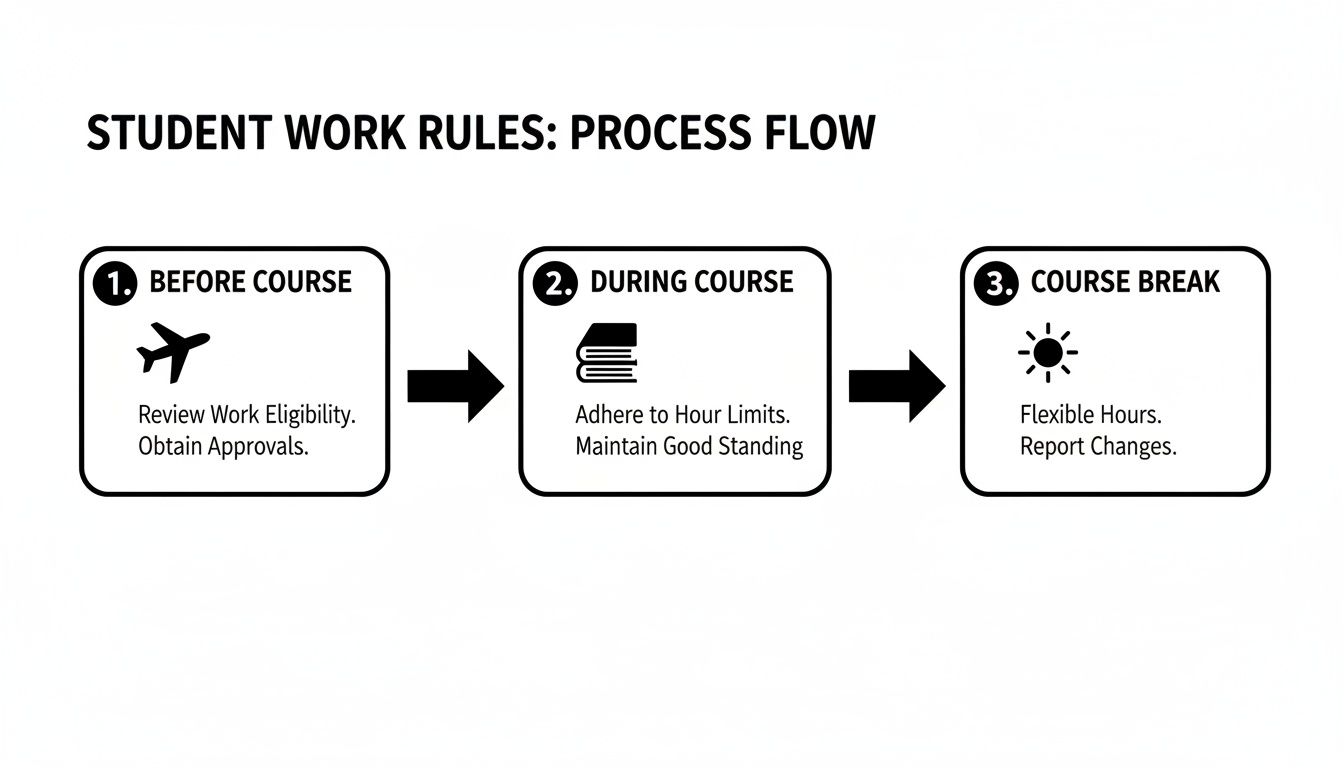
As the infographic shows, strict limits apply while you're studying, but during those well-deserved official breaks, the restrictions are lifted.
How to Track Your Hours Effectively
Staying on top of this rolling limit means you have to be organised. Trying to rely on memory is a recipe for disaster, especially if you’re juggling multiple jobs or have a casual roster that changes all the time.
A dead-simple but effective method is to use your phone's calendar or a dedicated timesheet app. As soon as you finish a shift, log your hours. It takes 10 seconds and creates a running tally you can check anytime to see where you stand in the current 14-day period.
This one small habit can be the difference between a smooth journey and accidentally breaching your visa conditions. If you're keen to understand every angle of your visa, have a look at our guide on student visa assistance subclass 500. Knowing the ins and outs of your visa is the best way to make sure your study adventure in Australia is a success.
Disclaimer: Information in this article is general in nature and may not be current at the time of reading. Immigration laws and policies are subject to frequent changes. For the most up-to-date and personalised advice tailored to your specific situation, we strongly recommend you book an appointment with a registered migration agent. For any official government fees, please refer directly to the Department of Home Affairs website at https://www.homeaffairs.gov.au/.
Unlocking Unlimited Work Hour Windows
While getting the 48-hour fortnightly rule right is crucial during semester, knowing when that limit completely disappears is the real key to boosting your earnings. Your student visa has built-in periods where you can work unlimited hours. Planning around these windows can make a massive difference to your bank account and your resume.
These aren't loopholes or secret tricks; they're official parts of your visa designed to give you flexibility when you’re not deep in study. Think of it like this: your year has a 'study mode' with the 48-hour cap, and a 'break mode' with no work restrictions at all. The trick is knowing exactly when you're in 'break mode'.
The main opportunities for unlimited work are before your course starts, after it finishes (but before your visa runs out), and during any official, scheduled study breaks. These holidays—summer, winter, mid-semester—are golden. They're your chance to work full-time, and you can get a better handle on planning for them by looking into the complete visa rules for international students in Australia.
Defining a Scheduled Course Break
So, what counts as an 'official' break? The only answer that matters comes from your education provider’s academic calendar. That document is your bible. A ‘scheduled course break’ is any time your institution has formally put classes and assessments on hold.
This generally covers:
- Major Holidays: The big one is the long summer break, usually from December to February. The winter break around June or July is another prime time for unlimited work.
- Mid-Semester Breaks: Most unis will give you a week or two off in the middle of each semester. These absolutely count.
- Official University Shutdowns: Any other holiday period formally listed on the academic calendar is good to go.
It's absolutely critical to understand that a break you decide to take doesn't count. If your course is technically 'in session' but you skip a few classes, the 48-hour fortnightly limit is still very much in effect. Only breaks officially scheduled by your uni or TAFE unlock those unlimited work rights.
The Pre-Course and Post-Course Windows
Your chance to work full-time actually starts before you even open a textbook. Once your student visa is granted and you’ve landed in Australia, you can work as much as you want right up until your course officially begins. It's a fantastic time to get settled, find a job, and build up a financial cushion before the study grind kicks in.
That same freedom comes back after you've handed in your last assignment. From the day your course is officially finished until your visa expires, you're free to work unlimited hours again. This post-study period is invaluable for getting some local work experience or saving up for whatever comes next.
Confirming Your Dates with Confidence
Never, ever just assume when a break begins or ends. The dates can shift slightly each year and they differ between institutions. Your uni or college is always the most reliable source.
To stay on the right side of the rules and work without worry:
- Check the Academic Calendar: At the start of every year, find the official academic calendar on your institution's website and bookmark it.
- Verify with Student Services: If you have any doubt, get in touch with your student administration or international student support office. They can give you written confirmation of the official dates.
- Keep Records: It's always smart to save a copy of the calendar or any emails that confirm these dates for your own records.
By being proactive and planning around these unlimited work windows, you can seriously improve your financial situation and get so much more out of your time in Australia.
Disclaimer: Information in this article is general in nature and may not be current at the time of reading. Immigration laws and policies are subject to frequent changes. For the most up-to-date and personalised advice tailored to your specific situation, we strongly recommend you book an appointment with a registered migration agent. For any official government fees, please refer directly to the Department of Home Affairs website at https://www.homeaffairs.gov.au/.
When the Rules Bend: Exceptions for PhD Students and Dependents
While the 48-hour fortnightly limit is the standard for most, the Australian government knows that some academic paths just don't fit into a neat box. The work rules for a Student Visa aren't a one-size-fits-all policy, especially when you get into the world of intensive postgraduate research or bring your family along for the ride.
These exceptions are there for a reason: to support students in higher-level studies and their families. They offer much-needed flexibility to manage life and finances in Australia. It’s absolutely vital to know if you or your partner fall into one of these special categories.
No Limits for Postgraduate Research Students
If you’re diving deep into a postgraduate research course, you can breathe a sigh of relief. The standard work limitations simply don't apply to you. This is a massive advantage for anyone committing their time to serious academic investigation.
So, who qualifies for this?
- Masters by Research: Students enrolled in a master's degree where the main component is a research thesis.
- Doctoral Degree (PhD): Anyone undertaking a doctorate.
For these students, there are no restrictions on working hours from the moment their course officially begins. This really acknowledges the unique, often self-directed nature of research degrees, where a typical 9-to-5 study schedule just doesn't exist.
This exception means research students can properly support themselves and take on work that fits around their demanding study schedules, all without the pressure of a fortnightly hour cap.
It’s a smart policy that helps make pursuing advanced research in Australia a much more realistic option for top international scholars.
What About Work Rights for Your Partner?
When you come to Australia on a student visa, your partner can usually join you as a dependent. But here’s the critical part that many families need to get right: their right to work is tied directly to your course of study.
In most cases, your partner is subject to the same 48-hour per fortnight work limit that you are. This allows them to help with the household bills while you focus on your classes.
However, that limit disappears in certain situations. Your partner can work unlimited hours once you’ve started studying in one of these courses:
- A Masters degree (either by research or coursework)
- A Doctoral degree (PhD)
That’s right—if you’re studying for any Master's or a PhD, your partner’s earning potential isn't capped. This can be a huge source of financial relief and makes life a lot more flexible for your family. It's a key rule that makes Australia a very attractive destination for postgraduate students who want to bring their loved ones with them.
Disclaimer: Information in this article is general in nature and may not be current at the time of reading. Immigration laws and policies are subject to frequent changes. For the most up-to-date and personalised advice tailored to your specific situation, we strongly recommend you book an appointment with a registered migration agent. For any official government fees, please refer directly to the Department of Home Affairs website.
How to Stay Compliant and Protect Your Visa

Knowing the rules around your student visa working hours is one thing, but proving you’re following them is another. Think of it as a shared responsibility. You need to track your hours carefully, and your employer has a legal duty to make sure they’re hiring someone with the right to work in the first place.
Staying compliant isn't just about avoiding trouble; it’s about protecting your visa, your future plans in Australia, and your own peace of mind. Luckily, the government has a straightforward tool that puts you in the driver's seat, making it easy to manage and share your visa information.
Your Essential Tool: VEVO
The Visa Entitlement Verification Online system, or VEVO, is a free online service run by the Department of Home Affairs. This is the one and only official source for your visa details and conditions, especially your work rights. It’s not just for you—it’s how employers legally check that you’re allowed to work for them.
Using VEVO is simple:
- Get Online: You can jump on the VEVO system through the Home Affairs website or download the handy myVEVO mobile app.
- Enter Your Details: You’ll just need your passport info and a visa grant number or transaction reference number (TRN) to log in.
- Check Your Conditions: Once you're in, you'll see a clear summary of your visa status, its expiry date, and all the conditions attached, including the all-important one about your work limits.
VEVO is your single source of truth. It lets you check your conditions any time and even email a PDF of your entitlements directly to a potential employer. This makes the hiring process smooth and transparent for everyone involved.
Why Employers Must Check Your Visa
In Australia, it's illegal for a business to hire someone who doesn't have the right to work. They face massive penalties if they get it wrong, which is why every legitimate employer will ask to verify your visa before they offer you a job. It isn’t about them not trusting you; it’s a strict legal requirement for them.
By using VEVO to show them your work rights, you demonstrate that you’re organised, you understand your obligations, and you’re ready to start work legally. It makes a fantastic first impression. And remember, staying compliant goes beyond just work hours; it also means having your mandatory OSHC (Overseas Student Health Cover) sorted.
The Unbreakable Link Between Tax and Immigration
The government’s ability to track student working hours is now incredibly precise, thanks to direct data-sharing between the Australian Taxation Office (ATO) and the Department of Home Affairs.
The moment you start a job, you give your employer your Tax File Number (TFN). This number links everything—your income, tax, and superannuation—directly to your immigration profile. If a discrepancy pops up, like working more than 48 hours per fortnight, the system flags it almost instantly. While it was once estimated that 25-30% of students might have unknowingly worked over their limit, today's connected systems make that nearly impossible to do without being detected.
Breaching your work conditions is a very serious matter that can lead to visa cancellation. Your visa is the foundation of your entire educational journey in Australia, so protecting it should be your top priority. Following the rules is also a huge part of demonstrating you are a genuine student, a concept we dive into in our article on what is the Genuine Student requirement.
Disclaimer: Information in this article is general in nature and may not be current at the time of reading. Immigration laws and policies are subject to frequent changes. For the most up-to-date and personalised advice tailored to your specific situation, we strongly recommend you book an appointment with a registered migration agent. For any official government fees, please refer directly to the Department of Home Affairs website at https://www.homeaffairs.gov.au/.
Your Next Steps for Expert Visa Guidance
So, you've made it this far. You now have a solid grasp of your work rights as an international student in Australia. Getting your head around the 48-hour fortnightly rule, knowing when you can work unlimited hours, and understanding the key exceptions are the absolute cornerstones of a successful stay. When you know the rules, you can work with confidence.
But let's be realistic—immigration law isn't simple. It's a complex beast that's always changing. While this guide gives you the fundamentals of your work conditions, your own journey might have a few twists and turns. Things like switching your course, figuring out your next visa after you graduate, or even just clearing up a small mistake in your work hours are all moments where you really need an expert in your corner.
Disclaimer: Information in this article is general in nature and may not be current at the time of reading. Immigration laws and policies are subject to frequent changes. For the most up-to-date and personalised advice tailored to your specific situation, we strongly recommend you book an appointment with a registered migration agent. For any official government fees, please refer directly to the Department of Home Affairs website at https://www.homeaffairs.gov.au/.
When to Seek Professional Advice
Getting professional guidance isn't a sign of failure; it's a smart, proactive move. It's always, always better to ask for help before a little question mark turns into a major headache.
Think about getting in touch with an expert if you're:
- Starting to map out your post-study work visa options.
- Considering a change of course or education provider.
- A bit fuzzy on what your work rights are once your course is finished.
- Worried you might have accidentally gone over your work hour limit.
In these crucial moments, a quick search online just won't cut it. You need advice that's tailored to you. For a deeper dive, check out our tips for choosing a migration agent.
And remember, balancing work with your studies is the whole point. Keeping your grades up is non-negotiable. To make sure you're staying on top of your academic game, it’s worth looking into resources that offer dedicated homework help for college students.
Disclaimer: The information in this article is general in nature and may no longer be current by the time you read it. Immigration laws and policies change frequently. For the most up-to-date and personalised advice for your specific situation, we strongly recommend you book an appointment with a registered migration agent.
And for any official government visa fees, always go straight to the source: the Department of Home Affairs website at https://www.homeaffairs.gov.au/. Taking these steps means you're armed with the right information to move forward with total certainty.
Frequently Asked Questions
When you're trying to balance work and study in Australia, a few tricky questions are bound to pop up. Let's tackle some of the most common ones so you can navigate these situations with confidence.
Disclaimer: Information in this article is general in nature and may not be current at the time of reading. Immigration laws and policies are subject to frequent changes. For the most up-to-date and personalised advice tailored to your specific situation, we strongly recommend you book an appointment with a registered migration agent. For any official government fees, please refer directly to the Department of Home Affairs website at https://www.homeaffairs.gov.au/.
What Happens If I Work More Than 48 Hours in a Fortnight?
Going over the 48-hour limit is a breach of visa condition 8105. This isn't just a minor slip-up; it's a serious issue that could put your visa at risk of cancellation. The Department of Home Affairs and the Australian Taxation Office (ATO) share data, making it very easy for them to spot any inconsistencies between the hours you work and what's allowed.
If you realise you’ve accidentally worked too many hours, don't panic, but do act quickly. The first step is to immediately adjust your work schedule to get back within the legal limit. It's also a very good idea to get advice from a registered migration agent straight away. They can help you understand the potential consequences for your specific case and figure out the best way forward.
Does Unpaid or Volunteer Work Count Towards My Hour Limit?
This is a really common point of confusion, and the difference is crucial. Generally, genuine volunteer work for a registered non-profit or charity doesn't count towards your 48-hour fortnightly limit. The key here is that the work must be truly voluntary—meaning you receive no payment or other material rewards for your time.
But here’s the catch: if an unpaid position is a role that an Australian resident would normally get paid for (think many unpaid internships), it’s considered 'work'. This rule is in place to stop unpaid roles from being used as a loophole to get around the work restrictions. Always get clarity on the nature of any unpaid position before you start.
How Do I Prove I Am Complying with My Work Hours?
Keeping good records is your absolute best defence. Your official payslips are the most important piece of evidence, as they show exactly who you worked for, your pay rate, and the hours you logged. Make sure you save every single one.
On top of that, it’s smart to keep:
- Bank Statements: These will show the salary payments coming into your account, which should match up with your payslips.
- Employment Contracts: Your contract is the official document outlining your agreed work conditions.
- Personal Timesheets: Whether it’s a simple spreadsheet or a phone app, tracking your hours yourself—especially if you have more than one job—gives you a clear, real-time picture of your fortnightly total.
Having all these documents organised and on hand means you can easily prove you’re following the rules if the Department of Home Affairs ever asks.
Disclaimer: Information in this article is general in nature and may not be current at the time of reading. Immigration laws and policies are subject to frequent changes. For the most up-to-date and personalised advice tailored to your specific situation, we strongly recommend you book an appointment with a registered migration agent. For any official government fees, please refer directly to the Department of Home Affairs website at https://www.homeaffairs.gov.au/.
Navigating your visa journey requires expert guidance you can trust. The team at My Visa Guide provides clear, ethical, and meticulous support for all your Australian visa needs, ensuring you move forward with confidence. For a personalised strategy and professional assistance, visit us at https://www.myvisaguide.com.au.