Navigating the Australian student visa requirements often feels like you've been handed a complex puzzle without the picture on the box. But it doesn't have to be that way. This guide is your roadmap, designed to cut through the confusion and break down the Subclass 500 visa into clear, manageable steps.
Disclaimer: The information provided in this article is for general guidance only and may not be current at the time of reading. Immigration policies change frequently. We strongly recommend booking an appointment with our registered migration agent for the most up-to-date and personalised advice. For any department fees, always refer to the official Australian Government website at https://www.homeaffairs.gov.au/.
Your Journey to Studying in Australia Starts Here
We're going to demystify the entire process, moving past the dense government jargon to give you the practical advice you actually need. Think of this as a conversation with an expert who’s been through this hundreds of times.
We'll walk you through everything, from the absolute must-haves for eligibility to compiling a document checklist that leaves no room for doubt.
It's More Than Just Paperwork
Your student visa application isn't just a stack of forms; it’s the story of your ambition. Every single document—from your Confirmation of Enrolment (CoE) to your bank statements—works together to build a compelling picture for the case officer reviewing your file. The real secret to success? Preparation and truly understanding what each requirement is asking of you.
Part of that preparation might also involve getting your other documents in order, like a professional CV for university applications or scholarship opportunities. For some great pointers on that, check out this resource on How to Write a CV for a Student.
A Quick Heads-Up: Immigration rules can and do change, sometimes overnight. The information here is a solid starting point, but it's for general guidance only. For advice that's tailored to your specific situation and reflects the very latest policies, your best bet is always to book an appointment with a registered migration agent at My Visa Guide.
What About Fees and Timelines?
One of the first questions on everyone's mind is cost. While this guide focuses on the evidence you need to provide, the official government application charges are always listed directly on the Department of Home Affairs website. Make sure you check their site for the most current visa fees so there are no surprises in your budget.
Here’s how we’ve structured this guide to build your confidence step-by-step:
- Core Eligibility: The non-negotiable foundations your application is built on.
- Genuine Student Requirement: How to clearly and convincingly explain your intentions.
- Financial Capacity: Proving you have the funds to support yourself.
- Document Checklists: A complete list so you don't miss a single thing.
Let's start by digging into the foundational pillars of your visa application.
Meeting the Core Visa Eligibility Requirements
Before we even get into building a compelling case for your student visa, we need to talk about the absolute non-negotiables. Think of these as the concrete foundations of your Subclass 500 visa application. If any of these are missing, your application is a non-starter.
These are the first things a case officer checks. They’re the black-and-white proof that you have a legitimate place to study in Australia and that you’re properly prepared for your time here.
To make it easier, let's break down the core requirements you absolutely must have sorted before you even think about hitting 'submit'.
Subclass 500 Visa Core Requirements at a Glance
This table summarises the essential, non-negotiable items every applicant needs.
| Requirement | What It Means | Key Document |
|---|---|---|
| Enrolment | You must be accepted into a full-time, registered course. | Confirmation of Enrolment (CoE) |
| Health Cover | You need compliant health insurance for your entire stay. | Overseas Student Health Cover (OSHC) Certificate |
| Age | You must be at least 6 years old to apply. | Passport / Birth Certificate |
| Welfare | If you're under 18, you need approved welfare arrangements. | CAAW Form / Parent/Guardian Nomination |
Getting these four pillars locked in is your first major milestone. Let's look at the two biggest ones in a bit more detail.
Your Golden Ticket: Confirmation of Enrolment (CoE)
The very first piece of the puzzle is your Confirmation of Enrolment (CoE). This isn't just an offer letter; it's the official document your school issues after you’ve formally accepted your place and paid your tuition deposit.
Your CoE is the definitive proof that you are enrolled full-time in an Australian course. Crucially, the institution providing it must be listed on the Commonwealth Register of Institutions and Courses for Overseas Students (CRICOS). If a school isn't on that list, you simply cannot get a student visa to study there. End of story.
Disclaimer: The information provided in this article is for general guidance only and may not be current at the time of reading. Immigration policies change frequently. We strongly recommend booking an appointment with our registered migration agent for the most up-to-date and personalised advice. For any department fees, always refer to the official Australian Government website at https://www.homeaffairs.gov.au/.
Protecting Your Health: Overseas Student Health Cover (OSHC)
Next up is health insurance. It's a mandatory condition that you have adequate health cover for the entire time you plan to be in Australia. This is where Overseas Student Health Cover (OSHC) comes in.
OSHC is your safety net, covering your costs if you need to see a doctor or end up in hospital. You have to arrange and pay for your OSHC before you lodge your visa, because you'll need to include the policy details in your application. It’s about ensuring you're looked after without the risk of facing massive medical bills.
This flowchart shows how these fundamentals fit together.
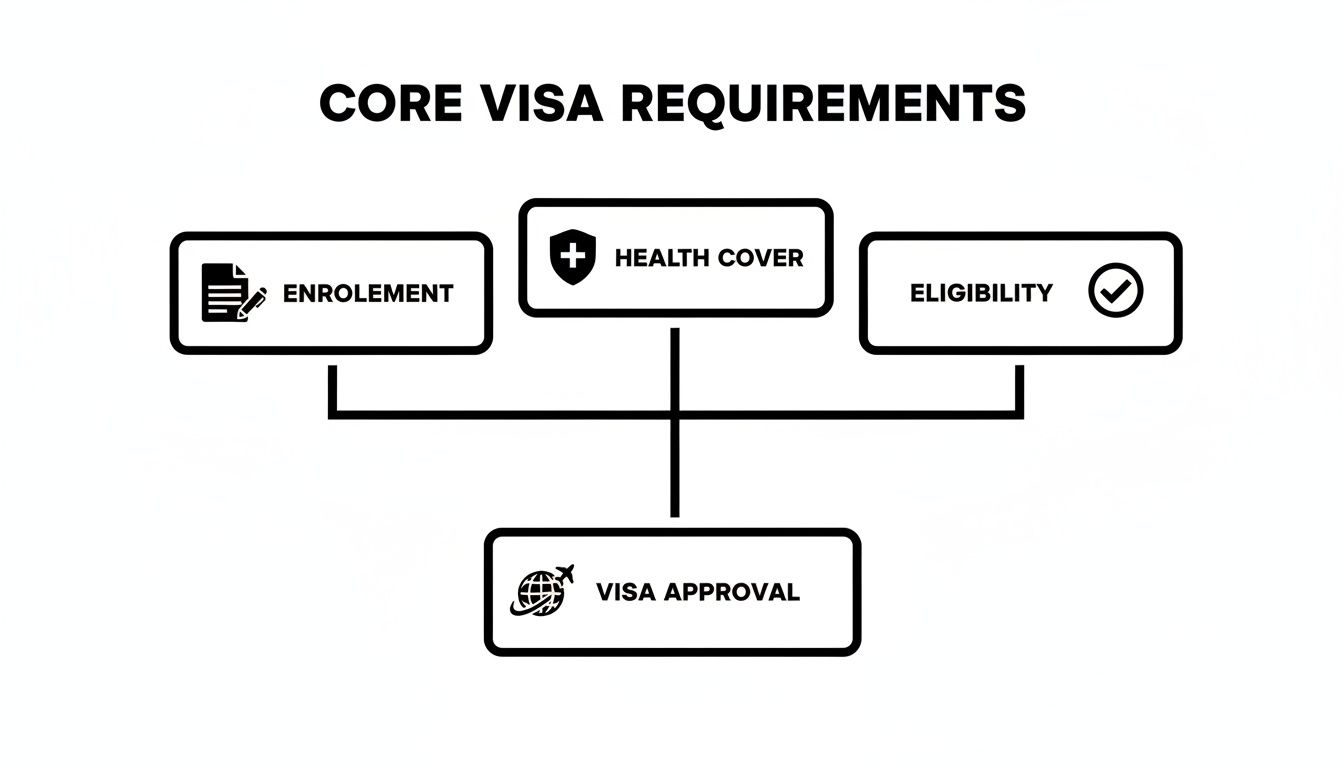
As you can see, getting your enrolment and health cover sorted are the essential first steps that form the base of your entire application.
Other Foundational Pillars of Your Application
Beyond your CoE and OSHC, there are a few other key pillars that hold up your application. We'll dive much deeper into these in the next sections, but here’s a quick overview of what else you’ll need to prove:
- English Language Proficiency: You need to show you have the English skills to actually succeed in your course.
- Financial Capacity: You must prove you have enough money to pay for your tuition, travel, and living costs without issues.
- Health and Character: You’ll need to meet specific health standards and be considered a person of good character.
Each of these requires its own set of specific evidence. Proving your English ability, for example, is a common hurdle, but it's one you can definitely prepare for. You can check out our guide on English proficiency support for a detailed rundown on how to meet the standard.
Proving You Are a Genuine Student
So, you’ve sorted your Confirmation of Enrolment and organised your health cover. Now you’ve reached what is arguably the most personal—and crucial—part of your application: the Genuine Student (GS) requirement. This isn't just about ticking another box. It's your opportunity to tell your story and convince the Department of Home Affairs that your primary reason for coming to Australia is, genuinely, to study.
Think of it as the ‘why’ that drives your entire visa application. The case officer wants to get a clear picture of your ambitions, your plans, and exactly why Australia is the right place for you to chase them. A weak or generic answer here is one of the fastest routes to a visa refusal, so it pays to get this right.
What Is the Genuine Student Requirement?
The GS requirement is a series of targeted questions embedded within your visa application form. They’re specifically designed to gauge your true intentions as a student. Your answers need to come together to paint a clear, logical, and believable picture of a well-thought-out study plan.
The goal is to show that you're not just using the student visa as a back door to work or stay in Australia long-term. Your story needs to be authentic, packed with detail, and directly linked to your personal, academic, and professional life.
To pull this off, you'll need to tackle several key areas with specific and convincing details.
Answering the Key Questions Convincingly
Your GS responses are built around answering a set of direct questions. Forget about one-sentence replies; each answer should be a thoughtful paragraph that adds another layer to your overall narrative.
Here’s a breakdown of the core questions you'll need to address:
- Your Current Circumstances: You'll need to detail your family and community connections back home, your current economic situation, and things like military service or political involvement. This helps the case officer understand what you'd be returning to after your studies.
- Why This Course and Provider: Get specific. Why did you pick this exact course at this particular institution in Australia? Mention specific course modules, the reputation of the academic staff, or unique facilities that drew you in. "It's a good course" just won't cut it.
- Benefits of the Course: Clearly explain how this qualification will help you in the future. Will it open doors to a specific job in your home country? Help you climb the ladder in your current career or start your own business? Be precise.
- Ties to Your Home Country: What compelling reasons do you have to return home once you graduate? This could be close family, property you own, a standing job offer, or solid business prospects.
- Immigration History: You must be completely upfront about any previous visa applications you've made to Australia or any other country. This includes any past refusals or cancellations.
Each answer should logically flow into the next, building a coherent story that proves your genuine intentions.
Important Disclaimer: Please remember that immigration regulations and requirements can change without notice. The information in this guide is for general informational purposes only. For the most current and personalised advice regarding your circumstances, it is essential to book an appointment with a registered migration agent. For any department fees, always refer to the official Australian Government website at https://www.homeaffairs.gov.au/.
Contrasting Weak vs Strong Responses
To really see the difference, let’s use an example. Imagine you’re applying for a Master of Information Technology.
A Weak Answer (Why this course?):
"I want to study IT in Australia because it is a popular field with many job opportunities. The university has a good reputation."
This is the kind of generic response that raises red flags. It’s unconvincing, shows very little research, and doesn't connect the course choice to any personal goals.
A Strong Answer (Why this course?):
"I have chosen the Master of Information Technology at [University Name] because of its specialisation in cybersecurity, which aligns with my career goal of becoming a security analyst in my home country's growing banking sector. Professor Jane Smith's research in network intrusion detection is particularly relevant to my interests, and the university's industry partnership with [Tech Company] offers practical experience I cannot gain elsewhere."
Now that is an answer that works. It's specific, shows real research, and links the course directly to a clear career path back home. This is the level of detail you need to meet the australia student visa requirements for the Genuine Student test.
Finally, a crucial piece of advice: always be truthful. Inconsistencies or false information are easily spotted and will almost certainly lead to a visa refusal and a potential ban on future applications. For official information on visa application fees, always refer to the Australian Government's Department of Home Affairs website.
Showing You Can Afford Your Australian Dream
Let’s be honest, talking about money can be a bit awkward. But when it comes to your Australian student visa, getting your finances in order is one of the most important hurdles to clear. The Department of Home Affairs needs to see, in black and white, that you can support yourself during your studies without having to rely on part-time work or finding yourself in a tough spot.
Think of it as laying a solid financial foundation before you even step on the plane. You’ll need to prove you have genuine access to enough money to cover your travel, tuition, and living expenses for at least the first 12 months of your course. It's all about demonstrating you’re ready for the real costs of living and studying in Australia.
What’s the Magic Number?
So, how much do you actually need to show? It’s not a random figure pulled out of thin air. The Department uses a clear formula to calculate the minimum amount, which breaks down into three key parts.
- Tuition Fees: This is the cost for your first year of study, which you'll find listed on your Confirmation of Enrolment (CoE). If your course is shorter than a year, it'll be a pro-rata amount.
- Living Costs: There’s a set annual figure for general living expenses. As of late 2023, this was AUD $24,505 for a primary applicant. This number gets updated, so always double-check the latest figures.
- Travel Costs: You’ll need to account for your return airfare. For most applicants, this is estimated at AUD $2,500. However, if you're coming from East or Southern Africa, the figure is AUD $3,000.
Just add these three numbers up, and you’ve got your target. It's that straightforward.
To make it clearer, let’s run through a quick example of how you would calculate your minimum required funds.
Calculating Your Minimum Financial Capacity
| Cost Component | Sample Annual Cost (AUD) | Evidence Required |
|---|---|---|
| First-Year Tuition Fee | $30,000 | Confirmation of Enrolment (CoE) |
| Living Costs (12 Months) | $24,505 | Bank statements or loan documents |
| Return Travel Costs | $2,500 | Bank statements or loan documents |
| Total Required Funds | $57,005 | Combination of all relevant documents |
This table gives you a basic idea, but remember that your tuition and travel costs will vary based on your specific course and home country.
Where Can the Money Come From?
The Department has pretty strict rules about acceptable sources of funds. It’s not enough to just have the money—you have to prove it’s genuinely yours to use and show where it came from. A clear paper trail is essential.
Generally, these sources are accepted:
- Your Own Savings: Money in a bank account under your name that has been there for a consistent period, usually at least three months.
- Sponsors: Your parents, legal guardians, or partner can sponsor you. You'll need to provide evidence of your relationship to them and prove their financial stability.
- Education Loans: A formal loan agreement from an approved bank or financial institution taken out specifically for your studies.
- Scholarships or Government Aid: An official letter confirming your scholarship or financial backing from your home government.
Crucial Insight: It’s not just about the closing balance. Case officers look very closely at bank statements for any large, last-minute deposits. This practice, often called "funds parking," is a huge red flag and can lead to serious questions about whether the money is genuinely available for your use.
Getting Your Paperwork Right
Each source of funds requires its own specific set of documents. For instance, if your parents are sponsoring you, you’ll need to provide their bank statements, proof of their income (like tax returns or payslips), and a signed letter confirming their support.
Organising your documents properly is just as critical as having the funds in the first place. Don't forget, another key expense to plan for is your health insurance. You can learn more about Overseas Student Health Cover (OSHC) in our article to understand what's required.
Disclaimer: This information is for general guidance and may not be current when you read it, as immigration policies can change. To get the latest, most accurate advice for your situation, we strongly recommend you book an appointment with our registered migration agent. All official government visa fees are available on the Department of Home Affairs website.
Your Complete Student Visa Document Checklist
Let's be blunt: a messy or incomplete application is one of the easiest ways to get a visa refusal. It’s also one of the most avoidable. Think of your document checklist as the blueprint for your application. Each piece needs to be there, and it needs to be perfect, to build a strong, decision-ready case that gets a "yes".
Getting this right isn't just about collecting papers. It's about proving every claim you’ve made about who you are, your academic past, and your financial stability with concrete evidence. Here’s how we break down this massive task into manageable steps.
Core Identity and Travel Documents
First things first, you need to prove who you are. These documents are the absolute foundation of your application. Any mismatch or out-of-date information here can grind your application to a halt.
- Passport: This is non-negotiable. You'll need a clear, colour copy of your passport’s bio-data page (the one with your photo and details). Crucially, your passport must be valid for your entire planned stay in Australia.
- National Identity Card: If your country issues one, include a certified copy of both the front and back.
- Birth Certificate: A certified copy is needed to confirm your age and identity, showing your name, date of birth, and your parents' details.
- Passport-Sized Photographs: Don't just use any old photo. You need recent, high-quality photos that meet Australia's specific visa photo requirements.
Academic and Enrolment Evidence
Next up, you need to paint a clear picture of your entire academic journey. This is where you show the case officer you have a legitimate educational history that logically leads to your chosen course in Australia. This is a massive part of meeting the australia student visa requirements.
- Confirmation of Enrolment (CoE): As we mentioned earlier, this is the golden ticket. It's your official proof that you've been accepted into a CRICOS-registered course.
- Academic Transcripts and Certificates: Time to dig out your old records. Include certified copies of everything from high school onwards—transcripts, mark sheets, and completion certificates.
- English Language Test Results: Your official report card from your English test (like IELTS, TOEFL, or PTE). Remember, it must have been taken within the last two years.
Important Disclaimer: Please remember that immigration rules are subject to change, and the information in this article may not be current when you read it. For the most up-to-date and personalised advice, it is crucial to book an appointment with a registered migration agent. For any department fees, always refer to the official Australian Government website at https://www.homeaffairs.gov.au/.
Financial and Health Documentation
This final pile of paperwork proves you’re ready for the practical side of living and studying overseas. You’re showing the Department you have the money to support yourself and the health cover to stay safe.
- Proof of Financial Capacity: This can be bank statements, official education loan documents, or scholarship letters proving you have access to the required funds.
- Overseas Student Health Cover (OSHC): You must provide your OSHC policy certificate. This proves you have health insurance locked in for your entire visa period.
- Genuine Student (GS) Statement: While this is now a series of targeted questions in the online application, having your detailed answers pre-written and ready to go is a smart move.
- Relationship Evidence: If a parent, partner, or other family member is sponsoring you, you’ll need to prove your connection with certified birth or marriage certificates.
Every single document has a job to do. Miss one, and the whole application can stall. For any government fees, always check the official Department of Home Affairs website to get the latest figures.
Passing the Health and Character Checks
Okay, so you’ve sorted out your enrolment and proven you can support yourself financially. The next major hurdle? Passing Australia’s mandatory health and character checks.
These checks are a non-negotiable part of the australia student visa requirements. Think of them as the government doing its due diligence to protect the community. They aren’t designed to catch you out, but they do demand your full and honest cooperation. It's really about building trust and showing you'll be a positive addition to Australia.
The Health Examination Process
Depending on where you’re from and how long you plan to study, you might need to get a medical check-up. The main concern is ensuring you don’t have a condition, like active tuberculosis, that could be a public health risk here in Australia.
If you’re asked to do a health exam, you can’t just go to your regular family doctor. The process is very specific. You must book an appointment with a panel physician who has been officially approved by the Department of Home Affairs.
The examination itself is pretty standard and usually involves:
- A general physical check-up.
- A chest X-ray to screen for TB.
- Potentially other tests, like for HIV, depending on your individual circumstances.
Disclaimer: The information provided here is for general guidance and may become outdated as immigration policies change. We strongly advise booking an appointment with our registered migration agent for the most current and personalised advice. For any department fees, always refer to the official Australian Government website at https://www.homeaffairs.gov.au/.
What Is 'Good Character'?
The character requirement is exactly what it sounds like—it’s about demonstrating you’re a law-abiding person. You’ll face direct questions on your visa application about your past, and it is absolutely critical that you answer with complete honesty.
You may also be required to provide police certificates (sometimes called penal clearance certificates). This is common if you're over 16 and have lived in any country for 12 months or more within the last 10 years.
Getting these certificates can be a slow process, so it's a smart move to get started on this early. Hiding even a minor conviction can lead to an immediate visa refusal and could even get you barred from applying again in the future. For a much deeper dive, you can learn more about health and character requirements in our detailed guide.
Finally, a quick note on fees. Government visa application charges can and do change. Always double-check the latest costs on the Australian Government's Department of Home Affairs website to avoid any surprises.
Your Top Student Visa Questions Answered
As you get closer to hitting 'submit' on your application, it's natural for specific questions to pop up. Let's tackle some of the most common queries we hear from students, giving you direct, practical answers to clear up any lingering doubts.
What Are the Most Common Refusal Reasons?
Hands down, the biggest pitfalls are a weak Genuine Student (GS) statement that doesn't tell a convincing story, or not providing solid enough proof of your finances. Submitting an incomplete application with missing documents is another major one. Less common, but still critical, are failing to meet the health or character standards. This is exactly where an experienced migration agent earns their keep—spotting these potential deal-breakers before you even apply.
Can I Work While Studying in Australia?
Yes, absolutely. You're allowed to work up to 48 hours per fortnight once your course is in session, and you can work unlimited hours during scheduled holidays. But remember, the Australian government sees you as a student first and an employee second. Your primary purpose must always be your studies. Keeping your enrolment active and maintaining good attendance is non-negotiable, as your work rights are directly tied to you meeting your student visa conditions.
A Quick Disclaimer: Immigration law is constantly shifting. The information here is intended as a general guide and might not be perfectly current by the time you read it. For advice that’s tailored to your specific situation and reflects the very latest rules, we can't stress this enough: book an appointment with our registered migration agent. For any department fees, always refer to the official Australian Government website at https://www.homeaffairs.gov.au/.
How Long Does Visa Processing Take?
This is the million-dollar question, and the honest answer is: it varies. A lot. The time it takes can depend on where you're applying from, how complete your application is, and simply how busy the Department of Home Affairs is at that moment. You can check their official website for the latest processing time estimates. The single best thing you can do to speed things up is to lodge a 'decision-ready' application—one that has every single required document, correctly formatted, right from the start.
What if My Situation Changes After My Visa is Granted?
Life happens, and the Department gets that. But you have a legal obligation to tell them about any significant changes. This includes things like moving to a new address, getting a new passport, or deciding to change your course or even your education provider. Be especially careful if you're thinking of switching to a course at a lower qualification level, as that could require a whole new visa application. Always get professional advice before you make a change to avoid accidentally breaching your visa conditions.
For any official visa fees, your single source of truth should always be the Department of Home Affairs website.
Working through the student visa process can feel overwhelming, but you really don't have to figure it all out on your own. The expert team at My Visa Guide is here to offer clear, honest, and incredibly detailed help to make your application the strongest it can possibly be. Book your consultation today and take the next confident step toward your Australian education.