

An Australia PR points calculator gives you an instant snapshot of where you stand for skilled migration. It’s a quick way to see how your age, English level, work history, qualifications and even partner credentials add up against Australia’s visa thresholds.
How Calculator Works At A Glance
Just enter your date of birth, test scores, employment years and education details. In seconds, you’ll see your raw score next to the 65-point entry bar and find out how close you are to the more competitive 80-point zone.
- Age Bands: Up to 30 points, with a sweet spot at 25–32 years
- English Proficiency: As many as 20 points for Superior English (IELTS 8.0/PTE 79+)
- Skilled Employment: Maximum 20 points overseas plus 5 more for any Australian experience
- Qualifications: Ranges from 10 for a diploma up to 20 for a doctorate
- Partner Skills: A further 10 points if your partner meets the criteria
For a Subclass 189 visa you need at least 65 points. In reality, most invitations go to applicants scoring around 80.
If you’re aiming for Subclass 190, add 5 nomination points. Regional hopefuls with Subclass 491 can pick up an extra 15.
Real Example In Action
Imagine a 32-year-old civil engineer who nabs Superior in IELTS, holds a bachelor’s degree and has clocked five years overseas work plus two in Melbourne. That profile hits 80 points—enough to get an invitation in most rounds.
You’ll immediately see where your shortfall lies if, say, you have zero Aussie experience or your partner hasn’t met the skill requirements.
Key Factors And Maximum Points
Below is a quick reference table summarising each points category and its maximum value.
| Factor | Max Points | Notes |
|---|---|---|
| Age | 30 | Ideal range 25–32 years |
| English Proficiency | 20 | Superior band (IELTS 8.0/PTE 79+) |
| Skilled Employment | 20 + 5 | 20 overseas plus 5 for Australia |
| Qualifications | 20 | Doctorate level |
| Partner Skills | 10 | Partner must satisfy core criteria |
This breakdown highlights where to focus your efforts—whether it’s sharpening your test score, completing a professional year or validating partner skills.
Take a look at the calculator layout to see how these categories break down visually. You’ll find the age and language slices dominate most profiles.

Key takeaway Calculate and visualise your strengths early to target lifts via professional year or partner skills.
Next Steps
You now have a clear starting point. For an in-depth look at each visa pathway, check out our guide on visa tracks.
Here are three steps to move forward:
- Prioritise your lowest-scoring category—book your IELTS or PTE test straight away
- Gather evidence for all work experience, both overseas and in Australia
- Explore partner skills assessments or state nomination to secure extra points
Most invitations these days land between 80 and 95 points, so it pays to overshoot the 65 threshold. In the upcoming chapters, we’ll break down each factor, share worked examples and point out common pitfalls. Stay tuned.
Key Concepts Of Australia PR Point Calculator
Before you start crunching numbers on a PR point calculator, it helps to understand where those points actually fit into Australia’s Migration Program. It isn’t just a checklist – it’s your ticket into a capped system that strongly favours skilled migrants.
Australia’s 2025–26 Migration Program is limited to 185,000 places, with 132,200 reserved for skilled visas and 52,500 for family streams. Although you only need 65 points to qualify, invitations typically land at 80+ points. Securing a state nomination can add bonus marks and boost your chances further.
For a deeper dive into the 2025–26 allocations, check out Emerson Migration Law.
Skilled Versus Family Stream Allocation
Australia splits its migration spots into two clear streams, each reflecting different policy goals:
- Skilled Stream
• Prioritises occupations in demand
• Offers the bulk of places (about 132,200) - Family Stream
• Reunites partners and dependent children
• Capped at 52,500 spots
Each year, the government adjusts these quotas to match labour forecasts. Occupation ceilings then limit how many individuals per profession receive an invitation, making fields like engineering and IT fiercely competitive.
Visa Category Score Thresholds
Every skilled visa subclass has its own cut-off and bonus structure. Knowing these thresholds helps you strategise:
| Visa Subclass | Minimum Points | Competitive Range | Nomination Bonus |
|---|---|---|---|
| 189 Skilled Independent | 65 | 75–90 | N/A |
| 190 Skilled Nominated | 65 | 80–95 | +5 |
| 491 Skilled Regional | 65 | 85–100 | +15 |
Choosing the right subclass can instantly lift your score. For instance, adding a state nomination to a Subclass 190 application turns a 70 into 75 points.
State Nomination Quotas And Occupation Ceilings
State and territory governments each set their own yearly nomination limits, tied back to national occupation ceilings:
- Victoria: 3,668 nominations in 2025
- South Australia: 2,266 nominations
- Smaller regions often fill quotas more slowly
If your occupation appears on multiple state lists, shop around. A lesser-known territory might offer you a smoother path to points.
Impact On EOI Rankings
Your final point total determines where you sit in the Expression of Interest (EOI) queue. Every extra five points can vault you ahead of dozens of competitors.
“Adding even 5 extra points can be the difference between waitlisting and receiving an invitation.”
Targets around 80+ points give you breathing room when draws tighten. A strategic approach means calculating your core points first, then layering on bonuses like partner skills or professional years.
Real-World Scenario Of Competitive Draws
Take a 32-year-old civil engineer with Superior English, a bachelor’s degree and five years of overseas experience. Even scoring 80 points, they compete against hundreds in the same occupation list. In a recent draw, only the top 150 engineers received invites.
- English Band: Superior (IELTS 8.0) = 20
- Overseas Experience: 5 years = 15
- Qualifications: Bachelor = 15
A single extra year of Australian work or partner qualifications could easily push this profile into the successful bracket.
How Five Points Can Change Your Rank
In IT rounds, we’ve seen applicants jump from rank 320 to 85 by tacking on just 5 points—enough to secure an invitation. Whether it’s through a professional year, state nomination or additional English tests, small gains can make a big difference.
Calculating Core Points For Age English Skilled Employment And Qualifications
Australia’s PR points calculator divides your profile into four building blocks so you can see where your strengths lie—and where you might need a boost.
Below, we unpack each factor and share tips on entering the right info to maximise your score.
- Age contributes up to 30 points
- English Proficiency ranges from 0 (Competent) to 20 (Superior)
- Skilled Employment combines overseas experience (up to 20) with Australian employment (up to 5)
- Qualifications span 10 points for a diploma through 20 points for a doctorate
Age Brackets Explained
There’s a clear sweet spot here: 25–32 years deserves the full 30 points.
Under 25 still nets 25 points, but once you slip past 32, the tally drops quickly. By the time you hit 40, you’re looking at 15 points, and none beyond 44.
- 18–24 years = 25 points
- 25–32 years = 30 points
- 33–39 years = 25 points
- 40–44 years = 15 points
English Proficiency Bands
Language ability can make or break your submission. A Competent score (IELTS 6) gets you 0 points, Proficient (IELTS 7) unlocks 10, while Superior (IELTS 8+) is worth 20.
Aim for that half-band margin. Every extra 0.5 can translate into 5 points—so don’t leave speaking or writing skills to chance.
Learn to polish your speaking, reading and writing skills in our detailed English proficiency guide: Explore English support tips
Boosting from Proficient to Superior often outweighs adding extra years of work experience.
Skilled Employment Experience
Your career history is split between overseas and local roles. Eight years abroad will earn you a maximum 20 points, then you build on that with any time you’ve spent in Australia.
Here’s how it breaks down for most applicants:
- 3–4 years overseas = 5 points
- 5–7 years overseas = 10 points
- 8–10 years overseas = 15 points
- 10+ years overseas = 20 points
- 1–2 years in Australia = 0 points
- 3+ years in Australia = 5 points
Even a short stint in an Aussie office or branch can pay dividends—so consider swapping a week away for a few months down under.
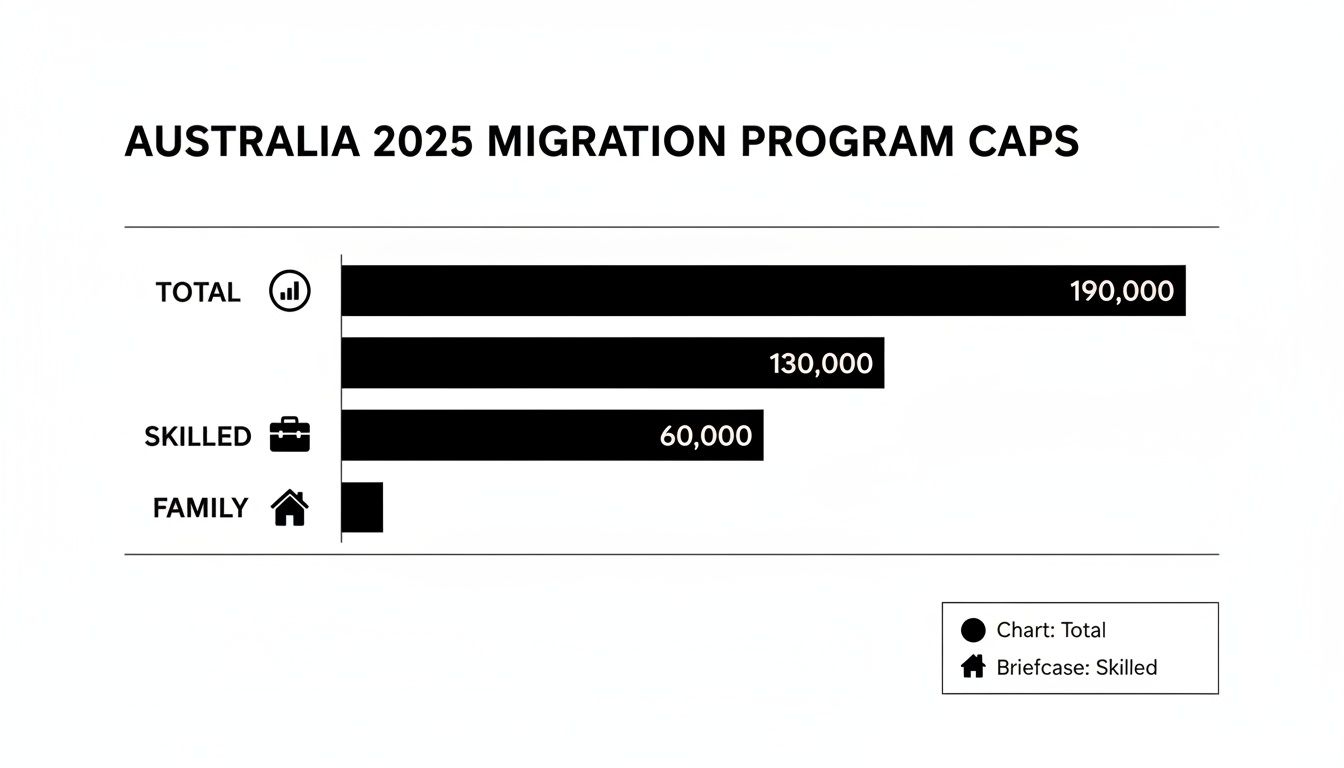
This infographic visualises the 185,000 Migration Program caps: 132,200 skilled and 52,500 family places.
Qualifications And Education
Higher education is rewarded handsomely. A diploma or trade qualification scores 10 points, a Bachelor’s or double degree is 15, and a Doctorate is 20.
- Diploma = 10 points
- Bachelor’s or Double Degree = 15 points
- Master’s by Coursework = 15 points
- Doctorate = 20 points
On top of that, completing a professional year or adding Australian study can rack up another 5 points each.
Worked Example Of A 30-Year-Old Candidate
Imagine you’re 30, you speak at a Superior level, hold a Bachelor’s and have three years overseas plus two in Sydney.
Here’s the tally:
- Age 30 = 30 points
- Superior English = 20 points
- Overseas experience (3 years) = 5 points
- Australian experience (2 years) = 5 points
- Bachelor’s degree = 15 points
That brings you to 75 points. Add a professional year (+5) and regional study (+5), and you’re sitting on 85 points.
Key Takeaway: Hitting 85 points places you well above the 65-point passing mark that most candidates just scrape by.
Many successful applicants score between 80 and 95 points. For example, a 30-year-old with a PhD, five years of Aussie work, a skilled partner, Australian study and a professional year reached 95 points. Check out more insights on Visa Envoy.
Tips To Push Past Cutoffs
A few smart moves can add critical points:
- Complete a professional year program (+5)
- Undertake a Master’s by research (+5)
- Secure a partner skills assessment (+10)
- Pursue state nomination (+5 for subclass 190, +15 for 491)
For a tailored plan that squeezes every possible point out of your profile, consult My Visa Guide.
Maximising Score With State Nomination And Regional Pathways

State or territory nomination can catapult your points from just scraping the minimum into genuinely competitive territory. Picking up an extra 5 points for a Subclass 190 nomination—or an eye-watering 15 points with Subclass 491—often makes the difference between waiting ages and receiving your invite swiftly.
Many applicants target states whose occupation lists match their skills. Beyond faster rounds, this strategy clarifies whether you’ll settle in a capital city or a regional area. Either way, nomination can neatly plug gaps like limited Australian work experience.
State Nomination Volumes And Points Boosts
Below is a snapshot of 2025 nomination quotas and the points you’ll gain. These figures reveal where demand outstrips supply—and where you might find a shorter waiting period.
| State | Subclass 190 Nominations | Subclass 491 Nominations | Points Boost |
|---|---|---|---|
| Victoria | 3,668 | 800 | +5 / +15 |
| New South Wales | 3,000 | 1,500 | +5 / +15 |
| South Australia | 2,266 | 600 | +5 / +15 |
| Queensland | 1,800 | 900 | +5 / +15 |
| Western Australia | 1,200 | 600 | +5 / +15 |
If you’re after shorter wait times, consider states with lower nomination volumes or those ramping up regional intake.
Adding 15 points through a regional provisional nomination can be a game-changer for skilled professionals.
Aligning With State Requirements
Every state and territory handpicks occupations to match its local labour needs.
• Engineers, for example, often see faster approvals in Queensland than in New South Wales.
• Some regions demand a set period of local employment or study.
• Sponsorship agreements and regional residence pledges also come into play.
Match your profile to each list and focus on the states that give you the clearest edge.
Regional Study Advantages
Studying outside metro areas frequently ticks the Subclass 491 eligibility box.
- Two years at a designated regional campus secures nomination eligibility.
- Local internships or part-time roles bolster your application further.
- Completing a professional year in a regional centre adds yet more weight.
A 28-year-old nurse spent two years studying in regional Adelaide, backed that with local volunteer work—and swiftly secured a Subclass 190 nomination from South Australia.
Balancing Pathways And Commitments
You don’t have to pick between capital-city convenience and regional points boosts.
- Check how often each state holds invitation rounds.
- Weigh regional living costs against metropolitan perks.
- Seek positions offering both local sponsorship and nomination backing.
Understanding Commitment Agreements
State nomination usually comes with conditions.
Most jurisdictions ask you to:
- Live and work in a specific postcode for at least two years.
- Provide proof such as a lease agreement, utility bills or an employment contract.
Gather these documents early to avoid compliance hiccups.
Tracking Invitation Trends
Nomination draws vary by subclass and region.
- Subclass 190 rounds typically occur monthly, with cut-offs around 75 to 85 points.
- Subclass 491 regional draws may accept lower scores but allocate fewer places.
- Bookmark the Department of Home Affairs website to see the latest draw results.
Signing up for state migration newsletters ensures you catch sudden changes.
Next Steps To Maximise Your Points
Map your occupation against states with the biggest quota gaps and the least competition. For deeper tactics on skilled migration strategies, dive into our guide on skilled migration pathways.
Common Mistakes To Avoid With Australia PR Point Calculator
Even the smartest tool can trip you up if your inputs aren’t spot-on. A single typo or overreach might skew your entire score. Before you click “calculate,” give every field a thorough once-over.
Take the case of an engineer who marked herself as a Superior English speaker when she’d only achieved Proficient results. That slip cost her 10 points on her EOI and pushed back her Subclass 189 application by weeks.
- Overestimating English proficiency can wipe 10 points off your result and give you false confidence.
- Treating gaps between jobs as continuous work inflates your skilled experience tally.
- Overlooking NAATI accreditation details means forfeiting 5 points for translations.
- Forgetting to claim your professional year can shave 5 points from your total.
Misclassifying Employment Gaps
It’s tempting to group short breaks as “continuous” employment, but the calculator distinguishes consecutive from non-consecutive service. Even a two-month sabbatical can shift you down a points bracket.
For instance, Mia logged six years of experience but missed noting a six-month career break. Her overseas work score plunged from 15 to 10 points overnight.
Errors With Overseas Qualifications
Not every overseas degree slots neatly into Australia’s equivalency frameworks. Assuming a three-year UK diploma equals an Aussie Bachelor can cost you 5 points.
Always verify your overseas credentials with a recognised assessment service before entering them into your EOI.
Common Qualification Checklist
| Issue | Impact on Score |
|---|---|
| Unassessed transcripts | Lose 10 points on qualifications |
| Dual degrees duplicated | Inflated score then audit penalty |
| NAATI translation omitted | Miss out on 5 translation points |
Strategies For Unusual Cases
Dual qualification holders often try to claim points twice. Instead, pick the credential that earns the most and keep the other on file as backup.
Extended career breaks—whether for parental leave or health reasons—deserve clear documentation. Attach letters or contracts to show why you paused, so your calculator doesn’t misinterpret those months.
- Label each break with exact start and end dates in your EOI.
- Sketch a timeline chart to map all work and study periods visually.
- List partner skills separately to keep them from mixing with core points.
Overlooking a single entry can cost more than rushing to submit an inaccurate EOI.
Partner Skills Pitfalls
Partner skills points aren’t automatic. Your spouse needs a separate skills assessment. One applicant missed crediting her partner’s four years of professional experience—and lost 10 points as a result.
- Check your partner’s test scores against SkillSelect requirements.
- Include marriage or de facto certificates to pass any EOI audit.
Study Date Errors
Omitting complete study dates can knock out 5 points for Australian study. Some applicants forget to record their visa subclass or transcript completion dates, triggering an audit.
Always cross-check transcript dates and visa labels before you submit.
Calculator Rounding Errors
Many tools round fractional years down by default, hiding up to three months of experience. To avoid this, enter partial years in full months.
- Use MM/YY format for work durations, not decimals.
- Review the final breakdown to spot any hidden deductions.
Last Minute Tips
- Double-check every number against your original documents.
- Set a reminder to update your EOI if new test results arrive.
- Stick to one date format across all fields for consistency.
Final Checklist Before Submission
- Verify age band, English results and work experience details.
- Confirm NAATI accreditation, professional year and partner skills entries.
- Cross-check study dates against your transcript and visa records.
Planning Next Actions For Your PR Application
Your preliminary points score shines a light on the areas where you can make quick gains. Rather than wait for the next invitation round, you can focus on boosting English, work experience or qualifications now. These targeted upgrades often cut months off your waiting time.
For example, improving your IELTS score by half a band earns you 5 points. Completing a recognised Professional Year program adds another 5 points. And achieving NAATI CCL accreditation secures 5 points for language credentials.
Consider these immediate moves:
- Book an IELTS or PTE test with the goal of hitting the Superior band
- Enrol in a government-recognised Professional Year programme
- Register for the NAATI CCL test to validate your translation skills
- Complete short courses that offer up to 5 bonus points
Each of these steps lines up with visa invitation dates, giving your Expression of Interest an edge.
Next, let’s dive into practical advice for sharpening those test results.
Improving Test Scores
A small lift in your English proficiency can transform your PR profile. Upping your IELTS writing or speaking by 0.5 bands alone can push you past the 65-point mark, making you far more competitive.
You don’t need to overhaul your routine—focus on structured practice and targeted feedback. Try full-length mock tests under timed conditions to master pacing and pressure.
Key study tips:
- Sharpen reading speed with daily skimming and scanning drills (aim for 190 words/min)
- Record yourself on speaking prompts, then compare with official band descriptors
- Use IELTS™ practice materials to familiarise yourself with exam formats
- Join online forums for peer reviews and real-time score feedback
If you prefer a faster turnaround, the PTE delivers results in 48 hours. Compare formats and pick the one that suits your style and timeline.
Partner Skills And NAATI
Bringing your partner’s assessment on board can unlock 10 points. Pair that with a NAATI CCL accreditation for an extra 5 points—and you’re looking at a significant score boost.
To make it count:
- Confirm your partner’s qualifications align with ANZSCO skill levels
- Book your NAATI CCL test well in advance to lock in your date
- Attach certified copies of both your credentials when updating your EOI
These bonus points often swing the balance when occupation cut-offs tighten.
“Just 5 extra points can shift your rank by hundreds in a competitive draw.”
Once you’ve secured these points, the timing of your EOI lodgement becomes critical.
Timing Your EOI Lodgement
Visa invitation rounds happen every month, with some states running separate draws. Submitting your EOI right after you’ve updated scores or assessments can make all the difference.
Follow this sequence:
- Check recent cut-off trends for your occupation
- Update your profile with new IELTS, PTE or NAATI results
- Lodge your EOI at least one day before the next scheduled draw
A few strategic tweaks like these can trigger fresh invitations without overhauling your core profile. If you hit a plateau, seeking expert eyes on your EOI fields can uncover simple optimisations.
At My Visa Guide, we audit your EOI, spotlight optimisations and track draw outcomes so you don’t waste time.
Expert Advice And Next Steps
Whenever your score edges over a key threshold, it’s time for a fresh strategy session. Our team at My Visa Guide can:
- Conduct an EOI Audit to validate every point
- Guide you through a Visa Strategy Session to map out deadlines
- Provide ongoing insights via our blog and webinars
Act now to turn your Australia PR points estimate into an invitation. Learn more about our services on My Visa Guide and book your consultation today.
FAQ
Many applicants wonder how their age affects their PR points. It all comes down to fitting your birthday into the right band. Here’s the low-down.
Understanding Age Bands
- Under 25: 25 points
- 25–32: 30 points
- 33–39: 25 points
These brackets shift in five-point jumps. Miss your window by a day and you could drop 5 points.
How To Handle Multiple Qualifications
You might hold degrees from several countries, but only your top credential counts. For example, a UK three-year bachelor equates to an Australian bachelor, yet two diplomas don’t stack into double points.
- Map each qualification against the ANZSCO list
- Send all transcripts for overseas equivalency checks
- Claim only the credential that scores highest to steer clear of audits
Updating Your Expression Of Interest
Scored higher in your English test or gained extra work experience? Log into your ImmiAccount and upload new documents straight away. Every update recalculates your total and can push you further up the invitation list.
Timing updates right before a draw can boost your chances.
Aim to upload at least 48 hours before draw day to avoid last-minute hiccups.
When To Seek Expert Support
If your profile is straightforward, you can probably go it alone. But add in partner skill claims, career breaks or NAATI accreditation and things get tricky. A registered migration agent brings clarity on state-nomination trends and draw timings.
- A detailed EOI audit catches hidden errors
- Personalised points reviews highlight your strongest factors
- Ongoing tracking means you won’t miss any draws
The australia pr point calculator gives you a quick estimate, but a thorough verification of each entry locks in accuracy.
Ready to put your best foot forward? Partner with My Visa Guide for a precise EOI assessment and expert support. Book your consultation today.