
The Australia points calculator is the official system the government uses to rank everyone who wants to apply for a skilled migration visa. Think of it as a scorecard that awards you points for things like your age, English skills, and work history to figure out if you’re eligible and what your chances are of getting an invitation to apply for permanent residency.
Disclaimer: Please be aware that immigration laws and points requirements change frequently. The information in this article is for general guidance and may not be current when you read it. For the most up-to-date and personalised advice, book an appointment with one of our registered migration agents. All government visa fees should be confirmed on the official Department of Home Affairs website at https://www.homeaffairs.gov.au/.
Understanding the Australian Points System
Imagine Australia’s skilled migration program as a highly competitive queue. To get a spot near the front, you need to prove you’ve got the skills and qualities the country is looking for. The Australia points calculator is simply the tool the government uses to measure these qualities and decide where you stand in that line. It’s not just about meeting a minimum score; it's about scoring high enough to get noticed.
This system is now the absolute cornerstone of Australia's skilled immigration strategy. In fact, points-tested visas make up roughly 72 percent of the entire permanent skilled migration program today. That’s a massive jump from just 3 percent back in 2000, which really shows you just how critical your points score has become for filling Australia’s labour shortages.
What Is the Purpose of the Points Test?
The main reason for the points test is to have an objective, fair, and transparent way of choosing skilled migrants. Instead of someone making a subjective call, the calculator gives a clear numerical value to different parts of your profile.
Here’s what it’s designed to do:
- Objectivity: It makes sure every single applicant is measured against the exact same yardstick, from their age to their qualifications.
- Ranking: It gives the Department of Home Affairs a straightforward way to rank candidates in the Expression of Interest (EOI) pool and invite the top-scoring people to apply for a visa.
- Economic Contribution: The things that get you points—like skilled work experience and top-tier English—are directly linked to a migrant's ability to settle in, find a job, and contribute to the Australian economy.
Below is a screenshot of what the official calculator looks like on the Department of Home Affairs website.
This tool is a great starting point for a rough estimate, but getting an accurate score means you really need to understand the fine print behind each category. To see how this calculator fits into the bigger picture, it helps to have a general understanding of the Australian visa system. Ultimately, the score you get from this test directly impacts which visas you can even consider, which is a fundamental part of the skilled migration process.
Calculating Your Core Points Score
Think of Australia's skilled migration points system as building a house. Before you can put up the walls or the roof, you need a rock-solid foundation. In the points system, that foundation is built from four "core" categories: Age, English Language Proficiency, Skilled Employment, and Educational Qualifications.
Getting these right is the most critical first step. It's how you build a strong case and accurately gauge where you stand. Understanding how the points stack up in these areas will show you where your strengths lie and, just as importantly, where you might be able to make some improvements to boost your score for an Australian visa.
This flowchart gives you a great visual breakdown of how these key factors feed into your overall score, which is what ultimately determines your chances of getting that coveted visa invitation.
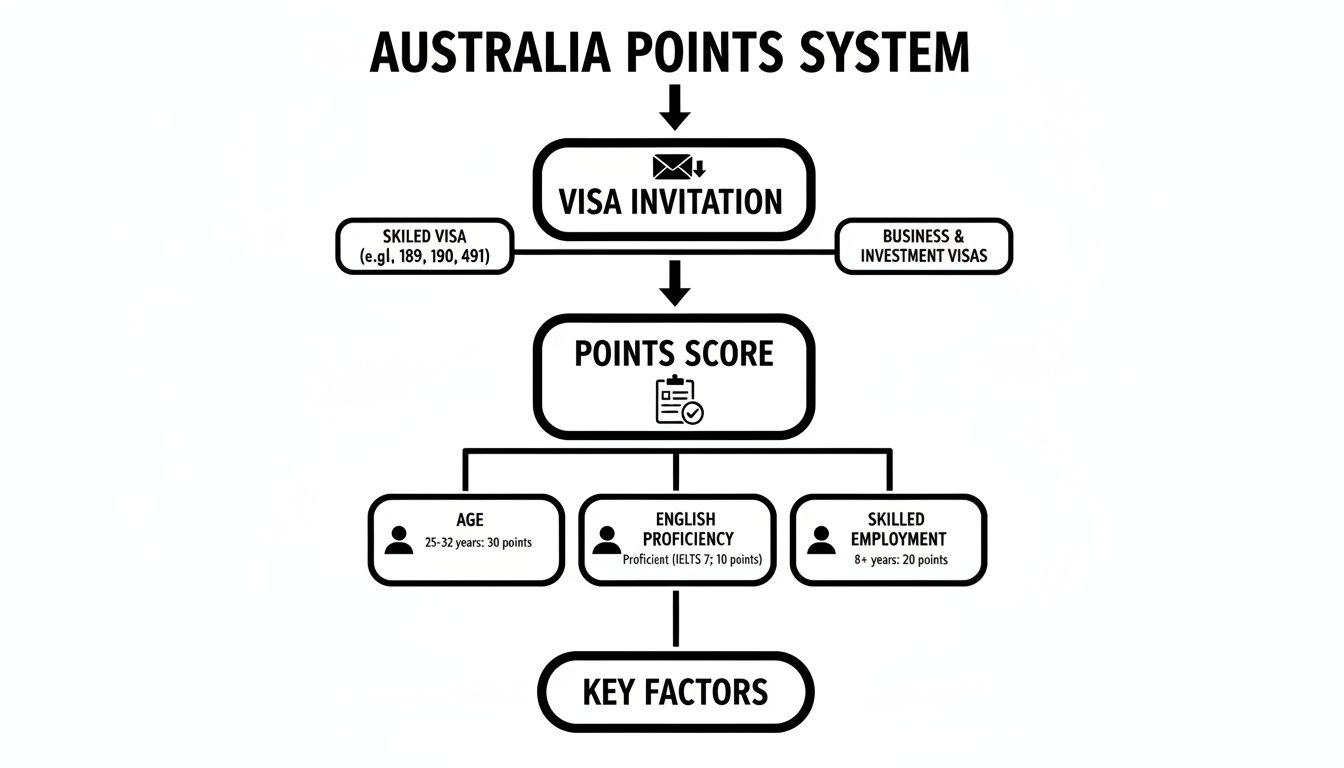
As you can see, your personal attributes directly contribute to that final tally. That total score is the number one thing the Australian government looks at when deciding who to invite to apply for a visa.
Disclaimer: Please be aware that immigration laws and points requirements change frequently. The information in this article is for general guidance and may not be current when you read it. For the most up-to-date and personalised advice, book an appointment with one of our registered migration agents. All government visa fees should be confirmed on the official Department of Home Affairs website at https://www.homeaffairs.gov.au/.
H3: The Critical Role of Age
Let’s be honest: age is the one factor you can’t change. It's a huge part of the points calculation because the system is designed to favour younger applicants who will likely spend more years working and contributing to the Australian economy.
The points for age are structured like a curve. The sweet spot is for applicants aged between 25 and 32, who can claim the maximum 30 points. The points awarded begin to drop off as you head into your late 30s and early 40s. Once you hit 45, the points for age drop to zero.
Here's a quick look at the breakdown:
- 18–24 years: 25 points
- 25–32 years: 30 points (Maximum)
- 33–39 years: 25 points
- 40–44 years: 15 points
- 45 years and over: 0 points
This really highlights why it’s a good idea to start your migration journey as early as you can. A single birthday can sometimes be the difference between getting an invitation and missing out.
H3: Demonstrating Your English Language Proficiency
Strong English skills are non-negotiable for settling into Australia, both in the workplace and in your community. Because of this, the points test gives a significant boost to applicants who can prove they have a high level of English proficiency. It’s a tiered system—the better your test score, the more points you get.
There are three key levels of English ability that award points:
- Competent English: This is the minimum requirement to even be eligible for most skilled visas. You won't get any points for it (0 points), but you have to meet this standard to get into the pool.
- Proficient English: Reaching this level shows a solid command of the language and will net you a handy 10 points.
- Superior English: This is the top tier. It demonstrates an advanced level of fluency and gives your score a massive boost with 20 points.
These levels are tied to specific scores on approved English tests like IELTS, PTE Academic, TOEFL iBT, and Cambridge (C1 Advanced). For example, to claim points for 'Superior English', you'll generally need an IELTS score of 8 in every band or a PTE Academic score of 79 in each component. If you need a hand reaching those top scores, our team can help with effective English proficiency preparation.
H3: Gaining Points from Skilled Employment Experience
Your work history is probably the best indicator of your ability to contribute to the Australian workforce. The points calculator recognises this by awarding points for relevant skilled employment, but it draws a clear line between experience gained in Australia and experience from overseas.
One quick but crucial note: To claim any points for work experience, that experience must be in your nominated skilled occupation (or one that’s very closely related). It also must have happened after you were officially deemed skilled by your skills assessing authority. This is a common trip-up that can lead people to over-claim points.
Overseas Work Experience (Outside Australia)
This covers your skilled work in any country other than Australia.
- 3–4 years of experience: 5 points
- 5–7 years of experience: 10 points
- 8 or more years of experience: 15 points
Australian Work Experience (Inside Australia)
Experience you've gained while working in Australia is weighted more heavily, as it proves you're already familiar with the local workplace culture and standards.
- 1–2 years of experience: 5 points
- 3–4 years of experience: 10 points
- 5–7 years of experience: 15 points
- 8 or more years of experience: 20 points
It's important to know that you can't add these two categories together. You can only claim points from one table. So, if you have 10 years of overseas experience (15 points) and 2 years of Australian experience (5 points), you would claim the higher of the two, which is 15 points for your overseas work.
H3: Your Educational Qualifications
Last but not least, your formal education plays a big part in your points total. The higher your qualification, the more points you can claim, as long as it’s recognised as being at a comparable standard to an Australian qualification.
Here’s a general guide to how the points are awarded:
- Doctorate (PhD): A PhD from an Australian university or a recognised overseas institution will get you the maximum of 20 points.
- Bachelor's or Master's Degree: This level of qualification is worth 15 points.
- Diploma or Trade Qualification: A diploma or trade qualification completed in Australia earns 10 points.
- Recognised Skills Assessment: If your skills assessing body confirms your qualifications are suitable for your nominated occupation, you can claim 10 points.
Nailing down these four core pillars is your first step to confidently navigating the points calculator. By getting a clear picture of where you stand in each category, you can start building a strategy to strengthen your profile and work towards a successful migration outcome.
Finding Extra Points to Boost Your Score
Once you’ve tallied up the points from the big four—age, English skills, work experience, and qualifications—it’s time to hunt for the bonus points. These are the strategic extras that can lift a decent score into a truly competitive one, giving you a serious edge in the Expression of Interest (EOI) pool.
Think of these as the finishing touches. While the core categories build your foundation, these bonus points are where smart planning can make all the difference, often providing the final push you need to get that coveted invitation.
Disclaimer: Please be aware that immigration laws and points requirements change frequently. The information in this article is for general guidance and may not be current when you read it. For the most up-to-date and personalised advice, book an appointment with one of our registered migration agents. All government visa fees should be confirmed on the official Department of Home Affairs website at https://www.homeaffairs.gov.au/.

Specialist Education and Australian Study
The Australian government loves to see a commitment to both high-level skills and the local education system. If you’ve dedicated time to advanced research or studied right here in Australia, there are valuable points on offer.
Here’s how you can claim them:
- Specialist Education Qualification: This is a big one. Completing a Master's degree by research or a Doctorate (PhD) from an Australian university in a designated STEM field (Science, Technology, Engineering, and Mathematics) nets you a massive 10 points. It’s a clear reward for those at the top of their academic game.
- Australian Study Requirement: Simply completing a degree, diploma, or trade qualification that took at least two academic years of study at an Australian institution will add 5 points to your score.
- Regional Australian Study: If those same two years of study were done while you were living and studying in a designated regional area, you can claim another 5 points. This is a great incentive designed to pull talent into communities beyond the major city centres.
The Professional Year Advantage
For recent graduates in fields like accounting, IT, or engineering, the Professional Year Program is an absolute game-changer. It’s essentially a structured internship combined with professional development training, designed to give you real-world, hands-on experience in an Australian workplace.
Not only does it make you far more employable, but successfully completing a Professional Year adds a very handy 5 points to your migration score. It's well worth looking into the Professional Year Programs available in Australia to see if you qualify.
Accredited Community Language Skills
Are you fluent in one of Australia’s key community languages? This skill can earn you an extra 5 points. To get them, you’ll need to be accredited at the paraprofessional level (or higher) by the National Accreditation Authority for Translators and Interpreters (NAATI).
It’s a fantastic way to turn your language abilities into a tangible boost for your visa application.
Unlocking Points Through Your Partner
Don't overlook your partner! Their skills and qualifications can be one of the most significant sources of bonus points, but they have to meet very specific criteria.
There are a few ways this can play out:
- Single Applicant: If you’re flying solo, you automatically get 10 points. This levels the playing field so that single applicants aren’t at a disadvantage.
- Skilled Partner: You can claim 10 points if your partner is also a skilled professional. They’ll need to be under 45, have at least 'Competent' English, and hold a positive skills assessment for an occupation on the same skilled list as you.
- Partner with Competent English: Even if your partner doesn’t have a skills assessment, you can still claim 5 points as long as they can prove they have 'Competent' English.
These bonus categories are where strategic thinking really pays off. Whether it’s completing a PhD, getting your partner to sit an English test, or leveraging your language skills, each option is a pathway to a stronger score in the Australia points calculator.
Using State and Regional Nominations to Your Advantage
While racking up points across the core categories is essential, one of the most powerful tools in your migration playbook is a nomination from an Australian state or territory. For many hopefuls, this is the single biggest factor that can turn a waiting Expression of Interest (EOI) into a coveted invitation to apply.
So, why do these nominations even exist? Simple: to fill specific skill shortages where they’re most needed. A state like Victoria might be crying out for software developers, while regional South Australia could be desperate for civil engineers. By nominating skilled migrants, states and territories get to plug critical gaps in their local economies.
This creates a perfect win-win. The state gets the talent it needs, and you get a massive points boost and a much clearer path to a visa. It's a strategic game that shifts the focus from just hitting a generic points target to proving your skills are in demand in a specific part of the country.
Disclaimer: Please be aware that immigration laws and points requirements change frequently. The information in this article is for general guidance and may not be current when you read it. For the most up-to-date and personalised advice, book an appointment with one of our registered migration agents. All government visa fees should be confirmed on the official Department of Home Affairs website at https://www.homeaffairs.gov.au/.
The Two Key Nomination Pathways
When we talk about state nominations, we're really talking about two specific visa subclasses. Each offers a different points value and comes with its own residency conditions, so understanding the trade-offs is crucial for your strategy.
Here are the two heavy hitters:
- Subclass 190 (Skilled Nominated Visa): This is a permanent residency visa. If a state or territory nominates you for the 190 visa, you’ll pocket an extra 5 points. Now, that might not sound like a lot, but in the fiercely competitive world of skilled migration, those five points can absolutely be the difference-maker.
- Subclass 491 (Skilled Work Regional (Provisional) Visa): This is a provisional visa that sets you on a pathway to permanent residency after you’ve met certain conditions. A nomination here gives you a whopping 15 points—a genuine game-changer that can dramatically elevate your total score.
Choosing between the two really boils down to your current points total and how open you are to living and working in a designated regional area for a few years. For many applicants, that huge 15-point leg-up from the Subclass 491 makes it an incredibly compelling option.
How to Pursue a Nomination
It all starts with your Expression of Interest (EOI), which you lodge through the SkillSelect system. Inside your EOI, you can flag your interest in being considered for nomination by any—or all—of the Australian states and territories.
From there, state and territory governments regularly scan the EOI pool, looking for candidates who match what they need. Their criteria often go a step beyond the basic Department of Home Affairs requirements and can include things like:
- Having an occupation on their unique skilled occupation list.
- Meeting a higher bar for English language ability or work experience.
- Having existing ties to the state, like having studied or worked there before.
If a state likes what they see in your profile, they'll send you an invitation to apply for nomination. Once you accept and the nomination is official, the bonus points are added to your EOI, and an invitation from the Department of Home Affairs to apply for the visa itself usually follows shortly after.
Putting it all Together: Real-World Points Calculations
The theory behind the Australia points calculator is a great start, but seeing it work in practice is where the lightbulb really goes on. To show you how all these categories click together, let's walk through the entire process for two different but very realistic profiles. This step-by-step approach will give you the confidence to apply the same logic to your own situation.
Let’s meet our two hopeful migrants:
- Anjali: A 28-year-old Software Engineer with top-tier English skills.
- Carlos: A 35-year-old Electrician whose partner has skills that will add valuable points to their application.
By tallying their scores, we'll see how different strengths can lead to a competitive total and flag some common spots where people miscalculate.
Disclaimer: Please be aware that immigration laws and points requirements change frequently. The information in this article is for general guidance and may not be current when you read it. For the most up-to-date and personalised advice, book an appointment with one of our registered migration agents. All government visa fees should be confirmed on the official Department of Home Affairs website at https://www.homeaffairs.gov.au/.

Case Study 1: Anjali the Software Engineer
Anjali is a highly skilled IT professional laser-focused on moving to Australia. She's put in the hard work to perfect her English and has built a solid career overseas. Let's run the numbers.
Anjali's Profile:
- Age: 28
- English: Superior (IELTS 8.0 in all bands)
- Qualifications: Bachelor of Computer Science
- Work Experience: 6 years as a Software Engineer overseas
- Partner Status: Single
- Other: No Australian study or specialist qualifications
Her Points Calculation:
- Age: At 28, Anjali is right in that 25-32 sweet spot, scoring the maximum 30 points.
- English Language Proficiency: Her fantastic IELTS score confirms 'Superior English', adding a huge 20 points to her total.
- Skilled Employment (Overseas): With 6 years of relevant experience, she lands in the '5-7 years' bracket, securing a solid 10 points.
- Educational Qualifications: Her Bachelor's degree is recognised, awarding her 15 points.
- Partner Status: As a single applicant, she automatically gets 10 points.
Tallying that up, Anjali’s total comes to a very impressive 85 points. This is a highly competitive score that puts her in an excellent position for a Subclass 189 (Skilled Independent) visa invitation, meaning she likely won't even need a state nomination.
Case Study 2: Carlos the Electrician
Carlos is a seasoned tradesperson with a slightly different profile to Anjali. He's a bit older, and his partner’s skills are going to play a key role in getting their application over the line.
Carlos's Profile:
- Age: 35
- English: Proficient (PTE Academic 65+ in all sections)
- Qualifications: Trade qualification as an Electrician
- Work Experience: 10 years as an Electrician overseas
- Partner Status: Has a partner
- Partner's Skills: His partner is 32, has 'Competent' English, but does not have a skills assessment.
His Points Calculation:
- Age: At 35, Carlos falls into the 33-39 age bracket, which gives him 25 points.
- English Language Proficiency: His 'Proficient' English score adds another 10 points.
- Skilled Employment (Overseas): A full decade of experience puts him in the top '8+ years' tier, earning him the maximum 15 points for overseas work.
- Educational Qualifications: His recognised trade qualification provides 10 points.
- Partner Skills: Because his partner has proven 'Competent' English, Carlos can claim an extra 5 points.
Adding it all up, Carlos is sitting on 65 points. While this meets the minimum threshold to lodge an Expression of Interest (EOI), it's probably not high enough to get an invitation for the Subclass 189 visa by itself.
Worked Example Point Calculation
This side-by-side comparison shows just how two very different pathways can lead to a visa, using the points calculator to play to individual strengths.
| Points Category | Applicant 1 'Anjali' (IT Professional) | Applicant 2 'Carlos' (Tradesperson) |
|---|---|---|
| Age | 30 points (28 years old) | 25 points (35 years old) |
| English Proficiency | 20 points (Superior) | 10 points (Proficient) |
| Overseas Employment | 10 points (6 years) | 15 points (10 years) |
| Qualifications | 15 points (Bachelor's Degree) | 10 points (Trade Qualification) |
| Partner Status | 10 points (Single) | 5 points (Partner has Competent English) |
| Subtotal | 85 points | 65 points |
Anjali's high score, driven by her age and 'Superior' English, makes her a shoo-in for an independent visa. Carlos, on the other hand, is the perfect candidate to pursue a state nomination.
A nomination for a Subclass 190 visa would add 5 points, bringing him to 70. Even better, a regional Subclass 491 nomination would add a massive 15 points, rocketing him up to a very competitive 80 points.
Answering Your Top Questions About the Points Calculator
When you start digging into the Australian points calculator, a few common questions always seem to pop up. It's completely normal. Getting these sorted out is key to knowing where you stand and planning your next move with a bit more confidence. Let's tackle some of the most frequent queries we hear.
Just keep in mind, this is solid guidance on the usual sticking points, but immigration rules can and do change.
Disclaimer: Please be aware that immigration laws and points requirements change frequently. The information in this article is for general guidance and may not be current when you read it. For the most up-to-date and personalised advice, book an appointment with one of our registered migration agents. All government visa fees should be confirmed on the official Department of Home Affairs website at https://www.homeaffairs.gov.au/.
What’s the Magic Number? The Minimum Points Score I Need
The official line is that you need a bare minimum of 65 points to even be considered and lodge an Expression of Interest (EOI). But here’s the reality check: hitting 65 points doesn't mean an invitation to apply for a visa is on its way.
Think of it as the minimum height to get on a ride at the theme park—it gets you in the queue, but it doesn't guarantee you a seat. The actual score needed to land an invitation is almost always much higher and swings wildly depending on your occupation and how many other people are in the running. Your best bet is to always aim for the highest score you can possibly get.
Do My Points Get Locked In When I Submit My EOI?
Nope, your points score isn't set in stone. It's a living thing that can shift even after your EOI is in the system, and it's your job to keep it accurate.
For example, the moment you have a birthday that bumps you into an older age bracket, your points will drop automatically. On the flip side, if you tick over another year of skilled work experience or finish a new degree, you can (and should) jump back in and update your EOI to claim those extra points.
A Word of Warning: Keeping your EOI honest is non-negotiable. If you claim points you aren’t actually entitled to, even by accident, it can lead to a visa refusal. Worse, you could be facing a ban from applying again for some time.
Can I Claim Points for Work I Did Before I Got My Qualification?
This is a big one, and the answer is almost always no. To claim points, your skilled employment has to be from after you met the minimum requirements for your occupation. This is what's known as your "deemed skilled" date.
Your skills assessing authority is the one who officially sets this date. Any work you did before you finished that degree or got that trade certificate is generally seen as "unskilled" in the eyes of immigration and won't count towards your points total.
My Job Isn’t on Any Skilled List. Is It Game Over?
For any points-tested skilled visa, your occupation absolutely must be on one of the relevant skilled occupation lists. There's no way around that.
But don't give up immediately if you can't find your exact job title. It's well worth looking for closely related occupations where your daily duties and skills might be a good match. A registered migration agent can be a lifesaver here, as they can look at your whole career history and see if there's another suitable occupation pathway you might not have considered.
Figuring out the points calculator is just the first hurdle; building a perfect, decision-ready application is what wins the race. The MARA-certified agents at My Visa Guide offer expert, end-to-end support to make sure your profile is as strong as it can be. Don't leave your future to guesswork—book a professional consultation today and get it right the first time.