So, you’ve decided to study in Australia. Fantastic choice. But before you even think about hitting ‘submit’ on that visa application, there’s some crucial groundwork to cover. Getting these initial steps right is non-negotiable and sets the stage for a smooth, successful application.
Think of it this way: you wouldn't build a house without a solid foundation. These first steps—securing your spot in a course, arranging health cover, and proving you can support yourself—are the foundation of your student visa. Nail these, and the rest of the process becomes a whole lot less stressful. Let's walk through exactly what you need to do first.
Secure Your Confirmation of Enrolment (CoE)
First things first, you need a Confirmation of Enrolment (CoE). This is the golden ticket. It’s the official document from your university or college that proves you’ve accepted a spot in a full-time, registered course. Without a CoE, your visa application simply can't move forward.
It’s also vital that your institution is on the Commonwealth Register of Institutions and Courses for Overseas Students (CRICOS). This is your guarantee that the course and the provider meet Australia’s high standards for international education.
Be strategic with your course choice. The Australian government has made it very clear where its priorities lie. In 2024-25, nearly 75% of all new student visas were granted for higher education courses. At the same time, the Vocational Education and Training (VET) sector saw a staggering 50% drop in visa grants compared to the previous year. The message is clear: the government is heavily favouring university-level studies.
Arrange Your Overseas Student Health Cover (OSHC)
Next up is health insurance. This isn't optional; it's a mandatory condition for your visa. You must have Overseas Student Health Cover (OSHC) for the entire length of your stay in Australia.
OSHC is there to help with the costs of any medical or hospital care you might need. You can often arrange it directly through your university (they usually have a preferred provider), or you can shop around and purchase a policy yourself from any approved Australian health insurer.
A key detail many people miss: your cover needs to start from the day you arrive in Australia, not the day your course begins.
Prove Your Financial Capacity
The Department of Home Affairs needs to see that you can support yourself financially. This is one of the most common hurdles for applicants. You must show you have genuine access to enough money to cover your travel to Australia, your first 12 months of tuition fees, and your living costs.
Evidence for this can come in a few forms:
- Bank statements showing sufficient funds.
- Proof of a loan from a government body or your education provider.
- Documents detailing a scholarship or other financial support.
As you're getting your finances in order, it's a smart move to start researching student accommodation options. This will give you a realistic idea of living costs and help you budget properly.
Finally, make the Department of Home Affairs website your best friend. Always double-check the latest visa application fees and financial evidence requirements directly on their site. You can find the most current pricing on their fees and charges page at https://www.homeaffairs.gov.au/. Getting this part right from the start can save you from a potential visa refusal.
Your Pre-Application Game Plan
Before you dive into the ImmiAccount portal, it's worth taking a moment to gather everything you need. A little organisation now saves a lot of headaches later. Here’s a quick checklist of the absolute must-haves.
Initial Student Visa (Subclass 500) Preparation Checklist
| Checklist Item | Why It's Critical | Pro Tip from My Visa Guide |
|---|---|---|
| Passport | Your primary form of identification. The visa is linked to it. | Ensure your passport is valid for at least six months beyond your intended stay. |
| Confirmation of Enrolment (CoE) | This is the non-negotiable proof of your study plans. | Double-check that all details on the CoE (name, course, dates) are 100% correct. |
| Overseas Student Health Cover (OSHC) | A mandatory visa condition. You can't apply without it. | Compare providers. Some offer better value or specific benefits that suit your needs. |
| Proof of Financial Capacity | Demonstrates you can support yourself without issues. | Organise your financial documents well in advance. Bank statements should show a consistent history, not a sudden large deposit. |
| Genuine Student (GS) Evidence | Documents supporting your GS claims (academic history, employment, etc.). | Start drafting your responses and gathering supporting evidence early. This isn't something to rush. |
Having these key items ready to go will make the actual online application process far more efficient and less prone to errors. It's all about preparation.
Crafting a Compelling Genuine Student Statement
Think of your Genuine Student (GS) statement as the heart and soul of your visa application. It’s where you stop being just a number and a set of documents, and become a person with a story. This is your one real chance to speak directly to the case officer and convince them you’re a genuine student.
If you take one thing away from this guide, let it be this: ditch the generic templates. Your statement needs to be an authentic, compelling narrative explaining exactly why you've chosen Australia, this specific course, and how it all fits into your bigger life plan. The goal is to prove you genuinely intend to study, then take that education back home to build your future.
It’s not just about saying the right things; it’s about building a logical, evidence-backed case for yourself.

Structuring Your Narrative for Impact
A strong GS statement is easy to follow. Imagine you're answering the questions the case officer is already thinking about. By breaking your statement into clear sections, you can cover all the crucial ground without it feeling like a wall of text.
Your story needs to create a clear, logical link between your past, present, and future. Kick things off by outlining your current personal and financial situation back home. Then, build a bridge to why you’ve picked this particular course at this specific university in Australia. Finally, and this is crucial, you must connect the dots to show how this Australian qualification leads to a tangible career back in your home country.
Addressing Your Personal Circumstances
Be open and honest about your life back home. This section grounds your application in reality and is your chance to show the strong ties you have, which is a massive part of the Genuine Student requirement.
Make sure you touch on things like:
- Family Ties: Talk about your immediate family—parents, siblings, spouse, or children—who are staying behind.
- Economic Situation: Briefly cover your family's financial position, including any businesses or property they own. This helps demonstrate your financial stability and strengthens the argument that you have good reason to return.
- Social Connections: Mention any community involvement or other significant social links that tie you to your home country.
For example, if you're the sole heir to a successful family business that you're expected to join after you graduate, that’s a powerful incentive to return home. Likewise, owning property or having significant assets in your name really bolsters your case.
Connecting Your Course to Your Future Career
This is where your application can truly shine or fall flat. You have to draw a direct, believable line from the course you plan to study in Australia to the specific career you’ll pursue when you get back.
Vague statements like "it will give me better opportunities" just won't cut it. You need to be specific and back it up with evidence.
Your job is to convince the case officer that this course is a deliberate and necessary step towards a real, achievable career goal in your home country—not just a random choice to get a visa.
Let's say you're applying for a Master of Data Science. A weak statement says, "I want to study Data Science because it is a growing field." A much stronger statement would be, "The manufacturing sector in my home region is expanding by 15% each year, but there’s a critical shortage of skilled data analysts. My family’s business is struggling with production forecasting, and this Master's degree will give me the exact predictive modelling skills I need to modernise our operations and capture more market share."
See the difference? One is generic, the other is personal, specific, and believable.
Handling Your Immigration History and Red Flags
Honesty is always the best policy here. If you've had a visa refused before—from Australia or any other country—you absolutely must declare it and explain what happened. Trying to hide a refusal is one of the fastest ways to fail the character test and potentially face a ban.
It’s also smart to get ahead of any potential "red flags" in your profile. Things like a big gap in your studies, choosing a course that seems unrelated to your background, or being a mature-age student. Address them head-on and explain the reasons logically. For instance, if you have a five-year gap in your resume, explain that you were managing a family business or caring for a relative, and detail how that experience actually motivated you to return to study.
This is a tricky area, and what the Department of Home Affairs considers a "genuine" student can feel a bit subjective. To get a much deeper understanding, you can learn more about the Genuine Student requirement in our detailed guide. It’ll give you more insight into what case officers are really looking for.
Disclaimer: Please be aware that Australian immigration laws and visa requirements change frequently. The information provided in this article is for general guidance only and may not be current when you read it. For the most up-to-date advice tailored to your specific situation, it is essential to book an appointment with a registered migration agent. For any Department fees, always refer to the official website: https://www.homeaffairs.gov.au/.
Gathering Your Essential Visa Application Documents
A successful student visa application is built on a foundation of flawless, organised documentation. Think of your documents as the evidence that supports every claim you make in your application, especially in your Genuine Student statement. This is where you prove who you are, what you’ve studied, and that you have the financial stability to support yourself.
Getting this part right is non-negotiable. Missing or incorrect documents are one of the most common reasons for delays or, worse, refusals. Let’s break down exactly what you need to pull together a decision-ready application.
Core Identity and Academic Documents
First up are the documents that establish who you are and what you've accomplished academically and professionally. These are the absolute must-haves for every single applicant.
You'll need to provide high-quality, colour scans of these core items:
- Your Current Passport: The bio-data page is what they need. Critically, make sure your passport is valid for at least six months beyond your planned stay in Australia.
- Birth Certificate: This verifies your identity and age.
- National Identity Card: If your country issues one, you need to include it.
- Academic Transcripts and Certificates: Gather the official records from all your high school and tertiary studies. Don't leave anything out.
- Work Experience Documents: If your work history is relevant to your chosen course, include reference letters, contracts, or payslips to back it up.
When you're dealing with official papers for international use, getting them certified correctly is a huge deal. Understanding the distinction between an apostille and a notary public can be crucial for making sure your documents are properly authenticated and accepted by Australian authorities.
Demonstrating Your Financial Capacity
Proving you have enough money is one of the biggest hurdles. The Department of Home Affairs needs to be completely confident that you can cover your tuition, travel, and living costs without having to rely on unauthorised work.
The required amount can change, so you should always check the official government sources for the latest figures. As a general rule, you’ll need to show evidence that you can cover:
- Travel Costs: Your return airfare to Australia.
- Living Expenses: The standard amount set by the government for a student's first 12 months.
- Tuition Fees: The first 12 months of your course fees.
Solid evidence can include personal bank statements showing a consistent savings history over time, official student loan documents, or scholarship letters. A word of warning: sudden, large deposits dropped into your account just before you apply are a massive red flag. Plan your finances well in advance.
Disclaimer: Please be aware that Australian immigration laws and visa requirements change frequently. The information provided in this article is for general guidance only and may not be current when you read it. For the most up-to-date advice tailored to your specific situation, it is essential to book an appointment with a registered migration agent. For any Department fees, always refer to the official website: https://www.homeaffairs.gov.au/.
Health, Character and Language Requirements
Beyond your finances and academics, you also have to meet Australia's strict health, character, and English language standards. These aren't just bureaucratic hoops; they exist to protect the Australian community and to ensure you can actually succeed in an English-speaking academic environment.
Key documents in this category include:
- English Proficiency Test Results: A valid score from a recognised test like IELTS, PTE Academic, or TOEFL iBT.
- Overseas Student Health Cover (OSHC): You must have proof of your policy. To get a better handle on what you need, you can read our guide on choosing the right OSHC provider.
- Health Examination: Depending on your country, you may be required to undergo a medical examination with a panel physician approved by the Department.
- Police Certificates: You might need to provide a police clearance certificate from every country you've lived in for 12 months or more over the last 10 years.
Understanding Evidence Levels
Here's something many applicants miss: the amount of documentation you need isn't the same for everyone. It all comes down to your "evidence level" under the Simplified Student Visa Framework (SSVF), which is determined by combining your country of citizenship with your chosen education provider.
An evidence level of 1 is the lowest risk and requires the least amount of paperwork (often just your CoE and OSHC). On the other end of the scale, an evidence level of 3 is considered the highest risk and demands extensive proof of your finances and English skills.
This system is constantly being updated based on risk assessments. For example, applicants from several South Asian countries are now facing much higher scrutiny. Due to what the government called 'emerging integrity risks,' countries like India, Nepal, and Bangladesh have been shifted from Evidence Level 2 to Evidence Level 3. This change shows just how important it is to prepare an exceptionally strong and well-documented application, as your financial and personal documents will be examined with a fine-tooth comb.
A Walkthrough of the ImmiAccount Lodgement Process
You’ve meticulously gathered your documents and polished your Genuine Student statement. Now for the final hurdle: lodging your application through the ImmiAccount portal. This is the Department of Home Affairs’ official online platform, and getting comfortable with it is crucial for a smooth submission. Think of it as the digital finish line where all your hard work pays off.
The whole thing is done online, from creating your account to hitting that final 'submit' button. And while the platform is designed to be user-friendly, I’ve seen how one tiny data entry mistake can cause major delays. At this stage, accuracy and a sharp eye for detail are your best friends.
Creating and Navigating Your ImmiAccount
First things first, you’ll need to create a new ImmiAccount. You'll use a valid email address, which becomes the main channel for all official communication from the Department, so make sure it's one you check regularly. Once you’re in, you can start a new application for the Student visa (subclass 500).
The online form is pretty extensive. It’s broken down into multiple pages that cover everything from your personal details and family members to your full education and travel history. Don't try to rush it. It's much smarter to complete it over a few sessions than to speed through and make a mistake.
A classic pitfall I see applicants fall into is inconsistency. Make absolutely sure the information you enter—names, dates of birth, passport numbers—is an exact match to what’s on your official documents. Even a single letter difference between the form and your passport can raise a red flag and slow everything down.
Uploading Your Documents Correctly
After you’ve filled out the form, you’ll hit the document upload stage. This is where you attach all the evidence you’ve so carefully prepared. The portal has some strict rules about files, so pay close attention.
- File Format: Stick to accepted formats. PDF or JPG are usually the safest bets.
- File Size: There’s a maximum size limit for each file, often around 5MB. You might need to compress larger documents before uploading.
- Clear Naming: Name your files in a way that makes sense (e.g., "Passport_John_Smith.pdf" or "Financial_Capacity_Bank_Statement.pdf"). This helps you stay organised and makes the case officer's job easier, which is always a good thing.
This flowchart gives you a simple visual overview of the core document pillars you'll be uploading.
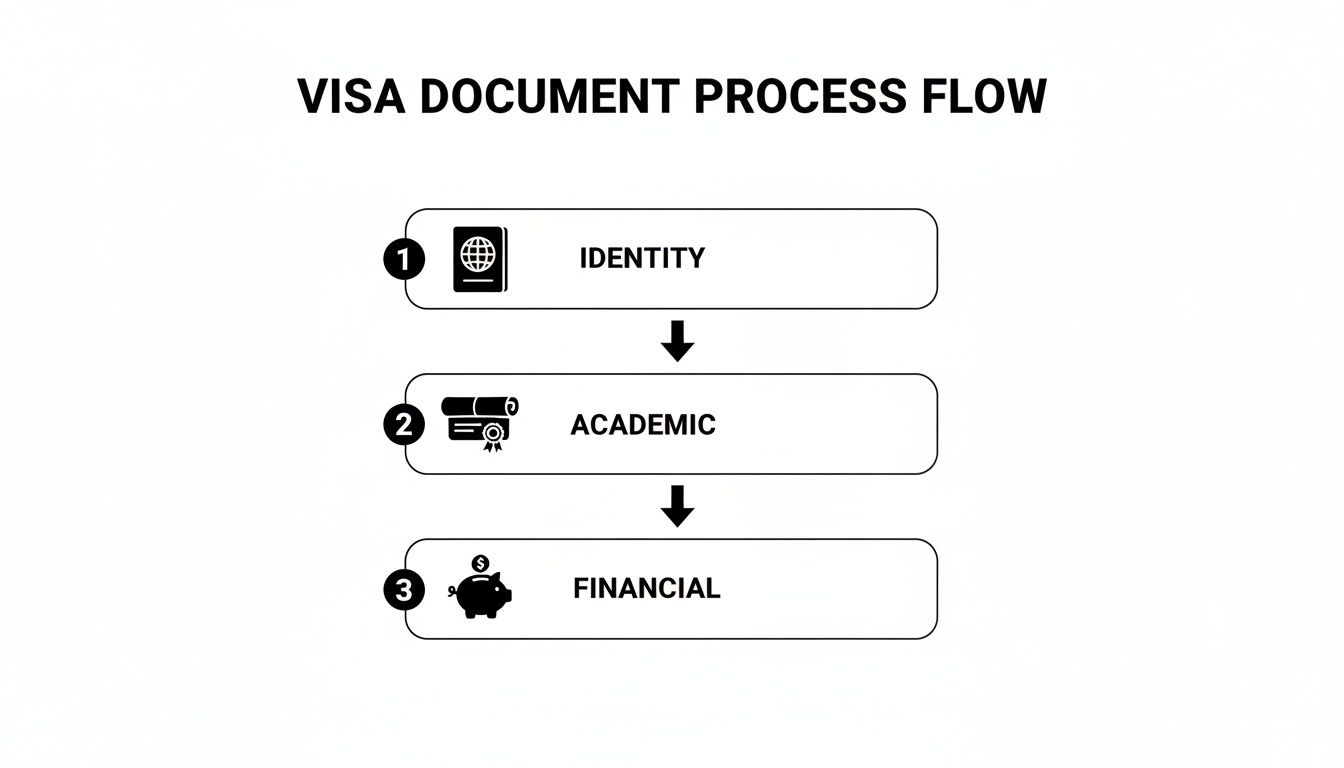
As you can see, your application is built on three solid pillars of proof: who you are, your academic background, and your financial ability to support your stay.
Finalising Payment and Submission
The very last step before you can lodge is paying the Visa Application Charge (VAC). This has to be paid by credit card, directly through the ImmiAccount portal.
Disclaimer: Visa application fees change from time to time. For the most up-to-date and accurate figures, it's always best to book an appointment with a registered migration agent. You should also confirm the latest fees directly on the Department of Home Affairs website at https://www.homeaffairs.gov.au/ before you pay.
Once your payment goes through, you can finally submit your application. You’ll immediately get an acknowledgement letter containing your Transaction Reference Number (TRN). Guard this number—it’s your key to tracking your application’s progress.
But your job isn't quite over. After submitting, you need to keep a close eye on your ImmiAccount. The Department might issue a Request for Further Information (RFI), and you'll have a strict deadline to respond, usually 28 days. Replying to an RFI promptly and with the correct information is absolutely critical to keeping your application moving forward toward a successful outcome.
Getting your student visa is a massive win, but don't close the book just yet. Your visa grant isn't just a ticket into Australia; it's a rulebook you need to live by. Understanding these rules is every bit as important as nailing the application itself.
Think of your visa conditions as the terms and conditions of your stay. Slipping up can lead to serious headaches, even visa cancellation, and nobody wants that. Stick to the rules, and you can focus on what you came here for: studying and enjoying everything Australia has to offer.
Key Student Visa Conditions You Must Know
Your visa grant notice will spell out everything you need to know, but there are a few non-negotiables that apply to pretty much every Subclass 500 visa holder. It’s on you to keep these in check.
Here are some of the big ones:
- Stay Enrolled: You absolutely must be enrolled in a full-time, CRICOS-registered course. No exceptions.
- Keep Up Your Grades: Your school will have standards for course progress and attendance. You need to meet them.
- Valid Health Cover: Your Overseas Student Health Cover (OSHC) must be active for your entire stay in Australia.
- Keep Your Details Updated: Let your education provider know your address within seven days of arriving. If you move, you've got another seven days to tell them.
Disclaimer: Please be aware that Australian immigration laws and visa requirements change frequently. The information provided in this article is for general guidance only and may not be current when you read it. For the most up-to-date advice tailored to your specific situation, it is essential to book an appointment with a registered migration agent. For any Department fees, always refer to the official website: https://www.homeaffairs.gov.au/.
Your Work Rights: The Rules of the Game
One of the best perks of studying in Australia is getting to work part-time. Right now, the rule is you can work up to 48 hours per fortnight while your course is running. Just so we're clear, a 'fortnight' is a 14-day block that starts on a Monday.
When you're on a scheduled course break, you can work as many hours as you like. It's a fantastic chance to get some local experience and top up your bank account. But whatever you do, don't go over that 48-hour limit during study periods. It's a direct breach of your visa, and the consequences are serious.
What’s Next? Thinking About Life After Graduation
Your Australian qualification can be a major launchpad for your career, whether you plan to head home or try to stay in Australia. It’s a smart move to start exploring your options long before you throw your graduation cap in the air.
International students are a huge part of Australia's story. By September 30, 2025, the number of Student (Subclass 500) visa holders hit a massive 736,306. That shows just how popular Australian education is and the doors it can open. You can dive deeper into these visa holder stats on vsure.com.au.
Popular Post-Study Options
| Pathway | Description | Best For |
|---|---|---|
| Temporary Graduate Visa (Subclass 485) | Lets you live, study, and work in Australia for a while after you graduate. | Graduates from higher education courses who want to get some Aussie work experience on their CV. |
| Professional Year Program | A mix of formal training and a hands-on internship to get you job-ready. | Graduates in Accounting, IT, or Engineering who want to boost their skills and their points for skilled migration. |
| Skilled Migration | Visas like the Subclass 189 or 190 for skilled workers Australia needs. | Graduates whose job is on a skilled occupation list and who can pass the points test. |
Thinking about your next chapter is a crucial part of the journey. To get you started, you should check out our detailed guide on your post-study pathways in Australia. It paints a much clearer picture of the move from student to skilled professional. When you see your student visa as the first step in a bigger plan, you start making smarter choices about your course and career right from the get-go.
Got Questions About the Student Visa?
When you're deep in the visa application process, a few specific questions always seem to pop up. These are the ones we hear all the time from students, so let's clear them up right now.
Can My Family Come with Me?
Yes, in most cases, you can bring your family along. The Department of Home Affairs allows you to include eligible family members—or 'dependents' as they're officially known—in your student visa application. This usually covers your partner and your dependent children under 18 years of age.
Here's a crucial tip: you must declare every family member on your application form, even if they have no plans to join you in Australia right away. If you don't, getting them a visa to join you later can become incredibly complicated, if not impossible. Just remember, adding dependents means you'll need to show you have more funds to support everyone.
What if My Visa Gets Refused?
Getting a visa refusal is tough, but don't panic—it's not necessarily the final word. When you receive the decision, the notification letter will spell out exactly why it was refused and what your options are for a review.
If you applied from within Australia (onshore), you might have the right to appeal the decision to the Administrative Appeals Tribunal (AAT). For applications made from outside Australia (offshore), the review options are usually much more limited. The key is to understand the refusal reasons inside and out before deciding your next move, whether that’s lodging an appeal or putting together a stronger application.
How Long Can I Stay After My Course Ends?
The length of your visa is directly tied to the length of your course, but you do get a bit of extra time at the end. It generally works like this:
- If your course is longer than 10 months and finishes at the end of the Aussie academic year (that’s November-December), your visa will usually stay valid until 15 March of the next year.
- If your course is over 10 months long but finishes between January and October, you’ll typically get an extra two months on your visa after your course completion date.
This buffer period is built-in so you have time to pack up, do some travelling, or even apply for your next visa, like the popular Temporary Graduate visa (subclass 485).
Disclaimer: Please be aware that Australian immigration laws and visa requirements change frequently. The information provided in this article is for general guidance only and may not be current when you read it. For the most up-to-date advice tailored to your specific situation, it is essential to book an appointment with a registered migration agent. For any Department fees, always refer to the official website: https://www.homeaffairs.gov.au/.
Embarking on your study journey in Australia is a significant step, and getting the visa application right is the foundation of your success. At My Visa Guide, we specialise in simplifying this complex process. Our MARA-certified agents provide expert guidance on everything from course selection to post-study pathways, ensuring your application is meticulously prepared. Avoid common pitfalls and start your Australian adventure with confidence. To ensure your application is decision-ready, visit us at https://www.myvisaguide.com.au and book a consultation today.