IMPORTANT NOTICE
When you start looking into bringing your parents over to Australia, one of the first things you'll realise is that it’s a serious financial commitment. The total parent visa Australia cost can swing wildly, starting from around $7,000 for the slower, non-contributory visas and soaring past $48,000 per parent for the much faster contributory options.
But that headline number isn't just one single fee. It's a puzzle made up of government application charges, mandatory bonds, second instalment payments, and a whole host of other necessary expenses.
Disclaimer: Information in this article is general in nature and may not be current at the time of reading. Visa regulations and fees can change without notice. Always refer to the official Department of Home Affairs website for the latest department fees. For advice tailored to your specific situation, book an appointment with a registered migration agent.
Untangling the True Cost of an Australian Parent Visa
So, what does that financial commitment actually look like on paper? The total cost is more complex than most people think. You've got the initial government application charges, then for the faster visas, there are hefty second instalments. Add in a mandatory Assurance of Support (AoS) bond and other bits and pieces, and the costs can really start to pile up.
This guide is here to help you put all those pieces together. We’ll break down the fundamental trade-off every family has to weigh up: time versus money. Getting your head around this core choice is the first real step to setting a realistic budget and building a solid migration plan.
The Two Main Pathways Explained
At a glance, Australian parent visas fall into two main camps, and which one you choose dictates both the cost and the waiting time you’re in for.
- Contributory Visas: Think of this as the 'fast-track' option. You’re essentially making a significant contribution towards your parent's future health and welfare costs. In return, the processing time is slashed from decades down to a much more manageable few years.
- Non-Contributory Visas: This is the far more affordable route, with much lower government fees. The catch? The waiting list is incredibly long. We’re talking a queue that can stretch for more than 20 years, which, for many families, just isn't a practical solution.
The image below gives you a clear visual of just how different the starting costs are for these two main routes.
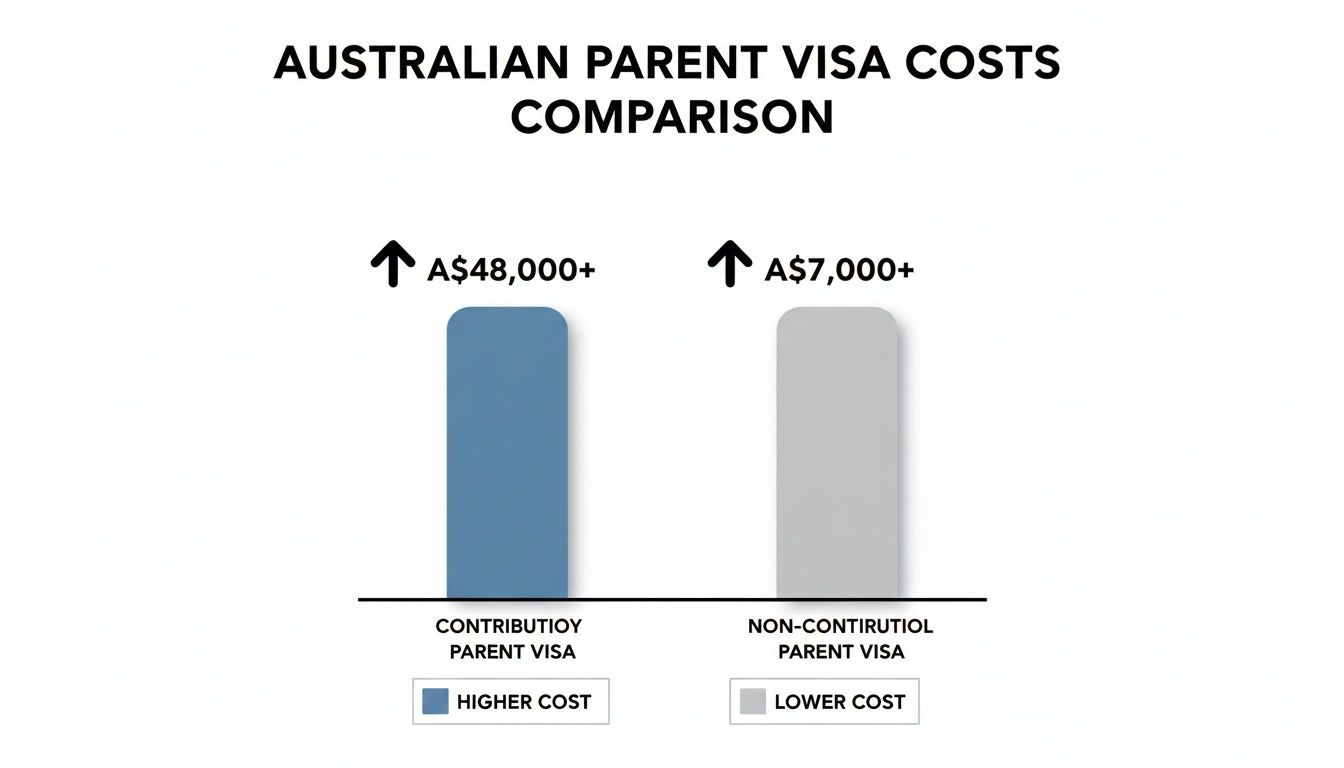
As you can see, the financial gap is massive. This really highlights the tough decision families face between getting their parents here sooner versus what they can realistically afford.
Parent Visa Pathways At a Glance: Cost vs Wait Time
To make this trade-off even clearer, let's lay out the main permanent parent visa options in a simple table. This gives you a quick snapshot of the essential differences.
| Visa Subclass | Visa Type | Approximate Govt. Application Cost (per person) | Approximate Processing Time |
|---|---|---|---|
| Subclass 103 | Parent (Non-Contributory) | ~$7,100 | 20-30+ years |
| Subclass 143 | Contributory Parent (Permanent) | ~$48,640 | 4-6 years |
| Subclass 173/143 | Contributory Parent (Temporary to Permanent) | ~$33,025 (Stage 1) + ~$20,285 (Stage 2) | 4-6 years (total) |
| Subclass 804 | Aged Parent (Non-Contributory) | ~$7,100 | 10-15+ years |
This table really drives home the point: lower costs mean significantly longer waits. For those who need a faster outcome, the Contributory Parent Visa (Subclass 143) is often the go-to choice, though the total cost hits around AUD 48,640 for one applicant. This is usually broken down into a first instalment of about AUD 5,040 when you lodge the application, with the much larger second instalment of AUD 43,600 due just before the visa is granted.
You can learn more about these different visa streams on our family migration page.
Disclaimer: Information in this article is general in nature and may not be current at the time of reading. Visa regulations and fees can change without notice. Always refer to the official Department of Home Affairs website for the latest department fees. For advice tailored to your specific situation, book an appointment with a registered migration agent.
The Fast Track: Breaking Down Contributory Visa Costs
Ever wondered why some families pay a vastly higher price for an Australian parent visa? The simple answer is speed.
The ‘Contributory’ visa pathway, which covers the popular Subclass 143 (Contributory Parent) and Subclass 864 (Contributory Aged Parent) visas, is built for families who simply can’t bear the thought of waiting decades to be reunited.
This fast-track option comes with a hefty price tag because it involves a massive ‘contribution’ from you or your parents. Think of it as pre-paying for your parent's potential future healthcare and welfare costs. In return, the government grants them priority processing. It's the mechanism that lets them jump the enormous queue, shrinking a potential 30-year wait down to just a few years.
Demystifying the Two-Part Payment Structure
One of the key things to understand about the parent visa Australia cost for these visas is the two-part payment structure. It’s a staged approach designed to help families manage the significant financial hit over the entire processing period.
You don’t have to find the whole amount on day one. Instead, the cost is split into two instalments:
- First Instalment (Visa Application Charge): This is the initial fee you pay when you lodge the application. It gets the ball rolling and covers the Department of Home Affairs’ administrative costs to start processing your case.
- Second Instalment (Contribution Amount): This is the big one—the much larger payment that represents the main ‘contribution’. The good news is that it's only requested right at the end of the process, just before the visa is granted.
This system gives families several years between the first and second payments to get their finances in order, making an otherwise daunting cost a bit more achievable.
The Numbers: A Closer Look at the Fees
So, what are the actual figures we’re talking about? While the government adjusts these fees, the difference between the visa options really highlights the tough choices families face.
For instance, the standard, non-contributory Subclass 103 visa costs around AUD 7,345 paid over two instalments. In stark contrast, the contributory Subclass 143 skyrockets to approximately AUD 48,640—that’s a premium of over 560% for a dramatically shorter wait.
These contribution fees were brought in to help fund Australia’s healthcare system as migrant numbers grew. They’ve been indexed upwards over time, and with other costs like the Assurance of Support bond, the total expense can be considerable.
Disclaimer: Information in this article is general in nature and may not be current at the time of reading. Visa regulations and fees can change without notice. Always refer to the official Department of Home Affairs website for the latest department fees. For advice tailored to your specific situation, book an appointment with a registered migration agent.
A Smart Strategy: Spreading the Cost with the 173/143 Pathway
For many families, coming up with the full contribution amount in one go is a massive challenge, even with the staggered payment system. This is where a clever two-step strategy involving the Subclass 173 (Contributory Parent – Temporary) visa can be a lifesaver.
This pathway allows you to break the process, and the cost, into two very distinct stages:
- Stage 1 – Apply for the Subclass 173 Visa: This gets your parent a temporary visa valid for two years. You’ll pay a significant—but not the full—portion of the total contribution cost at this stage. Once granted, your parent can come to Australia, live here, and even get access to Medicare.
- Stage 2 – Apply for the Subclass 143 Visa: At any point before the two-year temporary visa expires, you can then apply for the permanent Subclass 143 visa. This is when you pay the remaining balance of the contribution fee.
This approach effectively spreads the total parent visa Australia cost over a much longer period, making it a far more manageable financial journey. It’s a flexible solution that can bring your parents to Australia sooner without needing the entire contribution amount ready at once. Understanding all your options, including the various permanent residency pathways, is the key to making the right choice for your family.
When the eye-watering price of a Contributory visa feels completely out of reach, don't despair. You have other options. But, and it's a big but, these more affordable routes come with serious trade-offs, mostly around waiting times and what kind of residency you get at the end. It's a different way to think about the whole parent visa Australia cost puzzle.
Let’s break down the pathways built for families who need to prioritise a lower upfront cost over speed. This means looking at two very different beasts: the classic 'patient pathway' of the Non-Contributory visa and the newer, more flexible Temporary visa.
The Patient Pathway: The Non-Contributory Visas (Subclass 103 & 804)
The Non-Contributory Parent visa (Subclass 103) and its onshore version, the Aged Parent visa (Subclass 804), are the polar opposites of their contributory cousins. On paper, they look fantastic because the government application fees are so much lower.
For a single parent, the Subclass 103 visa comes in at around AUD 4,990. That's just a fraction of the contributory price tag, which makes it seem like a no-brainer for anyone on a tight budget.
But this affordability comes at a massive cost: time. The waiting list for these visas is legendary, with official processing times stretching out for decades. For most families hoping to bring their elderly parents over, a potential 30-year wait just isn't realistic. It turns a dream into a very uncertain, very long waiting game.
This pathway is often called the 'queue visa' for a good reason. While the financial hurdle is much lower, the time barrier is enormous, making it suitable only for those in very specific situations who can truly afford to wait.
A Modern Alternative: The Sponsored Parent (Temporary) Visa (Subclass 870)
The Australian government saw the dilemma families were facing—stuck between a visa that was too expensive and one that was too slow. Their solution was the Sponsored Parent (Temporary) visa (Subclass 870). This option creates a modern, practical middle ground for a lot of families.
The first thing to understand is that the Subclass 870 is not a permanent residency visa. Instead, it lets your parents live in Australia for a long, continuous stretch. It’s a real, tangible way to get your family together sooner without the huge financial hit of a permanent contributory visa.
Its flexible cost structure is pretty straightforward:
- 3-Year Stay: The government application fee is AUD 5,735.
- 5-Year Stay: The government application fee is AUD 11,470.
Your parents can renew this visa from outside Australia, which means they can stay for up to 10 years in total. Sure, it doesn't lead to permanent residency or give them access to Medicare, but the benefits are huge. Processing is much faster—often just a few months—and it sidesteps one of the biggest roadblocks of the permanent parent visas.
Key Advantage: No Balance of Family Test
Here’s the game-changer for many: the Subclass 870 does not require the 'Balance of Family Test'. This test, which is a must for all permanent parent visas, demands that at least half of the parent's children are permanent residents in Australia. For so many families, this rule is an instant dealbreaker.
The Subclass 870 completely removes that barrier, opening a door for families who thought they had no options left. It’s powerful proof that permanent residency isn't the only way to bring your loved ones to Australia.
Disclaimer: Information in this article is general in nature and may not be current at the time of reading. Visa regulations and fees can change without notice. Always refer to the official Department of Home Affairs website for the latest department fees. For advice tailored to your specific situation, book an appointment with a registered migration agent.
Uncovering the Hidden Costs You Need to Budget For
The official government application charge is just the tip of the iceberg when it comes to the total parent visa Australia cost. Many families are caught off guard by the other non-negotiable expenses that are critical for a successful application. To create a realistic budget, you have to look far beyond the headline visa fee and account for these equally important costs right from day one.

These aren’t optional extras; they're mandatory hurdles every applicant has to clear. Overlooking them can lead to serious financial stress and, even worse, long delays in your application. Let's pull back the curtain on each of these so-called 'hidden' costs so you can build a truly complete financial plan.
The Assurance of Support (AoS) Bond
The Assurance of Support, or AoS, is easily one of the biggest additional costs for most permanent parent visas. It's a hefty, refundable security deposit the Australian government holds to make sure your parents won't need to rely on social security payments after they arrive.
Think of it as a financial safety net. The person who provides the AoS (the 'assurer') has to pass a strict income test to prove they can financially support your parents. The bond itself is held for a set period—usually 10 years for contributory parent visas—and is returned in full (without interest) as long as your parents don't claim any qualifying social welfare payments during that decade.
The current bond amounts are:
- $10,000 for one parent applicant.
- $14,000 for two parent applicants.
That's a huge sum to have tied up for ten years, making it an absolutely critical piece of your financial planning puzzle.
Mandatory Health and Character Checks
Every single person applying for an Australian visa has to meet specific health and character requirements. These checks are non-negotiable and come with their own price tags that can quickly add up, especially if your parents have lived in several different countries.
1. Health Examinations
All parent visa applicants must have a medical examination with a government-approved panel physician. The cost varies depending on the country and what specific tests are needed, but you should budget for around $300 to $500 AUD per person.
2. Police Certificates
You’ll need to get a police clearance certificate from every country your parents have lived in for 12 months or more over the last 10 years. The cost and how you get these certificates can be wildly different from one country to the next, so it’s smart to get started on this early.
3. Biometrics Collection
Applicants from certain countries might also need to provide biometrics (fingerprints and a photo) at an Australian Visa Application Centre. This service usually comes with a small fee.
For a deeper dive into what these checks involve, you can explore more about Australia's health and character requirements in our guide.
The Cost of Professional Guidance
While you can lodge an application yourself, the sheer complexity of parent visas makes getting professional help a very wise investment. One small mistake on a form or a single missing document can lead to a refusal, costing you thousands of dollars and years of wasted time.
A registered migration agent, like our experts here at My Visa Guide, provides support you just can't put a price on. Our fees cover:
- Figuring out the absolute best visa strategy for your family.
- Making sure your application is decision-ready and ticks every legal box.
- Taking care of all the back-and-forth with the Department of Home Affairs.
- Guiding you through every single step, from health checks to the AoS process.
Investing in professional services is about more than just convenience; it's about protecting your financial investment and giving your family the best possible shot at success.
To help you get a clearer picture, here's a quick summary of the additional costs you'll need to factor into your budget.
Estimated Additional Costs Checklist
| Expense Item | Estimated Cost Range (AUD per person) | Key Considerations |
|---|---|---|
| Assurance of Support (AoS) Bond | $10,000 (1 person) or $14,000 (2 people) | Refundable after 10 years (for most parent visas) if no social security is claimed. |
| Health Examination | $300 – $500 | Varies by country and required medical tests. Charged per applicant. |
| Police Certificates | $50 – $200+ | Cost varies significantly by country. Required for each country lived in for 12+ months in the last 10 years. |
| Biometrics Collection | $30 – $100 | Only required for applicants from certain countries. |
| Document Translation | $50 – $150 per document | Necessary for any official documents not in English (e.g., birth certificates). |
Remember, these are estimates. The final tally will depend on your parents' specific circumstances, but this checklist gives you a solid foundation for a comprehensive budget.
Disclaimer: Information in this article is general in nature and may not be current at the time of reading. Visa regulations and fees can change without notice. Always refer to the official Department of Home Affairs website for the latest department fees. For advice tailored to your specific situation, book an appointment with a registered migration agent.
Beyond the immediate visa expenses, it's vital to budget for long-term considerations such as aged care costs; discover more in our comprehensive guide to aged care financial planning in Australia. This will help you create a sustainable financial future for your parents once they arrive.
How Annual Quotas and Queues Shape Your Timeline
Ever wondered why the wait times for Australian parent visas feel so incredibly long? It’s a common frustration, and the answer isn't about slow paperwork—it's a deliberate system of supply and demand, all controlled by government-set annual caps.
Think of it like trying to get a membership to a very exclusive club. The club decides it will only accept a handful of new members each year. It doesn't matter if thousands of perfectly qualified people are lined up outside; once that yearly limit is hit, the doors close until the next year. This is exactly what happens with parent visas.
The government sets a strict annual quota, or capping, on the number of permanent parent visas it grants each financial year. With far more families applying than there are spots available, a massive queue forms, getting longer every day.
Why Contributory Visas Get Priority Access
So, how do some families seem to jump this enormous queue? This is where the Contributory visa pathway comes in.
When you pay that huge second instalment for a Contributory visa, you’re not just paying a fee—you're essentially buying a priority pass. The government allocates a much larger slice of the annual visa pie to contributory applicants, allowing them to bypass the main line.
This is the fundamental trade-off at the heart of the parent visa decision:
- Non-Contributory Applicants (Subclass 103/804): You join the general queue, which moves at a snail's pace because it gets very few of the available spots each year.
- Contributory Applicants (Subclass 143/864): You join a much shorter, faster-moving priority queue that gets the lion's share of the annual visa spots.
It puts the high cost into perspective. You're not just paying for the visa itself; you're paying to secure one of the very limited, high-priority places available each year.
The Numbers Behind the Wait
The real-world impact of these caps is staggering. To manage migration numbers, the government keeps a tight rein on the program, with only 8,500 places allocated for the 2025-26 financial year. This single number has to cover all permanent parent visa subclasses.
With demand so much higher than supply, the backlog is immense. Even a "fast-tracked" Contributory Subclass 143 visa can face a wait of several years. For the Non-Contributory Subclass 103, the queue can stretch to over 30 years. It’s a confronting reality.
You can dive deeper into Australia's migration planning levels and see the official allocations by exploring insights on recent government budgets.
Disclaimer: Information in this article is general in nature and may not be current at the time of reading. Visa regulations and fees can change without notice. Always refer to the official Department of Home Affairs website for the latest department fees. For advice tailored to your specific situation, book an appointment with a registered migration agent.
Building Your Financial Plan for a Successful Application
Let's be honest: navigating the parent visa process is a financial marathon, not a sprint. You've gotten your head around the various costs, but now it's time for the most critical step—turning that knowledge into a concrete action plan. This means mapping out a detailed financial strategy that covers every single stage of the application.

A good plan starts by plotting out the key financial milestones. You’ll need to clearly define the initial application fee, the funds for the Assurance of Support bond, and a realistic timeline for saving up that substantial second instalment for the contributory visas. As you build your budget, it's also worth looking into effective tax planning strategies to make every dollar work harder for you.
Your Most Valuable Asset
This is where having an expert in your corner can make all the difference in managing the total parent visa Australia cost. A MARA-registered migration agent from My Visa Guide isn't just an extra expense; we're your most valuable asset in making this journey a success.
Our role goes far beyond just filling out forms. We're here to help you:
- Select the Right Pathway: We’ll sit down with you, analyse your family’s financial situation, and recommend the visa option that makes the most sense for your budget and goals.
- Prevent Costly Delays: A perfectly prepared, decision-ready application avoids the kind of expensive mistakes or refusals that can set you back thousands of dollars and months of time.
- Stay Ahead of the Curve: Government fees and policies can change without much warning. We keep you informed of any shifts that could affect your budget, so you can adjust your financial plan before it becomes a problem.
Disclaimer: Information in this article is general in nature and may not be current at the time of reading. Visa regulations and fees can change without notice. Always refer to the official Department of Home Affairs website for the latest department fees. For advice tailored to your specific situation, book an appointment with a registered migration agent.
Don't leave a journey this important to chance. Partnering with a professional ensures you have a clear, strategic, and financially sound plan from start to finish. It’s about giving you peace of mind and the best possible shot at reuniting your family here in Australia.
Your Top Questions About Parent Visa Costs, Answered
When you're navigating the financial side of a parent visa, a lot of specific questions can pop up. Let's tackle some of the most common queries we get, helping you tie up any loose ends in your financial planning.
Can I Pay the Parent Visa Application Fee in Instalments?
Yes, for the permanent parent visas—like the Contributory Subclass 143 and the Non-Contributory Subclass 103—you absolutely can. The government application charge is cleverly split into two parts. You’ll pay a smaller fee when you first lodge the application, and the much, much larger second instalment is only requested years down the track, right when the Department is ready to grant the visa.
This structure is a game-changer, giving you a crucial window of several years to get your finances in order for that final payment. Just keep in mind that this doesn't apply to the temporary Subclass 870 visa, which requires the entire government fee to be paid upfront.
What Happens to the Assurance of Support Bond Money?
Think of the Assurance of Support (AoS) bond as a refundable security deposit. The government holds onto it for a legally set period—usually 10 years for most permanent contributory parent visas. The whole point is to guarantee your parent won't need to lean on certain social security payments after they arrive.
So long as no qualifying welfare payments are claimed during that decade, the full bond amount is returned to whoever paid it (the assurer). It’s a straightforward process, but remember: you won't earn any interest on that money while it's being held.
Are There Any Fee Waivers or Concessions Available?
This is a firm no, unfortunately. The Visa Application Charges (VAC) for all parent visas are set in stone by the Australian government. They aren't eligible for any waivers, discounts, or concessions, regardless of your personal circumstances.
The hefty price tag on contributory visas is a deliberate policy choice, designed to help offset future healthcare and social support costs. Because of this, it's absolutely vital to budget for the full amount. If you can't pay the second instalment when it's requested, the visa will be refused, and you won't get your initial payment back.
Disclaimer: Information in this article is general in nature and may not be current at the time of reading. Visa regulations and fees can change without notice. Always refer to the official Department of Home Affairs website for the latest department fees. For advice tailored to your specific situation, book an appointment with a registered migration agent.
Do I Get a Refund if My Parent Visa Is Refused?
Generally, the first instalment of the Visa Application Charge you pay when lodging the application is non-refundable. This fee covers the government's administrative work in assessing your case, no matter the outcome.
The silver lining, if you can call it that, is if the application is refused before the huge second instalment is requested, you simply won't have to pay that final amount. This really underscores why getting your application complete and accurate from day one is so critical—it protects your initial financial investment.
Figuring out the complexities of the parent visa Australia cost requires careful planning and, often, a bit of expert guidance. The team at My Visa Guide is here to give you clear, honest advice, helping you choose the right pathway and prepare a flawless application. Book a consultation with us today to start your family's journey with confidence.