IMPORTANT NOTICE
Before we jump into the nitty-gritty of the new student visa rules, there's something you absolutely need to know about how immigration law works.
Your Essential Disclaimer for Visa Applications
Australian immigration rules can be a moving target. Policies shift, often without much warning. While this guide is accurate as of its publication date, what’s true today might not be the full picture tomorrow. Think of this as your starting point, not the final word.
For the most current advice that’s actually tailored to your situation, we can't stress this enough: book a consultation with a registered migration agent. They live and breathe this stuff and can give you up-to-the-minute guidance. Information in this article can be no longer true when you are reading it.
And when it comes to official government fees or visa application charges, the only place you should be looking is the Department of Home Affairs website. You can find their latest fee schedules right at https://www.homeaffairs.gov.au/.
Consider this guide your detailed map. A professional migration agent, however, is your live navigator—the one who helps you steer clear of unexpected roadblocks on your journey.
Understanding the Major Changes to Australian Student Visas
If you’re planning to study in Australia, you’ve probably heard whispers about some big visa changes. It’s true – the landscape for international students is shifting, and it’s happening for a reason. These aren't just random tweaks; they're part of a deliberate move by the government to manage migration levels and safeguard the world-class quality of Australia’s education system.
At the end of the day, the government wants to bring the focus of the international student program back to what it’s all about: education. After a huge surge in applications following the pandemic, there were growing concerns about the strain on infrastructure and some people using the student visa route more for work than genuine study. These new rules are the official response, designed to rebalance the system.
Navigating visa rules can feel like a maze, but it helps to know where to turn for solid advice. It's always a mix of understanding the law, getting expert help from a migration agent, and checking the official government sources.
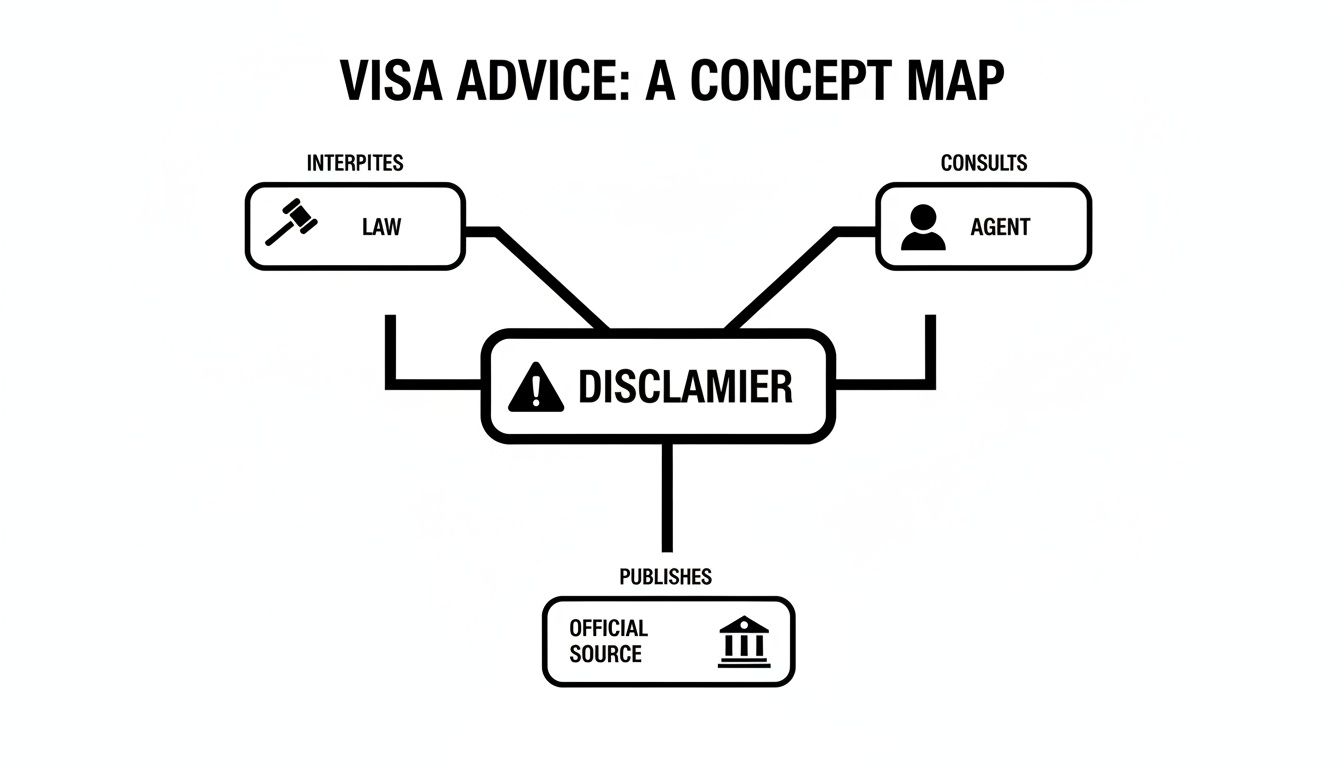
The main takeaway here is that you need a multi-pronged approach. Rely on the legal framework, lean on expert agents, and always cross-reference with official information. And remember, immigration policy is never set in stone.
Key Updates You Must Know
So, what are the biggest shifts you need to get your head around? The changes hit several key parts of the application process, making the whole thing a lot more rigorous. Knowing what they are is your first step to building a rock-solid application.
Here are the four most critical updates:
- New Student Enrolment Caps: The government will now put a limit on how many international students each institution can enrol.
- Genuine Student (GS) Requirement: The old Genuine Temporary Entrant (GTE) statement is gone. It's been replaced by a much more focused Genuine Student test.
- Increased Financial Evidence: You’ll now need to prove you have access to more money to cover your living costs.
- Higher English Language Scores: The minimum test scores required to prove your English skills have been bumped up.
Important Disclaimer: Please remember that immigration policies can change. For the most current and personalised advice, it is always best to book an appointment with a registered migration agent as the information in this article can be no longer true when you are reading it.
To make these changes easier to digest, here's a quick comparison of the old rules versus the new ones.
Key Student Visa Rule Changes At a Glance
| Visa Aspect | Previous Rule | New Rule |
|---|---|---|
| Genuineness Test | Genuine Temporary Entrant (GTE) statement required | Replaced by a more targeted Genuine Student (GS) requirement with specific questions |
| Financial Capacity | Proof of funds for living costs was $24,505 AUD | Increased to $29,710 AUD to reflect higher living expenses |
| English Proficiency | IELTS score of 5.5 or equivalent | Minimum score raised to IELTS 6.0 or equivalent |
| Enrolment Management | No federal caps on international student numbers | Government now has the power to cap enrolments at institutions |
This table shows that across the board, the standards have been raised to ensure applicants are well-prepared for their studies in Australia.
What This Means for Applicants
Put simply, these new rules raise the bar. Your application is going to be under a much bigger microscope. The focus has shifted from just proving you’ll leave Australia after your course to demonstrating you are a serious, well-prepared student with a clear plan for your education and career.
Think of it this way: the old system was like a basic checkpoint. The new system is more like a detailed interview where you have to convincingly argue your case. For example, the switch from GTE to the Genuine Student requirement means your personal statement needs to be less about your ties to home and more about why your chosen course in Australia is the most logical and beneficial step for your future.
As always, make sure you're checking the official Department of Home Affairs website for the latest visa application charges and fees. You can find this crucial information at https://www.homeaffairs.gov.au/. Every single change, from the money you need in the bank to your language skills, is designed to make sure students arriving in Australia are truly set up for success, both in the classroom and out.
Of all the recent changes to Australia's student visa rules, this is the big one: a new federal cap on how many international students can enrol. This isn't just a minor adjustment; it's a fundamental shift in how Australia manages its world-class education sector. If you're planning to study here, you absolutely need to understand what this cap means for your application.
At its core, the idea is straightforward. The government can now set a limit on the number of new international students each university, TAFE, or college can take on. This whole policy came about to get a handle on the record-breaking number of students who arrived after the pandemic, which put a real strain on infrastructure across the country, especially housing.
Why Is This Happening Now?
The timing is no coincidence. It's a direct response to the massive surge in student visas granted after COVID-19 travel restrictions were lifted. Students flocked back to Australia, and while that was great for the education sector, it also created some serious growing pains. The system just couldn't sustainably accommodate that many people arriving so quickly.
So, the government decided to step in. In a major move to manage growth and ease the pressure on the housing market, they announced a cap on new international student numbers, set to kick in from 2025. Initially, the limit was flagged at 270,000 places, with plans to lift it to 295,000 in 2026. This came after a peak in the 2023 financial year, when close to 600,000 student visas were granted as students from countries like China and India returned in droves. You can read more about the government's decision on Arab News.
Disclaimer: Immigration laws and policies are constantly changing. For advice that's up-to-date and tailored to your situation, we can't stress this enough: book an appointment with a registered migration agent. Information in this article can be no longer true when you are reading it.
How Will the Cap Actually Work?
This isn't a simple, one-size-fits-all national limit. The cap will be allocated to individual education providers. Think of it like a quota system – each university, TAFE, and private college will get its own maximum number of international students it's allowed to enrol.
This gives the government a lever to pull, allowing them to prioritise certain courses and institutions. For instance, universities that are heavily involved in critical research or offer courses that address Australia's skills shortages will likely get a bigger piece of the pie.
- Universities: You can expect higher education providers, especially those known for their research output, to be treated more favourably.
- Vocational Education and Training (VET): Private VET colleges might face much tighter restrictions on their enrolment numbers, particularly those that have been under the microscope for quality issues.
What this all means is that your choice of institution is now more critical than ever. A university with a larger cap simply has more spots available, which could directly impact your chances of getting an offer.
Who’s Going to Feel the Impact?
The new enrolment cap won't affect everyone equally. The main group in the firing line will be new students applying from outside Australia. If you're at the very beginning of your journey, you’ll be competing for a spot in this newly managed, and much more competitive, system.
However, some students will likely be exempt. While the final details are still being ironed out, we expect the caps won't apply to:
- Students enrolled in higher degrees by research (like PhDs and Master's by research programs).
- Students heading to regional campuses, as a way to encourage growth outside the major capital cities.
- School students and those in certain English language (ELICOS) programs that act as a direct pathway to further studies.
This is all designed to protect Australia's top-tier research programs while controlling the overall numbers in the most popular cities and course types. The bottom line? These new rules for Australia student visa applicants make strategic course and location selection a non-negotiable part of your application.
And a quick reminder: always check the official Department of Home Affairs website at https://www.homeaffairs.gov.au/ for the latest government fees for your visa application.
Mastering the New Genuine Student (GS) Requirement
Easily one of the biggest changes in the new rules for Australia student visa applications is the switch from the old Genuine Temporary Entrant (GTE) test to the new Genuine Student (GS) requirement. This isn't just a simple name swap; it's a completely different way of looking at student applications. Getting your head around this change is absolutely vital.
The old GTE was all about proving you intended to leave Australia once your studies were finished. You had to show strong ties to your home country to convince the case officer you wouldn't just stick around. It was basically a "promise to leave."
The new Genuine Student requirement flips that on its head. Now, it's all about your future. Think of it as presenting a "plan for success," where you have to prove you're a serious, committed student and that your chosen course is a logical stepping stone to a clear career path. The focus has shifted from your past ties to your future potential.
From Promise to Plan: The GTE vs. GS Mindset
Imagine you're applying for a business loan. The old GTE approach was like the bank asking, "Can you prove you have good reasons to go back home and won't just disappear with our money?" All your energy went into showing you had a house, family, or a job waiting for you.
The new GS approach is totally different. Now, the bank is asking, "Show us your business plan. How will this loan build a successful future for you, and why does this plan make sense based on your skills?" The spotlight is firmly on the logic and viability of your study plan.
What this means for you is that your application has to tell a clear, convincing story about your academic and career journey. The Department wants to see you've done your homework—that studying in Australia is a deliberate, well-considered investment in your future, not just a backdoor way into the country. You can dive deeper into the specifics in our detailed guide on what is the genuine student requirement.
Answering the Crucial GS Questions
To figure out if you're a genuine student, the Department now asks a specific set of questions in the online visa form. Your answers are the heart of your application and must be backed up with solid evidence. Waffling, vague statements just won't fly anymore.
You'll need to clearly address these key areas:
- Your Current Circumstances: Give details about your family, community ties, and current employment situation back home.
- Why Australia? Explain your reasons for choosing Australia for your studies over other potential countries.
- Why This Provider and Course? Justify your choice of a specific university or college and explain how the course directly builds on your past studies and leads to your future career goals.
- The Benefits of Your Course: Be specific about how completing this course will benefit you, both personally and professionally.
- Previous Study in Australia: If you've studied here before, you must provide your full academic history.
- Your Plans After Studying: Explain what you plan to do after graduation, linking it directly to the skills your new qualification will give you.
Disclaimer: Immigration laws can and do change, sometimes with very little warning. For the most up-to-date advice that's tailored to your personal situation, we always recommend you book an appointment with a registered migration agent as the information in this article can be no longer true when you are reading it.
Crafting a Compelling GS Statement
The answers to these questions form your GS statement, and it's your chance to speak directly to the person deciding your fate. It must be personal, detailed, and 100% authentic. Every claim you make needs proof to back it up.
For instance, when explaining your course choice, don't just say, "It's a good course." That's not enough. Instead, explain how specific modules, like 'Machine Learning' or 'Statistical Modelling,' will give you the exact skills you need for your target job as a Data Analyst.
Likewise, when talking about your career goals, get specific. Name a few potential employers in your home country, mention current job market trends, and even include expected salary ranges to show you've done the research. This demonstrates to the case officer that your plan is realistic and well-founded, which is the key to satisfying the new GS requirement. And remember, it’s always a good idea to check the official Department of Home Affairs website at https://www.homeaffairs.gov.au/ for the latest visa application fees.
Navigating Increased Financial and English Language Hurdles
On top of the Genuine Student requirement, two other massive pillars of your visa application have been reinforced: how much money you have and how well you speak English. These aren't just minor tweaks; they're significant hurdles you need to clear. Trying to cut corners here is a fast track to a visa refusal, so careful preparation is everything.
The government isn't doing this to be difficult. These changes are a direct response to the rising cost of living in Australia and the high academic standards of our institutions. They want to be sure that when you land, you're set up for success from day one—both financially and linguistically.
The New Financial Capacity Requirement
Let's talk numbers. The amount of money you need to prove you have access to has taken a decent leap. As of late 2023, a primary student visa applicant now has to show they have at least $29,710 AUD to cover their first 12 months of living costs. This is a big jump from the previous figure of $24,505 AUD.
This isn't a number plucked out of thin air. It’s tied to the real cost of living and is reviewed each year to make sure students arrive with enough of a buffer to handle rent, food, transport, and everything else without falling into financial stress.
A Quick Disclaimer: Australian immigration rules can and do change. For the most up-to-date and personalised financial advice, your best bet is always to book an appointment with a registered migration agent. The information in this article can be no longer true when you are reading it.
So, how do you actually prove you've got the cash? The Department of Home Affairs is pretty specific about the kind of evidence they'll accept.
- Bank Statements: You'll need to show statements from an approved bank that demonstrate a consistent savings history over time.
- Loan Documents: Proof of a loan from the government or a recognised financial institution is also a solid option.
- Scholarships or Sponsorship: If you're getting financial support from your university or another official source, you'll need the formal paperwork to back it up.
Remember, just having the money isn't the whole story. You have to prove it’s genuinely yours and available for your studies. A large, unexplained deposit appearing in your account right before you apply is a massive red flag for case officers. Looking further ahead, managing finances is also crucial when considering big life steps like buying a home in Australia on a temporary visa.
Higher English Language Test Scores
The other major change is the bump in the required English language test scores. Rolled out in early 2024, the new standards are designed to ensure you have the communication skills to not just get by, but to truly thrive in an Aussie classroom and community.
These new minimums are now in effect across all the major tests.
| Test Type | Previous Minimum Score | New Minimum Score |
|---|---|---|
| IELTS (Academic) | 5.5 | 6.0 |
| PTE Academic | 42 | 50 |
| TOFL iBT | 46 | 64 |
This change really highlights just how important strong English skills are to your application. If you're finding it tough to hit these higher scores, it's time to get proactive. A great starting point is to check out our guide on how My Visa Guide offers English proficiency support.
These tougher financial and language rules are a central part of the new rules for Australia student visa applications. They are there to filter for well-prepared, genuine students who have the best chance of succeeding. Getting your documents perfect and hitting these benchmarks has never been more critical. And as always, for the latest official government application fees, go straight to the source at https://www.homeaffairs.gov.au/.
Right, so you understand the new rules. But what does that actually mean for your chances of getting that visa grant notice?
Let's be blunt: the game has changed. These stricter rules mean every single application is going under the microscope. It’s no longer a simple box-ticking exercise. Think of it more like a competitive job interview, where only the most convincing and well-prepared candidates get through.
The reality is, with the government zeroing in on the Genuine Student (GS) requirement, demanding more proof of funds, and setting the bar higher for English, the Department of Home Affairs is digging deeper. Case officers are scrutinising your real motivations, your financial backstory, and your academic history like never before. An application that might have just squeaked by a year ago now faces a much higher chance of refusal.
A Look at the Numbers: Success and Rejection Rates
The data tells a pretty clear story. Australia's student visa approval rates have always had their ups and downs, but we're now in a period of tighter control.
Back in 2021, during the pandemic when application numbers were low, we saw a peak approval rate of 96.8%. Then, as the borders flew open, there was a massive surge, with 263,737 visas granted in 2022 before the government started pumping the brakes.
The trend now is all about moderation and control. While we saw an 85-87% approval rate for well-prepared applicants in 2025, projections for 2026 suggest this could dip slightly to between 83-88%. This doesn't mean it's impossible—far from it. It just means the margin for error has practically vanished. For a deeper dive, you can find more insights about Australian visa success rates on leverageedu.com.
A Quick Disclaimer: Immigration rules and success rates can change in the blink of an eye. For advice that's tailored to your exact situation, the smartest move is to book an appointment with a registered migration agent. The information in this article can be no longer true when you are reading it.
This isn't to scare you, but to set your expectations straight. Success is absolutely within reach, but it demands a flawless application.
Common Mistakes That Get Visas Refused
With rejection rates sitting somewhere between 12-17%, you need to know what’s tripping people up. Unsurprisingly, the main reasons for refusal under the new rules for Australia student visa applications tie directly back to the big changes.
Here are the most common pitfalls that can sink your application:
- A Weak Genuine Student (GS) Statement: Vague, copy-paste answers are a massive red flag. If you can't clearly and convincingly connect your chosen course to your past studies and future career, you're on a fast track to refusal.
- Shaky Financial Evidence: Just meeting the minimum amount isn't the whole story. You have to prove the funds are genuinely yours and have been for a while. Large, unexplained deposits that appear in your account right before you apply are one of the first things a case officer will question.
- Inconsistent Information: Does your GS statement say one thing while your financial documents or academic history suggest another? Any mismatch, no matter how small, creates doubt. Consistency across every single document is non-negotiable.
- A Puzzling Course Choice: Picking a course that seems like a random detour from your previous education or doesn't line up with your career goals will undermine your claim of being a genuine student. It has to make logical sense.
Dodging these bullets isn't about luck; it's about strategy. You need to build a coherent, compelling story that leaves no room for doubt about why you want to study in Australia. And remember, for the latest official government visa fees, always check directly on the Department of Home Affairs website. In this tougher climate, a perfect application is your best—and only—defence.
Your Game Plan for Getting That Visa
Knowing the new rules is one thing, but actually putting that knowledge to work to build a winning visa application? That's what really counts. The bar for student visas has been set higher than ever, which means a sloppy, last-minute application just won't cut it anymore. It's time to get strategic and build a case that leaves no room for doubt.
The whole application landscape is more competitive now, and that’s a direct result of the new rules for Australia student visa applications. We saw international student numbers hit a peak of around 600,000 in 2023. Since then, the government has put caps in place, and while the numbers year-to-date for October 2025 are still high at 833,041, that's only a tiny 0.3% dip from 2024. This signals that the intake is stabilising under these tighter policies.
Looking at early 2026, we can see that 53,747 higher education visas were granted to main applicants outside Australia between January and May. This shows a clear focus on processing specific applications amidst the new annual cap of 295,000. You can find more detail on these student visa trends on modernmigrationaustralia.com.au.
What do all these numbers mean for you? They paint a very clear picture: every single detail in your application has to be perfect.
Your Must-Do Application Checklist
To help you get everything in order, I’ve put together a checklist of the key things you absolutely have to nail for a strong application under the new, stricter standards.
Nail Your Genuine Student (GS) Statement: Forget generic, copy-paste answers. You need to write a compelling story that connects the dots between your past studies, the course you've chosen, and where you see your career going. Be specific, make it personal, and back up everything you say with evidence.
Get Your Finances in Order: Triple-check that you meet the new financial capacity requirement of $29,710 AUD. Make sure your proof of funds is from an approved source and shows you’ve been saving consistently. Large, last-minute deposits are a huge red flag for case officers, so avoid them at all costs.
Check Your English Score: Make sure your English test results are up to scratch. For example, the new minimum for an IELTS score is 6.0. If you're not quite there, make it a priority to study more and retake the test with plenty of time to spare before you lodge your application.
Justify Your Course Choice: Take a hard look at the course and institution you've picked. You have to be ready to explain exactly why this specific program is the logical next step for you, both academically and professionally. Does it make sense with your history? Be honest with yourself.
Disclaimer: This guide is for general information, but remember, Australian immigration law can and does change. For advice that’s tailored to your specific situation, it's absolutely crucial to book an appointment with a registered migration agent. The information in this article can be no longer true when you are reading it.
Why Expert Guidance is a Game-Changer
Trying to figure all this out on your own can be incredibly overwhelming. This is where getting a MARA-certified migration agent on your team becomes your biggest advantage. An expert can spot potential weaknesses in your application that you might completely miss, turning a good application into a great one.
From helping you find the right words for your GS statement to making sure your financial documents are presented perfectly, a migration agent adds a professional layer of review that can make all the difference. They know what case officers are looking for and how to frame your application to really show off your strengths as a genuine student. You can find out more about how our team can support you with our student visa assistance for subclass 500.
At My Visa Guide, we're all about being transparent and ethical. Our goal is to set you up for the best possible outcome, helping you turn the challenge of these new rules into your success story. And just a reminder, for any official department fees, always go straight to the source at https://www.homeaffairs.gov.au/.
At My Visa Guide, our MARA-certified migration agents are here to give you clear, honest, and expert advice to help you get through Australia's new student visa rules. Let's work together to build a strong application and make your study goals a reality. Book your consultation today.