IMPORTANT NOTICE
The 482 DAMA visa requirements open up a more flexible route for skilled workers, allowing regional employers to sponsor them under special agreements. Think of it as a custom-made version of the standard Temporary Skill Shortage (TSS) visa (Subclass 482)—one that's been specifically tailored to fix critical job shortages in designated regional areas of Australia.
Disclaimer: Migration regulations and policies are complex and change frequently. The information provided in this article is for general guidance only and may not be current at the time of reading. To receive advice tailored to your specific circumstances, we strongly recommend you book an appointment with a registered migration agent. For any department fees, always refer to the official https://www.homeaffairs.gov.au/ website.
Understanding the 482 DAMA Visa
A Designated Area Migration Agreement, or DAMA, is a formal deal struck between the Australian Government and a specific regional body. The whole point is to give local businesses a lifeline, helping them fill roles they genuinely can't find Australian workers for. This program is a real game-changer, both for regional economies and for skilled migrants who might not tick all the boxes for the standard visa streams.
While the normal Subclass 482 visa follows a pretty rigid set of rules, the DAMA pathway brings in what we call concessions—or flexibilities. These adjustments make it easier for certain applicants to get sponsored and work in a particular region.
How DAMA Differs from Standard Visas
The key difference really boils down to its adaptability. A DAMA isn't a whole new visa class; it's a special arrangement that works within the existing employer-sponsored program. It essentially empowers regions to negotiate terms that make sense for their unique local economy.
This creates several major advantages:
- Broader Occupation Lists: DAMAs often feature occupations you won't find on the standard skilled visa lists, opening doors for roles in hospitality, agriculture, and aged care, among others.
- Flexible Skill Requirements: Some agreements might ease up on the usual requirements for work experience or formal qualifications, offering a bit more wiggle room.
- Pathways to Permanency: Many DAMAs include a clear, structured pathway to permanent residency, usually through the Employer Nomination Scheme (Subclass 186) visa after you’ve worked in the region for a few years.
Disclaimer: Australian migration law changes all the time. The information you're reading here might not be current when you see it. For the most up-to-date and personalised advice, it's always best to book an appointment with a registered migration agent.
The Purpose of DAMAs
At the end of the day, DAMAs are all about supporting the growth and sustainability of regional communities. By giving employers access to a wider talent pool, these agreements help keep vital local industries not just running, but thriving. It's a targeted approach that ensures migration directly solves documented labour shortages right where they're being felt the most.
For any visa application, always double-check the official Department of Home Affairs website for the latest government fees and forms.
Here’s the rewritten section, designed to sound like an experienced human expert and match the provided writing style.
How DAMA Concessions Can Help Your Application
This is where the DAMA pathway really shines. The true power of the 482 DAMA visa requirements is their flexibility. While the standard Subclass 482 visa follows a pretty rigid, one-size-fits-all rulebook, a DAMA introduces special advantages called ‘concessions’.
Think of them as tailored adjustments made to solve real-world problems for a specific region.
These concessions are the number one reason why many skilled workers—who might not tick all the boxes for other visas—find a way forward with a DAMA. They can turn a clear-cut refusal into a genuine opportunity for both you and your sponsoring employer. In short, a region can negotiate with the government to relax certain rules for occupations it’s desperate to fill.
Lower English Language Requirements
Let's be honest, meeting Australia’s English language standards can be a massive hurdle. The DAMA program often tackles this head-on by offering a concession on the minimum test scores.
For example, a standard 482 visa might need an IELTS score of 5.0 overall with no band less than 4.5. But under a DAMA, a region might get approval to sponsor a worker with a slightly lower score. This acknowledges that for many hands-on roles, functional English is what really matters. This one simple adjustment opens the door for so many skilled people.
Salary Concessions and TSMIT
Salary is another area where DAMAs offer some much-needed breathing room. Normally, all employer-sponsored visas must meet the Temporary Skilled Migration Income Threshold (TSMIT), a benchmark set by the government to ensure visa holders get a fair wage.
But DAMAs recognise that salaries in regional towns don't always match those in Sydney or Melbourne. A DAMA can include a concession allowing an employer to pay up to 10% less than the standard TSMIT, as long as the salary still matches what a local Australian worker would earn for that same job, in that same place. This makes it far more realistic for regional businesses to bring in overseas talent.
Important Note on Fees: Just a heads-up, visa application charges and other government fees can and do change. For the most up-to-date costs, always check directly on the official Department of Home Affairs website.
Greater Flexibility with Age Limits
For experienced, mature workers, the typical age limit for permanent residency (usually 45) can be a deal-breaker. This is where many DAMAs offer a game-changing concession for the permanent residency pathway that can follow the temporary 482 visa.
It’s quite common for DAMA arrangements to allow applicants to be up to 50 or even 55 years old when they apply for the permanent Subclass 186 visa. This is huge. It shows that the system values the deep experience that older workers bring to regional communities and industries.
To really see the difference, let’s put the standard rules side-by-side with the typical DAMA concessions.
Standard 482 Visa vs 482 DAMA Visa Key Differences
The table below breaks down the key advantages a DAMA can offer compared to the standard 482 visa stream. It highlights how these agreements are designed to address specific regional shortages.
| Requirement | Standard Subclass 482 Visa | Typical 482 DAMA Concession |
|---|---|---|
| Salary | Must meet the full TSMIT (e.g., $73,150). | Can be up to 10% below TSMIT, if it matches the local market rate. |
| English Proficiency | Requires a set minimum score (e.g., IELTS 5.0 with no band below 4.5). | May accept a lower overall score, depending on the role and region. |
| PR Age Limit | Generally capped at 45 years for the subsequent 186 visa. | Often extended to 50 or 55 years for the permanent pathway. |
| Occupation List | Limited to the official short-term and medium-to-long-term lists. | Includes a wider range of occupations specific to the region's needs. |
Of course, these concessions aren't a free-for-all. They are spelled out in each individual DAMA and only apply to specific occupations. This targeted approach makes sure the flexibility solves genuine labour shortages without undermining Australia's broader migration program. Understanding these benefits is the first step to seeing if the 482 DAMA visa requirements are the right fit for your journey to Australia.
Disclaimer: Migration regulations and policies are complex and change frequently. The information provided in this article is for general guidance only and may not be current at the time of reading. To receive advice tailored to your specific circumstances, we strongly recommend you book an appointment with a registered migration agent. For any department fees, always refer to the official https://www.homeaffairs.gov.au/ website.
Meeting the Eligibility Criteria for Applicants
Alright, now that we've covered how DAMA concessions can open new doors for businesses, let's switch gears and focus on you—the visa applicant. While concessions make the process more flexible, you still need to prove you have the right skills, background, and character for the job and for life in Australia.
Think of it like applying for a specialised role. The company has tweaked the job description (the DAMA concessions) to find the perfect person, but you still need a strong resume to get your foot in the door. For the 482 visa, this means ticking several key boxes.
First and foremost, your entire journey hinges on finding an approved employer in a DAMA region who is ready to nominate you for a role on their specific occupation list. That's the non-negotiable starting point.
Your Skills and Work Experience
At the heart of any 482 DAMA application is proving you can actually do the job you’re being sponsored for. You’ll need to show that you have the qualifications and work history to match the nominated occupation. This is usually where most of the paperwork comes in.
For most roles, you’ll need to gather:
- A Positive Skills Assessment: This is where an authorised assessing body officially verifies that your skills and qualifications meet Australian industry standards.
- Relevant Work History: The standard benchmark is at least two years of full-time, relevant work experience. Some DAMAs might offer concessions on this, but it’s the typical requirement you should aim for.
- Qualifications and Licensing: Be prepared to provide certified copies of your degrees, diplomas, and any licences or registrations needed to practice in your field.
This isn't just about ticking boxes. This evidence demonstrates to the Department of Home Affairs that you're a skilled professional who can hit the ground running.
Checking the DAMA Occupation Lists
One of the biggest advantages of the DAMA pathway is its unique occupation lists. These aren’t the same as the standard skilled occupation lists you see for other visas. Each DAMA region negotiates its own list directly with the government, based on what its local job market desperately needs.
This means you might find occupations like Childcare Worker, Agricultural Technician, or Truck Driver available under a DAMA, even when they're not on other mainstream visa lists. Your first move should be to check the specific DAMA list for the region you’re targeting—like Far North Queensland or the Northern Territory—to see if your profession is included.
Disclaimer: Immigration rules and fees can change with little notice. To get the most current advice tailored to your specific situation, it's always best to book an appointment with a registered migration agent. All government fees should be double-checked directly on the Department of Home Affairs website.
From Student or Graduate to Sponsored Employee
It's very common for successful DAMA applicants to already be in Australia on another visa. The local experience you gain on a Temporary Graduate (Subclass 485) or Student Visa (Subclass 500) can make you a much more attractive candidate for DAMA sponsorship.
Australia's need for skilled workers is clear, with primary Subclass 482 visa grants jumping by 31% in a single year due to persistent labour shortages. This surge brought the total number of primary 482 visa holders to around 119,000, showing just how crucial employer sponsorship is. If you're already here, this is a massive opportunity to transition into one of these high-demand sponsored roles.
Meeting Health and Character Requirements
Last but certainly not least, every applicant must meet Australia’s health and character standards. This is a fundamental part of almost every Australian visa application, and it’s taken very seriously.
You'll need to complete a medical examination and provide police clearance certificates from any country you’ve lived in for 12 months or more over the last 10 years. These checks are in place to protect the health and safety of the Australian community. To get a better handle on what's involved, you can read our detailed guide on the health and character requirements for Australian visas.
Understanding Your Obligations as a Sponsoring Employer
For businesses struggling to find local talent, sponsoring a worker through a DAMA can feel like a lifeline. But it’s important to see this for what it is: a serious legal and ethical commitment, not just a paperwork exercise. The government holds sponsoring employers to a very high standard, and for good reason—the system is designed to protect everyone involved, both local and overseas workers.
Meeting the 482 DAMA visa requirements from your side as an employer isn’t a one-off task. Think of it as a partnership where you first need to prove a genuine skills gap and then live up to the promises you make to both your new employee and the government. Getting this wrong can lead to hefty penalties, including large fines and even being banned from sponsoring anyone in the future.
The First Steps: Endorsement and Labour Agreement
Before you can even start thinking about a specific candidate, you need to get the official go-ahead from two different bodies. This is a crucial two-stage process that’s all about verifying the legitimacy of your business and the role you need to fill.
First up, you have to apply for an endorsement from the Designated Area Representative (DAR) in your specific region. The DAR is the local authority that manages the DAMA on the ground. They’ll take a close look at your business to make sure you’re actively operating in the area and that your need for the role is genuine.
Once you have the DAR's stamp of approval, the next step is to apply to the Department of Home Affairs for a formal DAMA labour agreement. This is the legal document that officially binds you to all the terms of that DAMA, including any concessions you get and all of your ongoing sponsorship duties.
Proving a Genuine Need Through Labour Market Testing
One of the absolute cornerstones of the employer-sponsored visa system is proving that you've genuinely tried—and failed—to find a suitable Australian citizen or permanent resident for the job. This process is called Labour Market Testing (LMT).
You can't just say you looked; you have to prove it. This means advertising the position in a very specific way for a set period, which is typically at least 28 days. Usually, this involves posting job ads on national platforms like Workforce Australia, plus at least two other prominent recruitment websites. You must keep detailed records of these ads and any applications you receive to show that your recruitment efforts were legitimate.
Disclaimer: Migration laws and policies are complex and subject to change. The information in this article is for general guidance only and may not be current when you read it. For advice tailored to your specific situation, it is essential to book an appointment with a registered migration agent.
Your Ongoing Sponsorship Obligations
Getting the visa granted is really just the beginning of the journey. As a sponsoring employer, you're signing up for a list of ongoing obligations that last for the entire time the visa holder is employed by you.
Here are some of your key duties:
- Paying the Correct Salary: You must pay your sponsored worker at least the salary you specified in the nomination, even if you used a DAMA concession to get them here. Crucially, this salary also has to be in line with what an equivalent Australian worker would be earning in the same role.
- Ensuring Fair Work Conditions: Your sponsored employee is entitled to the exact same workplace rights and conditions as any Australian employee under the law. No exceptions.
- Notifying the Department of Changes: You are legally required to keep the Department of Home Affairs in the loop about certain events, like if the employee stops working for you.
- Fulfilling Training Benchmarks: Some labour agreements come with a requirement to contribute to a training fund or demonstrate that you're investing in training your local Australian workforce.
Even with some policies getting tighter, employer sponsorship is more critical than ever. Recent figures showed that 482 visa grants shot up to 68,200 in a single year—a 31% increase. This trend is largely driven by Australia’s huge temporary visa population, which includes many graduates and working holiday makers actively seeking sponsorship. For employers, this is a massive talent pool, but it also means we can expect stricter audits and more rigorous LMT down the track.
A crucial part of your responsibility is getting the finances right. It’s wise to consult a tax and superannuation guide for temporary visa holders to make sure you're fully compliant with all Australian tax and super obligations for your sponsored employee.
Juggling all these duties requires careful management from day one. To get a broader picture of what it means to become a business sponsor, check out our guide on employer sponsorship pathways. And remember, always confirm official government fees for any visa application directly on the Department of Home Affairs website.
So, How Does the DAMA Application Process Actually Work?
Applying for a visa under a DAMA isn't something you do in one go. It’s a structured, step-by-step journey where your employer takes the lead for the first few stages before handing the baton over to you for the final visa application. Think of it as your employer laying all the groundwork first.
This sequential process is designed to make sure that by the time you lodge your visa paperwork, all the necessary approvals from your employer's side are already locked in. It’s a four-stage process, starting with your employer getting the green light from their local region and finishing with you submitting your visa application.
This flowchart maps out the key steps an employer has to nail before they can even nominate you for a role. It shows how everything flows from one stage to the next.
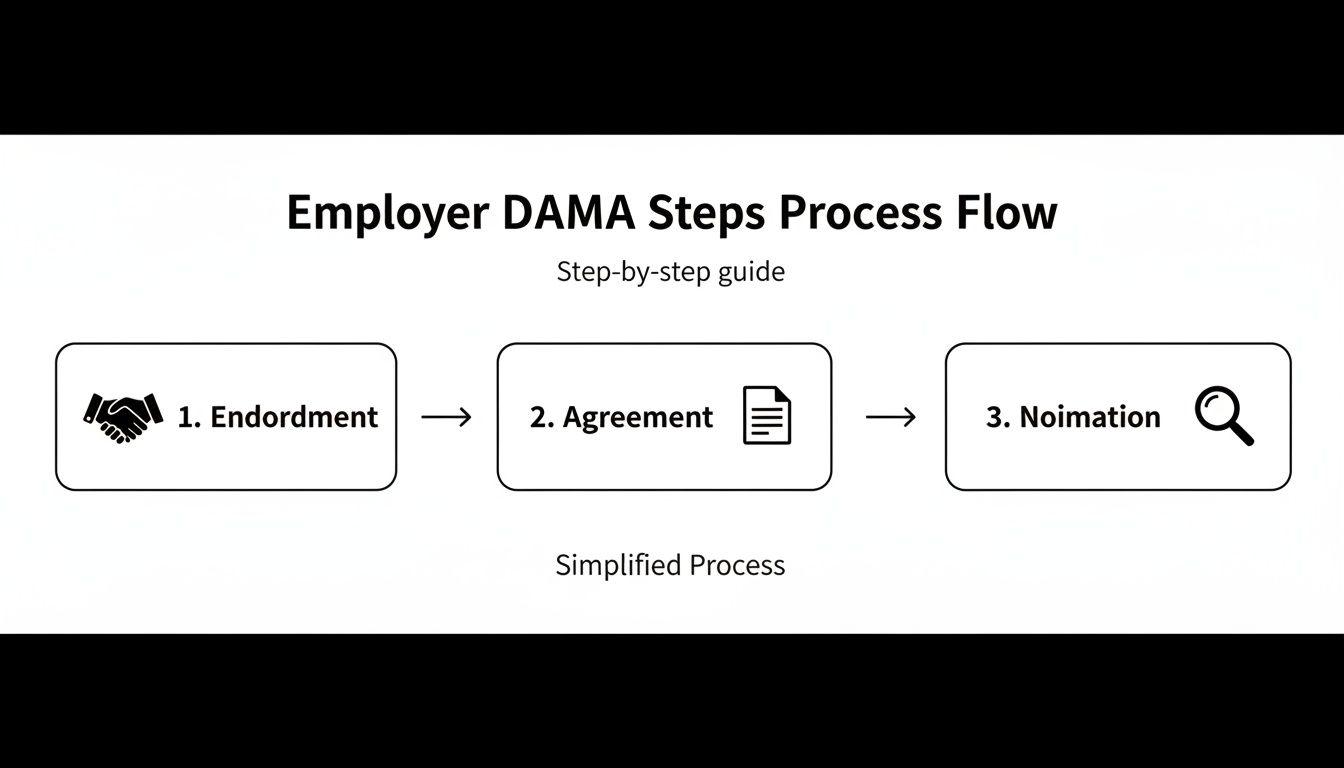
As you can see, an employer can’t just skip ahead to nominating a worker. They have to finalise their labour agreement with the government first.
Stage 1: Employer Gets an Endorsement
It all starts with your potential employer. Their first move is to apply to their regional Designated Area Representative (DAR) for an endorsement. The DAR is like the local gatekeeper; they check out the business to make sure it’s a legitimate local operation with a real need to fill the position they want to sponsor you for.
Stage 2: Employer Locks in the Labour Agreement
Once the DAR gives them the thumbs up, the employer then applies to the Department of Home Affairs for a DAMA Labour Agreement. This is the formal contract between the business and the Australian Government, giving them the official right to use the DAMA concessions for specific jobs. These agreements are usually valid for five years.
Stage 3: Employer Lodges Your Nomination
With the labour agreement officially in place, the employer can finally nominate you for the specific role. This nomination application lays out all the details—the job, your salary, and how it all fits within the terms of their DAMA. This is also where they have to show proof that they’ve tried to find a local worker first through Labour Market Testing.
Disclaimer: Migration laws are notoriously complex and can change in the blink of an eye. The information here is for general guidance only and might not be up-to-date when you read it. To get advice that’s right for your specific situation, it's essential to book an appointment with a registered migration agent.
Stage 4: You Submit Your 482 Visa Application
Now, it's your turn. After your employer has lodged the nomination (and often, after it's been approved), you can finally submit your Subclass 482 visa application. Your application is directly linked to their nomination, and this is where you'll provide all your personal documents—your skills assessment, proof of work experience, English test results, and health and character checks.
It’s crucial to understand what’s happening in Australian migration right now. The number of people on temporary visas has skyrocketed, with a staggering 387,572 people on bridging visas alone. This points to huge processing backlogs and a lot of people switching visas from within Australia, which has a direct knock-on effect for 482 applicants. For employers and skilled workers like yourself, this means the government is applying much tougher integrity checks and scrutinising every application more closely. You can get more insight into these migration pressures and what they mean for you.
With these kinds of backlogs, getting every single document perfect from the start has never been more critical. A small mistake or a missing document can cause massive delays, sending your application to the back of a very, very long queue. Your best strategy is meticulous attention to detail. And always double-check the latest government fees on the official Department of Home Affairs website before you lodge anything.
Using DAMA as Your Pathway to Permanent Residency
For many skilled workers, getting a Temporary Skill Shortage (Subclass 482) visa is just the first step on a much bigger journey. The real goal? Making Australia your permanent home. The great news is that most Designated Area Migration Agreements are built with this exact future in mind, offering a clear and structured pathway to permanent residency.
This is one of the biggest advantages of the DAMA stream. Unlike some standard 482 visa pathways that can feel like a dead end with no clear route forward, a DAMA acts as a reliable bridge, rewarding your commitment to a regional community.
The Typical Transition to Permanent Residency
So, how do you make the leap from a temporary DAMA visa to permanent residency (PR)? The most common route is through the Employer Nomination Scheme (Subclass 186) visa, specifically using the Labour Agreement stream.
Think of it as graduating from a temporary arrangement to a permanent one. After you’ve worked for your sponsoring employer in the designated region for a set period—usually two to three years—you can become eligible for them to nominate you for a permanent visa. This pathway is designed to recognise that you've successfully put down roots and become part of the local workforce and community.
Disclaimer: Migration laws and policies are constantly changing. The information here is for general guidance and might not be current when you read it. To get the most accurate and personalised advice for your situation, it's essential to book an appointment with a registered migration agent.
Overcoming the Age Barrier with DAMA Concessions
One of the toughest hurdles for many experienced applicants in the standard migration streams is the age limit, which typically cuts off at 45 years for permanent residency. This is where a DAMA can be an absolute game-changer.
Many DAMAs include a crucial age concession for the Subclass 186 visa pathway. It’s quite common for these agreements to allow applicants to be up to 50 or even 55 years old when they apply for their permanent visa. This is a practical recognition of the incredible experience and stability that mature workers bring to regional industries.
Building Your Strategic Roadmap
Securing permanent residency is the final piece of the puzzle, turning all your hard work and dedication into a long-term future in Australia. But you don't have to figure it all out on your own. Getting professional guidance can help you build a strategic roadmap that takes you from your first temporary visa all the way to citizenship.
Understanding the specific rules of your particular DAMA right from day one is the key to a smooth transition later on. You can learn more about the different options available by exploring our guide on permanent residency pathways in Australia. And for any application, always double-check the latest government fees on the official Department of Home Affairs website.
Of course. Here is the rewritten section, crafted to sound completely human-written and natural, following the style of your provided examples.
Your 482 DAMA Questions, Answered
When you're looking at the 482 DAMA visa requirements, it’s completely normal for a lot of questions to pop up. It’s a pretty unique pathway, after all. To help clear things up, we've put together some quick, straightforward answers to the questions we hear most often from both skilled workers and the businesses wanting to sponsor them.
Can I Apply If My Job Isn't on the Main Skilled Lists?
Absolutely, and this is probably the biggest drawcard of the DAMA pathway. Each region with a DAMA gets to negotiate its very own list of occupations directly with the government, based on what skills they’re genuinely short of on the ground.
You'll often find a whole range of jobs on these lists—everything from agricultural technicians to childcare workers—that simply aren't an option under the standard Subclass 482 visa. The very first thing you should do is find the DAMA list for the specific region you’re hoping to call home.
Are the English Requirements Always Lower?
An English language concession is a very common feature of DAMAs, but it’s not something you can automatically assume will be there. The exact requirements all come down to the fine print of that region's specific labour agreement, and sometimes it even changes from one job to another.
Think about it this way: a role that involves a lot of customer or client interaction might still need a higher level of English than a more hands-on trade position. It’s so important to check the exact details for the DAMA and the specific occupation you're targeting.
Disclaimer: Australian migration law is incredibly complex and changes all the time. The information here is for general guidance and might not be up-to-date when you read it. To get advice that’s right for your specific circumstances, you really must book an appointment with a registered migration agent.
How Long Does the 482 DAMA Visa Process Take?
Processing times can really be a mixed bag. Because the DAMA process has those extra steps that a standard 482 visa skips—like getting the nod from the Designated Area Representative (DAR) and then getting the labour agreement finalised—it can sometimes take a bit longer.
All sorts of things can affect the timeline, from how complex your case is to how quickly the regional body is processing endorsements and what the Department of Home Affairs' general workload looks like. Honestly, the single best thing you can do to avoid frustrating delays is to make sure your application is spot-on and complete right from the start.
Can I Bring My Family on a DAMA Visa?
Yes, you can. You’re typically able to include your partner and dependent children in your Subclass 482 DAMA visa application. They will usually get the same rights to work and study as they would on a standard 482 visa, allowing your family to start this new chapter in regional Australia together.
Just remember to always check the official Department of Home Affairs website for the most current information on any government visa fees.
Getting your head around the complexities of the 482 DAMA visa requirements takes real expertise and a solid plan. The team here at My Visa Guide is ready to give you the professional support you need to make your application as smooth and successful as possible.
Book your consultation with My Visa Guide today to start your journey to regional Australia.