IMPORTANT NOTICE
At its heart, the 186 visa is all about a partnership. You need a skilled role, an Australian employer willing to nominate you, and the ability to meet specific criteria for your chosen application stream, along with the standard health, character, and English language checks. When both you and your sponsoring employer tick all the right boxes, you’re on the path to success.
Understanding The Subclass 186 Visa: Your Pathway To PR

The Subclass 186 visa, known officially as the Employer Nomination Scheme (ENS), is a permanent visa built for skilled workers sponsored by an Australian business. Think of it as a bridge connecting skilled professionals with local businesses that desperately need their expertise. Ultimately, this bridge leads straight to permanent residency (PR), making it one of the most popular permanent residency pathways in the country.
But this visa isn't a one-size-fits-all solution. It's actually split into three distinct streams, each designed for different situations. Figuring out which path lines up with your journey is the first—and most critical—step.
The Three Streams Of The 186 Visa
The ENS program is structured to fit various applicant profiles by offering three different trails, all leading to the same destination: Australian permanent residency.
- Temporary Residence Transition (TRT) Stream: This is the "loyalty pathway." It's designed for skilled workers already in Australia on a temporary visa (like the Subclass 482 or the old 457 visa) who have been working for their sponsoring employer for a set period.
- Direct Entry (DE) Stream: This route is for skilled applicants who might not have worked for the sponsoring employer before. Instead, they prove their skills through a positive skills assessment and solid work experience in their nominated occupation.
- Labour Agreement Stream: This is a more specialised pathway for workers whose employer has negotiated a unique labour agreement with the Australian government. These agreements are usually in place to tackle severe or unusual skill shortages in specific industries.
Why Is The 186 Visa So Popular?
The Employer Nomination Scheme has seen incredible growth over the years, which really shows how much Australia values skilled migration. Grant numbers jumped from 29,520 in 2016-17 to a peak of over 30,000 in subsequent years, particularly bolstering sectors like IT, engineering, and healthcare.
What’s really telling is that 86% of 186 grants in recent years went to applicants who were already here, working and contributing onshore. This highlights just how valuable starting on a temporary skilled visa can be as a stepping stone to PR. For a closer look, you can always dig into the migration program statistics on the Department of Home Affairs website.
Disclaimer: Immigration laws and visa requirements can change frequently and without notice. The information here is for general guidance and may not be current when you read it. It is not a substitute for professional advice on general immigration law. For the most accurate, up-to-date advice tailored to your personal situation, book an appointment with a registered migration agent at My Visa Guide. Always refer to https://www.homeaffairs.gov.au/ for any department fees for any visa.
Choosing Your Path: Direct Entry vs. TRT vs. Labour Agreement
Navigating the 186 visa requirements first means figuring out which of the three distinct streams is the right fit for your situation. Think of them as different trails up the same mountain—each one leads to permanent residency, but the journey is tailored to a specific type of climber. Your history with your sponsoring employer, your skills, and even your occupation will determine which path you take.
The three main pathways are the Temporary Residence Transition (TRT) stream, the Direct Entry (DE) stream, and the Labour Agreement stream. Making the right choice from the get-go is vital, as the eligibility criteria for each are fundamentally different.
Let's break down how each one works.
The Temporary Residence Transition (TRT) Stream: The Loyalty Pathway
The Temporary Residence Transition (TRT) stream is best understood as the "loyalty pathway." It's specifically designed for skilled workers who have already put in the time and built a solid relationship with their sponsoring employer while on a temporary skilled visa, like the Subclass 482 or its predecessor, the Subclass 457.
Essentially, this stream acknowledges the commitment both you and your employer have already made. To be eligible, you generally must have worked for your sponsor in your nominated occupation for a specific period—typically at least two years—while holding an eligible temporary visa.
Key features of the TRT stream include:
- Existing Employment Relationship: You must be sponsored by the same employer who sponsored your temporary visa.
- Consistent Occupation: The role you’re being nominated for has to be the same one you held on your temporary visa.
- Proven Track Record: This pathway is built on your proven performance and contribution to the Australian business over time.
The Direct Entry (DE) Stream: The Direct Hire Pathway
In contrast, the Direct Entry (DE) stream is the "direct hire pathway." This route is for skilled individuals who can prove their qualifications and experience right from the start, without needing a prior employment history with their sponsoring employer in Australia. You might be applying from overseas, or you could be in Australia on a different visa that doesn’t lead to the TRT stream.
The core of the DE stream is proving your skills from the get-go. Instead of relying on a history with a specific employer, you have to meet a higher bar of independent verification.
This stream requires applicants to get a positive skills assessment from the relevant assessing authority for their nominated occupation. This assessment formally confirms that your skills and qualifications meet Australian standards—a critical step in demonstrating your expertise.
On top of that, you’ll typically need to show at least three years of relevant, post-qualification work experience. Your nominated occupation must also be on the right skilled occupation list, making this a more direct but often more demanding path. For more detailed information on various sponsorship routes, you might be interested in exploring our guide on employer-sponsored pathways.
The Labour Agreement Stream: The Specialised Route
The Labour Agreement stream is a specialised and much less common pathway. This option is only on the table when an employer has negotiated a unique agreement directly with the Australian government to fill specific and exceptional skill shortages that can't be met through the standard visa programs.
These agreements are custom-built contracts that outline specific terms, and they can sometimes offer concessions on requirements like age, English language ability, and occupation lists. This isn't a stream you can just choose; your eligibility depends entirely on whether your employer has such an agreement in place. Labour agreements are usually found in specific industries or regions facing critical workforce gaps.
Subclass 186 Visa Streams at a Glance
To make things clearer, here’s a quick comparison of the three streams side-by-side.
| Requirement | Temporary Residence Transition (TRT) Stream | Direct Entry (DE) Stream | Labour Agreement Stream |
|---|---|---|---|
| Prior Work with Sponsor | Yes, typically 2 years on a 482/457 visa. | Not required. | As specified in the agreement. |
| Skills Assessment | Generally not required. | Mandatory for most applicants. | May be required, as per the agreement. |
| Work Experience | Met through the 2 years with the sponsor. | At least 3 years of relevant experience. | As specified in the agreement. |
| Occupation List | Role must be on the relevant list. | Role must be on the Medium and Long-term list. | Occupation is specified in the agreement. |
As you can see, the path you take depends heavily on your history in Australia and the nature of your skills. The TRT rewards loyalty, the DE focuses on proven skills from day one, and the Labour Agreement stream is a special arrangement for unique circumstances.
Disclaimer: The details of visa requirements, including eligibility criteria for each stream, are subject to change. This information is intended for general guidance and may not reflect the most current regulations. For updated and personalised advice, please book an appointment with one of our registered migration agents. Always refer to https://www.homeaffairs.gov.au/ for any department fees for any visa.
Meeting the Core Applicant Requirements
Once you've figured out which stream fits your situation, it's time to tackle the fundamental requirements that apply to almost everyone. Think of these as the four non-negotiable pillars holding up your application: your skills and experience, your English language ability, your health, and your character.
Getting these elements right is crucial. The Department is looking for new permanent residents who can hit the ground running and contribute to the Australian economy and community. Let’s break down exactly what you need to show for each of these pillars.
This decision tree helps you see the main pathways to the 186 visa at a glance, making it easier to visualise where you fit in.
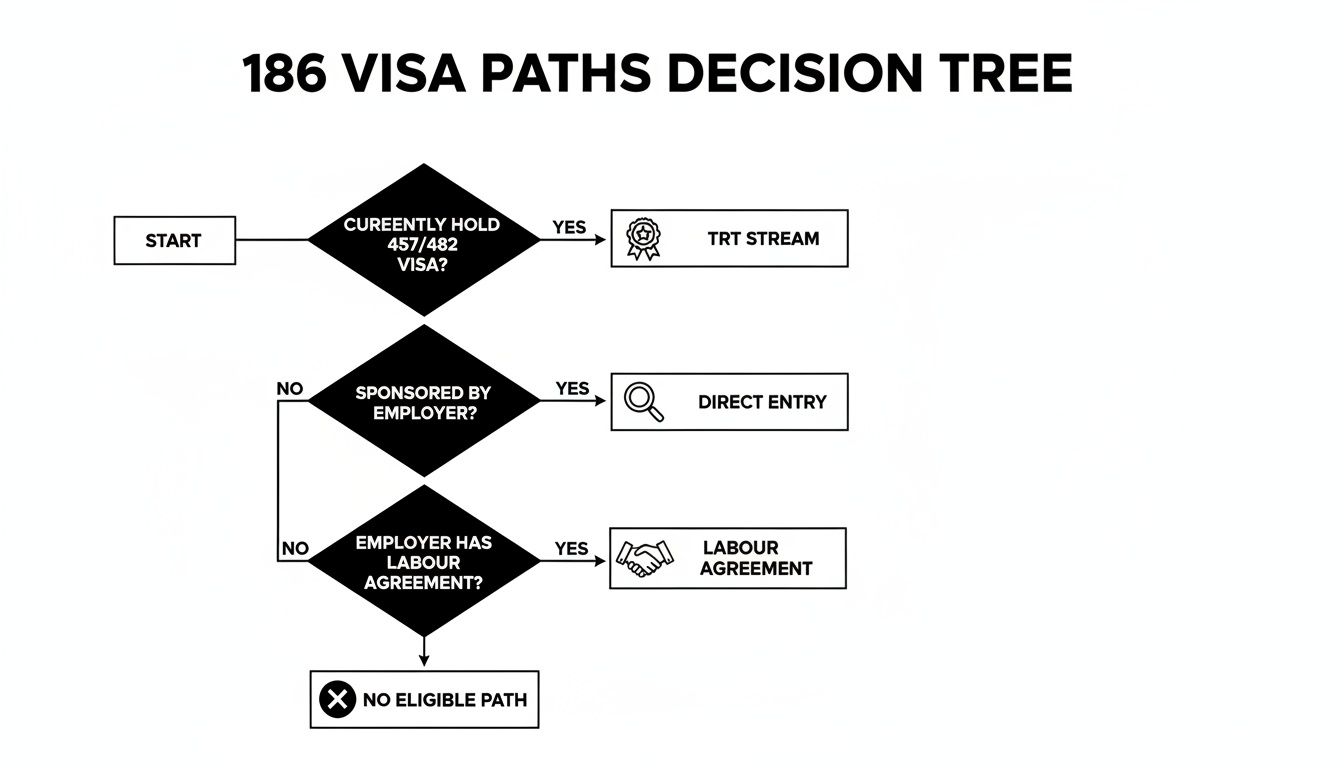
The flowchart really highlights how the TRT stream is a loyalty-based path, Direct Entry demands upfront skill validation, and the Labour Agreement is a much more specialised route.
Your Skills and Work Experience
Your professional background is the heart and soul of your 186 visa application. The Department of Home Affairs needs proof that you’ve got the right qualifications and a solid track record in your nominated field. The specifics of what you need to provide, however, vary quite a bit between the Direct Entry (DE) and Temporary Residence Transition (TRT) streams.
For the Direct Entry stream, the bar is set higher because you don’t have a long-term working history with your sponsor to fall back on. You’ll need to prove your expertise independently through two key things:
- A Positive Skills Assessment: This is a formal evaluation by a designated body for your occupation. It’s their way of confirming your qualifications and experience are up to Australian standards.
- Three Years of Relevant Experience: You have to show evidence of at least three years of full-time work experience in a role directly related to your nominated occupation, and this must be after you gained your qualifications.
On the other hand, if you’re applying through the TRT stream, you generally don’t need a formal skills assessment. Why? Because your sustained work with your sponsoring employer is seen as proof of your skills. The main hurdle here is having worked for that employer for a specific period (usually at least two years) on an eligible temporary visa, like the Subclass 482 visa.
Competent English Language Proficiency
Being able to communicate effectively is vital for settling into the Australian workforce and community. That's why nearly all 186 visa applicants must show they meet a minimum standard of English, unless they qualify for an exemption. The benchmark for this visa is called 'Competent English'.
You can demonstrate this by hitting the minimum scores on an approved English language test. Just be sure the test was taken within the three years right before you lodge your visa application.
What exactly is 'Competent English'?
It means achieving a specific minimum score. For instance, in the IELTS test, you’d need at least 6.0 in each of the four bands (listening, reading, writing, and speaking). Equivalent scores from other tests like PTE Academic, TOEFL iBT, or Cambridge C1 Advanced are also accepted.
Some people are exempt, like citizens and passport holders from the UK, USA, Canada, New Zealand, or the Republic of Ireland. It's always a good idea to double-check the latest rules, as the list of accepted tests and required scores can change.
Health and Character Standards
The final two pillars are the health and character checks, and they are mandatory. The Australian government has a duty to protect the community, so all permanent visa applicants—and any family members included in the application—must pass these assessments.
The Health Requirement:
You’ll need to book a medical examination with a panel physician approved by the Department of Home Affairs. These exams are designed to screen for any conditions that could be a public health risk or put a major strain on Australia’s healthcare system. The exact tests you’ll undergo depend on your age, which country you’re from, and what you plan to do in Australia.
The Character Requirement:
This is all about your past conduct. You’ll be asked to provide police clearance certificates from every country where you have lived for 12 months or more in the last 10 years (since you turned 16). A significant criminal record, as you might expect, could result in your application being refused.
Getting through these checks can sometimes be tricky. For a deeper dive into what's involved, you can learn more in our detailed guide on health and character requirements.
Disclaimer: Immigration laws and visa requirements are subject to change. The information provided in this article is for general guidance only and may not be current at the time of reading. For the most accurate and up-to-date advice tailored to your situation, we strongly recommend you book an appointment with a registered migration agent. Always refer to https://www.homeaffairs.gov.au/ for any department fees for any visa.
Understanding Your Employer's Side of the Deal
The Subclass 186 visa isn't just about you; it's a partnership. While you’re pulling together proof of your skills and experience, your employer is tackling an equally critical part of the process: the nomination.
Think of it as two sides of the same coin. Without a successful nomination from your employer, your visa application simply can't move forward.
Getting a handle on your employer's responsibilities is a smart move. It gives you a 360-degree view of the process and helps you work together to build a rock-solid application. For any HR managers or business owners reading this, consider this your cheat sheet for navigating sponsorship duties without a hitch.
Let's break down exactly what Australian businesses need to do to nominate a skilled worker for a 186 visa.
Is the Job Real? Proving the Position is Genuine
This is the first and biggest hurdle for any employer. They have to prove to the Department of Home Affairs that the job you're being offered is a genuine, full-time, and ongoing role within the business. The Department is incredibly thorough here—they need to be completely convinced the position wasn't just invented to help someone get a visa.
So, how does an employer do that? They need to show the position makes sense for the size and type of their business. This usually means providing evidence like:
- An organisational chart that clearly shows where your role fits in.
- A detailed position description spelling out your duties and responsibilities.
- Proof that the job existed before or that it's essential for the company's growth.
On top of that, the role must be guaranteed for at least two years from the date the visa is granted, and your employment contract needs to reflect this commitment.
Paying the Right Salary: Market Rate Rules
To keep things fair for everyone, employers have to pay a proper salary. This is non-negotiable and is governed by two key rules: the salary must be above the Temporary Skilled Migration Income Threshold (TSMIT), and it must match the Annual Market Salary Rate (AMSR) for that specific job.
The AMSR is simply what an Australian worker would be paid for doing the same job in the same location. Employers have to show their working out here, often by providing evidence of what they pay other Australians in similar roles, or by pointing to industry awards and salary data.
This rule is in place to make sure overseas workers aren’t being underpaid, which would otherwise drive down wages for local workers. If the salary offered is below the market rate, the nomination is almost certain to be refused.
The Skilling Australians Fund (SAF) Levy
There's also a significant financial commitment involved: the Skilling Australians Fund (SAF) levy. This is a one-off, mandatory payment an employer makes when they lodge the nomination. The money goes into a government fund used to train Australian apprentices and trainees.
The fee depends on the company's turnover:
- Small Businesses (annual turnover under $10 million): A one-off payment of $3,000.
- Larger Businesses (annual turnover of $10 million or more): A one-off payment of $5,000.
This levy is non-refundable in most cases, even if the nomination or visa gets rejected. It’s a serious investment and a key part of the 186 visa requirements that shows just how committed an employer has to be to the sponsorship process.
Disclaimer: Australian immigration laws and policies can change. This content is for general informational purposes and may not be current when you read it. For the most accurate advice on your specific circumstances, you should book an appointment with a registered migration agent. Always refer to https://www.homeaffairs.gov.au/ for any department fees for any visa.
Your Step-by-Step Guide to a Decision-Ready Application

Getting a Subclass 186 visa isn't just about ticking boxes; it's about telling a clear, consistent story to the Department of Home Affairs. The goal is to submit a ‘decision-ready’ application – a case file so complete and well-organised that the case officer has everything they need to say "yes" without asking for a single extra document.
Getting this right from the start can seriously speed up processing times and, more importantly, boost your chances of success. Let’s walk through the proper order of operations, from day one to submission day, to help you build a bulletproof application.
Stage 1: The Initial Assessment and Document Gathering
Before you or your boss even think about lodging an application, everything starts with a hard, honest self-assessment. This is where you double-check that you genuinely meet the criteria for your chosen stream (Direct Entry or TRT) and begin pulling together the core documents for your file.
Think of this as laying the foundation for a house. If you rush it, cracks will appear later. Start gathering your identity documents, qualification certificates, and detailed employment records. You need to be forensic here – make sure every name and date lines up perfectly across all your paperwork. Even small inconsistencies can look like red flags to a case officer.
Stage 2: Nailing Your Skills Assessment (Direct Entry Stream Only)
If you're on the Direct Entry pathway, this step is an absolute non-negotiable. Getting a positive skills assessment from the right Australian authority is the official proof that your skills and experience are up to Australia’s standards for your occupation.
It’s crucial to understand this is a completely separate process from the visa application itself, and it can take months. Start early. Every assessing body has its own unique set of rules and required documents, so you’ll need to research exactly what’s needed for your trade or profession and prepare a thorough submission. This is a classic bottleneck, so build its timeline into your master plan.
A common mistake is treating the skills assessment like a quick formality. It’s not. Give it the same attention and seriousness as the visa itself, because a negative outcome will stop your Direct Entry application dead in its tracks.
Stage 3: The Employer Lodges the Nomination
Once your side of the paperwork is in order, the ball is in your employer's court. They need to lodge the nomination application, which is their official pitch to the Department. They have to prove the position is genuine, that the salary meets the required thresholds, and pay the Skilling Australians Fund (SAF) levy.
You’ll need to hand over key documents to them for this part, including your positive skills assessment (for DE), your passport, and your CV. The nomination and the visa are two separate but linked applications. The nomination has to be approved for the visa to be granted, though it’s very common to lodge both at the same time to get the process moving.
Stage 4: You Lodge the Visa Application
After the nomination is in, it's your turn to lodge the final visa application. This is the grand finale where you pull everything together: identity documents, English test results, health examination results, police clearances, and all the evidence proving your work experience.
Being organised is your superpower at this stage. A truly decision-ready application is meticulously structured, with every piece of evidence clearly labelled and easy for the case officer to find and understand. And please, double-check your dates! Expired police checks or English tests are one of the most common and easily avoidable reasons for delays.
A Quick Look at Processing Times
The time it takes to get a decision on a Subclass 186 visa can vary a lot, depending on which stream you're in and how complex your case is. The Department of Home Affairs publishes its global visa processing timeframes, which are a good guide.
Right now, you can generally expect:
- Direct Entry Stream: Most applications are finalised within 5 to 11 months.
- Temporary Residence Transition Stream: This is often faster, with most decisions made in 4 to 9 months.
Putting in a complete, logically organised, decision-ready application is the single best thing you can do to aim for the quicker end of those estimates.
Disclaimer: Australian immigration law and processing times are constantly changing. The information here is for general guidance and might not be current when you read it. For advice tailored to your specific situation, it's always best to book an appointment with a registered migration agent. All official government fees are listed on the Department of Home Affairs website.
Of all the hurdles in the 186 visa process, some crop up more often than others. Knowing where the common traps lie is the best way to sidestep them and keep your application on the right track.
Think of it this way: the Department needs to be convinced of two key things—that the job is real and that you are the right person for it. A surprising number of applications stumble right at the first hurdle.
One of the biggest reasons for refusal is failing to prove the genuineness of the nominated position. Your employer can't just create a role out of thin air to sponsor you. They have to show that the job is a critical, necessary part of their business. If it looks like the position was invented just to get you a visa, your application is dead in the water.
Another classic mistake? Inconsistent information. Even small mix-ups can create big problems. The dates on your CV, your employment reference letters, your skills assessment, and the visa forms themselves must all tell the same story. A single conflicting date can raise a red flag, casting doubt over everything you've submitted.
When Your Duties Don't Match the Job Title
This is a big one. It’s not enough to simply have the right job title; your day-to-day tasks have to align with what the government officially expects for that role. This is all laid out in the Australian and New Zealand Standard Classification of Occupations (ANZSCO).
Let's say you're nominated as a "Marketing Specialist". If your application is full of duties like basic data entry and answering sales calls, that’s a problem. The case officer will look at the ANZSCO description, which talks about strategic planning and market analysis, and see a mismatch. They'll likely conclude the role isn't genuine.
To get this right, you and your employer need to sit down with the ANZSCO task list for your occupation. Carefully comb through it and make sure your position description and reference letters accurately reflect those skilled duties using similar, honest language.
Failing to prove your work experience is another deal-breaker, especially for the Direct Entry stream. You need to show at least three years of solid, relevant experience after you gained your qualification. Vague reference letters that don't detail your duties or incomplete pay slips just won't cut it. Your evidence has to be clear, specific, and verifiable.
Disclaimer: Australian immigration laws and visa criteria are subject to change, often without notice. The information provided here is for general guidance and may no longer be accurate when you read it. To receive personalised and current advice, you must book an appointment with a registered migration agent. For all current government application costs, please refer to the official Department of Home Affairs website.
Your 186 Visa Questions, Answered
When you get down to the nitty-gritty of the Subclass 186 visa, a lot of specific questions tend to pop up. Let's walk through some of the most common ones we hear from both applicants and their employers to clear up some of the finer details.
How Is My Work Experience Calculated?
For the Direct Entry stream, the magic number is three years. You need to show you’ve worked full-time (or the part-time equivalent) for at least that long. Crucially, this experience is typically counted after you’ve earned the formal qualification needed for your job. It can’t just be any job, either—it has to be a perfect match for the tasks laid out in the official ANZSCO description for your nominated occupation.
What if My Sponsoring Company Gets Sold?
This is a scenario that can definitely throw a spanner in the works. If your employer's business is sold or goes through a major restructure after your nomination is in but before your visa is granted, it can complicate things. The first step is to let the Department of Home Affairs know straight away. Depending on the details of the sale and how the business structure has changed, the new owners might need to lodge a brand-new nomination for you.
Can My Family Come With Me on a 186 Visa?
Absolutely. You can include your family unit in your Subclass 186 application. This generally means your partner and any dependent children (either yours or your partner's). Just remember, every single person included in the application has to meet the same health and character requirements as you do.
A Quick Note on Partners:
If your partner is over 18 and can't demonstrate at least 'Functional English', you'll likely face an extra government fee. This is often called the second instalment, and it’s something to factor into your budget.
Will I Get a Bridging Visa?
Most likely, yes. If you’re already in Australia on a valid visa (like a 482 visa) when you lodge your 186 application, you’ll usually be granted a Bridging Visa A (BVA). This visa sits quietly in the background and only kicks in the moment your current visa expires. It’s the legal mechanism that allows you to stay in Australia lawfully while you wait for the decision on your permanent residency.
Getting through the maze of Australian visa rules takes more than just filling out forms—it requires careful planning and deep expertise. At My Visa Guide, our registered migration agents are here to give you the clear, honest advice you need to build your future in Australia.