IMPORTANT NOTICE

An Australian PR points calculator is a handy tool that gives you a quick estimate of where you stand in the race for a skilled migration visa. It tallies up points based on things like your age, English skills, work experience, and qualifications. You'll need at least 65 points just to get your foot in the door by submitting an Expression of Interest (EOI).
Disclaimer: The information provided in this article is for general guidance only and may not be current at the time of reading. Immigration laws, regulations, and points allocations are subject to change. For the most up-to-date and personalised advice, it is essential to book an appointment with a registered migration agent. For any official government fees, please refer to the Department of Home Affairs website at https://www.homeaffairs.gov.au/.
Decoding the Australian PR Points System
Think of Australia's skilled migration program less like a simple application and more like a competitive tender process. The government is looking for talented people who can hit the ground running and contribute to the economy, and the PR points system is how they score each bid. It’s the framework the Department of Home Affairs uses to rank everyone, ensuring the process is fair, transparent, and aligned with what Australia needs.
The journey starts when you lodge an Expression of Interest (EOI). This isn't a formal visa application; it’s you putting your hand up and saying, "I'm interested!" You submit your EOI through the SkillSelect portal, detailing your skills and background. The system then automatically calculates your points, and if your score is high enough, you might get that coveted invitation to apply for a visa.
Why Do Points Matter So Much?
Hitting the 65-point minimum is just the first hurdle. It makes you eligible, but it’s no guarantee of an invitation. For many in-demand jobs, the competition is so fierce that the actual score needed to secure an invitation is much, much higher.
The points system is competitive by design. A higher score gives you a stronger profile, pushing you closer to the front of the queue when invitations are sent out.
This is exactly why you need to get familiar with every single category in the points test. When you know where points come from, you can play to your strengths and work on areas where you might be able to pick up a few extra. This guide will break it all down, piece by piece, so you can figure out exactly where you stand. Our guide on skilled migration also offers a great bird's-eye view of the whole process.
Australia’s points-based system isn’t new; it’s been the backbone of its skilled migration policy for decades. It was first rolled out way back in 1973 to prioritise migrants who could bring valuable skills and economic benefits. By the 2008–09 financial year, its impact was clear: a massive 56.4% of all permanent migrants came to Australia through this very pathway. If you're curious, you can learn how to create a calculator to understand the mechanics behind these tools.
How Each PR Points Category Works
To really get the most out of a PR points calculator, you first need to understand what’s going on under the bonnet. The Australian skilled migration points system isn't just a random checklist. Each category is deliberately chosen to pinpoint candidates who are most likely to thrive economically and settle into Australian life. It’s a direct reflection of what the government is looking for in a new skilled migrant.
Think of it like building a footy team. The selectors aren't just looking for one type of player; they want a well-rounded squad with different strengths. Your age signals your potential long-term contribution, your English skills show you can communicate on-site and in the community, and your qualifications and experience prove you have the specific skills Australia actually needs. This is exactly why just scraping by with the 65-point minimum often isn't enough—you’re in a competitive process, trying to prove you're the best fit for the team.
The infographic below highlights the core pillars of the points system: age, education, and experience. These three areas are the foundation of your total score.
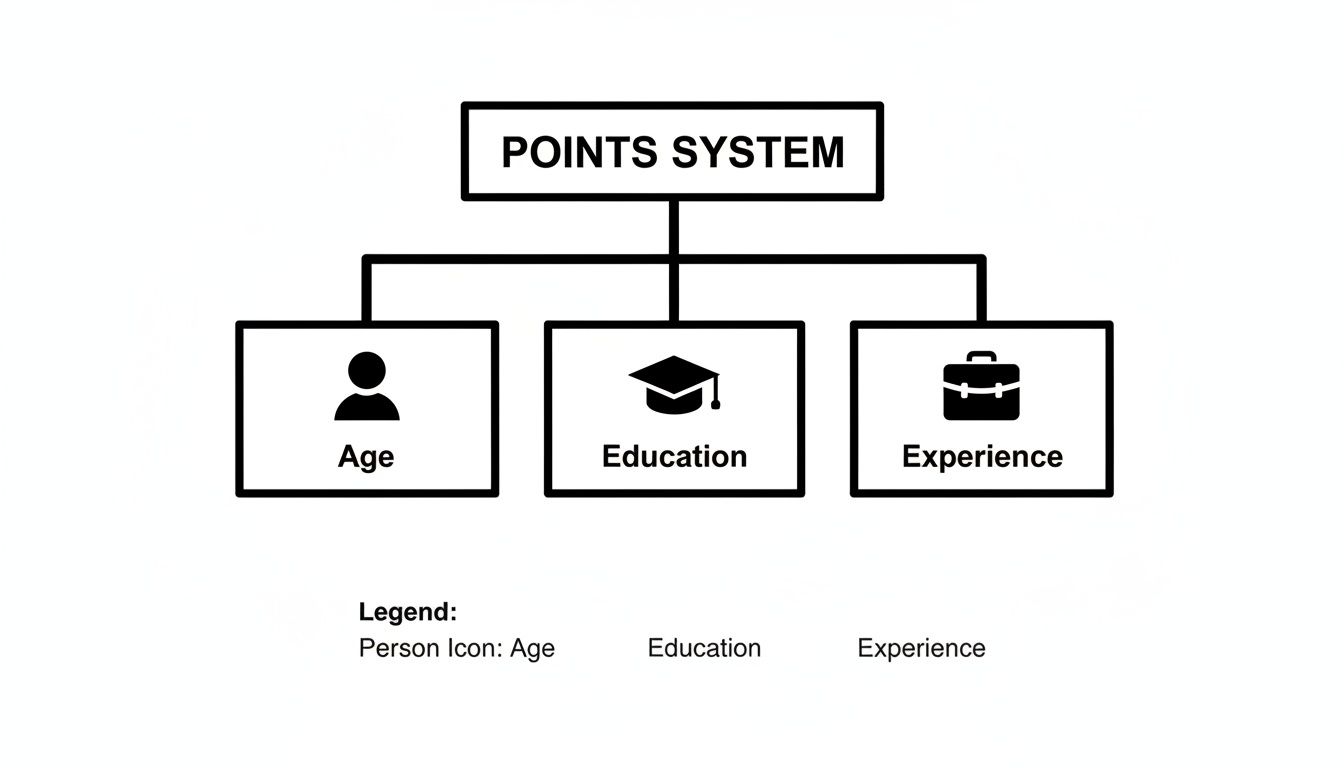
As you can see, these are the heavy hitters where you’ll likely rack up the bulk of your points. Getting them right is critical to your whole migration strategy. Let’s break each one down.
Age: The Unshakeable Foundation of Your Score
Age is the most straightforward category, but it’s also one of the most powerful. The system is unashamedly biased towards younger applicants, who are seen as having more years to contribute to the Australian economy and tax system. The absolute sweet spot is between 25 and 32 years old, where you can claim the maximum points.
Here’s the breakdown:
- 18–24 years: 25 points
- 25–32 years: 30 points (the maximum)
- 33–39 years: 25 points
- 40–44 years: 15 points
The big one to watch? The moment you turn 45, your points for age drop to zero. For many hopeful migrants, this creates a very real deadline, making the timing of your application absolutely crucial.
English Language Proficiency: The Key to Everything
Your ability to communicate in English is completely non-negotiable. This isn’t just about ticking a box on a form; it's about proving you can function effectively in an English-speaking workplace and community. You’ll need to sit a recognised English language test—like IELTS, PTE Academic, TOEFL iBT, or Cambridge C1 Advanced—and your score determines your points.
The points are tiered to reward higher fluency:
- Competent English: This is the bare minimum you need to even be eligible, but it gives you 0 points.
- Proficient English: A solid score here will net you 10 points.
- Superior English: Nailing the test with a top-tier score gives you a huge boost of 20 points.
Because this category offers so many points, it's one of the few areas you have direct control over. Many applicants will sit their English test multiple times, pushing for that 'Superior' score. It’s often the single most effective way to jump up the rankings.
Skilled Employment Experience: Proof You Can Do the Job
This is where you show you’ve got relevant, hands-on experience in your nominated occupation. It’s not enough to have simply had a job; the work must be deemed 'skilled' by the relevant Australian skills assessing authority. And here’s the kicker: you can only claim points for experience that’s closely related to the exact occupation you’re applying for.
Points are up for grabs for both Australian and overseas experience, with a clear preference for work done locally. All experience must have been gained within the last 10 years.
A classic mistake is claiming points for work you did before your skills were formally recognised. For many occupations, the assessing body will set a "deeming date"—only experience gained after this date counts towards points.
For your overseas experience, the points look like this:
- 3–4 years: 5 points
- 5–7 years: 10 points
- 8+ years: 15 points
And for Australian experience, the rewards are even better:
- 1–2 years: 5 points
- 3–4 years: 10 points
- 5–7 years: 15 points
- 8+ years: 20 points
This heavy emphasis on local experience is the government’s way of favouring candidates who have already proven they can adapt to the Australian workplace.
Educational Qualifications: Your Formal Credentials
Your educational background is a massive indicator of your skill level. The points system gives more weight to higher qualifications, especially those from well-regarded institutions.
The points are awarded as follows:
- Doctorate (PhD): 20 points
- Bachelor's or Master's degree: 15 points
- Diploma or trade qualification: 10 points
- A positive skills assessment for your nominated occupation: 10 points
Just remember, you can only claim points for your highest qualification. If you hold both a Master's degree and a PhD, you'll get the 20 points for the doctorate, not a combined total.
The Bonus Points: Finding Your Strategic Edge
Beyond the main categories, there are several clever ways to pick up extra points. These 'bonus points' can be the difference-maker, pushing your score from "maybe" into the "invitation-worthy" zone.
Here are a few of the key opportunities:
- Australian Study Requirement: Completed a degree, diploma, or trade qualification in Australia that took at least two years of full-time study? That’s 5 points.
- Specialist Education: Earned a Master's by research or a PhD from an Aussie institution in a designated STEM field? That’s an extra 10 points.
- Partner Skills: If your partner also meets the basic age, English, and skills assessment requirements, you could add up to 10 points to your total.
- State or Territory Nomination: This is a big one. A nomination from a state or territory for a Subclass 190 visa adds 5 points, while a nomination for a regional Subclass 491 visa adds a game-changing 15 points.
To help you see it all in one place, here is a summary of the entire points system.
| Australian PR Points System Summary | ||
|---|---|---|
| Points Category | Criteria / Requirement | Points Awarded |
| Age | 18–24 years | 25 |
| 25–32 years | 30 | |
| 33–39 years | 25 | |
| 40–44 years | 15 | |
| English Proficiency | Competent English | 0 |
| Proficient English | 10 | |
| Superior English | 20 | |
| Overseas Skilled Employment | 3–4 years (in last 10 years) | 5 |
| 5–7 years (in last 10 years) | 10 | |
| 8+ years (in last 10 years) | 15 | |
| Australian Skilled Employment | 1–2 years (in last 10 years) | 5 |
| 3–4 years (in last 10 years) | 10 | |
| 5–7 years (in last 10 years) | 15 | |
| 8+ years (in last 10 years) | 20 | |
| Educational Qualifications | Doctorate (PhD) from a recognised institution | 20 |
| Bachelor's or Master's degree from a recognised institution | 15 | |
| Diploma or trade qualification completed in Australia | 10 | |
| Positive skills assessment from relevant authority | 10 | |
| Specialist Education | Master's by research or PhD in a STEM field from an Australian institution | 10 |
| Australian Study Requirement | Minimum two years of study in Australia | 5 |
| Professional Year | Completion of a Professional Year in Australia | 5 |
| Credentialled Community Language | NAATI certification | 5 |
| Study in Regional Australia | Lived and studied in a designated regional area | 5 |
| Partner Skills | Partner has Competent English | 5 |
| Partner has positive skills assessment & Competent English | 10 | |
| Single (no partner) | 10 | |
| State/Territory Nomination | Nomination for Subclass 190 | 5 |
| Nomination for Subclass 491 (Regional) | 15 |
Understanding how each of these pieces fits together is the first step in building a winning migration strategy. A good PR points calculator is the perfect tool to help you map it all out.
Disclaimer: The information provided in this article is for general guidance only and may not be current at the time of reading. Immigration laws, regulations, and points allocations are subject to change. For the most up-to-date and personalised advice, it is essential to book an appointment with a registered migration agent. For any official government fees, please refer to the Department of Home Affairs website at https://www.homeaffairs.gov.au/.
Calculating Your Score with a Real-World Example

It’s one thing to read about the points categories, but it’s another to see how they all fit together in a real-life scenario. Using a PR points calculator is a great way to get a quick snapshot, but nothing beats doing a manual tally. It forces you to get real about where you stand and what you can prove.
So, let's walk through a practical example to make it all click.
Meet Anika. She’s a skilled IT professional from overseas with a dream of moving to Australia on a skilled migration visa. Before she can even think about lodging an Expression of Interest (EOI), she needs to figure out her points score to see if she’s in the running.
By breaking down her profile, we can see exactly how a person's life and career translate into cold, hard points.
Anika's Profile Breakdown
Let's take a look at Anika's background. Every single one of these details needs to be backed up by official documents.
- Age: She is 31 years old.
- Education: She holds a Bachelor of Computer Science.
- Work Experience: Anika has worked as a Software Engineer for six years outside Australia.
- English Proficiency: She recently took the IELTS test and scored the equivalent of Superior English.
- Partner Status: Anika is single.
With these details, we can start adding up her score, just as you would do for yourself.
Tallying the Points Step-by-Step
Alright, let's connect Anika’s profile to the points table and see where she lands. This is where an abstract profile becomes a concrete number.
Age (30 points): At 31, Anika fits squarely into the 25–32 age bracket. That’s the sweet spot, giving her the maximum 30 points right off the bat. A fantastic start.
English Proficiency (20 points): Her Superior English result is a massive win. This achievement alone adds another 20 points, showing just how much the system values strong language skills.
Educational Qualifications (15 points): Her Bachelor of Computer Science is a recognised degree, which grants her a solid 15 points.
Overseas Work Experience (10 points): With six years of relevant experience, she lands in the 5–7 years category. This adds a valuable 10 points to her score.
Partner Status (10 points): Since Anika is applying on her own, she automatically gets the 10 points for being single.
Anika's Initial Score Calculation:
30 (Age) + 20 (English) + 15 (Education) + 10 (Experience) + 10 (Single) = 85 points
With a score of 85, Anika is in an excellent position. She’s comfortably over the 65-point minimum and is a very competitive candidate for an invitation to apply for a visa like the Skilled Independent (Subclass 189).
This whole exercise shows you how every detail matters. The points test has been a central part of Australia’s skilled migration program for decades. It's a system that has seen net overseas migration grow from just 30,042 in 1992–93 to a record 536,000 in 2022–23, with points-tested visas playing a huge role. If you're curious, you can learn more about how immigration has shaped Australia on Wikipedia.
By running through this manual check yourself, you’ll feel much more confident using an online PR points calculator, because you'll know exactly what evidence you need to stand behind every point you claim.
Disclaimer: The information provided in this article is for general guidance only and may not be current at the time of reading. Immigration laws, regulations, and points allocations are subject to change. For the most up-to-date and personalised advice, it is essential to book an appointment with a registered migration agent. For any official government fees, please refer to the Department of Home Affairs website at https://www.homeaffairs.gov.au/.
Common Mistakes When Calculating Your Points
Knowing what not to do is just as important as knowing what to do. The Australian migration system is incredibly precise, and even a small oversight can lead to an inflated score, a rejected application, and a whole lot of disappointment. Let's walk through the common pitfalls that trip people up before they even get started.
Tallying up your points is a bit like assembling flat-pack furniture; if you misread one little instruction early on, the whole thing can fall apart later. Too many applicants accidentally claim points they aren't actually entitled to, ending up with a score that looks fantastic on paper but crumbles under official scrutiny.
Miscalculating Skilled Work Experience
One of the most frequent mistakes is claiming points for all your past work experience. The rules are much stricter than that. You can only claim points for skilled employment that directly relates to your nominated occupation and happened within the last 10 years.
A classic trap here is the "deeming date." Your skills assessing authority might decide that you only became officially ‘skilled’ after a certain period of work. They might, for example, deduct your first two years of experience, meaning only the work you did after that specific date is eligible for points.
Scenario: David has worked as an accountant for five years and confidently claims 10 points for his overseas experience. But his skills assessment from CPA Australia says he only met the required standard after his first two years on the job. This means he can only claim points for three years of experience, which drops his score from 10 points down to just 5.
Overestimating English Proficiency
The dream of getting 20 points for Superior English is a powerful one, but you can't claim them based on confidence alone. Your points are tied directly to your official results from a recognised test like IELTS or PTE.
So many applicants fill out a points calculator with the score they hope to get, not the one they actually have. This creates a dangerously optimistic picture of their chances. Always, always use your official, in-date test results when you're doing the maths.
Misinterpreting Partner Skill Points
The rules for partner points are another common source of confusion. Just having a partner doesn’t automatically give you extra points. To claim the maximum 10 points for a skilled partner, they have to tick all of these boxes:
- Be under 45 years of age.
- Have at least 'Competent' English.
- Nominate a skilled occupation that is on the same list as yours.
- Hold a positive skills assessment for that occupation.
If even one of those requirements isn't met, you can't claim those crucial points. It’s an all-or-nothing package deal.
Claiming Unverified Qualifications
Just like your work history, your educational qualifications have to be formally recognised as equivalent to Australian standards. You can't just claim 15 points for a Bachelor's degree without first confirming its standing. Your skills assessing body will usually verify this as part of their assessment. Claiming points for a qualification that isn't deemed equivalent is a fast track to a visa refusal.
Steering clear of these common mistakes is critical. Every single point you claim must be legitimate, defensible, and backed up with solid evidence. Taking the time to understand these nuances now ensures the score you calculate is one you can confidently stand behind when it counts.
Disclaimer: The information provided in this article is for general guidance only and may not be current at the time of reading. Immigration laws, regulations, and points allocations are subject to change. For the most up-to-date and personalised advice, it is essential to book an appointment with a registered migration agent. For any official government fees, please refer to the Department of Home Affairs website at https://www.homeaffairs.gov.au/.
Actionable Strategies to Increase Your PR Points

If you've run your numbers through a PR points calculator and the result isn't quite what you were hoping for, don't panic. The first score you get is just a baseline—it’s the starting line, not the finish line. Many successful migrants began with a score that needed a bit of work. The trick is knowing exactly where to focus your energy to build a more competitive profile.
There are several proven ways to legitimately boost your points total. Some are a long game, requiring time and investment, while others are quicker wins you can target now. The best path forward really depends on your personal circumstances, your nominated occupation, and how soon you want to get your Expression of Interest (EOI) into the pool.
This is where you shift from just calculating to actively strategising. It's all about making smart, targeted moves to strengthen your application and climb higher in the SkillSelect rankings.
Maximise Your English Language Score
One of the most powerful levers you can pull is your English language score. The gap between ‘Proficient’ and ‘Superior’ English is a huge 10 points, a difference that can single-handedly change your migration prospects. Best of all, this is an area you have direct control over.
- Proficient English: This gets you a solid 10 points.
- Superior English: This doubles your haul to a game-changing 20 points.
It’s very common for applicants to sit their English test (like IELTS or PTE) more than once to chase that top score. A bit of investment in professional preparation can make all the difference. If you're looking to sharpen your skills, check out our resources for English proficiency support.
Gain More Skilled Work Experience
Time can be one of your best friends when it comes to building points. Clocking up more relevant work experience, whether in Australia or overseas, will steadily increase your score. This strategy is especially powerful if you're already on the cusp of hitting a higher points bracket.
For instance, if you have four years of overseas skilled experience, just one more year will take you from 5 points up to 10 points. It’s the same story for local experience—going from two years in Australia to three years doubles your points from 5 to 10.
Keep in mind, only experience that your assessing authority deems 'skilled' and that you've gained in the last 10 years will count. This is why keeping meticulous records of your roles and responsibilities is absolutely crucial to proving your claims.
Consider a Professional Year Program
If you're a recent graduate in Accounting, IT, or Engineering, a Professional Year Program (PYP) is a brilliant way to add 5 extra points to your tally. A PYP is a structured program that blends formal learning with a practical internship here in Australia.
It’s a double win. Not only do you get the points, but you also gain invaluable local work experience and develop professional skills that are fine-tuned for the Australian workplace. This makes you a much stronger candidate in the eyes of both the government and future employers.
Pursue State or Territory Nomination
Getting a nomination from an Australian state or territory is one of the biggest boosts you can possibly get. This is a critical pathway for candidates whose scores might not be high enough to secure a direct invitation for the Skilled Independent (Subclass 189) visa.
Here’s how the nomination points stack up:
- Subclass 190 (State Nominated): A nomination for this visa adds a very helpful 5 points to your total.
- Subclass 491 (Skilled Work Regional): Landing a nomination here gives you a massive 15 points.
These extra points are often the deciding factor that pushes an EOI over the line and results in an invitation. The fierce competition for these nominations really underscores why it’s so important to optimise every single part of your profile. In recent migration programs, over 130,000 places were earmarked for the Skill stream, with countless successful applicants using these strategies to meet the threshold.
Disclaimer: The information provided in this article is for general guidance only and may not be current at the time of reading. Immigration laws, regulations, and points allocations are subject to change. For the most up-to-date and personalised advice, it is essential to book an appointment with a registered migration agent. For any official government fees, please refer to the Department of Home Affairs website at https://www.homeaffairs.gov.au/.
From Score to Action: The Next Steps
Right, you've crunched the numbers with a points calculator and have a score staring back at you. So, what now? This is where theory turns into action. Your points score is essentially your ticket to get into the game, but the real match is about to begin. The very next, and most critical, move is lodging an Expression of Interest (EOI).
Think of an EOI as your official handshake with the Australian government, signalling you're keen on skilled migration. It’s your professional profile thrown into a massive, competitive pool of global talent. It's crucial to get this straight: an EOI is not a visa application. It's a formal declaration of your points claim, asking the government to take a look and consider you.
Submitting Your Expression of Interest
Once your EOI is submitted, it lands in the SkillSelect pool alongside thousands of other hopefuls. The government then holds regular invitation rounds, cherry-picking candidates with the highest point scores in occupations they need. This is exactly why a strong, competitive score is so important—it has a direct impact on whether, and how quickly, you might get that coveted invitation.
Your EOI will sit in the SkillSelect pool for up to two years. The good news is that it’s a live document. If your situation changes for the better—say, you gain another year of work experience or ace a new English test—you can update your EOI and boost your score.
Preparation Is Everything
Getting an invitation to apply for the visa is a huge milestone, but it also starts a ticking clock. You typically have just 60 days from the invitation date to lodge a complete, decision-ready visa application. That’s a seriously tight turnaround, which makes having all your ducks in a row beforehand absolutely essential.
Before you even think about hitting 'submit' on your EOI, you should have these documents scanned, organised, and ready to go:
- Your passport and other identity documents.
- Your official English language test results.
- The final outcome letter from your skills assessment.
- Evidence for all your educational qualifications, like transcripts and completion certificates.
- Detailed proof of your skilled employment—think contracts, payslips, and comprehensive reference letters.
That 60-day window leaves zero room for scrambling or mistakes. Every point you claim in your EOI must be backed up by solid evidence in your final application. Any mismatch, no matter how small, can lead to a visa refusal and the loss of your hefty application fee.
This is the stage where your self-calculated score is put under the microscope by a case officer. If you're still weighing up your options, our overview of the various permanent residency pathways can give you a clearer picture. Making sure your application is airtight, complete, and compelling is what turns your points score into a visa grant.
Disclaimer: The information provided in this article is for general guidance only and may not be current at the time of reading. Immigration laws, regulations, and points allocations are subject to change. For the most up-to-date and personalised advice, it is essential to book an appointment with a registered migration agent. For any official government fees, please refer to the Department of Home Affairs website at https://www.homeaffairs.gov.au/.
Your Questions Answered
When you're digging into the points calculator, a lot of specific questions are bound to pop up. Let's tackle some of the most common ones we hear from people just like you.
A quick heads-up: Immigration rules and the points system can and do change. This info is a great starting point, but it's for general guidance only. For the absolute latest on your situation and official government fees, always check the Department of Home Affairs website and chat with a registered migration agent.
What’s the Real Minimum Score for Australian PR?
Officially, the magic number to get into the pool and lodge an Expression of Interest (EOI) is 65 points. But here’s the reality check: hitting 65 is just the entry ticket, not a guaranteed invitation to the main event.
The competition is fierce, particularly for popular jobs. The actual score you need to get an invitation is often much, much higher. A better way to gauge your target is to look at the scores from the latest invitation rounds for your specific occupation.
Can I Claim Points for Work Experience That Isn’t Related to My Main Job?
In a word, no. This is a big one that trips a lot of people up and can lead to a visa refusal. You can only claim points for skilled work that’s directly and closely related to the occupation you've been nominated for.
There’s another catch, too. This experience usually has to be from the period after you’ve been officially deemed skilled by the relevant assessing body. Claiming points for experience that doesn't fit these rules is a major risk you don’t want to take.
Is the Points System Different for Each Skilled Visa?
The core points test is the same for the big three skilled visas: the Subclass 189, 190, and 491. The main game-changer is the extra points you get for being nominated.
- Subclass 190 Visa: This one needs a nomination from a state or territory government, which adds a handy 5 points to your total.
- Subclass 491 Visa: This visa offers a huge boost. A nomination from a state, territory, or an eligible family member gives you an extra 15 points.
For many people, those extra nomination points are exactly what makes these state-sponsored pathways a more realistic and achievable route to living in Australia.
Your Australian visa journey is a big deal, and it needs careful planning with advice you can trust. At My Visa Guide, our registered migration agents give you clear, honest guidance to build the strongest application you possibly can. Book a consultation today and take the next confident step toward your future in Australia.