IMPORTANT NOTICE

The Skilled Independent Subclass 189 visa is the holy grail for many skilled professionals dreaming of Australia. It's a points-tested permanent visa, but the key difference is that you don't need anyone to sponsor you—not an employer, not a family member, and not a state government. This visa gives you the freedom to live and work anywhere you like in Australia, indefinitely. It's about as direct a path to permanent residency as you can get, provided you have the skills Australia is looking for.
Disclaimer: Immigration laws and information can change without notice. The content in this article is for general informational purposes only and may not be accurate or up-to-date at the time of reading. It is crucial to book an appointment with a registered migration agent for the latest and most personalised advice. For any official government fees, always refer to the Department of Home Affairs website at https://www.homeaffairs.gov.au/.
Your Direct Pathway to Australian Permanent Residency
Imagine having the freedom to build your life anywhere in Australia, with all the security that permanent residency brings, purely on the strength of your own skills and experience. That’s the incredible opportunity the Subclass 189 visa offers.
So, how does it all work? At its core, the Subclass 189 operates on a points system. Think of it like a professional scorecard where you rack up points for key attributes like your age, qualifications, work history, and English language skills.
Understanding the Competitive Landscape
The more points you have, the better your chances are. You’re not just applying in a vacuum; you're competing against a global pool of talented applicants, and it’s a tough crowd. The system is designed this way to handpick the best and brightest professionals to fill critical gaps in the Australian economy.
For example, while the minimum threshold to be considered is 65 points, the reality is that the actual scores needed for an invitation are often much, much higher.
For the 2024-25 financial year, the government has allocated only 16,900 places for the Subclass 189 visa. That's a pretty significant drop, and it's turned up the heat on the competition. This squeeze means the minimum points needed for an invitation have skyrocketed, frequently sitting above 80-85 points. It also heavily favours applicants between 25-32 years old, as they can claim the maximum 30 points for age.
Preparing for Success
In this kind of environment, a well-prepared application isn’t just a good idea—it's the only way to succeed. Every single detail matters.
Once you’ve successfully secured your Australian Permanent Residency (a huge milestone!), the next step is the physical move. If you're eyeing off a life in Australia's cultural capital, this comprehensive guide to moving to Melbourne is a fantastic resource to help you get settled.
As you dive deeper into your options, you'll discover there isn't just one way to make Australia home. We've put together an overview of the different permanent residency pathways you might want to explore.
Disclaimer: Immigration laws and information can change without notice. The content in this article is for general informational purposes only and may not be accurate or up-to-date at the time of reading. It is crucial to book an appointment with a registered migration agent for the latest and most personalised advice. For any official government fees, always refer to the Department of Home Affairs website at https://www.homeaffairs.gov.au/.
How the Subclass 189 Points Test Really Works
The points test is the heart of the Subclass 189 visa, but it’s much more than just a numbers game. You should think of it as a detailed look at your professional profile, built to find candidates who can hit the ground running and contribute to Australia's economy. While the official pass mark is 65 points, the reality is that competition is fierce. Successful applicants often need scores much higher than this to get an invitation.
This system is Australia's way of hand-picking skilled professionals with the most valuable and in-demand skills. Every category in the test, from your age to your English language ability, is weighted to reflect what the country needs. Nailing a high score isn’t about just ticking boxes; it requires a smart, strategic approach.
The diagram below gives you a clear picture of how this all fits together, showing the points system as the critical bridge between the visa itself and the ideal candidate profile.
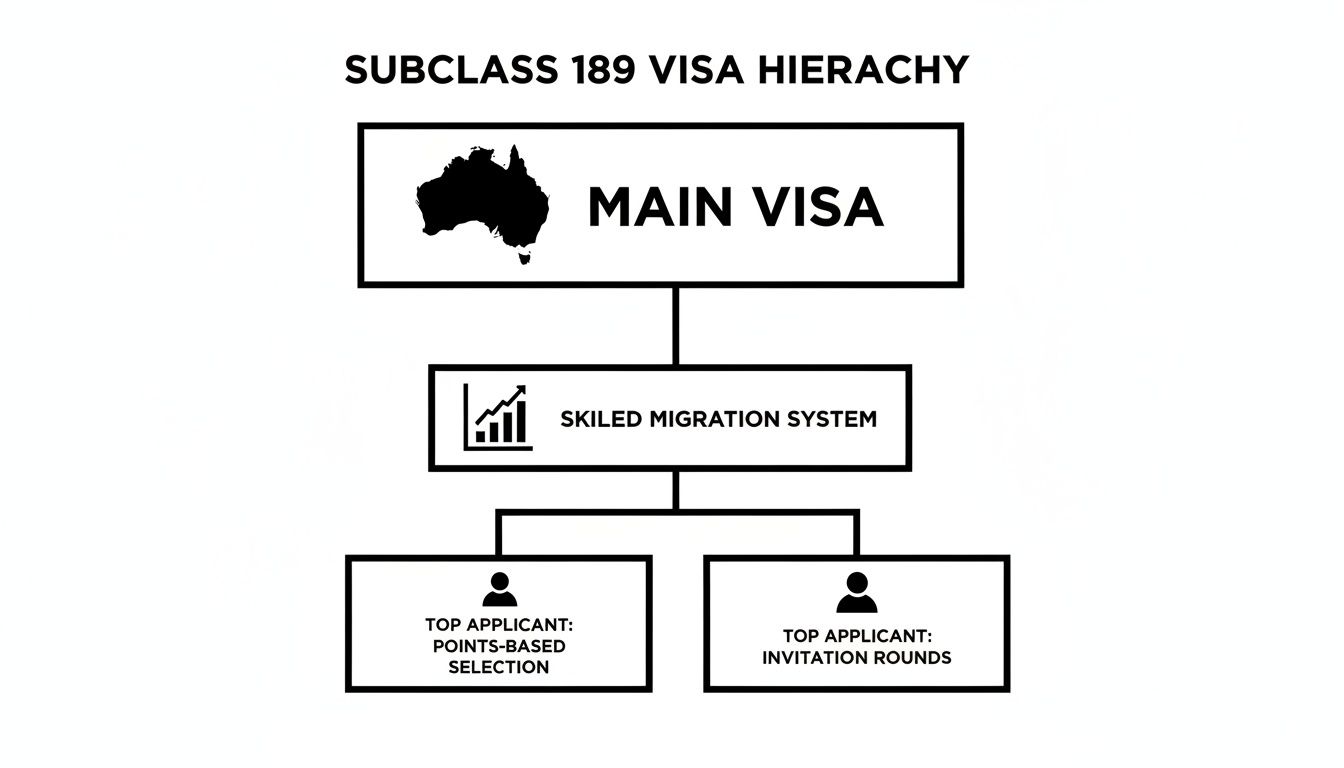
As you can see, getting through the points test successfully is what will position you as a top-tier candidate in a very competitive field.
Decoding the Core Points Categories
To build a winning score, you need to understand exactly how each part adds up. It’s all about knowing where you can gain the biggest advantages.
Age: The system definitely favours younger applicants. If you’re aged between 25 and 32, you’ll get the maximum 30 points, which reflects the government's preference for professionals with a long career ahead of them. The points then start to drop off for older age brackets, hitting zero for anyone aged 45 and over.
English Language Proficiency: Excellent English skills are a must-have and a huge opportunity to score points. While 'Competent' English is the minimum benchmark, reaching 'Superior' English (like an IELTS score of 8 or more in every band) can add a massive 20 points to your total.
Skilled Employment Experience: Your work history is a powerful signal of your expertise. The more relevant experience you have in your chosen occupation, the more points you can claim. For instance, eight or more years of skilled work outside Australia can get you 15 points. Experience gained in Australia is valued even more, rewarding those who have already contributed locally.
To help you visualise this, here’s a quick breakdown of how points are awarded across the key factors.
Subclass 189 Points Test Breakdown
A summary of points awarded for key eligibility criteria in the Skilled Independent visa application.
| Factor | Criteria | Points Awarded |
|---|---|---|
| Age | 18–24 years | 25 |
| 25–32 years | 30 | |
| 33–39 years | 25 | |
| 40–44 years | 15 | |
| English | Competent | 0 |
| Proficient | 10 | |
| Superior | 20 | |
| Overseas Experience | 3–4 years | 5 |
| 5–7 years | 10 | |
| 8+ years | 15 | |
| Australian Experience | 1–2 years | 5 |
| 3–4 years | 10 | |
| 5–7 years | 15 | |
| 8+ years | 20 | |
| Education | Doctorate (PhD) | 20 |
| Bachelor/Masters Degree | 15 | |
| Diploma/Trade Qualification | 10 |
Remember, this table is a guide. The goal is to stack points from multiple categories to build the strongest possible total.
Gaining a Strategic Advantage
Looking beyond the core categories, there are several other ways to give your score a serious boost and help you stand out. These are often the make-or-break factors that take an application from just ‘eligible’ to ‘invited’.
For example, if your partner also meets the basic criteria for age and English, and has a positive skills assessment in an eligible occupation, you can claim an extra 10 points for their skills. That’s a significant jump.
Maximising Your Educational and Specialised Skills
Your qualifications are another key area in the points test. A doctorate (PhD) from an Australian university or a recognised overseas equivalent will get you the highest possible points for education (20 points).
On top of that, certain specialised qualifications can give you a real edge:
- Specialist Educational Qualification: If you’ve completed a Master's by research or a Doctorate from an Australian institution in a designated STEM field (Science, Technology, Engineering, or Mathematics), you could add an extra 10 points.
- Professional Year in Australia: Finishing a structured professional development program here in Australia, in your nominated field or a closely related one, can add another 5 points.
These extra points show a high level of specialisation and commitment to your field, making your profile far more attractive.
Disclaimer: Immigration laws and information can change without notice. The content in this article is for general informational purposes only and may not be accurate or up-to-date at the time of reading. It is crucial to book an appointment with a registered migration agent for the latest and most personalised advice. For any official government fees, always refer to the Department of Home Affairs website at https://www.homeaffairs.gov.au/.
Meeting the Essential Eligibility Requirements
Before you even start thinking about the points test for the Subclass 189 visa, there are a few fundamental hurdles you need to clear first. These are the non-negotiables, the absolute deal-breakers that act as the first checkpoint for your application.
Think of it like building a house. You can't start putting up walls or choosing paint colours until you've laid a solid foundation. These initial requirements are that foundation.
The Foundational Checks
First up, there are some personal criteria everyone has to meet. You absolutely must be under 45 years of age when you get your invitation to apply. This isn’t flexible; it’s a hard cut-off.
You also have to meet Australia's health and character standards. This means undergoing a medical exam and getting police clearance certificates from countries you've lived in. It’s all about making sure new migrants are of good character and won’t pose a health risk to the community. For a deep dive into what this involves, check out our guide on the specific health and character requirements.
Finally, you need to prove you have at least a competent level of English. While getting a higher score will earn you more points down the track, meeting this basic language level is a mandatory first step.
The Occupation Gatekeeper: The MLTSSL
Beyond your personal details, the single most important factor is your occupation. Your profession must be on the Medium and Long-term Strategic Skills List (MLTSSL). This isn't just some random list; it's a carefully selected group of occupations Australia has identified as critical for its economy.
If your occupation isn't on the MLTSSL, the Subclass 189 visa journey stops here. It's the first and most crucial professional checkpoint you'll face.
This list gets updated from time to time to reflect what's happening in Australia’s job market, so it’s vital to check the current list before you put any time or money into the process.
The demand for certain skills is pretty clear from the data. Between April 2016 and June 2020, the Department of Home Affairs granted 63,893 Subclass 189 visas to primary applicants. The top-invited role? Software Engineer, with 8,185 grants. Not far behind was Accountant (General) with 6,381 grants. It just goes to show the ongoing need for tech and finance pros. You can find more detailed stats on the Department of Home Affairs website about visa grant trends.
The Crucial Skills Assessment
So, you've confirmed your job is on the MLTSSL. What's next? You need to get a positive skills assessment. This is a formal evaluation carried out by a specific assessing authority for your profession.
This isn’t just a box-ticking exercise. It’s an official body verifying that your qualifications and work experience are up to Australian standards. For instance:
- An IT professional would likely be assessed by the Australian Computer Society (ACS).
- An engineer’s skills would be looked at by Engineers Australia.
- Accountants need to go through organisations like CPA Australia or CAANZ.
Each authority has its own rules, fees, and processing times. You must have this successful assessment in your hands before you can even think about submitting an Expression of Interest (EOI). It’s the official stamp of approval that says you’ve got the skills Australia is looking for.
Disclaimer: Immigration laws and information can change without notice. The content in this article is for general informational purposes only and may not be accurate or up-to-date at the time of reading. It is crucial to book an appointment with a registered migration agent for the latest and most personalised advice. For any official government fees, always refer to the Department of Home Affairs website at https://www.homeaffairs.gov.au/.
Your Step-by-Step Guide to the Application Journey
The road from an initial idea to holding a Subclass 189 visa in your hand is a series of precise steps. Timing and accuracy are absolutely critical here—miss one deadline or get one detail wrong, and it can unfortunately throw your entire application off course.
This roadmap is designed to give you a clear, no-nonsense walkthrough of the entire process, so you can move forward with confidence.

The journey doesn't actually start with a visa application. It begins with an Expression of Interest (EOI).
Submitting Your Expression of Interest
Think of the EOI as putting your hat in the ring. You submit it online through the Department of Home Affairs’ SkillSelect system, where you’ll fill in details about your age, skills, qualifications, and work history—everything that ties back to the points test.
It’s crucial to understand that an EOI is not a visa application. It's simply you telling the government you're interested and claiming a certain number of points. You must have all your key documents, like a positive skills assessment and your English test results, ready before you submit it. Why? Because you'll have to prove every single point you claim later on.
What Are Invitation Rounds?
Once your EOI is in the system, you join a competitive pool of skilled people from around the globe. Periodically, the Department of Home Affairs holds invitation rounds where they pick the highest-scoring candidates from this pool.
An invitation is never guaranteed. It all comes down to Australia’s economic needs at the time and how your points score stacks up against everyone else's.
The competition can be fierce. In a recent round, for example, invitations went out to skilled professionals with at least 80 points, but this was the bare minimum for occupations like Secondary School Teachers and Social Workers. Most other professionals in fields like engineering, tech, and community services needed 85 points or more to get a look-in. This really highlights how competitive the 189 visa has become. You can read more about how these rounds reflect Australia's skilled migration priorities.
This system ensures only the top-ranking candidates are invited to actually apply for the visa.
Receiving the Invitation to Apply
Getting that Invitation to Apply (ITA) is a huge moment. It means your EOI has been selected, and you are now officially invited to lodge your Subclass 189 visa application. But this is where the pressure really begins.
You have a strict 60-day deadline from the date of the invitation to submit your full application and pay the fees. This timeframe is non-negotiable. If you miss that window, your invitation expires. You’ll have to go back into the EOI pool and hope for another invitation, with no guarantee it will come.
Preparing a Decision-Ready Application
With your ITA in hand and the 60-day clock ticking, your focus must shift to putting together a flawless, "decision-ready" application. This is where you gather and submit all the evidence to back up every claim you made in your EOI.
Your essential document checklist will usually include:
- Identity Documents: Passports, birth certificates, and national ID cards.
- Skills Assessment: The official positive outcome letter from your assessing authority.
- English Proficiency: Your official English language test results (like IELTS or PTE).
- Employment Evidence: Detailed reference letters, contracts, and payslips to prove your work experience.
- Educational Qualifications: Certified copies of your university transcripts and completion certificates.
- Police Clearances: Certificates from every country you’ve lived in for 12 months or more over the last 10 years.
- Health Examinations: You and any family members on the application will need to complete medical exams with an approved panel physician.
Staying organised and paying close attention to detail at this stage is the key to a smooth process.
Disclaimer: Immigration laws and information can change without notice. The content in this article is for general informational purposes only and may not be accurate or up-to-date at the time of reading. It is crucial to book an appointment with a registered migration agent for the latest and most personalised advice. For any official government fees, always refer to the Department of Home Affairs website at https://www.homeaffairs.gov.au/.
Choosing the Right Skilled Visa for Your Goals
The Subclass 189 visa is often seen as the ‘golden ticket’ of skilled migration. It offers total independence and the freedom to live and work anywhere in Australia. But is it the only route, or even the best one for you?
Getting your head around how the 189 stacks up against its cousins—the state-nominated Subclass 190 and the regional Subclass 491—is the first step in building a smart migration plan.

Think of these visas as three different doors into Australia. The door you can open depends on your points score, your occupation, and whether you’re open to committing to a specific part of the country for a couple of years.
The Trade-Off: Freedom vs Opportunity
At its core, the difference between these visas is a simple trade-off: complete freedom versus a massive strategic advantage.
The Subclass 189 gives you that unparalleled independence, but the competition is brutal. Invitation scores often soar to 85 points or higher, putting it out of reach for many.
This is where the Subclass 190 and 491 come in. These visas involve a partnership with a state or territory government, and that partnership comes with a game-changing reward.
- Subclass 190 (Skilled Nominated): If a state nominates you, they gift you an instant 5 bonus points.
- Subclass 491 (Skilled Work Regional): A nomination for this visa gives you a huge 15 bonus points.
Those extra points can be the difference between your EOI sitting in the pool for months and getting that coveted invitation. The catch? This boost comes with a commitment. For the 190 visa, you’re generally expected to live and work in the state that nominated you for at least two years. With the 491, that commitment is to a designated regional area for three years.
Making the Strategic Choice
So, which visa is the right fit? It really comes down to your individual profile and goals.
An applicant with a sky-high points score and an occupation in red-hot demand nationally might find the Subclass 189 is their most direct path. Simple.
For most people, though, state nomination is a much more realistic pathway. Think about it: a candidate sitting on 70 points has a very slim chance of a 189 invitation. But with a state nomination for the 190, their score jumps to a more competitive 75. If they secure a regional nomination for the 491, their score becomes a powerful 85.
Exploring all your options is a critical part of the process. To get a better feel for the landscape, you can read our detailed guide on the Australian skilled visa program.
To help you visualise the differences, we’ve put together a simple comparison.
Skilled Visa Comparison Subclass 189 vs 190 vs 491
This table gives you a head-to-head comparison of Australia's main skilled migration visas to help you figure out the right pathway.
| Feature | Subclass 189 (Independent) | Subclass 190 (Nominated) | Subclass 491 (Regional) |
|---|---|---|---|
| Sponsorship | None required | State/Territory nomination required | State/Territory nomination required |
| Bonus Points | 0 | 5 | 15 |
| Living Requirement | Live and work anywhere in Australia | Live and work in nominating state | Live and work in a designated regional area |
| Visa Type | Permanent Residency | Permanent Residency | Provisional (pathway to PR) |
| Competition | Extremely high | High | Moderate to high |
Ultimately, choosing the right visa is about weighing up your desire for total independence against the very real, practical advantages that state sponsorship can offer. It’s about playing the game smartly to give yourself the best possible chance of success.
Disclaimer: Immigration laws and information can change without notice. The content in this article is for general informational purposes only and may not be accurate or up-to-date at the time of reading. It is crucial to book an appointment with a registered migration agent for the latest and most personalised advice. For any official government fees, always refer to the Department of Home Affairs website at https://www.homeaffairs.gov.au/.
Got Questions About the Subclass 189 Visa? We've Got Answers
Going through the Subclass 189 visa process can feel like a maze, and it's natural to have questions pop up along the way. To clear things up, here are some straightforward answers to the queries we hear most often. Getting these details right can be the difference between a smooth application and a costly mistake.
What Are the Most Common Refusal Reasons?
Honestly, most visa refusals come down to preventable errors. One of the biggest traps we see is inconsistent information—where details on one document don't quite match up with another. Another classic pitfall is claiming points for work experience but not backing it up with solid proof like payslips, tax records, or properly detailed reference letters.
Other common roadblocks include failing to meet Australia's strict health or character requirements, or simply missing the non-negotiable 60-day deadline to lodge your application after getting an invitation. Your best defence? A meticulously prepared, decision-ready application that leaves no room for doubt.
Can I Include My Family in a Subclass 189 Application?
Yes, absolutely. You can include your partner and any dependent children (including your partner's dependent children) on your Subclass 189 visa application.
Just remember, every family member on the application must also meet the same health and character standards as you do. On the bright side, including your partner can sometimes be a strategic move. You might be able to claim extra points if they meet certain criteria for age, English language ability, and skills.
How Long Is the Invitation to Apply Valid?
Your Invitation to Apply (ITA) is valid for exactly 60 calendar days. This is a hard deadline—there are no extensions. You must submit your complete visa application and pay all the necessary fees within this two-month window.
If you let this deadline pass, your invitation expires, and you're back in the Expression of Interest (EOI) pool, hoping for another round. A second invitation is never guaranteed, so it's critical to act fast once that ITA lands in your inbox.
Disclaimer: Immigration laws and information can change without notice. The content in this article is for general informational purposes only and may not be accurate or up-to-date at the time of reading. It is crucial to book an appointment with a registered migration agent for the latest and most personalised advice. For any official government fees, always refer to the Department of Home Affairs website at https://www.homeaffairs.gov.au/.
The Australian visa system is complex, but you don't have to tackle it alone. The expert team at My Visa Guide provides clear, honest advice and meticulous application support to give you the best possible chance of success. Start your journey with confidence by booking a consultation with us today.