IMPORTANT NOTICE

If you're looking to navigate Australia's skilled migration program, your journey starts with one thing: the points test.
This is the core system the government uses to rank skilled professionals for visas like the Subclass 189, 190, and 491. Getting your head around the Australian PR points calculator is the single most important first step to figuring out where you stand.
Decoding the Australian PR Points System
The whole point of the General Skilled Migration (GSM) program is to bring in professionals who can jump right in and contribute to Australia's economy. The points test is simply the tool they use to sort through applications and invite the best-fit candidates. It’s a framework that awards points for specific skills and attributes the government sees as valuable for settling in and succeeding here.
It's crucial to think of the points test less like a pass/fail exam and more like a competitive leaderboard.
Yes, the minimum score to even get into the candidate pool is 65 points, but hitting that number is just the beginning. It makes you eligible to lodge an Expression of Interest (EOI), but it’s no guarantee of an invitation to apply for the actual visa.
Why Does the Points System Exist?
Simply put, the government uses this system to manage the flow of skilled migrants in a way that's fair, transparent, and meets Australia's economic needs. By assigning points to different factors, they can prioritise people with the most sought-after skills and qualities.
These key factors include:
- Age: Younger applicants tend to score more points.
- English Language Proficiency: A strong command of English is highly rewarded.
- Work Experience: Your time spent working both in Australia and overseas counts.
- Educational Qualifications: The higher your qualification, the more points you can claim.
- Partner Skills: You can even claim points if your partner meets certain skill requirements.
Disclaimer: The information provided in this article is for general guidance only and may not be current at the time of reading. Immigration laws and policies change frequently. We strongly recommend booking an appointment with a registered migration agent for the most up-to-date advice tailored to your situation. For official information on government fees, always refer to the Department of Home Affairs website at https://www.homeaffairs.gov.au/.
This structured system helps make sure the people invited for permanent residency are those best placed to integrate into the Australian workforce and community. Understanding how it all works is the first big step in mapping out your migration plan.
For a deeper dive into the available visa options, check out our guide on skilled migration pathways in Australia. This guide will help you understand each part of the points calculator, see where you currently stand, and identify your next strategic steps.
A Detailed Breakdown of Each Points Category
Think of the points system as a roadmap—it shows you exactly what the Australian government is looking for in its skilled migrants. It’s not just about hitting a magic number; it’s about understanding the why behind each category, from your professional peak to your English skills.
Let's break down each area so you can see where your strengths lie and, more importantly, where you can strategically improve.
Your Age Matters More Than You Think
Australia’s skilled migration program definitely has a sweet spot when it comes to age. The system is set up to favour applicants who have a long runway ahead of them to contribute to the economy.
The golden ticket is the 25 to 32 years age bracket, which snags you the maximum 30 points. That’s a huge head start, reflecting the government's preference for professionals in their prime.
After that, the points begin to taper off:
- 18-24 years: 25 points
- 33-39 years: 25 points
- 40-44 years: 15 points
The hard cutoff is 45. Once you reach this age, you can no longer claim any points for age, making it a real deadline for many aspiring migrants.
English Language Proficiency: A Key Differentiator
Your ability to communicate is non-negotiable. It’s not just about passing a test; it’s about integrating into the Aussie workplace and community. The points system rewards strong English skills generously, and honestly, this is one of the best places to boost your score.
There are three levels to be aware of:
- Competent English: This is the baseline, the minimum you need to even be eligible for most skilled visas. It gives you 0 points.
- Proficient English: Hitting this level (think an IELTS score of 7 across all bands) gets you a solid 10 points.
- Superior English: This is the top tier, equivalent to an IELTS 8 in each band. Making this leap is a game-changer, adding a massive 20 points to your score.
For many people I've worked with, putting in the extra effort to move from 'Proficient' to 'Superior' English is the single most effective move they can make. That extra 10-point jump can be the difference between waiting for an invitation and getting one.
Skilled Employment Experience: Inside and Outside Australia
Your work history is solid proof of the skills you’re bringing to the table. The system recognises both your experience back home and any work you’ve done here, but it definitely gives an edge to local experience. Why? Because Australian employers love seeing that you already know the local work culture.
Overseas Experience (in the last 10 years)
- 3-4 years: 5 points
- 5-7 years: 10 points
- 8+ years: 15 points
Australian Experience (in the last 10 years)
- 1-2 years: 5 points
- 3-4 years: 10 points
- 5-7 years: 15 points
- 8+ years: 20 points
It's clear to see how much faster you rack up points with Australian experience. A single year of skilled work here is worth the same as up to four years of experience from overseas.
This visual gives you a good sense of where you need to be.
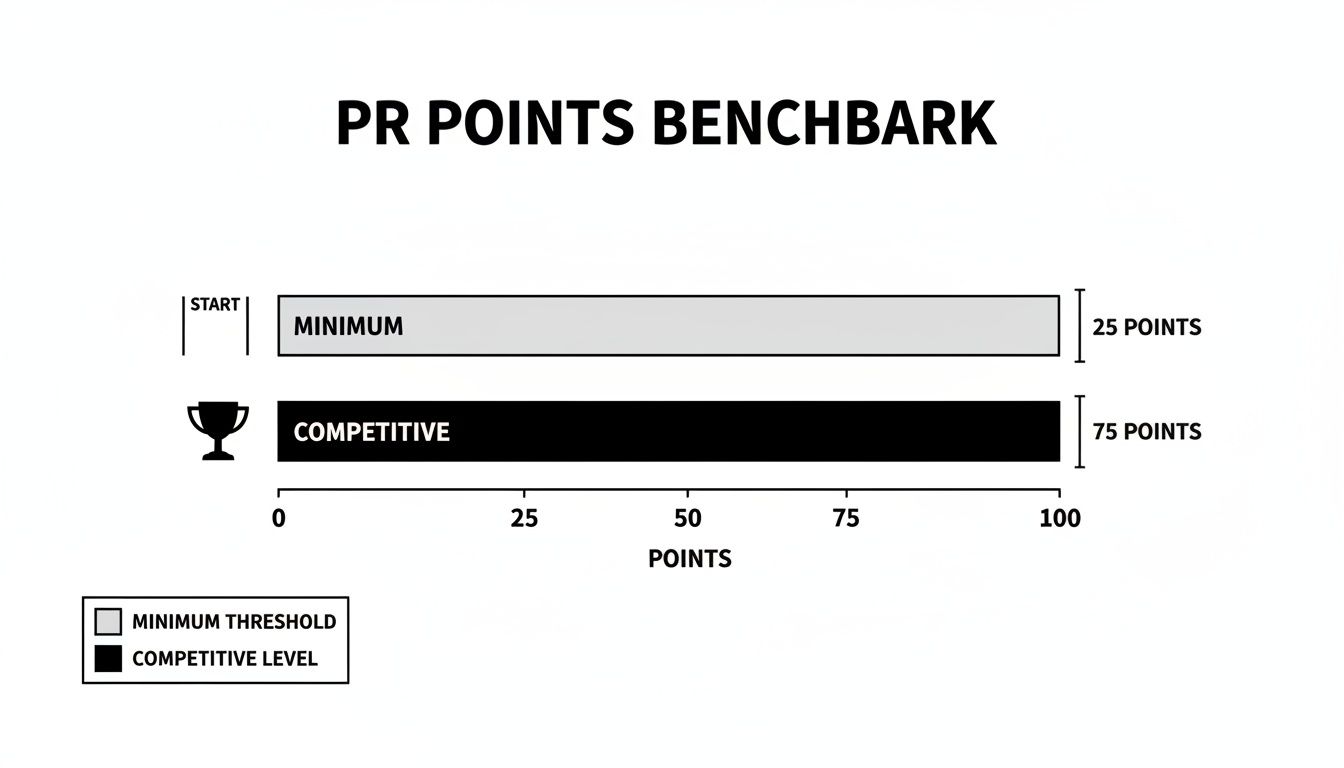
While 65 points might get your foot in the door, aiming for 75 or higher makes your application far more likely to be picked in the invitation rounds.
Your Educational Qualifications
Higher education is another major points-earner. The Department of Home Affairs looks at your qualifications and measures them against Australian standards to determine their value.
Here’s how the points stack up:
- Doctorate (PhD): 20 points
- Bachelor's or Master's Degree: 15 points
- Diploma or Trade Qualification: 10 points
There are also some juicy bonus points on offer. If you’ve completed a Master's by research or a PhD from an Australian institution in certain STEM fields (Science, Technology, Engineering, or Maths), you can claim an extra 10 points. This is a clear incentive to attract and keep top-tier talent in innovation.
To put it all together, let’s look at a quick example. Picture a 28-year-old software engineer from India aiming for the Skilled Independent (Subclass 189) visa. Right off the bat, being 28 gives them the maximum 30 points for age. If they nail their English test and score 'Superior,' that's another 20 points, bringing them to 50. Now, if they've been working in Australia in their nominated occupation for just three years, that adds another 10 points, putting them in a very strong position. You can explore more scenarios like this in this comprehensive guide for professionals.
Disclaimer: The information provided in this article is for general guidance only and may not be current at the time of reading. Immigration laws and policies change frequently. We strongly recommend booking an appointment with a registered migration agent for the most up-to-date advice tailored to your situation. For official information on government fees, always refer to the Department of Home Affairs website at https://www.homeaffairs.gov.au/.
Strategic Ways to Increase Your Points Score
So, you've run your numbers through a PR points calculator and the score isn't quite where you need it to be. Don't panic. This is not the end of the road; in fact, this is where a smart migration strategy really kicks in.
Think of your initial score as a baseline, not a final verdict. There are several powerful, practical ways to give your total a significant boost and make your Expression of Interest (EOI) stand out in the pool. Let's move past the theory and into a real-world playbook designed to make you a much stronger candidate for Australian permanent residency.

Target Superior English Proficiency
One of the most direct ways to add points is by retaking your English language test. While 'Competent' English is the minimum to be eligible, it gets you exactly zero points. Hitting the 'Proficient' level (like an IELTS 7 in all bands) adds a very handy 10 points.
But the real game-changer is achieving a 'Superior' score, such as an IELTS 8 across all bands. This leap adds a massive 20 points to your total. For many people I've worked with, that 10-point jump from 'Proficient' to 'Superior' is the single biggest factor that takes them from just being eligible to actually receiving an invitation.
If you need a hand reaching those higher scores, you can learn more about our English proficiency support services and how we can help you prepare.
Leverage Your Partner’s Skills
If you have a partner or spouse, don't overlook their potential to add serious points to your application. Their skills are a huge asset, and the system is designed to recognise that.
You can claim extra points if your partner meets certain criteria:
- 10 Points: Your partner is also an applicant, is under 45, has a positive skills assessment in an occupation on the same list as yours, and has Competent English.
- 10 Points: You are single, or your partner is already an Australian citizen or permanent resident.
- 5 Points: Your partner is an applicant and has Competent English but doesn't meet the other skills criteria.
A couple can often reach a competitive score together that might have been out of reach for just one person. It’s a collaborative effort that the migration system actively encourages.
Gain More Relevant Work Experience
Time and experience are your friends in this process. Each additional year you spend in skilled employment can inch you up the points ladder. The system rewards both Australian and overseas experience, though local experience carries more weight.
Think about it this way: getting just one more year of skilled Australian work experience can move you from the 1-2 year bracket (5 points) to the 3-4 year bracket (10 points). Likewise, going from seven years of overseas experience to eight years bumps you from 10 points to 15 points.
Sometimes, the best strategy is patience. Continuing to work in your nominated occupation while your EOI is in the pool can actively improve your score over time.
Pursue Advanced or Specialised Qualifications
Further education is another powerful lever. If you have a diploma or trade qualification (10 points), completing a Bachelor's or Master's degree can lift your score to 15 points. Going all the way to a Doctorate (PhD) will earn you the maximum 20 points for education.
There's also a fantastic incentive for STEM specialists. If you complete a Master's by research or a PhD from an Australian institution in a specific Science, Technology, Engineering, or Mathematics field, you can claim an extra 10 points. This is a clear pathway for experts in high-demand industries.
Consider a Professional Year Program
For recent international graduates in Accounting, IT, or Engineering, a Professional Year Program (PYP) is a brilliant strategic move. It’s a structured program that combines formal learning with an Australian internship.
Completing a PYP awards a crucial 5 points. But it's about more than just the points; it provides priceless local work experience and professional connections, making you a far more compelling candidate for both employers and the Department of Home Affairs.
Disclaimer: The information provided in this article is for general guidance only and may not be current at the time of reading. Immigration laws and policies change frequently. We strongly recommend booking an appointment with a registered migration agent for the most up-to-date advice tailored to your situation. For official information on government fees, always refer to the Department of Home Affairs website at https://www.homeaffairs.gov.au/.
Picking the Right Visa: How Your Points Score Fits In
Getting your head around your points total is the first big step. But the real strategy begins when you figure out how that score connects to the different visa pathways. The "magic number" you need for an invitation isn't a single, fixed target; it shifts dramatically depending on which visa you're aiming for. Hitting the minimum 65 points gets you in the game, but your competitiveness will look very different across the main skilled visa options.
Let's break down the three heavy hitters in the General Skilled Migration program: the Subclass 189, Subclass 190, and Subclass 491 visas. Each one offers a unique route to residency, with its own rules and perks. Choosing the right one is a crucial piece of your PR puzzle.
The Subclass 189 Skilled Independent Visa
You can think of the Subclass 189 as the top-tier, direct route to permanent residency. It's the most straightforward because you don't need a nomination from a state or territory government.
This independence is its biggest selling point, but it also makes it brutally competitive. You're up against every other high-scoring applicant in the country, with invitations going to the top of the pool. Because of this, just meeting the 65-point threshold is rarely enough. For in-demand fields like IT, engineering, or accounting, you often need a score well into the 80s or even 90s to get a look-in during competitive invitation rounds. This one is really for the highest-scoring candidates.
The Subclass 190 Skilled Nominated Visa
This is where things get interesting. The Subclass 190 visa brings state nomination into play, which can be a game-changer. If an Australian state or territory needs people with your skills for their local economy, they can nominate you.
Landing a state nomination gives you a huge advantage: an instant 5 bonus points. That boost can be exactly what you need to push your application over the line. For example, if you have 70 points on your own, a 190 nomination bumps you up to 75, making you a much stronger candidate.
The trade-off? You’re generally expected to commit to living and working in the nominating state for at least your first two years in Australia. This is a fantastic option if your score is good, but maybe not quite high enough for the super-competitive 189 visa.
The Subclass 491 Skilled Work Regional Visa
For many people, the Subclass 491 is the most practical and strategic path to calling Australia home. This visa requires a nomination from either a state/territory government or an eligible family member who lives in a designated regional area.
The main drawcard here is the massive points boost. A successful 491 nomination adds a whopping 15 points to your total. This can completely change your prospects, turning a modest 65-point profile into a highly competitive 80-point application. It opens the door for a much wider range of skilled professionals.
Keep in mind, this is a provisional visa. You'll need to live, work, and study in a designated regional area for at least three years before you can apply for permanent residency. To see how this fits into the bigger picture, you can check out our guide on permanent residency pathways in Australia.
Disclaimer: The information provided in this article is for general guidance only and may not be current at the time of reading. Immigration laws and policies change frequently. We strongly recommend booking an appointment with a registered migration agent for the most up-to-date advice tailored to your situation. For official information on government fees, always refer to the Department of Home Affairs website at https://www.homeaffairs.gov.au/.
See How the Points System Works in Real Life
Theory is one thing, but seeing how the points actually stack up for different people is where it all starts to make sense. The best way to really get your head around the PR points calculator Australia uses is to walk through a few common, real-world scenarios.
Let's put it all into practice and look at three typical applicant profiles. These examples will show you exactly how factors like your age, education, and work history all come together to create your final score, helping you see where you might fit in.

Profile 1: The Recent International Graduate
Meet Priya. She’s 26, from India, and just finished her Master of Information Technology at an Australian university. Her dream is to get permanent residency by making the most of her local qualifications.
Here’s how her points break down:
- Age: At 26, Priya is in that sweet spot (25-32), nabbing the maximum 30 points.
- English: She smashed her PTE test with a 'Superior' score, adding a massive 20 points.
- Education: Her Australian Master's degree earns her 15 points.
- Australian Study: Because she studied here for two years, she gets another 5 points.
- Work Experience: Priya is fresh out of uni with no skilled work experience yet, so that’s 0 points for now.
Priya's Initial Score: 70 points
This is a fantastic start. With 70 points, Priya is well-placed to lodge an Expression of Interest (EOI). If she gets a state nomination for the Subclass 190 visa, she’ll jump to 75 points. Even better, a regional nomination for the Subclass 491 would take her to a very competitive 85 points.
Profile 2: The Experienced Overseas Professional
Now let's look at David, a 38-year-old Civil Engineer from the UK. He's got years of experience under his belt but has never set foot in Australia for work or study.
Let's run his numbers:
- Age: At 38, David falls into the 33-39 age bracket, which gives him 25 points.
- English: He has 'Proficient' English, securing 10 points.
- Education: His Bachelor of Engineering degree is recognised as equivalent to Australian standards, awarding him 15 points.
- Overseas Work: With more than eight years of solid engineering experience, David claims the maximum 15 points available for overseas work.
- Australian Experience: He has none, so that’s 0 points here.
David's Score: 65 points
David just scrapes past the minimum threshold. Honestly, at 65 points, his chances for a direct Subclass 189 invitation are slim. His smartest move would be to target a state or regional nomination (Subclass 190 or 491) to grab those crucial extra points. Alternatively, retaking his English test to hit that 'Superior' score would boost his total to a much healthier 75 points.
Profile 3: The Applicant with a Skilled Partner
Finally, we have Sofia, a 31-year-old Accountant from Brazil. She's applying with her partner, Lucas, who is a 30-year-old Marketing Specialist.
Here's Sofia's points tally:
- Age: Being 31, Sofia gets the full 30 points.
- English: 'Superior' English gives her another 20 points.
- Education: Her Bachelor's in Accounting is worth 15 points.
- Overseas Work: She has five years of relevant experience, which adds 10 points.
- Partner Skills: This is the game-changer. Lucas has a positive skills assessment and 'Competent' English, which lets Sofia claim an extra 10 points.
Sofia's Total Score: 85 points
By bringing her partner's skills into the equation, Sofia has built a really strong profile. A score of 85 puts her in a prime position to get an invitation for the Subclass 189 (Skilled Independent) visa. That's the one that offers the most freedom, letting her live and work anywhere in Australia.
Disclaimer: The information provided in this article is for general guidance only and may not be current at the time of reading. Immigration laws and policies change frequently. We strongly recommend booking an appointment with a registered migration agent for the most up-to-date advice tailored to your situation. For official information on government fees, always refer to the Department of Home Affairs website at https://www.homeaffairs.gov.au/.
Right, so you've crunched the numbers and have your points score. That’s a fantastic first step, but it's really just the beginning of the journey. Think of that score as your ticket to get into the game, not the final prize. Now, the real work begins: turning that number into a rock-solid application and officially throwing your hat in the ring.
First thing's first, and this one's non-negotiable: you absolutely must get a positive skills assessment. Before you can even dream of lodging an Expression of Interest (EOI), you need the official tick of approval from the designated assessing body for your occupation. This process is how you formally prove to the Department of Home Affairs that you have the qualifications and experience Australia is looking for.
Submitting Your Expression of Interest
With your positive skills assessment in hand, your next move is to submit an EOI through the SkillSelect portal. Let's be clear: this isn't a visa application. It's more like creating a professional profile that tells the government, "Hey, I'm interested in migrating, and here's why I'm a great candidate." You'll detail all your points claims—age, English skills, work history, education, the lot.
Your EOI then joins a pool with other hopefuls. From there, the system ranks everyone by their points score. When invitation rounds happen, it’s the candidates at the top of the leaderboard who get the call-up.
It's so important to understand this: a high score gives you a much better shot at receiving an Invitation to Apply (ITA), but it's never a guarantee. The points needed for an invitation can jump up or down depending on how many people are applying for your occupation and the scores of other candidates in the pool.
Getting Your Paperwork in Order
While you're waiting in the EOI pool, use this time wisely. Start getting all your supporting documents organised. You've already calculated your points, so now you need the proof to back them up. For any documents not in English, you'll need professional immigration document translation services to ensure everything is compliant. Having everything prepped and ready to go means you can lodge your visa application immediately if you get that coveted ITA.
The whole migration landscape is constantly shifting—policies change, occupation lists are updated. A competitive score today might not be enough in six months. This is exactly why getting professional advice can be invaluable for building a strong application that can weather these changes.
Disclaimer: The information provided in this article is for general guidance only and may not be current at the time of reading. Immigration laws and policies change frequently. We strongly recommend booking an appointment with a registered migration agent for the most up-to-date advice tailored to your situation. For official information on government fees, always refer to the Department of Home Affairs website at https://www.homeaffairs.gov.au/.
Your Top Questions Answered
Let's clear up a few common questions that pop up when navigating the PR points system. Think of this as a quick-fire round to address what's on most people's minds.
Does Scoring 65 Points Guarantee an Invitation?
In short, no. Hitting 65 points is the bare minimum to get your foot in the door and lodge an Expression of Interest (EOI). It makes you eligible, but it doesn't guarantee an invitation.
The reality is, the actual points needed for an invitation are almost always higher. This number shifts constantly depending on your occupation, how many people are applying, and the government's priorities. A higher score is what truly separates you from the crowd and gives you a realistic shot.
Can I Claim Points for My Partner?
Absolutely, and it can make a huge difference. You can claim up to 10 extra points if your partner is also applying for the visa.
To get these valuable points, your partner needs to be under 45, demonstrate competent English, and have a positive skills assessment for an occupation on the same skilled list as yours.
How Long Does an EOI Last?
Your Expression of Interest stays active in the SkillSelect pool for two years. If you don't receive an Invitation to Apply (ITA) in that time, it simply expires.
But here’s the key: your EOI is a live document. You can—and should—update it whenever you gain an advantage. Finished another year of work experience? Got a higher English test score? Update your EOI immediately. Every extra point boosts your ranking and your chances of getting that coveted invitation.
Disclaimer: The information provided in this article is for general guidance only and may not be current at the time of reading. Immigration laws and policies change frequently. We strongly recommend booking an appointment with a registered migration agent for the most up-to-date advice tailored to your situation. For official information on government fees, always refer to the Department of Home Affairs website at https://www.homeaffairs.gov.au/.
Ready to turn your Australian dream into a reality? The points system can feel like a maze, but you don't have to figure it out alone.
The expert team at My Visa Guide is here to give you clear, strategic advice that fits your profile. Book your consultation today to build a strong application and take the next confident step in your migration journey.