IMPORTANT NOTICE
So, you’ve made it to Australia to study. Fantastic! Now you’re probably wondering if you can get a part-time job to help with living costs and get some local work experience under your belt. The short answer is yes, but it comes with a few important rules you absolutely need to know.
Generally, as an international student, you’re allowed to work up to 48 hours per fortnight while your course is officially in session. But the good news is that once you’re on a scheduled course break—think summer holidays—that limit is lifted, and you can work as many hours as you like.
It's a system designed to be a win-win. It gives you the chance to earn money and gain skills, but it also makes sure your main focus stays where it should be: on your studies.
Your Guide to Student Visa Work Rules
Getting your head around the student visa working hours in Australia is one of the first things you should do. Sticking to these rules keeps you out of trouble with immigration and lets you make the most of your time here. The government has these conditions in place to protect the student visa program, ensuring everyone who comes here is genuinely here to learn.
Think of it as a balancing act. The rules give you enough room to work without letting it get in the way of your classes and assignments. This guide will walk you through exactly what this means for you, from how to count your hours correctly to what you can do during your official uni holidays.
To give you a quick overview, here are the work hour limits at a glance:
Student Visa (Subclass 500) Working Hours at a Glance
| Study Period | Permitted Working Hours |
|---|---|
| During Course Sessions | Up to 48 hours per fortnight |
| During Scheduled Breaks | Unlimited hours |
As you can see, the rules are pretty straightforward, but it's the details that matter.
Why These Rules Matter So Much
Let's be clear: sticking to your visa conditions is non-negotiable. The Department of Home Affairs keeps an eye on this, and breaking the rules can lead to some very serious problems, including having your visa cancelled.
But it’s not just about avoiding penalties. Managing your work and study life properly sets you up for success. It helps you:
- Focus on Your Education: Your visa was granted so you could get a quality Australian education. The work limits are there to make sure you have enough time for lectures, tutorials, and hitting the books.
- Gain Valuable Experience: A part-time job is a brilliant way to learn new skills, see how Australian workplaces operate, and start building a professional network.
- Support Yourself: Earning an income can make a huge difference, helping you cover rent, bills, and other living expenses without as much financial stress.
Of course, before you can even think about working, you need to be accepted into a course. Getting your documents in order is key, and a good academic transcripts translation guide can be a lifesaver, making sure Australian universities understand your qualifications correctly.
Disclaimer: Visa regulations and policies can change. The information in this article is for general guidance only and may not be current when you read it. For the latest updates and personalised advice, it is crucial to book an appointment with a registered migration agent. Always refer to the official Department of Home Affairs website for any government fees.
Unpacking the 48-Hour Per Fortnight Rule
At the heart of your student visa work rights is one crucial number: 48 hours per fortnight. Getting this right is non-negotiable for staying on the right side of your visa conditions. A simple miscalculation can snowball into serious trouble, so let's break down exactly how it works.
The whole system hinges on understanding what the Department of Home Affairs considers a 'fortnight'. It's not just any two-week block you pick from the calendar.
For visa purposes, a fortnight is a fixed 14-day period that kicks off on a Monday and wraps up on the following Sunday. Every calculation you make needs to be based on this specific Monday-to-Sunday cycle.
This fixed structure actually gives you a fair bit of wiggle room to balance your job with your uni deadlines. You aren't locked into working the same number of hours each week. Instead, you can shift your hours across the 14-day window to suit your study load.
How to Calculate Your Hours
Think of it as a rolling total. In any given Monday-to-Sunday fortnight, the hours you’ve worked must not creep over that 48-hour limit. Let’s walk through a real-world example to see this in action.
Compliant Scenario: Priya's Study Week
Meet Priya, a student juggling a café job with looming exams.
- Week 1 (Monday to Sunday): She needs to hit the books, so she only works 15 hours.
- Week 2 (Monday to Sunday): Exams are done, so she picks up extra shifts and works 33 hours.
Priya's total for this fortnight is 48 hours (15 + 33). Even though her hours in week one and week two were wildly different, she’s perfectly compliant. She used the flexibility of the system to her advantage.
This flow chart nails the core concept: your work rights change based on whether you're studying or on a break.
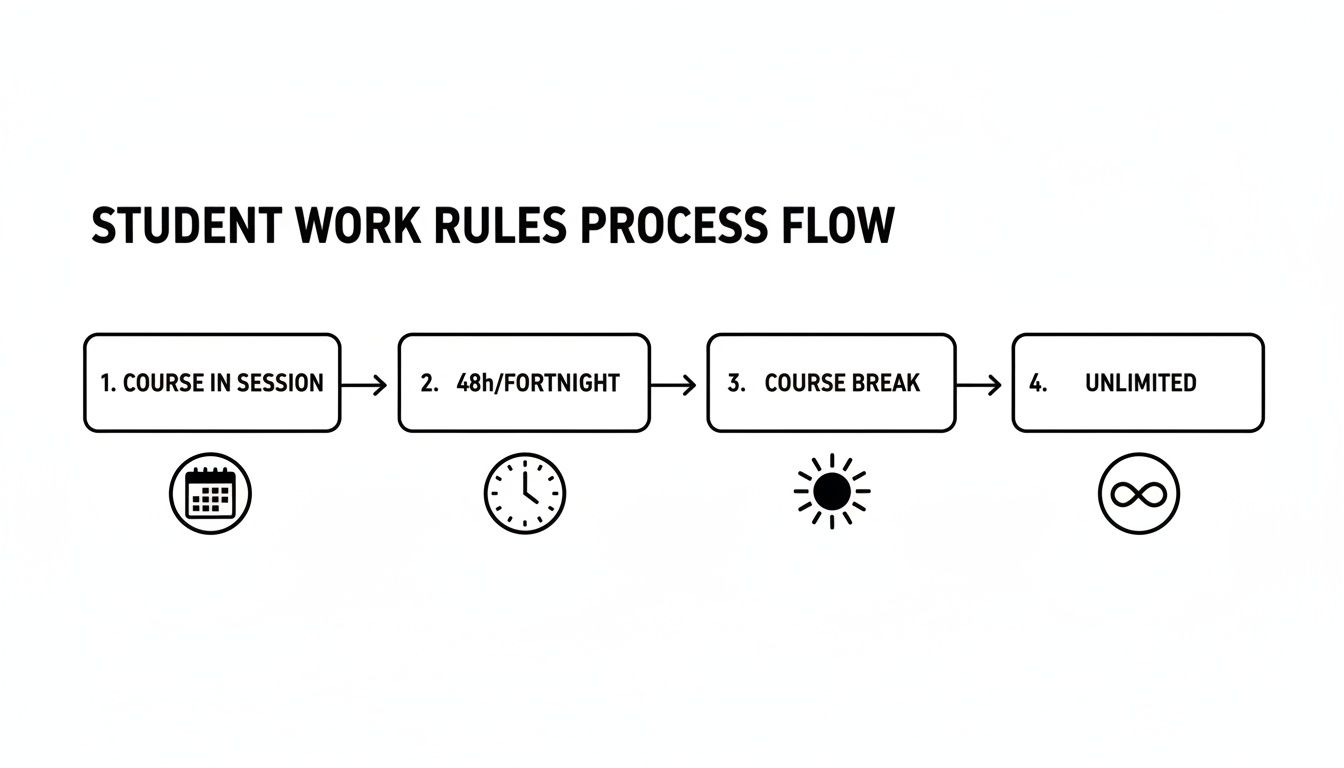
The key takeaway is that the rules are tied directly to your uni schedule—limited hours when your course is 'in session', and total freedom during scheduled holidays.
Common Traps to Sidestep
That same flexibility can catch you out if you're not paying attention. A classic mistake is thinking you can just average your hours out over a month, or stick to a simple 24 hours every single week. This is a fast track to an accidental breach.
Non-Compliant Scenario: Leo's Mistake
Now, let's look at Leo, who works in a retail store.
- Week 1 (Monday to Sunday): Leo works 25 hours.
- Week 2 (Monday to Sunday): He does the same again, working another 25 hours.
Leo might feel like he's played it safe. After all, 25 hours a week doesn't sound like much. But when you add it up, his total for that specific Monday-to-Sunday fortnight is 50 hours (25 + 25). That’s a breach. It’s a subtle but critical distinction that many students unfortunately miss.
Keeping a close eye on your hours isn't just a good idea—it's a visa requirement. A basic spreadsheet or a simple app on your phone is your best defence against accidentally going over the 48-hour cap.
What 'In Session' Actually Means
The 48-hour limit is active whenever your course is considered 'in session'. This isn't just about when you're physically in a classroom. It generally covers:
- The official start and end dates of your semester or term.
- Any time you are enrolled and expected to be studying, attending classes (online or in-person), doing coursework, or sitting exams.
Even if your entire course is delivered online, these rules still apply. Your work limits are linked to your enrolment status, not where you study. The only time the cap is lifted is during official, scheduled course breaks, which we’ll cover next.
Disclaimer: Visa regulations and policies can change. The information in this article is for general guidance only and may not be current when you read it. For the latest updates and personalised advice, it is crucial to book an appointment with a registered migration agent. Always refer to the official Department of Home Affairs website for any government fees.
Maximising Your Work Rights During Course Breaks
Once the semester wraps up and the 48-hour fortnightly limit is on pause, a massive opportunity opens up for international students: your scheduled course break. This is your chance to work without any hourly restrictions, turning your holiday period into a time for some serious financial gain and invaluable professional development.
This unlimited work right is a brilliant feature of the Australian student visa. It’s designed to help you support yourself and get real-world experience when you’re not required to be hitting the books. You can take on full-time temporary roles, juggle multiple jobs, or just pick up as many shifts as you can handle without worrying about a cap.
This freedom gives you a strategic advantage. You can build up savings to cover tuition and living costs for the next semester, dip your toes into different industries, and add some solid Australian work experience to your resume. It’s a period where you can really throw yourself into the local workforce.
What Is a Scheduled Course Break?
First things first, it's critical to understand exactly what counts as a "scheduled course break." Getting this wrong is a common pitfall and could lead you to accidentally breach your visa conditions by working unlimited hours when you're not meant to.
A scheduled break is an official holiday period that's formally built into your course’s academic calendar. Think of the long summer holiday or the mid-year winter break between semesters.
The key here is to confirm these dates directly with your education provider. Your university or college will have an official academic calendar that clearly lays out the start and end dates of all teaching periods and holidays. This calendar is your single source of truth.
A common mistake is thinking any time off from class is a scheduled break. That week you have between big assignments or a short, informal pause in your timetable? That doesn't count. The unlimited work rights only kick in during the official, university-sanctioned holidays.
Making the Most of Your Breaks
With no cap on working hours, a little bit of planning can turn this period into a massive success. It’s not just about earning money; it’s about striking a smart balance between work, rest, and getting ready for your next semester.
Here are a few practical tips to make the most of this opportunity:
- Find Temporary Roles Early: Don't wait until the last minute. Start your job search well before your break begins. Industries like hospitality, retail, and tourism are always on the lookout for temporary staff during peak holiday seasons.
- Gain Relevant Experience: Try to find short-term contracts or casual roles in a field related to what you're studying. It’s a fantastic way to apply what you've learned in the classroom and build up some professional connections.
- Don't Forget to Rest: Working full-time hours can be draining. Make sure you schedule some real downtime to relax and recharge before your studies kick off again. Hitting the next semester burnt out can seriously impact your academic performance.
- Keep Your Records: Even though the hours are unlimited, it’s a good habit to keep track of your payslips and work hours. This just helps ensure you're being paid correctly and gives you a clear record of your employment history for future reference.
Ultimately, your course breaks are a valuable resource. If you understand the rules and plan ahead, you can use this time to significantly improve your finances and professional standing—all while staying perfectly compliant with your visa.
Disclaimer: Visa regulations and policies can change. The information in this article is for general guidance only and may not be current when you read it. For the latest updates and personalised advice, it is crucial to book an appointment with a registered migration agent. Always refer to the official Department of Home Affairs website for any government fees.
Understanding Policy Changes and Key Exemptions
The world of Australian immigration is never static, and the rules around student visa working hours are a perfect example. These policies are constantly tweaked to strike a delicate balance: supporting the country's economy while ensuring the real purpose of a student visa—your education—always comes first. Keeping up with these changes is absolutely crucial for any international student.
The biggest recent shift has been the reintroduction of a cap, now set at 48 hours per fortnight while your course is in session. This move shows the government's dynamic approach, recognising the massive contribution students make to the workforce but also reinforcing that your studies have to remain the top priority.
This change doesn't exist in a vacuum. It’s part of a wider picture that includes planned visa caps and new financial capacity requirements, all of which shape the environment you'll be navigating during your studies in Australia.
The Shift to the 48-Hour Cap
Australia's student visa work rules have been on a bit of a rollercoaster lately. The government has been trying to juggle post-pandemic economic needs with maintaining the integrity of its education system. The result? As of 1 July 2023, international students on a Student Visa (Subclass 500) can work up to 48 hours per fortnight while their course is in session.
This was an increase from the old pre-pandemic limits, largely a response to major labour shortages in industries like hospitality. But remember, this 48-hour cap is strictly for when you're actively studying. The good news is you still have the freedom to work unlimited hours during your scheduled university holidays. This two-tiered system is designed to keep you focused on your degree while letting you earn more during your downtime. For more background on this policy, IDP.com has some great insights.
Disclaimer: Visa regulations and policies can change, sometimes overnight. The information here is for general guidance and might not be current when you read it. For the latest updates and advice tailored to your situation, it is vital to book an appointment with a registered migration agent. Always double-check official government fees on the Department of Home Affairs website.
Key Exemptions to the Rule
While the 48-hour per fortnight rule is the standard for most, there's a very important exception to be aware of. It’s specifically for students whose study patterns look very different from a typical coursework degree—we're talking about high-level research students.
The main group exempt from this work limit is:
- Students enrolled in a Master's by research or a doctoral degree (PhD).
Once you’ve officially started your Master's by research or PhD, you can generally work unlimited hours, even when the semester is technically underway.
There’s a clear reason for this special treatment. Postgraduate research doesn't follow a neat 9-to-5, semester-based schedule. It’s often an intense, project-driven journey that demands a level of flexibility the standard work limits just can't offer. The government recognises that these students are often directly contributing to Australia's research and innovation, and their work and study are frequently one and the same.
Of course, if your academic plans change, so do your work rights. Thinking of switching from a research degree back to a coursework program? You’ll definitely want to read our guide on how to change your course or provider, as this will have a direct impact on your visa conditions.
This exemption is a huge advantage, letting research students support themselves and gain valuable professional experience without the hourly cap. But with great freedom comes great responsibility—it's still on you to make sure your work doesn't get in the way of your academic progress. Maintaining satisfactory progress is a non-negotiable condition of your visa.
The Serious Consequences of Breaching Work Conditions
Going over your student visa working hours isn't a minor slip-up; it's a direct breach of your visa conditions. Let's be clear: the Department of Home Affairs treats these violations very seriously, and the fallout can permanently damage your future in Australia.
It's tempting to pick up a few extra shifts for more cash, I get it. But the risks are massive, and honestly, they're just not worth it. The government has sophisticated systems in place to track compliance, so it's less a matter of if you'll get caught, and more a matter of when.

How Breaches Are Actually Detected
A lot of students think that working a few extra hours, especially for cash, will fly under the radar. This is a very dangerous assumption. The Department of Home Affairs works hand-in-glove with other government bodies, especially the Australian Taxation Office (ATO), to keep an eye on things.
Data sharing between these departments is standard procedure. Whenever you work legally, your employer reports your income and tax information to the ATO against your Tax File Number (TFN). This creates a clear digital trail of your entire work history, including every hour you’ve worked.
Any mismatch between your reported work hours and what your visa allows can trigger an instant red flag. And relying on "cash-in-hand" jobs? That's just as risky. It not only leaves you vulnerable to exploitation by your employer but can still be uncovered through audits or tip-offs.
The Range of Potential Penalties
If you're found to have breached your work conditions, the consequences will depend on how serious and frequent the violation is. The Department has a few tools at its disposal, and none of them are pleasant.
Here are the possible outcomes:
- Formal Warning: For a minor, one-time mistake, you might just get a formal warning letter. This is a slap on the wrist, but it puts you on their radar.
- Visa Cancellation: This is the big one, the worst-case scenario. If your visa is cancelled, you'll be required to leave Australia. A cancellation can also come with an exclusion period, banning you from applying for another Australian visa for up to three years.
- Future Visa Refusals: Even if your current visa isn't cancelled, a breach is recorded on your immigration file permanently. This can make it incredibly difficult to get any future Australian visas, like a post-study work visa or permanent residency.
A Realistic Scenario of a Breach
Let’s look at a real-world example. Imagine a student, Chen, works 30 hours in the first week of his fortnight and 25 hours in the second. That’s a total of 55 hours. He might think, "It's only seven hours over, what's the big deal?"
But it is a big deal. It’s a clear breach of the 48-hour limit.
Months down the track, Chen applies for a new visa. His work history is automatically checked against his visa conditions. The breach is flagged, and he receives a "Notice of Intention to Consider Cancellation" (NOICC). Suddenly, he's thrown into a stressful and expensive process, trying to explain his actions while his entire future in Australia hangs by a thread.
The message here is simple: protect your investment in your education and your future opportunities. Stick strictly to the student visa work limits. The tiny gain from a few extra hours of work is nothing compared to the devastating cost of a visa cancellation.
Disclaimer: Visa regulations and policies can change. The information in this article is for general guidance only and may not be current when you read it. For the latest updates and personalised advice, it is crucial to book an appointment with a registered migration agent. Always refer to the official Department of Home Affairs website for any government fees.
Practical Tips for Keeping Your Work Rights in Check
Let’s be honest: juggling study and work is tough enough without having to worry about complex visa rules. But staying on the right side of your work conditions is a team effort—it’s a shared responsibility between you and your employer. With a bit of organisation, you can easily manage your hours, know your rights, and keep everything above board.
For students, it all comes down to good habits. Don't try to track your hours in your head. A simple system will be your best friend and provide a clear record if any questions ever come up. Think of it like another part of your study routine—just one more thing to manage on your path to success.
It also pays to be upfront with your employer from the get-go. A clear, honest conversation about your 48-hour per fortnight limit prevents any awkward misunderstandings down the track and shows them you’re serious about your obligations.
Simple Strategies for Students
Managing your work hours in Australia doesn’t have to be a headache. A few straightforward habits can make all the difference.
- Get a Tracking App: Your phone is already in your pocket, so put it to work. There are plenty of free apps out there for logging work hours. Find one that works for you and get into the habit of logging your shifts the moment they finish.
- Set Up a Shared Spreadsheet: A basic Google Sheet or Excel file is a fantastic, no-fuss tool. Just create columns for your start time, end time, and total hours for each shift. You could even share it with your boss for complete transparency.
- Know Your Rights at Work: Remember, your visa status has zero impact on your basic rights as an employee in Australia. You're entitled to the minimum wage, a safe workplace, and proper breaks. If something doesn't feel right, don't be afraid to get information from the Fair Work Ombudsman.
When you're on the job hunt, first impressions count. Knowing how to write a resume for an internship or a part-time role that clearly states your skills and your availability within visa limits will put you ahead of the pack.
A Quick Word for Employers
Hiring international students is a brilliant way to build a dynamic, skilled, and diverse team. But it’s crucial to remember that compliance is your responsibility, too. Pleading ignorance of an employee's visa conditions simply won't cut it if things go wrong.
Your most important tool here is the Visa Entitlement Verification Online (VEVO) system.
VEVO is a free, official online service from the Department of Home Affairs. It lets you check the visa details and work conditions of any current or potential employee. It is the single source of truth for confirming a student's work rights and their hour limits. Making VEVO checks a standard part of your hiring process is just smart business.
Using VEVO protects you, protects your student employees, and helps build a workplace founded on trust and compliance.
A Final Reminder
The world of Australian immigration is always shifting. This is especially true for student visas, as the government constantly tweaks policies to balance economic needs and educational goals. For example, Australia is working towards a 295,000 student visa cap by 2026 and has introduced new processing rules under Ministerial Directions 111 and 115. These shifts can affect everything from how long your application takes to how much money you need to show.
For the most accurate, up-to-the-minute advice that’s specific to your situation, your best move is to book an appointment with a registered migration agent. And always, always check the official Department of Home Affairs website for the current government fees before lodging any application.
Frequently Asked Questions About Student Work Hours
Getting your head around the rules for working on a student visa in Australia can throw up some tricky questions. Let's tackle some of the most common ones we hear, so you can handle these situations confidently and stay on the right side of your visa conditions.
Think of this as diving into the fine print. Understanding these details is key to managing your work life without accidentally crossing a line.
Can I Work More Than One Job?
Yes, absolutely. You're free to have two or more part-time jobs. The crucial thing to remember is that the 48-hour per fortnight limit is the total number of hours you work across all your employers combined.
It's entirely up to you to keep a careful log of your hours from each job. You need to be certain that the combined total doesn't creep over that fortnightly cap while your course is in session.
Does Volunteer Work Count Towards My Hours?
This is a really common point of confusion. As a general rule, genuine, unpaid volunteer work for a registered non-profit or charitable organisation doesn't count towards your 48-hour limit. The work has to be truly voluntary.
But you need to be very careful here. If you're "volunteering" in a role that would normally be paid (like an unpaid internship at a for-profit company), it could be seen as a breach of your work conditions. The key is whether the position is genuinely voluntary in nature.
What if My Course Starts or Ends Mid-Fortnight?
Your work restrictions are tied directly to your course schedule. The 48-hour limit kicks in from the official start date of your course and lifts on the official completion date.
For any fortnight that's split between a study period and a scheduled break, you have to be extra diligent. You can only work unlimited hours on the days that fall within the official break. For the days within the study period, any hours you work count towards that fortnightly cap. If you're ever in doubt, play it safe and stick to the limit.
Disclaimer: Visa regulations and policies are always subject to change. The information in this article is for general guidance and might not be current when you read it. For the most up-to-date and personalised advice, it is critical to book an appointment with a registered migration agent. Always refer to the official Department of Home Affairs website for any government fees.
What Should I Do If My Boss Asks Me to Work More?
You are legally required to say no to any request to work beyond your visa's limits. It’s important to handle this situation politely but firmly.
Explain to your employer that your student visa has strict work conditions and that breaking them could lead to your visa being cancelled, which would mean having to leave Australia. If you feel pressured, you can get free advice and support from the Fair Work Ombudsman, which protects the rights of all workers in Australia, including international students. Staying compliant is also a smart move for your future career; get a head start by exploring our guide on Australian post-study pathways.
Navigating your visa journey requires expert guidance and a clear strategy. At My Visa Guide, our MARA-certified agents provide meticulous application preparation and transparent advice to ensure you have the best chance of success. Whether you're just starting your studies or planning your future in Australia, we're here to support you every step of the way.