IMPORTANT NOTICE
If your life partner is an Australian citizen or permanent resident, the partner visa is your pathway to building a life together in Australia. It's a journey with a few moving parts, but understanding the basic structure from the get-go makes everything much clearer.
The process is designed in two stages: you start with a temporary visa (Subclass 820 or 309) and then, after a couple of years, you move onto the permanent visa (Subclass 801 or 100). The real starting point, though, is figuring out where you'll be when you hit 'submit' on your application.
Disclaimer: Immigration law and visa requirements change frequently. The information in this article may not be current at the time of reading. It is essential to book an appointment with a registered migration agent for up-to-date and personalised advice. For any Department fees, always refer to the official Department of Home Affairs website at https://www.homeaffairs.gov.au/.
Decoding the Australian Partner Visa Pathway
The very first question you need to answer is a simple one: are you applying from inside Australia or outside Australia? Your location at the time of lodging is the critical factor that determines which visa stream you'll follow. This one detail shapes your entire application, including the rights you have while you wait for a decision.
Getting this right is non-negotiable. It’s the foundation of your whole application.
The government has set up the partner visa as a combined application, but it's really two steps rolled into one. This structure is intentional—it gives the Department of Home Affairs a way to see that your relationship is genuine and continues over time.

The Two Core Visa Streams
So, which stream is yours? It all comes down to where you are when you apply.
-
Onshore Partner Visa (Subclass 820/801): This is for you if you're physically in Australia when you lodge the application. Once you apply, you’ll typically be granted a bridging visa that lets you stay here while a decision is made. The first stop is the temporary Subclass 820 visa, which allows you to live, work, and study in Australia. Then, roughly two years after you first applied, the Department will assess you for the permanent Subclass 801 visa.
-
Offshore Partner Visa (Subclass 309/100): If you're outside Australia when you apply, this is your route. You'll be granted the temporary Subclass 309 visa first, which is your ticket to travel to and settle in Australia. Just like the onshore stream, you'll be looked at for the permanent Subclass 100 visa after that two-year waiting period has passed.
It's absolutely vital to choose the correct stream. Lodging an onshore application while you’re overseas (or vice versa) will lead to an invalid application and a lost visa application charge.
Onshore vs Offshore Partner Visa At a Glance
To make it even clearer, here’s a quick breakdown of the key differences between the two main pathways. This should help you immediately see which stream fits your situation.
| Feature | Onshore Application (Subclass 820/801) | Offshore Application (Subclass 309/100) |
|---|---|---|
| Applicant's Location | Must be in Australia when applying and for the visa grant. | Must be outside Australia when applying and for the first visa grant (309). |
| Visa Subclasses | Temporary 820, leading to Permanent 801. | Temporary 309, leading to Permanent 100. |
| Bridging Visa | Yes, a Bridging Visa is typically granted, allowing you to stay in Australia. | No, you must wait outside Australia for the 309 visa to be approved. |
| Work Rights | Full work rights are usually included with the Bridging Visa and Subclass 820. | You can only work in Australia once your Subclass 309 visa is granted. |
| Medicare Access | Usually eligible for Medicare once the 820 application is lodged. | Not eligible for Medicare until you arrive in Australia on your 309 visa. |
This table is a great starting point, but every couple's circumstances are unique. The best path for you depends on many personal factors, including your current visa status if you're already in Australia.
Understanding the Sponsor's Role
You can't apply for a partner visa alone; you need a sponsor. Your sponsor must be your Australian citizen, Australian permanent resident, or eligible New Zealand citizen partner.
Being a sponsor isn’t just about putting your name on a form. It comes with legal responsibilities, like committing to support your partner financially and with accommodation for their first two years in Australia. Because of this, both you and your sponsor are under the microscope during the application process.
The demand for these visas is huge—they are a cornerstone of Australia's family migration program. For the 2025–26 program year, the government has allocated 52,500 places to the Family stream, with a massive 40,500 places dedicated specifically to partner visas. This shows just how many people are on the same journey as you.
Disclaimer: Immigration law and visa requirements change frequently. The information in this article may not be current at the time of reading. It is essential to book an appointment with a registered migration agent for up-to-date and personalised advice. For any Department fees, always refer to the official Department of Home Affairs website at https://www.homeaffairs.gov.au/.
Building a Strong Case with Relationship Evidence
At its core, your partner visa application isn’t just a stack of forms or a processing fee—it's your story. Your main job is to prove to the Department of Home Affairs that your relationship is both genuine and ongoing. This goes way beyond just saying you're a couple; you need to hand them compelling, organised evidence that paints a clear and complete picture of your shared life.
The Department looks at your relationship through the lens of four key pillars. Think of these as the main chapters in the story of you. A strong application will have solid proof across all four areas, leaving the case officer with no doubt about how real your commitment is.
Financial Aspects of Your Relationship
Showing that you share your finances is one of the most powerful ways to prove you're building a life together. It demonstrates a level of trust and mutual reliance that case officers expect to see in a genuine partnership. They are looking for hard proof that you pool your money and make financial decisions jointly.
Just sending money to each other every now and then won’t cut it. You need to show a consistent pattern of shared financial responsibility.
- Joint Bank Accounts: This is a big one. You'll want to provide statements showing both of you regularly using the account for day-to-day things like groceries, rent, and going out.
- Shared Bills: Get copies of utility bills (electricity, gas, internet) and rental agreements that clearly show both your names. If a bill is only in one person’s name, show proof that the other partner pays their share, like bank transfers with descriptions like "June rent contribution."
- Joint Assets and Liabilities: Do you have a car loan together? A mortgage? Did you buy a big-ticket item like a couch together? Receipts and loan documents in both names are gold.
A great tip is to build a timeline of your financial life together. For example, show them when you opened that joint account and how you've used it more and more over time, reflecting a deepening financial commitment.
The Nature of Your Household
This pillar is all about how you live together and share your domestic life. You’re essentially proving that you operate as a single household. The evidence here needs to paint a picture of your daily living arrangements and how you split the chores.
Here’s what that looks like:
- Lease Agreements or Property Titles: A formal lease agreement with both names is non-negotiable if you rent. If you own property together, the title deed is undeniable proof.
- Mail Addressed to Both of You: Start a folder and collect letters and official mail that come to your shared address with both names on them. You can also gather mail sent to each of you individually at the same address to show you both live there.
- Statutory Declarations: You can write statements explaining how you divide household tasks. Get specific: who does the cooking, who takes out the bins, who manages the garden? This adds a really personal touch to your application.
A common mistake is thinking that just living at the same address is enough. You have to show how you share that household. Describe your living space, how you decorated it together, and how you manage the day-to-day running of your home.
Social Aspects of Your Relationship
For this section, you need to prove that everyone in your life knows you as a couple. This shows your relationship isn't a secret; it’s openly acknowledged by your friends, family, and community.
This is where you can really bring your relationship to life with photos, stories, and statements from the people who know you best.
How to Prove Social Recognition
- Joint Travel: Flight tickets, hotel bookings, and photos from holidays you’ve taken together are fantastic. I always suggest creating a small photo album with captions explaining the date, location, and who you were with.
- Social Events: Show that you attend weddings, parties, and family get-togethers as a couple. This could be joint invitations you’ve received or photos of you at the events.
- Form 888 Declarations: These are formal statements from friends and family who are Australian citizens or permanent residents and can vouch for your relationship. You need a minimum of two, but getting more from a mix of people (family, friends, workmates) makes your case even stronger.
- Social Media: Don't underestimate this! Screenshots from Facebook showing your relationship status, photos you're tagged in together, and comments from friends and family can be surprisingly persuasive.
Effective communication is a cornerstone of any strong relationship and is vital for demonstrating a genuine and continuing commitment for your partner visa. Exploring this guide on how to communicate better in relationships can offer valuable insights on building and articulating the strength of your partnership.
The Nature of Your Commitment
This final pillar is all about your future together. The Department wants to see that you are mutually committed to a shared life, to the exclusion of all others. It’s about your long-term plans and the emotional support you give each other.
You need to tell them not just where your relationship has been, but where it’s going.
This can be shown through:
- Personal Statements: Both of you should write detailed, heartfelt statements about the history of your relationship, what you mean to each other, and your plans for the future—things like getting married, having kids, career goals, or buying a home.
- Wills and Superannuation: Naming your partner as a beneficiary on your superannuation fund or in your will is an incredibly strong piece of evidence. It screams long-term commitment.
- Evidence of Contact: If you’ve spent time apart, show how you kept in touch. Collect call logs, message histories (like WhatsApp or Messenger), and emails. This proves your bond remains strong even when you’re physically separated.
Putting together your evidence is the most time-consuming part of the partner visa application Australia, but it's without a doubt the most important. Be thorough, get organised, and let your unique story shine through.
Disclaimer: Immigration law and visa requirements change frequently. The information in this article may not be current at the time of reading. It is essential to book an appointment with a registered migration agent for up-to-date and personalised advice. For any Department fees, always refer to the official Department of Home Affairs website at https://www.homeaffairs.gov.au/.
Your Essential Document Checklist for a Seamless Application
Alright, this is where the rubber meets the road. Gathering your documents is the part of the partner visa process where theory becomes practice, and it’s arguably one of the most critical stages.
A meticulously organised and complete set of documents is your single best weapon against unnecessary delays. Think of it less like ticking boxes and more like building a professional portfolio of your relationship. The goal is to present a file that tells your story so clearly and convincingly that the case officer has no questions left to ask.
Disclaimer: Immigration law and visa requirements change frequently. The information in this article may not be current at the time of reading. It is essential to book an appointment with a registered migration agent for up-to-date and personalised advice. For any Department fees, always refer to the official Department of Home Affairs website at https://www.homeaffairs.gov.au/.
Core Identity and Civil Documents
Before you can prove you're a couple, you have to prove who you both are. These are the non-negotiables for both the applicant and the sponsor. Make sure you're working with high-quality, colour scans of the original documents.
- Passports: You'll need a crystal-clear scan of the bio-data page for both of you—that's the page with your photo and personal details. Double-check that both passports are current with at least six months of validity left.
- Birth Certificates: A full birth certificate for both partners is required. Critically, this document must show the names of both your parents.
- National Identity Cards: If you or your sponsor have a national ID card (separate from a passport), include a scan of the front and back.
- Passport-Sized Photographs: Each of you will need a recent, passport-style digital photo. The standard rule is that it must have been taken within the last six months.
If either of you has ever changed your name, you must show the official paper trail. This could be a marriage certificate or a formal change of name certificate from the relevant government authority.
Demonstrating Good Character
The Australian government is very serious about the character of the people it allows into the country. This means both the applicant and the sponsor have to prove they are of good character, primarily by providing police clearances.
You'll need a police certificate from every country where you've lived for 12 months or more over the last 10 years. This is a cumulative total, not a consecutive one. For example, if you lived in Canada for seven months and then went back for another six months a few years later, you’ve crossed the 12-month threshold and need a Canadian police check.
It's a common misconception that only the applicant's character matters. The sponsor must also pass the character test. An applicant can be refused a visa if their sponsor has a significant criminal record. You can dive deeper into the specifics in our detailed guide on the health and character requirements.
Assembling Your Relationship Evidence
This is the heart of your application and where most of your effort will go. We’ve already talked about how to build evidence across the four pillars, but this is about pulling it all together for the final submission.
| Evidence Category | Key Documents to Include |
|---|---|
| Financial Aspects | Joint bank account statements, shared utility or rent bills, proof of big joint purchases, joint loan or mortgage documents. |
| Nature of Household | A joint lease agreement or property title, mail addressed to both of you at the same address, personal statements on how you split household chores. |
| Social Aspects | Form 888 statutory declarations from your Aussie friends/family, joint travel itineraries, photos together at social events, wedding invitations addressed to you as a couple. |
| Mutual Commitment | Your personal written statements (the 'love story'), proof of being beneficiaries on each other’s superannuation or wills, and communication logs (like call logs or message history) if you've ever been apart. |
Handling Special Document Requirements
Not every document is as simple as scanning and uploading. You need to be on top of the rules for certification and translation to make sure your evidence isn’t dismissed on a technicality.
Document Certification
For online applications, high-quality colour scans of original documents are usually all you need. You generally don't have to get things like passports or birth certificates certified if you provide a good colour scan. However, if the Department specifically asks for a certified copy, you must get it done by an authorised person, like a Justice of the Peace (JP) in Australia.
Translations for Non-English Documents
Any document that isn't in English must be accompanied by a complete English translation. If you're in Australia, the translation must be done by a translator accredited by the National Accreditation Authority for Translators and Interpreters (NAATI). If you're lodging from overseas, the translator needs to be officially accredited or recognised in that country.
Digital Organisation for ImmiAccount
The ImmiAccount system has its limits. You can only upload 100 documents, and each individual file must be under 5MB. This means you need to be strategic.
- Group Similar Documents: Combine related evidence into a single, multi-page PDF. For instance, put all your 2023 joint energy bills into one file and name it
Joint-Energy-Bills-2023.pdf. - Use Logical Naming Conventions: Name your files clearly so you—and more importantly, your case officer—know exactly what's inside. Think
Applicant-Passport.pdf,Sponsor-Birth-Certificate.pdf, orForm-888-J-Smith.pdf. - Compress Large Files: If a PDF is sneaking over that 5MB limit, use a reliable online tool to compress it without losing too much quality.
Putting together a strong application is about more than just having the right documents; it's about presenting them in a logical and easy-to-follow way. For more practical tips on this, check out this excellent guide on assembling your application packet.
Disclaimer: Immigration policies and visa requirements are subject to change. The information provided in this article is for general guidance and may not be current when you read it. For the latest, personalised advice, it is crucial to book an appointment with a registered migration agent. All official government visa fees are listed on the Department of Home Affairs website: https://www.homeaffairs.gov.au/.
Lodging Your Application and Navigating the Wait
You’ve done the hard yards, meticulously organised your documents, and now you’re at the final hurdle of the preparation phase: launching your partner visa application. Everything from this point forward happens online through the Department of Home Affairs’ ImmiAccount portal. Think of this as the digital home for your application, from the moment you hit submit right through to the final decision.
First things first, you'll need to create an ImmiAccount if you don't already have one. From there, it's a matter of selecting the right partner visa subclass and tackling the extensive online forms – there’s one for the applicant and one for the sponsor. Once the forms are filled out and you've paid the hefty Visa Application Charge, you can finally start uploading all that evidence you’ve so carefully prepared.
This timeline gives you a realistic idea of how long it can take to get your key documents in order before you even get to the lodgement stage.
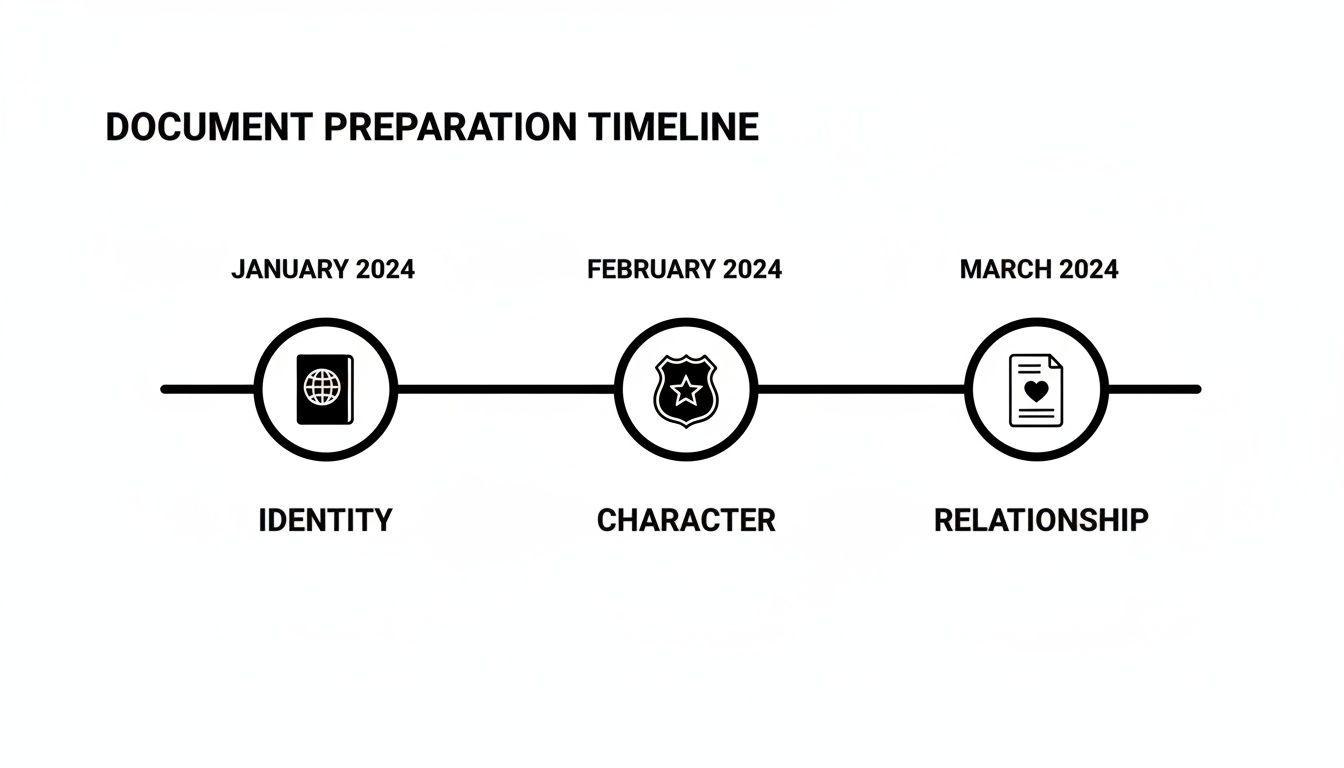
As you can see, gathering all your identity, character, and relationship evidence isn’t a weekend job. It’s a multi-month project that really benefits from careful planning.
Disclaimer: Immigration law and visa requirements change frequently. The information in this article may not be current at the time of reading. It is essential to book an appointment with a registered migration agent for up-to-date and personalised advice. For any Department fees, always refer to the official Department of Home Affairs website at https://www.homeaffairs.gov.au/.
Understanding What Happens After You Submit
Clicking 'submit' feels like a massive relief, but it’s also the start of the long waiting game. What happens next really depends on whether you've lodged an onshore (Subclass 820) or offshore (Subclass 309) application.
If you’re applying onshore, lodging the 820 visa application usually triggers the grant of a Bridging Visa A (BVA). This is a critical lifeline. It allows you to stay in Australia legally after your current visa expires while you wait for a decision. For most couples, the best news is that the BVA typically comes with full work and study rights.
It’s crucial to remember that the BVA only kicks in after your current visa ends. Until then, you absolutely must stick to the conditions of your existing visa.
A quick note for offshore applicants: You won't receive a bridging visa. You must wait outside Australia for a decision on your temporary Subclass 309 visa before you can pack your bags and move to Australia to be with your partner.
Health and Biometrics Requests
Shortly after you lodge, expect a request from the Department to complete a health examination. You'll get a notification in your ImmiAccount with a unique HAP ID, which you’ll need to book an appointment with a government-approved panel physician.
You might also be asked to provide biometrics—your fingerprints and a photo—at an Australian Biometrics Collection Centre. Don’t panic; these are just standard checks to verify your identity and make sure you meet Australia’s health requirements. It's always best to get these done as quickly as possible to avoid holding up your application.
Now, for the tough part: the waiting period for a partner visa can be incredibly long and is a source of huge anxiety for couples. The system is under enormous pressure; as of early 2024, reports indicated a backlog of nearly 100,000 partner visa applications. These visas consistently have some of the longest processing times in the entire migration program, often stretching into years. You can read more analysis on Australia's migration program planning to understand the scale of these backlogs.
Navigating the Long Wait
The wait can feel endless, but you can’t just set and forget. It's vital to keep the Department updated on any changes in your life. This includes things like a new address, a new passport, or if you get married after lodging as de facto partners.
Most importantly, don't stop collecting evidence of your life together.
- Keep taking photos at social events with friends and family.
- Continue saving your joint bank account statements.
- Hold onto flight bookings and photos from holidays you take together.
Every few months, it's a great idea to log into your ImmiAccount and upload a new batch of evidence. This shows the case officer who eventually picks up your file that your relationship is still genuine and continuing—which is exactly what they need to see.
Disclaimer: Immigration policies and visa requirements are subject to change. The information provided in this article is for general guidance and may not be current when you read it. For the latest, personalised advice, it is crucial to book an appointment with a registered migration agent. All official government visa fees are listed on the Department of Home Affairs website: https://www.homeaffairs.gov.au/.
Common Application Mistakes and How to Avoid Them
Even the most genuine, rock-solid relationships can hit a wall if the visa application is full of avoidable mistakes. Honestly, learning from where others have gone wrong is one of the best ways to build a stronger application from the very beginning. Think of this as your cheat sheet for sidestepping the common traps that lead to long delays or, worse, a refusal.
The Department of Home Affairs goes through every detail with a fine-tooth comb. Even tiny inconsistencies can raise a red flag, so your mission is to present a story that is crystal clear, honest, and perfectly consistent across every single document.
Disclaimer: Immigration law and visa requirements change frequently. The information in this article may not be current at the time of reading. It is essential to book an appointment with a registered migration agent for up-to-date and personalised advice. For any Department fees, always refer to the official Department of Home Affairs website at https://www.homeaffairs.gov.au/.
Inconsistent Dates and Details
One of the fastest ways to make a case officer doubt your application is to have conflicting information. It’s usually not intentional; it just happens when you and your partner are filling out forms and writing statements at different times.
For example, you might say you officially moved in together on 15 March 2022, but your partner remembers it as being in early April. It’s a small detail, but it creates a crack in your story. The solution? Before either of you writes a single word, sit down together and create a master relationship timeline.
This timeline should be your single source of truth for key dates:
- When and how you first met.
- The date your de facto relationship officially started.
- The day you moved in together.
- Key holidays, events, or trips you took as a couple.
- The date you got engaged or married, if that's part of your story.
Keep this timeline handy and refer to it religiously as you fill out your forms. Consistency isn't just a nice-to-have; it's a non-negotiable part of a successful partner visa application Australia.
Failing to Disclose Previous Visa Issues
Let me be blunt: complete honesty is non-negotiable. So many applicants get into hot water trying to hide or minimise a previous visa refusal, a cancellation, or even a simple overstay. Trust me, the Department of Home Affairs has incredibly detailed records. They will find out.
It is always, always better to be upfront. Disclose any past immigration hiccup, provide a straightforward explanation of what happened, and show why it won’t be an issue again. Trying to hide something is seen as a major character flaw and can lead to a refusal under Public Interest Criterion 4020. That’s serious business, potentially resulting in a ban on applying for other Australian visas.
A classic scenario I've seen is an applicant who had a student visa cancelled years ago for not meeting their attendance requirements. Hiding this is a critical error. The right move is to declare it, explain the circumstances (maybe you were young and foolish), and show that you now understand and respect Australia's visa rules.
Overlooking the Sponsor's Character Obligations
Couples often get so laser-focused on the applicant’s paperwork that they completely forget the sponsor is also being assessed. Your Australian partner or spouse has to pass the character test, too.
A significant criminal record, especially anything involving violence or offences against children, can make a sponsor ineligible. Both of you must provide police clearances from every country you've lived in for 12 months or more over the last 10 years. Don't fall into the trap of thinking only the applicant's history matters—the sponsor's character is just as critical to your success.
Not Updating the Department of Changes
Partner visa processing times are long, and life keeps moving. A surprisingly common mistake is forgetting to tell the Department about major life changes after you've lodged the application. You are legally required to keep them in the loop.
This includes things like:
- Moving to a new residential address.
- Getting a new passport.
- The birth of a child.
- Getting married (if you originally applied as de facto partners).
Failing to update your address means you could miss vital communication from the Department. And on the flip side, having a baby together is incredibly powerful evidence of your ongoing relationship—you should be rushing to send them that birth certificate. Keeping your file current shows you're proactive and taking the process seriously.
Disclaimer: Immigration law and visa requirements change frequently. The information in this article may not be current at the time of reading. It is essential to book an appointment with a registered migration agent for up-to-date and personalised advice. For any Department fees, always refer to the official Department of Home Affairs website.
When to Consider a MARA-Registered Migration Agent
Lots of couples get through the partner visa application on their own, and that's fantastic. If your case is straightforward—you’ve been married for years, have joint bank accounts, and a mountain of photos—you might be perfectly fine to DIY.
But let's be clear: this isn't just filling out some forms. It’s a full-blown legal application, and even tiny mistakes can have heartbreaking consequences. Bringing a MARA-registered migration agent on board isn’t just about convenience; it’s a strategic move to manage risk and give your application the best possible shot.
Deciding whether you need professional help can be a tough call. A good way to start is by taking an honest look at your situation.
Disclaimer: Immigration law and visa requirements change frequently. The information in this article may not be current at the time of reading. It is essential to book an appointment with a registered migration agent for up-to-date and personalised advice. For any Department fees, always refer to the official Department of Home Affairs website at https://www.homeaffairs.gov.au/.
Scenarios That Warrant Professional Guidance
While just about any application can benefit from a professional eye, some situations practically scream for it. If any of the following sound familiar, seeking expert advice is a very, very wise investment.
- Previous Visa Refusals or Cancellations: If the applicant has any kind of visa drama in their past, the application is immediately flagged as high-risk. An agent knows exactly how to address these old issues head-on, explaining them transparently and effectively to the Department.
- Character or Health Concerns: Failing the character test or having a health issue that might not meet the strict requirements can lead to a swift refusal. An agent is your best bet for preparing submissions for waivers and navigating these incredibly sensitive areas.
- Limited Documentary Evidence: Not every genuine relationship fits neatly into the Department's ideal evidence checklist. Maybe you've been together for a shorter period, or you don't have many shared financial documents. An experienced agent knows how to build a powerful, compelling case from the evidence you do have.
- Sponsor Eligibility Issues: Has the sponsor previously sponsored another partner? Or do they have their own character issues? If so, specific limitations and waiting periods might apply. These are tricky rules that a good agent handles every day.
The real value of an agent isn't just in the paperwork. It’s in their ability to spot potential problems from a mile away and deal with them before they become reasons for refusal. They know what case officers look for and can help frame your story in the strongest possible light.
The Agent's Role Beyond Paperwork
A great migration agent does so much more than tick boxes on a form. They become your strategist, your advocate, and your project manager through what is, let's face it, a hugely stressful journey.
They'll help you craft a tailored evidence strategy, handle all the official back-and-forth with the Department, and honestly, provide invaluable peace of mind. Choosing the right one is critical, so it pays to know what to look for. You can get a head start by reading our detailed tips for choosing a migration agent to make sure you find the perfect fit for your situation.
At the end of the day, if your case has any tricky spots or you're just feeling overwhelmed by the high stakes, investing in professional guidance can be the single most important decision you make. It can easily be the difference between a successful new life together in Australia and a devastating refusal.
Disclaimer: Immigration law and visa requirements change frequently. The information in this article may not be current at the time of reading. It is essential to book an appointment with a registered migration agent for up-to-date and personalised advice. For any Department fees, always refer to the official Department of Home Affairs website.
A Few Common Questions Answered
We get asked a lot of the same questions about partner visas, so I've put together some quick answers to the most common ones. Just remember, this is general advice. Migration law can change in the blink of an eye, so it’s always best to get advice that’s tailored to your specific case.
I can't stress this enough: book a chat with a registered migration agent to get the most up-to-date and personalised information for your application.
Disclaimer: Immigration law and visa requirements change frequently. The information in this article may not be current at the time of reading. It is essential to book an appointment with a registered migration agent for up-to-date and personalised advice. For any Department fees, always refer to the official Department of Home Affairs website.
Can I Include My Children in the Partner Visa Application?
Yes, you absolutely can. You’re generally able to include your dependent children in your partner visa application.
You'll need to prove they are your child (with a birth certificate, for example) and show that they are dependent on you. Keep in mind that there will be extra forms to fill out and additional government fees for each child you add to the application.
What is the Difference Between a De Facto and a Registered Relationship?
This is a big one. A de facto relationship is what the Department calls a relationship where you’ve been living together like a married couple for at least 12 months right before you lodge your visa.
A registered relationship is one that you’ve formally recorded with an Australian state or territory government. One of the major benefits of registering your relationship is that it can act as a waiver for that strict 12-month living-together rule, which is a lifesaver for couples who haven't quite hit that milestone yet.
What Happens if My Relationship Ends After Lodging the Visa?
If your relationship breaks down after you've lodged the application, you have a legal obligation to tell the Department of Home Affairs straight away. In most cases, unfortunately, this means the visa application will be refused.
However, there are some very specific and limited exceptions. For instance, if you and your Australian partner have a child together, or if you've been the victim of family violence. These situations are incredibly complex and sensitive, and you must get immediate advice from a registered migration agent if you find yourself in this position.
The partner visa journey can feel overwhelming, but you don't have to figure it all out on your own. The expert team at My Visa Guide is here to give you clear, honest advice and meticulous support from start to finish. Book a consultation with our MARA-registered migration agents today and take the next step towards your future in Australia with confidence.