IMPORTANT NOTICE

If you're an Australian employer looking to hire from overseas, you'll quickly come across a term called Labour Market Testing, or LMT. So, what exactly is it?
Think of it as the government's way of asking, "Have you genuinely tried to hire an Aussie first?" Before you can sponsor a skilled worker from another country, you need to prove that you’ve made a real, honest-to-goodness effort to find a suitable Australian citizen or permanent resident for the job—and came up empty-handed.
Disclaimer: Immigration regulations and requirements are subject to change. The information in this guide is for general purposes only and may not be current when you read it. For the most up-to-date and personalised advice, we strongly recommend booking an appointment with a registered migration agent. For any department fees for any visa, always refer to https://www.homeaffairs.gov.au/.
Decoding Labour Market Testing in Australia

At its heart, LMT is all about protecting the local workforce. It’s a non-negotiable step designed to ensure that Australian job seekers get the first crack at any open positions before they're offered to international talent.
This isn't just a box-ticking exercise. It's a structured process where you have to provide solid evidence that you have a genuine need for an overseas worker because you couldn't fill the role locally. This means running specific job ads, for a set period, on government-approved platforms.
The Core Principle of LMT
The whole point of LMT is to strike a delicate balance between two important national interests:
- Protecting Local Jobs: Giving Australian citizens and permanent residents priority access to employment opportunities.
- Addressing Skills Gaps: Allowing businesses to bring in talent from overseas when a genuine skills shortage exists, which helps keep the economy moving and prevents industry bottlenecks.
It's a cornerstone of Australia's skilled migration system, especially for employer-sponsored visas like the popular Subclass 482 Temporary Skill Shortage (TSS) visa. Get it right, and your visa nomination has a strong foundation. Get it wrong, and it’s a fast track to a refusal.
To give you a clearer picture, here's a quick breakdown of what's involved.
Labour Market Testing At a Glance
| Component | Key Requirement |
|---|---|
| Purpose | To prove no suitable Australian citizen or permanent resident is available for the role. |
| Advertising Period | Ads must run for a minimum of 28 consecutive days. |
| Timing | Must be conducted within the 4 months immediately before lodging the nomination application. |
| Required Platforms | At least two national-reach advertisements are mandatory. One must be on Workforce Australia. |
| Ad Content | Must include specific details like the position title, duties, skills required, and salary. |
| Evidence | Copies of all advertisements and a summary of responses and reasons for unsuitability. |
This table covers the basics, but as you can imagine, the devil is in the details. Each requirement needs to be met perfectly to satisfy the Department of Home Affairs.
Why It Matters for Your Business
Let's be blunt: failing to meet LMT requirements is one of the most common reasons for a visa nomination to be refused. This means wasted time, lost money, and a whole lot of frustration.
A properly executed LMT process, on the other hand, is the bedrock of a successful sponsorship application. It clearly demonstrates your business's legitimate need for an overseas employee. Navigating the rules for employer sponsorship is absolutely critical, and LMT is a huge part of that journey.
This guide will walk you through exactly how to get it right. And remember, when it comes to official government fees for visa applications, always check the Department of Home Affairs website directly for the latest figures.
Disclaimer: Immigration laws and policies can change without notice. This article provides general information and may not be current at the time of reading. We strongly advise booking an appointment with a registered migration agent for the latest advice tailored to your specific situation. For any department fees for any visa, always refer to https://www.homeaffairs.gov.au/.
The Purpose of Labour Market Testing in Australia
At its heart, Labour Market Testing (LMT) is the Australian government’s way of protecting the local job market. It's a structured process designed to strike a crucial balance between the needs of Australian businesses and the interests of the local workforce. Getting this balance right is what maintains the integrity of Australia's entire skilled migration program.
First and foremost, LMT acts as a shield for Australian citizens and permanent residents. By making employers advertise a role locally before they can offer it to an overseas worker, the government ensures that our own talent pool gets the first shot. It’s a simple but powerful idea: prevent local workers from being passed over for jobs they are perfectly qualified to do.
But it's not just about protection. The process also creates a clear, transparent pathway for employers to tackle genuine skill shortages. When a business genuinely can't find the specific expertise it needs within Australia, LMT is what proves it. This allows them to bring in global talent, fill those critical roles, and keep growing and innovating, rather than being held back by a skills gap.
A Gatekeeper for Genuine Need
Think of LMT as a gatekeeper. Its role isn't to block skilled people from coming to Australia, but to verify that the need for international expertise is real and not just a preference. It asks employers a straightforward question: "Have you genuinely tried to hire an Australian first?" By requiring proof of their recruitment efforts, it creates a solid, evidence-based case for why an overseas worker is necessary.
This verification step is non-negotiable. It’s a mandatory hurdle in Australia's visa framework for many skilled visas, proving that no suitable Australian is available for the job. Even in a resilient labour market, this is critical. The OECD noted Australia's unemployment was 4.1% in May 2024, with employment growth starting to slow down. Yet, some sectors like accommodation and the arts remain tight, which is exactly why proving a skills gap through LMT is so important. You can find more details in the OECD Employment Outlook 2025 country notes.
Real-World Application
Let's put this into practice. Imagine a regional engineering firm in Western Australia desperately needs a geo-technical engineer. But not just any engineer—they need someone with highly specialised experience in remote mining operations. This isn't a role you can fill with a standard job ad; it requires a unique blend of skills that just might not be available locally.
Before the firm can sponsor an expert from overseas, it must conduct LMT. This means advertising the position across Australia, clearly spelling out the specific, non-negotiable skills required. If, after the mandatory advertising period, they come up empty-handed with no suitable local applicants, they now have concrete evidence of a genuine skills shortage. This documentation becomes the cornerstone of their visa nomination, proving to the government that their need is a necessity.
Navigating these requirements can be tricky, and our guide to employer-sponsored pathways offers more insight into the bigger picture.
By completing LMT, the firm isn’t just ticking a box for a bureaucratic requirement; it's demonstrating its commitment to hiring locally first and validating the integrity of its request to the Department of Home Affairs.
This structured process ensures that skilled migration addresses real economic needs, rather than just displacing local workers. For employers, getting every step right is crucial, and comprehensive regulatory compliance training can be invaluable. Ultimately, LMT helps build a system where local and international talent can work side-by-side, strengthening Australia’s economy while protecting its workforce.
Disclaimer: Immigration laws and policies can change without notice. This article provides general information and may not be current at the time of reading. We strongly advise booking an appointment with a registered migration agent for the latest advice tailored to your specific situation. For any department fees for any visa, always refer to https://www.homeaffairs.gov.au/.
Meeting the LMT Advertising Requirements
Let’s be honest: successfully navigating Labour Market Testing (LMT) is all about getting the advertising phase right. And I mean exactly right. This isn’t a simple ‘post an ad and hope for the best’ situation; it’s a structured, non-negotiable process set by the Department of Home Affairs. Even the smallest slip-up here can get your nomination refused.
Think of this as your practical guide to compliant LMT advertising. We'll break down every single requirement into clear, actionable steps, so you can build a rock-solid foundation for your visa nomination.
This process flow shows how LMT acts as a critical gateway, making sure local talent gets the first bite of the apple before a skills gap is officially recognised.
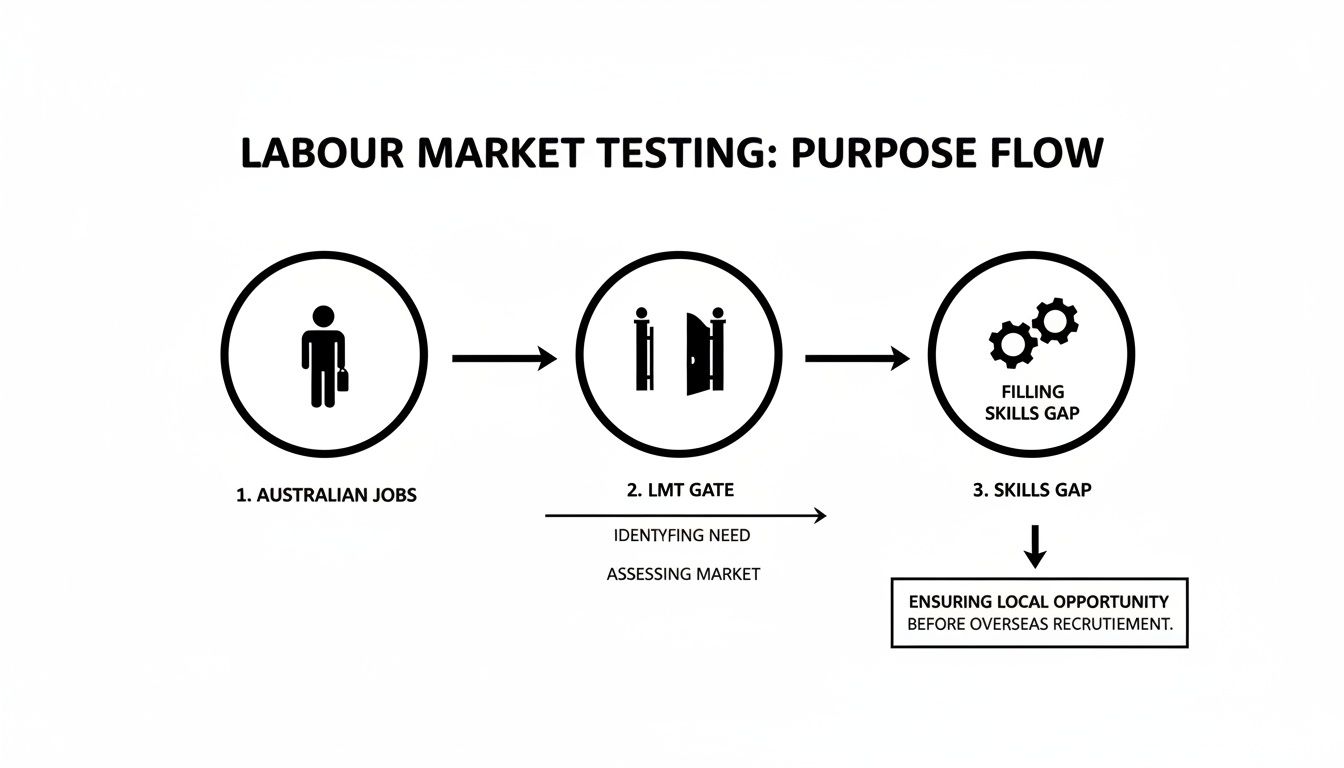
As you can see, LMT is the essential checkpoint that validates the need to hire from overseas. It’s how you prove a genuine skills shortage exists in the Australian market.
Where You Must Advertise Your Position
The government is incredibly specific about where your job ads must appear to be considered a genuine test of the local market. You’re required to run a minimum of two separate advertisements.
One of these ads must be on the government's official Workforce Australia website. This is mandatory—there are no exceptions.
For your second ad, you have a bit more flexibility, but it still has to be on a platform with national reach. Good options include:
- A major national recruitment website like SEEK, Indeed, or Jora.
- A national newspaper, either in print or its online version.
- An accredited professional association website that’s relevant to the occupation.
To really nail your LMT advertising strategy and show you’ve made a genuine effort, it helps to know what the current job market looks like. You can get a feel for this by researching local job advertisements on platforms like Indeed, which can give you some valuable insights.
The Specifics of Your Job Advertisement
Your job ad isn't just a recruitment tool; it’s a piece of evidence. The Department of Home Affairs treats it as such, and it must contain specific details to be considered compliant. If you miss any of these, your LMT could be deemed invalid.
Make sure your advertisement includes:
- Position Title: The exact title of the job being advertised.
- Job Description: A clear summary of the tasks and responsibilities.
- Skills and Experience: The key qualifications and experience needed for the role.
- Salary Information: The annual salary or a salary range (e.g., $85,000 – $95,000 per year). This can't be lower than what an Australian worker would be paid for the same job.
- Location of the Role: The physical workplace address.
- Sponsor's Business Name: The name of the company sponsoring the visa.
A common pitfall we see is advertising a salary range that doesn't match what’s on the nomination application or the employment contract. All your figures must be consistent across every document.
Timing and Duration Requirements
With LMT, timing is everything. The rules are designed to make sure your market test is recent and accurately reflects the current state of the Australian workforce.
Key Timelines to Remember:
- Advertising Duration: Each ad must be live and publicly accessible for at least 28 consecutive days.
- Validity Period: Your LMT evidence is only good for four months. This means you must lodge the nomination application with the Department within four months of taking the ads down.
Miss these deadlines, and you’ll have to start the entire LMT process all over again. It’s a costly and time-consuming mistake, so it pays to plan your recruitment and visa application timeline very carefully.
Disclaimer: Immigration laws and policies can change without notice. This article provides general information and may not be current at the time of reading. We strongly advise booking an appointment with a registered migration agent for the latest advice tailored to your specific situation. For any department fees for any visa, always refer to https://www.homeaffairs.gov.au/.
Gathering Your Evidence for a Compliant LMT Submission
Running the job ads is only half the battle. The real test comes down to proving you did it all by the book. Just placing an advertisement isn't enough to tick the box for the Department of Home Affairs. You have to meticulously document every single step of your Labour Market Testing (LMT) process to build a rock-solid, decision-ready nomination that leaves no room for questions.
This is a critical task. It’s about creating a comprehensive file of evidence that clearly shows you made a genuine, yet unsuccessful, attempt to find a suitable Australian worker. Cutting corners here is one of the fastest ways to get a Request for Further Information or, even worse, an outright refusal.

Think of it like building a legal case. Your mission is to present an airtight argument that sponsoring an overseas worker is a genuine necessity, not just a preference. Every screenshot, every receipt, and every recruitment note contributes to the strength of your submission.
Your LMT Evidence Checklist
To make sure nothing slips through the cracks, you need a system. Your evidence file should be organised and complete, anticipating every question a case officer might throw at you.
Here's a checklist of the essential documents you'll need to prove you've conducted compliant LMT.
LMT Evidence Checklist
| Evidence Item | Description & Key Details | Status (Checkbox) |
|---|---|---|
| Copies of All Advertisements | Full copies (screenshots or printouts) of every ad placed, showing the date it was first published and the full content. | ☐ |
| Advertising Duration Proof | Evidence that each advertisement ran for a minimum of 28 consecutive days, such as screenshots of the live ad at the start and end of the period. | ☐ |
| Payment Receipts | Invoices or receipts from the advertising platforms (e.g., SEEK, Indeed) proving the ads were paid for and published. | ☐ |
| Summary of Applications | A detailed document listing the total number of applications received and the number of candidates shortlisted for an interview. | ☐ |
| Reasons for Unsuitability | A clear, detailed explanation for why each shortlisted local applicant was not suitable for the position. | ☐ |
This checklist is the backbone of a strong LMT submission. Without these core components, the Department will consider your nomination incomplete.
Justifying Why Local Candidates Were Unsuitable
This is arguably the most scrutinised part of your evidence. You can't just write that applicants were "not a good fit." You need to provide legitimate, detailed, and non-discriminatory reasons that link directly back to the skills and experience you asked for in the job ad.
Let's look at the difference between a weak and a strong justification:
- Weak Justification: "The candidate lacked the necessary experience."
- This is way too vague. It tells the case officer nothing and will almost certainly trigger a request for more information.
- Strong Justification: "The candidate had only two years of experience in commercial project management, whereas the role required a minimum of five years' experience managing large-scale residential construction projects, as clearly stated in the advertisement."
- Now we're talking. It’s specific, measurable, and refers directly to the advertised requirements.
The key is to demonstrate that your assessment criteria were fair, consistent, and based entirely on the legitimate operational requirements of the role. Avoid subjective reasons and focus on objective, quantifiable skill gaps.
Ultimately, gathering your evidence is about telling a clear and compelling story. It should paint a picture of a genuine recruitment effort that, despite your best attempts, couldn't find a suitable Australian citizen or permanent resident, validating your need to sponsor a worker from overseas.
Disclaimer: Immigration laws and policies can change without notice. This article provides general information and may not be current at the time of reading. We strongly advise booking an appointment with a registered migration agent for the latest advice tailored to your specific situation. For any department fees for any visa, always refer to https://www.homeaffairs.gov.au/.
Dodging LMT Pitfalls: Exemptions and Common Mistakes to Avoid
While Labour Market Testing is a cornerstone of the employer-sponsored visa process, it's not a blanket rule. The Australian government has carved out specific exceptions where you can skip the advertising process altogether. Knowing if you qualify can save you a mountain of time and paperwork.
Just as important is being aware of the common slip-ups that can get your LMT evidence thrown out. A simple oversight on a job ad can bring the whole visa application to a grinding halt. Let's walk through when you don't need LMT and the mistakes you absolutely want to sidestep.
When Can You Skip Labour Market Testing?
In some situations, the Department of Home Affairs waives the need to test the local job market. These aren't loopholes; they're deliberate provisions for specific, well-defined circumstances.
A major category for exemptions comes from Australia's International Trade Obligations (ITOs). Many of our free trade agreements include clauses to make it easier for skilled workers to move between countries. If your candidate is a citizen of a country like China, Japan, Mexico, or Thailand, and their role fits the criteria, you might be off the hook for LMT. The same goes for the UAE under the newer Comprehensive Economic Partnership Agreement (CEPA).
Another couple of big exemptions are tied to the role itself.
- The Big Earners: If the job comes with a paycheque at or above the Fair Work high-income threshold (currently $167,500 a year), LMT isn't needed. The thinking here is that roles commanding such high salaries are inherently specialised and hard to fill locally.
- Intra-Company Transfers: Bringing an executive or senior manager over from an overseas branch of your business? LMT is typically waived in these cases.
The Most Common LMT Blunders
Even when LMT is mandatory, it's surprisingly easy to get it wrong. Many businesses stumble on what seem like minor details, but these can be deal-breakers for an application.
By far the most common mistake is getting the advertising wrong. This covers a whole range of errors, from running ads for a day less than the required 28 consecutive days, to forgetting to include the salary range or even your business's name. Think of each ad as a critical piece of evidence that has to be perfect.
The next major pitfall is sloppy record-keeping. Just running the ads isn't the whole job. You have to meticulously collect and present the proof, including screenshots of the ads while they were live, payment receipts, and a summary explaining why none of the local applicants were suitable. Simply saying someone was "not the right fit" won't fly with a case officer – you need to be specific.
Labour market testing is a foundational policy in Australia's visa system, requiring employers to seek local workers for visas like the 482 or 186. This process protects job opportunities for the 14,678,400 people employed as of October 2024. The policy has evolved since its introduction in 2013, with a key refinement in 2021 that exempted high-income roles. You can explore more data on Australian employment trends from Roy Morgan research.
Understanding these common mistakes is the first step to making sure your LMT process is solid, smooth, and successful.
Disclaimer: Immigration laws and policies can change without notice. This article provides general information and may not be current at the time of reading. We strongly advise booking an appointment with a registered migration agent for the latest advice tailored to your specific situation. For any department fees for any visa, always refer to https://www.homeaffairs.gov.au/.
How Professional Guidance Can Streamline Your LMT Process
Labour Market Testing can feel like traversing a maze. One misstep—say, an ad placed on the wrong platform or missing proof of advertising—can stall your entire visa nomination and cost precious time.
That’s where a seasoned migration expert steps in. With professional support, you don’t need to decipher every rule yourself. Instead, you hand over the details and focus on your core business, confident that all requirements are met correctly.
Expert Management Of Your LMT Obligations
At My Visa Guide, Registered Migration Agent Vijay Bharti (MARN 2217817) leads a dedicated team that takes care of the entire LMT journey. We stay up to date with the latest Department of Home Affairs directives so you don’t have to.
- Strategic Advertising: We craft and place compliant job ads on all mandatory platforms, including Workforce Australia.
- Meticulous Documentation: From screenshots and platform receipts to candidate summaries, we assemble every piece of evidence you need.
- Robust Justification: We prepare detailed explanations showing why local applicants didn’t meet your role’s requirements.
Partnering with us slashes the risk of common errors and creates a smoother path for your business and prospective employee. For tips on finding the right professional, check out our article on the tips for choosing a migration agent.
Entrusting your LMT to a professional migration agent is an investment in peace of mind. It ensures your application is built on a foundation of compliance, maximising your chances of a successful outcome without the stress of managing the details yourself.
Ready to keep your sponsorship process on track? Book a consultation with our team today.
Disclaimer: Immigration laws and policies can change without notice. This article provides general information and may not be current at the time of reading. We strongly advise booking an appointment with a registered migration agent for the latest advice tailored to your specific situation. For any department fees for any visa, always refer to https://www.homeaffairs.gov.au/.
Your Labour Market Testing Questions, Answered
When you're dealing with Labour Market Testing, it’s the little details that can trip you up. To help you stay on track, we’ve put together a few of the most common questions we get from employers, along with some straight-to-the-point answers.
These aren't just hypotheticals; they're real-world queries that touch on everything from deadlines and salary figures to who can actually run the ads for you.
How Long Is My LMT Evidence Good For?
This is a big one, and the timeline often catches people by surprise. Once your advertising campaign wraps up, the clock starts ticking. Your LMT evidence is generally considered valid for four months from the final day the ads ran.
What does that mean in practice? You have to get your nomination application lodged with the Department of Home Affairs inside that four-month window. If you miss it, the evidence is officially stale, and you’ll have no choice but to start the entire advertising process all over again. Planning your recruitment timeline around this is absolutely critical.
Do I Need to Do LMT if I'm Promoting an Existing Employee?
It’s a great question, especially for businesses that like to promote from within. The short answer is: it depends. If you're promoting a current sponsored employee, a significant change in their role, duties, or responsibilities will almost always trigger the need for a new nomination. And a new nomination means fresh LMT.
Even if the employee is staying on the same visa, a promotion can be legally viewed as a brand-new position. The rules here can be incredibly nuanced, hinging on the visa conditions and just how much the job has changed. Our advice? Always get professional guidance before you make a move.
Disclaimer: Immigration laws and policies can change without notice. This article provides general information and may not be current at the time of reading. We strongly advise booking an appointment with a registered migration agent for the latest advice tailored to your specific situation. For any department fees for any visa, always refer to https://www.homeaffairs.gov.au/.
What Salary Should I Put in the Job Ad?
The salary you advertise is non-negotiable and heavily scrutinised. You absolutely must state either a specific figure or a clear salary range (for example, "$80,000 – $90,000 per annum"). Vague statements like "competitive salary" won't cut it.
More importantly, the figure you advertise can't be a cent less than what an Australian worker would get for the same job in the same location. It also has to meet or beat the Temporary Skilled Migration Income Threshold (TSMIT), which is the government-mandated minimum for a sponsored worker. You can always find the latest TSMIT figure and other official fees over at the Department of Home Affairs website.
Can I Get a Recruitment Agency to Handle LMT for Me?
Yes, you certainly can. Partnering with a recruitment agency to manage the advertising process is often a smart move. They have the expertise to get the ads in front of the right audience and can handle the administrative side of things.
But—and this is a big but—the buck stops with you. As the sponsoring employer, you are ultimately responsible for ensuring every single LMT requirement is met perfectly. You need to be sure the agency has followed the rules to the letter and that all the right evidence has been collected. At the end of the day, the accountability is all yours.
Getting Labour Market Testing right is a non-negotiable part of any successful employer sponsorship. At My Visa Guide, our team of registered migration agents lives and breathes these details. We make sure your LMT process is bulletproof, so you can have complete confidence in your application.
To avoid costly mistakes and get your nomination on the right track from day one, book a consultation with us today.
Disclaimer: Immigration laws and policies can change without notice. This article provides general information and may not be current at the time of reading. We strongly advise booking an appointment with a registered migration agent for the latest advice tailored to your specific situation. For any department fees for any visa, always refer to https://www.homeaffairs.gov.au/.