IMPORTANT NOTICE
An invitation round for the visa 189 is when the Australian government periodically dips into the pool of skilled workers who have lodged an Expression of Interest (EOI) and invites them to formally apply for the Skilled Independent visa. It’s a competitive selection process where only candidates with the highest points scores in sought-after occupations get the nod to move forward.
Disclaimer: Information in this article may no longer be true at the time of reading. For the most updated and accurate advice tailored to your situation, we strongly recommend you book an appointment with a registered migration agent. For any department fees for any visa, please always refer to the official Department of Home Affairs website.
Cracking the Code of the EOI Waiting Room
Think of Australia’s skilled migration system as a highly exclusive waiting room, officially known as the Expression of Interest (EOI) pool. When you submit your EOI, you’re not just taking a number and joining a queue; it’s far more dynamic than that. It's not first-come, first-served.
Instead, the government holds what’s called a visa 189 invitation round to call forward the most qualified candidates. These rounds are the moments that matter. It's when the Department of Home Affairs scans the entire pool and hand-picks the applicants who best fit Australia's current economic and labour needs. Success isn't about how long you've been waiting; it's about having a profile that truly stands out.
What Determines Your Place in the Queue?
Several key factors determine whether you'll receive that coveted invitation. It’s a constantly shifting landscape where you are ranked against thousands of other hopefuls.
Your position in this competitive queue really boils down to three things:
- Your Points Score: This is the big one. The more points you have, the closer you are to the front of the line. Simple as that.
- Your Occupation: Some professions are just in higher demand than others. If your occupation has a high ceiling (meaning more spots are up for grabs), your chances naturally improve.
- Your EOI Submission Date: This is the tie-breaker. If you and another candidate have the exact same points score in the same occupation, the one who submitted their EOI earlier gets the invitation first.
At the end of the day, a visa 189 invitation round is the bridge that turns your EOI from a hopeful wish into a concrete opportunity to apply for permanent residency. Getting your head around how these rounds work is the first, most crucial step in crafting a successful migration strategy. For a wider look at your options, you can explore our detailed guides on various Australian skilled visa pathways.
How the Invitation Round Selection Process Works
Trying to figure out who gets picked during a visa 189 invitation round really comes down to understanding the three main rules of the game. It’s not a lottery; it’s a very deliberate process where the Department of Home Affairs ranks every Expression of Interest (EOI) based on a clear pecking order. Getting your head around these mechanics is the first real step to building a profile that stands out.
The whole system is built to prioritise candidates who meet Australia's most urgent economic needs. It’s less like a queue and more like a tiered boarding system for a flight—your ticket class determines when you get called up.
Disclaimer: Information in this article may no longer be true at the time of reading. For the most updated and accurate advice tailored to your situation, we strongly recommend you book an appointment with a registered migration agent. For any department fees for any visa, please always refer to the official Department of Home Affairs website.
The Points Test: Your Scorecard
The first and most important element is the Points Test. This is your official scorecard in the EOI pool. The Department hands out points for different factors that show your potential to contribute to the Australian economy.
Key factors include:
- Age: Younger applicants generally score more points.
- English Language Proficiency: A 'Superior' score can give your total a significant boost.
- Skilled Employment Experience: Work experience in Australia and overseas both count.
- Educational Qualifications: Higher qualifications, like a PhD, pull in more points.
- Partner Skills: You can claim extra points if your partner meets certain criteria.
Put simply, the higher your points score, the more attractive your EOI is, pushing you towards the front of the line for an invitation.
This flowchart shows the simplified journey from the EOI pool to receiving that all-important invitation.
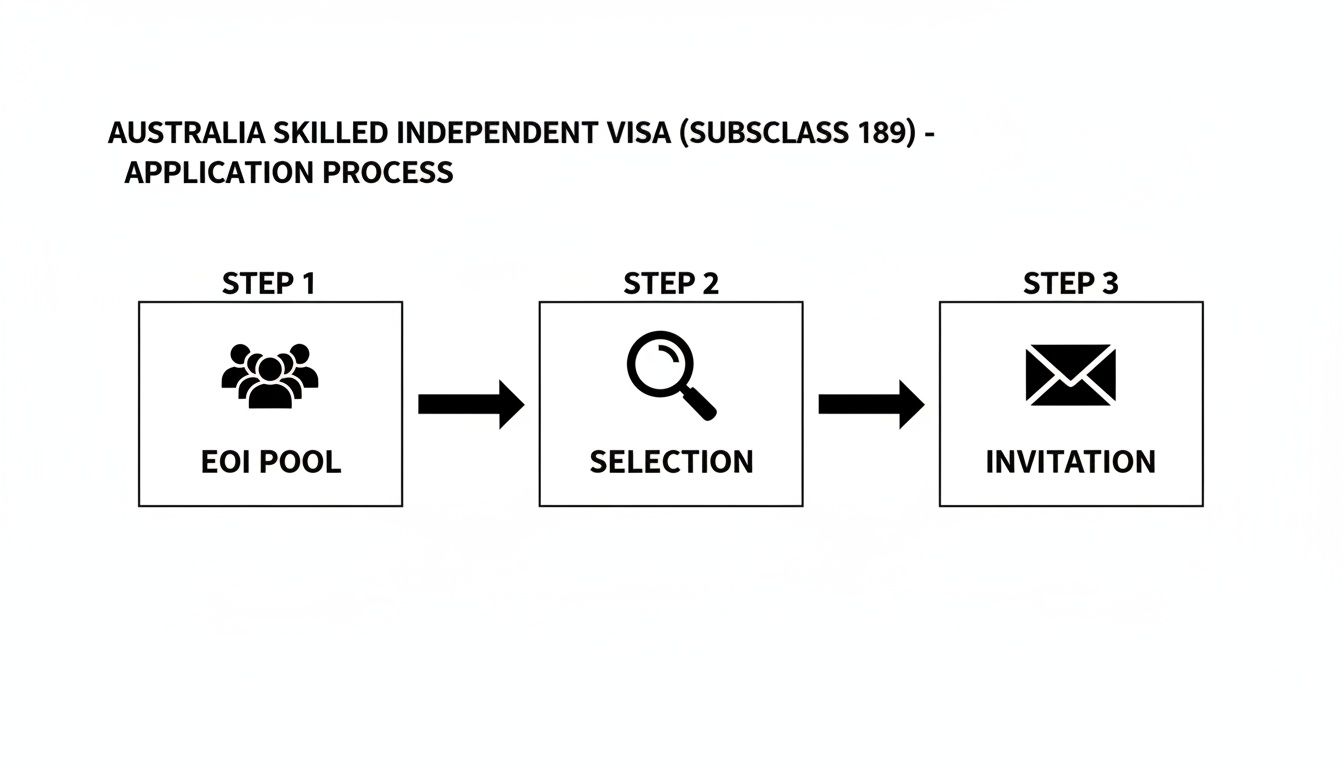
This visualises how candidates are first grouped together in the EOI pool before the Department selectively picks them based on the ranking criteria.
Occupation Ceilings: The Quota System
Next up, we have Occupation Ceilings. Imagine the government decides it needs a certain number of carpenters, nurses, and software engineers for the year. To stop all the available spots being filled by just one profession, they set a cap—or ceiling—on how many invitations can be sent out for each occupation.
This makes sure there's a balanced intake of skilled professionals across different industries. Even if you have a sky-high points score, if the ceiling for your occupation has already been hit, you won’t get an invitation until the next program year kicks off. It's a critical factor that adds another layer to the process beyond just your points.
The Tie-Breaker Rule
So, what happens when two people have the exact same points score and are in the same occupation? This is where the tie-breaker rule comes in. The system will always give priority to the person who submitted their EOI at an earlier date and time.
This is often called the 'date of effect'. In a really competitive round, even a few hours can be the difference between getting an invitation and having to wait for the next one. It just goes to show how important it is to submit a complete and accurate EOI as soon as you’re eligible.
By understanding these three pillars—the points test, occupation ceilings, and the tie-breaker—you can start to build a much smarter strategy for your skilled migration journey to Australia.
Decoding Recent Invitation Round Trends
If there’s one thing to know about the visa 189 invitation round, it’s that the numbers can swing wildly. One round might see thousands of invitations go out, while the next is completely paused. This isn't random; it's a direct reflection of Australia's economic needs and shifting government priorities at that exact moment.
By keeping a close eye on past trends, you can get a much better feel for the current climate and figure out where you stand. After each round, the Department of Home Affairs releases data that is gold for anyone with an active Expression of Interest (EOI).
Disclaimer: Information in this article may no longer be true at the time of reading. For the most updated and accurate advice tailored to your situation, we strongly recommend you book an appointment with a registered migration agent. For any department fees for any visa, please always refer to the official Department of Home Affairs website.
Reading the Official Data
When you look at the results, there are two key figures you need to zoom in on: the total number of invitations issued and the 'date of effect'. The date of effect is basically the cut-off for the lowest points score invited. It tells you how far back in the queue the government had to go to find people with that minimum score.
Let's say the lowest invited score was 85 points, and the date of effect was 01/01/2025. This means if you had 85 points but only submitted your EOI after that date, you wouldn't have received an invitation in that round. This little detail is crucial—it helps you manage your expectations and tells you whether you need to find ways to boost your points to stay in the game.
Understanding these patterns isn't just a numbers exercise. It’s about building a smart, realistic strategy for your migration journey.
Here’s a snapshot of what the official results look like on the Department's website.
As you can see, the table clearly lays out the invitation numbers for both the Subclass 189 and the regional Subclass 491 visas, giving you a transparent look at what's been happening.
Recent Fluctuations in Invitation Numbers
The unpredictable nature of the visa 189 invitation round is just part of the process. For example, the program roared back to life in 2025, with the August round issuing a massive 6,887 EOIs—a number we hadn't seen in years. It was a clear signal that the government was once again focused on independent skilled migrants.
But then, things shifted. The November 2025 round saw a drop to 10,000 total invitations, a noticeable decrease from the 15,000 issued in November 2024. This back-and-forth shows how the Department constantly fine-tunes the numbers based on what the labour market needs and how many applications they can process. It’s why having a strong EOI profile is so important. If you want to dig deeper, you can find more insights from a recent analysis of the Australian 189 invitation round to better understand these trends.
The constant fluctuation in invitation numbers means that a passive 'wait and see' approach is rarely effective. Proactively improving your EOI is the best way to prepare for the next opportunity, whenever it may arise.
Comparing Points Thresholds Across Occupations
When it comes to a visa 189 invitation round, not all professions are on a level playing field. The points score you need to clinch that coveted invitation is massively influenced by how much Australia needs your specific skills right now. It really boils down to simple supply and demand.
A high points score is always your best bet, but what’s considered “high” can be worlds apart from one occupation to another. For some, a score of 65 is enough to get a look-in. For others, even 95 points might not be enough to get you over the line in a fiercely competitive field. This is why you have to benchmark your own profile against the reality of your profession.
Disclaimer: Information in this article may no longer be true at the time of reading. For the most updated and accurate advice tailored to your situation, we strongly recommend you book an appointment with a registered migration agent. For any department fees for any visa, please always refer to the official Department of Home Affairs website.

High-Demand Versus High-Competition Fields
Working out where your job fits on this spectrum is the key to managing your expectations and planning your next move. Generally, you can think of the points thresholds as falling into a few different tiers.
For example, skilled trades are often in high demand and might see invitations go out to candidates with as little as 65 points. This is a direct reflection of Australia's ongoing need for people with hands-on skills.
On the flip side, you have the hyper-competitive professional fields like IT, engineering, and finance. Here, it’s not uncommon to see the required scores pushed up to 90, 95, or even higher. These roles attract a huge number of highly qualified applicants, all driving the points total sky-high. Professions like nursing and teaching, which are consistently needed, usually sit somewhere in the middle, requiring a strong but often more achievable score.
A Look at Recent Points Requirements
If we look at recent invitation trends, we can see this split very clearly. Data from recent 2025 rounds shows that trade occupations like carpenters and electricians held the lowest thresholds, sticking around the 65-point mark. This just confirms the strong, ongoing demand for vocational skills.
Meanwhile, professional roles such as engineers and scientists typically needed 90 points or more. One of the big outliers was finance management, which peaked at a staggering 100 points because of the sheer intensity of the competition. Nursing, however, remained one of the most stable and accessible professional routes, with invitations consistently issued to those with scores between 75–85 points. You can dive deeper into these invitation trends from recent visa 189 rounds to get a better feel for how different occupations have been tracking.
To give you a clearer picture, here’s a general breakdown of what we’ve been seeing lately.
Example Points Thresholds by Occupation Sector
This table gives a general idea of the points you might need for a Subclass 189 invitation in different job categories, based on recent trends.
| Occupation Sector | Typical Minimum Points Required | Level of Competition |
|---|---|---|
| Skilled Trades | 65+ | Low to Medium |
| Healthcare (e.g., Nursing) | 75 – 85+ | Medium |
| Education (e.g., Teaching) | 80 – 90+ | Medium to High |
| Engineering | 90+ | High |
| IT & Tech | 95+ | Very High |
| Accounting & Finance | 100+ | Extremely High |
Remember, these are just snapshots from recent rounds. The numbers can and do change.
The points required for your occupation are not static. They can change with every visa 189 invitation round based on economic needs, occupation ceilings, and the number of high-scoring candidates in the pool.
This constant shifting is exactly why you should always aim for the highest score you can possibly get, no matter what your job is. Knowing the typical benchmark for your field helps you understand if your current EOI is competitive enough, or if it's time to get proactive and find ways to boost your points total.
Actionable Steps to Boost Your EOI Points Score
If your current points total feels like it's just on the edge of being competitive for a visa 189 invitation round, now is the time to get proactive. Just waiting and hoping is rarely a winning strategy in the migration game. Instead, there are several clear, ethical pathways you can follow to beef up your Expression of Interest (EOI) and seriously improve your ranking in the pool.
Turning a borderline EOI into an invitation-ready profile often boils down to targeting a few specific, high-impact areas. A handful of extra points can make all the difference, bumping you ahead of thousands of others in the queue.
Disclaimer: Information in this article may no longer be true at the time of reading. For the most updated and accurate advice tailored to your situation, we strongly recommend you book an appointment with a registered migration agent. For any department fees for any visa, please always refer to the official Department of Home Affairs website.
Aim for Superior English Proficiency
One of the single most effective ways to get a major points boost is by levelling up your English language test score. While 'Proficient' English (think an IELTS 7 in each band) is a great start, hitting a 'Superior' score (like an IELTS 8 across all bands) nets you an extra 10 points. This one achievement can catapult your EOI into a much stronger position, making it a very worthwhile investment of your time and effort.
Gain More Skilled Work Experience
The points system is designed to reward sustained, relevant work experience. Sticking it out for another year or two in your nominated occupation can push you into a higher points bracket. For instance, going from three years of overseas skilled employment to five years lifts your points claim from 5 to 10. It shows a deeper level of expertise and commitment to your profession, which the Department values highly.
A classic mistake we see is people submitting an EOI and then just letting it sit there. Remember to jump back in and update your EOI as soon as you hit new employment milestones. You want your points score to reflect your most recent, hard-earned achievements.
Pursue Higher Educational Qualifications
Advanced qualifications are another powerful lever you can pull to increase your score. A Bachelor's degree is a solid foundation, but completing a Master's by research or a Doctorate (PhD) from an Australian or recognised international university can add serious weight to your profile. A PhD, for example, adds a massive 20 points to your EOI—the highest possible score for educational qualifications.
Explore Other Valuable Pathways
Beyond the big three, several other avenues can give you that crucial edge. Each one requires a bit of planning, but they can be instrumental in getting that invitation.
- Claim Partner Skills: If your partner or spouse can meet the age, English, and skills assessment requirements for an occupation on the same skilled list, you can claim an additional 10 points.
- Complete a Professional Year Program: For graduates in accounting, IT, or engineering, a Professional Year Program offers priceless Australian workplace experience and a handy 5 points. You can learn more about these structured internships by exploring our guide on Professional Year Programs.
- NAATI Accreditation: If you're fluent in a community language, getting accredited by the National Accreditation Authority for Translators and Interpreters (NAATI) can add another 5 points to your total.
By strategically combining these options, you can actively build a much stronger, more compelling EOI that truly stands out during the next visa 189 invitation round.
What to Do After Receiving Your Invitation
So, the email has landed in your inbox. An invitation to apply for the Skilled Independent visa. Take a moment to celebrate – this is a huge step forward on your journey to Australia!
But once the initial excitement settles, it's time to get serious. The clock is now ticking, and it's ticking fast. You have a strict 60-day window to lodge a complete, decision-ready visa application.
This period can fly by, so being prepared isn't just a good idea; it's essential. Think of this as the final sprint. Any mistakes or delays now could jeopardise everything you've worked for. Meticulous preparation is your best friend.
Disclaimer: Information in this article may no longer be true at the time of reading. For the most updated and accurate advice tailored to your situation, we strongly recommend you book an appointment with a registered migration agent. For any department fees for any visa, please always refer to the official Department of Home Affairs website.

Your Immediate Post-Invitation Checklist
The secret to a stress-free lodgement is having all your ducks in a row before the invitation ever arrives. Your visa application needs to be a perfect mirror of the claims you made in your Expression of Interest (EOI). No exceptions.
Here’s a rundown of what you’ll need to have ready to go:
- Proof of Identity: Passports, birth certificates, and national ID cards for you and any family members on the application.
- Skills Assessment: The official, valid skills assessment outcome for your nominated occupation.
- English Language Test Results: Your IELTS, PTE, or other recognised test report form.
- Employment Evidence: This is crucial. Get your payslips, employment contracts, and detailed reference letters lined up to back up every work experience claim.
- Educational Documents: Your academic transcripts and certificates of completion for all qualifications.
- Character Documents: This often takes time. You'll need police clearance certificates from every country you’ve lived in for 12 months or more over the last 10 years.
- Health Examinations: You'll need to book and complete a medical examination with a government-approved panel physician.
The Department of Home Affairs is incredibly thorough. A tiny inconsistency between your EOI and your final application – something you might think is insignificant – can be enough for a visa refusal. Honesty and accuracy are everything at this stage.
Getting organised means you can go from the high of receiving your visa 189 invitation round notification to lodging your application without breaking a sweat.
Got Questions? We’ve Got Answers
The whole visa 189 invitation round process can feel like a maze. It's only natural to have a bunch of questions floating around. Let's tackle some of the most common ones we hear from people just like you.
Disclaimer: Information in this article may no longer be true at the time of reading. For the most updated and accurate advice tailored to your situation, we strongly recommend you book an appointment with a registered migration agent. For any department fees for any visa, please always refer to the official Department of Home Affairs website.
Can I Update My EOI After Submitting It?
Yes, absolutely! In fact, you should be updating your Expression of Interest (EOI) in SkillSelect. Think of it as a living document.
If you rack up more work experience, crush a new English test with a higher score, or finish another qualification, get in there and update your profile. Keeping your points score current and accurate is one of the best things you can do to boost your chances.
What Happens If My EOI Expires?
Your EOI has a shelf life of two years. If you don't get that coveted invitation within that window, it automatically expires and vanishes from the pool.
There's no extension. You'll have to start from scratch and submit a brand-new EOI to get back in the game for future invitation rounds.
How Often Are Invitation Rounds Held?
This is the million-dollar question, and the answer can be frustrating: there’s no fixed schedule. The frequency of invitation rounds is completely at the discretion of the Department of Home Affairs, based on what Australia’s economy needs at the time.
We've seen periods where they've happened quarterly, but it's just as common for long, quiet spells to pass between them. It’s a waiting game, and staying prepared is key.
A lot of people chasing a Visa 189 are already in Australia on a temporary visa. Getting your head around your tax obligations is a massive part of managing your finances here. This fantastic guide to Australian tax for temporary residents is a great resource to help you figure it all out.