IMPORTANT NOTICE
Getting a student visa extension isn't just about filling out a few more forms. It's about showing the Department of Home Affairs that you still tick all the original boxes that got you here in the first place. You have to prove you’re still a genuine student, financially stable, and properly enrolled.
Think of it as a quick health check for your visa status. Getting this right from the start is the key to a smooth and successful application.
Disclaimer: The information provided in this article is general in nature and may not be accurate at the time of reading. Migration laws and Department of Home Affairs policies change frequently. For the most current advice and tailored guidance, we strongly recommend booking an appointment with a registered migration agent. For any Department fees, always refer to the official site at https://www.homeaffairs.gov.au/.
Nailing The Core Requirements For Your Visa Extension
Before you even think about hitting 'submit' on that online application, you need to be absolutely certain you meet the main eligibility criteria. The Department will put your situation under the microscope all over again. Any little gap or inconsistency could mean delays or, worse, a flat-out refusal. A strong application is built on a solid foundation.
Staying Enrolled in a CRICOS Course
This is the big one. You absolutely must be enrolled in a full-time, registered course. Your course and your education provider have to be on the Commonwealth Register of Institutions and Courses for Overseas Students (CRICOS). No exceptions.
And just getting an offer letter isn't enough. You need a valid Confirmation of Enrolment (CoE) that covers the entire period you're asking to extend your visa for. If your original course ran longer than planned or you're starting a new one, getting a fresh CoE is non-negotiable.
The Genuine Student Requirement
Every student visa application now hinges on the Genuine Student (GS) requirement, which has taken over from the old GTE rule. Your job is to convince the Department that your main reason for being in Australia is to study and that your chosen course makes sense for your future academic and career path.
Case officers will carefully read your personal statement and go through your documents to figure out your true intentions. They’re looking for a study pathway that is clear, logical, and believable. This is a critical part of the application, and we've put together a detailed guide on exactly what the Genuine Student requirement entails.
Proving You Have Sufficient Financial Capacity
You’ve got to show that you have real access to enough money to cover your tuition fees, travel, and living costs while you're here. The Department has set figures for annual living costs, and you’ll need to provide evidence you meet them.
It's not just about having a certain amount in a bank account on one particular day. It’s about demonstrating where the money came from and that you can consistently access it. From experience, case officers are often suspicious of vague financial documents or large, last-minute deposits.
Maintaining Continuous Health Insurance
Finally, you must have adequate health insurance for the entire time you plan to be in Australia on your new visa. This means your Overseas Student Health Cover (OSHC) needs to be continuous. There can't be any gaps between your old policy and the new one.
Even a single day's lapse in cover can be grounds for your visa to be refused. The best practice is to make sure your new OSHC policy kicks in the very day your old one expires.
Important Note: All visa application charges are subject to change. Always refer to the official Department of Home Affairs website at homeaffairs.gov.au for the latest fees before lodging your application.
Nailing Your Document Preparation: What You Absolutely Need
Think of your visa application as a story you're telling the Department of Home Affairs. A messy, incomplete story is confusing, but a well-organised one is convincing. Getting your documents in order isn't just about ticking boxes; it's about presenting a clear, strong case for why you should be allowed to continue your studies in Australia.
The absolute cornerstone of your extension application is a new Confirmation of Enrolment (CoE). This is non-negotiable. It’s the official proof from your university or college that you have a legitimate reason to stay. You must have this document for the entire length of your new course before you even think about hitting 'submit' on your application.
Next up is your financial proof. You need to show you can support yourself. This means clear, easy-to-follow bank statements, or perhaps evidence of a scholarship. A word of warning from experience: big, unexplained deposits that appear in your account right before you apply are a huge red flag for case officers. Your financial history needs to look stable and transparent.
Disclaimer: The information provided in this article is general in nature and may not be accurate at the time of reading. Migration laws and Department of Home Affairs policies change frequently. For the most current advice and tailored guidance, we strongly recommend booking an appointment with a registered migration agent. For any Department fees, always refer to the official site at https://www.homeaffairs.gov.au/.
Writing a Genuine Student Statement That Works
The Genuine Student (GS) statement is your one chance to speak directly to the person deciding your future. This has replaced the old GTE, and it's your opportunity to explain, in your own words, why you want to keep studying in Australia. It needs to be personal, logical, and most importantly, authentic.
This is where you connect the dots for the case officer. Explain your situation back home, why you chose this specific course, and how it all fits into your career goals. Whatever you do, don't just download a generic template from the internet—they've seen them all.
- Tell a coherent story: Show a clear line from your past studies, through this new course, to the career you plan to have back in your home country.
- Prove you’ve done your homework: Why this university? Why this particular course in Australia? What makes it better than options elsewhere?
- Get specific: Don't just say, "I want to get a good job." Instead, describe the exact kind of role you're aiming for and explain why this specific Australian qualification is the key to unlocking it.
Treat your GS statement like a formal, professional letter, not a quick email. It’s a critical piece of your application that gets scrutinised. A thoughtful, well-written statement can make a world of difference.
How to Organise Your Digital Files for ImmiAccount
The way you upload your documents to your ImmiAccount really matters. Imagine being the case officer faced with a jumble of poorly scanned, randomly named files. It’s frustrating and doesn't exactly scream "organised student." Take a little time to get this right.
First, create a single folder on your computer for this application. Scan every single document as a high-quality, easy-to-read PDF. Then, give each file a simple, logical name.
A Simple Naming System That Works:
Passport_John_SMITH.pdfCoE_University_of_Sydney_John_SMITH.pdfOSHC_Policy_John_SMITH.pdfFinancials_Bank_Statement_John_SMITH.pdfGS_Statement_John_SMITH.pdf
This tiny step shows you’re serious and makes the assessment process much smoother for the Department. It also acts as a final check for you to ensure nothing is missing. Incomplete applications are one of the top reasons for delays and rejections. In fact, around 15% of rejections stem from incomplete or badly prepared documents. You can learn more about the data behind international students from reports published by the Reserve Bank of Australia.
Don't Forget Your Health Cover
Finally, your Overseas Student Health Cover (OSHC) must be valid for the entire period of the visa you're asking for. No gaps. Not even for a day. You need to provide the actual policy certificate as proof. If you need a refresher on the rules, take a look at our detailed guide on what Overseas Student Health Cover involves. A lapse in your OSHC is a direct breach of your visa conditions and will almost certainly lead to a refusal.
To pull it all together, we've created a simple checklist to make sure you have everything ready to go.
Document Checklist for Student Visa Extension
Here’s a quick-reference table to run through before you start your application. It covers the absolute essentials you'll need to gather.
| Document Category | Specific Item | Key Tip |
|---|---|---|
| Identity | Passport Bio-data Page | Ensure your passport is valid for at least six months beyond your intended stay. |
| Enrolment | Confirmation of Enrolment (CoE) | Must cover the full period of the visa you are applying for. |
| Health Cover | OSHC Policy Certificate | The policy must be current and cover the entire length of your proposed visa. |
| Financials | Bank Statements / Loan Docs | Evidence must show sufficient funds to cover tuition, travel, and living costs. |
| Genuine Student | Personal GS Statement | Write a detailed and personal statement explaining your study and career goals. |
| Other Docs | Health Examinations / Biometrics | If required, complete these as soon as you are requested to by the Department. |
Having these documents prepared and properly organised is the best thing you can do to ensure a smooth, stress-free application process.
Lodging Your Application Through ImmiAccount
The ImmiAccount portal is where all the hard work comes together. It’s the official digital doorway to the Department of Home Affairs, but for many students, navigating it feels like the final exam. Let’s walk through the process so you can lodge your student visa extension with confidence, sidestepping the common traps.
Think of your ImmiAccount application as a structured interview with the Department. Every section is a question, and your job is to provide clear, honest, and accurate answers. You’ll start by either creating a new account or logging into your existing one and finding the correct form: the Student Visa (Subclass 500).
Once you’re in, the form will ask for everything from your passport details to your address history for the last 10 years. Don't rush this part. A simple typo in your name or date of birth might seem minor, but these small mistakes are notorious for causing major delays down the track.
Disclaimer: Migration laws and policies are subject to frequent changes. The information in this article is for general guidance only and may not be current when you read it. To receive advice specific to your circumstances, it is essential to book an appointment with a registered migration agent. For any Department fees, always refer to the official site at https://www.homeaffairs.gov.au/.
Navigating the Tricky Sections
Some parts of the online form consistently cause problems for applicants. One of the biggest culprits is entering your course details. You must use the exact CRICOS code for your course and your education provider, just as it appears on your new Confirmation of Enrolment (CoE). Any discrepancy here is a huge red flag for the case officer.
The declaration questions are another critical area. This is where you’ll be asked about your health, character, and your commitment to respecting Australian laws. Answer every single question completely and, most importantly, honestly. It’s always better to declare a minor issue, like an old traffic fine, than to be caught hiding it.
Expert Tip: The ImmiAccount system logs you out after a period of inactivity. Get into the habit of hitting the 'Save' button frequently as you move through each section. There’s nothing worse than losing an hour of work because the system timed out.
Uploading Your Documents Correctly
After you’ve filled out all the required information, you’ll get to the document attachment stage. This is where your meticulously organised digital files become your best friend. The system has specific categories for everything, like 'Proof of Identity', 'Health Insurance', or 'Evidence of Financial Capacity'.
It’s crucial to upload each document into its correct slot. Don’t just dump everything into a generic 'Other Documents' folder. Putting your OSHC certificate in the health insurance section and your bank statements in the financial capacity section makes the case officer’s job much easier, and that can only be a good thing for your application.
This chart shows how the main documents support your application.
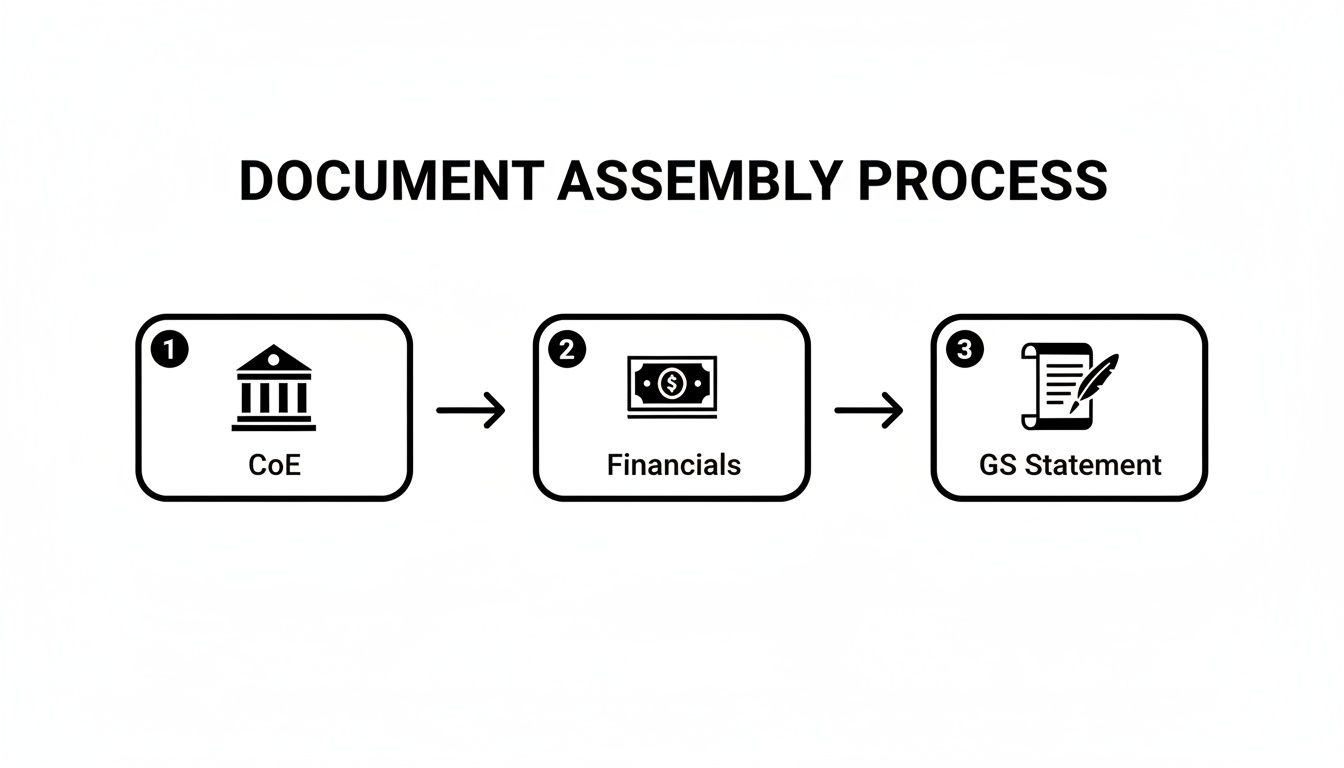
As you can see, your CoE, financial evidence, and GS statement are the three pillars holding up the integrity of your application.
Finalising and Paying for Your Application
The final step before you can submit is paying the Visa Application Charge (VAC). Your application isn't officially considered 'lodged' until this fee is paid. Visa fees change, so always check the latest amount directly on the Department of Home Affairs website to avoid any surprises.
Once your payment is confirmed, you can finally hit that 'Submit' button. You should get an immediate acknowledgement letter in your ImmiAccount. Soon after, you'll receive another notification confirming your Bridging Visa A (BVA) has been granted. This BVA is your permission to stay in Australia lawfully while your new visa is being processed; it will kick in the very moment your current student visa expires.
Understanding Bridging Visas and What Happens Next
So, you've lodged your student visa extension and paid the fee. Now what? This is when the waiting game begins, and it can feel a bit uncertain. Thankfully, the Department of Home Affairs has a system in place to keep you legally in Australia while your application is processed: the Bridging Visa.
Almost immediately after you submit your application, you’ll be granted a Bridging Visa A (BVA). This is an automatic and essential part of the process. It doesn’t kick in right away; instead, it sits dormant until your current Student Visa (Subclass 500) expires. The moment your old visa ends, your BVA seamlessly takes over, ensuring you remain lawful.
Disclaimer: The information in this article is for general informational purposes only and may become outdated. Migration law changes constantly. To get the most accurate and personalised advice for your situation, we strongly recommend that you book an appointment with a registered migration agent. For any Department fees, always refer to the official site at https://www.homeaffairs.gov.au/.
Your Status on a Bridging Visa A
Think of the BVA as a temporary continuation of your previous student visa. It allows you to stay in Australia legally, and crucially, it generally carries over the same conditions. This means if you were allowed to study and work on your previous visa, you can usually continue doing so under the same rules.
However—and this is important—you must check the specific conditions attached to your BVA grant notice. Never just assume the conditions are identical. These rules dictate exactly what you can and can't do, so reading the fine print is critical for staying compliant.
The number of students on bridging visas has been on the rise. This is partly due to applicants waiting on extension decisions who might no longer meet updated criteria, like the revised work hour limits. You can dig into more data on international students and visa stats by reading insights from the Reserve Bank of Australia.
Travel Restrictions and the BVA
Here’s a critical point that trips up so many students: a standard Bridging Visa A ceases the moment you leave Australia. If you travel overseas for any reason—a family emergency or a holiday—your BVA will be cancelled, and you won't be able to re-enter the country on it.
So, what if you absolutely must travel?
If you have a compelling reason to leave Australia while on a BVA, you must apply for a Bridging Visa B (BVB) before you fly out. A BVB grants you permission to leave and re-enter Australia while you await a decision on your main visa application.
- Plan Ahead: Applying for a BVB isn't instant. You'll need to provide evidence for your travel, like flight bookings or a letter explaining a family emergency.
- Don't Leave Without It: Leaving without a granted BVB can have serious consequences. You could find yourself stranded outside Australia, unable to return to your studies.
- Check the Fees: There is an application fee for the BVB. For current costs, always check the official Department of Home Affairs website at homeaffairs.gov.au.
Keeping the Department Informed
Your obligations don't stop once you've submitted your application. It's a visa condition that you inform the Department of Home Affairs of any changes to your circumstances. This isn't optional.
Important Reminder: Failing to update the Department can lead to serious delays or even a refusal. They must have your current details to communicate with you about your application.
Key changes you must report include:
- A new passport
- A change of address or phone number
- Changes in your family composition (like the birth of a child)
You can update most of these details yourself directly through your ImmiAccount. Keeping your information current is the only way to ensure you receive all important correspondence, including any requests for more information or, finally, the decision on your student visa extension.
Avoiding Common Reasons for Visa Refusal
Getting a visa refusal can be a gut-wrenching experience, throwing all your study and life plans into complete chaos. The best way to avoid this is to understand exactly why visa extensions get denied in the first place. This isn't about scaring you; it's about arming you with the right knowledge to build a rock-solid, refusal-proof application from day one.
The Department of Home Affairs looks at every single application with a fine-toothed comb, and even a tiny oversight can sink your chances. A huge number of extension applications are lodged by students already here in Australia, but that’s no guarantee of success. A Department report revealed the grant rate for onshore student visa applications—which are mostly extensions—was only 72.7%.
That means nearly three out of every ten applications hit a roadblock. It’s a sobering statistic that really drives home how critical a well-prepared submission is.
Disclaimer: The information provided in this article is general in nature and may not be accurate at the time of reading. Migration laws and Department of Home Affairs policies change frequently. For the most current advice and tailored guidance, we strongly recommend booking an appointment with a registered migration agent. For any Department fees, always refer to the official site at https://www.homeaffairs.gov.au/.
Failing the Genuine Student Test
By far, the most common hurdle we see is failing to convince the case officer that you are a Genuine Student (GS). This isn't a simple tick-box exercise; it's a subjective assessment of your intentions, and a weak or generic personal statement is a massive red flag.
Let me give you a real-world example. We once reviewed a case for a student, let's call him Li, who was finishing a Diploma of Business and wanted to extend his visa for a Bachelor of Information Technology. His GS statement was just one line: "I want to study IT because it has good job prospects." That’s a classic mistake. The case officer saw no logical link between his past and future studies and the statement showed zero personal insight. The application was refused because he couldn't prove his study intention was genuine.
To avoid this trap, your GS answers must:
- Tell a clear story: Explain precisely how your new course builds on what you've already studied and connects directly to your career goals back home.
- Prove you've done your homework: Justify why you picked this specific course at this particular university in Australia, over all other options.
- Get personal and specific: Ditch the clichés. Talk about the exact skills you'll gain and the kind of job you're aiming for after you graduate.
Inadequate Financial Evidence
Another major reason for refusal is messy or unconvincing financial documents. The Department needs to see crystal-clear proof that you have genuine and stable access to enough money for your tuition, travel, and living costs for your entire stay.
A common pitfall is a large, unexplained lump sum of cash suddenly appearing in a bank account right before you apply. This screams "borrowed funds" to a case officer and instantly raises suspicion. Your financial history needs to look consistent and transparent.
Pro Tip: If a family member is sponsoring you, their bank statement alone isn't enough. You absolutely must include a signed letter of support from them, official proof of your relationship (like a birth certificate), and evidence of their regular income. This paints a much more credible and complete financial picture.
Gaps in Health Cover or Enrolment
Your visa conditions are not optional—they are strict, mandatory rules. Two of the most critical are maintaining continuous Overseas Student Health Cover (OSHC) and being enrolled in a registered course at all times.
Even a one-day gap between your old OSHC policy ending and your new one starting can trigger an automatic refusal. It’s that serious. Likewise, if you have an unexplained break where you weren't formally enrolled in a course—for example, a long gap between finishing one diploma and starting another—your application is at risk. Compliance is everything. It's crucial to grasp the serious consequences of letting things slide; for instance, understanding the implications of overstaying your visa can show you just how important it is to maintain a valid status at all times.
When to Partner with a MARA Registered Migration Agent
Look, a lot of students handle their own visa extensions just fine. But there are definitely times when going it alone is a risky gamble. Knowing when to bring in a professional can be the single most important decision you make for your future in Australia.
A MARA-registered migration agent is far more than just a form-filler. Think of them as a strategist—someone who lives and breathes Australian migration law and can map out the best path forward for you.
If you’ve had a visa refused in the past, your new application is going to be under a microscope. An agent can pull apart the original refusal, figure out exactly what the case officer’s concerns were, and build a rock-solid new application that directly addresses those issues. This isn't a situation where you want to be guessing.
Disclaimer: Migration law is constantly changing, so the information here might be outdated by the time you read it. For advice that’s 100% current and specific to your life, your best bet is always to book a consultation with a registered agent. For any Department fees, always refer to the official site at https://www.homeaffairs.gov.au/.
Complex Cases Need Expert Guidance
Making big changes to your study plan is another major red flag for a DIY application. Maybe you’re jumping from a VET course to a completely different degree at university, or you have some gaps in your study history that are hard to explain. An agent knows how to frame these changes so they make sense to the Department of Home Affairs, showing a logical academic progression that lines up with the Genuine Student criteria.
Here are a few other times you should seriously consider getting professional help:
- Complicated Finances: If your money is coming from multiple places, like overseas businesses or complex family trusts, you need an expert to present it clearly.
- Health or Character Issues: Any declaration that might bring up the character test or require a health waiver needs to be managed very carefully from the start.
- Adding Family: Bringing dependents onto your application adds a whole new layer of rules and evidence that has to be perfect.
Ultimately, what an agent gives you is peace of mind. They’ll spot potential problems you’d never see and present your case in the strongest possible way. If you're thinking about your options, we've put together a guide with some helpful tips for choosing a migration agent to help you find the right person for the job.
Important Note: Government visa fees change. For the absolute latest visa application charges, you must check the official Department of Home Affairs website at https://www.homeaffairs.gov.au/. An agent can guide you, but the government's site is the final word.
Your Top Questions About Extending Your Student Visa
When it comes to extending a student visa, it's natural to have a lot of questions buzzing around. I've heard them all over the years. Let's tackle some of the most common ones I get from students just like you.
Disclaimer: Migration law is a tricky beast and it's constantly changing. The information here is solid general advice, but it's not a substitute for professional legal counsel. For advice that's perfectly tailored to your unique situation, the best move is always to book an appointment with a registered migration agent. For any Department fees, always refer to the official site at https://www.homeaffairs.gov.au/.
How Early Should I Lodge My Extension Application?
This is a big one, and my advice is always the same: don't leave it to the last minute. You should be aiming to get your new application lodged at least one to two months before your current visa is set to expire.
Sure, you can technically apply right up until the last day, but that's a high-stress strategy that leaves zero room for error. What if you're asked for more documents? What if the payment system has an issue? Applying early gives you a comfortable buffer and a whole lot more peace of mind.
Can I Keep Working While My Extension is Being Processed?
Yes, in most cases, you can. Here’s how it works: the moment your current student visa expires, your Bridging Visa A (BVA) kicks in automatically. A BVA is designed to keep you lawful while you wait for a decision on your new visa.
Crucially, a BVA usually copies the exact same conditions from your previous visa, which includes your work rights. However—and this is important—you must always check your official BVA grant letter. This document is your proof and will state the specific conditions that apply to you. Don't just assume.
What if My Course Finishes Months Before My Visa Expires?
It's a common scenario. You finish your final exams, but you still have a few months left on your visa. So, can you just hang out? Not really.
Your visa was granted for the specific purpose of studying. Once that purpose is complete, the Department expects you to either leave Australia or apply for a different visa. For many, this is the time to look into the Temporary Graduate visa (Subclass 485), if you're eligible. Staying on without a valid reason after your course is done can create problems for any future visa applications you might make.
It's also interesting to see how visa processes vary from country to country. For a different perspective, you might want to check out this guide to studying in the Netherlands, covering visas and admissions. For the most up-to-date Australian government fees, always head straight to the source: the official Department of Home Affairs website at https://www.homeaffairs.gov.au/.
Navigating all these rules can feel overwhelming, but you absolutely don't have to figure it all out on your own. The team at My Visa Guide is here to offer clear, expert advice for your student visa extension and any other migration pathways you're considering. Book a consultation with our MARA-registered agents today and let's secure your future in Australia with confidence.