IMPORTANT NOTICE
When people ask about the Australian student visa cost, the first number that usually comes up is the main application fee. Right now, that's AUD $710 for the Subclass 500 visa. But here’s the thing—that number is just the starting point. It doesn't even come close to the total amount you’ll need to budget for.
Disclaimer: Immigration laws, visa fees, and requirements change frequently. The information in this article is for general guidance and may not be current at the time of reading. For the most accurate and up-to-date advice tailored to your situation, it is essential to book an appointment with a registered migration agent.
What Is the Real Australian Student Visa Cost?
Think of your visa application costs like a puzzle. The main government fee, known as the Visa Application Charge (VAC), is the biggest and most obvious piece. But it's surrounded by several other essential, non-negotiable pieces you absolutely have to factor in to see the full picture.
These aren't optional extras; they're mandatory costs required for a complete and successful application:
- Overseas Student Health Cover (OSHC): You must have health insurance that covers you for your entire stay in Australia. This is a non-negotiable part of your visa conditions.
- Medical Examinations: To meet Australia's health requirements, you'll need a check-up with a government-approved panel physician.
- Biometrics Collection: This involves providing your fingerprints and a photograph at an official collection centre.
- Police Clearance Certificates: Depending on your visa history and the countries you've lived in, you may need to get police checks to prove your good character.
This diagram really helps to visualise how the total cost is built. It’s not just one fee, but a collection of different expenses that all add up.
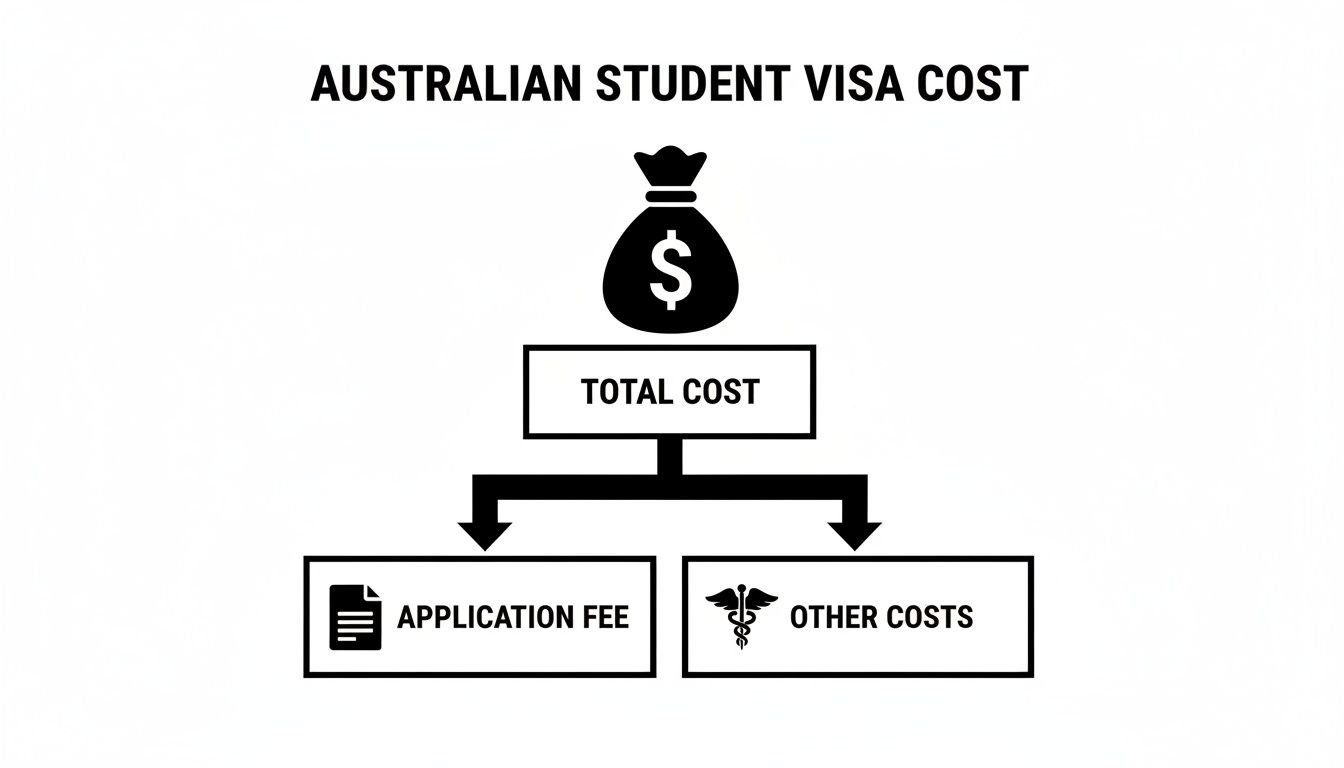
As you can see, focusing only on the AUD $710 application fee will leave you short. Those "other costs" make up a huge chunk of your initial outlay, and forgetting about them can cause major financial stress down the track.
To give you a clearer overview, here's a quick summary of the different cost components you need to prepare for.
Summary of Australian Student Visa Cost Components
| Cost Component | Estimated Cost (AUD) | Description |
|---|---|---|
| Visa Application Charge (VAC) | $710 (for the main applicant) | The standard government fee to lodge your Subclass 500 visa application. |
| Overseas Student Health Cover (OSHC) | $500 – $700 per year | Mandatory health insurance. The cost varies by provider and coverage level. |
| Medical Examination | $300 – $500 | A required health check-up with a panel physician approved by the Australian government. |
| Biometrics Collection | $40 – $100 | Fee for providing fingerprints and a photograph at an authorised collection centre. |
| Police Clearance Certificate | $50 – $150 per country | Required from countries you've lived in for 12 months or more in the last 10 years. |
| Additional Applicant Charge | $530 (for partner/spouse) | An extra fee for including a dependent partner or spouse in your application. |
| Subsequent Temporary Application Charge | $700 | An additional fee if you are applying for another visa while already in Australia. |
This table shows how quickly the expenses can accumulate beyond the initial application fee. Planning for each one is key to a smooth process.
Understanding Recent Fee Increases
It's also absolutely vital to keep an eye on how quickly things are changing. The Australian student visa fee has been climbing dramatically. In fact, it’s projected to jump from the current AUD $710 to as much as AUD $2,000 by 1 July 2025.
That’s a potential 182% increase in just over a year, which would give Australia one of the most expensive student visa fees in the world. You can discover more insights about these visa updates and how to budget for them on our blog.
Disclaimer: Immigration laws, visa fees, and requirements change frequently. The information in this article is for general guidance and may not be current at the time of reading. For the most accurate and up-to-date advice tailored to your situation, it is essential to book an appointment with a registered migration agent.
Getting this wrong isn't just a minor inconvenience—it can lead to serious financial stress and even delay your application. By understanding every single cost upfront, you can build a realistic budget and set yourself up for a successful and worry-free start to your studies in Australia.
Breaking Down the Visa Application Charge
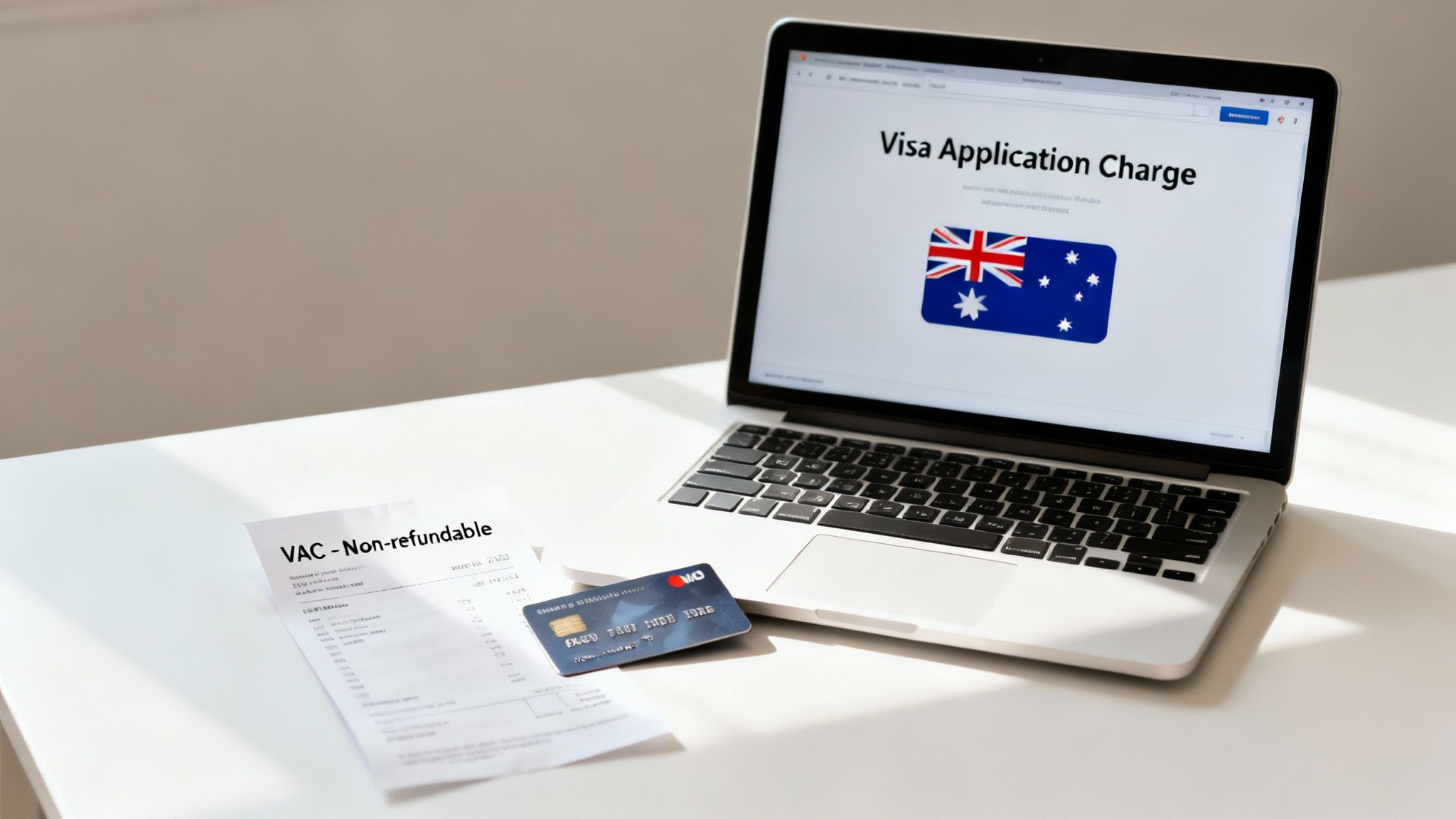
The biggest line item on your budget sheet will be the government's Visa Application Charge, or VAC. This is the non-negotiable fee you pay directly to the Department of Home Affairs just to have them look at your application. For most people, it's the single largest upfront cost.
It’s absolutely critical to understand that the VAC is non-refundable. Think of it as paying for the process, not the outcome. Whether your visa is approved or refused, that money is gone for good. This makes getting your application right the first time incredibly important.
The Cost for Primary and Secondary Applicants
The government has a tiered fee system, so what you pay depends on who is applying. The main student pays the highest amount, while any family members joining them have smaller, separate fees.
Here's the current breakdown:
- Primary Applicant: This is you, the student. You'll be up for the full base application charge, which is AUD $710.
- Additional Applicant (18 years and over): If you're bringing a partner or spouse, their application will cost an extra AUD $530.
- Additional Applicant (under 18 years): For each dependent child under 18, the fee is AUD $175.
These costs can snowball, especially if you plan to bring your family. Forgetting to budget for these additional applicant fees is a common mistake that can put a serious dent in your finances.
Understanding the Subsequent Temporary Application Charge
Here's a sneaky one to watch out for: the Subsequent Temporary Application Charge (STAC). This is a hefty surcharge that applies if you lodge a new temporary visa application while you’re already in Australia.
The STAC is an extra AUD $700 slapped on top of the usual VAC. So, if you finish one course and decide to apply for a new student visa to study something else—without leaving the country—you'll likely have to pay it. It’s the government’s way of encouraging students to plan their entire study journey from the get-go.
Why Are the Fees Increasing So Much?
If it feels like the cost of a student visa is always going up, you're not imagining things. The government has rolled out some steep increases in recent years as part of its wider migration strategy.
These hikes serve a couple of purposes. First, they’re a major revenue stream for the government. But more importantly, they function as a lever to control the flow of international students. By making it more expensive to apply, the government can help manage demand and align student numbers with other national priorities, like easing pressure on the rental market.
Disclaimer: Immigration laws, visa fees, and requirements change frequently. The information in this article is for general guidance and may not be current at the time of reading. For the most accurate and up-to-date advice tailored to your situation, it is essential to book an appointment with a registered migration agent.
Are There Any Exemptions to the Fee?
While the VAC is a fact of life for almost everyone, there are a few very rare exceptions. These are usually reserved for specific, government-backed situations.
Exemptions might apply to:
- Students sponsored by the Commonwealth Government.
- Certain secondary exchange students.
- Students forced to re-apply because their education provider shut down.
Honestly, these cases are few and far between. The safest bet is to assume you need to pay the full fee unless you have an official letter stating otherwise.
Alright, let's break down the other costs you'll need to factor into your student visa budget.
The main Visa Application Charge (VAC) is just the starting point. Think of the other mandatory expenses as the essential supporting cast for your application—without them, the whole show gets cancelled. This is where your budget needs some real-world precision, because these items can seriously add up.
We'll kick things off with the biggest one: your health insurance.
Securing Your Overseas Student Health Cover (OSHC)
Overseas Student Health Cover, or OSHC, isn't just a recommendation; it's a non-negotiable legal requirement. The Australian government insists that every international student has adequate health insurance for the entire time they're here. No OSHC, no visa. It’s that simple.
The price tag for OSHC can bounce around a bit, usually landing somewhere between $500 to $700 per year. The final cost really depends on the provider you go with and whether you're getting cover for just yourself (single), you and a partner (couple), or your whole family. Keep in mind, this is a hefty upfront payment, as you need to pay for the entire policy before the visa can be granted.
To get a better handle on your options, you can learn more about finding the right Overseas Student Health Cover for your specific situation.
To give you a clearer picture, here’s a table outlining the common ancillary costs you should expect.
Estimated Ancillary Costs for a Student Visa Application
Here's a quick look at the mandatory expenses that come after the main visa application charge. Budgeting for these is key to a smooth process.
| Expense Item | Estimated Cost Range (AUD) | Key Considerations |
|---|---|---|
| Overseas Student Health Cover (OSHC) | $500 – $700 per year | Price varies by provider and cover type (single, couple, family). Must be paid in full upfront. |
| Medical Examination | $300 – $500 | Cost depends on your location and the specific health checks required for your country of origin. |
| Biometrics Collection | $40 – $100 | A standard fee for fingerprint and photo collection at an official biometrics centre. |
| Police Clearance Certificates | $50 – $150 per country | Required for each country you've lived in for 12+ months in the last 10 years. Costs and processing times vary significantly. |
This table helps illustrate why you need to look beyond the headline visa fee to understand the total financial commitment.
Medical Examinations and Biometrics Collection
Next up, you have to show that you meet Australia's health standards. This means booking a medical examination with a government-approved panel physician. The cost for this health check typically falls between $300 and $500, though this can fluctuate depending on where you are in the world and what specific tests your application calls for.
You'll also have to provide your biometrics. This is a straightforward step where you visit a designated collection centre to have your fingerprints scanned and a digital photo taken. It's a quick process, but it still comes with a fee, usually around $40 to $100.
Disclaimer: Immigration laws, visa fees, and requirements change frequently. The information in this article is for general guidance and may not be current at the time of reading. For the most accurate and up-to-date advice tailored to your situation, it is essential to book an appointment with a registered migration agent.
Police Clearance Certificates
To tick the box for the 'character requirement', you'll likely need to provide police clearance certificates. These are official documents you need to get from every country you've lived in for 12 months or more over the last 10 years (since you turned 16).
The cost for these certificates can be all over the place, anywhere from $50 to $150 per country. The processing times can also vary wildly, so it’s smart to get the ball rolling on these early to avoid holding up your visa application.
Remembering these "hidden" costs is so important. And beyond the visa itself, you'll need to budget for living essentials like getting connected; an Australia eSIM travel guide can help you sort that out before you even land.
Each of these expenses—OSHC, medicals, biometrics, and police checks—is an essential piece of the puzzle. Adding them all up gives you a far more realistic view of what it truly costs to get your Australian student visa over the line.
Proving You Have Sufficient Funds to Study
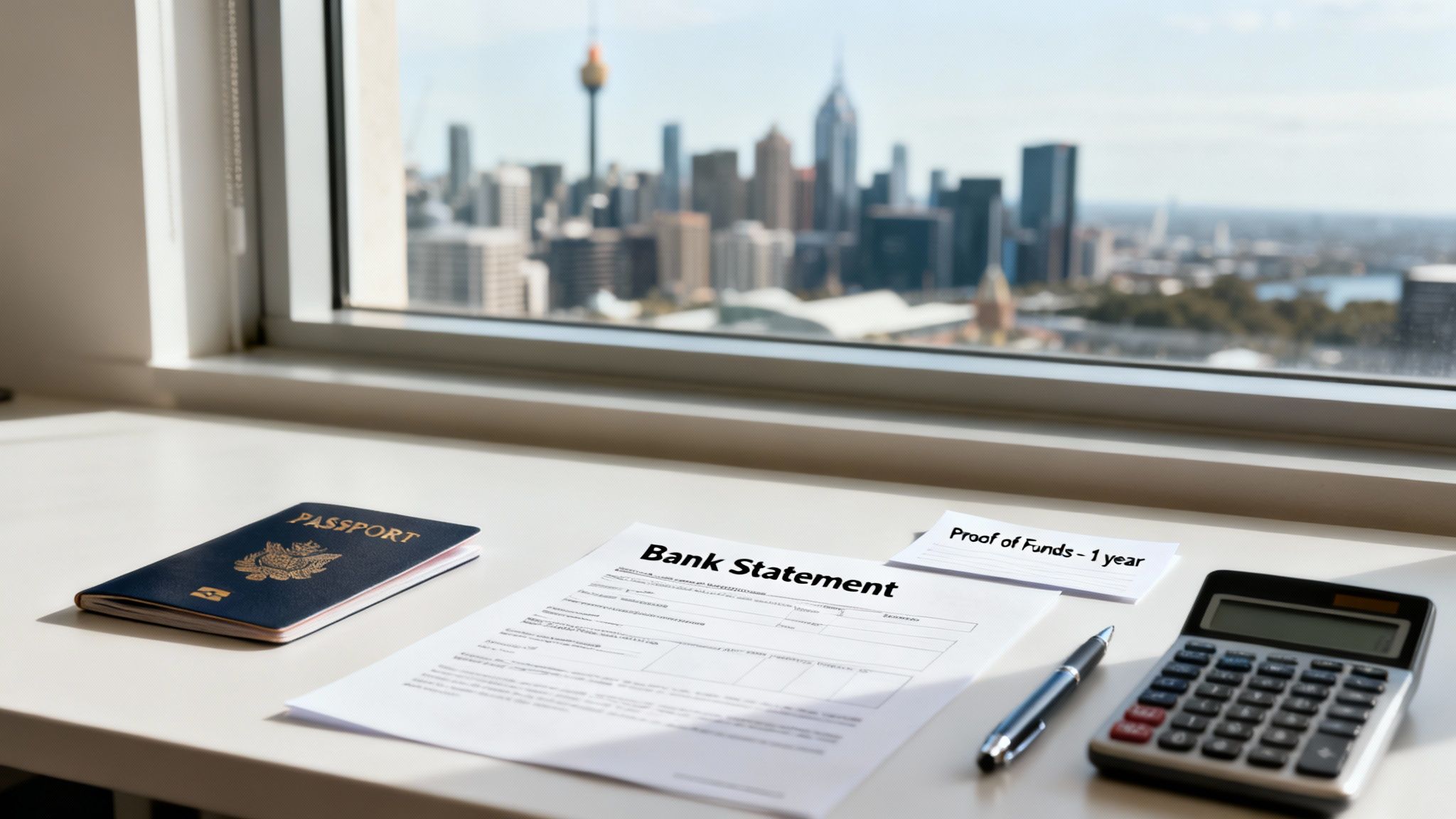
Paying for your visa application is one thing; proving you can actually afford to live and study in Australia is another challenge entirely. This is a critical step where many applications falter. The Australian government needs to see cold, hard proof that you have enough money to support yourself without running into financial trouble.
This isn’t just a suggestion—it's a core part of your application. You must demonstrate that you have clear access to sufficient funds to cover your tuition fees, living expenses, and travel costs for at least the first 12 months of your stay.
Calculating the Required Amount
So, how much money is "sufficient"? The Department of Home Affairs sets specific minimum amounts that you need to show. It’s not a guessing game. The total is calculated by adding up three key components:
- Living Costs: A set annual figure for yourself and any family members joining you.
- Tuition Fees: The cost of your first year of study, as outlined in your Confirmation of Enrolment (CoE).
- Travel Costs: An estimated amount for return airfares to your home country.
It's worth noting that the financial goalposts have shifted recently. The government has not only increased visa fees but also raised the financial capacity thresholds as of 10 May 2024. These changes are part of a broader strategy to manage student intake, with the Parliamentary Budget Office projecting a massive revenue gain of around AUD 764 million from fee hikes alone.
Example Calculation for a Student in Melbourne
Let's make this practical. Imagine a student named Alex who is planning to study a Bachelor of IT at a university in Melbourne for one year. Alex is applying alone.
Here’s a sample breakdown of the funds Alex would need to demonstrate:
- First Year's Tuition Fee: $35,000 (as per the CoE)
- 12 Months' Living Expenses: $24,505 (the current minimum set by the government)
- Return Airfare: $2,000 (a reasonable estimate for travel)
Adding these up, Alex would need to show evidence of having access to a total of $61,505 AUD. This is the minimum amount the government needs to see to be convinced of Alex's financial capacity.
Disclaimer: Immigration laws, visa fees, and requirements change frequently. The information in this article is for general guidance and may not be current at the time of reading. For the most accurate and up-to-date advice tailored to your situation, it is essential to book an appointment with a registered migration agent.
What Counts as Acceptable Evidence
You can't just say you have the money; you have to prove it with official documents. The evidence must be clear, legitimate, and easily verifiable.
Acceptable forms of evidence often include:
- Bank Statements: Showing a consistent savings history over a period of time.
- Loan Documents: An official letter from a financial institution confirming an education loan.
- Scholarship Letters: Documentation detailing the financial support provided by a scholarship.
- Parental/Sponsor Support: Evidence of your parents' or sponsor's annual income, usually accompanied by an affidavit of support.
If your financial documents aren't in English, you'll need to get them professionally translated. You might need to budget for professional bank statement translation services to ensure the case officer can clearly assess your financial standing. This isn't optional—it's a must.
The High Cost for Short English Courses
The standard, one-size-fits-all Australian student visa fee creates a real problem for a specific group of students: those coming to Australia for short courses. This hits especially hard for anyone enrolling in an English Language Intensive Course for Overseas Students, what most people know as an ELICOS program.
Imagine you’ve decided to spend three months in Australia polishing your English. You're excited, you've picked a great school, and then you see the visa application fee. Suddenly, you're faced with a non-refundable charge that's a huge chunk of your actual tuition cost. It’s enough to make anyone wonder if another English-speaking country with more sensible visa fees might be a better option.
This isn't just a hypothetical problem—it's had a massive impact on Australia's international education sector.
The Impact on the ELICOS Sector
Because the visa fee is the same for everyone, it puts the ELICOS sector at a serious disadvantage. These colleges and language centres rely on students who are looking for shorter, intensive study periods. When the visa application fee is almost as high as the course itself, it’s no surprise that students start looking elsewhere.
The consequences have been severe. The July 2025 student visa fee hike to AUD 2,000 sent shockwaves through the industry, with providers reporting skyrocketing visa rejection rates and a steep drop in new students. The economic fallout has been devastating, leading to an estimated 5,000 job losses and forcing several colleges to close their doors for good. You can read the full analysis of the visa fee's impact on ELICOS providers to get a sense of just how serious this is.
Disclaimer: Immigration laws, visa fees, and requirements change frequently. The information in this article is for general guidance and may not be current at the time of reading. For the most accurate and up-to-date advice tailored to your situation, it is essential to book an appointment with a registered migration agent.
The Push for a Fairer System
It's not just the students who are upset. Industry experts and peak bodies have been very clear that this flat-fee system isn't just unfair—it's bad for the economy. They’re pushing hard for a tiered fee system, where the visa cost actually makes sense for the length of the course.
A tiered approach would look something like this:
- Lower fees for short courses: Students signing up for programs under six months, like most ELICOS courses, would pay a much smaller visa application charge.
- Standard fees for longer degrees: Those undertaking multi-year Bachelor's or Master's degrees would continue to pay the full fee.
The goal here is to make Australia a competitive choice again for short-term study. A lot of students use ELICOS as a stepping stone to further education in Australia, so making that first step more affordable is a no-brainer. If that sounds like you, getting the right English proficiency support early on can help you map out your entire study journey.
The argument is simple: a fairer system is a win-win for both international students and the Australian economy.
Bringing It All Together: Your Next Steps
You've made it through the numbers and now have a solid picture of what it really costs to apply for an Australian student visa. From the main application charge to all those little extra expenses, you can now build a realistic budget and move forward with confidence.
But knowing the costs is just the first step. Now, it's time to put that knowledge into action.
Think of it like this: preparing for your visa application is a bit like planning a major expedition. You wouldn't set off without a map and a detailed checklist, right? A small oversight on your visa paperwork can end up costing you far more than just the application fee—it could lead to frustrating delays or, in the worst-case scenario, a refusal.
Your Final Financial Checklist
Before you hit 'submit' on that application, take a moment to run through this simple financial checklist. A quick review now can save you a world of stress later.
- Visa Application Charge (VAC): Have you budgeted for yourself and anyone coming with you?
- Overseas Student Health Cover (OSHC): Is your policy paid in full for the entire duration of your planned stay?
- Medical Examination: Are funds set aside for your appointment with an approved panel physician?
- Biometrics and Police Checks: Have you factored in these costs and started the process of getting your certificates early?
- Proof of Funds: Is your savings account ready to clearly demonstrate you can support yourself?
Why Getting Professional Guidance Is a Smart Move
Here's where we get to the most critical part. Australian immigration law is a constantly shifting landscape. The fees and rules you read about today can genuinely be outdated tomorrow, making trustworthy, current advice your most valuable asset. A small mistake based on old information can put your entire application at risk.
Disclaimer: Immigration laws, visa fees, and requirements change frequently. The information in this article is for general guidance and may not be current at the time of reading. For the most accurate and up-to-date advice tailored to your situation, it is essential to book an appointment with a registered migration agent.
Hiring a registered migration agent isn't just another line item on your budget; it’s an investment in your future. They work with the latest regulations every single day, ensuring your application is complete, correct, and "decision-ready." This kind of expert guidance gives you the best possible shot at success.
To get a handle on your application with total confidence, have a look at our dedicated student visa assistance for Subclass 500 and let us help you navigate the journey.
Your Top Questions About Visa Costs Answered
When you get down to the nitty-gritty of your visa application, the financial side can spark a lot of questions. Let's tackle some of the most common ones head-on to give you a clearer picture for your budget.
Is the Visa Application Fee Refundable if My Application Is Refused?
This is a tough one, but it’s crucial to know. In nearly every case, the Visa Application Charge (VAC) is non-refundable. Think of it this way: you're paying for the government's time and effort to process your application, not for the final outcome.
While there are some incredibly rare exceptions, you should always budget as if this fee is a sunk cost. This is exactly why getting your application right the first time is so important—it protects your investment.
How Much Does It Cost to Add My Family to the Application?
Bringing your family to share in your Australian adventure is a fantastic goal, but it does increase the overall student visa cost. For each family member you include on your Subclass 500 application, the government adds an "additional applicant charge."
These aren't small amounts, and they're charged on top of your own VAC. The costs differ based on age:
- Partner or spouse (18 or over): An additional charge applies for your partner.
- Dependent child (under 18): A smaller, separate fee is required for each child.
You absolutely need to factor these charges into your budget from day one to avoid any stressful financial surprises down the track.
Disclaimer: Immigration laws, visa fees, and requirements change frequently. The information in this article is for general guidance and may not be current at the time of reading. For the most accurate and up-to-date advice tailored to your situation, it is essential to book an appointment with a registered migration agent.
Do I Have to Pay for My OSHC All at Once?
Yes, you do. Paying for your Overseas Student Health Cover (OSHC) is a major upfront cost that you must handle in full before the Department will grant your visa. It’s a strict condition that you hold continuous health cover for the entire length of your stay.
So, if your degree is three years long, you’ll need to buy and pay for a three-year OSHC policy when you apply. It’s a significant lump sum, but it's a non-negotiable step to ensure you’re medically covered while studying in Australia.
Working through the maze of visa costs and rules is a huge part of your journey. The details can be tricky, and the stakes are high. To make sure your application is solid and your financial planning is spot-on, getting professional advice is your strongest move.
At My Visa Guide, our team of registered migration agents gives you the clear, up-to-date guidance you need to succeed. Book a consultation with us today and start your Australian study journey with total confidence.
Learn more and book your appointment at https://www.myvisaguide.com.au.