IMPORTANT NOTICE

The Subclass 189 visa is Australia's premier permanent residency pathway for skilled professionals who aren't sponsored by an employer or nominated by a state government. It's a points-tested visa, which means if you meet the criteria, you’re granted the freedom to live and work absolutely anywhere in Australia, right from day one.
Disclaimer: Please be aware that Australian immigration laws and visa criteria are subject to change. The information provided in this article is for general guidance only and may not be current at the time of reading. For the most accurate and personalised advice, it is crucial to book an appointment with a registered migration agent.
Your Direct Pathway to Australian Permanent Residency

Think of the Subclass 189 Skilled Independent visa as a merit-based invitation from Australia to the world's top talent. It’s specifically designed for people whose occupations are in high demand and who can hit the ground running, contributing to the economy without needing the safety net of a sponsor. This visa offers a level of freedom that sponsored visas simply can't match, letting you settle in any city or state that catches your eye.
Unlike its cousins—the Subclass 190 (State Nominated) or the 491 (Skilled Work Regional) visas—the 189 visa doesn't tie you down to a particular location or employer. Your entire eligibility rests on your personal merits: your age, qualifications, work experience, and English language skills.
Let's take a quick look at the key features of this visa.
Subclass 189 Visa at a Glance
| Feature | Description |
|---|---|
| Visa Type | Permanent Residency |
| Sponsorship Required | No employer or state sponsorship needed |
| Location Restriction | Live and work anywhere in Australia |
| Points Test | You must score at least 65 points |
| Application Process | Expression of Interest (EOI) by invitation only |
| Primary Benefit | Complete independence and freedom of choice |
This table sums up why the 189 is often called the 'golden ticket' of Australian visas.
The Power of Independence
This independence is the true superpower of the 189 visa. It hands successful applicants immediate permanent residency, giving them a solid foundation to build a life in Australia. The benefits are significant:
- Live and work anywhere in Australia without any restrictions.
- Get full access to Medicare, Australia's public healthcare system.
- You can sponsor eligible relatives for their own permanent residency.
- It’s a direct pathway to applying for Australian citizenship once you meet the residency rules.
These perks make it one of the most sought-after visas for skilled migrants across the globe. If you're weighing up your options, you can explore other routes in our detailed guide on Australian permanent residency pathways.
Why This Guide Is Essential
Getting your head around the points-tested system can be tricky, as every single component matters. This guide is here to break down the entire process for you, piece by piece. We'll walk you through checking your eligibility, calculating your points score, submitting an Expression of Interest (EOI), and finally, lodging your visa application. We'll also shed light on the competitive nature of invitation rounds and explain how a high score dramatically boosts your chances.
To get a broader perspective on the immigration journey, you might find it helpful to explore other online sources, such as these comprehensive immigration resources.
Meeting the Foundational Eligibility Requirements
Before you even get to the competitive points test for the 189 visa, there are a few fundamental hurdles everyone has to clear. These are the non-negotiables, the absolute bedrock of your application. Think of them as the qualifying rounds before the main event; fail here, and your journey stops before it even begins.
It all boils down to three core pillars: your age, your occupation, and your English language skills. Each one is a critical checkpoint you must pass to even be considered for this premier permanent residency pathway. Nailing these shows you have the foundational qualities Australia is looking for in its skilled migrants.
Disclaimer: Please be aware that Australian immigration laws and visa criteria are subject to change. The information provided in this article is for general guidance only and may not be current at the time of reading. For the most accurate and personalised advice, it is crucial to book an appointment with a registered migration agent.
The Age Requirement: A Strict Cut-Off
One of the most black-and-white rules is the age limit. To be invited to apply for the Subclass 189 visa, you absolutely must be under 45 years of age when you get your Invitation to Apply (ITA). This isn't a guideline; it's a hard stop.
This rule really highlights the visa's purpose: to bring in skilled professionals who can contribute to the Australian economy for many years to come. If you're getting close to this age, timing becomes everything. An invitation that arrives even one day after your 45th birthday means you're out of the running.
Your Occupation and the Skills Assessment
This is the true cornerstone of your application. It’s not enough to just say you work in a particular profession; you need to have your skills formally recognised as meeting Australian standards. This is where the positive skills assessment comes into play.
Essentially, this is a mandatory process where an official Australian assessing authority puts your qualifications and work experience under the microscope. They compare everything against the requirements for your occupation here in Australia. It’s the official stamp of approval confirming you have the expertise needed to do your job down under.
You must have this positive assessment in hand before you can even think about submitting an Expression of Interest (EOI). The main occupations for the 189 visa are all listed on the Medium and Long-term Strategic Skills List (MLTSSL).
Demonstrating Competent English Proficiency
Finally, you have to prove you have at least a competent level of English. This is usually done with an approved language test like IELTS, PTE Academic, TOEFL iBT, or OET. Hitting the minimum score is a must.
But here’s the thing—your English test result does way more than just tick a box. It can seriously boost your points score. While ‘competent’ English is the minimum, hitting 'proficient' or 'superior' levels will net you 10 or 20 points, respectively. That’s a massive competitive advantage.
- Competent English: Gets you over the line but earns 0 points.
- Proficient English: Adds a handy 10 points to your score.
- Superior English: Gives you a huge boost of 20 points.
So, preparing for these tests isn’t just a formality; it's a strategic move. When you're gathering documents from overseas for your application, it's also smart to check international authentication rules. You can consult the Hague Apostille Country List to see if documents from your country might need an apostille.
The Australian government is also getting smarter about how it picks candidates to fill workforce gaps. For the 2025–26 program year, the Department of Home Affairs is rolling out a new tier-based selection model. It divides occupations into different tiers to make sure invitations are targeted more effectively to where they're needed most. You can learn more about how this new 189 selection model works.
How to Calculate Your Score for the Points Test
The points test is where things get competitive for the 189 visa. Think of it as the core of your application. While the magic number to get in the door is 65 points, hitting that minimum doesn't automatically mean you'll get an invitation. It just gets you into the pool of candidates.
From there, it's all about standing out. Only those with the highest scores get invited to apply.
To give yourself the best shot, you need to get forensic about how points are awarded. Understanding the system lets you accurately tally your score, see where you stand against others, and find opportunities to boost your numbers. It’s a methodical process, but it’s one that puts you in the driver’s seat.
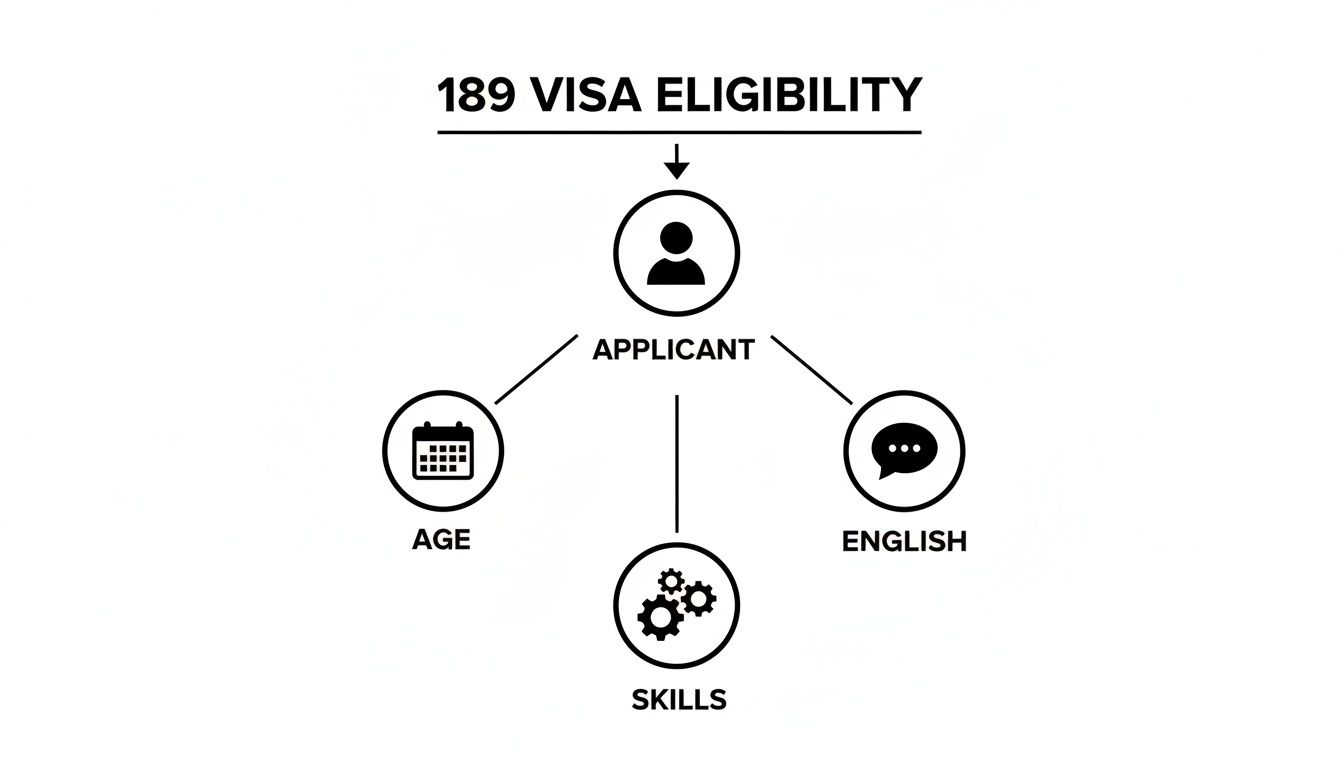
As you can see, the major pillars supporting your score are your age, English language skills, and professional background. Let's break down exactly how you can start adding up your points.
Breaking Down the Points Categories
The Australian government has a clear system for what it values. Your final score is built from several key areas of your personal and professional life. Here’s a look at what they are and how you can earn points in each.
-
Age: This is a big one. The sweet spot is between 25 and 32 years old, which lands you the maximum of 30 points. After that, the points start to taper off, dropping to zero once you turn 45.
-
English Language Skills: While 'Competent' English is the baseline, this is where you can gain a serious competitive edge. Scoring 'Proficient' English will add 10 points to your total, and 'Superior' English gives you a massive 20-point boost.
-
Skilled Employment Experience: Your work history is incredibly valuable, both in Australia and overseas. The more relevant experience you have in your nominated occupation, the more points you can claim. For example, eight or more years of overseas experience can net you 15 points.
-
Educational Qualifications: Higher education is rewarded handsomely. A Bachelor's or Master's degree will earn you 15 points, while a Doctorate (PhD) from a recognised institution is worth 20 points.
To make it even clearer, here’s a table that lays out how the points are awarded across the different categories.
Disclaimer: Please be aware that Australian immigration laws and visa criteria are subject to change. The information provided in this article is for general guidance only and may not be current at the time of reading. For the most accurate and personalised advice, it is crucial to book an appointment with a registered migration agent.
Subclass 189 Points Test Breakdown
| Category | Criteria | Points Awarded |
|---|---|---|
| Age | 18–24 years | 25 |
| 25–32 years | 30 | |
| 33–39 years | 25 | |
| 40–44 years | 15 | |
| English Language | Competent | 0 |
| Proficient | 10 | |
| Superior | 20 | |
| Overseas Work Experience | 3–4 years | 5 |
| 5–7 years | 10 | |
| 8+ years | 15 | |
| Australian Work Experience | 1–2 years | 5 |
| 3–4 years | 10 | |
| 5–7 years | 15 | |
| 8+ years | 20 | |
| Educational Qualifications | Doctorate (PhD) | 20 |
| Bachelor's or Master's Degree | 15 | |
| Diploma or Trade Qualification | 10 | |
| Specialist Education | Master's by research or PhD in a STEM field | 10 |
| Partner Skills | Partner has a positive skills assessment & competent English | 10 |
| Partner has competent English only | 5 | |
| Single applicant | 10 |
This table gives you a roadmap to calculating your potential score. Use it to work through each section and see where you land.
A Real-World Example
Let's see how this works in practice. Meet Priya, a software engineer hoping to make the move to Australia.
- She is 32 years old, putting her in the top age bracket for 30 points.
- She holds a Master's degree in Computer Science, which adds another 15 points.
- Priya has worked as a software engineer for six years outside of Australia, earning her 10 points for her skilled employment.
- She really buckled down to prepare for her English test and achieved a 'Superior' score, securing a crucial 20 points.
Adding it all up, Priya's score is: 30 (Age) + 15 (Education) + 10 (Experience) + 20 (English) = 75 points. This is a strong, competitive score that gives her a very good chance of receiving an invitation.
Why Your English Score Is Your Secret Weapon
Priya’s example shows just how powerful a great English score can be. The 20-point difference between 'Competent' (0 points) and 'Superior' (20 points) can be the single factor that pushes your application over the line in a tough invitation round.
Our Pro Tip: A high English score is often the quickest and most effective way to improve your chances. Investing time in preparing for your test can deliver a return of up to 20 points—that's the same value as a PhD or several years of extra work experience!
Many people find that some focused preparation is all it takes to unlock those extra points. If you're looking to lift your score, our team provides dedicated English proficiency support services to help you get the results you need.
Knowing your numbers is the first strategic step in your 189 visa journey. It gives you a clear picture of where you stand and helps you plan your next moves to become the kind of candidate the Department of Home Affairs is looking for.
Your Step-by-Step Guide to the 189 Visa Application Journey
Getting your hands on a Subclass 189 visa is a multi-stage marathon, not a sprint. It’s a structured process, and if you don’t know the roadmap, it’s easy to get lost. We've broken down the entire journey into clear, sequential steps so you know exactly what’s coming at every turn.
This whole thing actually kicks off long before you even think about lodging a visa application. It starts with proving your skills are up to Australian standards, then entering a competitive pool and patiently waiting for your number to be called.

Step 1: Nailing Your Skills Assessment
First things first: before you can even raise your hand to signal your interest in a 189 visa, you must get a positive skills assessment. This is the mandatory first hurdle.
An authorised assessing body for your specific occupation will meticulously go over your qualifications and work experience. Think of it as an official stamp of approval confirming you have the skills Australia is actively looking for. This assessment is non-negotiable and has to be in your hands before you can move on. It’s the foundational document that backs up everything you’ll claim about your professional abilities.
Step 2: Submitting Your Expression of Interest (EOI)
With a positive skills assessment secured and your points score tallied, your next move is to submit an Expression of Interest (EOI). This is done through the Department of Home Affairs' SkillSelect system.
An EOI isn't a visa application. It’s more like a formal profile you’re putting forward, telling the government, "Hey, I'm interested in migrating, and here's what I bring to the table."
It’s crucial to understand that submitting an EOI doesn't put you in a queue. Instead, it places you into a competitive pool with other hopefuls. You're ranked against everyone else based on your points score. The higher your score, the better your chances of getting noticed.
Disclaimer: The information in this article is for general guidance and may become outdated as immigration policies change. For the most current and personalised advice, it is vital to book an appointment with a registered migration agent.
Step 3: The Waiting Game—Receiving an Invitation to Apply
This is where the nail-biting begins. You'll be waiting for an Invitation to Apply (ITA). Periodically, the Australian government runs "invitation rounds," where they skim the top-scoring candidates from the SkillSelect pool and formally invite them to apply for the 189 visa.
Invitations are handed out based on a few key factors:
- Your total points score (this is the big one).
- The date and time you lodged your EOI, which acts as a tie-breaker for candidates with the same score.
- Occupation ceilings, which put a cap on how many people can be invited from a single occupation group.
Getting an ITA means you've made it through the most competitive part of the process. Now, you can officially lodge your visa application.
Step 4: Lodging the Visa Application—The Clock Is Ticking
Once that invitation lands in your inbox, a strict 60-day window opens for you to lodge your formal visa application. This is a hard deadline. Miss it, and your invitation expires, sending you right back to the EOI pool to start the waiting game all over again.
This is where you need to provide all the evidence to back up the claims you made in your EOI. You’ll be uploading a comprehensive set of documents, including:
- Identity documents (passports, birth certificates).
- Your positive skills assessment report.
- English language test results.
- Educational transcripts and qualifications.
- Proof of your work experience (contracts, payslips, reference letters).
Step 5: The Final Checks—Health and Character
After your application is lodged, you’re on the home stretch. The final steps involve completing health and character assessments. You'll need to book a medical examination with a panel physician approved by the Department.
You’ll also have to provide police clearance certificates from every country you’ve lived in for 12 months or more over the last 10 years. These checks are standard procedure to ensure all applicants meet Australia's public health and safety requirements.
Passing these is the last hurdle. From here, all you can do is wait for a decision. It’s worth noting that the system can face backlogs. Crowdsourced data shows processing times can be lengthy, and you can discover more insights about current Subclass 189 visa processing patterns on SmartVisaGuide.
Understanding Invitation Rounds and Points Trends
Hitting the 65-point minimum for the 189 visa Australia is a great start, but it's just the first hurdle. Think of it like getting a ticket to a sell-out concert—it gets you in the door, but it doesn't guarantee you a front-row seat. The real competition for this visa happens in the invitation rounds.
The Department of Home Affairs doesn’t simply work through a queue. Instead, they run periodic invitation rounds, picking candidates with the highest points scores from the Expression of Interest (EOI) pool. This is where every single point you can scrape together becomes absolutely critical to push your profile ahead of the pack.
Why Not All Occupations Are Treated Equally
The points score you’ll need for an invitation can swing wildly depending on your nominated occupation. Why? Because some professions are in scorching-hot demand, while others are flooded with applicants, making the competition incredibly fierce.
For instance, a Registered Nurse might get an invitation with 75 points because their skills are urgently needed in the healthcare sector. On the flip side, an Accountant—a role with a huge number of applicants—might need to score 95 or even 100 points just to be in the running.
This is mostly down to what’s known as "pro-rata" arrangements for very popular occupations. The government caps the number of invitations for any single profession each year (called occupation ceilings) to ensure they get a balanced mix of skills. Once a job hits its ceiling, the invitations stop until the next program year starts, no matter how high your points are.
Disclaimer: Please be aware that Australian immigration laws and visa criteria are subject to change. The information provided in this article is for general guidance only and may not be current at the time of reading. For the most accurate and personalised advice, it is crucial to book an appointment with a registered migration agent.
Decoding Recent Invitation Trends
Keeping an eye on past invitation rounds gives you a real-world look at the competitive landscape. It helps you set realistic goals and figure out the kind of score you should be aiming for in your field. Unsurprisingly, high-scoring candidates are always picked first, and recent trends drive this point home.
Take the November 13, 2025, invitation round as an example. A total of 6,887 EOIs were invited, showing just how keen Australia is to fill critical skills shortages. Registered Nurses were a major focus of that round, with successful candidates typically needing between 75–85 points. This just goes to show the consistent, high demand for healthcare professionals. You can get more details on the outcomes of the November 2025 invitation round here.
What This Means for Your Strategy
Understanding these trends is the key to building a smart strategy for your 189 visa Australia application. Just scraping by with 65 points isn't going to cut it. You have to be proactive and chase down every possible point to make your EOI stand out.
Here’s how this insight should shape your game plan:
- Set a Realistic Target Score: Do your homework. Look up the latest invitation rounds for your occupation to get a clear idea of a competitive points target.
- Focus on Maximising Points: Pinpoint areas where you can improve. Could you get a 'Superior' English score? Can you gain more relevant work experience?
- Monitor Occupation Ceilings: Keep an eye on the SkillSelect dashboard. You need to know if your occupation is getting close to its annual limit.
Thinking this way turns your application from a passive waiting game into an active pursuit. By getting to grips with the competitive dynamics, you can put your energy where it counts and seriously boost your chances of getting that life-changing invitation to apply for permanent residency.
Still Have Questions About the 189 Visa? Let's Clear Them Up.
Going through the details of the 189 visa can definitely bring up a lot of questions. We get it. To help you make sense of it all, here are some clear, straightforward answers to the most common queries we hear from applicants every day.
What's the Real Difference Between the 189, 190, and 491 Visas?
Think of these three skilled visas as different paths to the same goal, each with its own level of freedom and commitment.
The Subclass 189 visa is the true ‘independent’ one. You don't need a nomination from a state or territory, which gives you the ultimate freedom to live and work absolutely anywhere in Australia right from the get-go. It’s all about your own skills and points score—no strings attached.
On the other hand, the Subclass 190 (Skilled Nominated) and Subclass 491 (Skilled Work Regional) visas both hinge on getting a nomination from an Australian state or territory government. This nomination gives you a handy points boost, but it comes with a catch: you’re expected to live and work in that specific state or region for a while. That’s usually two years for the 190 and three for the 491. Another key difference is that the 491 is a provisional visa that sets you on a path to permanent residency, while the 189 and 190 grant it to you outright.
Disclaimer: Please be aware that Australian immigration laws and visa criteria are subject to change. The information provided in this article is for general guidance only and may not be current at the time of reading. For the most accurate and personalised advice, it is crucial to book an appointment with a registered migration agent.
Can I Bring My Family with Me on the Application?
Yes, absolutely. You can include members of your immediate family (what immigration calls your 'family unit') when you lodge your Subclass 189 visa application. This usually means your partner and any dependent children you or your partner have.
Just remember, every family member you include must also pass Australia's health and character checks. A great bonus is that your partner can even help boost your points score if they can prove competent English and have a positive skills assessment in an eligible occupation.
How Long Does My Expression of Interest Stay Valid?
Once you submit your Expression of Interest (EOI) into the SkillSelect system, it stays active in the pool for two years. During that time, you're officially in the running to receive an Invitation to Apply (ITA) for the 189 visa.
If you don't get an invitation within that two-year window, your EOI will expire and be removed from the system. If that happens, don't panic! You can simply submit a new one, as long as you still meet all the eligibility criteria. It's also a really good idea to keep your EOI updated if your circumstances change—say, you gain more work experience or ace a new English test. Every extra point boosts your chances of getting that coveted invitation.
Why Professional Guidance Is Your Strongest Asset
Trying to get a Subclass 189 visa isn't just about filling in forms; it's a strategic and often complicated journey. Australian immigration laws are a moving target. Points requirements can shift, occupation lists get updated, and processing priorities can change with very little notice. Going it alone in this environment is a massive risk.
This is exactly where the experience of a registered migration agent becomes your most powerful tool. An agent does so much more than just handle paperwork. They offer critical strategic advice shaped around your specific situation, finding the best ways to boost your points score and build the strongest possible application.
The True Value of an Expert
A good migration agent makes sure every single document is perfect and presented in the exact way the Department of Home Affairs wants to see it. This obsessive attention to detail helps you sidestep the common mistakes that lead to frustrating delays or even an outright visa refusal, protecting your time, your money, and your dream of living in Australia.
They're also your eyes and ears on the ground, keeping up with every policy shift that could affect your eligibility or your application strategy. When the stakes are this high, having an expert in your corner is the best insurance you can get for a successful outcome. For a better sense of what to look for, you might find our guide on tips for choosing a migration agent really helpful.
Disclaimer: Please be aware that Australian immigration laws and visa criteria are subject to change. The information provided in this article is for general guidance only and may not be current at the time of reading. For the most accurate and personalised advice, it is crucial to book an appointment with a registered migration agent.
Navigating the Subclass 189 visa requires more than just reading articles online; it demands expert guidance. The team at My Visa Guide is here to give you clear, honest, and strategic advice to help you reach your permanent residency goal. Book your consultation today and take the first real step on your journey to Australia. Find out how we can help at https://www.myvisaguide.com.au.