IMPORTANT NOTICE
Meeting the 482 visa Australia requirements is a bit like a three-part journey. It starts with the employer getting approved, then they nominate a specific job, and finally, you, the applicant, have to meet all the personal criteria.
Think of it as a relay race where both the employer and the applicant have to run their leg perfectly to get across the finish line.
Your Essential 482 Visa Requirements Checklist
The Temporary Skill Shortage (TSS) visa, or subclass 482 as it's officially known, is a vital tool for Australian businesses looking to bring in skilled people from overseas to fill critical roles. But getting one isn't as simple as just filling out a form. It’s a structured process with very clear stages, and both the business and the visa applicant have distinct responsibilities at each step.
Getting your head around this structure right from the start is the secret to a smooth, headache-free application.
Disclaimer: Australian migration law changes all the time. This article is a general guide to help you understand the process, but the information can be no longer true when you are reading it. It's always best to book an appointment with a registered migration agent for advice that’s current and tailored to your situation.
The Three Pillars of the 482 Visa
The whole 482 visa application is built on three pillars. You have to clear each one, in order, for the visa to be granted. If you stumble on any of them, the whole process grinds to a halt. That’s why it’s so important to know what each stage is all about.
- Sponsorship Application: This is the foundation. The employer has to prove they're a legitimate, lawfully-run business in good standing. Once they become an approved Standard Business Sponsor, they get the green light to sponsor skilled workers for up to five years.
- Nomination Application: With the sponsorship sorted, the business then needs to nominate the specific job they want to fill. Here, they have to show the role is genuine, that it's on the right skilled occupation list, and that the salary and advertising efforts (Labour Market Testing) meet the government's rules.
- Visa Application: This is the final piece of the puzzle, and it's all about you—the applicant. You have to prove you’ve got the right skills, qualifications, work experience, English language proficiency, and that you meet the health and character requirements for the job.
This infographic breaks down how each stage flows into the next.
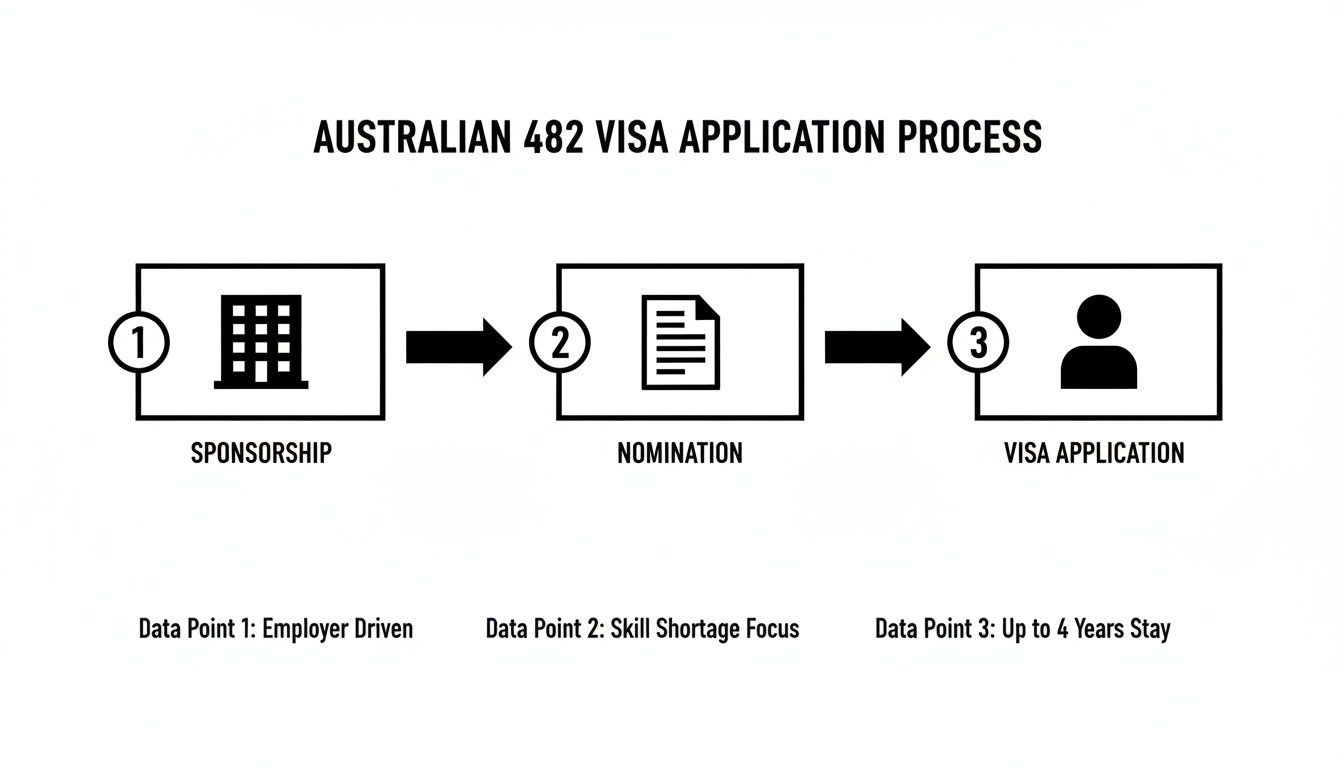
As you can see, it all starts with the employer. Before you can even think about the job or your own eligibility, the business has to be approved to sponsor.
To help you get a clear picture of how these three critical stages work together, here’s a quick summary:
The Three Pillars of the 482 Visa Application
| Stage | Who Is Responsible? | Primary Purpose |
|---|---|---|
| Sponsorship | The Employer | To prove the business is legitimate and eligible to sponsor overseas workers. |
| Nomination | The Employer | To demonstrate the specific job is genuine, needed, and meets salary/market testing rules. |
| Visa Application | The Applicant | To prove the individual has the skills, experience, and personal attributes for the visa. |
Each of these pillars has its own detailed requirements and potential pitfalls, which we'll dive into throughout this guide.
For any business new to this, the first big step is understanding what it takes to become a sponsor. We've put together a comprehensive breakdown in our guide on the Australian employer sponsorship process.
The First Hurdle: Getting Approved as a Standard Business Sponsor
Before your business can even think about nominating someone for a 482 visa, it first has to become a Standard Business Sponsor (SBS). The easiest way to think about this is like getting a special licence from the government – a licence that allows you to hire skilled talent from overseas. It’s the foundational step where you prove your company is a legitimate, active, and compliant player in the Australian market.
This whole initial stage has nothing to do with the specific job or the person you want to hire. It’s a deep dive into the business itself. The Department of Home Affairs needs to be completely satisfied that your company is stable, has a solid track record, and has a genuine need that can’t be filled locally. For anyone looking to get a 482 visa, understanding these employer requirements is critical, because the success of your visa application rests squarely on your sponsor's shoulders.
Proving You're a Lawfully Operating Business
At the core of the SBS application is one simple question: is your business "lawfully and actively operating" in Australia? This goes way beyond just having an Australian Business Number (ABN). It means you need to lay your cards on the table and provide hard evidence of your ongoing, legitimate commercial activities.
What you show will depend on your business's story. A company that’s been trading for years will have a different set of documents to a startup that’s just finding its feet. But the goal is the same: to paint a clear picture of your financial health and operational reality.
Typically, you'll need to pull together things like:
- Business Registration: Think ABN confirmation, ASIC company extracts, or trust deeds if applicable.
- Financial Records: Recent Business Activity Statements (BAS), profit and loss statements, and balance sheets are standard.
- Proof of Operations: A copy of your office lease agreement or recent utility bills to show you have a physical presence.
This isn't just paperwork for the sake of it. It’s a health check to assure the government that your company is a viable enterprise that can look after an overseas employee.
Showing Your Commitment to Local Jobs
Here’s a non-negotiable part of the deal: you have to demonstrate a rock-solid commitment to employing Australians first. The government's policy is crystal clear on this – sponsoring an overseas worker is meant to fill genuine skill gaps, not to undercut the local job market.
So, your business must show that it has non-discriminatory hiring practices and is genuinely committed to employing local labour. This isn't just a box to tick; it's a fundamental principle of the entire skilled migration program.
Disclaimer: Migration laws and sponsorship requirements are constantly changing. The information here is for general guidance only and can be no longer true when you are reading it. We strongly recommend booking a chat with a registered migration agent to get up-to-date advice tailored to your specific situation.
The Danger of "Adverse Information"
One of the fastest ways to get a sponsorship application knocked back is the presence of "adverse information." This is a broad term for any negative finding against your business or its directors by a government agency.
Think of it as a background check on your company's legal and ethical report card. Adverse information could be anything from:
- Breaches of workplace laws, like underpaying staff or not paying superannuation.
- Failing to meet your obligations as a sponsor in the past.
- Being under investigation by bodies like the Fair Work Ombudsman or the Australian Taxation Office.
Even an old issue you thought was resolved can come back to haunt you. For instance, if your business was previously found to have paid an employee below the modern award rate, that could be flagged as adverse information and sink your application. A clean record and complete transparency are absolutely essential here.
Getting Through the Visa Nomination Stage
Once your employer becomes a Standard Business Sponsor, they’ve cleared the first hurdle. That’s a big tick. Now, the spotlight shifts from the business itself to the specific job you’ve been offered. This is what we call the Nomination stage, and it’s where some of the most granular 482 visa Australia requirements really kick in.
Think of the sponsorship as the employer's general 'licence to hire' from overseas. The nomination, however, is the specific 'permit' for your particular role. The Department of Home Affairs puts the job under a microscope here, checking if it's genuine, pays a fair wage, and—most importantly—is a position that couldn't be filled by someone already in Australia. This part is a team effort, demanding careful preparation from the employer to build a rock-solid case for the role.
Choosing the Right Visa Stream
The first make-or-break decision in the nomination is picking the correct visa stream. This isn't up for debate or preference; it’s determined entirely by your nominated occupation and where it sits on Australia’s skilled occupation lists. Getting this wrong is a surefire way to get a refusal.
To give you a better sense of how they stack up, here’s a quick comparison of the three main streams for the 482 visa.
| Feature | Short-Term Stream | Medium-Term Stream | Labour Agreement Stream |
|---|---|---|---|
| Occupation List | Short-term Skilled Occupation List (STSOL) | Medium and Long-term Strategic Skills List (MLTSSL) | Occupations specified in the agreement |
| Visa Duration | Up to 2 years (or 4 years for some international trade obligations) | Up to 4 years | As per the terms of the specific agreement (often up to 4 years) |
| PR Pathway | Limited. Pathway to PR may become available after a certain period of employment. | Yes, typically eligible for permanent residency after 2 years with the same employer. | Yes, a pathway to PR is usually included in the agreement terms. |
| Renewals | Can be renewed onshore once, with limited options thereafter. | Can be renewed multiple times while in Australia. | Renewal terms are set out in the individual agreement. |
Knowing which list your profession falls on is absolutely fundamental. It doesn't just dictate how long you can stay—it shapes your entire long-term future in Australia.
The Make-or-Break Labour Market Testing
For most jobs, a non-negotiable part of the nomination is Labour Market Testing (LMT). This is where your employer has to prove to the government that they’ve made a real effort to hire an Australian citizen or permanent resident for your role first.
Disclaimer: Migration rules, especially around LMT and salary levels, can and do change. As this information can be no longer true when you are reading it, it is always best to book an appointment with a registered migration agent for advice that’s current and tailored to your situation.
In simple terms, the employer must advertise the position in Australia following very strict government rules before they can nominate you. The ads have to run for a specific duration, contain certain information, and be placed on approved platforms. The government wants to see cold, hard proof that no suitable local talent was available.
This means handing over copies of the job ads, payment receipts, and a summary of why any Australian applicants weren't the right fit. Messing up the LMT evidence is one of the most common reasons we see nominations get knocked back. To get a better grasp of the different employer-sponsored routes, have a look at our detailed guide on Australian employer-sponsored pathways.
Nailing the Salary and Position Requirements
On top of the advertising rules, the nomination also has to meet strict requirements around your salary and the authenticity of the role itself. This is to make sure overseas workers aren't being exploited with low pay and that the job is actually needed by the business.
Two key salary benchmarks must be cleared:
- Temporary Skilled Migration Income Threshold (TSMIT): Your salary has to be at or above this government-set minimum. As of late 2023, the TSMIT was set at $70,000 AUD plus your superannuation. This number is reviewed from time to time, so it's important to check the current rate.
- Annual Market Salary Rate (AMSR): Your pay must also be in line with what an Australian doing the same job in the same location would earn. This stops employers from undercutting local wages. The business needs to prove this with evidence, like salary surveys or by showing what they pay similar Australian employees.
Finally, the position itself has to be genuine. The Department will look at whether the job makes sense for the business, if your duties match the official ANZSCO description for that occupation, and if there's a real, ongoing need for someone in that role. A strong nomination application lays all this out clearly with plenty of evidence to back it up.
Meeting the Applicant Eligibility Criteria
Once the employer has sorted their end of the deal—getting the sponsorship and nomination approved—the spotlight swings directly onto you, the visa applicant. This is the third and final act, where you need to prove you’ve got the right qualifications, experience, and personal background to meet the 482 visa Australia requirements. It’s your chance to show you’re the professional they’ve been looking for.
Think of it like this: the sponsorship proved the business is a legitimate player. The nomination proved the job is a genuine need. Now, the visa application is your personal audition. You’re on stage, presenting the evidence that you’re the perfect person for the part. This involves a close look at your skills, English ability, health, and character.
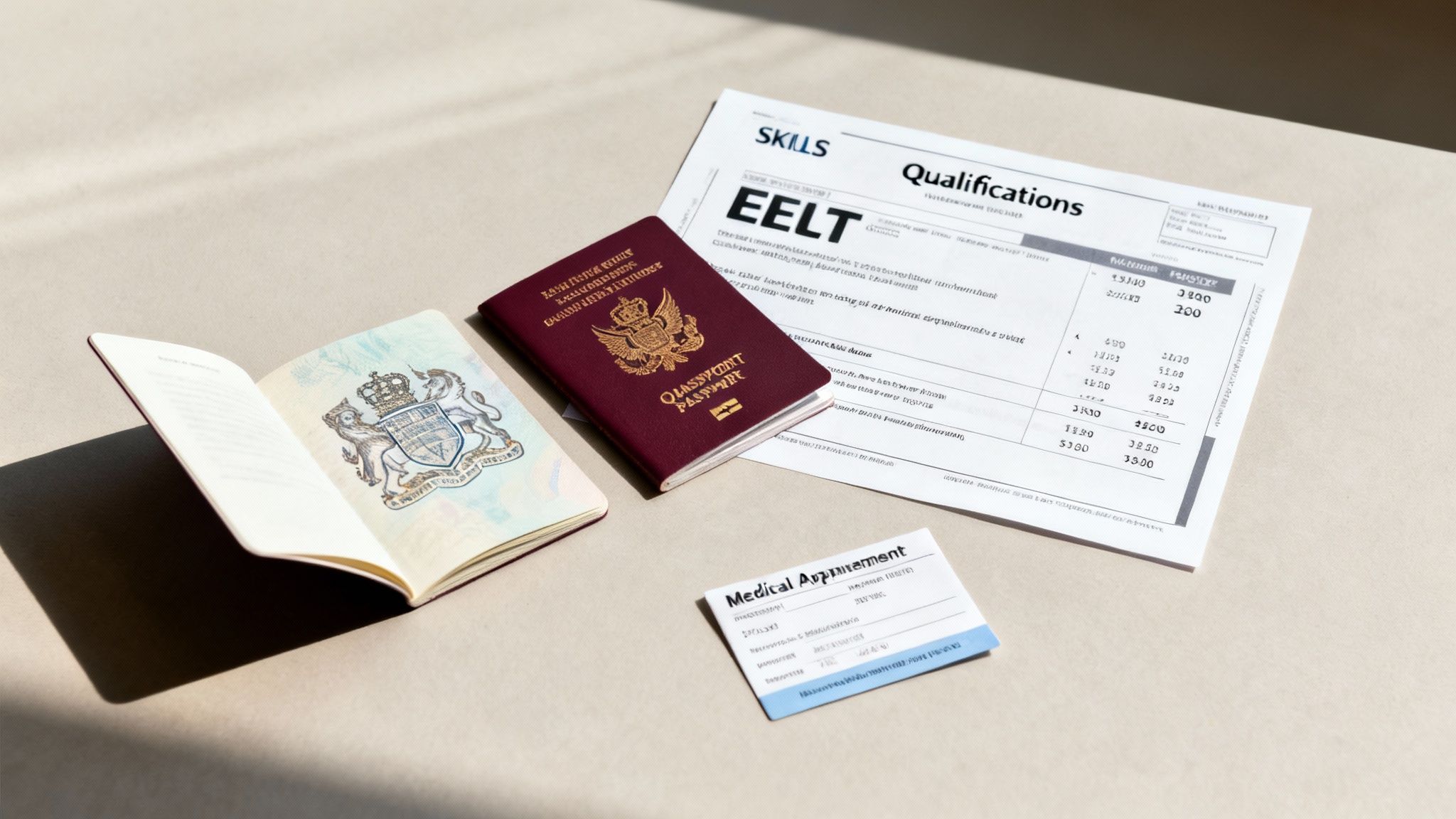
Aligning Your Skills and Experience
The absolute cornerstone of your application is demonstrating you have the right skills and work history for the job. The Department of Home Affairs is looking for a clear, unbroken line connecting your professional background to the role you’ve been offered.
In practical terms, this usually means you have to show you’ve worked in your nominated occupation (or something very similar) for at least two years full-time in the last five years. On top of that, your qualifications—like university degrees or trade certificates—must line up with the standards defined for that profession in the Australian and New Zealand Standard Classification of Occupations (ANZSCO).
The Skills Assessment Requirement
Here's a step that trips a lot of people up. For certain occupations and passport holders, a formal skills assessment is non-negotiable. This is an independent review by a specific assessing body that officially verifies your skills and qualifications are on par with Australian standards.
Disclaimer: Australian migration laws and requirements can change frequently and without notice. This information is intended as a general guide and can be no longer true when you read it. For the latest and most accurate advice, it is essential to book an appointment with a registered migration agent.
A skills assessment isn't just a "nice-to-have." If it’s mandatory for your role, your application is dead in the water without a positive result. This is a common hurdle for trade occupations (think chefs, electricians, and mechanics) and a range of professional roles. You absolutely must check if this applies to you early on, because these assessments can easily take several months to complete.
Demonstrating English Language Proficiency
Unless you get a pass (for instance, if you hold a passport from the UK, USA, Canada, New Zealand, or Ireland), you'll need to prove you can speak English. This is done by sitting an approved English test and hitting the minimum required scores.
The scores you need to get depend on which stream you’re applying for:
- Short-Term Stream: An overall IELTS score of 5.0, with no single band score falling below 4.5 (or the equivalent score in other tests like PTE Academic, TOEFL iBT, OET, or Cambridge C1 Advanced).
- Medium-Term Stream: An overall IELTS score of 5.0, but with a minimum of 5.0 in each of the four test components (or its equivalent).
Don't underestimate this. Failing to meet these scores is an automatic refusal, so putting in the time to prepare for your English test is crucial.
Passing Health and Character Checks
Finally, every single applicant for a 482 visa must meet Australia’s health and character requirements. These are strict, black-and-white criteria put in place to protect the Australian community.
Health Requirement: You (and any family you’re bringing along) will almost certainly need to have a medical examination. This has to be done with a panel physician approved by the Australian government. The exam is designed to screen for any conditions that might be a public health risk or put a heavy burden on Australia’s healthcare system.
Character Requirement: You have to be of good character to get the visa. This usually means getting police clearance certificates from every country you’ve lived in for 12 months or more over the last 10 years (since you turned 16). You must declare any criminal convictions or other character issues, as they can definitely affect the outcome of your application.
One of the big upsides here is speed. The 482 visa program is often much faster than other skilled migration pathways. You can typically expect processing for a 482 visa application to take somewhere between 21 to 47 days, and there are even priority processing options. That’s significantly quicker than other visas like the 186 or 190, which can drag on for many months. You can learn more about the fastest visa processing streams in Australia to see how it stacks up.
Understanding Costs, Timelines, and PR Pathways
Getting all the sponsorship, nomination, and applicant criteria right is the heart of a successful 482 visa application. But let's be honest, the practical side of things—costs, waiting times, and what the future holds—is just as important for your planning. This is where the theory meets reality. You need to map out the financial side, figure out a realistic timeline for your move, and think about your long-term goals in Australia.
Getting a clear picture of these elements means no nasty surprises down the track. It helps both employers and visa applicants budget properly and sets realistic expectations for the entire journey ahead.
A Breakdown of the Costs
Securing a 482 visa isn't just one single payment; it involves several different government fees and charges. It’s important to know who usually pays for what.
- Sponsorship Application Charge: This is the first fee an employer pays to become an approved Standard Business Sponsor.
- Nomination Charge: A separate fee is paid for nominating a specific position for you to fill.
- Visa Application Charge (VAC): This is the main fee for you, the visa applicant, and any family members you include in your application.
- Skilling Australians Fund (SAF) Levy: This one is a biggie for the employer. It's a hefty, non-negotiable contribution to a fund for training Australian workers, and the cost is based on the business's annual turnover and how many years they want to sponsor you for.
To really get a handle on the financial side of things, it’s also a good idea to understand the Australian tax residency test, as your tax status will have a big impact on your finances once you're living and working here.
Processing Times and Key Influences
While processing times can and do fluctuate, the 482 visa is generally known for being pretty efficient. The Department of Home Affairs gives estimated timelines, but a few things can definitely speed things up or slow them down. A complete, well-documented application will always move through the system faster than one that's missing information.
The recent demand for skilled workers really shows how popular this visa is. The 482 program has seen massive growth, with 63,700 applications lodged by March 2025—that's a 53% jump from the year before. With 110,740 primary visa holders now in Australia, the system is certainly busy, but it's also efficient. Crucially, this isn't a capped visa class, which is great news for applicants.
Disclaimer: Migration laws, visa costs, and processing times can change. As this information can be no longer true when you are reading it, it is essential to book an appointment with a registered migration agent for the most current and personalised advice.
Charting Your Pathway to Permanent Residency
For many people, the 482 visa isn't just a temporary work gig—it's the first major step towards making Australia their permanent home. The shot you have at permanent residency (PR) really depends on which visa stream you're on.
The Medium-Term stream is specifically designed to be that bridge. After you’ve worked for your sponsoring employer for a certain period (recent changes have brought this down to two years), you might be eligible to be nominated for the Employer Nomination Scheme (subclass 186) visa. This offers a direct, structured path from a temporary visa to becoming a permanent resident.
Even some people on the Short-Term stream may find pathways opening up as the regulations evolve. If you're planning for the long haul, it's definitely worth exploring all the available permanent residency pathways in Australia.
Common Mistakes That Can Derail Your Application
Getting a 482 visa is a meticulous process. It’s not just about being qualified for the job; it’s about proving it on paper, and even small slip-ups can lead to major delays or an outright refusal. I’ve seen highly skilled applicants get tripped up by common pitfalls that could have been easily avoided.
Let's walk through where things most often go wrong.
One of the biggest culprits? Incomplete or messy paperwork. You have to think of your application as a complete evidence file you’re handing over to a case officer. If they have to chase you for a missing payslip, an expired passport copy, or the wrong form, your file gets pushed straight to the bottom of the pile.
Another classic mistake is with translated documents. All non-English paperwork needs a certified translation. If you don't get this right, it can cast doubt on your entire application. It's so important to avoid common translation mistakes that can create unnecessary headaches and hold everything up.
Failing Key Nomination Criteria
A huge number of applications never make it past the nomination stage. This is the part where the employer proves their side of the bargain, and it’s usually where mistakes around Labour Market Testing (LMT) and salary calculations happen. These aren't just minor details; they are fundamental requirements.
- Weak LMT: Just sticking one ad on a job site and calling it a day won't cut it. Employers need to show they’ve made a genuine, robust effort to hire an Australian first. That means providing copies of multiple ads, payment receipts, and a clear summary explaining why local candidates weren't the right fit.
- Incorrect Salary: The salary you're offered has to hit two key benchmarks: the Temporary Skilled Migration Income Threshold (TSMIT) and the Annual Market Salary Rate (AMSR). It's the AMSR that trips people up. Employers often miscalculate it because they haven't properly benchmarked the role against what other Australian workers are earning for the same job, in the same location.
Disclaimer: Migration laws and application requirements are subject to change. This information is for general guidance only and can be no longer true when you are reading it. For advice that is current and specific to your circumstances, it is crucial to book an appointment with a registered migration agent.
Overlooking Your Own Eligibility Details
After all the hard work from the employer, it's gut-wrenching when an application falls over because of a simple mistake on the applicant’s side. This usually comes down to skills assessments and work experience.
Forgetting to check if your occupation requires a mandatory skills assessment is a show-stopper. So is miscalculating your two years of required work experience – the Department is incredibly strict on this. The final, crucial step before you hit 'submit' is to double-check that every single one of your personal requirements is met and backed up with solid evidence.
A Few Common Questions Answered
Getting your visa is a huge milestone, but it's not the end of the road. A few common scenarios often pop up for 482 visa holders, and knowing how to handle them is key to keeping everything on track. Let's clear up some of the most frequent questions we get.
What Happens If I Lose My Job?
This is easily the biggest worry for anyone on a 482 visa. If your time with your sponsoring employer comes to an end—whether you resign or are made redundant—your visa isn't cancelled on the spot.
You’re given a window, which is usually 60 consecutive days, to get your affairs in order. In that time, you need to either:
- Find a new employer who can lodge a new nomination for you.
- Lodge an application for a different visa, assuming you're eligible.
- Organise your departure from Australia.
It’s absolutely crucial to act fast. If you let this 60-day period slip by without taking one of these steps, you’ll be in breach of your visa conditions. That’s a serious situation that can jeopardise any future plans you have for Australia.
Can My Family Join Me on a 482 Visa?
Yes, absolutely. You can include your partner (married or de facto) and any dependent children in your 482 visa application. They’re known as 'secondary applicants' or 'dependants'.
Just remember, every family member will also need to pass the same health and character checks. Bringing them along will also add to the total visa application cost, so make sure you factor that into your budget from the get-go.
Can I Pick Up a Second Job?
The rules on this are crystal clear and very strict: no. Your 482 visa locks you into working for your sponsoring employer in your nominated role. That's it.
Disclaimer: Migration law is a moving target and the rules can change. The information here is general advice and can be no longer true when you read it. For advice that’s tailored to your specific situation, you really need to book an appointment with a registered migration agent.
Taking on a second job with another business, even if it's just a few casual hours a week, is a direct breach of your visa conditions. The only way around this would be to have that second job also sponsored through a whole separate 482 nomination, which is incredibly rare. It’s non-negotiable—stick to your approved job.
Working through the 482 visa Australia requirements can feel like a maze, but you don't have to navigate it alone. The expert team at My Visa Guide is here to give you clear, honest advice and make sure your application is put together perfectly for the best shot at success. Book a consultation today and let’s get started with confidence.