IMPORTANT NOTICE

Disclaimer: The information provided is general and may not reflect the latest policy changes. Please book an appointment with a registered migration agent for updated information as policies may have changed since you read this article.
A points calculator australia delivers an instant snapshot of your migration score by assigning points for age, English proficiency, skilled work history and qualifications. It’s the quickest way to see if you hit the 65-point threshold for skilled visas. Use it early to identify gaps and map out practical steps to boost your score.
Understanding The Key Concepts
Imagine the points test as cooking a recipe where each personal detail is an ingredient. A single weak element can change the outcome, but by fine-tuning each part you can optimise your final score.
- Age: Up to 30 points for applicants aged 25–32
- English Proficiency: Up to 20 points for superior test results
- Work Experience: 5–20 points based on years in skilled roles
- Education: 15–20 points for recognised degrees or diplomas
How The Calculation Reflects Economic Needs
Australia’s migration strategy rewards peak earning years and sectors with skill shortages. Over two decades, the skilled-stream share has climbed from just 3% in 2000 to 72% in the 2023-24 financial year.
Each permanent skilled visa holder is estimated to contribute $250,000 net to government budgets—roughly $34 billion annually. Read the full research about points-tested visas on the Grattan Institute report.
System Purpose And Visa Classes
The points framework underpins Subclass 189, 190 and 491, with extra incentives for state and regional sponsorship.
- Subclass 189: Independent stream, 65-point minimum
- Subclass 190: State-nominated, +5 points
- Subclass 491: Regional-nominated, +15 points
Younger applicants with strong credentials generally generate higher lifetime tax revenue. By weighting age, experience and qualifications, Australia aligns its intake with labour market demand and budget forecasts.
Building Your Score Pathway
Start by mapping your current score, then focus on categories that give the biggest point lift. A clear roadmap helps you channel effort where it counts.
- Run your details through a points calculator australia
- Prioritise high-yield areas like English tests or a professional year
- Seek state or regional sponsorship if you need bonus points
- Check out our guide on skilled migration pathways at My Visa Guide for deeper insights
For tailored advice, book an appointment with a registered migration agent—visa rules evolve and it pays to stay updated.
Exploring The Main Criteria
Every skilled migrant applicant builds their profile around four pillars in the points calculator australia: age, English ability, work experience and educational credentials. Knowing which categories carry the most weight helps you focus your efforts (Discover more insights about age and points distribution on academically.com).
Age
Australia prizes applicants in their prime working years. You bank up to 30 points if you’re 25–32, 25 points for 33–39, 15 points for 40–44, and 0 points beyond 45. This age structure often determines whether you meet the threshold or miss it by just a handful of points.
- 25–32 years: 30 points
- 33–39 years: 25 points
- 40–44 years: 15 points
- 45 years and over: 0 points
English Proficiency
Language skills translate directly into your score. An IELTS band of 7.0 (or equivalent) nets 10 points, while hitting 8.0 or a PTE score of 79 per band unlocks 20 points. Think of each band as a rung on a ladder: the higher you climb, the closer you get to your goal.
- IELTS 7.0 (or equivalent): 10 points
- IELTS 8.0/PTE 79 per band: 20 points
Work Experience
Hands-on experience is like building capital in your professional bank. Up to 20 points are on offer for eight years of skilled work in Australia, and up to 15 points for eight years overseas. Completing a Professional Year in Australia adds another 5 points, reflecting valuable local exposure.
- Eight years in Australia (skilled role): 20 points
- Eight years overseas (skilled role): 15 points
- Professional Year in Australia: 5 points
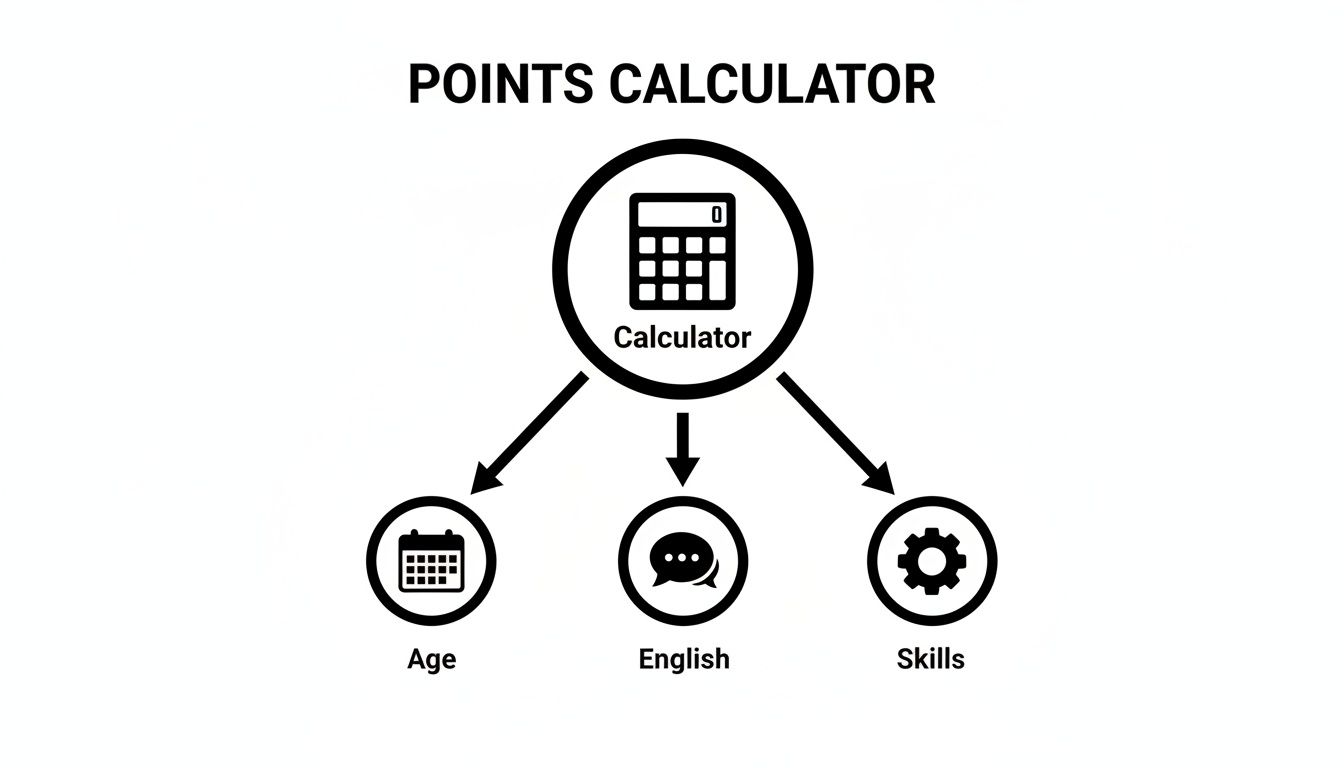
This diagram shows how age, English, work experience and education feed into the overall points calculation.
Education And Additional Factors
Your formal qualifications can contribute 15–20 points depending on your highest degree. Beyond academics, there are bonus pockets you can tap to edge over the line.
- Bachelor’s or higher degree: 15 points
- Doctorate: 20 points
- Partner skills assessment: 10 points
- State/territory nomination (Subclass 190): 5 points
- Regional sponsorship (Subclass 491): 15 points
“A small boost from a professional year or state sponsorship can be the edge you need to meet the threshold,” explains migration expert Vijay Bharti.
Points Allocation By Criteria
Below is an overview of how points are awarded for each eligibility factor in the Australian skilled migration points calculator.
| Criteria | Maximum Points | Notes |
|---|---|---|
| Age | 30 | Peak adaptability and earning potential (ages 25–32) |
| English Proficiency | 20 | Superior test results (IELTS 8.0/PTE 79 per band) |
| Skilled Employment (Australia) | 20 | Up to eight years in recognised skilled roles |
| Skilled Employment (Overseas) | 15 | Up to eight years in recognised skilled roles overseas |
| Educational Qualifications | 20 | Recognised bachelor’s or higher degree |
| Professional Year Program | 5 | Completed in Australia |
| Partner Skills Assessment | 10 | Verified partner qualifications |
| State or Regional Nomination | 15 | Subclass 491 regional sponsorship or Subclass 190 nomination |
This breakdown highlights where your strengths lie and which areas could benefit from a boost.
Think of each point category as a building block. Stack them strategically to maximise your total on any online calculator.
For personalised advice and the latest policy shifts, book an appointment with a registered migration agent. Rules change frequently, and expert guidance can save you time and stress.
Disclaimer: This information is general and may not reflect the latest policy changes. Please book an appointment with a registered migration agent for updated information.
Start your journey with confidence.
Compute Your Points With Online Tools
Crunching your migration points can feel like juggling a dozen figures at once. Online calculators cut through the clutter, delivering a clear score in minutes. Armed with an early estimate, you’ll know exactly how far from the 65-point benchmark you stand—and which areas need a boost.
Official Home Affairs Calculator
The Department of Home Affairs’ calculator on immi.homeaffairs.gov.au keeps things simple. Drop-down menus guide you through age bands, language scores, work history and qualifications. Hover-over tooltips explain each point allocation, so you’re never guessing.
Here’s a quick run-through:
- Select your age range to see up to 30 points for applicants aged 25–32.
- Enter your latest IELTS or PTE result to claim up to 20 points.
- Add your skilled employment both overseas and in Australia—worth up to 20 points.
- Choose your highest qualification to pick up between 15 and 20 points.
Here’s a screenshot of the official tool showing the age and English input fields:
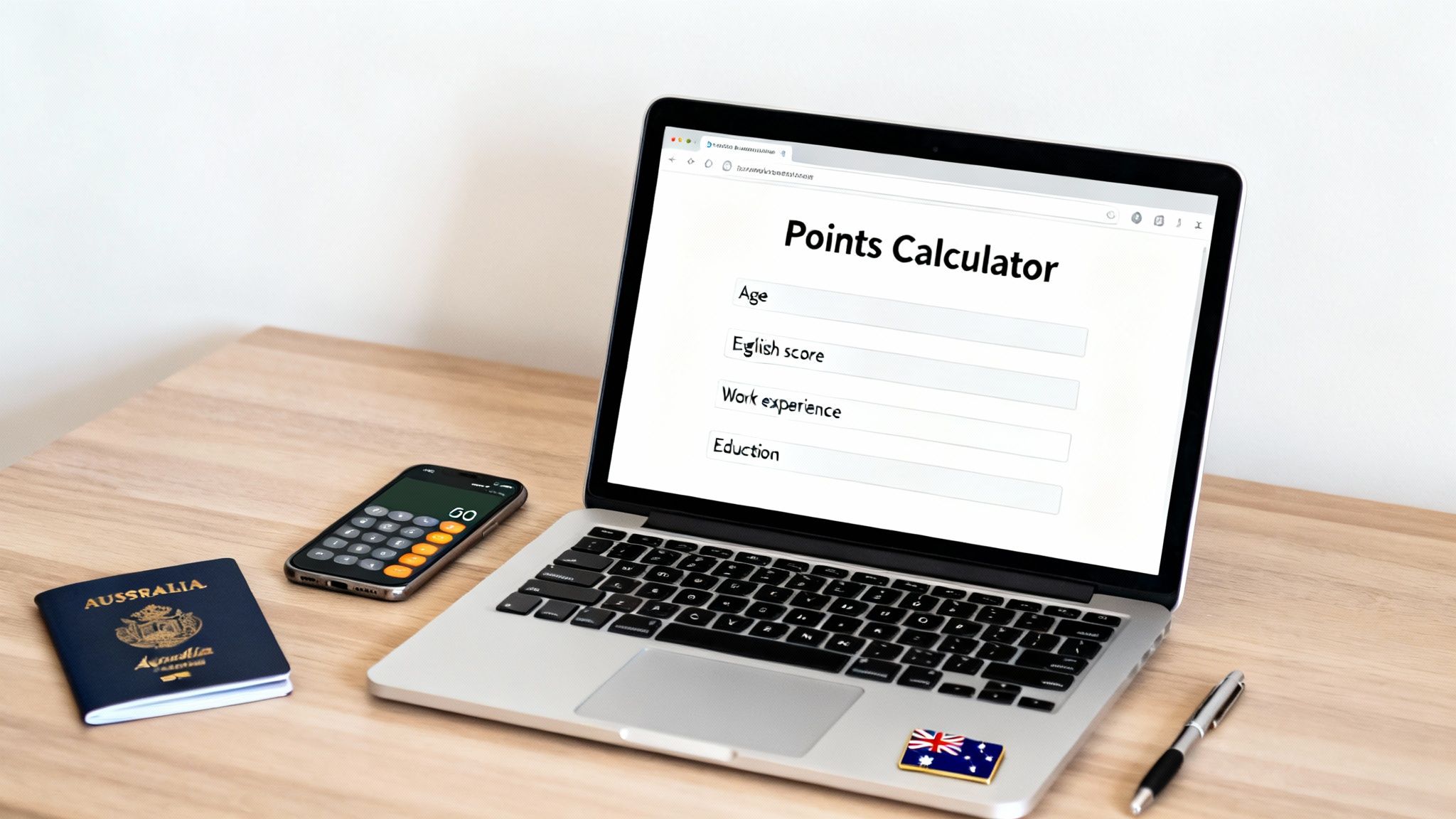
Menus are clean. Pop-up help icons pop in right when you need them. Use the print or PDF feature to keep a timestamped record of your entries.
Always double-check each entry to avoid simple slip-ups, like picking the wrong age bracket.
Third Party Calculator Comparison
Beyond the official tool, several reputable calculators layer on extra guidance. They often spot bonus points—think partner skills or professional year credits—and flag areas where you can improve.
Watch out for calculators that offer:
- Step-by-step prompts preventing any skipped sections
- Visual breakdowns into pillars such as age, English and work experience
- Alerts for potential boosts like state sponsorship options
That said, the true economic punch of Australia’s points-tested visas is striking. A Grattan Institute analysis shows each skilled permanent migrant adds $250,000 to government coffers over their lifetime—totalling around $34 billion each year (roughly 1.3% of GDP). Points calculators remind you: it’s 30 points for 25–32-year-olds, 20 points for superior English, and 20 / 15 points for eight-plus years of skilled work.
Once you finish, export or screenshot your summary so you can track any improvements. Run the numbers again after you boost your score—this way your final EOI truly reflects your highest possible tally.
Disclaimer: Book an appointment with a registered migration agent for updated information as policies may have changed when you read it.
Step By Step Worked Examples

We’ve crafted two case studies that resemble genuine migration profiles. Each section demonstrates how your personal details—age, English, work experience and qualifications—feed into a points calculator australia. First, tally by hand; then cross-check with an online tool.
Our worked examples cover:
- A 28-year-old with superior English and five years of Australian work
- A 35-year-old PhD graduate with overseas experience
Let’s jump into Example One.
Example One Candidate Profile
Our first candidate is a technical specialist aged 28, boasting an IELTS score of 8.5 and a completed Professional Year in engineering. They’ve clocked five years in skilled roles across Australia.
- Determine Age Points
- Age 28 nets 30 points
- Calculate English Proficiency
- IELTS 8.5 earns 20 points
- Add Skilled Employment (Australia)
- 5 years in a skilled role = 10 points
- Include Professional Year Bonus
- Completion adds 5 points
- Sum All Factors
- 30 + 20 + 10 + 5 = 65 points
Entering these details into the official online calculator should also return 65 points, satisfying the 65-point threshold for Subclass 189.
Key Insight
A single extra work year or a small test-score boost can be the difference between meeting or missing the cut-off.
Decision Checkpoints:
- Double-check your age-band selection
- Verify your English test date falls within validity
- Confirm employment dates cover full 12-month periods
- Ensure your Professional Year completion letter is on hand
Now, let’s look at a profile with different strengths.
Example Two Candidate Profile
Our second applicant is a 35-year-old research scientist with a PhD from an overseas university and seven years of skilled work abroad. Their English comes via PTE at 79 per band.
- Assign Age Points
- Age 35 gives 25 points
- Factor in English Ability
- PTE 79 per band = 20 points
- Count Overseas Skilled Employment
- 7 years abroad = 15 points
- Add Doctoral Qualification
- PhD = 20 points
- Final Tally
- 25 + 20 + 15 + 20 = 80 points
Plug these numbers into the points calculator australia and you’ll see 80 points, leaving room for state nomination or regional sponsorship if required.
Expert Note
Strong qualifications like a PhD can offset fewer age points.
Comparison Table
| Factor | Example One | Example Two |
|---|---|---|
| Age Points | 30 | 25 |
| English Points | 20 | 20 |
| Skilled Employment Points | 10 | 15 |
| Bonus (Professional Year/PhD) | 5 | 20 |
| Total Points | 65 | 80 |
This side-by-side view highlights which elements drive your overall score. Notice how a PhD’s 20 points can rival years of experience and age combined.
Next Steps And Tips:
- Test your own profile with an online points calculator
- Look out for partner-skills and regional-nomination fields to claim extra points
- Always save or screenshot your inputs—track any improvements over time
Disclaimer
Migration rules change. Consult a registered migration agent to confirm current policies and get tailored advice.
Boost Your Points Strategically
Sharpening your English test approach can give you a real edge on the points calculator Australia. Rather than last-minute cramming, break your study into focused sessions that target your weaker bands.
For instance, schedule 30-minute daily workouts for listening and reading. Follow up with timed writing prompts taken from past IELTS or PTE papers. Then join a local speaking club to recreate exam pressure.
- Daily 30-minute listening and reading exercises
- Writing prompts based on real test questions
- Speaking practice in a club setting
Enhance Your Language Skills
If you need a rapid boost, a high-intensity IELTS or PTE preparation course with weekly tutor feedback can be a game changer. Recording yourself on complex topics helps you spot recurring errors, so you can tackle them straight away.
- Join an online language exchange group
- Use mobile apps for targeted vocabulary drills
A full extra year of skilled work experience in your nominated occupation adds 5 points under Skilled Employment. That might mean extending your current contract, picking up a part-time role, or even volunteering in your field. Just be sure you log hours carefully and collect solid reference letters.
“A strategic extension of work hours turned a marginal profile into a competitive candidate,” notes a seasoned migration agent.
Completing an Australian professional year unlocks 5 points, while finishing a bachelor’s honours or a master’s degree overseas delivers 15 points. To explore these pathways in depth, check out Professional Year Options.
If your partner holds a suitable qualification, a positive skills assessment can contribute another 10 points. Always cross-check their occupation against the relevant assessing authority’s list to avoid surprises.
State or regional sponsorship also boosts your score. Under Subclass 190 you pick up 5 points, and Subclass 491 offers 15 points. Timing your Expression of Interest (EOI) with state nomination windows can be the difference between invitation and waiting list:
- Monitor state government invitation rounds on official sites
- Align your profession with the current high-demand occupation lists
- Lodge your skill assessment and EOI as soon as nominations open
Timing Your Moves
In Case Study One, a 29-year-old IT analyst lifted their score from 60 points to 70 points. They retook IELTS, completed a professional year and secured state nomination. Each move directly improved their EOI ranking.
Case Study Two follows a civil engineer with 5 years of overseas work and a master’s degree who reached 80 points. They added a partner assessment and submitted just ahead of a regional nomination round—maximising their buffer.
| Action | Points Gained | Description |
|---|---|---|
| IELTS Retake | 10 | Boosted English proficiency |
| Professional Year | 5 | Australian industry immersion |
| State Nomination (Subclass 190) | 5 | Extra government nomination incentive |
| Partner Skills Assessment | 10 | Verified spouse qualifications |
By plotting these steps on a timeline—for example, scheduling your language test three months before EOI lodgement and aligning work anniversaries with application windows—you’ll smoothly navigate deadlines.
Applying a layered strategy means each improvement builds on the last. Run your points calculator Australia after every major update to track real-time gains and never miss an opportunity.
Key Takeaway
Raising your skilled migration score is about small, strategic moves. Strengthen your language, extend work experience, pursue additional qualifications, and leverage sponsorships and partner assessments to bridge any remaining gap.
Disclaimer: This information is general and may not reflect the latest policy changes. For tailored advice, book an appointment with a registered migration agent.
Compare Skilled Visa Subclasses
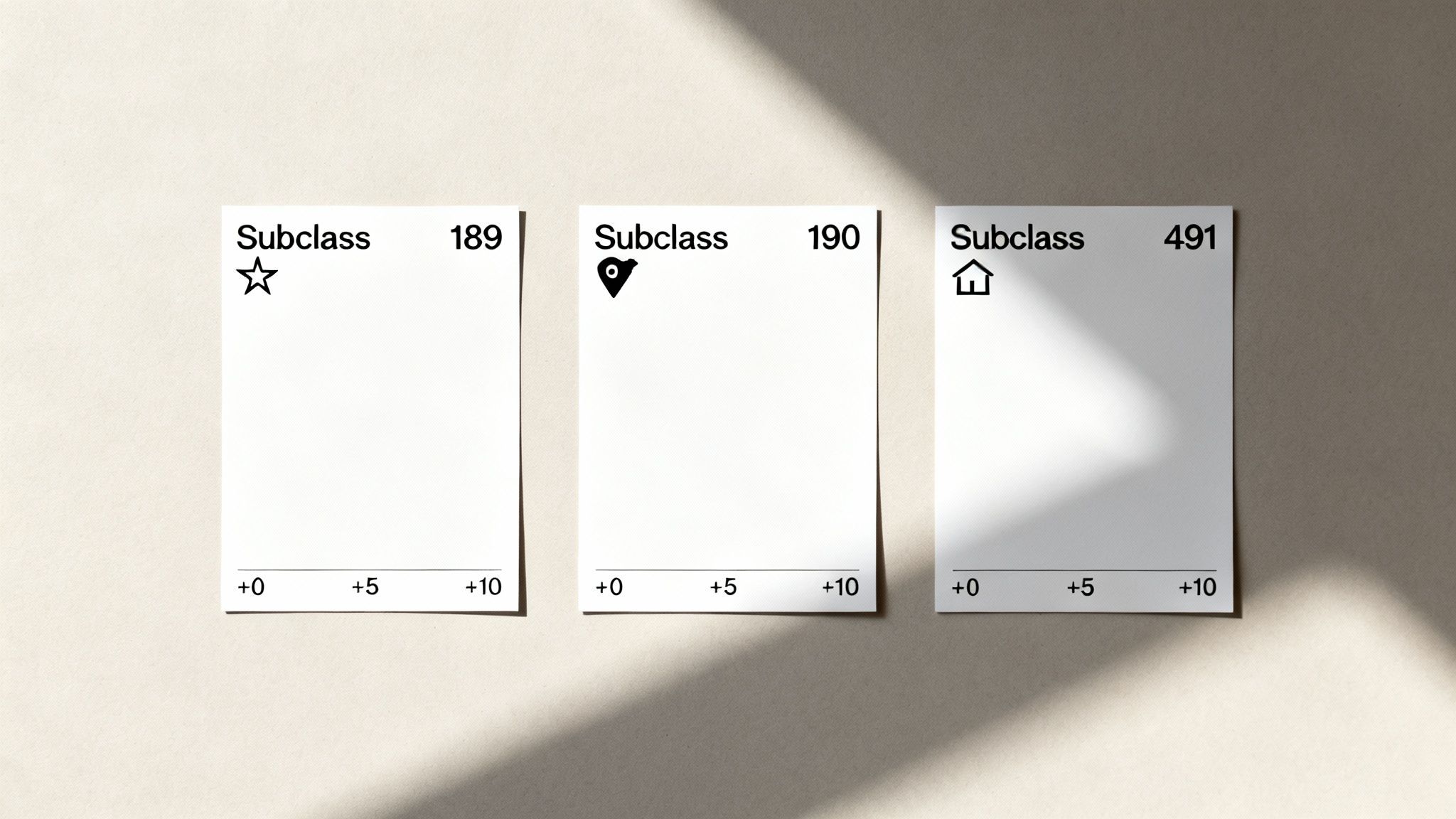
Australia’s skilled migration program offers three main streams—Subclass 189 (Independent), Subclass 190 (State-nominated) and Subclass 491 (Regional-nominated). Each requires a base 65-point score, yet the path to invitation and the obligations you take on differ markedly.
Your choice often comes down to where you want to live, whether a state government backs you and how many extra points you can secure.
- Subclass 189 Independent: Relies entirely on your personal points tally.
- Subclass 190 State-nominated: Adds 5 points once you secure a state or territory nomination.
- Subclass 491 Regional-nominated: Awards 15 points, committing you to live and work in designated regional areas.
To see which stream suits you best, plug your details into a points calculator australia.
Here’s a quick side-by-side look at the three skilled visa subclasses:
Comparison of Visa Subclasses
| Visa Subclass | Minimum Points | Additional Points | Nomination Requirement |
|---|---|---|---|
| 189 | 65 | 0 | Independent Stream |
| 190 | 65 | +5 | State Nomination |
| 491 | 65 | +15 | Regional Nomination |
This snapshot highlights the baseline score, bonus points and nomination criteria you’ll need to consider before lodging your Expression of Interest (EOI).
Invitation Rounds And Ceilings
Each month, the Department of Home Affairs publishes invitation rounds. They allocate slots based on your ranking within an occupation ceiling—a sort of quota for each profession.
If your job is in high demand, the ceiling can fill in days. By watching these rounds, you’ll know when your occupation opens up again.
- Invitations usually drop on the last working day of the month.
- Occupation ceilings limit the number of invites per skilled list.
- Regional occupations under 491 can have tougher thresholds but more generous points.
Residency And State Commitments
Securing a Subclass 190 nomination means promising to live in that state for at least two years. It’s a handshake agreement—honour it, and you keep your visa on track.
For Subclass 491, the bar is three years in regional Australia, whether you’re working, studying or running a business. Meeting these conditions locks in your pathway to permanent residency.
Neglecting these commitments can derail your visa and complicate future applications.
For a detailed walkthrough of eligibility and nomination criteria, check out our guide on skilled visa options in Australia.
Picking the right subclass early can accelerate your invitation chances by matching your strengths to nomination criteria.
Running your numbers through a points calculator australia each time your situation changes ensures your EOI always reflects your highest possible score.
My Visa Guide consultants can help you weigh each subclass against your profile and state priorities. Book an appointment with a registered migration agent—policy tweaks happen, and you’ll want the latest advice.
A strategic comparison now can save you months on the waiting list. Start comparing today now.
Next Steps And Frequently Asked Questions
You’ve now got a solid grasp of how the points calculator australia translates your profile into a migration score. Let’s turn that understanding into an action plan for your Expression of Interest (EOI).
Gather Essential Documents
Start by rounding up your English test score report, skills assessment outcome and academic transcripts. Then, collect reference letters from each supervisor covering the exact dates you’ve claimed on your work history.
- Confirm English test dates align with the points calculator australia assessment period.
- Organise work references by calendar year, with clear date ranges and contact details.
- Save all qualification documents as PDFs for a smooth online upload.
Always double-check each file name and folder prefix to avoid misplacing anything during lodgement.
Explore Nomination Streams
Every state and territory opens up different nomination windows and occupation lists. Research those streams that suit your nominated occupation closely.
- Subclass 190: +5 points when you secure a state or territory nomination.
- Subclass 491: +15 points for accepting a regional nomination.
To stay on top of changes, book a chat with a registered migration agent. Rules shift regularly and this guide might not capture the very latest tweaks.
Frequently Asked Questions
-
How accurate are online calculators compared to the official tool?
Third-party calculators generally mirror Home Affairs’ point weights but can lag behind policy updates. Always cross-check your score on the Department’s official website before you lodge. -
What is the minimum score needed for each visa subclass?
Subclass 189 demands 65 points. For 190 and 491, you also need 65 points but can top up with nomination points to boost your effective score. -
Can I update my points if my circumstances change after submission?
You can lodge a new EOI when you’ve gained extra points, but you can’t edit an existing one. Keep track of deadlines to resubmit in time. -
When should I consult a migration agent for personalised advice?
If your profile is complex, your occupation is near its ceiling or you need clarity on state criteria, a registered agent can map out the strongest pathway.
Use the checklist below to keep your application on track and revisit your score each time something changes. Running your details through a points calculator australia regularly helps you spot any new point-scoring opportunities.
When you feel ready, lodge your EOI and monitor your status until that all-important invitation arrives. Best of luck on your migration journey!
Final Checklist
- Confirm Validity: Ensure all test results and skills assessments remain current at lodgement.
- Review Points: Go through each category in your points calculator australia to spot any missing boosts.
- Document Certification: Prepare certified copies of every file to meet MARA guidelines.
- Monitor Nomination Windows: Track state nomination openings and submit your EOI promptly.
- Backup Files: Store your entire application folder on a cloud drive.
- Final Agent Check: Arrange a last-minute review with your migration agent before you hit submit.
Ticking off this list will help minimise errors and give your EOI a stronger ranking. Once it’s lodged, watch your inbox and invitation rounds closely.
Stay Informed
Policies and invitation results can shift quickly—staying informed gives you the edge.
- Check the Department of Home Affairs website weekly for occupation ceiling updates.
- Subscribe to migration alerts to catch any changes in real time.
- Schedule regular profile reviews with My Visa Guide to identify new point opportunities.
Start early to secure your ideal invitation window. And don’t forget to have My Visa Guide check your documents against MARA standards before lodgement.
Ready to lock in a strong application? Book your consultation with My Visa Guide today.